1 Introduction
Contemporary English is replete with adverb modifiers that boost meaning. According to Quirk, Greenbaum, Leech & Svartvik (Reference Quirk, Greenbaum, Leech and Svartvik1985: 445–6, 589) these are part of a more general subset of linguistic devices called amplifiers which ‘scale upwards from an assumed norm’. Amplifiers are subdivided into maximizers which ‘denote the upper extreme of a scale’, as in (1), and boosters which ‘denote a higher degree’, as in (2) (Quirk et al. Reference Quirk, Greenbaum, Leech and Svartvik1985: 591). In this article, I will study both of these under the more general term of intensifier.Footnote 2
(1) Maximizers:
(a) My mom's just like absolutely great. (TOR/2h)Footnote 3
(b) I'm completely independent. (TOR/r)
(c) It's all entirely different. (TOR/l)
(2) Boosters:
(a) I'm really lucky that someone like my two really good friends . . . (TOR/m)
(b) And then the teacher said, ‘You know, that's very dangerous.’ (TOR/u)
(c) It's so funny he thinks he's so cool. (TOR/n)
(d) I found the mental patients ah extremely interesting. (TOR/I)
(e) She was awful tired, you know, she was sleeping a lot. (TOR/I2)
Many scholars have studied intensifiers (e.g. Bolinger Reference Bolinger1972: 18; Labov Reference Labov and Schiffrin1985; Quirk et al. Reference Quirk, Greenbaum, Leech and Svartvik1985: 590; Partington Reference Partington, Baker, Francis and Tognini-Bonelli1993; Peters Reference Peters and Kastovsky1994; Bauer & Bauer Reference Bauer and Bauer2002; Lorenz Reference Lorenz, Wischer and Diewald2002; Nevalainen & Rissanen Reference Nevalainen and Rissanen2002), identifying in them several key characteristics which make them an ideal choice for the study of linguistic change: (i) versatility and colour; (ii) capacity for rapid change; and (iii) recycling of different forms. All of these characteristics lead to constant renewal as forms are continually replaced with newly coined expressions that can effectively intensify existing expressions. This means that in any given variety, at any point in time, the coexistence of different forms may mirror older and newer layers in the process of change.
2 Historical trajectory
Competition, change and recycling among intensifiers have been going on in English since the Old English period. Historical documents reveal that swiþe, as in (3a), gave way to well, as in (3b), which was replaced by full, as in (3c), and then right, as in (3d) (Mustanoja Reference Mustanoja1960: 319–27; Peters Reference Peters and Kastovsky1994; Ito & Tagliamonte Reference Ito and Tagliamonte2003: table 1; Méndez-Naya Reference Méndez-Naya2003).
(3)
(a)
(b)
Seo leo, þeah hio wel tam se, . . . heo forʒit sona hire niwan taman.
‘The lioness, although she is very tame, . . . she soon forgets her recent tameness.’
(c.888, K. Ælfred Boeth. XXV; OED s.v. well adv. IV.16.a.)(c) Ful faire and fetisly
‘very fairly and prettily’ (Ch. CT A Prol. 119, 124; cited in Mustanoja Reference Mustanoja1960: 319–20)
(d)
Ye diddyn hym vnder lok and sele/That he awey shuld not stele/But ye hym myssid right sone.
‘You put him under lock and seal, (so) that he should not steal away, but you missed him very soon.’
(c.1450, Cursor M. 17413; OED s.v. right adv. II.9.a.)
Subsample of the Toronto English Corpus (Tagliamonte Reference Tagliamonte2003–6)
The use of intensifiers has long had sociolinguistic correlates. Most important perhaps is the fact that intensifiers are overwhelmingly associated with teenagers and/or young people (Paradis Reference Paradis and Kirk2000; Stenström Reference Stenström, Hasselgård and Okesfjell1999, Reference Stenström and Kirk2000; Bauer & Bauer Reference Bauer and Bauer2002; Macaulay Reference Macaulay2006). Use of intensifiers is also associated with women (Stoffel Reference Stoffel1901: 101; Jespersen Reference Jespersen1922: 249–50). Moreover, women are accredited with leading in the use of new intensifiers (Jespersen Reference Jespersen1922: 250; Nevalainen this issue). Intensifiers are associated with colloquial usage and nonstandard varieties (Stoffel Reference Stoffel1901: 122; Fries Reference Fries1940: 204–5) as well as emotional language (Peters Reference Peters and Kastovsky1994; Tagliamonte & Roberts Reference Tagliamonte and Roberts2005). Finally, the use of particular intensifiers is said to signal in-group membership (Partington Reference Partington, Baker, Francis and Tognini-Bonelli1993: 180; Peters Reference Peters and Kastovsky1994: 271).
2.1 Grammatical change
The recycling and renewal of intensifiers reflects one of the general processes of grammaticalization, namely delexicalization (Sinclair Reference Sinclair, Davies and Ravelli1992; Partington Reference Partington, Baker, Francis and Tognini-Bonelli1993: 183; Lorenz Reference Lorenz, Wischer and Diewald2002). Delexicalization is defined as ‘the reduction of the independent lexical content of a word, or group of words, so that it comes to fulfil a particular function’ (Partington Reference Partington, Baker, Francis and Tognini-Bonelli1993: 183). While most commentators agree that intensifiers start out as lexical items with semantic content (e.g. Peters Reference Peters, Kellermann and Morrissey1992: 537–41), the specific details of their advancement along the cline of grammaticalization remain to be worked out. The best-studied situation is the evolution of very, which is described as the ‘most prominent case of grammaticalization’ (Lorenz Reference Lorenz, Wischer and Diewald2002: 145) and a ‘showcase example’ for the delexicalization process (Peters Reference Peters and Kastovsky1994: 270). An early account of very is presented in Mustanoja (Reference Mustanoja1960: 326–7). He argues that the intensifying adverb function of very originated in the adjective meaning ‘genuine/true’, as in (4a). A further stage came when very was used in coordinate constructions with a following attributive adjective, as in (4b), a context with considerable ambiguity of interpretation.Footnote 4 A final stage developed when very was used with adjectives to convey simple intensification, first with attributive adjectives as in (4c), and then with predicative adjectives as in (4d), where the original lexical meaning of ‘genuine/true’ is gone.
(4)
(a)
Grant me confort this day, As thow art God verray!
(c.1470, Gol. & Gaw 957; OED very a., adv. n.1 A.I.1.a)(b)
He was a verray parfit gentil knyght.
(Chaucer, Canterbury Tales, A Prol. 72)(c)
I was a very interested and anxious spectator.
(1782, R. Cumberland, Anecd. Painters (1787) II. 90; OED very a., adv. n.1 B.2.c)(d)
He was sike . . . and was verray contrite and sorwful in his herte.
(Trev. Higd. VI 93; cited in Mustanoja Reference Mustanoja1960: 326)
More recent research on the evolution of very has exposed a more nuanced cline of development. Using substantial corpus data, Adamson & González-Díaz (Reference Adamson and González-Díaz2004) track the spread of very from adjective to adjective modifier and finally to adverb modifier via a trajectory from nongradable to gradable adjectives. Examples from their research show that the first combinations of very with scalar adjectives go back to c.1450, as in (5a). Similar dating is given by the MED, as in (5b). According to Adamson & González-Díaz (Reference Adamson and González-Díaz2004) the meaning ‘extreme’ that appears from the late fourteenth century has an influence on the spread of very from nongradable to gradable adjectives. The original inference pointing to the ultimate end of a scale leads to the gradual association of the reading of ‘extreme’ to be transferred to very alone. Once this is established very becomes able to modify an adverb as a booster, as in (5c).
(5)
(a)
. . . but it was a very peynful & horybyl vn-to hir.
(Adamson & González-Díaz Reference Adamson and González-Díaz2004: example 11)(b)
The vjte is if þe watur be wery hote.
(c.1450, Treat.Fish. (Yale 171) 167/20; MED s.v. verrei adv. 2.d.)(c)
Very erly in the morning, au plus matyhn.
(1530, Palsgr. 814/1; OED s.v. very a. adv. and n1 B.2.b)
The critical quantificational aspect underlying the evolution of intensifiers is mirrored in the development of another adverb, pretty (Nevalainen & Rissanen Reference Nevalainen and Rissanen2002). This suggests that it may be a general mechanism underlying the development of adverbs that start out as nongradable adjectives (Adamson & González-Díaz Reference Adamson and González-Díaz2004).
In sum, the scenario of linguistic variation and change and step-wise incrementational development in the evolution of intensifiers presents a fruitful area for study from a quantitative variationist perspective. Ito & Tagliamonte (Reference Ito and Tagliamonte2003: 262) argue that the rapid rate of change associated with intensifiers means that the mechanisms of the delexicalization process may be sufficiently telescoped to enable the analyst to tap the underlying mechanisms of change. In other words, if an intensifier has arisen and developed in a short period, say 100 years, the underlying mechanisms of that change should remain accessible in the speech community. The way to gain access to such mechanisms is through the construct of apparent time. According to this construct, variation in a linguistic form in a community when examined by speaker age provides insight into the progress of a change (e.g. Bailey, Wikle, Tillery & Sand Reference Bailey, Wikle, Tillery and Sand1991). For example, if a form steadily increases from oldest to youngest speakers, this would be taken as evidence that the form is incoming. Since grammaticalization proceeds incrementally according to systemic patterns in the grammar, plotting these patterns by age may well reveal the mechanisms underlying the change. In addition, because the development of intensifiers is particularly sensitive to social factors such as sex (Stoffel Reference Stoffel1901; Jespersen Reference Jespersen1922), group membership (Stoffel Reference Stoffel1901; Peters Reference Peters and Kastovsky1994) and emotionality of content (Peters Reference Peters and Kastovsky1994: 286), extralinguistic distribution patterns over the same period may prove informative to the developmental process. The following testable hypotheses can be put forward (Ito & Tagliamonte Reference Ito and Tagliamonte2003: 262):
(a)
Correlation of intensifiers with particular linguistic contexts can be related with their degree of delexicalization.
(Mustanoja Reference Mustanoja1960; Partington Reference Partington, Baker, Francis and Tognini-Bonelli1993)(b) Correlation of linguistic patterns with speaker age can mirror the delexicalization process.
(c) Correlation of intensifiers with social factors can be taken to tap in to the social evaluation of the particular intensifier within the community.
(d) Through the examination of (a), (b) and (c) it may be possible to track the interrelationship between linguistic and social factors in language change.
3 Data and methods
I now turn to an analysis of the intensifier system of a particular variety of English, namely Canadian English as represented by the Toronto English Corpus. This corpus is based on informal conversations with people born and raised in the city of Toronto in Ontario, Canada, in the early 2000s (Tagliamonte Reference Tagliamonte2003–6). The corpus is stratified by age, sex and social class and was collected using a combination of quota-based random sampling and social networking. It contains well over one million words of rich vernacular data (for further information, see Tagliamonte Reference Tagliamonte2006b; Tagliamonte & D'Arcy Reference Tagliamonte and D'Arcy2007a, Reference Tagliamonte and D'Arcy2007b). The Toronto English Corpus provides a fitting site for examining language variation and locally based change.
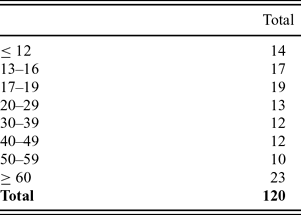
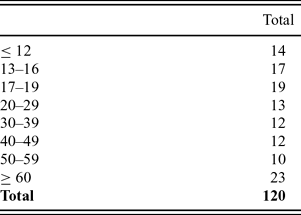
This study comprises data from 120 speakers from the corpus as outlined in table 1.
3.1 Circumscribing the variable context
Building on the fact that the vast majority of intensifiers in English occur with adjectival heads (Bäcklund Reference Bäcklund1973: 279), all adjectives capable of being intensified were included for analysis whether they were modified by an intensifier or not. Contexts that did not permit intensification, such as comparatives and superlatives, were excluded. Negative contexts were also left aside since they do not always express the same meaning. Adjectives modified by downtoners (e.g. kind of, sort of) were grouped with nonintensified contexts. For full discussion of these coding decisions along with examples, see Ito & Tagliamonte (Reference Ito and Tagliamonte2003) and Tagliamonte & Roberts (Reference Tagliamonte and Roberts2005).
The variable context thus defined provides a vantage point from which the social evaluation and spread of individual intensifiers can be tracked as well as ensuring that this analysis can be replicated. This methodological approach to the study of intensifiers extends an assessment of the contexts in which a particular intensifier occurs, to understanding its distribution within the larger system of which it is a part (Labov Reference Labov1972: 127). In this way, I provide an accountable assessment of the frequency and patterning of intensifiers from an internal grammatical as well as external, sociolinguistic, perspective.
The next step is to determine which lexical intensifiers typify the Toronto data, how frequently they are used and how they compare to other studies. I will also test for internal correlates of distribution as well as the influence of age and sex. It is particularly crucial to determine the influence and strength of contextual factors, some of which may be implicated in the expansion of use of one intensifier or the other into different types of adjectival head and different types of predication. By using multivariate analyses and the comparative method, the direction of effect, significance and relative importance of these factors can be evaluated (Poplack & Tagliamonte Reference Poplack and Tagliamonte2001: chapter 5).
4 Results
4.1 Distributional analysis
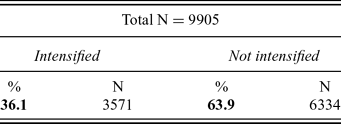
Table 2 provides a measure of intensification overall, by combining all intensifiers together in comparison with nonintensified contexts.
Overall distribution of intensification in Toronto English
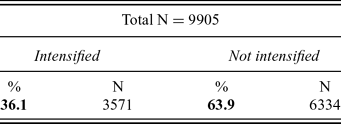
The table reveals that out of 9,905 adjectival heads 36.1 per cent were intensified. This is considerably higher than British English, 24 per cent (Ito & Tagliamonte Reference Ito and Tagliamonte2003: 265) and American English, 22 per cent (Tagliamonte & Roberts Reference Tagliamonte and Roberts2005: 287). The heightened rate of intensifier use in Toronto is unlikely to be due to genre differences since the British data in Ito & Tagliamonte (Reference Ito and Tagliamonte2003: 265) come from materials comparable to those that constitute the Toronto English Corpus (i.e. spoken vernacular data). Another hypothesis might be that the Toronto data come from a broader range of speakers, many of them well under 30.
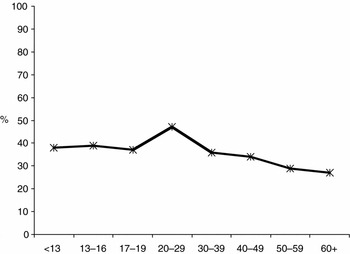
Figure 1 tests this possibility by plotting the overall distribution of intensification by speaker age.Footnote 5
Overall distribution of intensification by age

The figure reveals that the frequency of intensification is generally levelled across age groups with only a small difference between the <13-year-olds (38%) or the 17- to 19-year-olds (37%) and the 50+ age group (29%, 27%).Footnote 6 Thus, it is necessary to delve deeper into the intensifier system to assess linguistic change. I begin with the nature of this system's lexical inventory.
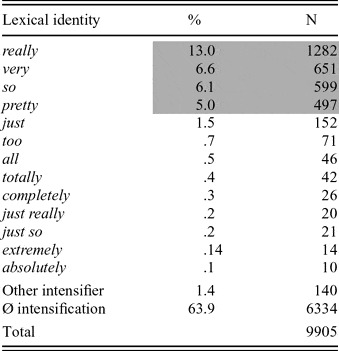
Table 3 shows the distribution of intensifiers in Toronto English according to lexical items that occurred ten times or more.Footnote 7 In interpreting the results of table 3, I will put the results in context with the historical record since this has an important bearing on how they should be interpreted.
Distribution of intensifiers by lexical item (N ≥ 10)

The most frequent intensifier by far is really, which occurs with a full 13 per cent of the intensifiable adjectives in the data. This corroborates Labov's (Reference Labov and Schiffrin1985: 44) observation that really is ‘one of the most frequent markers of intensity in colloquial conversation’ in American English.
Interestingly, the OED does not list attestations of really as an adverb meaning ‘very, extremely’; however, adverbial use of real with this function can be found from the early 1700s, as in (6a–b). It is also found in contemporary varieties in England, as in (6c–d).
(6)
(a)
An Opportunity of doing a real good Office.
(c.1718, J. Fox, Wanderer No. 17. 116; OED s.v. real adv. B.1)(b)
It looks real nice.
(c.1885, G. Allen, Babylon vi; OED s.v. real adv. B.1)(c)
It makes a real funny story.
(Maryport, Northwest England)(d)
We had a real nice hotel. It was cheap, but very nice.
(York, England)
While the OED suggests that the origins of real in this use are from Scots and that it is ‘not common in standard use in southern England’, in contemporary British English the related form really Footnote 8 is reported to be the most common premodifier of adjectives amongst teenagers in London (Strenström Reference Stenström, Hasselgård and Okesfjell1999). In fact, the ratio of adjective intensifier really is much higher in the COLT corpus than in the BNC (Lorenz Reference Lorenz, Wischer and Diewald2002: 153, table 1). The incidence of intensifier really is also high among 17- to 34-year-olds in York (Ito & Tagliamonte Reference Ito and Tagliamonte2003: figure 2) and in contemporary New Zealand English it ranks among the frequent reported intensifiers in 11- to 12-year-olds (Bauer & Bauer Reference Bauer and Bauer2002: 245). Toronto English appears to go along with these recent trends towards frequent use of really.Footnote 9
Frequency of main intensifiers across quantitative studies

In contrast, table 3 shows that the frequency of very is low, occurring with 6.6 per cent of the intensifiable adjectives. The low rate of very is notable since it is thought to be the most completely delexicalized intensifier in contemporary English (Lorenz Reference Lorenz, Wischer and Diewald2002: 146). It is also the oldest of the major forms in this dataset. As discussed earlier, its use as an intensifier can be found as early as the fourteenth century with an upswing in frequency in the sixteenth century continuing into Early Modern English. Very is also often reported to be the most frequent intensifier in contemporary English (Fries Reference Fries1940: 201; Bäcklund Reference Bäcklund1973: 290; Biber, Johansson, Leech, Conrad & Finegan Reference Biber, Johansson, Leech, Conrad and Finegan1999: 565–7); however, it is important to put this into a context of time, variety and genre. While very is the leading intensifier for contemporary spoken British English in York, in northeast England in the late 1990s, i.e. 38.3 per cent (Ito & Tagliamonte Reference Ito and Tagliamonte2003: 266) (see also table 3), an analysis of its distribution across the population by age demonstrated that it was declining rapidly. The comparatively low rate in Toronto corroborates an interpretation of a general twentieth-century waning of very in favour of really.
Perhaps the most interesting observation about table 3 is the comparatively high rate of intensifier so, as in (8a–c). At 6.1 per cent, so vies for position with very at 6.6 per cent, shaded.
(7)
(a) He'd get mad at me, so mad at me. (TOR/q)
(b) Like my mind is so focused and it's like actually the only time my mind is so completely focused. (TOR/&)
(c) I watched it and it was so boring. (TOR/s)
However, an intensifier function for so can also be traced back to earlier times in English. How far back is unclear as many of the earliest uses modifying adverbs or predicative adjectives cannot be replaced by very without considerably changing the sense. The earliest unambiguous examples I have found are from the early to mid 1800s, as in (8a–b). Note too that in these transcripts so is italicized, adding further support to the intensifying interpretation.Footnote 10
(8)
(a)
I'm so afraid you'll catch cold, aunt – have a silk handkerchief to tie round your dear old head.
(1837, Dickens, Pickwick Papers)(b)
If we walked to or from a party, it was because the night was so fine, or the air so refreshing, not because sedan-chairs were expensive.
(1853, Mrs Gaskell, Cranford)
An unexpected finding in table 3 is the frequency of pretty, as in (9a–c). At 5 per cent it competes robustly with both very and so, shaded.
(9)
(a) Girls are pretty smart at my school. (TOR/c)
(b) It was a pretty crazy thing to do in the first place. (TOR/=)
(c) Mr. and Mrs. Price were pretty good stuff to take in a nineteen year old. (TOR/£)
The use of pretty is apparently a North American phenomenon, where it occurs nearly four times more frequently than in British English (see Biber et al. Reference Biber, Johansson, Leech, Conrad and Finegan1999: 567, table 7.13). However, this is a form that can be tracked back in time as well. First attested as an adverb modifier in the sixteenth century, it too is a form that exhibits a rise in frequency in Early Modern English (Nevalainen Reference Nevalainen, Lindqvist and Mair2004: 21). Intensifying uses from the nineteenth century are easily found, as in (10).
(10)
(a)
Now Miss Jenkyns was daughter of a deceased rector of Cranford; and, on the strength of a number of manuscript sermons, and a pretty good library of divinity, considered herself literary . . .
(1853, Mrs Gaskell, Cranford)(b)
Mr. Winkle, thus admonished, abruptly altered his position, and in so doing, contrived to bring the barrel into pretty smart contact with Mr Weller's head. ‘Hollo!’ said Sam, picking up his hat, which had been knocked off, and rubbing his temple.
(1837, Dickens, Pickwick Papers)
In the twentieth century pretty has been observed to be among the most frequent intensifiers, but it is unique in that it is able to express ‘moderate degree’ as well as the sense of boosting meaning (Stoffel Reference Stoffel1901: 147–53). It is often not easy to discern whether it is being used as an intensifier or as a downtoner (Nevalainen & Rissanen Reference Nevalainen and Rissanen2002: 369) and many researchers treat it as the latter (Biber et al. Reference Biber, Johansson, Leech, Conrad and Finegan1999: 567, table 7.13; Nevalainen & Rissanen Reference Nevalainen and Rissanen2002: 369). In the Toronto speech community pretty scales the quality of the adjective upwards although with perceptually less thrust than other intensifiers. As we shall see, perhaps due to this very quality, it plays an important role in the intensifier system.
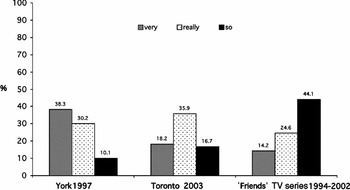
There may, in fact, be contrasts in intensifier use from one major variety of English to another. Recent research on the intensifier system using the same methodology as that employed in the present study permits such a comparison. Figure 2 shows the frequency of use of very, really and so across British, American and Canadian varieties.Footnote 11
The same three intensifiers are frequent – really, very and so. However, these forms occur at different orders of frequency. In the York data very is the most frequent intensifier followed closely by really while so represents only a small proportion of the intensifiers used, only 10.1 per cent. In the Toronto data, really is the most frequent intensifier while very and so are near parallel in use. One interpretation of the difference across these studies is that the data represent different stages in the cyclic evolution of English intensifiers (see Tagliamonte and Roberts Reference Tagliamonte and Roberts2005). York English represents an earlier stage in which very was dominant, but Toronto English is more advanced along the trajectory of change with really in an advanced position in the system and so rising. The pre-eminence of so stands out in Tagliamonte & Roberts' (Reference Tagliamonte and Roberts2005) study of the American television series Friends: it represents a striking 44.1 per cent of the intensifiers used. The authors argue that this heightened use was indicative (i) of the rise of so as the new favourite intensifier in North America and (ii) that the medium of television was mirroring this trend while at the same time pushing it forward.
In comparing across these studies it is important to consider the contrast in data composition. The York data comprise material from speakers aged 17−90+ collected in 1997 (Ito & Tagliamonte Reference Ito and Tagliamonte2003: 263); the Toronto data comprise material from speakers aged 9−90+ collected in the early 2000s; the Friends data comprise material from six actors in early adulthood (20s to 30s) collected between 1994 and 2002 (Tagliamonte & Roberts Reference Tagliamonte and Roberts2005: 285). Thus another reason why so is conspicuous in the Friends data is because the speakers come from a single age group, i.e. young adults. Moreover, the television scenario in which the actors are performing champions a trendy expressive style. In fact, Tagliamonte & Roberts (Reference Tagliamonte and Roberts2005: 296) suggest that it may herald developments to come.
In earlier research Ito & Tagliamonte (Reference Ito and Tagliamonte2003: 260) noted that the diachronic recycling and renewal of different intensifier forms could be related to their synchronic distribution patterns in apparent time. Thus, for example, older forms, such as very which arose in the fourteenth century, were less frequent than a form like really which arose some 400 years later.
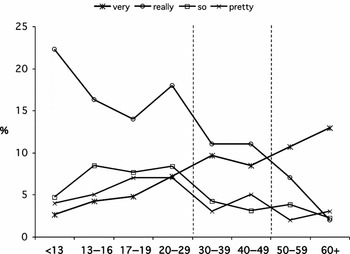
Yet the recycling and renewal process in intensifiers is said to take place quickly. Because the Toronto data comprise input from speakers born as early as the turn of the twentieth century to those born nearing the end, it may be possible to tap into the recycling process by plotting the frequency of individual intensifiers in apparent time. Figure 3 categorizes the speakers of the community into age groupings that have previously been found relevant for linguistic change in community-based corpora (Labov Reference Labov2001). The proportion of use of each of the four main intensifiers out of the total number of intensifiable adjectives is shown for each age grouping.
Overall distribution of main intensifiers by age

The apparent time perspective in figure 3 reveals a remarkable topography in which the intensifiers and their relationship to the speech community are unveiled. First, it confirms that these four main intensifiers are used by speakers of all ages in the city of Toronto, exposing the inherently layered system. However, there is a tremendous disproportion in the nature of the layering of these forms depending on the age of the speaker. Very is the most frequently used intensifier in the speakers over 50, but declines rapidly thereafter particularly among speakers under 30. In contrast, really increases steeply from oldest to youngest speakers, with a peak among the 20- to 29-year-olds. Recall the distinct hump in figure 1. While so is a minor variant, it exhibits an incremental increase from the 50+ age group to the 9- to 29-year-olds but is most frequent among the 13- to 29-year-olds. A similar pattern is found for pretty. Overall, these trends confirm that the intensifiers in this community are changing at top speed. Indeed, the community patterns naturally into three quite distinct intensifier systems as indicated by the broken vertical lines: the 13- to 29-year-olds have a system which prefers really; the 30- to 49-year-olds have a mixed system in which both really and very are dominant; and among the 50+ age group very is the favoured intensifier.
The first question to consider is: what processes underlie the trends? Is it delexicalization or some other type of grammaticalization phenomenon? The linguistic mechanisms that enable the delexicalization of words that become intensifiers do not happen catastrophically. Instead, this occurs through a step-by-step process, beginning with metaphorical (Peters Reference Peters and Kastovsky1994) or metonymic (Traugott Reference Traugott, Kemenade and Los2006; Paradis this issue) extension from an intensifier's original lexical meaning, to conventionalized uses with particular adjectives, to diffusion across diverse types of adjectives. The panorama of change visible in figure 3 suggests that the processes through which these changes are happening may also be accessible. Therefore the next question to address is whether any of the stages by which this delexicalization is known to happen can be viewed in the distributional differences between the generations in Toronto.
4.1.1 Adjective function
Perhaps the most straightforward delexicalization pathway attested for intensifiers is their patterning according to adjective function (e.g. Mustanoja Reference Mustanoja1960: 326–7). According to some researchers, a later stage in the development of intensifier very was when it came to modify predicative adjectives. Extrapolating from these observations, a comparison of intensifier use between predicative and attributive adjectives could be taken as evidence for the delexicalization process. Higher frequency of use with predicative adjectives or equal distribution across both might reflect a later point in an intensifier's development.
Such hypotheses can be tested by comparing the distribution of intensifiers across types, attributive adjectives, as in (11), and predicative adjectives, as in (12).
(11) Attributive:
(a) Yeah, very very inflated beer prices at some places. (TOR/2j)
(b) They didn't feel comfortable with sort of the risk of buying a really big piece, a really big house and property. (TOR/I^)
(12) Predicative:
(a) My mom said that it's really dangerous for me. (TOR/I4)
(b) The guys are so different! (TOR/ND)
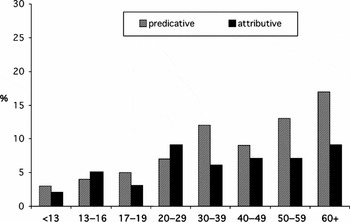
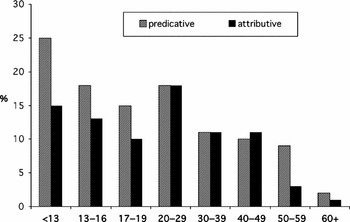
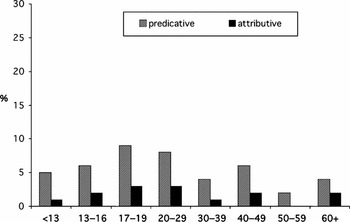
Figures 4a–c show the distribution of very, really and pretty according to this distinction for each age group.
Distribution of very by age and type of predication

Distribution of really by type of the modified adjectives

Distribution of pretty by type of the modified adjectives

The figures show that these three intensifiers have quite different patterns according to adjective function. Figure 4a reveals that very is much more frequent for predicative adjectives for all the 30+ age groups. But among the younger generations, the pattern is inconsistent. Figure 4b reveals that really is more frequent for predicative adjectives for the under 20s, but from the 20-year-olds on up there is little difference until the 50+ age group. Figure 4c reveals that pretty occurs more often with predicative adjectives, regardless of speaker age. Putting these results together with the frequency distributions in figure 3 reveals that where really and very occur most robustly, their frequency is higher among predicative adjectives. Thus really exhibits a profile that indicates advanced delexicalization among the younger speakers, while very exhibits a profile that indicates advanced delexicalization among the older speakers. In contrast, pretty indicates an advanced profile throughout the speech community.
As to the fourth intensifier under scrutiny, so is virtually restricted to predicative position. The attributive example in (13) is the only token in nearly 10,000 adjectival heads.
(13) Attributive so:
Because that's usually what we get, so hot wings. (TOR/Ss)
The reason for this anomalous behaviour in comparison with the other intensifiers is likely to be due to the origin of so as a comparative conjunction rather than an adjective. However, this asymmetrical distribution means that the only context that permits comparison among really, very, so and pretty as intensifiers is the predicative adjective context. Therefore, in the analyses that follow, I will consider predicative contexts only. In this way I focus on the layering of forms in a context where all of them are possible, thus tapping the mechanisms underlying the use of the current, key, competitors in the contemporary Toronto English intensifier system.
The next question is, what is the underlying basis by which intensifiers diffuse?
4.1.2 Negative vs positive evaluation
A factor that has been considered in the literature on intensifiers is the negative vs positive attributes of the intensified adjective (e.g. Méndez-Naya Reference Méndez-Naya2003: 375). This observation derives from the fact that some intensifiers have their origins in negative adjectives such as awful, terrible, frightful, etc. When such adjectives take the form of intensifying adverbs, i.e. awfully, terribly, frightfully, they can be adduced to be more advanced in terms of delexicalization when they collocate with modifiers having positive connotations (e.g. good, nice and glad). For example, Partington (Reference Partington, Baker, Francis and Tognini-Bonelli1993: 184) suggests that if an intensifier such as terribly shows a preference for negative items, this can be interpreted as indicating that in comparison to other intensifiers ‘terribly has gone a little less far along the road of delexicalization’ (see also Lorenz Reference Lorenz, Wischer and Diewald2002: 145).
Further, badly in (14a) easily collocates with adjectives having negative connotation but it becomes questionable with positive ones in (14b).Footnote 12 This intensifier seems not to modify adjectives such as big, kind or fast. Moreover, badly seems to be restricted for use with adjectives derived from verbs with negative connotation (e.g. burned and injured), although it goes with wrong in (14c). Thus badly would be a ‘less grammaticalized’ intensifier. In contrast, very is highly delexicalized because it combines ‘very widely indeed and is also the intensifier with the least independent lexical content’ (Partington Reference Partington, Baker, Francis and Tognini-Bonelli1993: 183).
(14)
(a) The house was badly damaged. (YRK/7)
(b) ? It was badly good.
(c) He was badly wrong.
Because such correlations relate to specific intensifiers these can only be tested by an examination of relevant individual forms.Footnote 13
Of the five instances of terribly in the Toronto English Corpus, three are negative, (15a–c) (sick, crooked, noisy), but two are positive (rich, proud), (15d–e).
(15) Negative intensifiers
(a) She felt terribly sick over the weekend. (TOR/(R)
(b) A good example is Davenport Road that's terribly crook– oh Wellesley Street, terribly crooked. (TOR/Nb)
(c) The traffic London was very very noisy, terribly noisy in compared to here. (TOR/Ne)
(d) We're terribly proud of the fact there's absolutely no discrimination. (TOR/I∞)
(e) Capitalism like is- create- become terribly rich. (TOR/2q)
Of the two instances of awful(ly) both are negative, as in (16).
(16)
(a) She was awful tired, you know, she was sleeping a lot. (TOR/I2)
(b) Now that I look back on it, seems to be awfully high. (TOR/Il)
The data are too sparse to make much of these results; however, they generally confirm the idea that the original lexical source of the intensifier and its relationship to the meaning of the lexical adjective it modifies influence the use of forms. This, in turn, reflects the broader process of development from specific lexical meaning to more general, abstract meaning, one of the well-known parameters of grammaticalization (Hopper Reference Hopper, and Heine1991; Lehmann Reference Lehmann1995).
4.1.3 Collocation patterns
A related phenomenon is the tendency of grammaticalizing forms to leave the tracks of their development in contextual patterns of distribution. Partington (Reference Partington, Baker, Francis and Tognini-Bonelli1993: 183) argues that there is a direct correlation between delexicalization and collocational behaviour: the more delexicalized an intensifier is, the more widely it collocates. In other words, incoming intensifiers can be expected to collocate with a small set of specific lexical items, older ones can be expected to appear widely across a broad range of adjective types and those that are falling away retreat to particular collocations or restricted registers of the language (Méndez-Naya Reference Méndez-Naya2003: 377). Indeed, Partington suggests that delexicalization and ‘width of collocation’ are probably the same phenomenon (Reference Partington, Baker, Francis and Tognini-Bonelli1993: 183). However, which pattern underlies the delexicalization process underway for a particular intensifier, in a given context, at a given time?
4.1.4 Semantic classification
Different types of adjectives may be more or less propitious to innovating forms. In earlier research on contemporary British English, Ito & Tagliamonte (Reference Ito and Tagliamonte2003) operationalized the model provided by Dixon (Reference Dixon1977), which divides adjectives into eight groups, as illustrated in (17)–(24):
(17) Dimension (e.g. big, large, little, small, long, short, wide, narrow, thick)
He's a realbig guy. (TOR/j/M)
(18) Physical Property (e.g. hard, soft, heavy, light, rough, smooth, hot, sweet)
It was a reallyhot day and like on the way there I started to feel really, really weak. (TOR/k)
(19) Colour (e.g. black, white, red)
It was really really reallyred yesterday. (TOR/F)
(20) Human Propensity (e.g. jealous, happy, kind, clever, generous, gay, rude)
My dad was sohappy . . . my mom was Ø happy too. (TOR/F)
(21) Age (e.g. new, young, old)
He was great but he was also veryold. (TOR/)
(22) Value (e.g. good, bad, proper, perfect, excellent, delicious, poor)
It seemed a verypleasant place. (TOR/6)
(23) Speed (e.g. fast, quick, slow)
Like, Canadians are veryslow at recognizing their own people. (TOR/£)
(24) Position (e.g. right, left, near, far)
I actually got to Newfoundland which is sofar away. (TOR/s)
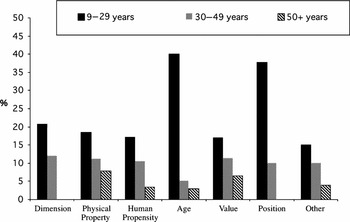
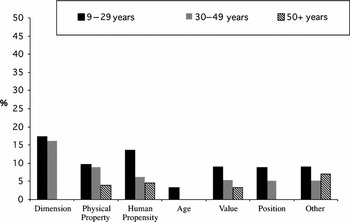
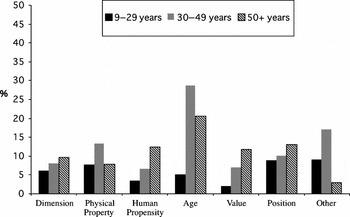
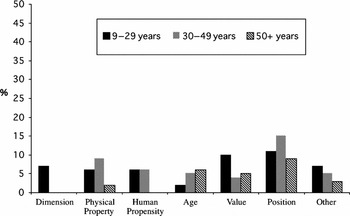
Figures 5a–d depict the distribution of really, so, very and pretty according to these categories in predicative adjective contexts. For this analysis, the community has been categorized into a three-part division for age. These groupings reflect the divisions sketched earlier in figure 3, which showed three distinct intensifier systems in the community.
Distribution of really by type of the modified adjectives

Distribution of so by type of the modified adjectives

Distribution of very by age and type of adjective

Distribution of pretty by type of the modified adjectives

Figure 5a displays the use of really. In the 50+ age group it occurs among five adjective types – physical property, human propensity, age, value, and other. Among the 30- to 49-year-olds it occurs across all types. Among the 9- to 29-year-olds it occurs across all types and much more frequently. This shows that really has diffused into more and more adjectival categories from oldest to youngest speakers as well as increasing in frequency in each category.
Figure 5b shows the occurrence of so. The proportions are lower overall and uniformly so. The 50+ age group have minimal occurrence of so and it occurs in only four adjective types: physical property, human propensity, value and other. The 30- to 49-year-olds have increasing as well as broader use. Finally, among the 9- to 29-year-olds so occurs not only the most frequently, but also across all the different adjective types. The same incremental pattern of shift is visible from one generation to the next with one exception: the ‘other’ category which represents a combination of adjectives that do not fit into Dixon's categorization schema. Note, too, that the rise in frequency from middle-aged to youngest speakers is visible but not as strikingly so as with really.
Figure 5c shows the occurrence of very. Here the most frequent use is among the middle-aged and oldest speakers. Interestingly, despite greatly decreased frequency in each category, the youngest generation maintains a diffused pattern for very, testimony to its entrenched status in the language. The 30- to 49-year-olds even have higher rates in some categories (physical property, age, other) than the 50+ age group where very is much more frequent overall.
Figure 5d shows the occurrence of pretty. Like so, it is most diffused among the 9- to 29-year-olds where it is also most frequent for dimension, value and other adjectives.
Taken together, the results from figures 5a–d suggest that the diffusion of an intensifier does not happen at the same time as an increase in use. Indeed, it appears that diffusion predates a surge in frequency (see also Ito & Tagliamonte Reference Ito and Tagliamonte2003). This result lends support to Mair's (Reference Mair2004) idea of a ‘delayed increase of discourse frequency’ in grammaticalization, which predicts that grammaticalization will occur first, then diffusion begins, only subsequently leading to increasing frequency. Thus, unlike some concepts of grammaticalization in which an increase in frequency is attributed to the development of grammatical status (Krug Reference Krug2000), these findings suggest that usage rates continue to rise, indeed even escalate, as a new form diffuses into broader contexts (see also Bybee, Perkins & Pagliuca Reference Bybee, Perkins and Pagliuca1994: 8). Similarly, when an intensifier is waning, as in the case of very in this community, it appears that the use of a form recedes uniformly across the broad contexts of its use.
4.1.5 Emotional value
Intensifier use is also thought to correlate with the emotional value of the modified adjective (e.g. Peters Reference Peters and Kastovsky1994). Indeed, Tagliamonte & Roberts (Reference Tagliamonte and Roberts2005) found that the use of intensifier so was significantly tied to emotional adjectives particularly among female speakers. This hypothesis can be tested by categorizing each of the adjectives in the data according to whether it encodes an emotion, as in (25), as opposed to some physical attribute or other quality, as in (26).
(25) Emotion:
(a) I don't know; that's why I'm so happy. (TOR/2a)
(b) 'Cause she's so funny . . . she's so mean . . . and so evil! (TOR/3b)
(26) Nonemotion:
(a) I just thought it was like so small. (TOR/TM)
(b) Like her belly's big and my belly's so flat. (TOR/r)
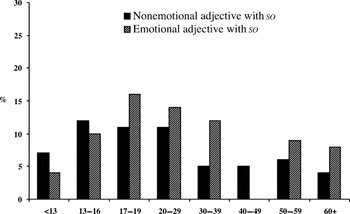
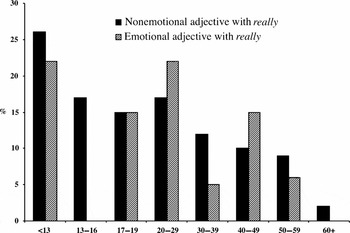
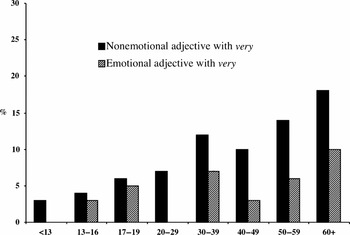
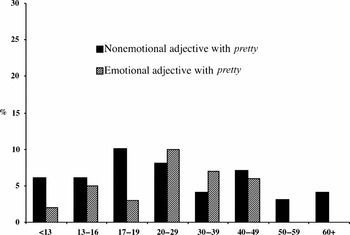
Figures 6a–d show the distribution of each of the main intensifiers according to whether the adjective they modify is emotional or nonemotional. Due to the binary contrast (and sufficient data in each cell) the distributions can be representatively shown for each ten-year age span.
Distribution of so by emotional value of the adjective

Distribution of really by emotional value of the adjective

Distribution of very by emotional value of the adjective

Distribution of pretty by emotional value

Figure 6a reveals that there is a near pan-community tendency for so to modify emotional adjectives more than nonemotional adjectives.Footnote 14 The only exception to this pattern is among the very youngest age groups, the <13-year-olds and the 13- to 16-year-olds, where so is more likely to occur among nonemotional adjectives. Figure 6b reveals that really has no consistent trend of use along the dimension of emotionality of the adjectives: the pattern (where visible) goes one way or the other across the board with the exception of the 17- to 19-year-olds where there is no difference. Note however the heightened tendency for really with emotional adjectives among the 20- to 29-year-olds.Footnote 15Figure 6c provides yet another perspective. Intensifier very is more frequent among non-emotional adjectives for every age group, even among the young where it is rare. Figure 6d shows that pretty is more frequent with nonemotional adjectives, except for the 20- to 39- year-olds.
Putting these new findings into perspective with the earlier results now exposes how intimately an adjective's emotional value is linked to the type of intensifier that may be used to boost it. The out-going intensifier very is favoured across all age groups for contexts with less emotional impact, exactly as can be predicted by a highly delexicalized form. These results, together with those in figure 5c above, also make clear the extent to which very remains entrenched in these contexts among the middle-aged speakers. In contrast, really shows alternating tendencies by age, suggesting that it holds an intermediate status along the delexicalization pathway within this speech community. Finally, intensifier so reveals its incipient phase by a strong and consistent propensity for use with emotion-laden adjectives among the vast majority of the population (aged 17–60+). This provides support for Peters' (Reference Peters and Kastovsky1994: 274) observation that new intensifiers will appear in contexts with ‘a stronger personal and emotional involvement’. What about pretty? It appears to be new based on distribution by age and diffusion by adjective type, but with respect to the dichotomy emotional/nonemotional it does not exhibit the expected pattern. In fact, quite the contrary: it collocates with nonemotional adjectives. Further understanding of these results will require exploration of the sociolinguistic arena.
4.1.6 Speaker sex
An association of intensifiers with women, particularly incoming intensifiers, is a frequent observation in the literature (Jespersen Reference Jespersen1922: 249–50 citing Lord Chesterfield; Key Reference Key1975: 75). The use of so, in particular, has been associated with women. Lakoff (Reference Lakoff1973: 15), for example, refers to it as a characteristically female intensifier.
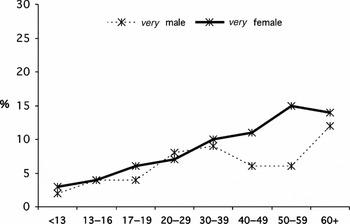
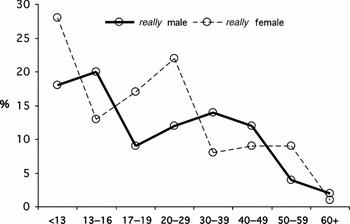
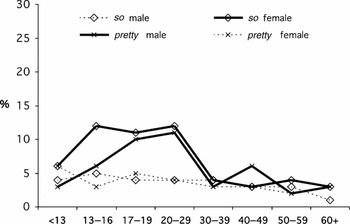
Given this background and the findings up to this point, the high frequency of really among the under 30s in figure 3 can be interpreted as a strong indication that this form is a recent favoured intensifier in Toronto. This is supported by the striking correlation of really with emotional adjectives among the 20- to 29-year-olds (see figure 6b). However, as also visible in figure 3, the intensifiers so and pretty are increasing across the same age group (under 30s). Intensifiers that are incrementally waning when viewed across the speech community, such as very, might be predicted to have even distribution between the sexes since very has the profile of a diffused, highly delexicalized intensifier, and, as far as I am aware, no particular association with females. In contrast, the suggestive upswing of so and pretty might lead to the prediction that young women are leading these developments. Figures 7a–c test for these conjectures by plotting the distribution of the main intensifiers by age but now also separating out the male and female speakers.
Distribution of very by speaker sex and age

Distribution of really by speaker sex and age

Distribution of so and pretty by speaker sex and age

Figure 7a shows the use of very. Among the 60+ age group, the females show a slightly elevated use of very, but among the 40- to 59-year-olds, the contrast is considerable. Then, from the 40-year-olds on down, there is minimal to no sex difference. Figure 7b shows the use of really. The general trend is towards a rise in frequency of really from oldest to youngest speakers; however, a number of erratic shifts can be observed. In particular the <13-year-olds, the 17- to 19-year-olds and the 20- to 29-year-old females have lofty rates of really in comparison to the males. Figure 7c shows the use of the two incoming forms so and pretty. The results corroborate the claims in the literature regarding so – the 13- to 29-year-old young women are leaders in its use. However, there is an equally prominent trend among the young men; they are leading in the use of pretty. The unexpected result is the diametrically opposed behaviour of the young people with respect to their choice of so or pretty. Such contrasts are not unprecedented. Male/female differences in intensifier use are well documented. However, these findings provide a clear and astonishing picture of male/female differences. Among the oldest generation there is a sex difference for very. At various points there are extreme sex differences for the use of really. In the youngest generation in Toronto males and females have selected entirely different intensifiers as their favoured new form. In sum, the use of intensifiers by male and female speakers of different ages is intimately tied to the stages of intensifier renewal in the community grammar.
4.1.7 Summary
In sum, the results from figures 3–7 provide a number of pieces of evidence to support the fact that very, really, so and pretty represent different degrees of grammaticalization in Canadian English as spoken in Toronto as well as the sociolinguistic nature of the grammaticalization process. Several internal factors have been tested using the apparent time construct to explore the grammaticalization pathways the intensifiers may be following. Among the factors that appear to underlie the developments are adjective function, adjective type and the emotional value of the adjective. In addition, the male/female dimension is a vital component. The next step is to test these factors simultaneously and determine which are statistically significant.
4.2 Multivariate analysis
In this section the intensifier system in Toronto is subjected to a number of analyses. Recall that this speech community is highly differentiated (see figure 3): the 20- to 29-year-olds have a system of intensification where really is the most frequent intensifier. The middle-aged group, the 30- to 49-year-olds, are a watershed generation, where really and very are robust competitors. Among the 50- to 91-year-olds, very is the pre-eminent intensifier. The critical nature of the age differentiation was confirmed by a multiple regression of each of the four main intensifiers (not shown) in which age and sex were both statistically significant for each of the four main intensifiers. This means that an analysis putting all the age groups together will obscure the underlying processes responsible for the choice of individual forms. Therefore, the analyses that follow test these age groups separately. Further, I restrict the analysis to the two intensifiers very and really which occur at sufficient thresholds of frequency for viable statistical modelling.
A number of different lines of evidence can be inferred from the multivariate analyses: statistical significance, relative strength of factors and ranking of factor categories significant (for further discussion, see Tagliamonte Reference Tagliamonte2006a). Higher numbers for factors can be interpreted as favouring the intensifier under investigation whereas lower ones disfavour it. The higher the number, the greater the contribution of that factor to the use of the intensifier. The factors for which the numbers are enclosed in square brackets were considered in the analysis, but found not to be significant.
Each analysis tests the same set of factors each of which was shown earlier to influence the choice of intensifier and has the potential to reveal the status of the intensifier in the grammar. Advanced delexicalization is indicated by: (i) a correlation of the intensifier with predicative adjectives and (ii) a spread of use of intensifiers across adjective types. The adjective type factor group tests diffusion using Dixon's (Reference Dixon1977) schema (seen earlier in a distributional analysis in figures 5a–d) with the added subcategory of emotion.Footnote 16 Thus, the new schema provides a more nuanced test of the diffusion of intensifiers across adjective types.
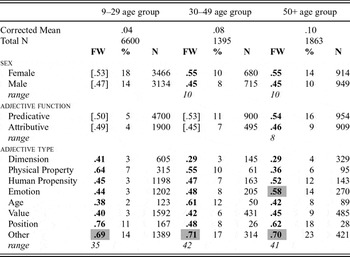
Table 4 shows the results of three separate multivariate analyses of the probability for very to be used as an intensifier in three age groupings in Toronto: 9- to 29-year-olds, 30- to 49-year-olds and 50+ age group.
Three multivariate analyses of very by age group in the Toronto English Corpus

The table shows that the effect of adjective type is the strongest constraint in every age group with range values of 35, 42 and 41. The other factors (sex and adjective function) exert a statistically significant effect in certain age groups, but their strength is comparatively weak (the range values are only 10 and 8 respectively). Women aged 30–49 and 50+ favour the use of very. It is used most often with predicative adjectives among the 50+ age group. The factor weights for the different categories of adjective type are more revealing. Very is favoured strongly and with more types of adjectives among the 50+ age group. This age group favours the use of very with adjectives of human propensity and notably emotion, but younger speakers (aged 9–49) disfavour it. Among the 9- to 29-year-olds very has receded to adjectives of physical property, 0.64, and position adjectives, 0.76. There is one common trend across age groups, shaded: the high probability of very in the ‘other’ category: 0.69, 0.71 and 0.70. The fact that very exhibits this statistically significant pan-community correlation with a grab bag of different types of adjectives reveals that its waning frequency has not caused a loss of its delexicalized status.
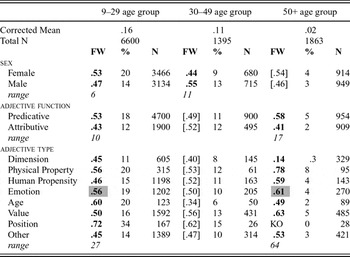
Table 5 shows the results of three separate multivariate analyses of the probability for really to be used as an intensifier in the same three age groupings: 9- to 29-year-olds, 30- to 49-year-olds and 50+ age group.
Three multivariate analyses of really by age group in the Toronto English Corpus

This table shows somewhat the reverse of the trends shown in table 4. Once again, adjective type is strong, but this time only among the 9- to 29-year-olds and the 50+ age group. Adjective function exerts a much weaker effect. The youngest and oldest groups favour the use of really with predicative adjectives. This indicates advanced delexicalization at both ends of the speech community. The effect of speaker sex reveals another nuance. Not surprisingly, given the distributional data in figure 7b, it fluctuates by age group. Females aged 9–29 favour the use of really but males aged 30–49 favour its use. Among the 50+ age group the sex effect is not significant although a comparable direction of effect among the younger speakers is visible (females slightly favour really).
As in the analysis of very in table 4, the different categories of adjective type reveal age differences. In this case, emotional adjectives favour the use of really at 0.61 in the oldest generation and at 0.56 in the youngest generation. Thus, at both ends of the age spectrum, the emotional value of the adjective triggers the use of really. Further, the oldest generation favours really with the same number of types of adjectives as the youngest generation, although these are not the same.
These findings confirm that really is frequently used and widely diffused across the speech community, thus confirming Lorenz's (Reference Lorenz, Wischer and Diewald2002: 157) prediction that really ‘is the most likely candidate to follow in the wake of very and become the next fully grammaticalised adjective intensifier’. However, despite the general decline of very, both very and really exhibit a comparable state of diffusion across the speech community. The next step is to consider what these patterns and trends mean.
5 Discussion
Toronto English has four main intensifiers competing in the current generations of speakers – very, really, so and pretty. The speech community is undergoing dramatic change not only in terms of frequency of these intensifiers but also lexical preference by speaker age.
Research initiatives in the last ten years point to the fact that the English intensifier system at the turn of the twenty-first century is a linguistic reflection of a spectacular generation gap (see also Paradis Reference Paradis and Kirk2000; Stenström Reference Stenström, Hasselgård and Okesfjell1999; Reference Stenström and Kirk2000; Bauer & Bauer Reference Bauer and Bauer2002; Ito & Tagliamonte Reference Ito and Tagliamonte2003). The same is true, if not more so, of the intensifier system in the city of Toronto. Here, recurrent use of the intensifier very is a mark of being over 50, while an overarching penchant for really will identify a speaker as much younger. Such trends echo many contemporary studies of intensifiers which show that very is waning while really is dominant. Yet in Toronto English something more is going on. The intensifier system is shifting once again.
When an intensifier recedes (as in the case of very), older females, in this case the over 40s, tend to retain the erstwhile fashionable form (see figure 7a and table 4). When an intensifier is the generally favoured form in a community, in this case really, sex differences fluctuate unsystematically by age (see figure 7b and table 5). However, when an intensifier is incoming, the expectation is that females will tend to push it forward. As far as intensifier so is concerned, they clearly do (see figure 7c). Yet incoming intensifiers are not always associated with females because in Toronto young males have their own favoured form – pretty (figure 7c). In other words, in this community both females and males are leading in the diffusion of incoming intensifiers, but not the same ones.
Why would young Canadian males use pretty while their female counterparts use so? This polarization of the sexes in Toronto is (to my knowledge) entirely beneath consciousness. Yet these particular choices seem somewhat surprising given the ‘girlish’ associations of pretty deriving (at least in part) from its adjectival meaning as ‘attractive’ or ‘good-looking’, a use still robust in Canadian English. It seems that young males could be reacting against a distinct female trend – the use of so. The males gravitate (albeit unconsciously) towards another form in the available inventory that has no obvious social connotations – pretty fits the bill. In this way this generation of young men participate in the change, but in their own way.
What of the underlying mechanism of change? These findings present a provocative dilemma for the analyst: are the shifting patterns in intensifier choice the result of delexicalization or some other process? Although very is receding, it has not lost its capacity to collocate with a broad range of adjectives, even among the youngest speakers who rarely use it (figure 5c). As far as really is concerned, it first expanded (visible in collocation contrasts between the over 50s and 30- to 49-year-olds) (figure 5a), before markedly increasing in frequency amongst the 9- to 29-year-olds, a finding consistent with its trajectory of development in other research (Ito & Tagliamonte Reference Ito and Tagliamonte2003), supportive to the claim of its delexicalized status (Lorenz Reference Lorenz, Wischer and Diewald2002) and consistent with a delayed increase model of grammaticalization (Mair Reference Mair2004). Thus, both very and really are delexicalized.
What of the predicative vs attributive adjective difference? First, very, the delexicalized English intensifier par excellence, does not exhibit a statistically significant propensity to occur with predicative adjectives except in the 50+ age group where it is most frequent. Second, really has this correlation among the 50+ age group where it is infrequent as well as in the 9- to 29-year-olds where it is the most frequent form, and at a higher proportion than very among the 50+ age group. Such statistically significant correlations raise the question of whether the predicative vs attributive difference is an accurate concomitant of delexicalization, at least once the grammatical change has long passed.
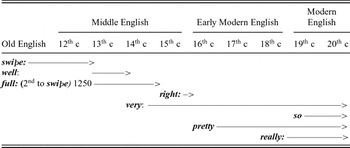
Indeed, despite the visible stepwise developments in apparent time, the evidence from the contextual factors does not unequivocally point to a diachronically rooted, ongoing delexicalization process. The main intensifiers are already delexicalized: they can appear across a wide range of adjective types, they can appear with predicative adjectives; they are used across the speech community. Indeed, all four have been around for a long time. Table 6 displays a rough overview of the history of each form based in part on Mustanoja (Reference Mustanoja1960: 319–28).
Overview of intensifiers in the history of English

The table shows that intensifying functions for so, very, really and pretty have been around for several hundred years. This means that however impressive the trajectories of community-level waxing of forms (really), or waning of forms (very), and even the incipient new trends (so, pretty), they cannot possibly be the result of continuous grammatical change. Instead, it appears that intensifiers, once delexicalized – perhaps even partially delexicalized – can be left underdeveloped in the language or fade away yet remain available to be co-opted back into the active system. In fact, such a scenario has been suggested before. Mair (Reference Mair2004) argues for ‘static grammaticalisation’ in which underused or latent options, already grammaticalized, are kept ‘alive’ ready to be deployed again when the context is suitable and appropriate.
Peters (Reference Peters and Kastovsky1994: 271) points out that during Early Modern English there was an unparalleled growth in the booster repertoire. The fallout is still visible today within the intensifier system in Toronto. There are actually many forms available to be employed as intensifiers in a speaker's grammar, but little utilized. Alongside the main intensifiers focused on here there are also innumerable rare forms, as in (27). These were subsumed under ‘other’ in table 3.
(27)
(a) But he's dead serious, like. (TOR/3T)
(b) I was heavily disappointed. (TOR/3B)
(c) Our street was choc a bloc full of young families. (TOR/I∞)
(d) She was awful tired, you know, she was sleeping a lot. (TOR/I2)
(e) He's super super selfish. (TOR/I)
Moreover, just as reported for the city of York in Ito & Tagliamonte (Reference Ito and Tagliamonte2003), on occasion very old forms can also be heard in the Toronto speech community. The intensifier well, as in well familiar, was heard from a middle-aged radio announcer on Toronto Radio in March 2007.
Further support to the idea that an intensifier's delexicalization trajectory may lie dormant for reactivation at any time comes from the recent rise in the use of an intensifying function for so in contexts that would otherwise not be available for intensifiers. Take for example the trendy ‘GenX so’, a label which comes from the fact that these uses of so seem ‘to have first appeared in the speech of Generation Xers’, i.e. the 1980s (Zwicky Reference Zwicky2006). GenX so can appear with dates, time expressions, proper nouns and pronouns, negatives, VPs etc., as in (28).Footnote 17
(28)
(a) That is, like, so 1980s.
(b) It's so you.
(c) You are so dead!
(d) It's so not entertaining.
(e) We so don't have a song.
While such uses are apparently quite new, the example in (29) is surely similar, especially since not only is the context fitting, but so was transcribed in the original in italics.
(29)
The ladies of Cranford are quite sufficient. ‘A man,’ as one of them observed to me once, ‘is so in the way in the house!’
(1853, Mrs Gaskell, Cranford)
It remains to be discovered precisely when and how the extended contexts of GenX so appeared. Although this intensifier is undergoing new developments, the origins of these processes may be deeper-rooted in the past than we realize.
In sum, the intensifier system in a given place and time will include a number of favoured forms. But lurking in the corners and cubby-holes of the grammar will be older forms and newer forms, nonce forms and nascent forms. What I believe is happening in Toronto is a quintessential embodiment of intensifier recycling. How else could an intensifier such as so have existed in the language for two hundred years, be reported as incoming and associated with females in the early 1900s (Stoffel Reference Stoffel1901: 101), surge into the limelight in the American television show Friends in the 1990s (Tagliamonte & Roberts Reference Tagliamonte and Roberts2005), and now be increasing among Toronto adolescents? It must be the case that so has come and gone and come again.Footnote 18
Endemic to research on intensifiers is the idea that renewal is critical (Stoffel Reference Stoffel1901, Bolinger Reference Bolinger1972; Peters Reference Peters and Kastovsky1994). Bolinger, in particular, argued for conditions of ‘fevered invention’, a process driven by speakers' desires to be original, demonstrate verbal skills and to capture attention. It perhaps goes without saying, then, that intensifiers by their very nature cannot have staying power since their impact is only as good as their novelty. Overuse, diffused use, long-time use, will lead to a diminishment in the intensifier's ability to boost and intensify. Thus, I suggest that the waxing and waning of intensifiers is actually a requisite of the feature for the speech community. Moreover, how long an intensifier lasts most likely has as much to do with its sociolinguistic status as with its success along the delexicalization path.
In earlier research, I suggested that new forms in the intensifier system are not created ex nihilo. The results reported here corroborate this idea and suggest further that once a word has evolved to have an intensifier function it remains in the reservoir of forms that a language user may deploy to boost meaning from that point onwards, regardless of whether it actually becomes one of the favoured forms or not. Moreover, along with perpetual recycling of forms, delexicalization processes appear to start and stop and pick up again. What is most curious of all, however, is exactly what it is that boosts a particular form to dominance at a given point in time and space. This mystery, I leave for future research.