Congenital heart disease (CHD) is one of the most prevalent birth defects in the United States, with 8-10 cases of CHD diagnosed per 1,000 births and 2.4 million Americans living with CHD as of 2010. Reference Gilboa, Devine and Kucik1 Improving CHD treatment in recent decades has decreased mortality rates and increased life expectancies for children with CHD, of whom approximately 85% now survive into adulthood. Reference Razzaghi, Oster and Reffhuis2 Despite increasing survival rates, children with CHD have worse health and higher rates of functional limitations (limitations on daily or age-typical activities) compared to children without CHD. Reference Razzaghi, Oster and Reffhuis2 Children with CHD also reported lower health-related quality of life outcomes than children without the disease, Reference Ernst, Marino and Cassedy3,Reference Xiang, Su and Liu4 Compared to children living without CHD, children with CHD are three times more likely to be in poor overall health, are more likely to miss school days, and are more likely to have comorbidities such as asthma, ear infections, and neurodevelopmental disorders, compared to children without CHD. Reference Razzaghi, Oster and Reffhuis2
Children with CHD commonly require specialty health services early and throughout life including cardiac surgery, regular cardiology follow-up, home health care, specialised medical equipment, or prescription medication. Reference Farr, Downing, Riehle-Colarusso and Abarbanell5 As a result, children with CHD use healthcare services to a significantly greater extent than children without CHD. Reference Razzaghi, Oster and Reffhuis2 Children with CHD are also more likely to use special education services than children without the disease. Reference Farr, Downing, Riehle-Colarusso and Abarbanell5,Reference McClung, Glidewell and Farr6 As with other chronic conditions, both individual and community socio-economic status may affect access to care and health outcomes among children with CHD. Socio-economic status is a multifactorial construct representing position in the social stratification system. Reference Pampel, Krueger and Denney7 While originally considered as an individual characteristic, socio-economic status has also been examined at the community level, referring to stratification among locales or communities in economic resources, social ties, and power. Reference Arcaya, Tucker-Seeley, Kim, Schnake-Mahl, So and Subramanian8 Living in lower socio-economic status or rural communities can limit access to healthcare facilities and services for children with CHD, Reference Xiang, Su and Liu4 and lower neighbourhood socio-economic status is associated with poorer outcomes among children requiring heart transplantation. Reference Bucholz, Sleeper and Newburger9 Considering individual families’ socio-economic status characteristics, lower maternal education and children’s coverage by public health insurance were both found to adversely affect the health outcomes of children with CHD. Lower maternal education, in particular, has been associated with poorer developmental outcomes in early childhood and later life. Reference Ernst, Marino and Cassedy3
Despite existing evidence suggesting that low socio-economic status is associated with poor CHD outcomes in infancy and poorer quality of life in later childhood, much of the research in this area has relied on data from children under active cardiology follow-up or in contact with a particular hospital system. Reference Ernst, Marino and Cassedy3,Reference Xiang, Su and Liu4,Reference Bucholz, Sleeper and Newburger9,Reference Peyvandi, Baer and Moon-Grady10 Because children with CHD may be lost to cardiology follow-up as they age, Reference Lee, Cinanni and Di Cristofaro11 current studies may underestimate the impact of family socio-economic status on long-term outcomes of children with CHD if they exclude children who are unable to access specialty cardiology care due to socio-economic status disadvantages. Studies using clinical databases to examine CHD outcomes may also lack information on family socio-economic characteristics, including parental education and household income, that are not routinely ascertained in clinical settings. To overcome these limitations, we assessed the association of family socio-economic status and other family characteristics with general health, functional status, and special education service utilisation among children with CHD included in a nationally representative, population-based survey. Reference Razzaghi, Oster and Reffhuis2 We hypothesised that measures of socio-economic disadvantage would be associated with disadvantages in children’s overall health status, activity limitations, missed school days due to health problems, and increased utilisation of special education services or medical equipment among children with CHD.
Materials and methods
The study was certified not for the human subjects research by the Institutional Review Board at East Carolina University. Data were retrieved from the 2007-2018 rounds of the National Health Interview Survey, an annual cross-sectional in-person interview survey sponsored by the Centers for Disease Control and Prevention that aims to gather health information about the non-institutionalised United States population. A sample child is randomly selected from each household, and detailed information on the health of this child, including diagnosis of CHD, is reported by a knowledgeable adult from the household. 12,13 Among households participating in the National Health Interview Survey, response rates to the sample child questionnaire exceed 90%, minimising risk of response bias. 12 The weighted sample of children from the National Health Interview Survey is intended to be representative of non-institutionalised United States children aged 0–17 years. We included all children with caregiver-reported CHD in the study, excluding children <2 years of age at the time of the interview (when health status for children with severe CHD may be largely determined by surgical factors). Missing data on outcome variables and covariates were handled through case deletion, due to the low number of cases with missing data.
The presence of CHD was ascertained through the question, “has a doctor or health professional ever told you that [the sample child] had CHD?” The primary outcome was the general health status of children with CHD, reported as excellent, very good, good, fair, or poor. 12,13 We recoded this scale so that increasing numbers corresponded to better health (1 = poor, 5 = excellent). Secondary outcomes included measures reflective of limitations on daily or age-typical activities. First, the presence of activity limitations was measured by asking “what conditions or health problems cause [this child’s] limitations” and whether the child is limited in any way. 12,13 Second, we queried the number of school days missed due to health problems in the past year. Third, we queried whether the child received special education services. Fourth, we queried whether the child required any special medical equipment because of their health condition. 12,13
Covariates were selected based on the study team’s assessment of clinically relevant factors potentially affecting the outcome variables. Socio-economic status covariates included in our analysis referred to family characteristics which represented access to economic and social resources. Specific variables in this category included mother’s highest education (categorised as less than high school education, high school degree or equivalent, some college or 2-year degree, or 4-year college degree or higher), food stamp programme participation, insurance coverage (any private insurance, public insurance coverage only, other, or no coverage), and whether the family income was above or below the federal poverty level. Reference Cortright, Buckman, Tumin, Holder and Leonard14 Additional covariates included the child’s age, sex, race and ethnicity, number of siblings, and the Census region of residence (Northeast, Midwest, South, or West). All study variables were categorical with the exception of ordinal data for general health and continuous data for child age and number of school days missed due to illness.
Study variables were summarised using weighted means or proportions with 95% confidence intervals. We used multivariable regression analysis to assess the relationship between family characteristics and study outcomes, with logistic regression used for binary outcomes, ordered logistic regression used for ordinal outcomes (e.g., the scale of general health status), and Poisson regression used for the number of missed school days. In ordered logistic regression, the adjusted odds ratio represented the change in odds of being in the next-highest category of health (implying better health) associated with a 1-unit change in the independent variable. All models were adjusted for all covariates described above, included survey weights to account for unequal probability of selection for the survey and accounted for the complex sampling design. Data analysis was conducted in Stata/SE 15.1 (College Station, TX: StataCorp, LP) and the significance level of p < 0.05.
Results
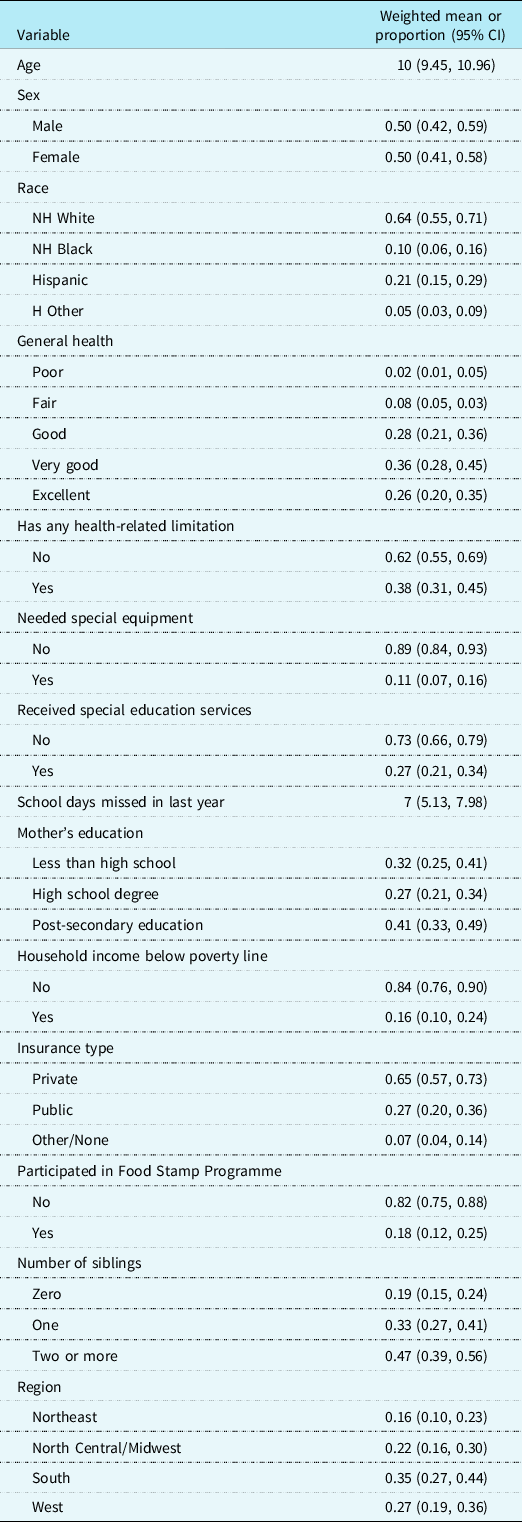
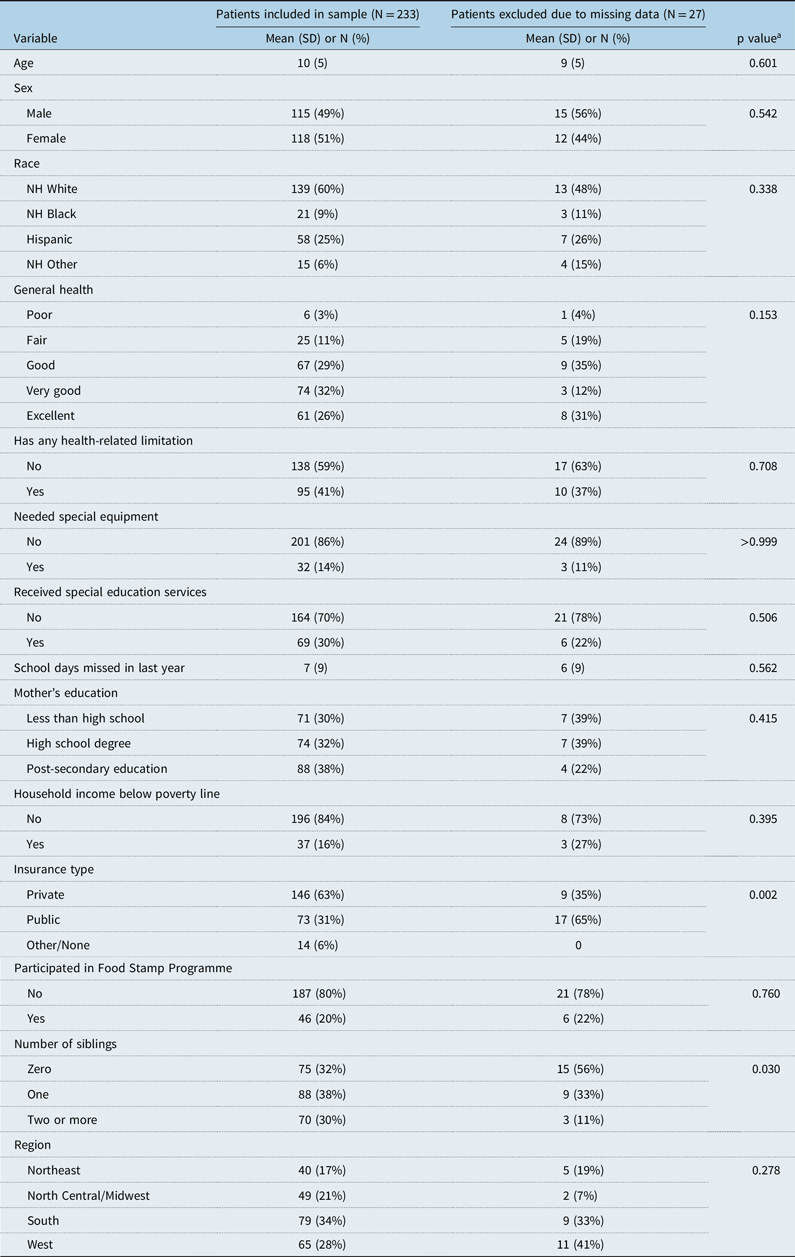
Among 133,542 sample children in the 2007–2018 National Health Interview Survey, we identified 233 children with CHD meeting inclusion criteria. Based on the survey weighting procedure, 12 this sample was representative of a population of approximately 126,600 children with CHD living in the United States during this period (mean age, 10 years; 50% female; 64% non-Hispanic white, 21% Hispanic, 10% non-Hispanic black, and 5% of other race/ethnicity). Patient characteristics are summarised in Table 1. Considering study outcomes, 10% had fair or poor health, 38% reported having any health-related limitation on their usual activities, 11% reported needing special equipment due to health problems, and 27% received special education services. The weighted mean of school days missed in the last year due to health problems was 7. Socio-economic status characteristics estimated from this sample indicated that among children with CHD, 59% had mothers who did not complete education beyond high school, 16% were living in households with income below the poverty status line, 27% had public insurance, 7% had other or no insurance, and 18% participated in the food stamp programme. On unweighted comparisons, children excluded due to missing data (n = 27) were similar to children included in the analysis (n–233), with the exception of being more likely to have public insurance coverage and no siblings (Appendix).
Patient characteristics

Abbreviations: CI, confidence interval; NH, Non-Hispanic.
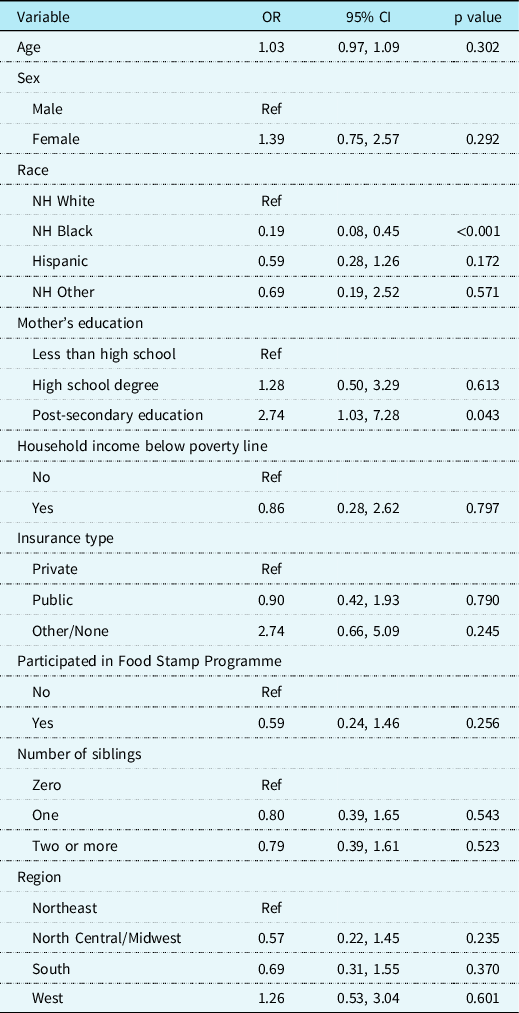
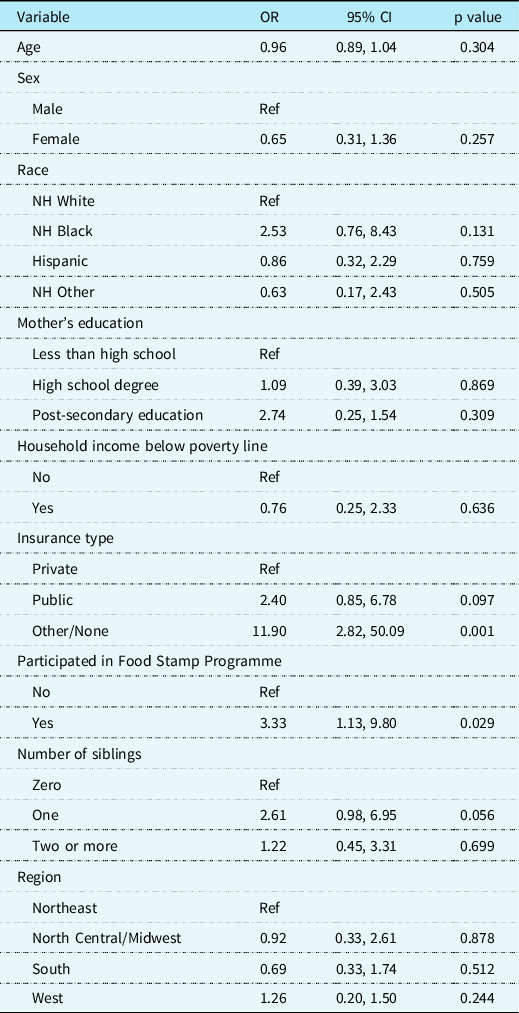
Multivariable ordered logistic regression analysis of the general health of children with CHD (Table 2) found that non-Hispanic black children were less likely to have better health than non-Hispanic white children with CHD (Adjusted Odds Ratio, 0.19; 95% Confidence Interval: 0.08, 0.45, p < 0.001). Mothers’ post-secondary education was associated with greater odds of reporting better general health, compared to children whose mothers had a high school education or less (Adjusted Odds Ratio 2.74; 95% Confidence Interval: 1.03, 7.28, p = 0.043). Other socio-economic characteristics, including poverty status, insurance type, and food stamp programme participation, were not found to be significantly associated with general health self-reports. On logistic regression of activity limitations (Table 3), we found that children with neither private nor public insurance had significantly higher odds of having any limitation (Adjusted Odds Ratio 11.90; 95% Confidence Interval: 2.83, 50.09; p = 0.001). Food stamp programme participation was also significantly associated with increased likelihood of activity limitation (Adjusted Odds Ratio 3.33; 95% Confidence Interval: 1.13, 9.80; p = 0.029).
Ordered logistic regression of general health

Note: HNIS General health ratings are on a five-point Likert scale ranging from 1 “excellent” to 5 “poor” and reported by a family member on behalf of the sample child. Reference Lee, Cinanni and Di Cristofaro11 For this study the Likert scale values are inversed, with higher values implying better reported health.
Abbreviations: CI, confidence interval; NH, Non-Hispanic; OR, odd ratio; Ref; reference.
Logistic regression of health-related limitation in any activities

Abbreviations: CI, confidence interval; NH, Non-Hispanic; OR, odd ratio; Ref, reference.
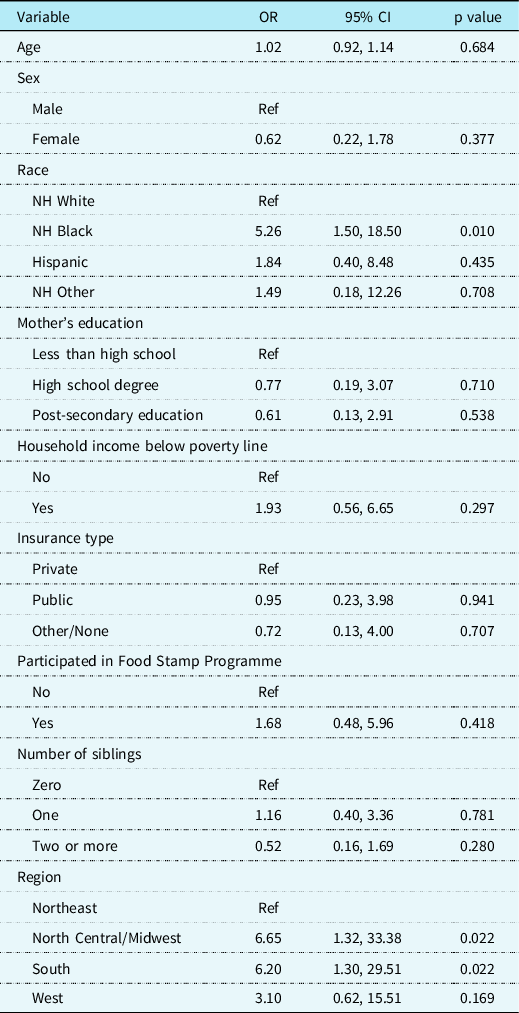
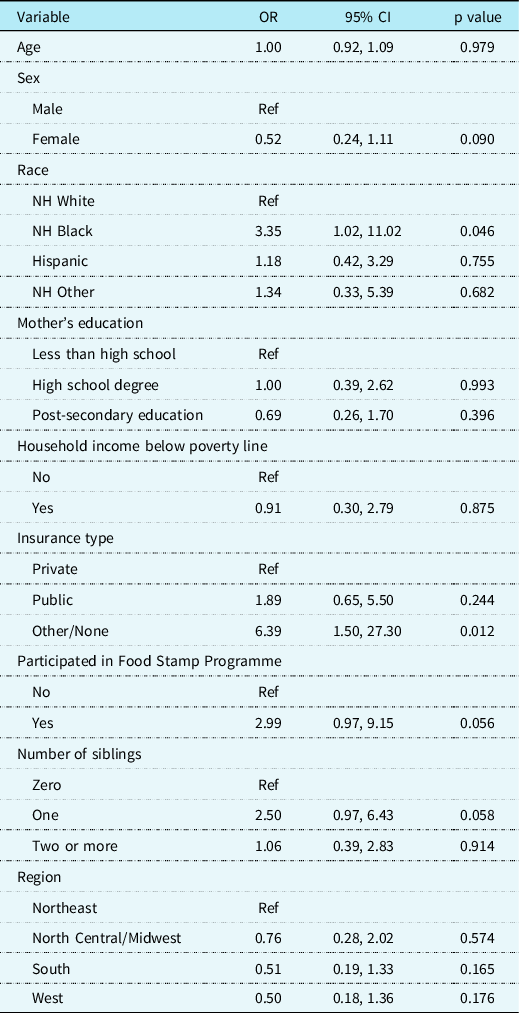
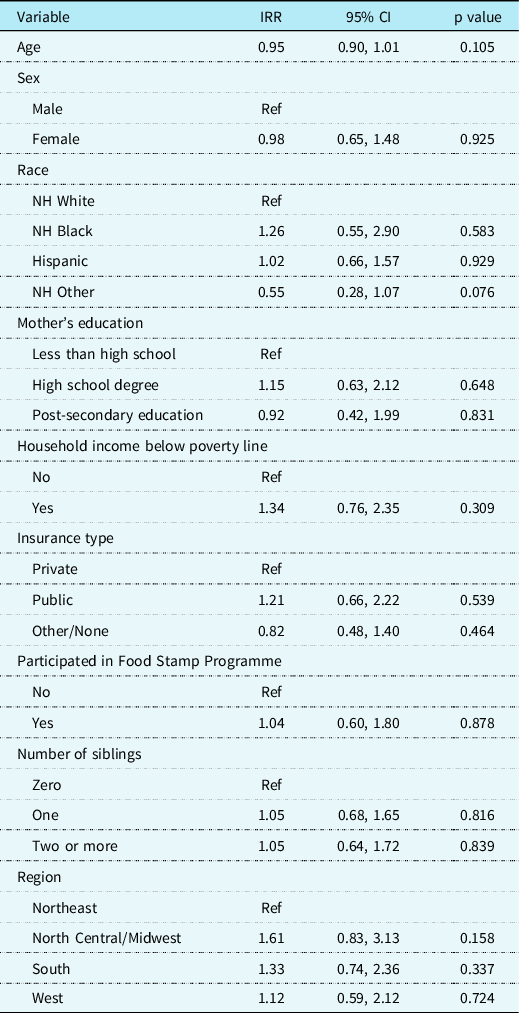
As shown in Table 4, non-Hispanic black children with CHD had significantly greater odds of needing special equipment compared to non-Hispanic white children (Adjusted Odds Ratio 5.27; 95% Confidence Interval: 1.50, 18.50; p = 0.010). This outcome was the only one in our study exhibiting regional variation; children from the North Central/Midwest and Southern regions of the United States both had greater odds of needing special equipment, compared to children from the Northeastern United States. On logistic regression of receiving special education services (Table 5), we found non-Hispanic black children had greater odds of receiving special education services, compared to non-Hispanic white children (adjusted odds ratio 3.35; 95% confidence interval: 1.02, 11.02; p = 0.046). Additionally, children with insurance other than private or public were more likely to receive special education services, compared to children with private insurance (adjusted odds ratio 6.39; 95% confidence interval: 1.50, 27.30; p = 0.012). Lastly, none of the covariates in our study were associated with the number of school days missed due to illness (Table 6).
Logistic regression of needing special equipment due to health condition

Abbreviations: CI, confidence interval; NH, Non-Hispanic; OR, odd ratio; Ref; reference.
Logistic regression of receiving special education services

Abbreviations: CI, confidence interval; NH, Non-Hispanic; OR, odd ratio; Ref; reference.
Poisson regression of the number of missed school days

Abbreviations: CI, confidence interval; IRR, incidence rate ratio; NH, Non-Hispanic; Ref, reference.
Discussion
Our study found associations of maternal education, food stamp programme participation, and health insurance coverage type with outcomes of caregiver-related health, activity limitation, requirement of specialised medical equipment, and receipt of special education services. However, these socio-economic characteristics exhibited inconsistent associations with the outcomes in our study, and none were associated with missed days of school due to illness. Children growing up with CHD may experience reduced quality of life and greater likelihood of functional limitation related to this condition. Reference Ernst, Marino and Cassedy3,Reference Xiang, Su and Liu4,Reference Eagleson, Justo, Ware, Johnson and Boyle15 Lower quality of life corresponds with increased disease severity and medical care utilisation, Reference Ernst, Marino and Cassedy3 and these outcomes may be exacerbated by socio-economic disadvantage. Specific concerns for these families include access to transportation, health literacy, and ability to pay for health care. Recent studies have noted the strong impact of psychosocial factors on quality of life, including anxiety and stress, for both patients and their families. Reference Ernst, Marino and Cassedy3,Reference Denniss, Sholler, Costa, Winlaw and Kasparian16 While the impact of socio-economic status has been described for the health of infants with CHD, including those who undergo cardiac surgery, Reference Bucholz, Sleeper and Newburger9,Reference Lee, Cinanni and Di Cristofaro11 our study adds new data on the association of socio-economic characteristics with health and functional status outcomes in later childhood, including among children in the community who may no longer be under cardiology follow-up.
Considering specific measures of socio-economic status, we found that lower maternal educational attainment correlated with worse caregiver-rated health among children with CHD. In a previous study, low socio-economic status was adversely associated with quality of life among children with CHD, a relationship that appeared to be mediated by lower health literacy among caregivers. Reference Bucholz, Sleeper and Newburger9 Similarly, we found that children with CHD who had neither public nor private insurance were especially likely to experience functional limitations, and to be receive special education services. In the general paediatric population, disruption of health insurance coverage is associated with a lack of continuity in care, resulting in unmet healthcare needs. Reference Tumin, Miller, Raman, Uffman and Tobias17 While lack of insurance coverage is associated with adverse health outcomes for all children, it is particularly significant for children with chronic conditions requiring ongoing subspecialty care, including children with CHD. Expanding public insurance coverage may assist in minimising the likelihood of coverage gaps for this vulnerable population.
Uniquely among studies assessing quality of life or health outcomes among children with CHD, we found that family food stamp programme participation was associated with increased likelihood of activity limitation. Previous studies have found that children who live in food insecure households report lower quality of life, Reference Casey, Szeto and Robbins18 and the American Academy of Pediatrics recommended in 2015 that paediatricians should screen for food security at health maintenance visits. 19 This screening remains limited in paediatric practices, with only 15% of paediatricians in a variety of specialties conducting regular screening for food insecurity. Reference Barnidge, LaBarge, Krupsky and Arthur20 Future studies should analyse the feasibility and utility of food insecurity screening in specialty clinics, like paediatric cardiology, to address the needs of patients seen in these clinics who are at high risk for food insecurity. This work could build on successful initiatives in primary care settings to identify and address food insecurity though a combination of enrolment in needs-based programmes and referral to community resources, such as food banks. Reference De Marchis, Torres and Benesch21
Neurodevelopmental impairments associated with early surgery for CHD can lead to deficits in educational performance in later childhood, with one study reporting that children with CHD performed below average on literacy and mathematics in standardised state exams. Reference Mulkey, Swearingen and Melguizo22 Furthermore, family socio-economic status disadvantage was associated with poorer neurodevelopmental outcomes among children with CHD in another study. Reference Bellinger, Wypij and Rivkin23 Children with CHD are more likely to receive special education services than children without CHD, as they experience difficulty in learning, concentration, communication, self-care, and delays in gross and fine motor skills. Reference Razzaghi, Oster and Reffhuis2,Reference Farr, Downing, Riehle-Colarusso and Abarbanell5 Furthermore, children with CHD are also three times more likely than children without CHD to miss 10 more days of school in the past 12 months. Reference Razzaghi, Oster and Reffhuis2,Reference Farr, Downing, Riehle-Colarusso and Abarbanell5 However, our study did not find that school absences among children with CHD were associated with family socio-economic status or other child or family characteristics. Children who miss school may have more severe disease with residual defects requiring frequent paediatric cardiology follow-up visits, or may have schooling interrupted by hospitalisations or non-elective surgical interventions.
Apart from our analysis of missed school days, it is also important to note that multiple potential associations between socio-economic status and health-related outcomes did not reach clinical or statistical significance in our study. For example, in our analysis of general caregiver-rated health, several important indicators such as poverty status, insurance type, and food stamp programme participation were not associated with this outcome. At least two mechanisms may be responsible for limiting the association between socio-economic status and the outcomes in our study. First, there may be survivorship bias where the most disadvantaged children with CHD have the highest mortality risk in infancy and may not have survived to be included in the NHIS sampling frame. Second, increased contact with the healthcare system among children with CHD (compared to children without CHD) may have helped address health problems in this population that would have demonstrated a stronger socio-economic gradient in a sample of all children. We also note that aside from differences according to socio-economic characteristics, our analysis found notable racial disparities in the health status of children with CHD. This finding was similar to studies that have examined the significance of racial disparities in healthcare outcomes among infants with CHD. Reference Peyvandi, Baer and Moon-Grady10 In the NHIS sample, non-Hispanic black children tended to have worse caregiver-rated health, were more likely to require specialised equipment, and were more likely to be enrolled in special education than white children with CHD. Therefore, further attention to equity in the health and functional status of children with CHD must consider both socio-economic and racial disparities in outcomes in this patient population.
Though our study presents novel information on the association between socio-economic status and health-related outcomes in a population-based sample of children with CHD, our conclusions are limited by some aspects of the data and analytic approach. First, the National Health Interview Survey questionnaires address a number of important social determinants of health, but does not capture other potentially relevant factors, such as transportation access and health literacy. Considering differences by health insurance coverage, it is possible that some patients with private coverage had greater barriers to accessing care than patients with public or other coverage, due to cost-prohibitive copays. Furthermore, the National Health Interview Survey does not contain granular information on the type or severity of the defect, or pertinent medical and surgical history that may help distinguish between CHD and other cardiac problems. With only one child chosen per family for completion of the detailed health questionnaire, it is possible that the survey missed additional children with CHD living in the same family. Our weighted estimate of the number of children with CHD is lower than published estimates reporting up to 1 million United States of America children live with CHD. 24 This may be because minor or surgically corrected CHD may be under-reported by caregivers responding to the survey. Caregiver responses to survey questions were subjective, so interpretation of outcomes such as general health status could be affected by the respondent’s educational attainment and health literacy. Additionally, the psychometric properties of outcome measures (especially the general health question) could not be analysed in this study. A more granular primary outcome measure may have revealed greater disparities by socio-economic status. Lastly, the National Health Interview Survey was intended to provide nationally representative estimates, but the public-use data from this survey could not be subset to examine state-level differences in socio-economic status or health-related outcomes.
Our analysis demonstrates that family characteristics and in particular socio-economic status are associated with several outcomes for children with CHD. Children with CHD who lacked public or private health insurance or whose families participated in the food stamp programme were at increased risk for functional limitation and need for special education services, although these characteristics were not consistently associated with all outcomes examined. Additionally, we identified significant disparities between black and white children in a range of health and functional status outcomes. From a medical standpoint, we have achieved great success in outcomes, morbidity and mortality as evidenced by the fact that many of these CHD patients are living well into adulthood. It is of utmost importance to provide holistic care for this population and identify socio-economic factors that may be associated with poor health and development, in order to deliver appropriate interventions and further improve outcomes. Additional research is needed to elucidate the role of these factors, which may not be routinely captured in paediatric cardiology follow-up care.
Supplementary material
For supplementary material accompanying this paper visit https://doi.org/10.1017/S1047951121004042
Acknowledgements
None.
Financial support
This research received no specific grant from any funding agency, commercial or not-for-profit sectors.
Conflicts of interest
None.
Appendix
Unweighted comparison of study variables between included and excluded children

Abbreviations: CI, confidence interval; NH, Non-Hispanic.