Introduction
Endoscopic ear surgery is routinely being used to address ear pathologies, from the external ear as far as the petrous apex. This paradigm shift towards endoscopic ear surgery is by virtue of the multitude of advantages that the endoscope offers over the conventional microscope. However, of the major limitations of endoscopic ear surgery, bleeding is a vital one. As endoscopic ear surgery is necessarily performed single-handedly for the purpose of instrumentation, bleeding can compromise the surgeon's visualisation and adversely affect outcomes. Hence, it is useful to devise measures that can check the intra-operative bleeding and improve visualisation.
Tranexamic acid is a drug commonly used to decrease bleeding in a number of operative procedures. This study aimed to assess the effectiveness of tranexamic acid as a haemostatic agent in endoscopic ear surgery.
Materials and methods
Patient selection and inclusion criteria
Fifty patients undergoing various endoscopic ear surgical procedures, such as endoscopic tympanoplasty, endoscopic atticotomy or mastoidectomy, endoscopic ossiculoplasty, and endoscopic stapedotomy, at our institution between October 2018 and March 2019, were included in this double-blind, randomised, controlled trial. Informed written consent was obtained from all participants, along with institutional ethical clearance.
Regarding the inclusion criteria, patients were aged 18–50 years, with chronic otitis media (mucosal (inactive) and squamosal (active or inactive)), and otosclerosis diagnosed clinically and by audiological parameters. All patients were normotensive, with haematological parameters and coagulation profile within normal limits. Patients with active middle-ear infection or signs of inflammation on otoendoscopy (checked 1 day prior to surgery), patients with other systemic co-morbidities such as cardiac, hepatic, renal or vascular diseases, and those on anti-coagulation therapy, were excluded.
All patients underwent routine pre-anaesthetic examination, audiological and radiological investigations, and pre-operative otoendoscopy.
Study design and blinding process
Our study was a double-blind, randomised, placebo-controlled trial. The patients undergoing endoscopic ear surgery were randomly allotted to one of two groups: a study group that received tranexamic acid as a haemostatic agent and a control group which received normal saline.
A study investigator, who was excluded from further data collection and analysis, was in charge of the randomisation process, and the preparation and administration of tranexamic acid and normal saline. The randomisation sequence was generated by a table of random numbers, and allocation was concealed using sealed opaque envelopes.
The study group received a slow intravenous tranexamic acid bolus (10 mg/kg) half an hour before the start of surgery, followed by infusion (5 mg/kg/hour). The infusion was prepared in normal saline bottles in order to blind the surgeon, assistant, anaesthesiologist and patient. The control group received the same dose of normal saline in the exact same manner.
Surgery
All procedures were performed under local anaesthesia, with 2 per cent lignocaine with adrenaline (1:1 00 000), by authors AD and SM. The four-quadrant infiltration method was utilised. Routine steps of respective endoscopic ear surgery were followed. No form of diathermy (monopolar or bipolar) was used. Intra-operative bleeding and surgical field visualisation were graded.
Study parameters and results analysis
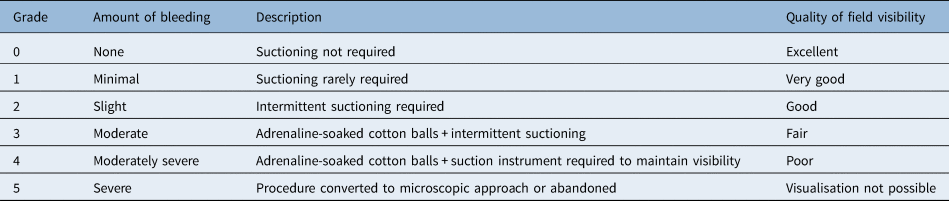
The principal factors of interest in our study were the amount of intra-operative bleeding and the quality of surgical field visualised with or without the use of tranexamic acid. For this purpose, we devised a grading system termed the Das and Mitra endoscopic ear surgery bleeding and field visibility score (Table 1).
Das and Mitra endoscopic ear surgery bleeding and field visibility scoring system

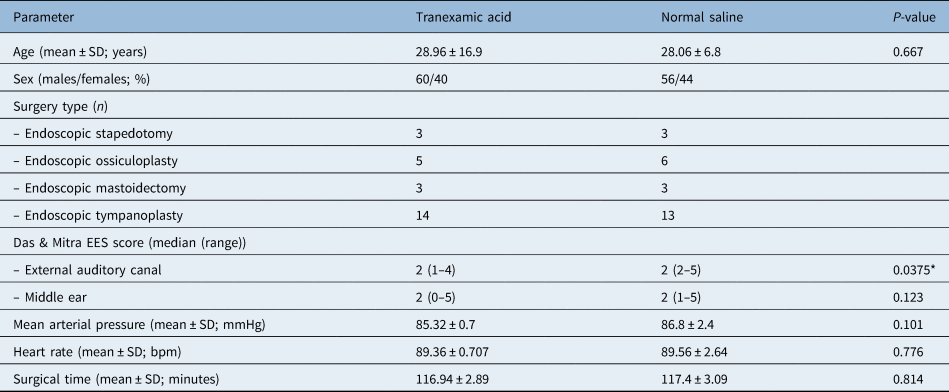
The mean values for mean arterial pressure, heart rate (recorded at 30-minute intervals throughout the surgical procedures) and surgical time are depicted in Table 2.
Summary of demographic data, surgical procedures, Das and Mitra EES score, mean arterial pressure, heart rate and surgical time

*P < 0.05. EES = endoscopic ear surgery; SD = standard deviation; bpm = beats per minute
Adrenaline was used at a concentration of 1:1000. An 18 G micro-ear suction tip was used as the standard suctioning instrument.
For statistical analysis, data were analysed using SPSS software (version 24.0; SPSS, Chicago, Illinois, USA) and GraphPad Prism software, version 5. Data were summarised as: mean and standard deviation (SD) for continuous variables, median and interquartile range for ordinal variables, and number and percentage for categorical variables. The paired t-test was employed for paired samples that were normally distributed. The Wilcoxon signed rank test was used for paired samples that were non-normally distributed. P-values of 0.05 or less were considered to be statistically significant.
Results
Demographic distribution
Sixty-four per cent of patients (32 out of 50) were male and the rest were female. The minimum age was 18 years and the maximum age was 50 years, with a mean age of 28.5 years.
Case distribution
Fourteen patients who underwent endoscopic tympanoplasty received tranexamic acid, while 13 patients received normal saline. Six patients underwent endoscopic mastoidectomy, of which three received tranexamic acid and the rest received normal saline in the same dosage. Five patients who underwent endoscopic ossiculoplasty received tranexamic acid, while six received normal saline. Of the six patients who underwent endoscopic stapedotomy, three received tranexamic acid, while the rest received normal saline (Figure 1).
Distribution of endoscopic ear surgery cases in each group. ES = endoscopic stapedotomy; EO = endoscopic ossiculoplasty; EM = endoscopic mastoidectomy; ET = endoscopic tympanoplasty; NS = normal saline; TA = tranexamic acid

Bleeding and surgical field visualisation
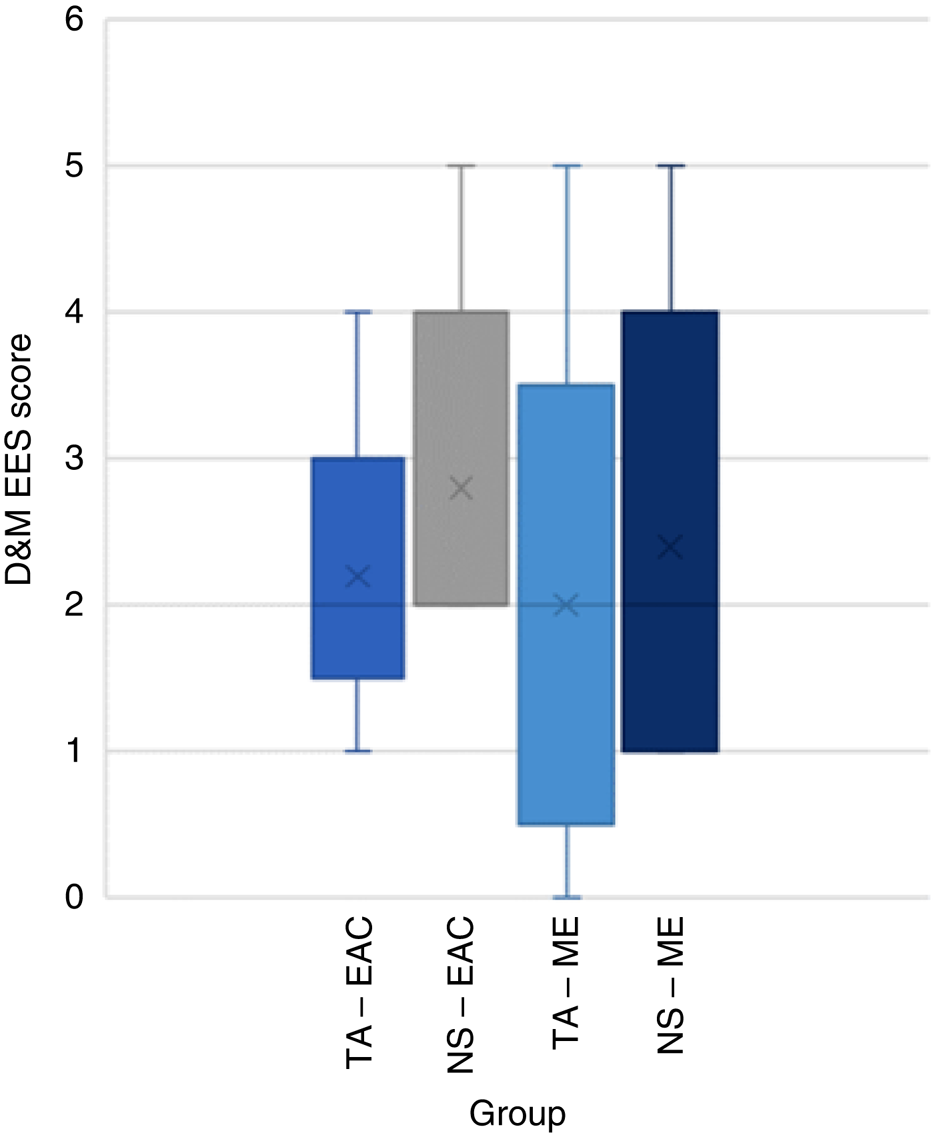
The Das and Mitra score was used to grade bleeding and field visibility. This scoring system was used separately for the external auditory canal and middle ear for better analysis. For the external auditory canal, the median score was 2 (range, 1–4) for the patients receiving tranexamic acid, while that for the control group receiving normal saline was 2 (range, 2–5). The finding was statistically significant (p = 0.03752). Regarding the middle ear, the median score was 2 (range, 0–5) for the tranexamic acid group and that for the control group was 2 (range, 1–5). The result was not statistically significant at p < 0.05 (Figure 2).
Box and whisker plot showing median Das and Mitra endoscopic ear surgery (D&M EES) scores (with ranges) for tranexamic acid (TA) and normal saline (NS) groups, for the external auditory canal (EAC) and middle ear (ME).

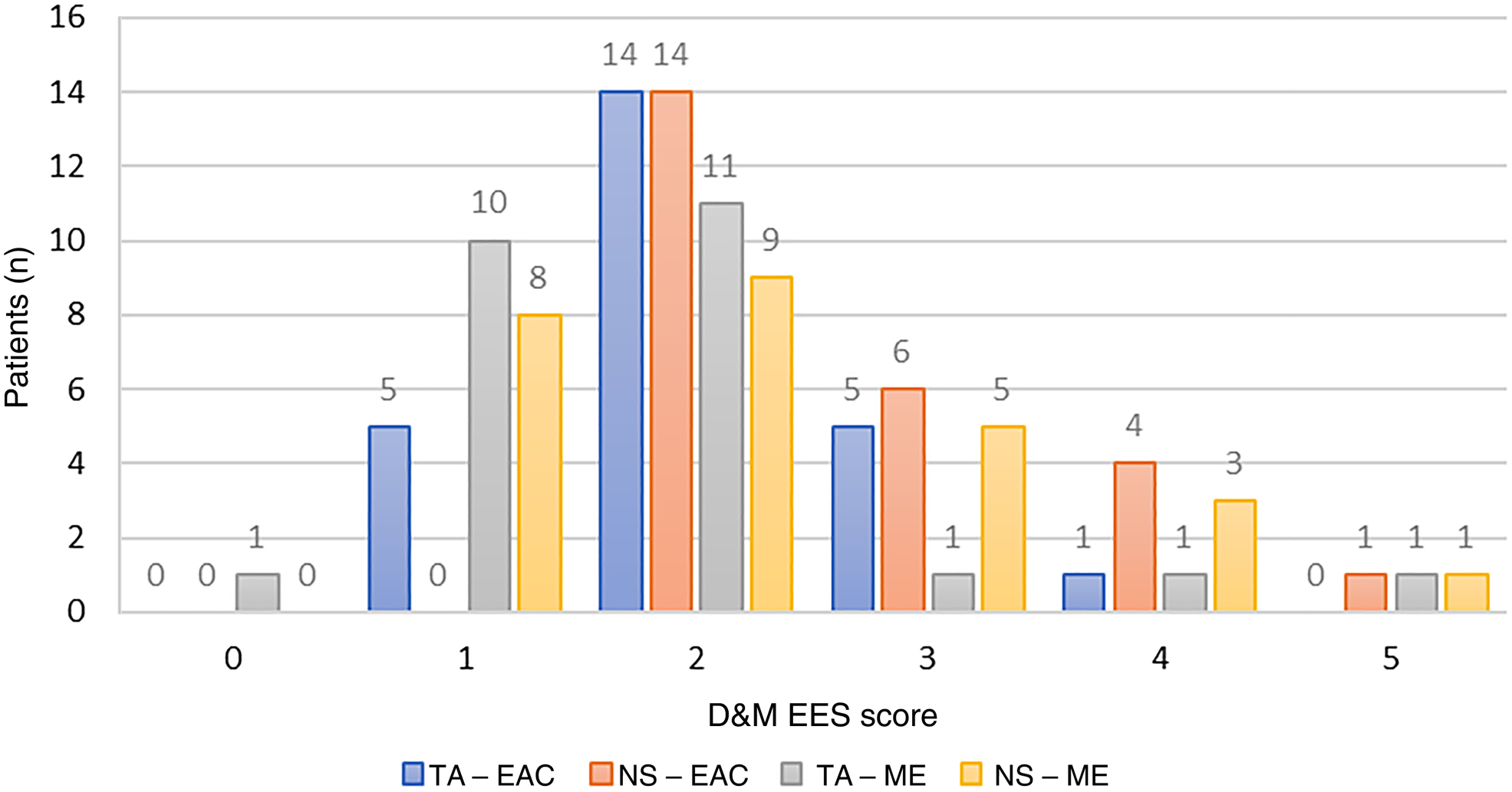
The distribution of cases in the tranexamic acid and normal saline groups, both for the external auditory canal and middle ear, is depicted in Figure 3.
Number of cases that attained each Das and Mitra endoscopic ear surgery (D&M EES) score, for each group: tranexamic acid (TA) – external auditory canal (EAC); normal saline (NS) – external auditory canal; tranexamic acid – middle ear (ME); and normal saline – middle ear.

Mean arterial pressure and heart rate
The mean (± SD) values for mean arterial pressure and heart rate were comparable in both groups, with no statistically significant differences between them. All values were within normal physiological limits (Table 2).
Mean surgical time
The mean (± SD) surgical time in the tranexamic acid group was 116.94 ± 2.89 minutes, while that in the normal saline group was 117.4 ± 3.09 minutes. The difference was not statistically significant (p = 0.814) (Table 2).
Discussion
Bleeding in endoscopic ear surgery is a major concern for the operating surgeon. Endoscopic surgery is performed primarily single-handedly. The working field within the external auditory canal is limited and the middle-ear space is confined. Thus, significant bleeding can soil the tip of the endoscope. For these reasons, the endoscope needs to be taken out and re-introduced, and suction instruments or adrenaline-soaked cotton balls need to be used continually for the purpose of keeping the surgical field clear. This is tedious and time-consuming, and tests the patience of the surgeon which declines with time, causing a deterioration in the final surgical outcome.
A number of techniques have been used to achieve haemostasis intra-operatively. These include the use of diathermy probes (monopolar and bipolar), which are especially useful during tympanomeatal flap elevation.Reference Anschuetz, Bonali, Guarino, Fabbri, Alicandri-Ciufelli and Villari1 Adrenaline cotton balls have been used locally for haemostasis and serve as useful adjuncts for soft tissue dissection.Reference Kozin, Remenschneider, Shah, Reardon and Lee2 However, such measures need to be employed intra-operatively and are necessarily time-consuming. The surgical time could be significantly reduced if the surgical field can be prepared beforehand, so that less time is invested during the procedure itself for the purpose of haemostasis. Moreover, agents that can exert their effect at a systemic level should be more effective. One such haemostatic agent is tranexamic acid.
Tranexamic acid is an anti-fibrinolytic and can stabilise an already-formed clot. It is used in a wide range of surgical procedures, including cardiac operations and extensive orthopaedic surgical procedures (e.g. simultaneous bilateral knee arthroplasty).Reference Zhang, Bai, Chen, Zhou, Yu and Zhou3,Reference Cao, Chen, Huang, Huang, Alexander and Lin4 There are no reports of adverse side-effects of tranexamic acid, even at high doses.
Bleeding in endoscopic sinus surgery has been studied extensively, and several grading systems have been used. The two commonly used grading systems are the Boezaart grading scale and the Wormald grading scale.Reference Boezaart, van der Merwe and Coetzee5,Reference Athanasiadis, Beule, Embate, Steinmeier, Field and Wormald6 Previously, given the lack of an exclusive grading scale for endoscopic ear surgery, the Boezaart grading scale for sinus surgery has been used for endoscopic ear surgery. Later, the Modena bleeding scale was devised by Alicandri-Ciufelli et al. exclusively for endoscopic ear surgery.Reference Alicandri-Ciufelli, Pingani, Mariano, Anschuetz, Molinari and Marchioni7 However, certain points of the scale seem to be prone to subjective variation and hence high inter-rater variability. Thus, we attempted to devise a scale that is more practical and can be applied readily during surgery.
Our grading system, named the Das and Mitra endoscopic ear surgery bleeding and field visibility score, is a 6-point system. Grades, which range from 0 to 5, correspond to the amount of bleeding, from none to severe, and to the quality of field visibility, from excellent to visualisation not possible. Each grade is described in terms of the situations faced commonly in day-to-day endoscopic ear surgical procedures and the manoeuvres (directed towards securing the bleeding) involved, in accordance with the most basic instruments and resources required for endoscopic ear surgery.
The use of intravenous tranexamic acid during functional endoscopic sinus surgery has been studied extensively. Langille et al. found no statistically significant result with the use of tranexamic acid.Reference Langille, Chiarella, Côté, Mulholland, Sowerby and Dziegielewski8 However, a study by El Shal et al. and a meta-analysis conducted by Ping et al. found tranexamic acid to be an effective haemostat in nasal surgery including functional endoscopic sinus surgery.Reference El Shal and Hasanein9,Reference Ping, Zhao, Sun, Lu and Li10
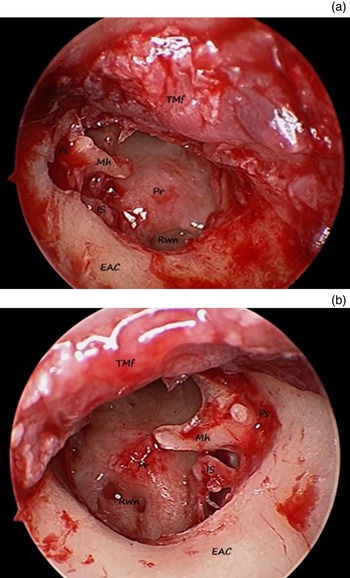
To the authors’ knowledge, no study has previously been conducted on the effectiveness of tranexamic acid as a haemostat in endoscopic ear surgery. In our study, according to the new grading system, those patients who received tranexamic acid were found to have better intra-operative haemostasis and hence surgical field visualisation, especially while working in the external auditory canal during tympanomeatal flap elevation (p < 0.05 for the Das and Mitra endoscopic ear surgery bleeding and field visibility score for external auditory canal) (Figure 4).
• Clear visualisation of the operating field is key to successful endoscopic surgery
• Tranexamic acid, an anti-fibrinolytic, is an effective haemostatic agent in functional endoscopic sinus surgery
• The role of tranexamic acid in endoscopic ear surgery has not been explored previously
• The Das and Mitra score was designed to assess intra-operative bleeding and surgical field visibility in endoscopic ear surgery
• The scoring system is clear, practical, readily applicable during surgery and independent of subjective variation
• Tranexamic acid use results in less intra-operative bleeding and superior visibility within the external auditory canal, improving precision, speed and cost-effectiveness
Surgical field with (a) normal saline as control, and (b) with tranexamic acid as haemostatic agent. TMf = tympanomeatal flap; Ps = Prussak's space; Mh = handle of malleus; Pr = promontory; IS = incudostapedial joint; Rwn = round window niche; EAC = external auditory canal

We acknowledge the limitations of our study, which include a limited sample size wherein certain differences may not appear significant even if they do exist. This highlights the need for larger, multi-centric trials to enable more in-depth studies of the potential advantages that this drug may offer regarding the long-term surgical outcomes of endoscopic ear surgery.
Conclusion
Tranexamic acid appears to be a useful adjunct for improving surgical field visualisation in endoscopic ear surgery; its use may improve surgical precision, and enable the procedure to be carried out faster and more cost-effectively.
Competing interests
None declared