Introduction
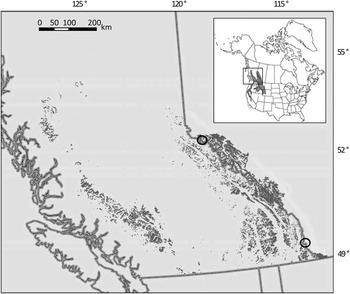
Whitebark pine, Pinus albicaulis Engelmann (Pinaceae), is a high-elevation, five-needle pine found in subalpine forests of western North America (Arno and Hoff Reference Arno and Hoff1989; Price et al. Reference Price, Liston and Strauss1998). The centre of abundance of this species is the Greater Yellowstone Ecosystem, with populations extending north to ~55° latitude in the mountains of Alberta and British Columbia, Canada, and south to ~36° in the Sierra Nevada and Cascade ranges in the United States of America (Fig. 1).
Probable distribution of whitebark pine in western Canada and in North America (insert). Grey shading indicates the distribution of whitebark pine. The circled areas indicate the northern (Willmore Wilderness Park) and southern (Crowsnest Pass) study areas (modified from Committee on the Status of Endangered Wildlife in Canada 2010).

Populations of whitebark pine are declining across much of its range. These declines are primarily due to impacts of: (1) the exotic fungal pathogen, white pine blister rust, Cronartium ribicola Fischer (Cronartiaceae) (Smith et al. Reference Smith, Wilson, Rasheed, Walker, Carolin and Shepherd2008); (2) the mountain pine beetle (MPB), Dendroctonus ponderosae Hopkins (Coleoptera: Curculionidae), a native bark beetle with populations presently erupting on an unprecedented scale throughout the Canadian part of its range (Gibson et al. Reference Gibson, Skov, Kegley, Jorgensen, Smith and Witcosky2008; Safranyik et al. Reference Safranyik, Carroll, Regniere, Langor, Riel and Shore2010); and (3) rapid climate change (Logan and Powell Reference Logan and Powell2001; Tomback and Achuff Reference Tomback and Achuff2010). Consequently, whitebark pine has been recently added to the list of endangered species in Canada (Committee on the Status of Endangered Wildlife in Canada 2010).
Given its myriad ecological roles, whitebark pine is considered a foundation species for subalpine communities across its range (Ellison et al. Reference Ellison, Bank, Clinton, Colburn, Elliot and Ford2005). For example, the seeds of whitebark pine are an important food source for many animals, including bears (Ursus arctos horribilis Ord; Mammalia: Ursidae), birds (Nucifraga columbiana (Wilson); Aves: Corvidae), and squirrels (Tamiasciurus hudsonicus (Erxleben); Mammalia: Sciuridae) (Tomback et al. Reference Tomback, Arno and Keane2001). In addition, its presence regulates snowmelt and runoff at high altitudes and ameliorates extreme microsite conditions thereby facilitating succession and increasing plant diversity at the timberline (reviewed in Tomback et al. Reference Tomback, Arno and Keane2001). However, with the exception of some attention to its major pests (e.g., Bartos and Gibson Reference Bartos and Gibson1990; Gibson et al. Reference Gibson, Skov, Kegley, Jorgensen, Smith and Witcosky2008; Raffa et al. Reference Raffa, Powell and Townsend2013), there have been no systematic studies of relationships between this tree species and associated invertebrates. Given that invertebrates comprise the bulk of diversity in Canadian terrestrial ecosystems (Danks Reference Danks1979), many ecological relationships between whitebark pine and invertebrates are expected in high-elevation ecosystems.
Saproxylic invertebrates (those associated with moribund or decaying trees) are extremely diverse, representing a substantial component of forest biodiversity (Stokland Reference Stokland2012). They are also particularly susceptible to extirpation because of highly specific microhabitat requirements, which are often spatially and temporally ephemeral (Siitonen Reference Siitonen2001; Langor et al. Reference Langor, Hammond, Spence, Jacobs and Cobb2008). Ips woodi Thatcher (Coleoptera: Curculionidae), for example, is potentially threatened because it feeds exclusively on moribund or dead limber pine, Pinus flexilis James (Pinaceae) (Thatcher Reference Thatcher1967; Wood Reference Wood1982), another endangered five-needle pine (Alberta Sustainable Resource Development and Alberta Conservation Association 2007). Studies of saproxylic invertebrates suggest that assemblages differ among pines species, although those findings are potentially confounded by geographic effects (e.g., de Leon Reference de Leon1935; Dahlsten and Stephen Reference Dahlsten and Stephen1974). Therefore, investigation of whether other invertebrate species have similarly exclusive host associations with whitebark pine can help identify the full range of threats related to declines of this important subalpine tree species.
The MPB has created a large number of standing dead snags of whitebark pine and lodgepole pine (Pinus contorta latifolia (Engelmann) Critchfield (Pinaceae)) in Canadian subalpine forests. We sampled saproxylic beetle assemblages in MPB-created snags of both species co-existing in mixed subalpine stands. Beetles (Coleoptera) were selected for study because they are taxonomically and trophically diverse, sensitive to perturbations in dead wood quantity and quality, and are taxonomically relatively well known (Siitonen Reference Siitonen2001; Langor et al. Reference Langor, Hammond, Spence, Jacobs and Cobb2008).
This is the first systematic survey of beetles associated with whitebark pine snags in Canada, and it serves four main objectives: (1) to describe the beetle assemblage associated with whitebark pine snags; (2) to determine if beetle assemblage composition and structure in MPB-killed snags differs between whitebark and lodgepole pines; (3) to determine if there are species exclusively associated with whitebark pine that might be threatened by its decline; and (4) to determine if the composition or abundance of known predators and competitors of the MPB differ between whitebark and lodgepole pines in a way that could affect local MPB population dynamics in subalpine areas. We hypothesised that faunal composition would differ between the two host species, with the possibility that some species exclusively inhabit whitebark pines. Testing this hypothesis is of particular importance to forest managers because felling and burning of MPB-infested trees is a common management tool, even in protected areas, and such activities could adversely affect populations of invertebrate species associated with whitebark pine.
Methods
Study sites
The study was conducted in subalpine forests in two regions of the Rocky Mountains in Alberta: (1) north, Willmore Wilderness Park (2008–2009), and (2) south, Crowsnest Pass (2009–2010). These sites represent the approximate northern and southern limits of whitebark pine distribution in Alberta (Fig. 1). In each region, research was conducted at two sites, each with relatively continuous canopies. Sites in Willmore Wilderness Park were Deveber Creek (53.72466°N, 119.54844°W; 1500–1550 m; south aspect) and Featherstonhaugh (53.78957°N, 119.76147°W; 1550–1650 m; south). Sites in the Crowsnest Pass region were Gould Dome Mountain (49.91399°N, 114.64803°W; 1920–2060 m; west) and Dutch Creek (49.85065°N, 114.62191°W; 1890–1930 m; north).
Given challenges with access to these remote sites and our focus on sites with a significant proportion of whitebark pine, we selected sites for study that contained variable mixtures of Engelmann spruce, Picea engelmannii Perry ex Engelmann (Pinaceae); subalpine fir, Abies lasiocarpa (Hooker) Nuttall (Pinaceae); lodgepole pine; and whitebark pine in the canopy. The Featherstonhaugh and Gould Dome Mountain sites were dominated by subalpine fir and Engelmann spruce, and Dutch Creek was similar except that lodgepole pine was absent. Deveber Creek was dominated by lodgepole pine and whitebark pine, with spruce and subalpine fir mostly limited to the understorey.
The MPB had been active in all stands starting three to four years before the study; however, beetle eruptions were still in the early stages, as evidenced by the high ratio of live to dead pine trees. Snags in early stages of decay were selected for study as these stages were deemed most likely to exhibit exclusive host-invertebrate associations (Langor et al. Reference Langor, Hammond, Spence, Jacobs and Cobb2008; Wu et al. Reference Wu, Yu and Zhou2008).
Insect collection
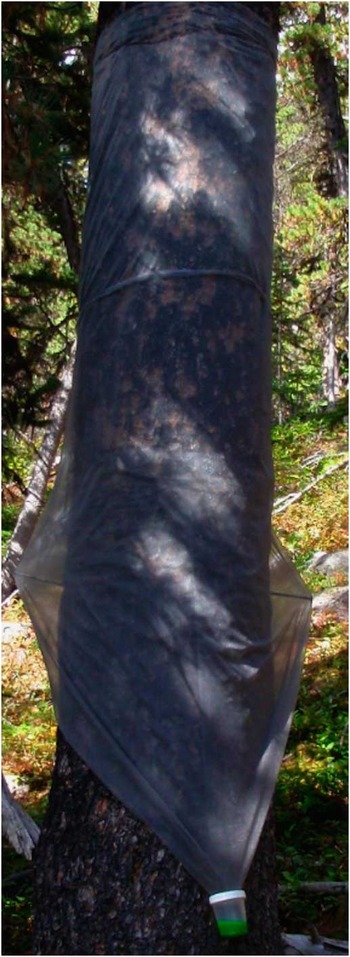
Emergence traps and flight intercept traps were used to collect insects associated with snags. Emergence traps were constucted of nylon insect screen (mesh size=0.5 mm) fastened tightly to boles using loops of taught wire and staples to enclose a 1-m long section of each snag (Fig. 2). The bottom portion of each emergence trap was shaped into a funnel that directed emerging insects into a small plastic cup. Before completely screening a section of a snag, two 30 cm spikes were driven ~2 cm into the snag at ±90° from the apex of the funnel. These spikes held the screen away from the surface of the tree providing space for emerging insects to fall to the base of the trap. Flight intercept traps consisted of a clear piece of plastic (Plexiglas®, Plaskolite, Columbus, Ohio, United States of America), 0.15×20×30 cm, attached perpendicularly to the snag (Kaila Reference Kaila1993; Hammond Reference Hammond1997). Intercepted insects fell through a canvas funnel attached to the bottom of the plastic panel into a small plastic cup. Both types of trap were placed at breast height (~1.3 m) and collection cups were filled with silicate-free ethylene glycol to kill and preserve insects. Traps were oriented down-slope on all snags.
Photograph of an emergence trap enclosing a 1-m section of a pine snag.

Sampling design
Traps were attached to whitebark and lodgepole pines that had been attacked and killed by the MPB one to four years previously. We estimated year of death based on foliage colour (Safranyik and Carroll Reference Safranyik and Carroll2006) as follows: canopies fading from green to yellow had been attacked the previous year (fader), canopies that were entirely red had been attacked two to three years previously (red kill), and red canopies that had dropped most foliage had been killed three to four years previously (grey kill). To the trained eye, the precise year since death could be determined for the vast majority of snags; however, a small number proved more difficult. Thus, snags are grouped into three classes grouping multipes years since death for this analyses.
At each site in Willmore Wilderness Park, one trap of each type was attached to three different fader and red-kill trees of each species (two tree species×two snag ages×three replicates×two trap types×two sites=48 traps on 48 trees in total). In the Crowsnest Pass, MPB populations were being aggressively controlled and all faders had been felled and burned the winter previous to the study. Consequently, one trap of each type was attached to three different red-kill trees and three grey-kill trees of each species, except that only whitebark pine was sampled at Dutch Creek because lodgepole pines were absent (36 traps on 36 trees). Emergence traps were installed in Willmore Wilderness Park on 15–17 July 2008 and flight intercept traps were installed there 20–21 August 2008. The accumulated catch from these traps was collected every two to three weeks until 16 September 2008 and once more on 23–24 July 2009. Emergence and flight intercept traps were installed in the Crowsnest Pass 30 June–1 July 2009. The insects were collected from these traps every two to three weeks until 22 September 2009, and once more on 16 May 2010.
All adult beetles were identified to the lowest possible taxonomic level, with most specimens identified to species. Specimens of some groups could not be reliably identified and were excluded from the analysis. These included the Aleocharinae (Coleoptera: Staphylinidae), female Corticaria Marsham (Coleoptera: Latridiidae), and female Dichelotarsus Westwood (Coleoptera: Cantharidae). Pityophthorus Eichoff (Coleoptera: Curculionidae: Scolytinae) and male Corticaria could be reliably assigned to species or morphospecies based on external or genitalic characters. Singletons of higher taxonomic rank that could not be identified to species (e.g., Pselaphinae (Coleoptera: Staphylinidae) and Acrotrichis Motschulsky (Coleoptera: Ptiliidae)) were included in the analysis. Nomenclature follows Bousquet et al. (Reference Bousquet, Bouchard, Davies and Sikes2013). A synoptic collection of all beetles was deposited in the arthropod collection of the Canadian Forest Service, Northern Forestry Centre, Edmonton, Alberta, Canada.
Data analysis
To compare species richness between the two hosts across the range of snag ages, species accumulation curves with 95% confidence intervals were constructed using sample-based rarefaction (Mao-Tao function) in EstimateS version 8.2.0 (Colwell Reference Colwell2009). Analyses were performed separately by trap type and region/year, because of differences in trapping days between years and trap type.
Redundancy analysis (RDA) was used to describe relationships between beetle assemblages, host species, and snag age within each region/year. Species abundance data were Hellinger-transformed (Legendre and Gallagher Reference Legendre and Gallagher2001) using the decostand function in the vegan package (Oksanen et al. Reference Oksanen, Blanchet, Kindt, Legendre, Minchin and O’Hara2011) for R version 2.12.1 (R Development Core Team 2010). Subsequent analyses were all performed in R, using routines as indicated below.
Redundancy analysis is a linear, constrained ordination method that relates sample composition to constraining and conditional variables (Legendre and Legendre Reference Legendre and Legendre1998). We used the rda function in the vegan package. The factors “host species” and “snag class” were included in the RDA as constraining variables and the covariates “site” and “accumulated number of trap days” were included in the RDA as conditional variables. Accumulated number of trap days was included to help account for unequal sampling periods and trap disturbance. Scaling 1 was used to focussed on inter-sample distances, and only vectors that projected outside the equilibrium circle were plotted. To test if the constraining variables were significantly related to species composition, an analysis of variance-like permutation test was performed using the anova.cca function with 9999 permutations to compare the overall RDA model, each model term and the first two ordination axes (Legendre and Legendre Reference Legendre and Legendre1998). The order of factor inclusion in the model did not significantly change the results of any permutation test.
Redundancy analysis was performed on a subset of data from the emergence traps containing the MPB and its known and probable competitors and predators. Emerging MPBs were collected from the first two snag age classes but not the third, and therefore data from grey-kill traps were removed from this subset of the data before analysis. Overall, 723 individuals in 28 species of phloeophagus scolytines and generalist predators, but not scavengers, were selected for analysis (see Appendix 1). Redundancy analysis and permutation tests were performed on this subset of species for a model that included host species and snag age as constraining variables and number of trap days, region, and site as conditional variables. Indicator species analysis (ISA) (Dufrêne and Legendre Reference Dufrêne and Legendre1997) was used to assess strength of species association with host species and snag class. This analysis was performed using the indval function in the labdsv package (Roberts Reference Roberts2010). Indicator species analysis combines the relative abundance and relative frequency of a species into an indicator value between 0 (no indication) and 1 (perfect indication). We ignored indicator values from lodgepole pines in Crowsnest Pass, as these trees were sampled at only one site and, therefore, the values generated by this analysis are not meaningful. In this study, only species with indicator values (IndVal)⩾0.6 and P<0.05 were considered good indicators, following Jacobs et al. (Reference Jacobs, Spence and Langor2007). Significance of indicator values was evaluated with a Monte-Carlo test statistic using 9999 randomisations.
Results
Beetle assemblage structure
A total of 10 182 beetles were collected, of which 9270 could be identified to one of 139 different species or morphospecies representing 36 different families (Appendix 1). The striped ambrosia beetle, Trypodendron lineatum (Olivier) (Coleoptera: Curculionidae), was by far the most abundant species collected, comprising 59% of the total catch. Ninety-nine per cent of the specimens of this species were collected from the fader snag class. The Scolytinae (Curculionidae) were the most species-rich group, with 25 species collected, including the common species: Hylurgops porosus (LeConte), Pityophthorus murrayanae Blackman, Ips pini (Say), and Orthotomicus latidens (LeConte).
The Staphylinidae (excluding Aleocharinae) were the second most species-rich group with representatives of 20 species collected. Most staphylinid species were represented by only a few individuals while the most abundant species, Phloeostiba lapponicus (Zetterstedt), accounted for 65% of all identified members of this family. Because the species-rich Aleocharinae could not be reliably identified, the real species richness of Staphylinidae was undoubtedly higher than that of Curculionidae.
Notable among the less species-rich taxa were two fungivores, Epuraea linearis Mäklin (Nitidulidae) (2.5% of overall catch) and Epuraea truncatella Mannerheim (3.8%); and two predators, Corticeus praetermissus (Fall) (Tenebrionidae) (3.6%) and Rhizophagus dimidiatus Mannerheim (Monotomidae) (0.7%). These taxa were relatively common and abundant, and together comprised 10.6% of the overall catch. These insects are commonly associated with the MPB in Alberta (D.W.L., personal observation) and elsewhere (de Leon Reference de Leon1935; Dahlsten and Stephen Reference Dahlsten and Stephen1974).
As is common in studies of saproxylic insects, the majority of species (93%) were “rare”, individually repesenting < 0.05% of beetle specimens collected, with 49 species represented by only one individual and 95 species represented by five or fewer individuals. Twenty-two species were new records for Alberta (Appendix 1). A number of the species collected are likely undescribed, including Leptophloeus Casey species 1 (Staphylinidae), several species of Corticaria (Latridiidae), and some Aleocharinae.
Trap type
The beetle assemblages represented in the catches of emergence traps and flight intercept traps were quite similar overall. Emergence traps collected more specimens (8942) but similar numbers of species (104), compared to flight intercept traps (1240 specimens; 98 species). When T. lineatum was excluded (adjusted total from emergence traps, 3007; flight intercept traps, 1126) emergence trap catches were still greater. Specimens that were abundant in emergence traps also tended to be abundant in flight intercept traps. Thirty-four species were unique to emergence traps. Twenty-nine species were captured only in intercept traps.
Flight intercept traps collected a small number of beetle species not targeted in this study. Some of these were species with saproxylic habits that are not known to feed on Pinus Linnaeus; e.g., the scolytine, Scierus pubescens Swaine (Coleoptera: Curculionidae); while others are likely not strictly saproxylic at all; e.g., the aphodiine dung beetles (Coleoptera: Scarabaeidae: Aphodiinae), and the leaf beetles, Syneta Dejean species (Coleoptera: Chrysomelidae); but may instead seek shelter in bark crevices.
Species richness
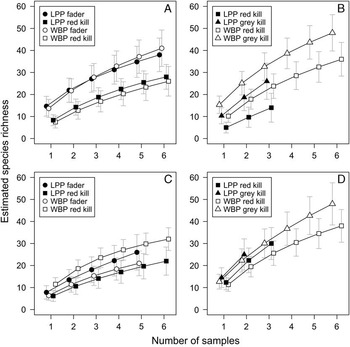
Overall, 23% more species were collected in traps placed on whitebark pines (117 species), than on lodgepole pines (90 species); however, rarefaction analysis, which standardises species richness according to sample size, showed no differences in species richness between the two host species within any snag class in either trap type (Fig. 3A–D). Comparisons of species richness between host species based on trajectories of the rarefactions are likely reliable, but it should be noted that most species accumulation curves failed to approach an asymptote, suggesting that the fauna has not been fully characterised.
Species accumulation curves of saproxylic beetles collected on MPB-killed whitebark pines (WBP) and lodgepole pines (LPP) in three decay classes (fader, red kill, and grey kill) and two trap types in subalpine forests. Curves were computed by sample-based rarefaction of beetle catches in emergence traps in Willmore Wilderness Park (A) and Crowsnest Pass (B) and in flight intercept traps in Willmore Wilderness Park (C) and the Crowsnest Pass (D). Estimates of species richness (Mao-Tao function) and 95% confidence intervals are presented.

Quantitative multivariate description of assemblages
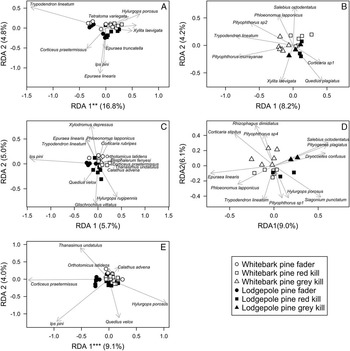
The ordinations produced by RDA of emergence trap data suggested some overall similarity of the fauna within snags of the same host species and class; however, overlap among these groups was substantial and consequently the variation explained by each RDA axis small (Fig. 4A–B). The RDA of emergence trap catches in Willmore Wilderness Park (P=0.001, Fig. 4A) showed that the variables of site and accumulated trap-days together explained 15% of the variation in emergence trap catches, while host species and snag class together explained 18%. Beetle assemblages were strongly influenced by snag class (P<0.001) but did not differ significantly between host species (P=0.242). In the Crowsnest Pass (Fig. 4B) the RDA did not fit the beetle assemblage data well (P=0.576). Site and accumulated trap-days together explained 15% of the variation in emergence trap catch and host species and snag class together explained only 11%. In the Crowsnest Pass, neither snag class (P>0.345) nor host species (P>0.740) had strong effects on beetle assemblages.
Redundancy analysis (RDA) of beetles collected in (A) emergence traps in Willmore Wilderness Park, (B) emergence traps in Crowsnest Pass, (C) flight intercept traps in Willmore Wilderness Park, and (D) flight intercept traps in Crowsnest Pass. Variation explained by the first and second RDA axes are indicated. For panels (A) to (D), only vectors of species scores extending beyond the equilibrium circle are shown and scaling 1 was used. Panel E shows a RDA of a subset of data from Willmore Wilderness and the Crowsnest Pass collected in emergence traps. The dataset of 28 species includes the mountain pine beetle and species known or likely to be associated with it. Significance codes for each axis are: *P<0.05, **P<0.01, ***P<0.001.

According to RDAs, host species and snag class had relatively small effects on the beetle assemblages sampled by flight intercept traps in both Willmore Wilderness Park (P=0.415) and in the Crowsnest Pass (P=0.418) (Fig. 4C–D). In Willmore Wilderness Park, site and accumulated trap-days together explained 19% of the variation in flight intercept trap catch while host species and snag class together explained only 9%. Neither snag class (P=0.404) nor host species (P=0.401) had strong effects on beetle assemblages. In the Crowsnest Pass, site and accumulated trap-days together explained 19% of the variation in flight intercept trap catch and host species and snag class together explained 12%. Beetle assemblages were not significantly influenced by host species (P=0.168) or snag class in (P=0.648) in the Crowsnest Pass.
The more circumscribed assemblage including the MPB and its competitors and predators was much more influenced by the variables of host species and snag class (Fig. 4E) than was the larger assemblage of beetles. Region, site, and accumulated trap-days together explained 24% of the variation among emergence trap catches of this group, and host species and snag class together explained an additional 10%. Both host species (P=0.023) and snag class (P=0.027) significantly influenced this assemblage. Species-by-site biplots indicate that catches of five species most influenced this pattern: Ips pini and Corticeus praetermissus were strongly associated with fader lodgepole pines; Hylurgops porosus was more closely related with red-kill whitebark pines; the predaceous clerid, Thanasimus undulatus (Say) (Coleoptera: Cleridae), was most commonly associated with fader snags of both species; and Quedius velox Smetana (Coleoptera: Staphylinidae) was most commonly associated with red-kill snags of both species (Fig. 4E).
Individual species responses
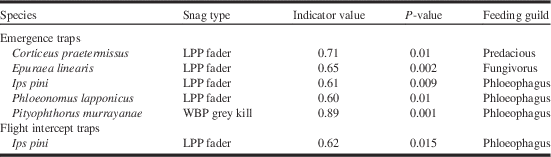
Indicator species analysis identified five significant and meaningful indicators. Four of these were indicators of lodgpole pine and one species indicated whitebark pine (Table 1). Ips pini indicated lodgepole pine for both trap types. Indicator species were from all the major feeding guilds and showed no obvious association with any higher taxonimc groupings.
Summary of indicator species analysis of saproxylic beetles collected on MPB-killed whitebark pine (WBP) and lodgepole (LPP) pine snags in subalpine forests of Alberta.
Note: Fader, red kill, and grey kill describe the canopy condition used to estimate snag age class. Only species with P< 0.05 and indicator values > 0.6 are shown.
Thirty-eight species emerged only from whitebark pines (Appendix 1). Microstagetus parvulus Wollaston (Coleoptera: Corylophidae) and Agathidium fenderi Hatch (Coleoptera: Leiodidae) were two such species known only from the range where whitebark pines grow. As well, four undetermined species of Pityophthorus (Coleoptera: Curculionidae) and one of Corticaria (Coleoptera: Latridiidae) were also collected only on whitebark pine.
Discussion
Host effects
Overall, there were no large differences in the saproxylic assemblages using MPB killed whitebark and lodgepole pines. The majority of saproxylic beetles likely do not discriminate between hosts within the same genus, but instead prefer a specific host genus (e.g., Pinus versus Picea Dietrich) or a higher taxonomic grouping, such as broad-leaved versus conifer species (Bright Reference Bright1976; Wood Reference Wood1982; Irmler et al. Reference Irmler, Heller and Warning1996; Siitonen Reference Siitonen2001; Jacobs et al. Reference Jacobs, Spence and Langor2007; Wu et al. 2008; Ulyshen and Hanula Reference Ulyshen and Hanula2009). The decline of whitebark pine presents numerous ecological challenges, fortunately, the extirpation of large numbers of saproxlic beetle species will not be one of them. Of course, our focus has been on beetles; other diverse but more poorly known taxa with saproxylic associations may show tighter host associations.
We did not find conclusive evidence that any saproxylic beetle species was exclusively associated with snags of whitebark pine. This generality, however, does not preclude the possibility of exclusive host associations like the one observed between Pinus flexilis and Ips woodi (Thatcher Reference Thatcher1967; Wood Reference Wood1982). The majority of species collected exclusively from whitebark pine in emergence traps were either collected in very small numbers or are also known from outside the range of this tree species. Three fungivorus species, Microstagetus parvulus (one specimen), Agathidium fenderi (one specimen), and Corticaria species 2 (two specimens) emerged only from whitebark pine, but in view of these small numbers it would be risky to classify any of these species as host specific. It seems more likely that these species are associated with specific fungi (Stehr Reference Stehr1991; Wheeler and Miller Reference Wheeler and Miller2005a, Reference Wheeler and Miller2005b), rather than with a specific host tree species. However, it is possible that decaying whitebark pine supports a different community of microorganisms than lodgepole pine, and so associations with fungivores could still be host tree specific.
If any beetle species are exclusively associated with whitebark pine, they are likely to be xylophagous or phloeophagous, and in genera for which there are gaps in knowledge of host associations and distributions (e.g., Pityophthorus), or among undescribed species (e.g., Corticaria, Aleocharinae). Pityophthorus murrayanae was a good indicator of grey-kill whitebark pine at the study sites; however, it has a transcontinental distribution and is associated with numerous species within the Pinaceae (Wood Reference Wood1982). Although the other unidentified species of Pityophthorus are candidates for having unique host association with whitebark pine, this cannot be determined without more work after these species are reliably identified. Although noted previously (e.g., Langor et al. Reference Langor, Hammond, Spence, Jacobs and Cobb2008) a full understanding of saproxylic insect diversity in North America awaits work needed to close taxonomic gaps.
Despite not finding beetle species unique to whitebark pine, or major differences in assemblage structure between the two pines, both RDA and ISA revealed some differences in the abundance of several important species. Differences between hosts in patterns of species abundance were most evident in the data subset that included the MPB and its competitors and predators, particularly among the Scolytinae. Ips pini was a significant indicator of lodgepole pine and O. latidens, D. ponderosae, and a number of Pityophthorus were more common in whitebark pine. This is noteworthy from a pest management perspective because I. pini decreases MPB attack density and brood production through interspecific competition (Rankin and Borden Reference Rankin and Borden1991; Safranyik et al. Reference Safranyik, Shore, Linton and Rankin1999). Raffa et al. (Reference Raffa, Powell and Townsend2013) reported that I. pini had a greater landing rate on MPB attacked lodgepole pines than whitebark pines and attributed this pattern to the profile of volatile compounds released from lodgpole pines as being more attractive to I. pini. Our data and observations recorded by others suggest that MPB attacking whitebark pines may be less constrained by competition with I. pini. Though this will not be a major factor influencing outbreaking MPB populations, it will impact endemic MPB populations and may be one factor contributing to the transition from endemic population levels to incipient outbreaks in naive, high-elevation whitebark pine forests.
Snag class effects
Species richness is generally believed to decrease with advancing decay in coniferous dead wood (Savely Reference Savely1939; Howden and Vogt Reference Howden and Vogt1951; Siitonen Reference Siitonen2001; Ulyshen and Hanula Reference Ulyshen and Hanula2010). Although beetle species richness did not differ significantly among snag classes in our study, we explored only a relatively narrow range of decay. Efforts to characterise the fauna associated with more advanced decay classes of both snags and logs of lodgepole and whitebark pines will undoubtedly reveal many more saproxylic beetle species associated with these hosts. Similarly, pyrophilus species may be using the felled and burned whitebark pine logs; however, investigation of these burnt logs was outside the scope of this project.
Beetle species composition, however, did change with snag class (i.e., time since death), with differences between fader and red-kill snags greater than those between red-kill trees and grey-kill trees. This pattern mainly reflected the fact that species specialised on freshly killed trees, such as ambrosia beetles, bark beetles and their predators, occurred in high numbers in fader snags. Similar uniqueness and rapid turnover of specialised fauna associated with freshly dead trees has been observed for other tree species (Howden and Vogt Reference Howden and Vogt1951; Hammond et al. Reference Hammond, Langor and Spence2001, Reference Hammond, Langor and Spence2004; Siitonen Reference Siitonen2001; Jacobs et al. Reference Jacobs, Spence and Langor2007). Species turnover was likely relatively slow in our study compared to that recorded in other work with saproxylic beetles due to the cool temperatures at our high-elevationstudy sites. For example, we observed MPBs emerging from red-kill snags, possibly indicating that their development took >1 year. At high elevations the prolonged life cycle of some species such as MPB, the slower rate of decay of wood and the narrower window for colonisation may greatly reduce faunal differences between fader and red-kill classes compared to that observed in pine at lower elevations.
Both trapping period and year of collection differed between the two study regions, likely accounting for some variation observed among assemblages. For example, no significant or meaningful indicator species were identified from the red-kill snag class, this may be in part explained by unequal sampling periods for this snag class between the two regions.
Trap type
Emergence traps collected a far greater number of specimens and slightly more species than flight intercept traps. Analysis of data from emergence traps identified more significant indicators and, for the most part, explained more variation in the data sets. Given these benefits, and the fact that emergence traps provide stronger evidence for host association than flight intercept traps, we strongly encourage their use for future studies of sparoxylic insects seeking to discover more than species presence.
Conclusions and management recommendations
This study showed that assemblages of saproxylic beetles differed only subtly between two sympatric, distantly related pine species in subalpine forests. These differences occurred predominantly among scolytine bark beetles that generally require fresh or recently killed phloem to complete their development. No species was clearly exclusively associated with whitebark pine; however, exclusive association with whitebark pine is possible for seven rarely encountered species or morphospecies. These species deserve additional study to ascertain host range in relation to conservation status.
Based on evidence to date, felling and burning MPB-infested whitebark pine, a commonly used practice to manage this pest even in protected areas, will not threaten the great majority of saproxylic species because they are exclusively associated with that tree species. The study did identify a few candidate beetle species of concern, and these require further consideration and study. Although our study was limited to trees dead < 5 years, beetle affinities for particular host species generally decrease with time after death (Langor et al. Reference Langor, Hammond, Spence, Jacobs and Cobb2008; Wu et al. Reference Wu, Yu and Zhou2008). Altering the amount or quality of dead wood on a landscape, as occurs through felling and burning following MPB infestation, however, can lead to long-term declines in saproxylic species (Siitonen Reference Siitonen2001). Nonetheless, risks of allowing MPB populations to spread unchecked through whitebark pines and subalpine forests in general, likely exceed possible impacts associated with altering dead wood dynamics. We hold that the best approach for saproxylic beetle conservation in western pines, is to ensure that subalpine whitebark pine stands are conserved to the greatest extent possible and that they are re-established in the wake of mortality and management activities so that habitat for saproxylic insects is assured in the long term.
Acknowledgements
The authors thanks Stéphane Bourassa, Philip Hoffman, Christine Twerdoclib, Ben Esch, and Sherril Esch for their assistance in the field; Charlene Wood, Seung-Il Lee, James Hammond, Greg Pohl, Dustin Hartley, and Jenna Jacobs for taxonomic assistance; Jaime Pinzon and Guillaume Blanchet for statistical advice; and Brooks Horne and Joyce Gould for help in locating sites. We acknowledge the Natural Sciences and Engineering Research Council, Alberta Conservation Association Grants in Biodiversity, Natural Resources Canada-Canadian Forest Service, Foothills Research Institute, and Alberta Environment and Sustainable Resource Development – Parks, and Lands and Forests for financial support.
Supplementary Material
To view supplementary material for this article, please visit http://dx.doi.org/10.4039/tce.2016.3