Introduction
Patients born with a univentricular heart usually require advanced cardiac surgery, known as the Fontan operation.Reference Fontan and Baudet1,Reference Kreutzer, Galindez, Bono, De Palma and Laura2 Although the Fontan operation successfully treats cyanosis and ventricular volume overload, it is a palliative procedure and results in a univentricular circulation with unique characteristics, including the serial coupling of pulmonary and systemic circulation and abnormal ventricular loading conditions. Eventually, attrition of the circulation leads to a constellation of serious symptoms and findings known as “Fontan Failure”.Reference Deal and Jacobs3,Reference Wolff, van Melle, Ebels, Hillege, van Slooten and Berger4 Fontan failure is not synonymous to cardiac failure, but indicates progressive failure of the non-physiologic circulatory system. It may include impaired clinical functional status, ventricular dysfunction, chronic arrhythmias, gradual increase in pulmonary vascular resistance, and/or chronic and progressive systemic venous congestion, the latter leading to protein-losing enteropathy, hepatic failure, and hepatocellular carcinoma.Reference Deal and Jacobs3 Timely recognition of deterioration of each of these features may be of help to initiate early treatment, prevent or delay Fontan failure, and improve survival.
A valuable aid in the early recognition of imminent failure of the Fontan circulation may be the serum level of N-terminal pro-brain natriuretic peptide. Nowadays, this cardiac peptide is one of the pillars of cardiologic clinical practice,Reference McMurray, Adamopoulos and Anker5 where it is acknowledged as an important aid both in the diagnosis of congestive heart failure with either reduced or preserved ejection fraction in patients with a biventricular heart, and as a predictor of survival, and as a guide for management strategies in these patients.Reference van Veldhuisen, Linssen and Jaarsma6,Reference Brunner-La Rocca, Eurlings and Richards7 Increased N-terminal pro-brain natriuretic peptide levels have been reported in the Fontan population, but its interpretation in the setting of this abnormal and unique circulation is insufficiently clarified.Reference Koch, Zink, Singer and Dittrich8,Reference Burchill, Redington and Silversides9
The purpose of this study is to investigate whether N-terminal pro-brain natriuretic peptide represents a measure for ventricular function or for other key variables of circulatory performance in both children and adults with a Fontan circulation.
Materials and methods
Patient population
Consecutive patients ≥10 years old with a Fontan circulation, attending the outpatient clinic of the University Medical Center Groningen between January 2012 and October 2013, were included in the current cross-sectional study. During these visits, each patient underwent a standardised set of tests, including transthoracic echocardiography, cardiopulmonary exercise testing, cardiac magnetic resonance examination, and laboratory measurements. The investigation conforms to the principles outlined in the Declaration of Helsinki. The institutional ethics committee approved the conduct of this investigation. Informed consent was obtained from all study patients and/or their parents.
Clinical variables
Patient characteristics
Data on demographics and clinical variables were extracted from medical records. These data included age, gender, body mass index, cardiac anatomy, type of initial Fontan operation, follow-up since the Fontan operation, blood pressure, oxygen saturation in rest, and current cardiac medication use.
Functional status
Functional status was defined as the NYHA functional class and maximal oxygen uptake during exercise (peak VO2). NYHA functional class was assessed by two experienced physicians. Maximal oxygen uptake during exercise was measured during cardiopulmonary exercise testing using stationary cycle ergometry in children <18 years old and treadmills in adults. The maximal oxygen uptake during exercise was calculated as the mean of the two highest oxygen uptake measurements during exercise. The maximal oxygen uptake during exercise index is presented as absolute value indexed by body weight and as percentage of predicted compared to normal values.Reference Bongers, Hulzebos and van Brussel10,Reference Wasserman, Hansen and Sue11
Laboratory measurements
Venous blood samples were drawn during routine follow-up. For N-terminal pro-brain natriuretic peptide measurements, the specimens were collected in 4.5 ml lithium-heparin tubes, centrifuged, and directly determined by immunoassay using the Roche Modular E, Roche Diagnostics, Mannheim, Germany (capacitance–voltage of 5.7 (5.2 ± 6.2), see Clerico et al. for further test characteristicsReference Clerico, Zanizotto and Prontera12). Additionally, hepatic indicators associated with systemic venous congestion (gamma-glutamyl transferase) and potential confounders in N-terminal pro-brain natriuretic peptide measurements, including anaemia (haemoglobin) and renal function (creatinin), were measured.
Echocardiography
Transthoracic echocardiography was performed using a commercially available General Electric ultrasound machine with a 3.5 MHz probe. A standardised protocol was used, which included parasternal, apical, subcostal, and suprasternal views. Analysis of echocardiographic images was performed offline by an experienced sonographer, blinded for all other study information. Systolic function was estimated (eyeballing) and dichotomized as no/mild or moderate/severe dysfunction. For the assessment of diastolic function, the peak early (E) and late inflow velocities (A) across the dominant atrioventricular valve were measured using a pulsed Doppler sample on the apical chamber view. Pulsed-wave tissue Doppler imaging was used to assess the peak early (e’) and late (a’) diastolic velocities of the atrioventricular annulus of the non-septal (free) wall. The E/e’ ratio and E/A ratio were calculated.
Cardiac magnetic resonance examination (cardiac MRI)
All studies were performed on a 1.5 Tesla system (Siemens, Magnetom Avanto, Erlangen, Germany). The MRI protocol included a stack of short-axis slices from the base of the heart to the apex of the heart using cine steady-state free precession with end-expiratory breath holding. The following scan parameters were used: slice thickness 6 mm; slice gap 4 mm; TR 2.7–3.4 ms; TE 1.1–1.7 ms; flip angle 80–90; matrix 171–192; voxel size 1.25 mm × 1.25 mm × 8.0 mm, and 1.7 mm × 1.7 mm × 6.0 mm. No sedation was applied. Commercially available software was used for the imaging analysis (Qmass, version 7.6. Medis Medical Imaging Leiden, the Netherlands). End-systolic and end-diastolic phase were visually selected, using the largest and smallest systemic ventricular cavity on the longitudinal- and short-axis views. The contours of the systemic and hypoplastic ventricle were manually drawn on epicardial and endocardial borders from the most apical to the most basal short-axis slice. The end-systolic and end-diastolic blood volumes were calculated from the endocardial contours; both the volumes of the systemic and hypoplastic ventricle were included except for patients with pulmonary atresia and intact ventricular septum. Ventricular mass, including trabecular and papillary tissue, was calculated by using MassK semi-automatic threshold-based segmentation software.Reference Freling, van Wijk and Jaspers13,Reference Jaspers, Freling, van Wijk, Romijn, Greuter and Willems14 The ejection fraction and cardiac index were calculated from end-diastolic and end-systolic blood volume, heart rate, and body surface area.
In addition, measurements of the inferior caval vein circumference were performed on the magnetic resonance angiography source image data in order to estimate the degree of systemic venous congestion. Double-oblique short axes of the inferior caval vein were determined in the 3D setting (Aquarius iNtuition software, TeraRecon, San Mateo, California, USA) with the long axis oriented from the mid-vessel on the sagittal plane and the short axis oriented perpendicular to the vessel wall on the oblique plane. The circumference of the vessel was measured between either the right atrium or extracardiac conduit anastomosis and the hepatic vein influx and indexed by body surface area.
Statistical analyses
All statistical analyses were performed using SPSS for Windows (version 22, SPSS inc, Chicago, Illinois, USA). Continuous data were reported as mean ± standard deviations or median and interquartile range and categorical data as number of patients (percentage of total number of patients).
The primary outcome parameter was N-terminal pro-brain natriuretic peptide. Because N-terminal pro-brain natriuretic peptide is a skewed variable and is known to be age and gender dependent, it is first logarithmically transformed and then Z-scores were calculated. Based on reference data provided by Koerbin et al and Nir et al. (paediatric data) and Fradley et al. (adult data), 50th percentile references (p50) and 97.5th percentile references (p97.5) according to age and gender were modelled.Reference Koerbin, Abhayaratna, Potter, Apostoloska, Telford and Hickman15–Reference Fradley, Larson and Cheng17 In determining Z-scores, p50 was considered the zero reference, and standard deviation units were calculated by dividing the difference between p97.5 and p50 by 1.96. The covariates included patient characteristics, functional status, abovementioned cardiac parameters, and variables associated with systemic venous congestion (inferior caval vein diameter, γ-glutamyl transferase levels). Operative technique was classified as atriopulmonary connection or Björk modification, total cavopulmonary connection with a lateral tunnel or right auricular-inferior caval vein conduit,Reference Waterbolk, Bink-Boelkens, Elzenga, Beaufort-Krol and Ebels18 and total cavopulmonary connection with an extracardiac conduit.
The correlations between the Z-scores for N-terminal pro-brain natriuretic peptide and covariates were tested using a linear regression analyses. The covariates showing a correlation of p-value < 0.10 with Z-scores for N-terminal pro-brain natriuretic peptide were tested in a multivariate model using a backwards approach. A p-value < 0.05 was considered significant.
Results
Patient characteristics
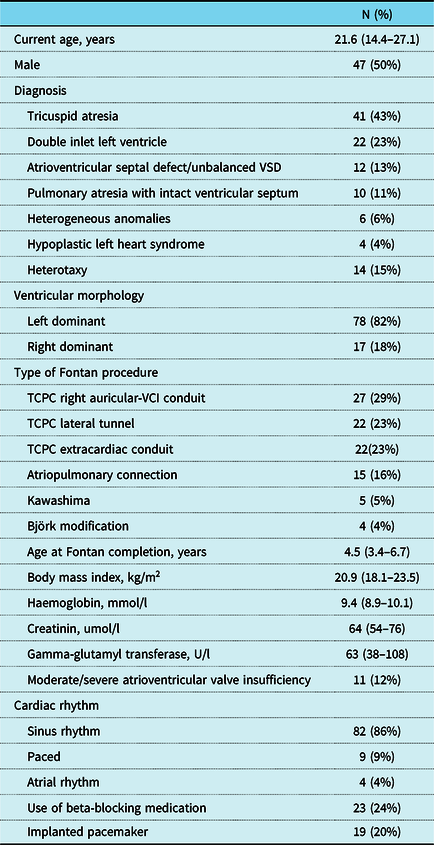
Ninety-five patients were included in the current study; 39 children (<18 years old) and 56 adults. Patient characteristics are displayed in Table 1. The patients underwent the Fontan operation between 1975 and 2010, at a median age of 4.5 (interquartile range 3.4-6.7) years. Median time since the Fontan operation was 15 (8–23) years, with a minimum of 2 years and maximum of 37 years. The median age at inclusion was 33 (30–41) years in patients with an atriopulmonary connection or Bjork modification, 20 (16–23) years in patients with a lateral tunnel, and 13 (11–15) years in patients with a extracardiac conduit (p < 0.001). Patients in NYHA class III/IV (N = 11) had a significantly higher age than those in class I/II (N = 84, 31 (21–44) years versus 19 (14–25) years, p < 0.001).
Patient characteristics (n = 95)

TCPC = total cavopulmonary connection; VCI = inferior caval vein; VSD = ventricular septal defect.
Sixty-two patients (65%) underwent MRI examination. The remaining patients could not participate in the MRI analyses because of an implanted pacemaker or pacemaker leads in 23 patients (24%), claustrophobia in 2 patients (2%), and patient refusal in 7 patients (7%). The median time between laboratory measurements and MRI was 24 hours (interquartile range 0–26 days).
Clinical variables
Functional status
Thirty-six patients (38%) were in NYHA functional class I, 48 patients (51%) were in NYHA functional class II, and 11 patients (12%) were in NYHA functional class III. Maximal oxygen uptake during exercise was 25.2 ± 8.5 ml/min/kg (58 ± 14% of predicted). Two patients (2%) suffered from protein-losing enteropathy, and two patients (2%) were diagnosed with severe liver cirrhosis or hepatocellular carcinoma.
Laboratory measurements
Median N-terminal pro-brain natriuretic peptide was 114 (interquartile range 61–264) ng/l, with a minimum of 9 ng/l and a maximum of 1862 ng/l. Mean Z-score for N-terminal pro-brain natriuretic peptide was 2.3 ± 1.5 and 51 patients (54%) had a N-terminal pro-brain natriuretic peptide level above the 97.5th percentile of age- and gender-adjusted normal values (Z-score > 2). For males, Z-score +2 ranges from 42 to 179 ng/L and for females, 111 to 228 ng/L. One patient (1%) showed signs of kidney dysfunction, with an increased creatinine level (162 µmol/l) and a decreased eGFR (30 ml/min/1.73 m2). Median γ-glutamyl transferase was 63 (interquartile range 38–108) U/l, and 59 patients (62%) had a γ-glutamyl transferase above the reference range.
Cardiac imaging
Using echocardiography, eyeballing estimation of the ventricular function revealed that 10 patients (11%) had a moderate/severe systolic dysfunction. Diastolic Doppler velocities showed a mean e’ of 10.8 ± 3.4 cm/s, median E/A ratio of 1.4 (IQR 1.1–1.8), and median E/e’ ratio of 6.2 (interquartile range 5.2–8.2). Mean MRI-derived ventricular ejection fraction was 56 ± 8%, and mean cardiac index was 3.1 ± 0.9 ml/min/m2. All patients had an ejection fraction > 40%. Median indexed mass was 63 (interquartile range 54–73) gr/m2 and indexed end-diastolic volume was 74 (interquartile range 61–88) ml/m2. Inferior caval vein calculated diameter was 24 (interquartile range 21–31) mm.
Correlation analyses
Patient characteristics
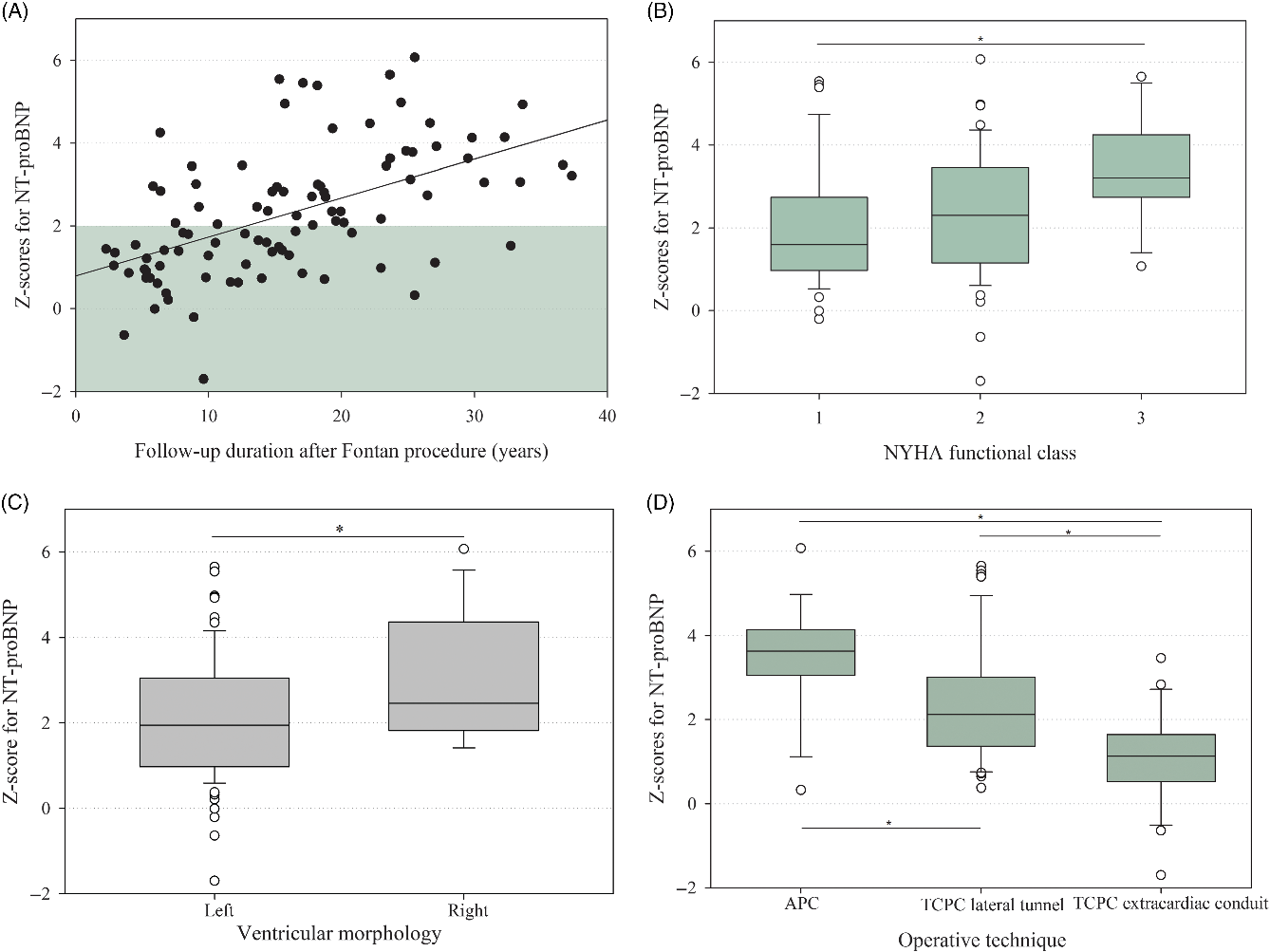
The Z-scores for N-terminal pro-brain natriuretic peptide increased significantly with longer follow-up duration after the Fontan operation (r = 0.274, p < 0.001, Figure 1A). Patients with a N-terminal pro-brain natriuretic peptide level above the 97.5th percentile were significantly older compared to those with N-terminal pro-brain natriuretic peptide levels in the normal range (26 ± 9 versus 17 ± 7 years, p < 0.001). N-terminal pro-brain natriuretic peptide level was 84 (40–126) ng/l, Z-score 1.1 ± 1.1, in the patients with an extracardiac conduit. This was significantly lower compared to a median N-terminal pro-brain natriuretic peptide of 110 (59–212) ng/l in patients with a lateral tunnel (Z-score 2.4 ± 1.4, p < 0.001) and 341 (182–452) ng/l in patients with a atriopulmonary connection of Björk modification (Z-score 3.4 ± 1.4, p < 0.001, Figure 1B). Of the 22 Fontan patients with an extracardiac conduit, five were fenestrated. An exploratory analysis suggested higher Z-scores for logNT-proNBNP in non-fenestrated patients (1.21 ± 1.18 versus 0.62 ± 0.95). Z-scores for N-terminal pro-brain natriuretic peptides were significantly higher in patients with right ventricular morphology versus left ventricular morphology (Figure 1C).
(A) Relation between follow-up duration and N-terminal pro-brain natriuretic peptide levels; for males, Z-score +2 ranges from 42 to 179 ng/L; for females, 111 to 228 ng/L. (B) Relation between NYHA functional class and N-terminal pro-brain natriuretic peptide levels. For *p-value < 0.05. (C) Relation between ventricular morphology and N-terminal pro-brain natriuretic peptide levels. For *p-value < 0.05. (D) Relation between operative technique and N-terminal pro-brain natriuretic peptide levels. For *p-value < 0.05.

Functional status
N-terminal pro-brain natriuretic peptide Z-scores were 1.9 ± 1.4 (N-terminal pro-brain natriuretic peptide level 84 [49–139] ng/l) in patients in NYHA-fc I. These did not significantly differ from the N-terminal pro-brain natriuretic peptide Z-scores in patients in NYHA functional class II (Z-score 2.3 ± 1.5; N-terminal pro-brain natriuretic peptide 120 [65–269] ng/l), but were significantly lower than the Z-scores in patients in NYHA functional class III (3.5 ± 1.2; N-terminal pro-brain natriuretic peptide 341 [179–543] ng/l; p = 0.011, Figure 1D).
Neither maximal oxygen uptake during exercise as absolute value nor as percentage of predicted showed significant correlations with Z-scores for N-terminal pro-brain natriuretic peptide. Also, no correlations were demonstrated between N-terminal pro-brain natriuretic peptide Z-scores and initial diagnosis, heterotaxy, age at Fontan completion, atrioventricular valve insufficiency, the presence of cardiac arrhythmias or pacemaker implantation, echocardiographic systolic and diastolic measurements, and MRI-derived ventricular ejection fraction or indexed end-diastolic ventricular volume.
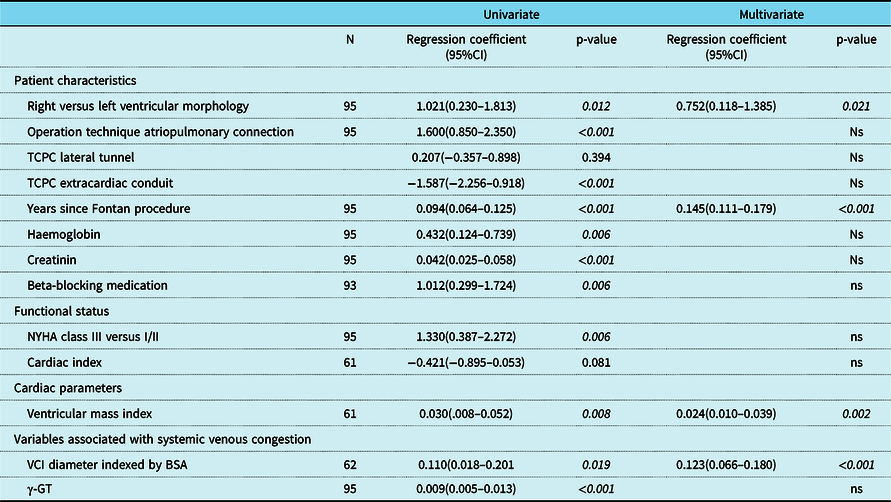
Further regression analyses for the Z-scores for N-terminal pro-brain natriuretic peptide are displayed in Table 2. Of all included variables, follow-up since Fontan operation, indexed ventricular mass, and inferior caval vein diameter contributed significantly to the model (R 2 = 0.615).
Regression analyses for Z-scores for N-terminal pro-brain natriuretic peptide in Fontan patients

BSA = body surface area; CI = confidence interval; γ-GT = gamma-glutamyl transferase; N = number of patients included in analyses; TCPC = total cavopulmonary connection; VCI = inferior caval vein.
Discussion
The current study showed that N-terminal pro-brain natriuretic peptide levels are increased in 54% of Fontan patients when compared to reference values. Serum levels of N-terminal pro-brain natriuretic peptide, adjusted for age and sex, correlated with clinical functional status, ventricular morphology and mass, the type of Fontan connection, the extent of systemic venous congestion, and the time since Fontan completion. All these factors are recognised as key determinants of performance of the Fontan circulation. Interestingly, no correlation was found between N-terminal pro-brain natriuretic peptide levels and echocardiographic or MRI-derived measurements of (uni-)ventricular function. Multivariable analyses showed N-terminal pro-brain natriuretic peptide Z-scores to correlate independently with right ventricular morphology, the extent of systemic venous congestion, and time since Fontan completion.
The patients with a Fontan circulation in this study, although relatively young, had increased levels of N-terminal pro-brain natriuretic peptide. This is in accordance with previous studies, showing increased peptide levels in 20–60% of Fontan patients, depending of the duration of follow-up in the study populations.Reference Koch, Zink, Singer and Dittrich8,Reference Burchill, Redington and Silversides9 The current study, including children as well as adults and thus representing a wide age spectrum, confirmed an inverse relation between NT-proBNP peptide levels and age, as previously reported. Because of this wide age range, we chose to use age- and gender-adjusted Z-scores for N-terminal pro-brain natriuretic peptide levels.
The unique characteristics of the Fontan circulation hamper extrapolation of the known clinical value of N-terminal pro-brain natriuretic peptide in biventricular heart failure to the Fontan circulation and make the interpretation of increased NT-proBNP levels in Fomntan patients challenging. The natriuretic peptides are released from the ventricular and, in lower concentrations, atrial myocardium in response to increased wall stress. Pathologic conditions associated with volume- or pressure-overload of the heart, such as congestive biventricular heart failure, result in increased serum levels of N-terminal pro-brain natriuretic peptide.Reference Brozena and Jessup19,Reference Litwin and Grossman20 However, a Fontan circulation is associated with highly abnormal loading conditions of the functional uni-ventricular heart; the systemic and pulmonary circulations are serially coupled; and the circulation is characterised by a chronically restricted preload, systemic venous congestion, and an increased afterload of the single ventricle.Reference Gewillig and Kalis21
Furthermore, anatomical and surgical characteristics are highly variable in patients with a Fontan circulation. It is subject of debate for many years whether right ventricular morphology is a predictor for poorer outcome after the Fontan operation when compared to left ventricular morphology.Reference Hirsch, Golderberg and Bove22,Reference Khairy, Fernandes and Mayer23 The current study identified a right ventricular morphology to be independently associated with higher N-terminal pro-brain natriuretic peptide levels and supports the concept of the morphological right ventricle being less able than a morphological left ventricle to chronically cope with the haemodynamic stress of increased systemic afterload.Reference Holmgren, Westerlind, Berggren, Lundberg and Wahlander24,Reference Lechner, Schreier-Lechner and Hofer25 This seems similar to a systemic right ventricle in a biventricular circulation, as in congenitally corrected transposition or atrial switch for transposition of the great arteries.
Also, various modifications of the Fontan procedure have been used during the past decades, where a variable amount of atrial tissue is incorporated in the circuit.Reference Fontan and Baudet1,Reference Kreutzer, Galindez, Bono, De Palma and Laura2,Reference Waterbolk, Bink-Boelkens, Elzenga, Beaufort-Krol and Ebels18,Reference De Leval, Kilner, Gewillig and Bull26,Reference Giannico, Corno and Marino27 While the ventricular exposure to increased wall stress may be similar in these modifications, atrial wall stress differs significantly. Indeed, in the current study, N-terminal pro-brain natriuretic peptide levels correlated with the type of Fontan procedure and were lowest in the extracardiac total cavopulmonary connection, confirming previous reports.Reference Wolff, Ebels and van Melle28 It is important to notice, however, that the type of operative technique and age – and thus the time since Fontan completion – are highly related. The current study showed by multivariate analysis that the relation between NT-proBNP serum level and the type of Fontan procedure was not independent from the time since Fontan procedure.
Due to these unphysiologic characteristics of the circulation, attrition of the Fontan circulation is known to develop gradually over time and is therefore closely related to the patients’ “Fontan-age”. The use of age-adjusted Z-scores for N-terminal pro-brain natriuretic peptide in this study allowed for identification of an independent relation with the time since Fontan operation and found this variable to be the strongest predictor in the multivariate analysis. It suggests that N-terminal pro-brain natriuretic peptide Z-scores reflect the gradual attrition of the Fontan circulation over time. This is further supported by the significant association between N-terminal pro-brain natriuretic peptide Z-scores and NYHA functional class in Fontan patients in the current and previous studies.Reference Khairy, Fernandes and Mayer23,Reference Ohuchi, Takasugi and Ohashi29 Functional class has been reported to be predictive for outcome in Fontan patients.Reference De Vadder, Van De Bruaene, Gewillig, Meyns, Troost and Budts30 Whether N-terminal pro-brain natriuretic peptide levels in Fontan patients may also have prognostic value, as shown in biventricular heart failure, cannot be concluded from the current study. However, serum brain natriuretic peptide was previously found to be the only independent predictor of Fontan failure and mortality in a series of 106 Fontan patientsReference Burchill, Redington and Silversides9 and strongly related to the risk of cardiovascular events and death or heart failure in patients with adult CHD.Reference Baggen, van den Bosch and Eindhoven31
It is well-known that Fontan failure is a complex syndrome not synonymous to ventricular failure. In large series of patients presenting with Fontan failure, this was associated with ventricular failure in only 30–50% of the cases. In the current study, no correlations between N-terminal pro-brain natriuretic peptide levels and conventional measures of cardiac function could be demonstrated. In contrast to studies in patients with a biventricular circulation, previous studies in patients with a Fontan circulation showed no consistent correlation between N-terminal pro-brain natriuretic peptide and measures of cardiac function.Reference Koch, Zink, Singer and Dittrich8,Reference Holmgren, Westerlind, Berggren, Lundberg and Wahlander24,Reference Eindhoven, van den Bosch, Jansen, Boersma and Roos-Hesselink32–Reference Heck, Muller, Weber and Hager35 In the current study, a weak correlation with “net” cardiac index existed, again suggesting that serum level of N-terminal pro-brain natriuretic peptide is related to the circulatory performance more than intrinsic cardiac or myocardial function. Several explanations might be in place: Assessment of function of univentricular hearts is difficult since the anatomic variation is huge and no reference values for adequate function of a single ventricle exist, neither echocardiographic nor MRI. Furthermore, most conventional measures of ventricular function are load-dependent and thus hard to interpret in the setting of a Fontan circulation. Finally, the number of patients with systolic dysfunction was limited in the current and previous studies. In the current study, none of the patients had an MRI-derived ejection fraction < 40%, which might have limited the power of the analyses.
The current study did demonstrate that a higher ventricular mass correlated with higher N-terminal pro-brain natriuretic peptide level, consistent with the finding of Atz et al.Reference Atz, Zak and Breitbart36 The explanation for this relation is unclear. The ventricular mass in a univentricular heart is believed to be increased compared to normal biventricular hearts, due to abnormal loading conditions, already present in prenatal life.Reference Gewillig and Kalis21 Potentially, the increased mass itself releases more brain natriuretic peptide, not reflecting current loading conditions. On the other hand, higher ventricular mass may be a result of higher actual loading conditions and thus wall stress in the Fontan circulation, thereby reflecting unfavourable conditions. Finally, higher ventricular mass may lead to diastolic dysfunction and via this mechanism lead to an increase in N-terminal pro-brain natriuretic peptide levels.
Next to ventricular dysfunction, key determinants of the Fontan failure “syndrome” include arrhythmias, thromboembolic events, gradual rise of pulmonary vascular resistance due to vascular remodelling induced by chronic non-pulsatile flow and associated with restricted ventricular preload, and increase of systemic venous congestion.Reference Gewillig and Kalis21,Reference Ridderbos, Wolff and Timmer37–Reference Szabo and Bahrle39 The chronic venous congestion may lead to protein-losing enteropathy, liver cirrhosis, and hepatocellular carcinoma.Reference Van Deursen, Damman and Hillege40–Reference Kiesewetter, Sheron and Vettukattill42 It is of clinical importance that N-terminal pro-brain natriuretic peptide levels correlated with several of these key determinants of Fontan failure, including the extent of venous congestion (reflected by inferior caval vein diameter and gamma-glutamyl transferaseReference Law, Ettedgui, Beerman, Maisel and Tofovic43), ventricular morphology, and time since Fontan completion. This suggests that a rise in brain natriuretic peptide might be an early marker of imminent Fontan failure, which unfortunately occurs in many Fontan patients over time. Early recognition of deteriorating circulatory performance, instead of just straightforward ventricular dysfunction, will enable early diagnostic workup in order to identify a potentially treatable cause, early initiation of treatment, prevention or delay of Fontan failure, and improvement of survival.
Strengths and limitations
Due to its cross-sectional study design, serial changes over time in N-terminal pro-brain natriuretic peptide levels and its relation with Fontan attrition could not be addressed in the current study. The multivariate regression analyses were limited to patients who underwent MRI imaging (n = 62) and might have been biased since these patients were significantly younger (17 (13–24) years) compared to patients without MRI examination (25 (20–31) years). As a general consideration in using indexed variables in correlation analyses, the use of age in the Z-score calculation might impact the correlation analyses with other indexed variables.
The strength of our study compared to previous reports studying brain natriuretic peptide in Fontan patients lies in the inclusion of both children and adults with a Fontan circulation, which provide a wide age range. Since Fontan attrition develops gradually, but generally not becomes symptomatic before 10 years after Fontan completion, a study population with a wide age range is invaluable and allows early changes in NT-proBNP levels. The use of age- and gender-adjusted reference values for serum levels of N-terminal pro-brain natriuretic peptide in the form of Z-scores allows a more appropriate analysis of the effect of duration that a Fontan circulation exists in an individual patient.
Conclusions
In patients with a Fontan circulation, the proportion of patients with increased serum N-terminal pro-brain natriuretic peptide levels rises with longer follow-up after Fontan completion. Serum N-terminal pro-brain natriuretic peptide in these patients correlates with functional class, but do not necessarily indicate ventricular dysfunction. Increased N-terminal pro-brain natriuretic peptide levels in these patients were further associated with morphologic ventricular characteristics and signs of increased systemic venous congestion. Since these variables are acknowledged key determinants of the performance of the Fontan circulation, the current study suggests increased N-terminal pro-brain natriuretic peptide levels to indicate and allow for monitoring attrition of the Fontan circulation, independent of ventricular function. Whether NT-proBNP serum level-directed management is indeed effective in Fontan patients will require further prospective studies.
Acknowledgments
None.
Financial support
None.
Conflict of interest
The University Medical Center Groningen received fees for consultancy activities of RMF Berger for Actelion, Pfizer, Lilly, Bayer, and GSK outside the content of this manuscript.
Supplementary material
To view supplementary material for this article, please visit https://doi.org/10.1017/S1047951120000657