Introduction
Cognitive impairment, a core feature of schizophrenia, accounts for 20–60% of variance in functional outcome (Green, Reference Green1996). From infancy to early adulthood, development of many cognitive functions is delayed (Reichenberg et al. Reference Reichenberg, Caspi, Harrington, Houts, Keefe, Murray, Poulton and Moffitt2010), perhaps with deterioration before first episode (Caspi et al. Reference Caspi, Reichenberg, Weiser, Rabinowitz, Kaplan, Knobler, Davidson-Sagi and Davidson2003) but then the cognitive function of patients with schizophrenia decline little or no faster than healthy populations until late middle age (Censits et al. Reference Censits, Ragland, Gur and Gur1997; Irani et al. Reference Irani, Brensinger, Richard, Calkins, Moberg, Bilker, Gur and Gur2012). Milder deficits in clinically unaffected relatives indicate a genetic contribution (Goldberg et al. Reference Goldberg, Ragland, Torrey, Gold, Bigelow and Weinberger1990; Cannon et al. Reference Cannon, Zorrilla, Shtasel, Gur, Gur, Marco, Moberg and Price1994) but the pathophysiological basis of cognitive deficits remains unclear (Harvey et al. Reference Harvey, Bowie and Friedman2001). Pharmacological cognition enhancers (CEs), like modafinil, have been used to investigate potential beneficial effects on cognitive domains and also the underlying mechanisms of cognitive deficits.
In healthy volunteers (HVs) without sleep deprivation, larger studies (n > 40) provide moderately consistent evidence of effects of modafinil, though often on the basis of uncorrected significance testing of multiple domains (Turner et al. Reference Turner, Robbins, Clark, Aron, Dowson and Sahakian2003; Randall et al. Reference Randall, Viswanath, Bharania, Elsabagh, Hartley, Shneerson and File2005b ; Müller et al. Reference Müller, Rowe, Rittman, Lewis, Robbins and Sahakian2013; Mohamed & Lewis, Reference Mohamed and Lewis2014). These include: decreased latency on delayed match to sample, stop signal and Stroop basic recognition tasks, more accurate rapid visual processing, spatial working memory, planning (Stockings of Cambridge task) and pattern recognition memory; but slower completion of the Hayling and clock completion tasks. Many such studies have used the Cambridge Neuropsychological Test Automated Battery (CANTAB; www.camcog.com) – a well validated computerised battery, which is easily compared with analogous animal task data (Robbins et al. Reference Robbins, James, Owen, Sahakian, Mcinnes and Rabbitt1994, Reference Robbins, James, Owen, Sahakian, Lawrence, Mcinnes and Rabbitt1998; Randall et al. Reference Randall, Shneerson, Plaha and File2003, Reference Randall, Fleck, Shneerson and File2004, Reference Randall, Viswanath, Bharania, Elsabagh, Hartley, Shneerson and File2005b ; Turner et al. Reference Turner, Robbins, Clark, Aron, Dowson and Sahakian2003; Müller et al. Reference Müller, Rowe, Rittman, Lewis, Robbins and Sahakian2013). Modafinil may have a greater effect on scores in samples with lower IQ or greater age, perhaps because these studies avoided ceiling effects (Randall et al. Reference Randall, Viswanath, Bharania, Elsabagh, Hartley, Shneerson and File2005b ).
A few modafinil trials in schizophrenia have also used CANTAB and modafinil's effects loosely resemble those in HVs, though studies are often smaller and again rely on uncorrected statistics. Scoriels & colleagues’ (Reference Scoriels, Barnett, Soma, Sahakian and Jones2012) single-dose, cross-over comparison of modafinil with placebo in 40 first-episode psychosis patients found significantly improved working memory, spatial working memory accuracy and strategy; fewer discrimination errors in the impulsivity task; and better facial emotion recognition (Scoriels et al. Reference Scoriels, Barnett, Murray, Cherukuru, Fielding, Cheng, Lennox, Sahakian and Jones2011). Turner et al.’s (Reference Turner, Clark, Pomarol-Clotet, Mckenna, Robbins and Sahakian2004) cross-over trial of 20 patients with chronic schizophrenia reported increased latency but more efficient solutions for the Stockings of Cambridge task, and fewer extradimensional shift (EDS) errors during the set shifting task. Overall these results suggest that modafinil has some beneficial effects on short term memory and attention, as well as on planning and set shifting in schizophrenia, although the mechanism of action is disputed and unclear (Gerrard & Malcolm, Reference Gerrard and Malcolm2007; Battleday & Brem, Reference Battleday and Brem2015). This is arguably consistent with imaging studies, which show increased anterior cingulate and dorsolateral prefrontal activation during cognitive and motor control tasks (Spence et al. Reference Spence, Green, Wilkinson and Hunter2005; Hunter et al. Reference Hunter, Ganesan, Wilkinson and Spence2006). Conversely, small, less powerful parallel-arm studies found no effects of modafinil on cognition (Sevy et al. Reference Sevy, Rosenthal, Alvir, Meyer, Visweswaraiah, Gunduz-Bruce and Schooler2005; Pierre et al. Reference Pierre, Peloian, Wirshing, Wirshing and Marder2007).
Only one trial has evaluated modafinil in schizophrenia using the MATRICS Consensus Cognitive Battery (MCCB) (Michalopoulou et al. Reference Michalopoulou, Lewis, Drake, Reichenberg, Emsley, Kalpakidou, Lees, Bobin, Gilleen, Pandina, Applegate, Wykes and Kapur2015). The MCCB has the advantages that it is accepted as a viable endpoint measure for clinical trials by the FDA, was developed specifically for use in schizophrenia, and has extensive normative data. Unlike CANTAB, MCCB's administration is heavily language-based, and it is not derived from equivalent animal data (Kern et al. Reference Kern, Nuechterlein, Green, Baade, Fenton, Gold, Keefe, Mesholam-Gately, Mintz, Seidman, Stover and Marder2008; Nuechterlein et al. Reference Nuechterlein, Green, Kern, Baade, Barch, Cohen, Essock, Fenton, Frese, Gold, Goldberg, Heaton, Keefe, Kraemer, Mesholam-Gately, Seidman, Stover, Weinberger, Young, Zalcman and Marder2008). In this trial, Michalopoulou et al. (Reference Michalopoulou, Lewis, Drake, Reichenberg, Emsley, Kalpakidou, Lees, Bobin, Gilleen, Pandina, Applegate, Wykes and Kapur2015) found no significant effect of modafinil on MCCB domain or composite scores or CogState SB (a computer-based battery) in a sample of 48 participants with chronic schizophrenia, mean age 37.2 ± 9.6 years. Many factors could have contributed to the absence of a measurable effect of modafinil on cognition: (i) modafinil does not enhance cognition in schizophrenia, (ii) modafinil enhances cognition in early schizophrenia but not chronic schizophrenia, or (iii) modafinil enhances cognition but the assessment batteries used are not sufficiently sensitive to detect changes over time.
To distinguish these explanations the current study examined participants in the early stages of schizophrenia with both the CANTAB and MCCB. Our main hypothesis was that compared with placebo, modafinil would have similar effects on cognition in early schizophrenia and HVs, and hence would normalise deficits in planning strategy, working memory, set shifting and social cognition in early schizophrenia, measured against HVs’ baseline. A secondary hypothesis that choice of cognitive battery would be an important factor in detecting modafinil-induced change in both patients and HVs, was tested by comparing CANTAB and MCCB batteries.
Method
We used a double blind randomised placebo-controlled crossover design to compare the effects of modafinil in participants with early schizophrenia and related disorders, and in matched HVs. The study in schizophrenia received ethical approval from the Greater Manchester South Research Ethics Committee and the extension to HVs from Greater Manchester East Research Ethics Committee East (REC numbers 13/NW/0626 and 14/NW/0299).
Participants
Patients aged between 18 and 35 years old were recruited from mental health services of King's Health Partners’ (London) and Manchester Academic Health Science Centre. Inclusion criteria were: (i) DSM-IV criteria for schizophrenia, schizophreniform or schizoaffective disorder [confirmed using the Mini International Neuropsychiatric Interview (Sheehan et al. Reference Sheehan, Lecrubier, Sheehan, Amorim, Janavs, Weiller, Hergueta, Baker and Dunbar1998)]; (ii) clinically stable in a non-acute phase for at least 8 weeks prior to the screening visit with duration of illness between 1 month and 3 years; (iii) treated with stable doses of 2nd generation antipsychotics (excluding clozapine) in the absence of concomitant anticholinergics for a minimum of 4 weeks prior to screening; (iv) a score of <5 on the PANSS conceptual disorganisation, hallucinations, unusual thought content and all negative subscale items; (v) English at a level sufficient to understand and complete study-related procedures, and score >6 on the Wechsler Test of Adult Reading (Holdnack, Reference Holdnack2001). Female participants of child-bearing potential were required to use an acceptable method of contraception for the duration of the study and have a negative pregnancy test result at screening.
Participants were excluded from the study if they met DSM-IV criteria for alcohol or substance abuse (other than nicotine) within the last month or dependence in the last 6 months preceding the screening visit. They were also excluded if they were being treated with modafinil, agents known to affect cognition (including anticholinergics, clozapine and thioridazine), compounds known to interact with modafinil, or any known drug allergies; a history of significant head trauma, or a serious neurological disorder; an abnormal ECG or physical examination findings; or participation in a study of any psychotropic medication or with a neuropsychological component in the 2 months preceding the screening visit.
For HVs, age and literacy inclusion criteria and all exclusion criteria were identical. HVs were matched to those in the first group on age (±5 years), gender, ethnicity and years of education. There was minimal variation in PANSS scores and medication dosage within the patient group.
Procedure
Thirty six HVs and 65 participants with schizophrenia attended visit 1, during which they gave written informed consent, followed by a check of their eligibility. Of these, 28 HVs and 46 schizophrenia patients were confirmed as eligible and included in the double-blind, placebo-controlled, single-dose cross-over study. Two HVs and six schizophrenia participants withdrew following randomisation; a further five HVs were withdrawn due to an adverse event or because they were unable to complete the study within the timeframe required.
Participants subsequently attended three neuropsychological assessment visits (visits two–four). They received medication on the day of visits three and four, 2 h prior to assessment, namely 200 mg modafinil on one occasion and an identical placebo tablet at the other visit, in random order. Visits three and four occurred 7–10 days apart to allow a wash-out period.
Drug treatment
The dose of 200 mg of modafinil was chosen after reviewing pharmacokinetic studies of modafinil and previous studies of modafinil in HVs (Wong et al. Reference Wong, King, Simcoe, Gorman, Laughton, Mccormick and Grebow1999a , Reference Wong, Simcoe, Hartman, Laughton, King, Mccormick and Grebow b ) and in patients with schizophrenia (Rosenthal & Bryant, Reference Rosenthal and Bryant2004; Turner et al. Reference Turner, Clark, Pomarol-Clotet, Mckenna, Robbins and Sahakian2004; Sevy et al. Reference Sevy, Rosenthal, Alvir, Meyer, Visweswaraiah, Gunduz-Bruce and Schooler2005; Spence et al. Reference Spence, Green, Wilkinson and Hunter2005; Hunter et al. Reference Hunter, Ganesan, Wilkinson and Spence2006; Pierre et al. Reference Pierre, Peloian, Wirshing, Wirshing and Marder2007). Participants were told to take the tablet 2 h before their appointment and reminded by telephone at the appropriate time, in order that peak plasma levels were reached during assessment, 2–3hrs after oral administration (Wong et al. Reference Wong, King, Simcoe, Gorman, Laughton, Mccormick and Grebow1999a , Reference Wong, Simcoe, Hartman, Laughton, King, Mccormick and Grebow b ). Vital signs were recorded at all four visits and adverse effects monitored at all visits and by telephone 7–10 days after visit four.
Allocation
Allocation, carried out via an online system at the King's Clinical Trials Unit, was by minimisation. Smoking status (known to effect cognitive performance) (Lees et al. Reference Lees, Applegate, Emsley, Lewis, Michalopoulou, Collier, Lopez-Lopez, Kapur, Pandina and Drake2015) and treatment site (to allow for possible differences) were used as stratifying factors. Capsules were supplied in coded bottles containing identical capsules of modafinil and placebo.
Cognitive tests
Participants completed the MCCB (Kern et al. Reference Kern, Nuechterlein, Green, Baade, Fenton, Gold, Keefe, Mesholam-Gately, Mintz, Seidman, Stover and Marder2008; Nuechterlein et al. Reference Nuechterlein, Green, Kern, Baade, Barch, Cohen, Essock, Fenton, Frese, Gold, Goldberg, Heaton, Keefe, Kraemer, Mesholam-Gately, Seidman, Stover, Weinberger, Young, Zalcman and Marder2008) and CANTAB Schizophrenia Battery (www.camcog.com). Alternative forms of tests were used at the different visits if they were sensitive to practice effects: these included the MCCB Brief Visuospatial Memory Test-Revised (BVMT-R), Hopkins Verbal Learning Test-Revised (HVLT-R) and Neuropsychological Assessment Battery (NAB) mazes, and the CANTAB Verbal Recognition Memory (VRM), Paired Associates Learning (PAL) and Intra/extradimensional Set Shift (IED).
Statistical analysis
To test the hypothesis that modafinil in patient participants would increase scores on specific tests towards healthy baselines, we assumed there were no carryover effects due to the wash-out period, but we allowed for period (i.e. time) and sequence effects, whilst our primary effect of interest was the treatment effect (i.e. modafinil vs. placebo). We used random effect models including data from baseline and treatment sessions, estimated using full information maximum likelihood. The models included a fixed effect for period and treatment, and a random intercept for each participant. The treatment effect for each outcome was given by a model coefficient, and associated standard error, p value, and 95% confidence intervals (CI). The effect interpreted was the change in outcome associated with receiving modafinil compared with receiving placebo, i.e. the comparison was between the scores during placebo and modafinil sessions, adjusted for the other elements outlined above.
To compare the HV and patient samples and test the prediction that modafinil would affect the two groups similarly, we analysed both studies together using the model described above, with the addition of a fixed effect term for study and an interaction between study and drug. The interaction tests whether the treatment effect differs between the samples. The interaction shows the difference in the effect of receiving modafinil compared with placebo, in the HVs compared with the patient sample.
Across both analyses p values were uncorrected for each test, following Rothman (Reference Rothman1990). 95% CI were calculated. Standardized treatment effect sizes were expressed as Glass’ δ, final score mean difference between modafinil and placebo divided by the final standard deviation for placebo.
Age (±5 years), gender, ethnicity and years of education were matched between groups, and there was minimal variation in PANSS scores and medication dosage within the patient group. As such they were not used as co-founders in the analysis.
Results
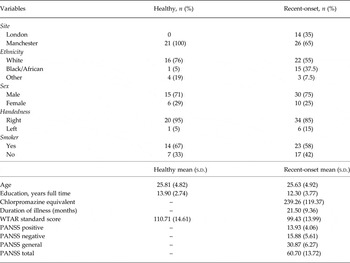
Of 28 eligible controls, 21 (75%) completed all test sessions. Of 46 eligible schizophrenia patients, 40 (87%) completed all test sessions. Fourteen (33%) controls and 23 (57.5%) patients smoked; 15 (71%) controls and 30 (75%) patients were male. Age and full-time education were similar across both groups (Table 1). Verbal IQ as represented by WTAR standardised score differed with effect size −0.81 (Glass’ δ, using HV s.d.). Online Supplementary Table S1 and Table 2 show baseline CANTAB and MCCB scores for the schizophrenia and HV groups. HV mean MCCB composite T-scores were 45.2 (s.d. 10.5), while patients’ scores were mean 28.8 (s.d. 13.0), showing a global deficit of δ-1.26.
Summary of participant characteristics and study variables

WTAR, Wechsler Test of Adult Reading; PANSS, Positive and Negative Symptoms Scale.
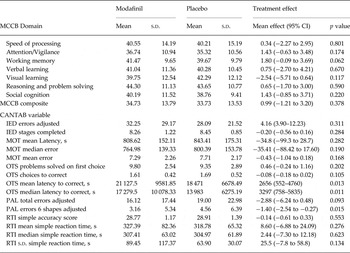
Summary statistics and modafinil effects for MCCB and selected CANTAB tasks in volunteers with schizophrenia

IED, intra-extradimensional set shift; MOT, motor screening; OTS, One Touch Stockings of Cambridge; PAL, paired associate learning; RTI, reaction time. Treatment effects indicate drug effect compared with placebo.
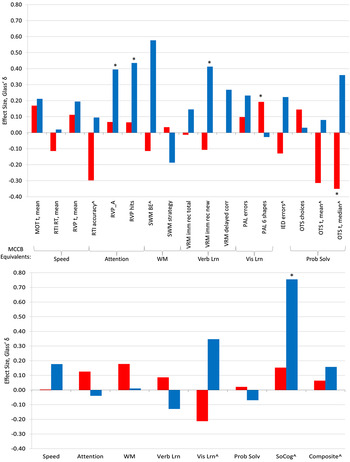
There was no significant effect of modafinil (compared with placebo) on patients’ MCCB scores (Fig. 1, Table 2 and online Supplementary Table S3), though working memory showed a trend towards improvement (1.80, CI −0.09 to 3.69; p 0.06). Examining patients’ CANTAB scores after modafinil (Fig. 1, Table 2 & online Supplementary Table S4), patients reached solutions for the OTS planning task in non-significantly fewer steps but significantly more slowly (median latency 3.3 seconds more; 95% CI 0.8–5.8). Modafinil-treatment also resulted in significantly fewer errors on the PAL visual learning task (6 shapes, p 0.015).
Effect size of modafinil v. placebo for MCCB domains (top) and CANTAB tests (bottom), with positive delta always indicating a better performance on modafinil compared with placebo. t = latency, Ln transformed variables indicated by ^. * indicates p < 0.05. Red bars – schizophrenia sufferers, blue bars – healthy volunteers. MCCB domains: speed – speed processing, attention – attention/vigilance, WM – working memory, Verb Lrn – verbal learning, Vis Lrn – visual learning, Prob Solv – reasoning and problem solving, SoCog – social cognition, Composite – MCCB composite. CANTAB Tasks: MOT – motor screening, RTI – reaction time, RVP – rapid visual information processing, SWM BE – spatial working memory between errors, VRM imm rec– verbal recognition memory immediate recall, corr – correct, PAL – paired associate learning, IED – intra-extradimensional set shift, OTS – One Touch Stockings of Cambridge.

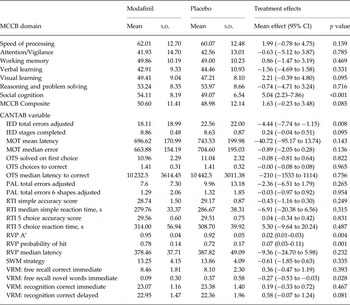
HVs had significantly improved scores after modafinil than placebo on the MCCB social cognition domain (5.04, CI 2.23–7.86, p < 0.001), and trends towards better scores for visual learning (2.21; CI −0.39 to 4.80; p 0.095) and global MCCB (composite score 1.63, CI −0.23 to 3.48, p 0.085; Fig. 1, Table 3 and online Supplementary Table S5). They significantly improved on some CANTAB measures of set shifting (IED adjusted errors, p 0.008), rapid visual information processing (RVP A, p 0.004; and hit probability, p 0.001), and verbal recognition memory (VRM immediate free recall novel words, p 0.028; Fig. 1, Table 3 and online Supplementary Table S6).
Summary statistics and treatment effects for MCCB and CANTAB in healthy volunteers

IED, intra-extradimensional set shift; MOT, motor screening; OTS, One Touch Stockings of Cambridge; PAL, paired associate learning; RTI, reaction time; RVP, rapid visual information processing; SWM, spatial working memory; VRM, verbal recognition memory. Treatment effects indicate drug effect compared with placebo.
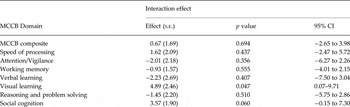
To examine the prediction that volunteers with and without schizophrenia would respond similarly to modafinil we examined interactions between response to modafinil and group. On the MCCB visual learning HVs were significantly more responsive to modafinil than patients (4.89; CI 0.07–9.71; p 0.047). There were no other significant differences in MCCB domains or on the CANTAB task scores (Table 4 and online Supplementary Table S7), though patients displayed trends towards more slowing of OTS completion after modafinil (−3.66 s, CI −7.41 to 0.08, p 0.055) and greater improvement in RVP probability of a hit (0.05, CI −0.01 to 0.11, p 0.097).
Comparison of modafinil effects between healthy volunteers and patients on MCCB

Discussion
The primary hypothesis was that modafinil would produce improvements in spatial planning, working memory, set shifting and social cognition, normalising these deficits in early schizophrenia. This hypothesis of specific improvements was not consistently supported in this single-dose crossover study. One measure of visual learning (PAL errors on CANTAB) improved in both groups following modafinil compared with placebo. A recent study by Kaser et al. (Reference Kaser, Deakin, Michael, Zapata, Bansal, Ryan, Cormack, Rowe and Sahakian2017) mirrored these findings, showing fewer total errors in a remitted depressed group receiving modafinil v. placebo albeit with more difficult PAL task than was used in this and most other studies (Turner et al. Reference Turner, Robbins, Clark, Aron, Dowson and Sahakian2003, Reference Turner, Clark, Pomarol-Clotet, Mckenna, Robbins and Sahakian2004; Scoriels et al. Reference Scoriels, Barnett, Soma, Sahakian and Jones2012). De Rover et al. (Reference De Rover, Pironti, Mccabe, Acosta-Cabronero, Arana, Morein-Zamir, Hodges and Robbins2011) used the 6 shape PAL task in mild cognitive impairment patients and found activation of the hippocampus. This study's findings of modafinil-induced improvements may suggest a mechanism which, works on the hippocampal neural circuitry, a theory supported by Kaser et al. (Reference Kaser, Deakin, Michael, Zapata, Bansal, Ryan, Cormack, Rowe and Sahakian2017) as well as Joo et al. (Reference Joo, Tae, Jung and Hong2008) who showed increased cerebral blood flow in healthy participants’ hippocampi. However, the mechanism by which modafinil works is still unknown; Turner et al. (Reference Turner, Robbins, Clark, Aron, Dowson and Sahakian2003, Reference Turner, Clark, Pomarol-Clotet, Mckenna, Robbins and Sahakian2004) suggest it may indirectly activate 5-HT inhibitory systems, resulting in reduced cortical GABA and improving patients’ impulse control, whilst Winder-Rhodes et al. (Reference Winder-Rhodes, Chamberlain, Idris, Robbins, Sahakian and Müller2010) proposed an activation of the noradrenergic system.
There was no significant effect on other CANTAB or MCCB measures of working memory or planning efficiency (e.g. the One Touch Stockings task or the MCCB problem solving domain). However, patients made choices on the Stockings task significantly more slowly after modafinil (i.e. OTS latency increased), an effect previously seen in HVs (Turner et al. Reference Turner, Robbins, Clark, Aron, Dowson and Sahakian2003; Randall et al. Reference Randall, Viswanath, Bharania, Elsabagh, Hartley, Shneerson and File2005b ; Winder-Rhodes et al. Reference Winder-Rhodes, Chamberlain, Idris, Robbins, Sahakian and Müller2010; Mohamed & Lewis, Reference Mohamed and Lewis2014), suggesting a speed/error trade-off with OTS choices-to-correct decreasing, bringing patient's scores closer to those of HVs at baseline. On the other hand, HVs improved in their social cognition performance, an effect previously seen in early schizophrenia (Scoriels et al. Reference Scoriels, Barnett, Soma, Sahakian and Jones2012), while here patients did not.
To test whether HVs and patients responded to modafinil in a similar way, which would suggest that the drug has similar mechanisms in both, an interaction term was added for drug and group (i.e. modafinil and patient) to models of the main effects of group (HV or patient) and drug (baseline, placebo or modafinil) with appropriate adjustment for session (baseline, first or second follow-up) on the various neurocognitive measures. CIs were wide, given the limited numbers and we found only one significant difference in modafinil's effect on schizophrenia and HV groups: a significant difference in MCCB visual learning, where HVs but not patients improved (Table 4). Admittedly, the positive finding could just be an artefact of multiple hypothesis testing. Alternatively, the MCCB domain score could be more sensitive to rapid processing than the CANTAB's PAL task, since like the MCCB domain score some CANTAB RVP measures improved in HV but not patients. The results are consistent with those of previous studies investigating the effects of modafinil, including improved performance on the same visual processing measures in HVs (Randall et al. Reference Randall, Viswanath, Bharania, Elsabagh, Hartley, Shneerson and File2005b ), an effect not demonstrated in schizophrenia sufferers (Scoriels et al. Reference Scoriels, Barnett, Soma, Sahakian and Jones2012), and an improvement in the OTS spatial planning task (Turner et al. Reference Turner, Robbins, Clark, Aron, Dowson and Sahakian2003; Turner et al. Reference Turner, Clark, Pomarol-Clotet, Mckenna, Robbins and Sahakian2004; Müller et al. Reference Müller, Rowe, Rittman, Lewis, Robbins and Sahakian2013).
HVs also differed from patients in that modafinil improved their social cognition task performance. Between the two batteries this is tested by one task, the MSCEIT, with several elements (Kern et al. Reference Kern, Nuechterlein, Green, Baade, Fenton, Gold, Keefe, Mesholam-Gately, Mintz, Seidman, Stover and Marder2008; Nuechterlein et al. Reference Nuechterlein, Green, Kern, Baade, Barch, Cohen, Essock, Fenton, Frese, Gold, Goldberg, Heaton, Keefe, Kraemer, Mesholam-Gately, Seidman, Stover, Weinberger, Young, Zalcman and Marder2008). The complexity of the MSCEIT, which like many social cognitive tasks has appreciable demands on working memory and other executive functions, makes this difficult to compare with the tasks that Scoriels’ group used (Reference Scoriels, Barnett, Soma, Sahakian and Jones2012), and could suggest the MSCEIT may not be the best task to use since schizophrenia sufferers might have difficulties performing the MSCEIT due to executive function deficits, if the task is a measure of executive function rather than social cognition.
An important limitation is the multiplicity of tests and the consequent impracticability of correction of p values. This is further complicated by its being unclear how much scores on any particular test will vary with scores on another, making independence of scores uncertain. This makes cautious interpretation of the results a necessity, but the approach taken across the field is to make such exploratory analyses at this early stage of investigation of the drug's relative impact in different groups. In addition, the use of a single dose may have been insufficient in patients to allow the full effects of modafinil to accrue. Our previous study entailed 2 weeks’ cognitive training while prescribed modafinil or placebo.
Do explanations in the literature for differences in the effects of modafinil on various samples based on lack of cognitive reserve or ceiling effects on tasks (Randall et al. Reference Randall, Viswanath, Bharania, Elsabagh, Hartley, Shneerson and File2005b ; Müller et al. Reference Müller, Rowe, Rittman, Lewis, Robbins and Sahakian2013) apply here? Randall et al. (Reference Randall, Shneerson and File2005a ) found HVs with lower, but above average, IQ showed significant improvement following modafinil. The HV sample in this study was well matched to patients on IQ and education, when compared with some previous samples. Despite this, patients with limitations in executive function (or other aspects of cognition) may have been restricted in their ability to improve performance on other tasks following modafinil if executive function deficits impaired performance on other tasks that required executive processing to enable high level performance of core skills. Cognitive impairment in schizophrenia affects all cognitive domains, and strongly correlates with functional outcome. A meta-analysis by Minzenberg et al. (Reference Minzenberg, Laird, Thelen, Carter and Glahn2009) reported reduced fronto-parietal activation in schizophrenia; Joyce (Reference Joyce2013) suggests this network may underlie impairment on different tasks and therefore functional outcome. However, the tasks available at this time are not able to directly test functional outcome, and there is a question over which outcomes are the more important. Arguably social functioning could be identified as the most important, with studies indicating a correlation between functional and neurocognitive improvements (Brekke et al. Reference Brekke, Hoe and Green2009; Hoe et al. Reference Hoe, Nakagami, Green and Brekke2012).
Comparing the two batteries, CANTAB proved more sensitive to changes in visual learning and processing that emerged only at trend levels of significance with MCCB. CANTAB was also able to identify changes in speed of planning that the MCCB, being paper-and-pencil-based, cannot. Although CANTAB does have some tests of social and emotional processing, which are different from those of the MATRICS battery, these were lacking from the standard CANTAB schizophrenia battery, used in this study. The credentials of the MCCB as the pre-eminent tool for investigating neurocognitive performance are not unequivocally endorsed by these results.
Conclusions
Given the inconsistency of findings concerning modafinil in schizophrenia (Scoriels et al. Reference Scoriels, Barnett, Soma, Sahakian and Jones2012, Reference Scoriels, Jones and Sahakian2013; Michalopoulou et al. Reference Michalopoulou, Lewis, Drake, Reichenberg, Emsley, Kalpakidou, Lees, Bobin, Gilleen, Pandina, Applegate, Wykes and Kapur2015; Vreeker et al. Reference Vreeker, Van Bergen and Kahn2015) the present study was mounted to test whether phase of illness was critical for the action of cognitive enhancers. We also compared cognitive assessment batteries’ sensitivities. Here, modafinil significantly improved visual learning and processing as assessed by CANTAB, but not MCCB, in patients with early schizophrenia. It also led to slower performance during one CANTAB task. Effect sizes were often larger in the CANTAB and it had the capacity to detect effects on speed of performance, but the MCCB was able to detect changes in social cognition the CANTAB tasks used in this study could not. We conclude that whereas phase of illness may not be crucial to demonstrating the action of cognitive enhancers, the selection of assessment instrument may be. This has implications for clinical trial design in this important therapeutic area.
The complexity of modafinil's actions and the multiplicity of tests prevent firm conclusions. Tentatively, one can suppose that modafinil improved certain aspects of HVs’ performance more than patients’, but any such differences were too small to reach significance in most domains. Patients, unlike HVs, showed no significant benefit to visual processing or efficiency of strategic cognition, suggesting specific differences between the two groups. Otherwise, the fact that there are similar findings in each group across this and other studies is most easily explained by a fundamentally similar effect of modafinil in health and early illness across several areas of cognition. Larger studies or evidence from more direct investigation of the mechanisms of modafinil in health and schizophrenia, for instance by brain imaging, would be needed to establish this.
Supplementary material
For supplementary material accompanying this paper visit https://doi.org/10.1017/S0033291717000885.
Acknowledgements
Funding for this study was provided by EU Innovative Medicines Initiative to the NEWMEDS programme (grant number 115 008); the European Commission had no further role in study design; in the collection, analysis and interpretation of data; in the writing of the report; and in the decision to submit the paper for publication. We acknowledge the support of the NIHR/Wellcome Trust Clinical Research Facility, Manchester and the UK Clinical Research Collaboration-registered King's Clinical Trials Unit at King's Health Partners, which is part funded by the NIHR Biomedical Research Centre for Mental Health at South London and Maudsley NHS Foundation Trust and King's College London and the NIHR Evaluation, Trials and Studies Coordinating Centre, the participants and NEWMEDS. The research leading to these results has received support from the Innovative Medicines Initiative Joint Undertaking under grant agreement n° 115 008 of which resources are composed of EFPIA in-kind contribution and financial contribution from the European Union's Seventh Framework Programme (FP7/2007-2013).
Declaration of Interest
Prof Kapur has received grant support from AstraZeneca, Bristol-Myers Squibb and GlaxoSmthKline and has served as consultant, scientific advisor and had speaking engagements for AstraZeneca, Bioline, Bristol Meyers Squibb, Eli Lilly, Janssen (Johnson and Johnson), Lundbeck, NeuroSearch, Otsuka, Pfizer, Roche, Servier, Solvay and Wyeth. Dr Pandina is a full time employee of Janssen Research & Development and is a Johnson & Johnson stock-holder. Prof Lewis has received consultancy fees from AbbVie, and Johnson and Johnson. All other authors declare no competing interests.
Ethical Standards
The authors assert that all procedures contributing to this work comply with the ethical standards of the relevant national and institutional committees on human experimentation and with the Helsinki Declaration of 1975, as revised in 2008.