Introduction
Aminoglycoside antibiotics are widely used in under-developed countries to treat Gram-negative bacterial infections and tuberculosis, although they are known to have serious side effects such as hearing loss and kidney failure.Reference Schacht1, Reference Forge and Schacht2 Ototoxicity-related hearing loss correlates with the gentamicin dose and duration of treatment, and progresses from high to low frequencies.
The main targets of aminoglycoside ototoxicity are the hair cells and supporting cells of the organ of Corti.Reference Kopke, Allen, Henderson, Hoffer, Frenz and Van de Water3 The biochemical mechanisms leading to aminoglycoside ototoxicity are not fully understood, but increasing evidence indicates the importance of iron chelation and the formation of a redox-active compound that promotes the accumulation of reactive oxygen species, leading to apoptosis and cell death.Reference Sha and Schacht4 Reactive oxygen species have been detected in cochlear explants treated with aminoglycoside antibiotics.Reference Lopez-Gonzalez, Delgado and Lucas5
Cochlear dysfunction caused by aminoglycoside ototoxicity can be evaluated by recording otoacoustic emissions.Reference Lopez-Gonzalez, Guerrero, Rojas and Delgado6 Otoacoustic emission results can establish not only the presence of ototoxicity but also the progression of outer hair cell ototoxicity over time. Distortion product otoacoustic emissions (DPOAEs) are otoacoustic emissions produced by the simultaneous presentation of two continuous, pure tones. Distortion product otoacoustic emissions are simply measured and interpreted, and are thus frequently used.
The relationship between aminoglycoside ototoxicity and oxygen-derived free radicals has been demonstrated in experimental models. Previous reports have indicated that free radical scavengers (e.g. 2,3-dihydroxybenzoate and nitro-l-arginine methyl ester) can reduce aminoglycoside-related ototoxicity.Reference Sinswat, Wu, Sha and Schacht7, Reference Nordang and Anniko8
In the present study, we investigated the potential otoprotective effects of pomegranate extract, which has antioxidant properties and no side effects in humans. Pomegranates have been used for centuries to treat inflammatory diseases and to prevent atherogenesis and urolithiasis.Reference de Nigris, Williams-Ignarro, Sica, Lerman, D'Armiento and Byrns9, Reference Tugcu, Kemahli, Ozbek, Arinci, Uhri and Erturkuner10 Pomegranate extract is a rich source of potent polyphenolic and flavonoid antioxidants. The soluble polyphenol content in pomegranate extract varies from 0.2 to 1.0 per cent, depending on the pomegranate variety, and contains primarily anthocyanins, catechins, tannins, gallic acid and ellagic acid.Reference Aviram and Dornfeld11
The aim of this study was to investigate the protective effect of pomegranate extract against aminoglycoside ototoxicity, by measuring reactive oxygen species levels in the cochleae and kidneys of rats, using luminol-amplified chemiluminescence, and by evaluating cochlear function using DPOAE testing.
Material and methods
Experimental design
The study was approved by the Animal Ethics Committee of the Medical Faculty of Istanbul University, Turkey.
Eighteen healthy, adult, female Wistar albino rats weighing 200–300 g were obtained. All animals were housed in a 14-hour light, 10-hour dark cycle and permitted ad libitum access to standard laboratory chow and tap water before and after procedures. Prior to the study, the rats were anaesthetised with 30 mg/kg ketamine hydrochloride and 4 mg/kg xylazine intraperitoneally and assessed by otoscopic examination.
Exclusion criteria
We excluded from the study animals showing any of the following features: otoscopically detectable external ear abnormalities (e.g. oedema and hyperaemia of the external auditory canal, tumour growths, or cerumen impaction); signs of middle-ear disease (e.g. tympanic membrane bulging, opacification, hyperaemia or perforation); and absence of distortion product otoacoustic emissions (DPOAEs) at any of the frequency ranges tested.
Drugs
The animals were anaesthetised with 30 mg/kg ketamine hydrochloride (Ketalar; Eczacibasi Ilac Sanayi ve Ticaret AS, Luleburgaz, Turkey) and 4 mg/kg xylazine (Alfazyne 2 per cent; Alfasan International BV, Woerden, The Netherlands). Gentamicin was administered intramuscularly at 160 mg/kg/day for 5 consecutive days.Reference Lopez-Gonzalez, Guerrero, Torronteras, Osuna and Delgado12
Pomegranate extract processing
Fresh pomegranates were washed, crushed and squeezed. The resulting mulch was treated enzymatically with pectinase to yield pomegranate extract plus by-products, including the inner and outer peels and seeds. Pectinase hydrolyses the α-1,4-galacturonide bonds in pectin, improving the extraction and filtration process and preventing the formation of pectin gels. The pomegranate extract was filtered, pasteurised, concentrated and stored at −18°C, as described previously.Reference de Nigris, Williams-Ignarro, Sica, Lerman, D'Armiento and Byrns9, Reference Tugcu, Kemahli, Ozbek, Arinci, Uhri and Erturkuner10 Concentrated pomegranate extract was diluted with water (20 ml concentrated extract per 500 ml of distilled water). A volume of 2.5 ml diluted pomegranate extract contained 100 µl pomegranate extract, equivalent to 2.8 µmol total polyphenol per day.
Study groups
The rats were randomly divided into three groups. The control group (n = 6) was administered intramuscular saline injections for 5 days. The aminoglycoside toxicity group (n = 6) was administered gentamicin (160 mg/kg/day intramuscularly) for 5 days. The aminoglycoside plus pomegranate extract group (n = 6) was administered gentamicin (160 mg/kg/day intramuscularly) plus pomegranate extract (2.5 ml, 100 µl/day via gavage) for 5 days.
Procedures
Immediately before drug treatment, rats with normal otoscopic findings were anaesthetised deeply with 50 mg/kg ketamine plus 10 mg/kg xylazine and subjected to DPOAE testing. The rats then received their allocated treatment (either saline, gentamicin, or gentamicin plus pomegranate extract). Twenty-four hours after their last injection, the animals were again anaesthetised and examined otoscopically to exclude new middle-ear abnormalities. Rats with normal otoscopic findings were again subjected to DPOAE testing. Immediately after the second DPOAE test, the animals were sacrificed with a lethal dose of ketamine hydrochloride administered intraperitoneally, and the right cochlea and right kidney were harvested. The cochlea and kidney were used for luminol-enhanced chemiluminescence assessment of reactive oxygen species.
Chemiluminescence
The cochleae were prepared as previously described.Reference Lopez-Gonzalez, Delgado and Lucas5 Each cochlea was dissected and its bony lateral wall completely opened and removed under a dissecting microscope. The tissue remaining in the preparation included the modiolus and the membranous cochlea. Each whole cochlea and whole kidney was prepared and tested, in separate experiments.
Chemiluminescence measurements were made at room temperature using a luminometer as previously described (Junior LB 9509; EG & G Berthold, Bad Wildbad, Germany).Reference Polat, Öztürk, Üneri, Yüksel, Haklar and Bozkurt13, Reference Haklar, Sayin-Özveri, Yüksel, Aktan and Yalçın14 Chemiluminescence is a non-invasive method widely used for the detection of reactive oxygen species. Following a chemical reaction, the light emissions generated by the reactive oxygen species are measured via an enhancer (i.e. luminol). In the present study, specimens (either cochlear or renal tissue) were placed into vials containing 2 ml of a solution of 0.5 M phosphate-buffered saline containing 0.02 M 4-(2-hydroxyethyl)-1-piperazine-ethanesulphonic acid (pH 7.4). Reactive oxygen species were quantitated after the addition of luminol to a final concentration of 0.2 mM. Luminol quantitates several reactive oxygen species, including H2O2, ·OH, ONOO− and HOCl−. Counts were obtained at 1-minute intervals. Results were given as the area under the curve for a counting period of 5 minutes, corrected for wet tissue weight, and expressed as relative light units per mg tissue.
Distortion product otoacoustic emission testing
Distortion product otoacoustic emissions were tested with an Otodynamics Echoport USB cochlear emission analyser and Otodynamics ILO version 6.0 software (Otodynamics, London, UK) in a silent room. An infant hearing screening probe was attached to the external auditory canal. The stimulus consisted of two pure tones (F1 and F2; F1/F2 ratio = 1.22) presented at 70 dB SPL. A total of 1000 acquisitions were analysed. Otoacoustic emissions were evaluated at 3, 4, 6 and 8 kHz. Distortion product otoacoustic emission testing was considered positive at signal to noise ratios of 6 dB SPL or more, as specified by the manufacturer.
Statistical analysis
The data were statistically analysed using SPSS Statistical Software version 17.0 (SPSS Inc, Chicago, Illinois, USA). All data were evaluated for normal versus non-normal distribution; as a result, non-parametric tests were applied. The Mann–Whitney U test was used to compare DPOAE results. The Kruskal–Wallis test was carried out to compare reactive oxygen species levels in the three groups, followed up by pair-wise comparison with the Mann–Whitney U test. Two-tailed p values of less than 0.05 were taken to indicate statistical significance.
Results
Distortion product otoacoustic emissions
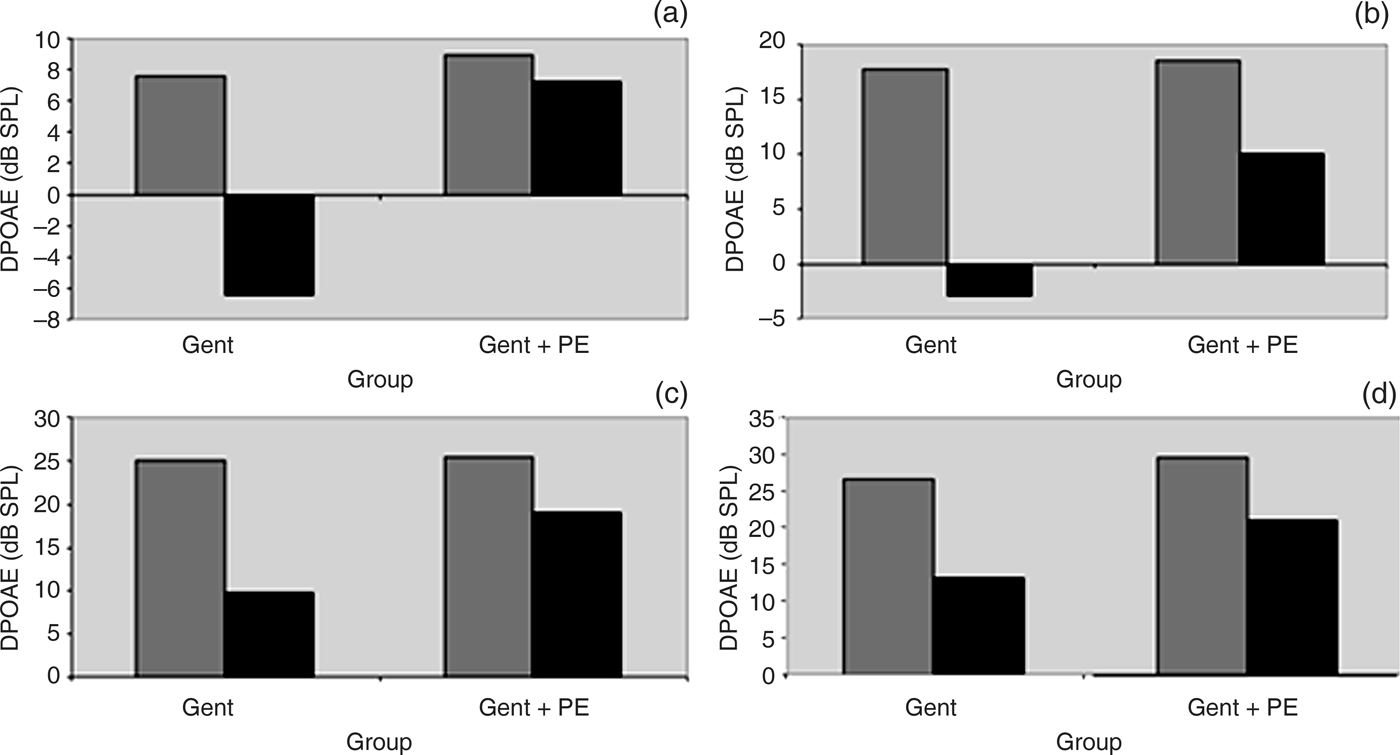
Table I and Figure 1 show a comparison of distortion product otoacoustic emission (DPOAE) amplitudes at baseline and after treatment, for the aminoglycoside and aminoglycoside plus pomegranate extract groups. Baseline levels were similar for both groups. Post-treatment decreases in emission levels were calculated and expressed as a median (range) for each group; these medians were compared statistically. Very significant differences between the groups were present at 3, 4 and 8 kHz (p < 0.001); there was no significant difference at 6 kHz (p = 0.06).
Mean distortion product evoked otoacoustic emission (DPOAE) amplitudes in the gentamicin (Gent) and gentamicin plus pomegranate extract (Gent + PE) groups, showing results at baseline (grey bar) and after treatment (black bar), for (a) 3 kHz, (b) 4 kHz, (c) 6 kHz and (d) 8 kHz test frequencies.

DPOAE amplitudes in treatment groups
*p < 0.001, compared with decrease in gentamicin group. Freq = test frequency; med = median; SPL = sound pressure level; PE = pomegranate extract
Reactive oxygen species
Cochleae
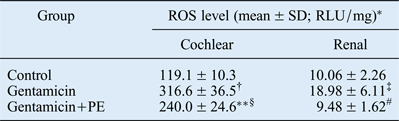
Cochlear reactive oxygen species levels were significantly greater in the two groups receiving gentamicin, as indicated by luminol chemiluminescence levels (Table II). The aminoglycoside group had very significantly higher levels than the control group (p = 0.002). The aminoglycoside plus pomegranate extract group had very significantly lower levels than the aminoglycoside group (p = 0.004). However, the aminoglycoside plus pomegranate extract group had very significantly higher levels than the control group (p = 0.002).
Cochlear and renal reactive oxygen species levels
All groups contained 6 animals. *Luminol-amplified chemiluminescence values. Cochlear results: †p = 0.002, vs control group; **p = 0.004, vs gentamicin group; §p = 0.002, vs control group. Renal results: ‡p = 0.004, vs control group; #p = 0.002, vs gentamicin group. ROS = reactive oxygen species; SD = standard deviation; RLU = relative light units; PE = pomegranate extract
Kidneys
Although renal reactive oxygen species levels were very significantly higher in the aminoglycoside group than in the controls (p = 0.004), levels in the aminoglycoside plus pomegranate extract group were similar to those in the control group (p = 0.59) (Table II). The aminoglycoside group had very significantly higher levels than the aminoglycoside plus pomegranate extract group (p = 0.002). These data suggest that oral administration of pomegranate extract had a systemic protective effect against aminoglycoside toxicity.
Discussion
Aminoglycoside antibiotics have the advantages of wide antimicrobial spectrum and low price, important features for developing countries. However, long-term administration of aminoglycoside antibiotics usually results in hearing loss. For this reason, thousands of individuals in developing countries suffer permanent hearing loss as a consequence of aminoglycoside ototoxicity.Reference Nakashima, Teranishi, Hibi, Kobayashi and Umemura15 In the present, experimental study, we achieved partially successful prophylaxis against aminoglycoside toxicity, using pomegranate extract. To our knowledge, this is the first study to investigate the protective effects of pomegranate extract against aminoglycoside ototoxicity.
Distortion product otoacoustic emission (DPOAE) testing is a method of evaluating outer hair cell function, one of the targets of gentamicin toxicity. Animal models of gentamicin ototoxicity show DPOAE alterations and outer hair cell lesions.Reference Halsey, Skjönsberg, Ulfendahl and Dolan16 Lopez-Gonzalez et al. demonstrated that animals treated with either gentamicin or tobramycin show consistent obliteration of DPOAEs at all test frequencies.Reference Lopez-Gonzalez, Guerrero, Rojas and Delgado6 In our study, the observed decrease in post-treatment DPOAE amplitude was significantly greater in the aminoglycoside group than in the aminoglycoside plus pomegranate extract group, suggesting that pomegranate extract had an otoprotective effect against gentamicin toxicity.
The ototoxicity of aminoglycoside antibiotics has been attributed to the production of reactive oxygen species, although the specific reactive oxygen species pathways involved have not been identified.Reference Priuska and Schacht17, Reference Sha and Schacht18 However, one reactive oxygen species that might play a role in ototoxicity is the superoxide radical, which is enzymatically dismutated to molecular oxygen and hydrogen peroxide by endogenous superoxide dismutase enzymes.Reference Sha, Zajic, Epstein and Schacht19 It currently appears that aminoglycoside antibiotics cause ototoxicity by increasing the levels of reactive oxygen species and altering the antioxidant defence system of the cochlea, outer hair cells and spiral ganglia.Reference Hirose, Hockenbery and Rubel20 Some authors suggest that the principal mechanism of ototoxicity is related to the production of nitric oxide, which is induced by the production of reactive oxygen species and the over-induction of inducible nitric oxide synthetase. An overload of reactive oxygen species, in conjunction with an impaired antioxidant system, leads to cell injury and apoptosis.Reference Clerici, DiMartino and Prasad21
Several studies have explored the possibility of administering an otoprotectant in an effort to reduce the negative impact of aminoglycoside antibiotics on hearing. One area of focus is the administration of antioxidant compounds in an attempt to reduce the accumulation of reactive oxygen species before they induce apoptosis in the inner ear.
Pomegranate is a readily obtained fruit, and its extract is rich in polyphenol antioxidants, including tannins and anthocyanins.Reference Aviram and Dornfeld11 These antioxidants are more potent, on a molar basis, than many other antioxidants, including vitamins C and E, coenzyme Q-10, and α-lipolic acid.Reference Aviram, Dornfeld, Kaplan, Coleman, Gaitini and Nitecki22 The antioxidant levels in pomegranate are higher than in many other fruits, including blueberries, cranberries, oranges and grapes. Anthocyanins have been shown to be effective inhibitors of lipid peroxidation, inducible nitric oxide synthetase and thus nitric oxide.Reference Tsuda, Horio and Osawa23
Various antioxidant agents have been tested for protective action against gentamicin-induced ototoxicity, including nitro-l-arginine methyl ester,Reference Nordang and Anniko8 melatonin,Reference Lopez-Gonzalez, Guerrero, Rojas and Delgado6 N-acetylcysteineReference Maniu, Perde-Schrepler and Cosgarea24 and taurine.Reference Liu, Chi and Gao25 In our study, reactive oxygen species levels were significantly lower in rats treated with gentamicin plus systemic pomegranate extract, compared with rats treated with gentamicin only. We suggest that pomegranate extract has a protective effect against gentamicin-induced ototoxicity, possibly by reducing the level of reactive oxygen species in the cochlea. This protective effect may also be due to decreasing nitric oxide content and inducible nitric oxide synthetase activity.
Several studies on gentamicin oto- and nephrotoxicity point to alterations in cell antioxidant potentials. It has been shown that, following gentamicin exposure, levels of antioxidant enzymes are reduced in cochlear and renal tissues, leading to lipid peroxidation and consequent cellular toxicity.Reference Walker and Shah26 In our study, levels of renal and cochlear reactive oxygen species clearly differed in the two treatment groups. Pomegranate extract appeared to preserve the organ function of rats exposed to gentamicin, possibly via systemic antioxidant effects.
• Aminoglycoside ototoxicity targets the cochlear outer hair cells and supporting cells
• This study assessed the otoprotective effects of oral pomegranate extract, a rich source of antioxidants
• Aminoglycoside toxicity was assessed via distortion product otoacoustic emissions and cochlear and renal reactive oxygen species levels
• Pomegranate extract appeared to reduce aminoglycoside ototoxicity
This study tested the hypothesis that the administration of pomegranate extract protects against gentamicin-induced ototoxicity. The results obtained suggest that systemic administration of pomegranate extract has a potential otoprotective role. Data from DPOAE testing and reactive oxygen species measurement suggest partial protection of organ integrity. In this context, it is feasible to use pomegranate extract to protect against gentamicin ototoxicity. Otoprotective effects can easily be monitored using DPOAE testing together with chemiluminescence detection of reactive oxygen species.
As a next step, well-designed, placebo-controlled, clinical studies need to be conducted to substantiate our results and to investigate the ideal pomegranate extract regimen for protecting against gentamicin-induced ototoxicity.
Conclusion
We studied the protective effect of systemic pomegranate extract against ototoxicity caused by gentamicin injections in rats. Pomegranate extract might have a significant protective effect against gentamicin ototoxicity. However, further studies are necessary to determine the appropriate indications and dosages of pomegranate extract, before clinical use is possible.