




No CrossRef data available.
‘Rewarding Impatience’ Revisited: A Response to Goodrich
Published online by Cambridge University Press: 24 April 2006
Extract
In “Rewarding Impatience: A Bargaining and Enforcement Model of OPEC” (International Organization, Spring 2004) I presented a theoretical model that suggested that in strategic situations where a bargaining phase is followed by an enforcement phase that resembles a prisoners' dilemma, impatient actors earned better outcomes than their more patient rivals. I also modeled the division of cartel profits in the Organization of Petroleum Exporting Countries (OPEC), particularly with regard to the relationship between bargaining strength and disparate time horizons, and found that there is some threshold level for which states that discount the future more heavily tend to receive better production offers than those that do not. The critique presented in Goodrich deals with the final section of the article, which presents the results of statistical analysis testing the implications of these theoretical models.I am grateful to Jeff Lewis, Drew Linzer, and Ken Schultz for suggestions and advice. Many thanks to Thomas Plümper for sharing the computer code for his procedure to analyze fixed effects with time-invariant covariates in Stata. The usual disclaimers apply.
Information
- Type
- Comment and Response
- Information
- Copyright
- © 2006 The IO Foundation and Cambridge University Press
In “Rewarding Impatience: A Bargaining and Enforcement Model of OPEC” (International Organization, Spring 2004) I presented a theoretical model that suggested that in strategic situations where a bargaining phase is followed by an enforcement phase that resembles a prisoners' dilemma, impatient actors earned better outcomes than their more patient rivals.1
I also modeled the division of cartel profits in the Organization of Petroleum Exporting Countries (OPEC), particularly with regard to the relationship between bargaining strength and disparate time horizons, and found that there is some threshold level for which states that discount the future more heavily tend to receive better production offers than those that do not. The critique presented in Goodrich deals with the final section of the article, which presents the results of statistical analysis testing the implications of these theoretical models.2Goodrich's primary argument is that a fixed-effects model is the appropriate statistical specification to analyze the hypotheses derived from the theoretical models presented in the article. While evidence for the “rewarding impatience” hypothesis would have been strengthened if proven robust to the inclusion of fixed effects, it is not at all surprising that the variables of interest were driven to insignificance given the loss of power experienced when fixed effects were included. This is because of the fact that the variables of interest are largely time-invariant; in other words, one does not actually observe resource-poor (and hence impatient) countries becoming resource-rich relative to their counterparts in the data set. Goodrich proposes fixed effects to eliminate potential omitted variable bias. Yet his suggested improvement causes more problems than it solves, particularly because fixed effects explain little additional variance.
Correction of Published Results
In November 2004, Goodrich—in the course of a replication project during his graduate study at Harvard University—alerted me to the fact that he had discovered an error in the way that I had lagged the dependent variable of the panel data set used in the 2004 article.3
I am grateful to him for bringing this computer coding error to my attention.4The original data analysis for the 2004 article was conducted in Stata 7. Subsequent versions of Stata have included an automated command to create lags in panel data sets.
I will focus the bulk of my response on the main regressions in the article regarding the relationship between per capita proven oil reserves and crude production. Discussion of additional proxies for impatience will be discussed in a subsequent section.
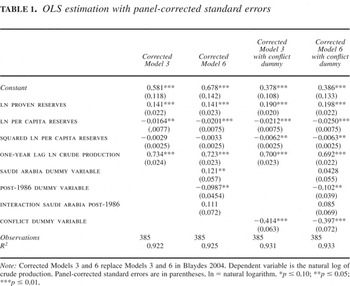
OLS estimation with panel-corrected standard errors

The key finding of the 2004 article—that countries with more proven reserves per capita produce less oil than their resource-poor counterparts, controlling for resource base—is upheld with the inclusion of the correct lag of the dependent variable. The statistical significance of the per capita reserves term remains significant at the 0.05 and 0.01 levels, respectively, for corrected Models 3 and 6. The squared term, however, which tests the nonmonotonic effect the game theoretic model suggests might exist is no longer statistically significant.6
Blaydes 2004 suggests that a nonmonotonic relationship may exist, but there is no guarantee that the relationship is nonmonotonic in the observed range of parameter values.
I am very grateful to Goodrich for bringing the coding mistake to my attention. Additionally, the suggestion to include a variable to control for conflict that disrupted country crude oil production is a valuable contribution. After dealing with these issues, however, the sign and statistical significance for all variables are the same as in the original article. As the corrected empirical tests all fail to refute the hypotheses I put forth, Goodrich instead turns his attention to the broader issue of techniques for handling time-series cross-sectional data.
Time-Invariant Covariates in Time-Series Cross-Sectional Data
Goodrich's primary suggested improvement for the empirical analysis is to run a fixed-effects specification to control for country-specific heterogeneity in the panel data set. While a sound suggestion for the analysis of time-series cross-sectional data sets in many cases, for the particular case of testing hypotheses regarding the bargaining behavior of countries in OPEC, fixed effects are problematic from both a statistical and a substantive perspective.
The argument advanced in the original article is that actors with a short-time horizon enjoy an advantage in situations where a bargaining stage is followed by an enforcement of that bargain in a second stage of the game, as originally set forth in Fearon.7
Fearon has suggested that this type of two-stage bargaining game might be widely applicable in political science and the model is particularly appropriate for OPEC, where countries have a short-term incentive to cheat on agreed-upon production levels to capitalize on high prices resulting from other countries' reduced production levels.The test variable is a country's per capita proven oil reserves, logged to eliminate skewness in its observed distribution. Per capita proven oil reserves was chosen because countries with more oil per capita have a longer shadow of the future than those with less oil on a per person basis. This variable is either slowly changing or virtually unchanging for all countries in the study for all years observed. As a result, Algeria, Indonesia, Iran, Iraq, Saudi Arabia, the United Arab Emirates (UAE), and Venezuela exhibit almost no change in this variable over the period of study. The observations for Kuwait decreased at a steady rate of 1 to 2 percent a year. Qatar exhibited a similar pattern. Libya and Nigeria showed a slow increase in per capita reserves until the early 1970s, when they stabilized and remained largely constant from the mid-1970s until the end of the period under investigation in 1995. What accounts for the unchanging nature of per capita proven reserves? Proven oil reserve discoveries peaked in 1960—the year OPEC was founded.8
In addition, the vast majority of major oil discoveries after 1960 were in non-OPEC countries.9Ibid.
The time-invariant nature of this variable has implications for statistical model selection. When explanatory variables are essentially constant across time, no relationship can be assessed for the time-series dimension. Yet this is exactly what Goodrich attempts to do with a fixed-effects specification.10
In addition, inclusion of the lagged dependent variable already controls for cross-country variation in the level of output; the country fixed effects, therefore, are only accounting for country-specific variation in the “growth” of output, making the lagged dependent variable and fixed-effects substitutes more than complements.
Specialists in the analysis of time-series cross sectional data suggest that at this point a researcher must weigh the benefits versus the costs of including the fixed effects. For example, Beck writes “If the gains, in terms of decreased sum of squared errors, are slight, albeit statistically significant, then it might be better to omit the fixed effects and suffer slight omitted-variable bias.”11
Beck 2001, 285.
Beck and Katz 2001, 492.
Nor is the choice of a fixed-effects specification a substantively innocuous decision. With this specification, Goodrich is effectively choosing to estimate the effect of extremely small year-on-year fluctuations in proven reserves on crude production. This approach is different than the true question of import as it pertains to both the formal model and one's interest in how impatience affects bargaining advantage, which is how relatively resource-poor countries fare in bargaining situations against their more resource rich (and therefore patient) rivals.
Goodrich next suggests that time-fixed effects should be included in the analysis as well. Together, these forty-five additional dummy variables (ten unit effects and thirty-five time effects) render the analysis hopelessly overspecified. This is particularly the case because these forty-five additional variables explain almost no additional variance (about 1.5 percent with the inclusion of both country and time-fixed effects). The Bayesian information criterion (BIC) judges models based on how much they decrease the sum of squared residuals with a penalty for lack of parsimony. The results of the BIC suggest that the unit and time-fixed effects from the fully specified Goodrich model should be excluded from the regression. Thus standard model selection techniques also favor a specification without these fixed effects.
The practice of including dozens of atheoretical variables into regression analysis is what Achen characterizes as a “garbage-can regression.”14
He writes that dumping long lists of explanatory variables into regression analyses rarely achieves the stated goal of controlling for auxiliary factors. Achen has even called into question the ability of researchers to make valid inferences with more than a handful of explanatory variables.15For the reasons mentioned above, Goodrich's suggested improvement of a fixed-effects model is a poor choice for analysis of this data. In the face of this situation, how might one proceed? There are four possibilities. The first is to estimate the results without fixed effects, as was done in my 2004 article.16
The other three possibilities will be discussed here: a random-effects model, a between-effects model, and a new procedure developed for fixed-effects with time-invariant covariates. All three additional specifications strongly support the “rewarding impatience” hypothesis.Random-Effects Model
From a theoretical perspective, a random-effects model is clearly a second-best option for analysis of this data set. This is particularly the case given the fact that one wants to make inferences based on the observed units rather than believing that these units are drawn from some larger sample universe. Despite the weak theoretical foundations for the choice of a random effects model, there are practical reasons for choosing it. Some have suggested that when time-invariant variables preclude the estimation of fixed effects, random effects may serve as a second best option.17
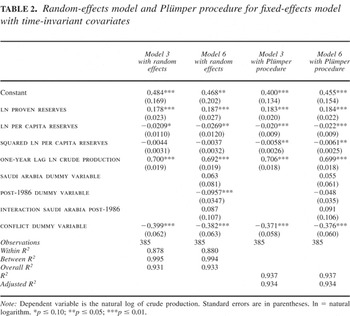
The results of the random-effects model are presented in Table 2. The coefficient on per capita proven reserves is both negative and statistically significant for each of the two relevant models. The coefficient on the squared term is signed as expected but is not statistically significant.Random-effects model and Plümper procedure for fixed-effects model with time-invariant covariates

Between-Effects Model
In his critique, Goodrich concedes that 94 percent of the variation in the key independent variable is cross-sectional and that the fixed-effects estimator is likely to capture random fluctuations in the level of proven reserves rather than any true change in a country's impatience.18
Given the weaknesses of the fixed-effects specification that he champions, he also presents the results of a between-effects model specification. The between-effects model reduces each of the variables to their respective country means and exploits variation between country cases to estimate effects. While between-effects specifications rarely achieve statistically significant results because of the small number of observations, Goodrich shows that the “rewarding impatience” effect is statistically significant even under this specification.19See Ibid., fig. 1.
The between-effects and the fixed-effects estimator provide two distinct pieces of information. The first says that relatively resource-poor countries produce more oil, given their resource base, than relatively resource-rich ones. The second says that, as resource-poor countries become richer, they do not appear to produce less oil. The first result is consistent with the “rewarding impatience” hypothesis, while the second is irrelevant because one does not actually observe relatively resource-poor countries becoming resource-rich countries in the data set.
Fixed-Effects Model for Time-Invariant Covariates
By reducing each of the variables to their country means, as is done with the between-effects specification, one is essentially discarding data and ignoring the fact that a particular pattern has been observed not just once, as between effects would suggest, but consistently for a number of years. Plümper and Troger propose an alternative model that allows the analysis of time-invariant covariates within the context of pooled data sets.20
The procedure, which can be implemented as a Stata ado-file called xtfevd, consists of three stages. The first stage runs a fixed-effects model without the time-invariant variables. The second stage decomposes the unit-effects vector into a part explained by the time-invariant variables and an error term. The third stage reestimates the first stage by pooled ordinary least squares (OLS) including the time-invariant variables plus the error term of stage two. See Plümper and Troger 2004 for details.
To summarize, the pooled model, the random-effects model, the between-effects model, and a new model developed specifically for the estimation of panel data with time-invariant covariates all strongly support the “rewarding impatience” hypothesis.21
The inclusion of time fixed effects (that is, dummy variables for t−1 years in the study) did not change the sign or statistical significance of key variables in any of the specifications. In fact, in every case I analyzed, when time fixed effects were included in the specification, the “rewarding impatience” effect was strengthened. Goodrich does not report the results of any regressions that included time fixed effects without also including country fixed effects.
Additional Comments
Goodrich contends that when properly analyzed, the evidence for the “rewarding impatience” claim is mixed. I have shown that under a variety of specifications, which are all more appropriate than the one that he has suggested, the “rewarding impatience” hypothesis is robust. Having addressed the main issue that he raises, I now address two additional points that he discusses in his critique. The first involves the use and interpretation of interaction terms and the second the development of additional proxy variables for the concept of impatience.
Interpretation of Interaction Terms
In their article Alt, Calvert, and Humes argue that Saudi Arabia increased oil production in late 1985 as part of a larger mixed strategy to establish a reputation for hegemonic toughness.22
One of the implications of their argument is that Saudi Arabia benefited from this reputation of toughness and earned a larger piece of the OPEC pie than it did before the orchestrated price drop. In testing their argument, I included a dummy variable for Saudi Arabia, another for the post-1986 era, as well as an interaction term for post-1986 Saudi Arabia in some of the original regression analyses. The Alt, Calvert, and Humes argument would suggest a positive and statistically significant coefficient on this interaction term. While consistently positive, this term was not statistically significant in any of the specifications that I ran. In his critique, Goodrich suggests that the interaction term should be interpreted as a difference between two of the coefficients and that under this procedure the Alt, Calvert, and Humes hypothesis enjoys statistical support in some of the models that he presents. The “rewarding impatience” hypothesis and the Alt, Calvert, and Humes contention that Saudi Arabia enjoyed a production advantage after 1986, however, are not mutually exclusive. It is entirely possible that Saudi Arabia enjoyed an advantage during the post-1986 years and that relatively poor, populous OPEC countries also enjoyed a bargaining advantage, to the detriment of other relatively wealthy OPEC countries. The inclusion of the Alt, Calvert, and Humes variables does not meaningfully alter the statistical effect of the “rewarding impatience” hypothesis in any specification and often serves to strengthen its statistical significance.23Despite his early attempts to champion the Alt, Calvert, and Humes hypothesis of hegemonic stability, on completion of his chosen statistical model Goodrich concludes that “Saudi Arabia's predatory pricing strategy—whatever its intent—does not seem to have had a significant effect on relative production shares.” Goodrich 2006.
Proxies for Impatience
The most powerful critique in the Goodrich comment involves the weakness of the regime instability proxy variables that I use to measure impatience and buttress the findings of the main regressions. There are a couple of possible explanations for why these variables have not proven to be robust in subsequent analyses. The first is related to the fact that these proxy variables suffered from considerable systematic missingness. The research project of Przeworski and others excluded a number of wealthy Gulf states from their analysis and also extended to 1990 rather than 1995, the end date for the OPEC analysis.24
The result is that half of the observations for these variables are coded as missing. More importantly, however, is the fact that the process relating political instability to oil production may be more complicated than I originally conceptualized. For example, in the original analysis, I assumed the countries that experienced a regime change would enjoy greater production, ceteris paribus, in that particular year because political instability was equated with “impatience.” Yet regime change can often have a dampening effect on oil production as factions fight for control of production facilities or political violence disrupts production. The proxies that I used in the original analysis, therefore, provided a weak test of the argument and are only robust in regressions that do not also include a control for serial correlation.25Some have argued that lagged dependent variables are not always appropriate as a statistical “control” and tend to suppress the explanatory power of other variables. See Achen 2000.
Conclusions
Goodrich proposes that the regression models in Blaydes be respecified to include country fixed effects. I have argued that a fixed-effects specification is statistically problematic because of the highly time-invariant nature of the key explanatory variables. In addition, this specification is substantively weak because it no longer tests the true question of import—how relatively resource-poor countries fare in bargaining situations against their more resource-rich (and therefore patient) counterparts. Goodrich proposes the fixed-effects model to eliminate the scourge of omitted variable bias; yet the fixed effects improve model fit so minimally that the degree of this bias is necessarily negligible. In his “solving” of the omitted variable problem, he renders theoretically relevant time-invariant variables, such as per capita reserves, unstable. Reanalysis of the data using a series of other more appropriate models show the “rewarding impatience” hypothesis to be robust, including a new statistical procedure developed specifically for time-series cross-section data with time-invariant covariates.
Theory and substantive knowledge can serve as a guide for deciding whether a particular statistical specification makes sense to evaluate the hypotheses that it sets out to test. This is particularly important when it comes to the use of fixed effects where one must consider whether the procedure is actually evaluating the theory that is purported to be tested.26
While I believe that replication is hugely important for the advancement of the discipline (and the reason why I freely placed the data for the original article on my Web site for Goodrich to access), it is incumbent on the person undertaking the replication to understand the theoretical and substantive point of departure for the data analysis before calling for countless additional control variables that explain little additional variance and destabilize the estimates of effects of theoretically relevant variables.References
REFERENCES
Achen, Christopher H.
2000.
Why Lagged Dependent Variables Can Suppress the Explanatory Power of
Other Independent Variables.
Paper presented at the Annual Meeting of the Society for
Political Methodology, University of California, Los Angeles,
July.
Achen, Christopher H.
2002.
Toward a New Political Methodology: Microfoundations and ART.
Annual Review of Political Science
5 (1):423–50.Google Scholar
Achen, Christopher H.
2004.
Let's Put Garbage-Can Regressions and Garbage-Can Probits Where
They Belong.
Paper presented at the Annual Meeting of the Peace Science
Society, Rice and Texas A&M Universities, Houston, November.
Alt, James E.,
Randall L. Calvert, and
Brian D. Humes.
1988.
Reputation and Hegemonic Stability: A Game-Theoretic
Analysis.
American Political Science Review
82 (4):445–66.Google Scholar
Beck, Nathaniel N.
2001.
Time-Series–Cross-Section Data: What Have We Learned in the
Last Few Years.
Annual Review of Political Science
4 (1):271–93.Google Scholar
Beck, Nathaniel N., and
Jonathon N. Katz.
2001.
Throwing Out the Baby with the Bath Water.
International Organization
55 (2):487–95.Google Scholar
Blaydes, Lisa.
2004.
Rewarding Impatience: A Bargaining and Enforcement Model of
OPEC.
International Organization
58 (2):213–37.Google Scholar
Clarke, Kevin.
2005.
The Phantom Menace: Omitted Variable Bias in Econometric
Research.
Conflict Management and Peace Science
22 (4):341–52.Google Scholar
Fearon, James D.
1998.
Bargaining, Enforcement, and International Cooperation.
International Organization
52 (2):269–305.Google Scholar
Goodrich, Ben.
2006.
A Comment on “Rewarding Impatience.”
International Organization
60 (2):
499–513.Google Scholar
Goodstein, David.
2004.
Out of Gas: The End of the Age of Oil.
New York:
Norton.
Plümper, Thomas, and
Vera Troger.
2004.
The Estimation of Time-Invariant Variables in Panel Analyses with
Unit Fixed Effects.
Paper presented at the 2004 Annual Meeting of the Society for
Political Methodology at Stanford University, California, July.
Plümper, Thomas,
Vera Troger, and
Philip Manow.
2005.
Panel Data Analysis in Comparative Politics: Linking Method to
Theory.
European Journal of Political Research
44 (2):327–54.Google Scholar
Przeworski, Adam,
Michael E. Alvarez,
Jose Antonio Cheibub, and
Fernando Limongi.
2000.
Democracy and Development: Political Institutions and Well-Being in
the World, 1950–1990.
Cambridge:
Cambridge University Press.
OLS estimation with panel-corrected standard errors
Random-effects model and Plümper procedure for fixed-effects model with time-invariant covariates
 You have
Access
- 1
- Cited by