Donkey milk has been given particular attention recently in scientific research, with the aim of recovering the biodiversity of the world's donkey breeds and the use of donkey milk (Martini et al., Reference Martini, Altomonte, Licitra and Salari2018). Historically, asinines have played a central role as draft animals in the old world's civilisations, facilitating agricultural and commercial activities. Despite extensive mechanisation, the asinine still supports the livelihoods of millions of people in less developed regions. New uses for donkeys have been explored in other places such as in tourism, leisure, assisted therapy and meat production. Native to Africa's arid zones, the donkey originated in semiarid regions and was introduced into the Northeast of Brazil during the colonial period (16th century), mainly brought from Europe (Camillo et al., Reference Camillo, Rota, Biagini, Tesi, Fanelli and Panzani2017; Dias et al., Reference Dias, Massara and Bocchiglieri2019). The Northeast of Brazil's semi-arid region, which comprises the Caatinga biome, is characterised by arid soils, low rainfall, and native pastures and rangelands that support grazing animals of the region (Nunes et al., Reference Nunes, Bennett and Júnior2014; Sant'Ana et al., Reference Sant'Ana, Bessa, Alves, Medeiros, Costa, Sousa, Bezerril, Batista, Madruga and Queiroga2019).
The asinine population is declining such that there are only about 46 million globally, of which 7 million are in the Americas. In Brazil, the donkey population is only 840 000 (FAOSTAT, 2018), found mainly in the Northeast region's states and predominantly from the Nordestina breed. This breed is considered very hardy being well adapted to the adverse conditions of the Brazilian semi-arid region (Dias et al., Reference Dias, Massara and Bocchiglieri2019), where it is used in various working activities including the production of mules and hinnies. As rural mechanisation proceeds, the importance of asinines diminishes and new uses, like milk production, need to be explored to preserve the Nordestina asinine breed. The Nordestina asinine breed's dairy potential has not yet been studied, and there is no market for donkey milk in the region. Nevertheless, Nordestina donkey mares are occasionally milked to supply the needs of isolated smallholding farmers.
Donkey milk is notable because its composition is somewhat similar to that of human milk (Martini et al., Reference Martini, Altomonte, Licitra and Salari2018; Altomonte et al., Reference Altomonte, Salari, Licitra and Martini2019). As a result it finds use in infant formulas, particularly for children suffering from allergy to cow's milk protein. Donkey milk appears to have hypoallergenic characteristics as well as good palatability (Cresi et al., Reference Cresi, Maggiora, Pirra, Tonetto, Rubino, Cavallarin, Giribaldi, Moro, Peila and Coscia2020).
Dairy lipids are important sources of essential fatty acids, such as linoleic (18:2 n-6) and α-linolenic (18:3 n-3) acids, as well as the fat-soluble vitamins A, D, E and K (Gentili et al., Reference Gentili, Caretti, Bellante, Ventura, Canepari and Rcurini2013; Gómez-Cortés et al., Reference Gómez-Cortés, Muárez and Angel de la Fuente2018; Martini et al., Reference Martini, Altomonte, Licitra and Salari2018). Lipids are involved in several physiological processes, including energy storage, membrane composition and cell signalling (Li et al., Reference Li, Li, Wu, Zheng, Shao, Li, Kang, Zhang, Yue and Yang2019). Donkey milk is considered a good source of nutrients and, although it has lower lipid content than human milk and other mammals, this characteristic helps in the sensory attributes of this milk. Due to its considerable amount of unsaturated fatty acids, donkey milk may potentially contribute to preventing inflammatory and cardiovascular diseases (Martemucci and D'Alessandro, Reference Martemucci and D'Alessandro2012).
The FA composition of donkey milk has been reported for European and Chinese breeds and production systems (Martemucci and D'Alessandro, Reference Martemucci and D'Alessandro2012; Camillo et al., Reference Camillo, Rota, Biagini, Tesi, Fanelli and Panzani2017; Valle et al., Reference Valle, Pozzo, Giribaldi, Bergero, Gennero, Dezzutto, McLean, Borreani, Coppaf and Cavallarin2018) including its variation during lactation (Martemucci and D'Alessandro, Reference Martemucci and D'Alessandro2012; Martini et al., Reference Martini, Altomonte, Manica and Salari2015; Li et al., Reference Li, Li, Wu, Zheng, Shao, Li, Kang, Zhang, Yue and Yang2019). However, the milk FA composition from the Nordestina breed mares grazing Caatinga vegetation has not yet been studied. Thus, the present study's objective was to characterise the composition of FA of the milk from Nordestina breed donkey mares managed traditionally, and to explore how it differs during the lactation.
Materials and methods
Sampling
A herd with 540 Nordestina breed donkeys' was kept on a farm with circa 600 ha located in Felipe Guerra's municipality, in the state of Rio Grande do Norte, Brazil (5° 37′ 20″ South, 37° 38′ 57″ West). The jennies grazed on the native vegetation of the semi-arid Caatinga biome during the day and had access to sorghum straw and circa 300 g/head of a blend of 2:1 of wheat bran and ground corn, during the night. The jennies were usually not milked, but the producer agreed to start milking twenty-four multiparous animals, aged between 4 and 10 years, weighing circa 150 kg, and differing in days in milk. The foals of the jennies that were milked were maintained with their dams except for four hours before milking. Jennies were milked by hand once a day at 05 am and then released to pasture. Milked jennies usually yield about 1 L per day, although lower yields were often observed. Individual milk samples were collected from 5 animals at each of these stages of lactation: around 30, 60 and 90 d in milk (DIM), and from an additional 9 animals at between 120 to 180 DIM. Milk samples used for fat determination were refrigerated (4 ± 1°C) without preservatives, and those used for fatty acid (FA) determination were freeze-dried and stored at −20°C until analysis.
Fat content analysis and determination of FA
Milk fat content was determined by mid-infrared spectroscopy using a Bentley Dairy Spec FT® (Bentley Instruments, Chaska, Minnesota, USA) calibrated for donkey milk. Details are provided in the Supplementary File. Briefly, the milk FA profiles were determined from direct transesterification of freeze-dried milk samples according to the procedures described by Molkentin and Precht (Reference Molkentin and Precht2000) but complemented with an acidic transesterification step. The FA methyl esters were analysed in a gas chromatographer (Varian 430, California, USA) equipped with a flame ionisation detector and a 100 m SP-2560 capillary column (Supelco, Bellefonte, USA). The FA was identified by comparison with FA methyl ester standards (ME19-Kit, Supelco, Bellefonte, USA) and expressed as area percentage.
The atherogenic index (AI) was computed:
 $${\rm AI} = \displaystyle{{12\colon 0 + 4 \times 14\colon 0 + 16\colon 0) } \over {\Sigma {\rm MUFA} + \Sigma ( {n-6\,{\rm PUFA}} ) + \Sigma ( {n-3\,{\rm PUFA}} ) }}$$
Statistical analysis
Data were analysed using the Proc Mixed of SAS (SAS Inc., Cary, USA) considering the class of DIM as single fixed factor in the model. When the model detected significant differences (P < 0.05), the least square means were submitted to a multiple comparison test using the Tukey–Kramer procedure.
Results and discussion
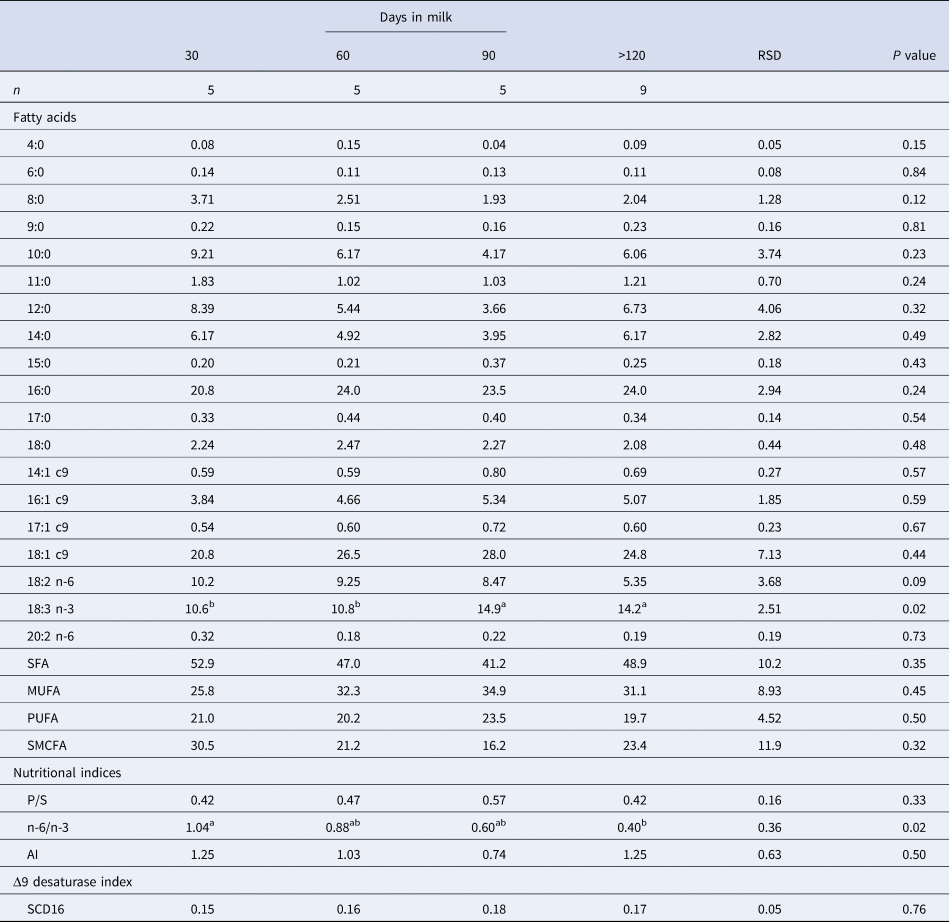
The FA profile of donkey milk samples with 30, 60, 90 and more than 120 d of lactation are shown in Table 1. The Nordestina donkey milk's fat content ranged between 0.45 and 0.61% across DIM classes. That range was similar to that found in the milk of the Martina Franca breed (0.42–0.72%) and the Amiata breed (0.34–0.46%) (Martemucci and D'Alessandro, Reference Martemucci and D'Alessandro2012; Martini et al., Reference Martini, Altomonte, Manica and Salari2015). The fat content of the Arcadian breed varied from 0.70 to 1.40% (Massouras et al., Reference Massouras, Triantaphyllopoulos and Theodossiou2017), and was higher than for the milk studied here. These fat content differences can be related to the different breeds, pasture and feed quality and availability, but may also be affected by milking techniques (manual vs. mechanical). Donkeys, and certainly Nordestina breed, have not been selected for milk production. Thus, jennies may be still highly dependent on the foal's stimulation to fully express the milk let-down reflex. This could result in an underestimation of fat content as cisternal milk typically is lower in fat compared to alveolar milk. The percentage of fat found in the Nordestina breed was low but consistent with what is expected from the asinine, and further studies are required to improve the fat content of the breed and species.
Fatty acid (FA) composition and FA nutritional indices of milk from Nordestina donkey mares at different stage of lactation (days in milk)

RSD, Residual standard deviation; n, Number of observations; SMCFA, Short and medium chain FA (aliphatic chain with 14 or less carbons); P/S, Ratio between PUFA and SFA; n-6/n-3, Ratio between n-6 PUFA and n-3 PUFA; AI, Atherogenicity index; SCD16, 16:1c9/(16:1c9 + 16:9); SFA, saturated fatty acids; MUFA, monounsaturated fatty acid; PUFA, polyunsaturated fatty acid; SMCFA, short and medium-chain fatty acid; SCD16, enzyme stearoyl-CoA desaturase calculated with the pair 16:1c9 and 16:0. Within rows, values with differing superscript differ significantly, P<0.05 or greater.
According to Dietary Reference Intakes, the total fat consumption for infants from 0 to 12 months should be about 30 g (AI, Adequate Intake) (Padovani et al., Reference Padovani, Amaya-Farfán, Colugnati and Domene2006). Due to its low-fat content, donkey milk alone will not supply the recommended fat intake for infants. The addition of medium-chain triglycerides and long-chain omega 3 PUFA rich oils to donkey milk may be an alternative approach to developing donkey milk-based formula for infant nutrition (Martini et al., Reference Martini, Altomonte, Licitra and Salari2018; Altomonte et al., Reference Altomonte, Salari, Licitra and Martini2019). The low fat content of donkey milk could be a limiting factor when compared to human and ruminant milk, but its use may be important in hypolipidemic and low-caloric diets (Li et al., Reference Li, Liu and Guo2018).
The four major FA in the donkey milk were oleic acid (18:1 c9, averaging 25.0% of total FA), palmitic acid (16:0, averaging 23.1% of total FA), 18:3 n-3 (ranging from 10.6 to 14.2% of total FA), and 18:2 n-6 (averaging 8.3% of total FA), which together comprised about 70% of FA. Another seven FA were present in abundance above 1%; 10:0 (averaging 6.4% of total FA), 12:0 (averaging 6.1% of total FA), 14:0 (averaging 5.3% of total FA), 16:1c9 (averaging 4.7% of total FA), 8:0 (averaging 2.5% of total FA), 18:0 (averaging 2.3% of total FA) and 11:0 (averaging 1.3% of total FA).
The only FA to be affected by lactation stage was 18:3 n-3, which was 38% higher on 90 and >120 DIM samples than on 30 or 60 DIM samples. Compared to the other farm mammals, horse and particularly donkey had the highest 18:3 n-3 concentration in milk. The concentration of 18:3 n-3 in donkey milk is usually about 7.25 g/100 g fat, thus higher than what is generally found in human milk (1.15 g/100 g fat) and cow's milk (0.56 g/100 g fat) (Martini et al., Reference Martini, Altomonte, Licitra and Salari2018). In our study, the concentration of 18:3 n-3 in the 90 DIM samples is as high as 14.9 g/100 g total FA. Contrarily to the ruminants, in the equids, the dietary PUFA is not hydrogenated in the digestive tract before absorption (Belaunzaran et al., Reference Belaunzaran, Bessa, Lavín, Mantecón, Kramer and Aldai2015). Thus, milk 18:3 n-3 variability will undoubtedly be explained by its concentration in the diet and the animal's ability to release and absorb it. Considering the putative health-promoting proprieties of 18:3 n-3 and its essential role as a precursor of long-chain n-3 PUFA and related eicosanoids, the high proportion of 18:3 n-3 found in Nordestina donkey milk is a very distinctive and desirable nutritional characteristic.
Although lauric (12:0), myristic (14:0) and palmitic (16:0) acids are generally considered hypercholesterolemic when supplied in the milk matrix they appear to have no impact on cardiovascular health parameters (Gómez-Cortés et al., Reference Gómez-Cortés, Muárez and Angel de la Fuente2018). The 14:0, 16:0 and 18:0 FA predominate in the milk of ruminant dairy species. Gómez-Cortés et al. (Reference Gómez-Cortés, Muárez and Angel de la Fuente2018) compiled data from FA of ruminant's milk and reported that 14:0 and 16:0 comprised around 10% and 27% of total FA and that 18:0 was more variable and ranged between 9 and 12% of total FA. In in our study, the 18:0 comprised only 2.3% of total FA, and the 14:0 and 16:0 comprised 5.3% and 23.1 of total FA indicating its lower proportion in donkey milk compared to ruminants, making donkey milk potentially healthier where saturated FA are concerned.
The sum of saturated FA, monounsaturated FA (MUFA) and PUFA represented on average 47.5%, 31.0% and 21.1% of total FA, respectively. The sum of short and medium-chain FA (SMCFA, henceforth defined as FA with carbon chain length of 14 carbon atoms or less) averaged 22.8% of total FA. As reported in literature, they are easily digestible and show a low tendency to be stored in fat tissue (Gómez-Cortés et al., Reference Gómez-Cortés, Muárez and Angel de la Fuente2018; Altomonte et al., Reference Altomonte, Salari, Licitra and Martini2019). As the lactation proceeds in donkey mares, the long chain FA proportion increases while that of short chain FA decreases (Martemucci and D'Alessandro, Reference Martemucci and D'Alessandro2012; Martini et al., Reference Martini, Altomonte, Manica and Salari2015; Valle et al., Reference Valle, Pozzo, Giribaldi, Bergero, Gennero, Dezzutto, McLean, Borreani, Coppaf and Cavallarin2018). However, in the studied milk these FA were similar up 120 DIM, making it necessary to extend the sampling time until the end of lactation of these animals to verify if the same pattern is observable in Nordestina donkey mares.
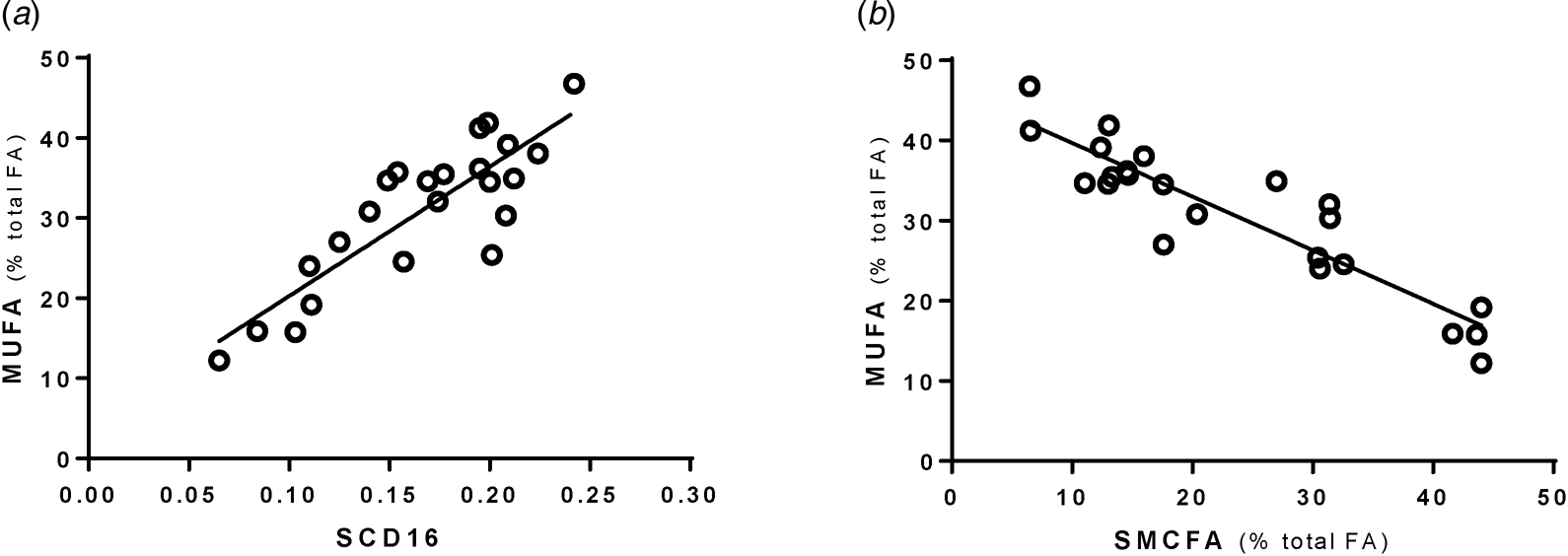
The Δ9-desaturase activity index is a proxy of the activity of the enzyme stearoyl-CoA desaturase (SCD) that catalyses the insertion of a double bond between the carbon 9 and 10 atoms of a FA (Paton and Ntambi, Reference Paton and Ntambi2009). The SCD activity index can be calculated using the relations between the SCD product and substrate pairs. Between SCD activity indexes, the one calculated with the pair 16:1 c9 and 16:0 (SCD16) was the one that presented the highest correlation with the MUFA proportion (Fig. 1a), justifying the medium chain FA values for all evaluated lactation periods (Martemucci and D'Alessandro, Reference Martemucci and D'Alessandro2012; Martini et al., Reference Martini, Altomonte, Manica and Salari2015).
Linear relationship between the sum of monounsaturated fatty acids (MUFA, % of total FA) and (a) the SCD16 (Δ9 activity index computed with 16:1c9 and 16:0 pair) or (b) the sum of short and medium chain fatty acids (MCFA, % of total FA). Equation A) MUFA = 4.1 ± 3.6 + 161 ± 20 × SCD16, n = 24, R 2 = 0.735, P < 0.001; Equation B) MUFA = 46.4 ± 1.6–0.67 ± 0.06 × SMCFA, n = 24, R 2 = 0.84, P < 0.001.

The SCD16, SMCFA and MUFA did not change during the lactation phase but showed a large individual variability (Fig. 1a and b). For example, both 12:0 and 10:0 varied from 0.6% to 14.0% of total FA and the sum of MCFA showed a 6.8 fold change between the minimum (6.4%) and maximum (44.0%) values. The variability of the SMCFA showed a negative linear association with the MUFA (Fig. 1b). This negative association was also observed in donkey milk by Massouras et al. (Reference Massouras, Triantaphyllopoulos and Theodossiou2017). The content of PUFA was much less variable between samples as also reported by Massouras et al. (Reference Massouras, Triantaphyllopoulos and Theodossiou2017).
The n-6/n-3 PUFA ratio differed with the lactation stage, reflecting the changes in 18:3 n-3 described above. The ratio between PUFA and SFA is desirable when it is greater than 0.45 and in the studied milk, this varied from 0.34 to 0.58. In the study by Massouras et al. (Reference Massouras, Triantaphyllopoulos and Theodossiou2017) it varied between 0.20 and 0.63, considerably higher values than in bovine milk (0.04).
In conclusion, donkey milk from the Nordestina breed showed no variability explained by the lactation periods analysed with respect to the FA profile, except for the 18:3 n-3 content. Despite having a low fat content, donkey milk can be considered a high-quality food and can be directed to hypolipidemic diets, helping combat cardiovascular diseases. This milk matrix presents an important potential as a functional ingredient in milk formulas due to the FA profile found, being interesting for the consumption of children and the elderly. Further studies are needed to preserve and enhance the species as well as its dairy potential, and it is also necessary to investigate the hygienic characteristics and the safety of the donkey milk of the Nordestina breed.
Supplementary material
The supplementary material for this article can be found at https://doi.org/10.1017/S0022029921000388.
Acknowledgements
This study was funded in part by the Coordenação de Aperfeiçoamento de Pessoal de Nível Superior (CAPES), code 001 funding.