


Introduction
The last 30 years have seen many developments in the treatment of psychosis (NICE, 2009). However, the extent to which the main pharmacological intervention, antipsychotic medication, provides a clinically meaningful benefit above placebo has recently been questioned (Lepping, Sambhi, Whittington, Lane and Poole, Reference Lepping, Sambhi, Whittington, Lane and Poole2011; Leucht, Arbter, Engel, Kissling and Davis, Reference Leucht, Arbter, Engel, Kissling and Davis2009; Rattehalli, Jayaram and Smith, Reference Rattehalli, Jayaram and Smith2010), while very high rates of drop-out from short and long-term clinical trials suggest low acceptability (Leucht, Arbter et al., Reference Leucht, Davis, Engel, Kissling and Kane2009; Lieberman et al., Reference Lieberman, Stroup, McEvoy, Swartz, Rosenheck and Perkins2005). According to some estimates, between one-fifth and one-third of patients will not have a good response to antipsychotic medication (NICE, 2009).
Psychosocial interventions appear to be highly acceptable to most service-users with psychosis (Villeneuve, Potvin, Lesage and Nicole, Reference Villeneuve, Potvin, Lesage and Nicole2010; Warner, Mariathasan, Lawton-Smith and Samele, Reference Warner, Mariathasan, Lawton-Smith and Samele2006). A recent review of one of these treatments, cognitive behavioural therapy (CBT), found it was moderately effective at reducing positive and negative symptoms, improving functioning and improving mood (Wykes, Steel, Everitt and Tarrier, Reference Wykes, Steel, Everitt and Tarrier2008), although there is not complete consensus on this (Lynch, Laws and McKenna, Reference Lynch, Laws and McKenna2010; Newton-Howes and Wood, Reference Newton-Howes and Wood2011). Unfortunately, the effects were smaller in rigorous and adequately-powered trials that attempted to control for non-specific aspects of therapy (e.g. increased social interaction). However, as outlined elsewhere (Tai and Turkington, Reference Tai and Turkington2009), CBT for psychosis is evolving and new treatments are in development. Preliminary efficacy data from a multiple-baseline case-series study of one of these new treatments, metacognitive therapy (MCT), will be reported here.
Metacognition in psychological disorder
Traditional CBT assumes that emotional distress is strongly influenced by the way a person makes sense of their experiences (Beck, Reference Beck1976). Unhelpful or distorted beliefs about self, others and the world are thought to be maintained by counterproductive attempts at coping, such as avoidance. Reductions in distress are thought to follow the development of new, more helpful beliefs. This is achieved through collaborative examination of the evidence, which is facilitated by behavioural change.
MCT, on the other hand, assumes emotional distress is related to activation of unhelpful forms of information-processing such as worry and rumination, “metacognitive” beliefs about the usefulness, controllability and danger of these processes, and counterproductive strategies of thought-control (Wells, Reference Wells2009) as outlined in the S-REF model (Wells and Matthews, Reference Wells and Matthews1994). Negative metacognitive beliefs (e.g. “My worry is uncontrollable”) are thought to play a central role in the onset and maintenance of many different emotional disorders and problems, including generalized anxiety (GAD) (Wells, Reference Wells1995), social anxiety (Clark and Wells, Reference Clark, Wells, Heimberg and Liebowitz1995), post-traumatic stress disorder (PTSD) (Wells and Sembi, Reference Wells and Sembi2004), obsessive-compulsive disorder (OCD) (Fisher and Wells, Reference Fisher and Wells2005), health anxiety (Bouman and Meijer, Reference Bouman and Meijer1999), depression (Papageorgiou and Wells, Reference Papageorgiou and Wells2001) and anger (Simpson and Papageorgiou, Reference Simpson and Papageorgiou2003). Metacognition has also been linked to the development of psychotic symptoms, specifically hallucinations (Baker and Morrison, Reference Baker and Morrison1998) and delusions (Freeman and Garety, Reference Freeman and Garety1999; Laroi and van der Linden, Reference Laroi and van der Linden2005; Morrison, Reference Morrison2001; Morrison, French and Wells, Reference Morrison, French and Wells2007; Morrison et al., Reference Morrison, Gumley, Ashcroft, Manousos, White and Gillan2011; Startup, Freeman and Garety, Reference Startup, Freeman and Garety2007). Recent work has suggested metacognitive beliefs may be more important in understanding the distress associated with hallucinations, rather than hallucination occurrence per se (Varese and Bentall, Reference Varese and Bentall2011).
Rather than challenging the validity of thoughts and beliefs about the self and world MCT encourages a person to develop a detached awareness of their thoughts with concomitant control of worry/rumination and unhelpful attentional strategies. This facilitates: (1) appropriate executive control over maladaptive processes and (2) challenging of metacognitive beliefs that worry and rumination are uncontrollable or dangerous. This, in turn, is thought to lead to a significant reduction in distress (Wells, Reference Wells2008). Early pilot trials and case studies suggest MCT (or components of MCT) is a promising treatment for OCD (Fisher and Wells, Reference Fisher and Wells2008), PTSD (Wells et al., Reference Wells, Welford, Fraser, King, Mendel and Wisely2008), GAD (Wells and King, Reference Wells and King2006) treatment-resistant depression (Wells et al., Reference Wells, Fisher, Myers, Wheatley, Patel and Brewin2009) and auditory and visual hallucinations in psychosis (Hutton, Morrison and Taylor, Reference Hutton, Morrison and Taylor2012; Valmaggia, Bouman and Schuurman, Reference Valmaggia, Bouman and Schuurman2007). Results from controlled trials suggest MCT may be superior to exposure therapy in treating PTSD (Proctor, Reference Proctor2008), and superior to relaxation therapy or CBT in treating GAD (van der Heiden, Muris and van der Molen, Reference van der Heiden, Muris and van der Molen2011; Wells et al., Reference Wells, Welford, King, Papageorgiou, Wisely and Mendel2010). In psychosis, a 4-session MCT-informed intervention, focused on reducing worry and challenging metacognitions, was found to be superior to treatment as usual in reducing persecutory delusions (Foster, Startup, Potts and Freeman, Reference Foster, Startup, Potts and Freeman2010).
A metacognitive approach to psychosis
Although existing cognitive models clearly identify metacognition and worry as important factors in psychosis (Garety, Kuipers, Fowler, Freeman and Bebbington, Reference Garety, Kuipers, Fowler, Freeman and Bebbington2001; Morrison, Reference Morrison2001), they also incorporate many non-metacognitive components, such as core beliefs (i.e. about self, others and the world), a focus on the content of appraisals, self-esteem and safety behaviours including avoidance. It remains to be seen whether a “pure” metacognitive model and treatment approach is of value in psychosis. We will now describe the key features of the model used in the current study.
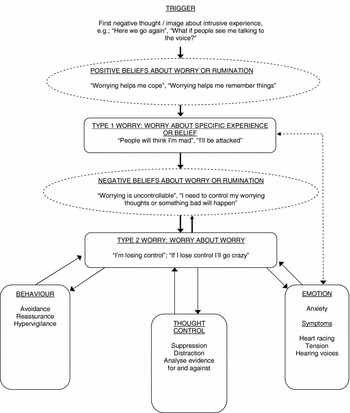
We adapted Wells’ metacognitive model of GAD (Wells, Reference Wells1995) in a similar way to that proposed by Morrison and colleagues (Morrison et al., Reference Morrison, Gumley, Ashcroft, Manousos, White and Gillan2011). To maximize fidelity with the metacognitive model (Wells, Reference Wells2009) we conceptualized negative thoughts rather than psychotic experiences as the trigger for the development of distress (see Figure 1 for an example of such a formulation). This reflects the fact that many people have psychotic-like experiences but are not distressed by them, and are not receiving help from services (Pechey and Halligan, Reference Pechey and Halligan2011, in press). In the metacognitive model, distress is a consequence of sustained processing in the form of worry and rumination and counterproductive mental regulation strategies.
A metacognitive case formulation

Psychotic experiences were not conceptualized as direct triggers for the development of further worry; rather the trigger was instead an initial worrying thought, such as “Oh no, I have to leave the house” or “God is talking to me again”. If an individual held positive metacognitive beliefs about the usefulness of worry (e.g. “Worrying keeps me safe”, “If I analyse my problems, I will find answers”), then this activated a chain of further worries or rumination which, as in GAD, varied in content depending on the initial trigger. Unusual thoughts, commonly viewed as delusions or paranoia, were classified as the content or output of worry, which equates with Wells’ concept of Type 1 worry in his GAD model. Whilst this worry contributes to distress, negative metacognitive beliefs and “worry about worry” (Type 2 worry) contribute to this becoming persistent and intense. Type 2 worries such as “My worry is uncontrollable” and “I'll go mad if I can't stop worrying” give rise to a further imminent sense of threat and interfere with attempts at regulating cognition.
Type 2 worries are thought to be closely linked to pre-existing negative metacognitive beliefs about worry. Typical negative metacognitive beliefs include “Thinking too much will drive me mad” and “Worry is uncontrollable”. Activation of Type 2 worries leads to an escalation of anxiety symptoms, which are then misinterpreted as further evidence that worry is uncontrollable or harmful (Wells, Reference Wells2009).
Negative metacognitions about worry are also thought to be maintained by counterproductive attempts at thought-control (Wells, Reference Wells2009). Thought suppression, a typical thought-control strategy in psychosis (Morrison and Wells, Reference Morrison and Wells2000), can lead to a paradoxical increase in the frequency of intrusive thoughts and/or associated distress (Lin and Wicker, Reference Lin and Wicker2007; Najmi, Riemann and Wegner, Reference Najmi, Riemann and Wegner2009; Wegner, Schneider, Carter and White, Reference Wegner, Schneider, Carter and White1987). Other strategies such as reassurance, distraction and avoidance all prevent an individual discovering they can control their thoughts by internal means, while evidential analysis drains resources required for adequate control of cognition and attention (Wells, Reference Wells2009). Some people may also engage in self-attacking or self-harm as a way of controlling thoughts, thus heightening their distress (Morrison and Wells, Reference Morrison and Wells2000). Some may consume alcohol or other substances. Most thought control strategies prevent an individual finding out that worry is not dangerous and does not need to be controlled.
The pattern of worry and rumination is also accompanied by changes in the direction of attention in which individuals begin to focus on potential sources of threat (Wells, Reference Wells2009). Overall the pattern of worry/rumination, threat monitoring and counterproductive self-regulation strategies is termed the Cognitive Attentional Syndrome (CAS) (Wells and Matthews, Reference Wells and Matthews1994). MCT aims to reduce the likelihood of CAS activation by modifying metacognitive control strategies and restructuring positive and negative metacognitive beliefs (Wells, Reference Wells2009).
The aim of the current study was to conduct a case series of MCT with people meeting criteria for treatment-resistant schizophrenia. The goal was to address a preliminary question: Can a brief course of MCT work in schizophrenia? In order to test this we selected severe, complex and treatment resistant cases to provide rigour. Our main hypothesis was that MCT could be associated with, at end-of-therapy and 3-month follow-up, a clinically significant reduction in the severity of both delusions and hallucinations. Our secondary hypotheses were that MCT would be associated with reduced anxiety, improved mood and a greater sense of subjective recovery. Finally, we hypothesized that symptomatic change would closely follow change in CAS activity, as predicted by the S-REF model.
Method
Design
Following eligibility checks and a full initial assessment, three participants were randomly allocated to receive 2, 3, or 4 weeks of brief weekly baseline assessments. Treatment commenced at the end of the baseline periods if stability in at least one of the primary symptoms was demonstrated. In line with other multiple baseline studies of MCT, stability was defined as an absence of improvement in the primary outcome over at least two consecutive assessments (Wells et al., Reference Wells, Fisher, Myers, Wheatley, Patel and Brewin2009). Conducting multiple baseline assessments controls for the effect of increased social contact, natural improvement and regression to the mean, allowing change following onset of treatment to be more confidently attributed to the intervention.
We planned for a maximum of 12 weekly 1-hour treatment sessions over a 3-month period. Participants received full assessments again at end of treatment and 3 months later, with no treatment provided in the interim period. Each participant also completed a brief assessment prior to each therapy session, allowing us to closely chart their progress.
Participants
The first three people who met our inclusion and exclusion criteria were included in the study. Since this was a pilot study, our aim was to recruit symptomatic, yet clinically stable and treatment-adherent individuals whose symptoms were not attributable to brain injury or alcohol/drug use, who wanted help and whose social care needs were being adequately met. By reducing the likelihood of symptomatic variance we hoped to increase our confidence that any subsequent change could be attributed to MCT.
Our inclusion criteria were therefore that participants had to: (1) have an identified care coordinator and be in regular contact with mental health services; (2) meet either ICD-10 criteria for schizophrenia, schizoaffective disorder or delusional disorder; (3) score at least 4 on PANSS delusions or hallucinations and/or 5 on suspiciousness; (4) be judged by their clinician to be clinically stable for at least the preceding 4 weeks; (5) be judged by their clinician to be taking prescribed antipsychotic medication for at least the previous 3 months; and (6) have distress ratings of at least 3 on either the auditory hallucinations or delusions subscale of the PSYRATS.
Participants were unable to take part if they: (1) had moderate to severe learning disability; (2) had evidence of clear organic neurological impairment (e.g. head injury or dementia); (3) were non-English speaking in so far as this would prevent the use of standardized assessment instruments; (4) had received inpatient/acute care immediately prior to or during baseline assessments; (5) were judged by their clinician to be clinically unstable within the preceding 4 weeks; (6) were judged by their clinician to be taking prescribed antipsychotic medication for less than 3 months preceding referral; (7) were not receiving care coordination; (8) had a primary diagnosis of substance misuse dependency; (9) had a score of 5 or more on conceptual disorganization on the PANSS.
Key participant details have been changed in the following descriptions in order to preserve anonymity. All diagnoses were made by the patients’ psychiatrists as documented in the case notes.
Participant 1
Participant 1 was a 45-year old female who presented with persecutory delusions, anxiety and suicidal ideation. She had a diagnosis of paranoid schizophrenia and had experienced persecutory delusions for approximately 20 years. She believed with very strong conviction that her family, work colleagues and strangers were very critical of her and believed she was a terrorist. She used to drink heavily to cope with her high levels of anxiety, but had managed to stop this. She had tried a number of typical and atypical antipsychotics over a 15-year period, and was currently taking 20 mg aripiprazole. She had acquired tardive akathesia which had resisted treatment with procyclidine. She was also taking 40 mg citalopram, 30 mg mirtazapine and varying doses of pregabalin. She had seen at least two therapists in the past where she had received CBT and motivational interviewing. Although she had found this beneficial she was concerned that the effects had not lasted.
Participant 2
Participant 2 was a 30-year old male with a diagnosis of schizophrenia. He had experienced auditory and visual hallucinations for 15 years. He believed with very high conviction that aliens were appearing to him, talking to him and interfering with his thoughts. He was also fearful that strangers would attack him or his family. He also suffered from chronic sleep deprivation partly attributable to unsuccessfully treated sleep apnoea. He took pregabalin (150 mg), intermittently before and during therapy. He had also been taking olanzapine (20 mg), citalopram (20 mg) and zopiclone (7.5 mg) for a number of years. He was switched from olanzapine to quetiapine (600 mg) during therapy and then to amisulpride (400 mg). He had not received a psychological intervention before.
Participant 3
Participant 3 was a 55-year old female who had heard voices since she was an adolescent some 40 years ago. The voices, which she believed were the thoughts of other people intruding on her mind, were continuous despite treatment with various antipsychotics. She had a diagnosis of paranoid schizophrenia, and was taking olanzapine (20 mg) and citalopram (60 mg) at the start of therapy. Her antipsychotic was changed to risperidone (6 mg) during therapy. She believed with very high conviction that other people could read her thoughts and that her experiences were the result of a conspiracy involving MI5. She had taken illegal drugs in the past to cope with her experiences and was currently addicted to several prescription drugs. She also drank heavily, used illegal stimulants and was a carer for her adult son, who also experienced mental health problems. She had not received a psychological intervention before.
Outcome measures – primary
Psychotic Symptom Rating Scales (PSYRATS; Haddock, McCarron, Tarrier and Faragher, Reference Haddock, McCarron, Tarrier and Faragher1999). The PSYRATS is a widely-used clinician-administered assessment of various dimensions of auditory hallucinations and delusions. Dimensions assessed include distress, frequency, loudness, intensity, perceived control and disruption to life for auditory hallucinations and distress, conviction, preoccupation and disruption to life for delusions. Each dimension is assessed on a 0–4 point scale, with higher scores indicating greater severity. Total scores can range from 0–44 for auditory hallucinations and 0–24 for delusions. We used the PSYRATS as the primary outcome in this study because it takes less time to administer on a weekly basis.
Outcome measures - secondary
Positive and Negative Syndrome Scale (PANSS; Kay, Fiszbein and Opler, Reference Kay, Fiszbein and Opler1987). The PANSS is a structured clinical interview that assesses positive and negative symptoms of schizophrenia, as well as general psychopathology, occurring over the preceding week. Each of the 30 items is normally scored on a 1–7 point scale, with higher scores indicating greater severity. Following recent recommendations (Leucht, Kissling and Davis, Reference Leucht, Kissling and Davis2010), we changed this to a 0–6 scale. Total scores normally range from 30–210, but this was adjusted to 0–180 for the current study.
Beck Depression Inventory, 2nd edition (BDI-2; Beck, Steer and Brown, Reference Beck, Steer and Brown1996). This is widely-used self-report measure of depressive symptoms occurring in the preceding 2 weeks, where 21 items are rated on a 0–3 scale, allowing a range of 0–63. Higher scores indicate greater severity.
Beck Anxiety Inventory (BAI; Beck, Epstein and Brown, Reference Beck, Epstein and Brown1988). The BAI is a self-report measure of anxiety symptoms occurring during the preceding week. Each of the 21 items is rated on 0–3 scale, allowing a maximum score of 63. Higher scores indicate greater severity.
Questionnaire about the Process of Recovery (QPR; Neil et al., Reference Neil, Kilbride, Pitt, Welford, Nothard and Sellwood2009). The QPR is a 22-item self-report measure of recovery from psychosis developed in close collaboration with service-users. It measures two domains of recovery, intrapersonal and interpersonal functioning, on a 5-point scale, from 0 (strongly disagree) to 4 (strongly agree) allowing a range of 0–96. Higher scores correspond to greater subjective recovery.
Cognitive Attention Syndrome Scale (CAS-1; Wells et al., Reference Wells, Fisher, Myers, Wheatley, Patel and Brewin2009). The CAS is a short self-report questionnaire that measures cognitive attentional syndrome activation in the preceding week. It provides a working measure of the frequency of worry and dwelling, threat-focused attention and counterproductive attempts at thought-control. It also provides a measure of current conviction in various positive and negative metacognitive beliefs. Thus, the CAS provides a short measure of the main features of the metacognitive model of psychosis we used in the current study.
We also administered other measures of metacognition, namely the Metacognitions Questionnaire (MCQ-30) (Wells and Cartwright-Hatton, Reference Wells and Cartwright-Hatton2004), the Interpretation of Voices Inventory (IVI) (Morrison, Wells and Nothard, Reference Morrison, Wells and Nothard2002) and the Beliefs about Paranoia Scale (BAPS) (Gumley, Gillan, Morrison and Schwannauer, Reference Gumley, Gillan, Morrison and Schwannauer2010), as well as a measure of social functioning, the Personal and Social Performance Scale (PSP) (Morosini, Magliano, Brambilla, Ugolini and Pioli, Reference Morosini, Magliano, Brambilla, Ugolini and Pioli2000). However, outcome data for these measures will be reported elsewhere, as they were administered as part of a larger study.
Procedure
Assessment. The PSYRATS, BDI-2, BAI and CAS-1 were completed during every assessment and treatment session. This allowed an accurate assessment of change in both our primary outcome and in our hypothesized mechanism of change (reduction in CAS scores). These assessments took on average 30 minutes to complete. The PANSS and QPR were completed at initial assessment, end-of-therapy and 3-month follow-up only. Administration of the PANSS increased the time taken for these assessments to 1–2 hours.
Participant 1 received 11 sessions of MCT lasting approximately 1 hour, participant 2 received 13, and participant 3 received 12. Therapy lasted longer than expected, mainly due to missed appointments but also because we decided to have longer gaps between sessions near the end of therapy. Participant 1's treatment lasted for 5 months, participant 2's for 8 months, and participant 3's for 10 months.
Treatment
Treatment followed the general principles of MCT for GAD, as outlined in Wells (Reference Wells2009). In accordance with the model we have presented, we did not attempt to engage in any direct treatment of hallucinations or delusions. The focus instead was on reducing worry, developing alternative ways of responding to thoughts and achieving metacognitive change. We attempted to achieve several goals in our first two sessions of MCT. These included generating an idiosyncratic formulation of a recent time when the participant was very distressed (see Figure 1 for an example), helping participants understand the counterproductive nature of existing thought-control strategies (e.g. suppression, self-harm, using worry to control worry) and encouraging participants to view their worrying thoughts as unimportant mental events that did not require further conceptual processing.
The second and third sessions involved teaching participants a new way of relating to their thoughts. A variety of exercises were used within and between sessions to help participants grasp the idea of detached mindfulness; these involved them developing a decentred awareness of their thoughts and letting them come and go without engaging with them (Wells, Reference Wells2005).
The evidence for and against negative metacognitive beliefs concerning the uncontrollability of worry was then examined. Participants were encouraged to test these metacognitive beliefs by practising worry postponement and detached mindfulness between sessions. Every session they were encouraged to increase the proportion of worrying thoughts they could postpone or simply let go. Once participants believed they could control their thoughts, we moved on to examining negative metacognitive beliefs about danger. The experience of intrusive or racing thoughts was normalized using published data or idiosyncratic surveys. Participants were also encouraged to engage in symptom provocation experiments, where they increased their worry and attempted to induce their feared catastrophe (e.g. going mad, having a heart attack). The implications of non-occurrence of the catastrophe were discussed in detail. Examination of negative metacognitive beliefs often took 4–5 sessions.
Positive metacognitive beliefs about worry were then examined using a cost-benefit analysis and verbal restructuring. Participants were asked how long they had been worrying, and whether they had achieved their goals (e.g. finding answers). When participants did identify benefits of worrying (e.g. keeping themselves safe), they were asked whether they needed to do this now, or whether the costs now outweighed the benefits. Examination of positive metacognitive beliefs often took 2–3 sessions.
The aim of the final two sessions was to construct a comprehensive blueprint and relapse prevention plan. This contained a written and diagrammatic formulation, a summary of the strategies used, an overview of progress and a future plan. Old strategies of thought-control and information processing were contrasted with the new way taught in therapy.
Training
The first author treated all three participants. He received training and tape-based supervision during monthly meetings with Adrian Wells and several other MCT therapists-in-training.
Data analysis procedure
Session-by-session PSYRATS, BDI-2 and BAI scores were graphically represented along with time spent worrying and degree of conviction in negative and positive metacognitive beliefs. Visual inspection of these data was used to determine whether therapy onset was associated with an improvement in these domains.
Clinically significant change
Following previous clinical trials (Durham et al., Reference Durham, Guthrie, Morton, Reid, Treliving and Fowler2003) we defined a clinically significant reduction as at least a 25% reduction in either PSYRATS auditory hallucination or delusions scores from baseline assessment to end-of-treatment. Following Leucht, Arbter et al. (Reference Leucht, Davis, Engel, Kissling and Kane2009), we defined a response to treatment on the PANSS as a 25% reduction in PANSS total scores, from initial baseline to end-of-treatment (Leucht, Davis, Engel, Kissling and Kane, Reference Leucht, Arbter, Engel, Kissling and Davis2009). Following Peuskens, Kaufman and Van Vleymen (Reference Peuskens, Kaufman and Van Vleymen2007), we defined “resolution” of symptoms as a score of less than 3 on 8 selected PANSS remission items at post-treatment. Analysis of remission rates was not possible in the current study due to the limited duration of the follow-up period and limited number of assessment points.
Results
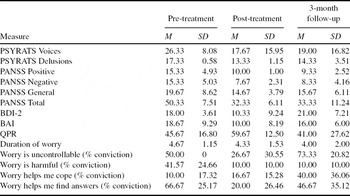
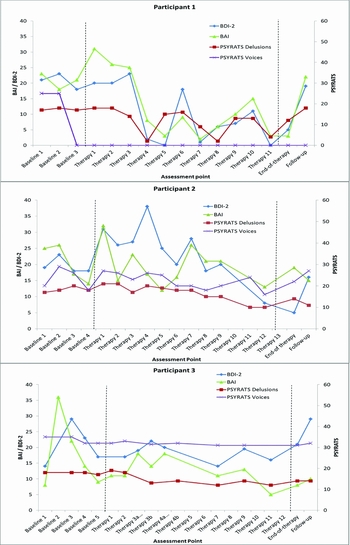
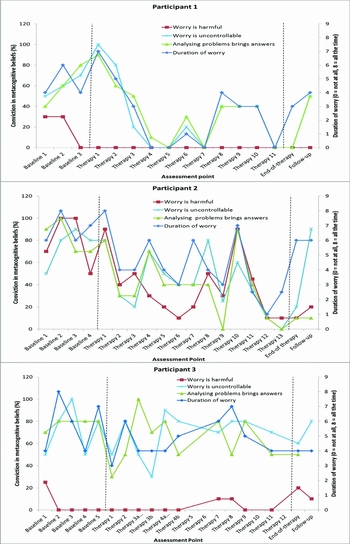
Each participant's PSYRATS, BDI-2 and BAI scores for every baseline assessment, therapy session, end-of-therapy and 3-month follow-up are displayed in Figure 2. Figure 3 shows each participant's scores on selected CAS-items measuring time spent worrying and conviction in key negative and positive metacognitions, over the same assessment points. Means and standard deviations for each outcome at baseline, end-of-therapy and follow-up are shown in Table 1. Table 2 shows the proportion of PANSS “resolution” items where participants scored less than 3.
Mean scores and standard deviations for each outcome measure across participants at baseline, end-of-therapy and follow-up

Proportion of PANSS “resolution” items scored less than 3

Each participant's ratings on the BDI, BAI and PSYRATS, from baseline to follow-up

Each participant's ratings on key items from the Cognitive Attentional Syndrome Scale, from baseline to follow-up

As shown in Figure 2, participant 1's PSYRATS auditory hallucination scores dropped substantially during the baseline period. This was because she reported voices that spontaneously remitted during the baseline assessments, before any therapy took place. Although we can speculate that therapy reduced the likelihood of recurrence, we suggest that focusing on PSYRATS delusion scores allows a more accurate assessment of treatment-attributable change. These scores are high and stable across the baseline period and become lower but more unstable throughout therapy. End-of-therapy scores suggest a substantial reduction of almost 30% from initial baseline; however follow-up scores suggest this improvement was not sustained. This same pattern was observed for BAI and BDI-2 scores as well as time spent worrying and degree of conviction in positive and negative metacognitions. The CAS and metacognition scores appear to decrease before psychotic symptom changes. This is consistent with the hypothesis that symptomatic change is achieved via modification of metacognitive beliefs and CAS deactivation. As shown in Table 2, BAI and BDI-2 scores at end-of-therapy were reduced by 87% and 76% respectively, compared to initial baseline. This improvement was not sustained; at follow-up her BDI-2 and BAI scores had returned to near baseline levels.
Participant 2's PSYRATS scores appeared to fluctuate to some degree over the baseline period and early stages of therapy. Change started to occur around therapy session 5 and by session 12 scores had reduced by almost 30% compared to baseline. This was not sustained by end-of-therapy and there was a slight increase in symptoms at follow-up. There was a large reduction of 63% in BDI-2 scores at end-of-therapy, despite these increasing markedly in the early stages of therapy. However this reduction was much smaller at follow-up (16%). There was a small 24% reduction in BAI scores at end-of-therapy compared to baseline, which grew to 40% at follow-up, suggesting any potential benefit was sustained. Although there was substantial variability in BAI scores throughout therapy, there was a clear and sustained reduction in conviction in target metacognitive appraisals. This was closely mirrored by a similar reduction in time spent worrying. This is again consistent with the hypothesis that metacognitive change leads to symptomatic improvement.
Participant 3 experienced a small but sustained reduction in PSYRATS auditory hallucination and delusion scores of at least 9% and 22% respectively. However this was associated with a concurrent 50–107% increase in BDI-2 scores and 25% worsening in BAI scores - the latter were very low at start and end, indicating only mild anxiety. The substantial variance in BDI-2 scores across baseline prevents us from confidently attributing the increase to potential negative effects of therapy. This fluctuation was mirrored by fluctuating conviction in key metacognitive appraisals and time spent worrying. Therapy did not appear to produce any major change in these indicators of CAS activation. This might indicate that metacognitive change is required for symptomatic improvement.
Clinically significant change
Our primary outcome measure was the PSYRATS. We decided, a-priori and on the basis of previous trials (Durham et al., Reference Durham, Guthrie, Morton, Reid, Treliving and Fowler2003), that a 25% reduction would be clinically worthwhile. On this basis, two out of our three participants achieved a clinically worthwhile improvement in PSYRATS delusion scores, one at end of treatment only, with a reduction of 29%, and another at follow-up only, with a reduction of 35%. For the latter participant, this improvement in delusions was accompanied by a comparable increase in hallucinations, as measured by PSYRATS hallucinations scores.
Our secondary measures suggest a somewhat different picture of change. As discussed, a reduction of 25% in PANSS total scores indicates clinically significant change in a group of patients whose symptoms are refractory to long-term antipsychotic treatment, while a 50% reduction reflects “much improvement” in this group (Leucht, Davis et al., Reference Leucht, Davis, Engel, Kissling and Kane2009). Under this criterion, two participants experienced clinically significant change, one of whom also experienced much improvement. The latter went on to experience a further reduction in symptoms at follow-up, while the former returned to near baseline levels. Overall, participant 3 experienced little change in PANSS total scores, participant 1 experienced clinically significant change, which was not sustained at follow-up, while participant 2 experienced much improvement, which was sustained at 3-month follow-up. Looking at symptom sub-groups, all participants experienced at least a 25% reduction in positive and negative symptoms by follow-up, compared to baseline; one experienced over a 50% reduction in negative symptoms, which was sustained at follow-up.
This picture of recovery is also reflected in the pattern of change on the QPR, our self-report measure of subjective recovery. Higher scores on this measure indicate greater subjective recovery. At end-of-therapy, participant 1 had a 43% increase, participant 2 had a 132% increase but participant 3 experienced a 27% reduction. At follow-up, participant 1's QPR scores had dropped by 76% compared to baseline, reflecting a substantial worsening. Participant 2's improvement appeared to be largely sustained, as reflected by a 90% increase compared to initial baseline. The reduction experienced by participant 3 had reduced somewhat at follow-up to 9%. Overall, one person had a significant improvement in recovery followed by a significant reduction, one had a large sustained improvement, and another experienced a significant reduction, which had returned to near baseline levels by follow-up.
Table 2 shows the proportion of resolution items scored 3 (mild) or less for each participant at baseline, end-of-therapy and follow-up. Although no participant achieved complete resolution (score of ≥3 on each item), the pattern of change is clearly moving towards this, with improvement on these items continuing at follow-up for two out of three.
Discussion
Summary of results
Based on our primary outcome measure, we found that a relatively short number of sessions of MCT were associated with a large, clinically significant reduction in the severity of delusions for two out of our three participants. Unfortunately, this change was not sustained for one person and for the other it was accompanied by an increase in hallucinations.
With the secondary outcome measures we found two out of three patients experienced large and clinically significant reductions in PANSS total scores, while all three experienced significant reductions (>25%) in PANSS positive and PANSS negative scores. We found two out of three experienced a large increase in self-rated recovery and a large decrease in depression and anxiety. These improvements continued at 3-month follow-up for one person, while the other lost the gains made and actually experienced a significant reduction in their sense of recovery, relative to baseline. Third, all patients moved towards resolution of symptoms, as indicated by their scoring 3 or less on a greater proportion of eight key PANSS items. This change largely persisted at follow-up.
We hypothesized that symptomatic change would closely follow change in metacognitive beliefs. This was supported by the pattern of responses on the CAS. The two participants who achieved symptomatic improvement also achieved a drop in conviction in positive and negative metacognitions. Participant 3, who did not respond, showed at best minimal change in conviction in negative metacognitions as well as an increase in positive beliefs about worry. In this case, treatment may have failed because of participant 3's long duration of illness, on-going stimulant use and adverse home environment. We also note she was the only participant not to have a care coordinator, meaning she received little support in her role as a carer or with her complex social issues.
Although our results are encouraging, we must also note the risk of adverse effects, since participant 3 had a large reduction in mood, increase in anxiety and reduction in subjective recovery. Participant 1 also experienced a large reduction in self-rated recovery at follow-up when compared to baseline.
Limitations
Several factors limit our ability to generalize from our study. First, there were only three participants. Although case studies and case series such as ours are an essential first step in the process of developing and testing a new intervention, only a clinical trial can provide definitive evidence of efficacy. Second, although the main assessments were completed by an independent experienced assessor, our design meant they could not be blinded. Given that use of non-blinded assessors is associated with inflated estimates of effect size in clinical trials of CBT for psychosis (Wykes et al., Reference Wykes, Steel, Everitt and Tarrier2008), future studies of MCT for psychosis should, if the design allows, employ independent and blinded raters. Third, our lack of a comparison group reduces our ability to confidently attribute change to therapy. Definitive conclusions must await the results of a randomized controlled trial. Changes in medication during treatment in two of the cases means that any observed effects could be attributed to this factor. It is also the case that the baseline PANSS assessment was only administered at the start of the multiple baseline period, and therefore any change in this measure includes change occurring during the baseline. Inspection of the graphs suggests this is an issue for interpreting participant 1's scores, whose auditory hallucinations resolved spontaneously during the baseline period. Our assessment of clinically significant change on the PSYRATS was also based on change from initial baseline, rather than last baseline. This could lead to an inaccurate estimate of treatment-attributable change; however, inspection of the graphs suggests this is only an issue for interpreting change in PSYRATS hallucinations of participant 1 (as discussed in the results section).
Conclusion and recommendations
Two out of three participants with long-standing, treatment-resistant psychotic symptoms appeared to achieve a clinically worthwhile benefit associated with MCT; all three experienced a reduction in positive and negative symptoms according to the PANSS. Treatment lasted between 11 and 13 hours, suggesting MCT may be a less time-intensive option for service-users. However, one participant experienced minimal improvement in symptoms, together with a reduction in mood and subjective sense of recovery. Furthermore, one participant who did respond did not maintain gains at follow-up. In interpreting these results, the obvious differences between the person who worsened and the two who recovered or stayed the same was a longer duration of illness (40 years versus 15–20), presence of complex substance-use problems, and a highly stressful home environment. In the therapist's clinical judgement, the latter was the primary reason for the deterioration. However, it is notable that MCT did not help this individual cope with these circumstances. On the other hand, there are also factors that made it more probable that participants 1 and 2 may have been more likely to improve, regardless of whether they received therapy. Both had supportive families, both abstained from drug and alcohol use, and both had a change in medication.
It is also important to set these results in context. For example, according to a recent meta-analysis, some 24% of participants demonstrated a clinically significant response to placebo alone in short-term trials of modern antipsychotics (Leucht, Arbter et al., Reference Leucht, Davis, Engel, Kissling and Kane2009). In the largest, longest and arguably best-designed study of CBT, some 40–50% of participants receiving befriending demonstrated at least a 50% improvement in symptoms (Sensky et al., Reference Sensky, Turkington, Kingdon, Scott, Scott and Siddle2000). Non-specific factors (e.g. hope, expectation, companionship), natural recovery or other variables (e.g. rater bias) seem to contribute in large part to the efficacy of existing treatments. Our multiple baseline period may not have been long enough to control for these effects.
Another issue is whether our working formulation was appropriate and acceptable. We conceptualized negative thoughts rather than psychotic experiences as the trigger for the development of distress. It could be argued that this fails to recognize that for many people the content of their experiences (e.g. derogatory voices, or visions of evil entities) can be very distressing, even if one is not prone to worry. Clinical experience suggests that the person who believes the world is about to end, or that they have been possessed by a demon, may find it somewhat difficult to detach from what might be perceived as life or death concerns. A metacognitive model that acknowledges the importance of experience, cognition and metacognition in determining distress may have greater face validity with patients and providers.
Our results suggest MCT for psychosis should be evaluated further. A larger case series might be useful to see if any modifications are required for this group. Such studies might consider incorporating a qualitative element, allowing careful assessment of participants’ views on the acceptability and accuracy of the metacognitive model and therapy approach. Our results might suggest MCT may need to be delivered for longer if change is to be sustained. The role of insight and conviction in responsiveness to MCT might also be important to consider. Perhaps it would be easier for patients to detach from their thoughts if they are able to contemplate that they might not be entirely realistic? Another important issue is whether all people with psychosis have the requisite capacity to think about their thoughts and feelings and, if not, whether this is something MCT can help to improve (Lysaker et al., Reference Lysaker, Buck, Carcione, Procacci, Salvatore and Nicolo2011). Although we did not detect major problems in self-reflectivity, these may become apparent in a larger case-series.
If and when the active ingredients of MCT for psychosis are identified, comparison to treatment as usual using a randomized controlled design and blind raters would help to establish benefits and costs of the treatment, as well as ensuring it does not cause harm. For definitive assessment of value, MCT should at some stage be compared to the most established psychological treatment for psychosis, currently cognitive behavioural therapy.
Acknowledgements and declaration of interests
We thank each participant for taking part in this study, and clinical staff who assisted with the study. We also thank Paul French, Nicola Chapman and Sophie Parker for their advice and support throughout the project, and we acknowledge with gratitude the very helpful comments of anonymous reviewers.
The authors report no known actual or potential conflict of interests.




Comments
No Comments have been published for this article.