To respond effectively to major natural disasters by giving relief and preventing diseases and to satisfy the need to fight terrorism, 22 medical emergency forces have been organized since 2004 across China to cope with events related to natural disasters, accidents, public health, and social security. These forces cover 7 major areas: central China, South China, East China, North China, Northeast China, Northwest China, and Southwest China. As a state-level emergency medical rescue team, the medical rescue team of a certain affiliated hospital from the Chinese People’s Armed Police Forces (PAPF) has participated repeatedly in a sequence of medical rescue work including the Wenchuan Earthquake, Great Khingan Fire, Landslide in Jixian County of Tianjin, and Ya’an Earthquake. To date, this force has become an emergency rescue force ready to provide 24-hour and whole-factor medical services.
General Situation
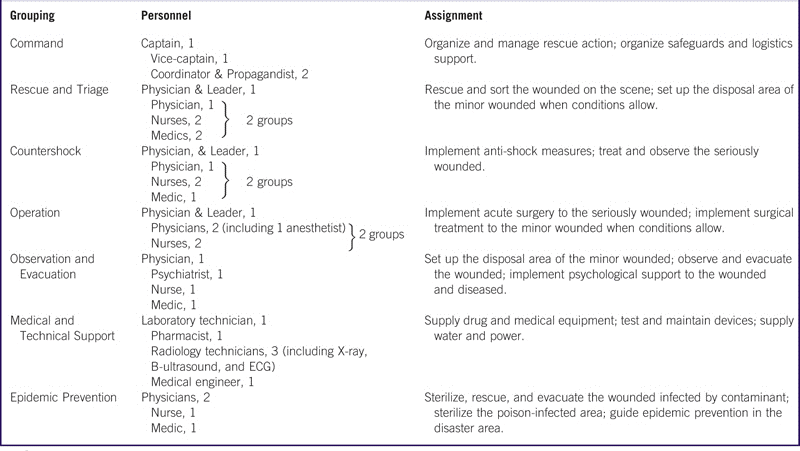
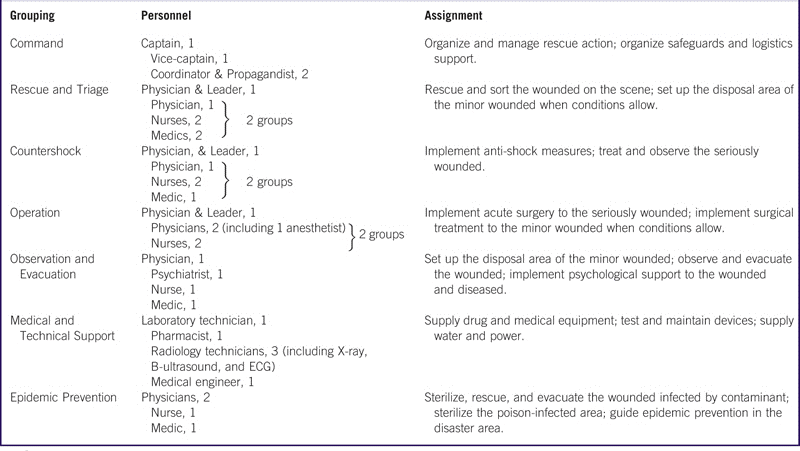
The medical rescue team is composed of officers in active service who are 32 years old on average. The team is focused mainly on domestic medical rescue tasks. The team is divided into 7 groups; more details are given in Table. Ordinarily, the team members are distributed in every division of the hospital, and once an order is given, they gather together immediately to go into action.
Grouping of Team and Personnel Compositions of Every GroupFootnote a
a ECG indicates electrocardiogram.
Grouping Mode
Currently, the team adopts 3 grouping modes to divide its members into groups based on the nature, the characteristics, and the rescue range of the task to be undertaken.
Small-Scale Grouping
This grouping mode is finished in 20 minutes to set out for action. With 10 to 20 people, it is focused on first aid in the field and is performed in groups.
Medium-Scale Grouping
This grouping mode is finished in 40 minutes to set out for action. With 30 to 50 people, it is centered on comprehensive treatment and is performed in a mobile hospital.
Large-Scale Grouping
This grouping mode is completed in 24 hours to set off for action. With 100 people, it is conducted mainly in the form of a shelter hospital that can carry out early treatment, specific treatment, and multidisciplinary joint treatment.
Equipment System
By way of allocation from higher authorities, self-research and development, repackaging, purchase, and other means, the team has amassed a full set of equipment composed of portable equipment, box-grouped equipment, field tent hospital, mobile hospital, and shelter hospital.
Portable Equipment
In accordance with the Field Medical Device Reserve Standard formulated in 2002, portable equipment consists of 7 kinds of knapsacks used for first aid, debridement, diagnosis and treatment, water testing and poison detection, other kinds of tests, and epidemic prevention and a power sprayer.
Box-Grouped Equipment
This equipment consists of 13 types of equipment such as surgical equipment, first aid equipment, auxiliary diagnosis equipment, field medical devices, and so on. The boxes are made of strong-intensity fiber and are featured with anti-vibration, waterproofing, portability, and good night sighting.
Tent Hospital
This hospital is composed of a military net-frame tent, a gas-filled tent, a tent big enough for a squad, and a tent for cooking. The tent hospital can be used not only to set up a temporary medical aid station by itself, but also to carry out a joint effort with a mobile hospital to form a general field hospital.
Mobile Hospital
This hospital is made up of a test and operation vehicle, medical equipment vehicle, transport and camping vehicle, medical service command and camping vehicle, medical and technical support vehicle, and medical care assurance vehicle. The mobile hospital can fulfill a set of functions in field conditions, such as integration of testing and operation, storage, encampment, real-time medical service command, information transmission, auxiliary diagnosis, and oxygen supply in high-altitude places.
Shelter Hospital
This hospital is composed of 8 core medical shelters, 8 gas-filled tents, and 11 independent supporting vehicles. The shelter hospital is equipped with an automated command information system, real-time data transmission system for patient data, and an operating room with 10,000-degree laminar flow purifying functions. It can play a significant role in earthquakes and other major disastrous events.
Training Mode
After continuous exploration and attempts, the medical rescue team has optimized its training modes as follows: hierarchical training, professional training, categorized training, and comprehensive drilling.
Hierarchical Training
In line with hierarchical training, rescue team members are trained according to the task for which they are responsible. For example, the commander’s training is focused on on-scene command, rescue coordination, situation estimation, campsite management, laws and regulations, communication with the media, etc.
Professional Training
This training is conducted according to general skills, basic skills, and special skills. All members have to grasp general skills or knowledge about search and rescue, communication, outdoor survival, self-aid and buddy aid, and religious beliefs. Basic skills include ventilation, dressing, hemostasis, immobilization, and transportation. Special skills are those concerning burns, frostbites, amputation, crush injury, countershock, and emergency rescue operations.
Categorized Training
This training is conducted according to the size of the rescue team. The rescue team with 10 or 20 members gets trained in such aspects as rapid assembling and setting off, application of field first-aid skills, etc. The mobile hospital trains its members from the aspect of setting up a temporary medical aid station, performing comprehensive rescue, and performing a proportion of emergency operations. The shelter hospital launches its training from the aspect of operation of the shelter hospital, treatment of the critically injured, multi-channel evacuation, and sanitation and epidemic prevention.
Comprehensive Drilling
After the accomplishment of individual training, comprehensive drills are conducted that include indoor drills, long-distance mobile marching and camping training, and coordinative drills with search and rescue detachments. After continual simulated drilling, a comprehensive rescue mode of “search-rescue-medicine” has been established in the rescue team.
Rescue Practice in Ya’an Earthquake on April 20
On April 20, 2013, an earthquake of magnitude 7.0 occurred in Lushan County, Ya’an city of Sichuan Province. The earthquake resulted in great casualty and property damage owing to its strong intensity and wide coverage. As soon as the earthquake happened, the National Health and Family Planning Commission decided to assign our state-level emergency medical rescue team to perform the rescue task. On the basis of the analysis of the casualties from the earthquake, the geographical and environmental features of the earthquake-stricken area, and the main task on the scene, 22 members were selected according to the small-scale grouping mode to form a medical rescue team. With one million yuan’s worth of portable equipment including medical instruments and medicines, the team rushed to the stricken area to carry out the medical rescue work.
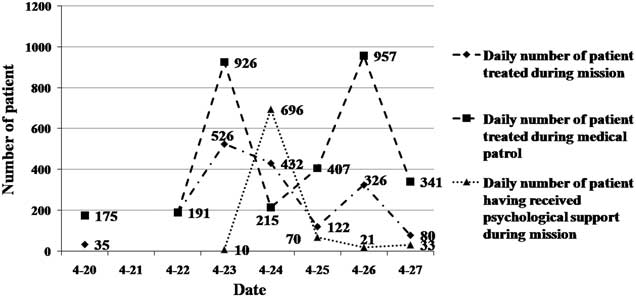
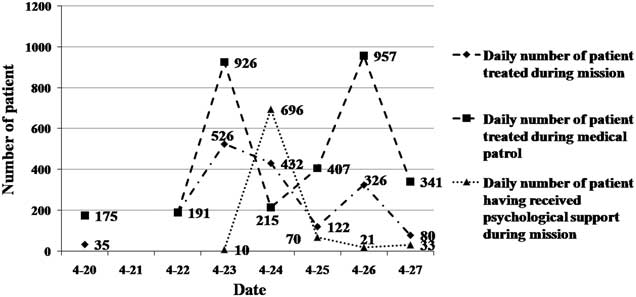
It took the rescue team 8 days to accomplish its mission. The rescue team had made its medical patrol in 1 city, Ya’an city; 2 counties, Lushan County and Baoxing County; 4 towns, Lingguan, Muping, Wulongxiang, and Laochangxiang; 6 villages, Goushan, Xueshan, Xinxiang, Xiaoyu, Xinbao, and Modao; 1 community, Muping community; and 150 resettlement places for earthquake victims. The relief work ranged from providing home services, disease diagnosis and treatment, and psychological support to conducting health education, sanitation, and epidemic prevention. In total, the team’s journey on foot amounted to more than 700 kilometers with 3212 victims diagnosed, 1712 treated, 830 given mental services, and 3 evacuated. More details are given in Figure.
Distribution of Patients Treated During the Mission. Injuries were mostly bone fractures, brain trauma, crush injury, chest trauma, skin scratches, and articular strains. Diseases consisted mainly of upper respiratory tract infections, diarrhea, leg pain, and dermatosis. April 21st witnessed the walk from Ya’an City to Baoxing County.
This action was characterized by three features. First, action was taken rapidly. From the minute the rescue team received the order to the time they received the first patient, they took only 10 hours. They were the first national rescue team who came to the stricken area from other provinces within 10 hours after the earthquake. Second, the rescue task covered almost all aspects of rescue work ranging from giving field first aid, evacuating the badly ill, and conducting health education, sanitation, and epidemic prevention activities. Third, there was no depletion of strength in the team during the rescue work. For all the aftershocks in the stricken area, the landslide, building collapses, debris flow, and other secondary disasters, no members of the rescue team were injured or became ill enduring the operation. This lack of injury speaks well of the normative drillings the team received during ordinary time and the well-organized command on the scene, both of which laid a solid foundation for the satisfactory accomplishment of the rescue work.
Conclusions
In the past 30 years, disasters have happened with increasing frequency and intensity and will continue to happen in the years to come.Reference Hoyois, Below and Scheuren Guha-Sapir 1 To respond effectively to disasters and to reduce the resulting damage, countries around the world have put great efforts into the research and operation of emergency medical rescue, which has greatly improved the construction and development of emergency medical rescue forces.Reference Koenig and Schultz 2 As early as in 1998, a National Disaster Medical System (NDMS) was developed in the United States. In the system there was a Deployable Rapid Assembly Shelter/Surgical Hospital (DRASH), which was a self-contained field hospital complete with triage, operating room, and intensive care unit areas. In Iran’s Bam Earthquake in 2003, this hospital played a significant role.Reference Owens, Forgione and Briggs 3 In addition, there are nearly 108 disaster medical assistance teams (DMATs) in the United States. Composed of 35 members on average including physicians, nurse practitioners, logistical personnel, pharmacists, physician assistants, respiratory therapists, paramedics, and emergency medical technicians, each DMAT can be deployed completely within 24 to 72 hours and sustains itself for 14 days.Reference Fuse and Yokota 4 The function of a DMAT from the United States is analogous to that of the mobile hospital we formed in the medium-scale grouping, but the composition of the DMAT is more comprehensive. Japan is a country frequently attacked by natural disasters and it was the Hanshin-Awaji Earthquake in 1995 that prompted the publication of the Japanese Basic Disaster Management Plan and the development of DMATs. To date, 734 DMATs have been organized in Japan. Composed of 5 to 6 members on average including physicians, nurses, and logistic personnel, they can be deployed in 6 to 24 hours and can support themselves for 72 hours. The function of a DMAT from Japan is similar to that of our tent hospital formed in the small-scale grouping, and these teams played a very important role in the Niigata Earthquake in 2007, Iwate-Miyagi Earthquake in 2008, and the Great East Japan Earthquake in 2011.Reference Aitken, Leggat and Harley 5 Other countries, such as Australia, also have many state-run DMATs such as Alpha, Bravo, Charlie, and Delta from New South Wales, Queensland, and Victoria and Echo from South Australia. Composed of 5 to 25 members, they are fully functional and strongly self-supported and all participated in the rescue work of the 2004 Tsunami in Southeast Asia.Reference Aitken, Leggat and Harley 5 As always, the army has played an irreplaceable role in the course of disaster rescue tasks. In 2010, Haiti was attacked by an earthquake of 7.0 magnitude killing 230,000 people and injuring 250,000. After the earthquake, a field hospital composed of 121 active servicemen was sent by Israel to join in the rescue work, and within 10 days, a total of 1111 patients were triaged according to their injuries and 737 patients were hospitalized.Reference Kreiss, Merin and Peleg 6 In the same way, when the Wenchuan earthquake took place, we adopted the maximum grouping principle to form a shelter hospital, and 100 members took part in the medical rescue task. As a result, the rescue team was able to receive in a timely manner and effectively treat a large number of patients.
Since the Emergency Response Law of PRC was enacted in 2007, nationwide, four-level emergency response networks covering state, province, city, and county have been established and several emergency medical rescue forces have been organized to go with the networks. Among these, our rescue team is the only state-level emergency medical rescue team from the PAPF. Since its foundation and with continual research and demonstrations, readjustment in drills, and practice tests, our medical rescue team has established a strikingly characteristic development pattern adaptable to domestic disaster medical rescue work from the perspective of the grouping method, equipment system construction, and group training model. To date, our team has been successful in fulfilling pressing, difficult, dangerous, and challenging tasks such as earthquake disaster response.
Acknowledgments
We thank our colleagues from the affiliated hospital of Logistics University of Chinese People’s Armed Police Forces who provided much information about the emergency medical rescue team.