Introduction
An association between a diagonal earlobe crease and cardiovascular disease was first suggested by Sanders T Frank in 1973 in the New England Journal of Medicine.Reference Frank1 Since then, there have been numerous further studies that have investigated the association of ‘Frank's sign’ with carotid disease, cerebral vascular disease and diabetic retinopathy. Although almost all of the studies since then have found a correlation between diagonal earlobe crease and cardiovascular disease, there is disagreement on whether this is an independent association or whether both of these are related to increasing age or other potential confounding cardiovascular risk factors.Reference Brady, Zive, Goldberg, Gore and Dalen2
The purpose of this meta-analysis was therefore to determine if there is a significant association between the presence of a diagonal earlobe crease (Figure 1) and coronary artery disease independent of other risk factors. Although there have been other reviews that have looked into this,Reference Lucenteforte, Romoli, Zagli, Gensini, Mugelli and Vannacci3 these have included autopsy studies or clinically diagnosed coronary artery disease, and none have specifically looked at studies solely using coronary angiography which is the ‘gold standard’ for confirming coronary artery disease.Reference Kamal, Kausar, Qavi, Minto, Ilyas and Assad4–Reference Tranchesi, únior, Barbosa, de Albuquerque, Caramelli, Gebara and Santos Filho6 At the same time, although this is an aural sign, there have been no studies in any otology journals and no reports in any otolaryngology literature.
Examples of diagonal earlobe creases.

We believe this is the first literature review and meta-analysis that solely looks at patients with diagonal earlobe crease undergoing angiography and the first article about this topic in an otology publication despite it being an important sign for otologists to be aware of.
Materials and methods
Protocol and information sources
The Preferred Reporting Items for Systematic reviews and Meta-Analyses checklistReference Moher, Liberati, Tetzlaff and Altman7 was used to report this review. The PubMed database was searched on 12 August 2020 using the following separate terms: ear lobe crease(s), earlobe crease(s) and Frank's sign.
Study selection, data collection and bias
Retrieved studies were filtered on title and abstract, and where there was any doubt, the study was accepted to the next level. Only original studies equal to or above Oxford Centre for Evidence-Based Medicine level 4 evidence8 that reported on the presence of a diagonal earlobe crease in patients undergoing coronary angiography were included. Selected studies were then assessed independently by both authors for quality and bias using Critical Appraisal Skills Programme checklists.9 Differences were resolved by discussion. Objective data were extracted from the studies and summarised into tables, and meta-analysis was performed using Revman review software (version 5.4).10
Results
Study selection
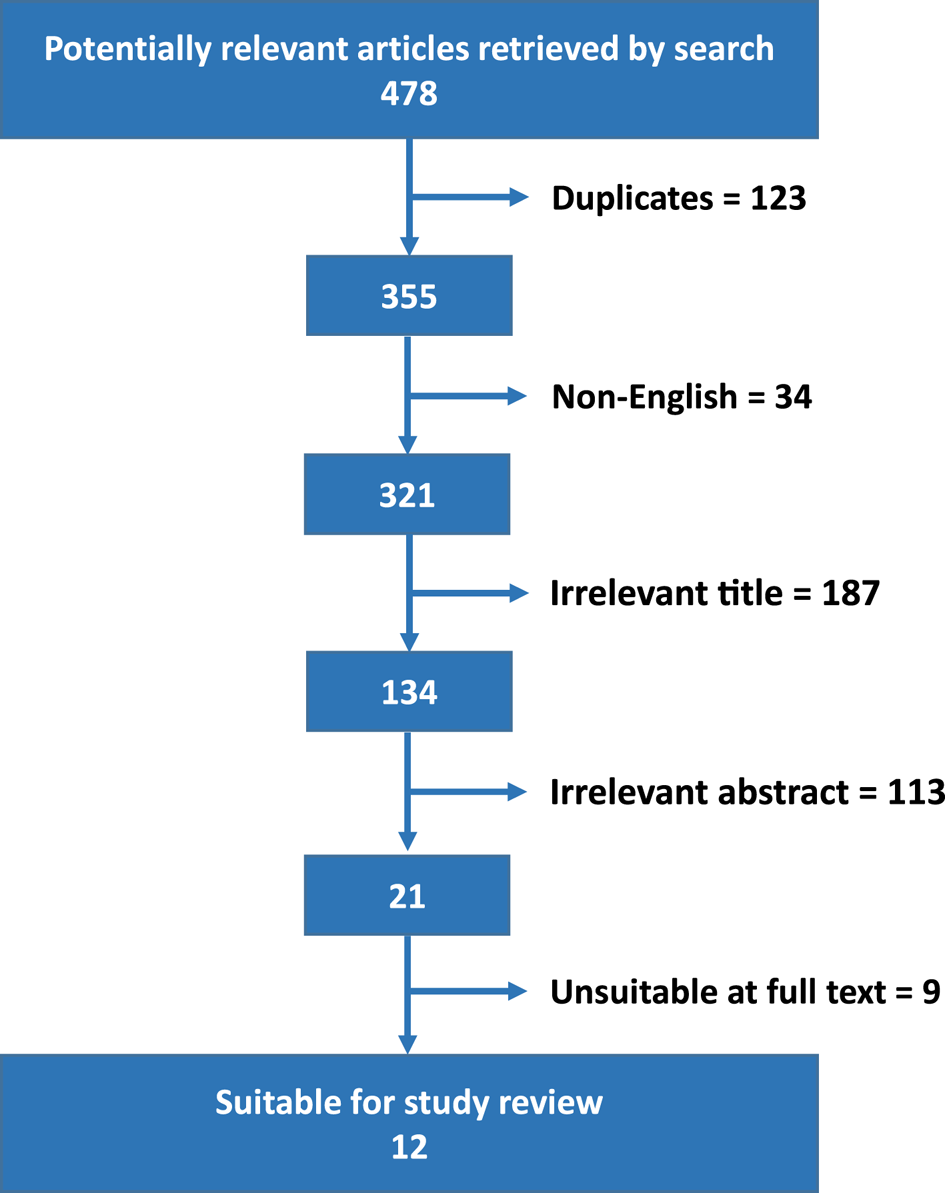
The search retrieved 355 individual studies that were filtered by language, title and abstract, leaving 21 original studies. Nine studies were then excluded at full text, mostly for not reporting on patients who had undergone coronary angiography, although one study was excluded for unclear resultsReference Brady, Zive, Goldberg, Gore and Dalen2 and another excluded for reporting on the same patients as another study.Reference Shmilovich, Cheng, Rajani, Dey, Tamarappoo and Nakazato11 This left 12 original studies published between 1974 and 2017 included in this review. Figure 2 shows the selection process.
Flow diagram of study selection process.

Study Characteristics
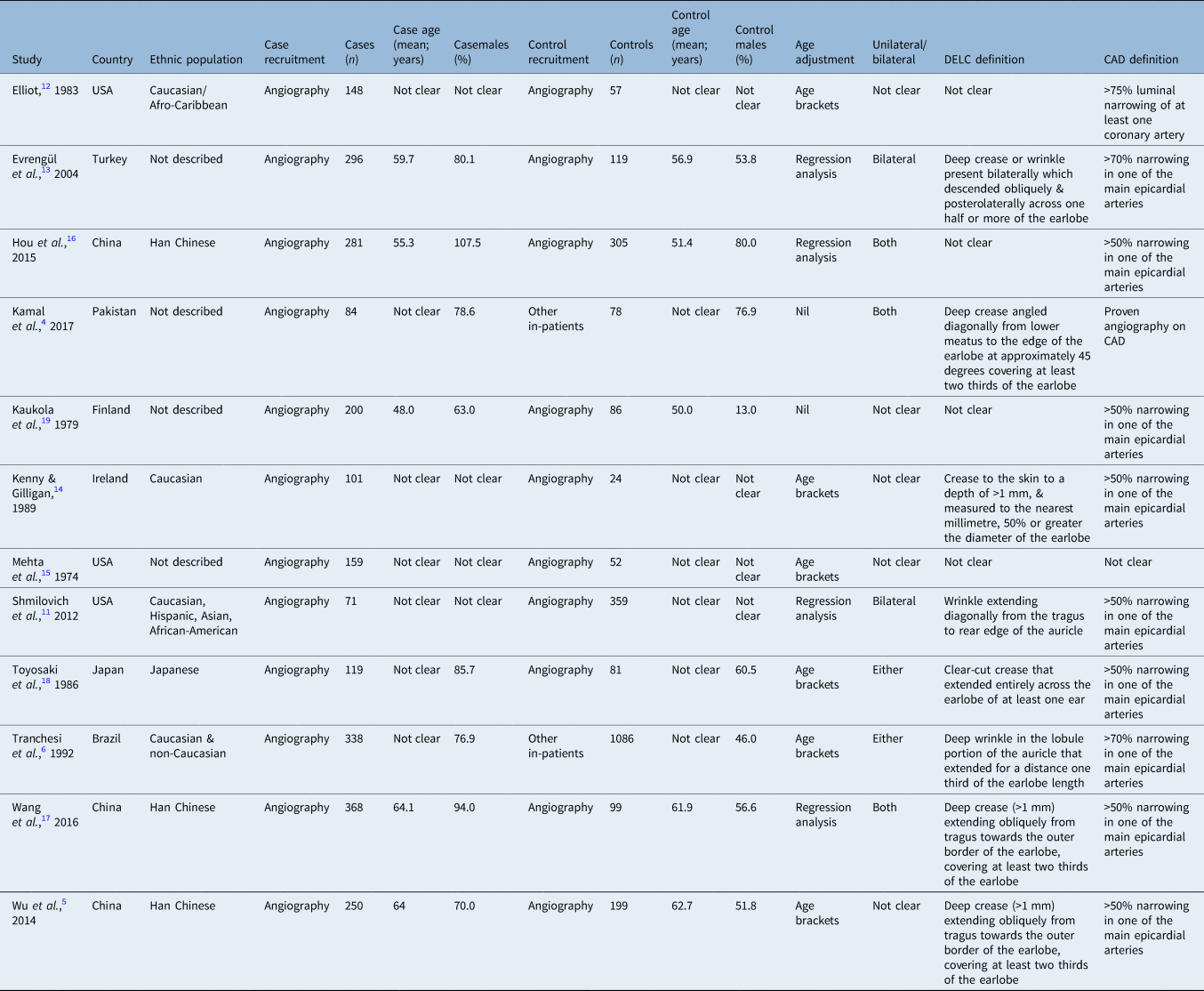
Key characteristics of the 12 studies are included in Table 1 and assessed quality of studies is shown in Appendix 1. All the studies were case-control studies and cumulatively included 4960 patients (minimum, 125; maximum, 1424) across 8 countries, and it is unlikely that this involved any duplicated patients because of the geographical and chronological spread of the studies. For each study, the case population was well described as patients undergoing coronary angiography. Most studies reported relatively consistent definitions of diagonal earlobe crease. This was typically a deep crease extending obliquely from the tragus towards the outer border of the earlobe, although the distance varied from a third to complete. All studies defined the presence of coronary artery disease as more than 50 per cent stenosis of at least one major epicardial vessel, except for 3 studies that used a threshold of more than 70 per cent stenosis.Reference Tranchesi, únior, Barbosa, de Albuquerque, Caramelli, Gebara and Santos Filho6,Reference Elliott12,Reference Evrengül, Dursunoğlu, Kaftan, Zoghi, Tanriverdi and Zungur13
Key characteristics of included studies

DELC = diagonal earlobe crease; CAD = coronary artery disease
Risk of bias within studies
Bias was mostly excluded from studies by the presence of diagonal earlobe crease being measured without knowing the cardiac history shortly before angiography and with fairly consistent definitions of diagonal earlobe crease and coronary artery disease. No patients were lost to attrition; however, two studiesReference Kamal, Kausar, Qavi, Minto, Ilyas and Assad4,Reference Tranchesi, únior, Barbosa, de Albuquerque, Caramelli, Gebara and Santos Filho6 used non-cardiac patients as controls, and it was assumed they had no coronary artery disease without undergoing angiography. Other potential biases are mentioned in the Results.
Overall results of studies
All 12 studies were included in the pooled analysis. This included 2415 cases and 2545 controls. The pooled results (Figure 3) suggested that patients with diagonal earlobe crease have an increased likelihood of having coronary artery disease (odds ratio, 4.61; 95 per cent confidence interval (CI), 3.17 to 9.60). There was significant heterogeneity among studies (I2 = 83 per cent; p < 0.00001), and the test for overall effect, Z, was 8.01 (p < 0.00001). Ten of the 12 studies found a significant association between diagonal earlobe crease and coronary artery disease. The two studies that found no significant associationReference Kenny and Gilligan14,15 were poorer quality studies, which both attributed their findings to age without any statistical analysis.
Forest plot of diagnostic odds ratios. CI = confidence interval; M-H = Mantel–Haenszel; df = degrees of freedom.

Sensitivity and specificity
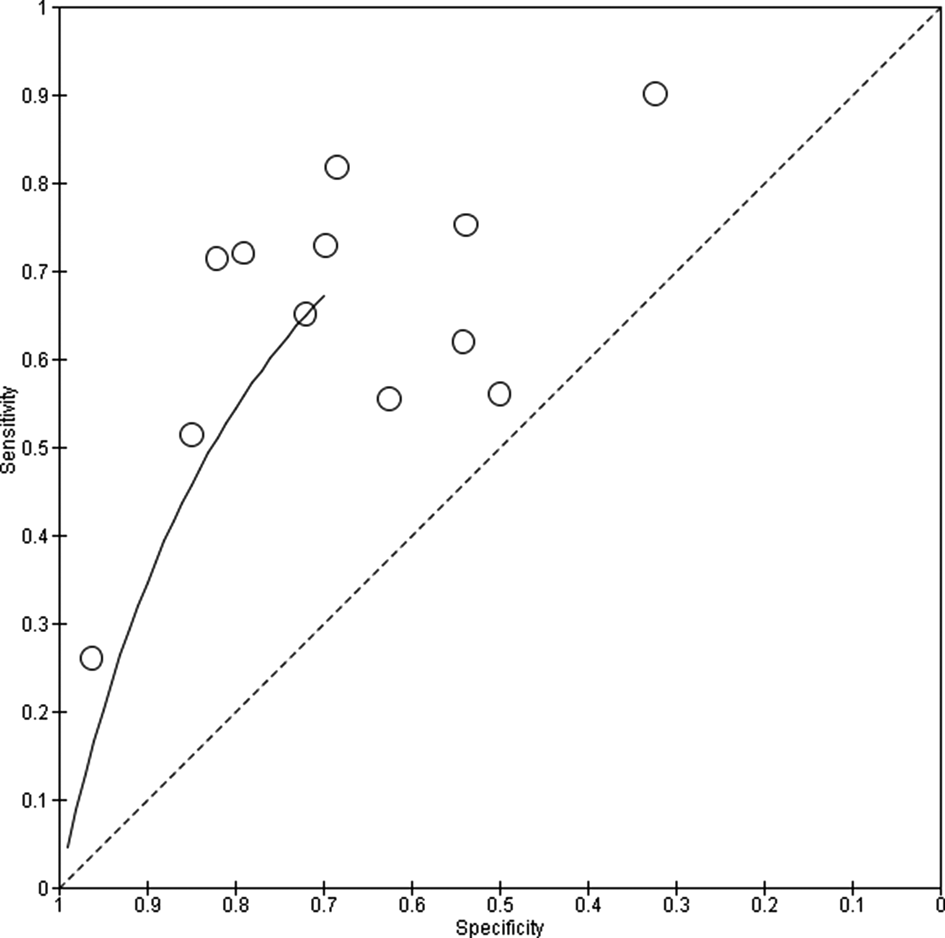
Sensitivity of diagonal earlobe crease as a diagnostic test for coronary artery disease ranged from 0.26 to 0.90, and specificity ranged from 0.32 to 0.96 (Figure 4). This variance, as demonstrated on the receiver operating characteristic curve (Figure 5), suggested that diagonal earlobe crease by itself is not suitable as a diagnostic test for coronary artery disease.
Sensitivity and specificity of studies. TP = true positive; FN = false negative; FP = false positive; TN = true negative; CI = confidence interval.

Receiver operating characteristic curve.

Bilateral versus unilateral diagonal earlobe crease
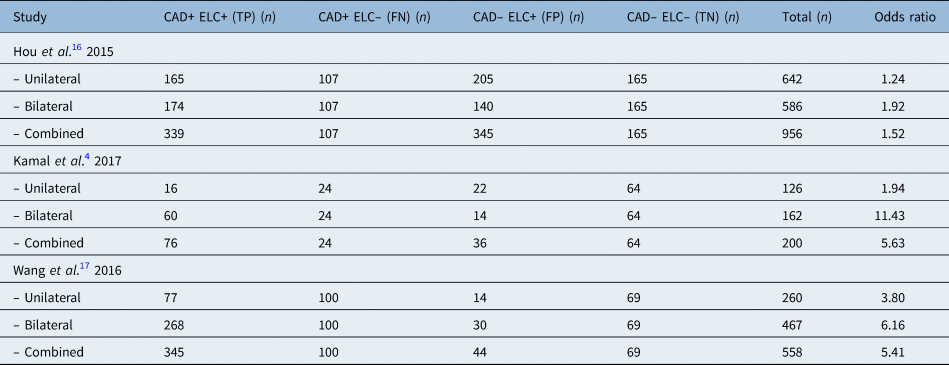
Three studies investigated unilateral and bilateral diagonal earlobe crease separately,Reference Kamal, Kausar, Qavi, Minto, Ilyas and Assad4,Reference Hou, Jiang, Wang, Shen, Wang and Zhong16,Reference Wang, Mao, Jia, Li, Ding and Ge17 two studies just looked at bilateral diagonal earlobe crease,Reference Shmilovich, Cheng, Rajani, Dey, Tamarappoo and Nakazato11,Reference Evrengül, Dursunoğlu, Kaftan, Zoghi, Tanriverdi and Zungur13 two studies included both unilateral and bilateral diagonal earlobe crease combined,Reference Tranchesi, únior, Barbosa, de Albuquerque, Caramelli, Gebara and Santos Filho6,Reference Toyosaki, Tsuchiya, Hashimoto, Kawasaki, Shiina and Toyooka18 and in five studies it was not clear which was used. Although this raises concerns, it is noted that in the three studies that compared bilateral and unilateral diagonal earlobe crease, unilateral diagonal earlobe crease was found to have either a reduced association with coronary artery diseaseReference Wang, Mao, Jia, Li, Ding and Ge17 or no significant association.Reference Kamal, Kausar, Qavi, Minto, Ilyas and Assad4,Reference Hou, Jiang, Wang, Shen, Wang and Zhong16 The breakdown is shown in Table 2. It is therefore believed that in any studies that included unilateral diagonal earlobe crease with bilateral diagonal earlobe crease, there would have been a diluting effect in the odds ratio and association with coronary artery disease.
Breakdown of diagnostic odds ratio for unilateral versus bilateral diagonal earlobe crease

CAD = coronary artery disease; ELC = earlobe crease; TP = true positive; FN = false negative; FP = false positive; TN = true negative
Age
In studies that reported a mean age, there was good comparison between case and control groups (Table 1). Ten of the studies looked at the association with age, either by looking at different age cohorts or by performing multivariate regression analysis. Of these 10, 4 studies looking at cohorts found a significant association between diagonal earlobe crease and coronary artery disease in all age brackets investigated,Reference Wu, Yang, Zhao, Chai and Jin5,Reference Tranchesi, únior, Barbosa, de Albuquerque, Caramelli, Gebara and Santos Filho6,Reference Elliott12,Reference Toyosaki, Tsuchiya, Hashimoto, Kawasaki, Shiina and Toyooka18 and four,Reference Shmilovich, Cheng, Rajani, Dey, Tamarappoo and Nakazato11,Reference Evrengül, Dursunoğlu, Kaftan, Zoghi, Tanriverdi and Zungur13,Reference Hou, Jiang, Wang, Shen, Wang and Zhong16,Reference Wang, Mao, Jia, Li, Ding and Ge17 using multivariate regression analysis, found that diagonal earlobe crease was independently and significantly associated with coronary artery disease when compared with age. Only two studiesReference Kenny and Gilligan14,15 suggested that diagonal earlobe crease was directly a result of age, and they provided no statistical analysis to support their view. Of the four studies that looked at different age cohorts, only oneReference Tranchesi, únior, Barbosa, de Albuquerque, Caramelli, Gebara and Santos Filho6 provided enough detail to look at the diagnostic odds ratio for different 10-year age cohorts. There was no obvious pattern with the ratios although the diagnostic odds ratio was greatest in the youngest cohort (less than 40 years old) and smallest in the oldest cohort (more than 70 years old).
Gender
It was noted that most studies that recorded gender had a disparate gender ratio between the case and control groups (Table 1). This is partly explained as female patients have a lower prevalence of coronary artery disease and are therefore more likely to be in the control group; however, only Kamal et al. gender-matched each group.Reference Kamal, Kausar, Qavi, Minto, Ilyas and Assad4 Although there was a reported increased prevalence of diagonal earlobe crease and coronary artery disease in male patients in most studies, only one studyReference Wang, Mao, Jia, Li, Ding and Ge17 looked at the odds ratio for both genders independently and found that women had a greater association between diagonal earlobe crease and coronary artery disease (female odds ratio, 6.368; 95 per cent CI, 2.961 to 13.694 vs male odds ratio, 5.420; 95 per cent CI, 2.804 to 10.477). No other studies reported results in sufficient detail to allow comparison with this study.
Ethnicity
Only two studies looked at different ethnic populations separately within their study. OneReference Tranchesi, únior, Barbosa, de Albuquerque, Caramelli, Gebara and Santos Filho6 found that diagonal earlobe crease was more prevalent in Caucasian than non-Caucasian populations, but there was still a significant association with coronary artery disease in both groups. AnotherReference Elliott12 attempted to investigate this as well, but cases and controls were not well matched on gender and race, and no meaningful results were obtainable. Overall, the 12 studies covered multiple ethnic populations from around the globe, and it is believed that this suggests the findings are applicable to a wider population, although variations between ethnic groups cannot be excluded.
Other cardiovascular risk factors
Eight of the studiesReference Wu, Yang, Zhao, Chai and Jin5,Reference Shmilovich, Cheng, Rajani, Dey, Tamarappoo and Nakazato11,Reference Evrengül, Dursunoğlu, Kaftan, Zoghi, Tanriverdi and Zungur13,Reference Kenny and Gilligan14,Reference Hou, Jiang, Wang, Shen, Wang and Zhong16–Reference Kaukola, Manninen, Valle and Halonen19 used multivariate regression analysis to look at the relationship between diagonal earlobe crease and other conventional cardiovascular risk factors including hypertension, hyperlipidaemia, smoking status, diabetes mellitus, obesity and family history. Although four studiesReference Shmilovich, Cheng, Rajani, Dey, Tamarappoo and Nakazato11,Reference Evrengül, Dursunoğlu, Kaftan, Zoghi, Tanriverdi and Zungur13,Reference Wang, Mao, Jia, Li, Ding and Ge17,Reference Toyosaki, Tsuchiya, Hashimoto, Kawasaki, Shiina and Toyooka18 found a significant correlation between diagonal earlobe crease and certain risk factors, such as age, male gender, hypertension and smoking status, this did not correspond with the presence of coronary artery disease. Instead, all eight studies found that diagonal earlobe crease was independently and significantly associated with coronary artery disease when compared against all conventional risk factors.
Severity of disease
Four studies looked at the association between diagonal earlobe crease and severity of coronary artery disease as assessed by the number of stenosed coronary arteries. Of these, twoReference Hou, Jiang, Wang, Shen, Wang and Zhong16,Reference Toyosaki, Tsuchiya, Hashimoto, Kawasaki, Shiina and Toyooka18 found no significant association between the number of diseased vessels and diagonal earlobe crease, but twoReference Wu, Yang, Zhao, Chai and Jin5,Reference Tranchesi, únior, Barbosa, de Albuquerque, Caramelli, Gebara and Santos Filho6 found that multi-vessel disease was more common in patients with diagonal earlobe crease.
Publication bias
No publication bias across studies was found, especially as two of the included studiesReference Kenny and Gilligan14,15 suggested that there was no association between diagonal earlobe crease and coronary artery disease.
Discussion
Summary of evidence
This study investigated if there was a significant association between the presence of a diagonal earlobe crease (diagonal earlobe crease) and coronary artery disease independent of age. By using the ‘gold standard’ diagnosis for coronary artery disease, angiography, we were able to provide a more objective analysis than other reviews that have included autopsy studies and clinically diagnosed heart disease.Reference Lucenteforte, Romoli, Zagli, Gensini, Mugelli and Vannacci3 Our study found that patients with diagonal earlobe crease have an increased likelihood of having coronary artery disease. In addition, despite some previous studies suggesting that diagonal earlobe crease was simply a result of age, all 10 of the included studies that looked at this found that the relationship between diagonal earlobe crease and coronary artery disease was independent of age and all other conventional cardiovascular risk factors.
We also looked to see if the diagnostic odds ratio varied between different cohorts. In looking at different age groups, only one studyReference Tranchesi, únior, Barbosa, de Albuquerque, Caramelli, Gebara and Santos Filho6 provided their findings for each age bracket, and although it found that the diagnostic odds ratio was greatest in the youngest cohort, the population size of each cohort was relatively small, and it is difficult to assess the validity of this finding without other studies. Similarly, only one study looked at different odds ratios between genders and found that it was greater in women than men (odds ratio, 6.368 vs 5.420); however, it is difficult to assess this effect overall in our analysis as there was frequently a disparate gender ratio between the case and control groups. Although this is because of poor recruitment, it may partly be influenced by there being a reduced prevalence of coronary artery disease in women and also some studies excluding patients with earlobe piercings causing an iatrogenic diagonal earlobe crease. Other studiesReference Moraes, McCormack, Tyrrell and Feely20 have found no difference in the prevalence of diagonal earlobe crease between males and females.
As the included studies spanned eight different countries, it is believed that the results are applicable to multiple ethnic populations. However, it is difficult to determine the impact of ethnicity especially as there are few studies that look at the general prevalence of diagonal earlobe crease in a healthy population. Without knowing the generalised prevalence of diagonal earlobe crease and relationship with coronary artery disease in different populations, it is difficult to ascertain the impact of ethnicity.
Although this study found that patients with diagonal earlobe crease have an increased likelihood of having coronary artery disease, there was wide variance in the sensitivity and specificity of diagonal earlobe crease as a diagnostic test. This supports findings from other studies that indicate diagonal earlobe crease should only be used as a physical marker, not a diagnostic clinical test for coronary artery disease.Reference Elliott12
• Diagonal earlobe crease and cardiovascular disease association has been known about for over 45 years, but some have suggested it is a result of a confounding factor
• Despite this being an aural sign, there have been no studies in otolaryngology publications
• This review suggested that patients with diagonal earlobe crease have a four times increased likelihood of having coronary artery disease
• This study indicated that the relationship between diagonal earlobe crease and coronary artery disease is independent of age and all other conventional cardiovascular risk factors
• Recent histology studies have also indicated a feasible mechanism for atherosclerosis to cause diagonal earlobe crease
• This is an important sign for otologists to be aware of although it should be used as a risk marker not a diagnostic test
Pathophysiology
At first there may not be any obvious link between coronary arteries and earlobes; however, a few papers shed some light on this issue. Autopsy studies involving biopsies of earlobes in patients with diagonal earlobe crease found thickening of arterial walls and tears in the elastinReference Shoenfeld, Mor, Weinberger, Avidor and Pinkhas21 and that both earlobe and myocardium are supplied by end arteries without collateral circulation.22 More recently, Stoyanov et al.Reference Stoyanov, Dzhenkov, Petkova, Sapundzhiev and Georgiev23 found that patients with diagonal earlobe crease had diffuse fibrosis of an arterial vessel located at the base of the earlobe crease and that this was associated with corresponding changes to myocardial tissue. As with our study, Stoyanov et al. also found that this correlation was independent of age. As has been suggested in an earlier study,Reference Shoenfeld, Mor, Weinberger, Avidor and Pinkhas21 a reduced blood supply to the earlobe could cause destruction of the elastin which manifests as creases in the earlobe. It is feasible therefore that the same atherosclerotic processes that cause narrowing of coronary arteries may be causing a similar effect in the blood vessels supplying the earlobe.
Limitations
There are three main limitations to this review. Firstly, to include sufficient studies we could not restrict the time period and the selected studies ranged over 40 years. However, the methodology for identifying diagonal earlobe crease and coronary artery disease remained unchanged in that period, and we believe all included studies are relevant. Secondly, although studies used fairly consistent definitions of diagonal earlobe crease and coronary artery disease, there was some variance especially in the length of the crease. Three studies also used more than 70 per cent stenosis of at least one major epicardial vessel to define coronary artery disease when the majority used 50 per cent stenosis, but it is not possible to determine the impact that had on their results. Studies also varied in using unilateral or bilateral creases to define diagonal earlobe crease, although it was noted that including unilateral creases appeared to reduce the odds ratio and therefore significant results were still considered valid. Lastly, some studies used non-cardiac patients as controls, and it was assumed that they had no coronary artery disease without undergoing angiography. We recommend that, for consistency, further studies assess bilateral diagonal earlobe crease and use the definition by Shrestha et al.Reference Shrestha, Ohtsuki, Takahashi, Nomura, Kohriyama and Matsumoto24 of a deep (more than 1 mm) diagonal crease extending obliquely at least two-thirds from the tragus towards the outer border of the ear. This should be assessed by two examiners with the patient upright, and patients with ear piercings, which could cause iatrogenic creases, should be excluded. Similarly, coronary artery disease should be defined as more than 50 per cent stenosis of at least one major epicardial vessel on angiography for both case and control groups.
Conclusion
This review looked to see if there is a significant association between the presence of a diagonal earlobe crease and coronary artery disease. We found that diagonal earlobe crease is associated with coronary artery disease independently of other known cardiovascular risk factors including age and that patients with diagonal earlobe crease appear to have an increased risk of coronary artery disease (odds ratio, 4.61), and this may be higher for patients with bilateral diagonal earlobe crease. The variety of groups included in the selected studies suggest that this finding is relevant to the wider population. The sign does not have sufficient specificity or sensitivity to be used as a diagnostic test, but instead it should be considered as a risk marker. For this reason, we believe it is an important quick sign for clinicians to be aware of, particularly those who more frequently examine ears. Histology studies have also indicated a feasible mechanism for atherosclerosis to cause diagonal earlobe crease and explain this finding.
Competing interests
None declared