INTRODUCTION
Invasive species are a threat to natural ecosystems. They displace indigenous species, alter existing ecosystems and have severe negative consequences for native biodiversity (Allendorf & Lundquist Reference ALLENDORF and LUNDQUIST2003, Sakai et al. Reference SAKAI, ALLENDORF, HOLT, LODGE, MOLOFSKY, With, BAUGHMAN, CABIN, COHEN, ELLSTRAND, McCAULEY, O'NEIL, PARKER, THOMPSON and WELLER2001, Williamson Reference WILLIAMSON1999). A key requisite for their success is integration into existing ecosystems. Therefore, to become invasive, introduced plant species may need to be part of the web of pollination and seed dispersal mutualisms (Ghazoul Reference GHAZOUL2002, Gosper et al. Reference GOSPER, STANSBURY and VIVIAN-SMITH2005, Parker & Haubensak Reference PARKER and HAUBENSAK2002, Richardson et al. Reference RICHARDSON, ALLSOPP, D'ANTONIO, MILTON and REJMANEK2000).
Whereas pollination is important for seed production of invasive taxa, seed dispersal is a key factor for colonization over long distances and, after reaching a new site, local recruitment. It is suspected that plants with generalized dispersal syndromes are more likely to become invasive than those relying on specialist dispersal agents (Buckley et al. Reference BUCKLEY, ANDERSON, CATTERALL, CORLETT, ENGEL, GOSPER, NATHAN, RICHARDSON, SETTER, SPIEGEL, VIVIAN-SMITH, VOIGT, WEIR and WESTCOTT2006, Renne et al. Reference RENNE, BARROW, RANDALL and BRIDGES2002). In particular, plants with a prodigious fruit display and small seeds/fruits are attractive to a broader disperser spectrum (Gosper Reference GOSPER2004, Vila & d'Antonio Reference VILA and D'ANTONIO1998). Seed dispersal by animals usually increases the likelihood that seeds will reach a favourable germination site away from the parent plant (escape hypothesis, Janzen Reference JANZEN1970). In addition, handling by animals (gut passage, de-pulping) can have positive effects on germination (Traveset et al. Reference TRAVESET, RIERA and MAS2001).
Dependence on animals for seed dispersal is especially important for woody species in the tropics and subtropics (Howe & Smallwood Reference HOWE and SMALLWOOD1982). In South Africa, for example, 31% of the invasive woody plant species have fruits that are potentially suitable for vertebrate dispersal and these species are concentrated in the subtropical northern and eastern parts of the country (Knight Reference KNIGHT, MACDONALD, KRUGER and FERRAR1986). In a broader survey of 199 ‘representative invasive species’ by Cronk & Fuller (Reference CRONK and FULLER1995), 25% of the species were found to have seeds which are bird-dispersed and 14% mammal-dispersed. Lloret et al. (Reference LLORET, MEDAIL, BRUNDU, CAMARDA, MORAGUES, RITA, LAMBDON and HULME2005) concluded that vertebrate dispersal is especially important for invasion of semi-natural habitats. However, most of these broad surveys are based on inferences from fruit morphology or qualitative observations, rather than quantitative observations or experimentation. Since frugivores can differ drastically in their dispersal effectiveness (Bleher & Böhning-Gaese Reference BLEHER and BöHNING-GAESE2001), a list of species observed to feed on fruits is not sufficient to evaluate the impact of animals on the invasion process. The behaviour of frugivores can result in seed being dropped under the parent plant (no dispersal), destroyed (seed predation), swallowed (without being destroyed) and dispersed away from the parent plant. In addition the effects of gut passage on seed germination can differ among frugivores. Very few studies have focused on how behaviour and gut passage determine the effectiveness of various frugivores as agents of dispersal of seeds of invasive species (Cordeiro et al. Reference CORDEIRO, PATRICK, MUNISI and GUPTA2004, Drummond Reference DRUMMOND2005, Renne et al. Reference RENNE, BARROW, RANDALL and BRIDGES2002).
In this study we focus on the tree Melia azedarach (Meliaceae), a highly variable species (Mabberley Reference MABBERLEY1984) that is increasingly becoming invasive in some tropical regions of the world (Sherley Reference SHERLEY2000, Space et al. Reference SPACE, Waterhouse, Denslow and Nelson2000) and which is already highly invasive in many subtropical regions (Henderson Reference HENDERSON1991, Tourn et al. Reference TOURN, MENVIELLE, SCOPEL and PIDAL1999). Fruit production is prolific and occurs during the dry season when most indigenous tree species have no fruits (Coates Palgrave Reference COATES PALGRAVE1983). Thus, it is reasonable to predict that M. azedarach would be highly attractive to local frugivores. However, the fruits of this tree have a diameter of c. 15 mm which exceeds the gape width of many frugivorous birds (Corlett Reference CORLETT, LEVEY, SILVA and GALETTI2002). We thus hypothesized that the spectrum of potential dispersal agents would be limited relative to that available in the local avian fauna.
In this study, we investigated (1) whether fruiting in the dry season makes M. azedarach an attractive food source to frugivores, and (2) the importance of various seed dispersal agents for the process of invasion by M. azedarach. For this purpose we quantified the frequency and effectiveness of various frugivores that utilize fruits of this species, and tested whether handling by animals had a positive effect on germination success.
STUDY SPECIES
Melia azedarach L. (Meliaceae) is a deciduous tree, which grows up to 23 m in height. The wild form originates from southern Asia and northern Australia and cultivars have been introduced to many parts of the world (North and South America, Mediterranean basin, Africa) as an ornamental and shade tree (Mabberley Reference MABBERLEY1984). The form in South Africa is suspected to originate from a domestication centre in northern India (Mabberley Reference MABBERLEY1984) and it was recorded in Cape Town for the first time in 1800 (Smith Reference SMITH1966). It has since become highly invasive in the warm eastern and northern parts of South Africa (Henderson Reference HENDERSON2001). It invades disturbed habitat, along riparian systems, roads and forest fringes (Henderson Reference HENDERSON1991, Henderson & Musil Reference HENDERSON and MUSIL1984, Richardson et al. Reference RICHARDSON, MACDONALD, HOFFMANN, HENDERSON, Cowling, Richardson and Pierce1997). Richardson et al. (Reference RICHARDSON, MACDONALD, HOFFMANN, HENDERSON, Cowling, Richardson and Pierce1997) listed it as the second most invasive plant, in terms of coverage, in the savanna biome, third in the forest biome and fifth in the grassland biome.
Fruits of M. azedarach are thinly fleshy drupes that turn yellow when ripe. Fruits collected from populations close to Pietermaritzburg, South Africa, were 12.7 ± 1.56 mm (mean ± SD) across their widest diameter, 10.8 ± 0.91 mm across their narrowest diameter and had a fresh mass of 0.62 ± 0.19 g (N = 40). The drupes become wrinkled and persist on the tree after leaves fall. Each fruit contains a hard endocarp (mean ± SD; length: 10.4 ± 1.07 mm; width: 7.77 ± 0.98 mm; weight: 0.38 ± 0.13 g; N = 22) with up to five seeds (Median: 3, range: 1–5, N = 40). Median crop size is c. 8000 fruits per tree. Leaves, bark, flowers and especially ripe fruits are poisonous to humans.
STUDY SITES
The study was conducted at four different study sites throughout the province KwaZulu Natal, South Africa. The sites were chosen along a gradient with the first site (Hayfields, 29°38′00.85″ S, 30 °25′01.71″E) being at the outskirts of a city (Pietermaritzburg), the second site (Thornville, 29°44′10.51″ S, 30°23′06.08″E) being 10 km outside the city and the third (Richmond, 29°54′52.41″ S, 30 °05′16.85″E) and fourth site (Louwsberg, 27°26′11.04″ S, 31°30′50.54″E) being at least 30 km away from a city. Furthermore, three of the four sites (Hayfields, Thornville, Richmond) were managed (grass farming, cattle farming, multiple farming) and the fourth site (Louwsberg) was partly bushveld, partly managed (sugar cane). Each site contained a well-established M. azedarach population of more than 20 trees with dbh >0.5 m.
METHODS
Seed-dispersal data
At each site, four–five trees were chosen randomly and observed for four–five consecutive days during the fruiting season of June–August 2005. Sites were rotated randomly and each site was visited at least twice. We conducted trial observations from 6h00 in the morning until 2h00 at night to identify periods of highest frugivore activity. Hence observations were conducted daily from 7h00–11h00 and 18h00–22h00. In the morning unit, observations started at 7h00 with a scan of 1 min of the focal tree. The time of day, number of bird species, and their abundance in the focal tree were recorded. These scans were performed every 15 min (7h00, 7h15, etc.) and are referred to as ‘scan’ observations. Between the scans, the most visible individual bird was observed and its foraging behaviour recorded (pecking, dropping fruit/seeds, swallowing, removing fruit from tree in beak (referred to as ‘focal’ observation data)). Observations ended when birds left the tree or stopped foraging for longer than 1 min. Fruits swallowed or taken out of the crown area in the beak were assumed to be dispersed. All observations were conducted using field binoculars (8 × 40, Tasco). Common names for observed bird species follow Hockey et al. (Reference HOCKEY, DEAN and RYAN2005).
In the evening observation unit, the number of fruit-eating bats circling the tree was recorded for 1-min scans every 15 min. In between the scans the duration of foraging and the number of fruits taken by an individual bat were recorded (focal observation data). As fruits are firmly attached to the parent tree, branches shook clearly when a fruit was taken. In cases where the fruit was eaten in the tree or was not ripe, bats dropped the seeds or fruit under the tree and a clear dropping sound could be heard and was recorded. Fruits taken by fruit-eating bats but not recorded to be dropped were assumed to be dispersed. All observations were conducted by using a night vision scope (moonlight, nv 100) and a torch. To establish the fruit-handling behaviour of bats which cannot be easily observed at a distance, fruits were presented to bats in large outdoor flight cages (8 × 5 × 3 m).
The diameter at breast height (dbh) and crop size was recorded for each focal tree. Crop size was estimated by counting the fruits per inflorescence, counting inflorescence on several branches, and then, by multiplication, estimating the total crop size in classes of 1000 fruits (e.g. <1000 fruit, <2000 fruits, etc.).
For analyses the total number of frugivore species and individuals feeding at M. azedarach during the 16 scans per tree was summed. We tested for effects of study site on the total number of frugivorous species and individuals (both log-transformed) as well as on rarefied species richness. We used ANOVA and ANCOVA including crop size (log-transformed) as a covariate in the model. Stepwise, we excluded first-interaction terms and then covariates if they were not significant, starting with the least significant. Differences among sites in species richness, abundance and rarefied species richness were tested with multiple pairwise comparisons using Tukey's HSD test which controls the group-wise Type I error rate (Quinn & Keough Reference QUINN and KEOUGH2002).
For each frugivore species and tree, we made separate calculations of the average numbers of individuals present per unit time (relative abundance, RA) by adding up all the scan data (16 min) and by dividing it by 16, the total number of scans. Then, using the focal observation data, we calculated the average foraging time (Ft) for each species per tree as well as the number of seeds dispersed per unit time (SDi) and the number of seeds dropped per unit time (SDr) corresponding to 1 min. We then calculated an estimate for dispersal (DiE) and dropping (DrE) for each frugivore species per tree.
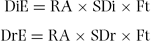
We tested for differences in dispersal estimate (DiE), dropping estimate (DrE) among the frugivore species based on the mean index values per site using the Kruskal–Wallis test as the data could not be normalized.
Germination experiments
To test whether handling by animals increases germination success, a sample of fruits collected randomly from several different trees was fed to individuals of the dark-capped bulbul (Pycnonotus barbatus) and Wahlberg's epauletted fruit bat (Epomophorus wahlbergi) kept in large outdoor flight cages (birds: 5 × 3 × 2 m; bats: 8 × 5 × 3 m). Whole branches with ripe fruits were suspended in the flight cages in the morning (dark-capped bulbul) or late afternoon (Wahlberg's epauletted fruit bat). Handled fruits (discarded endocarps) were collected from the floor on the same day (dark-capped bulbul) or the next morning (Wahlberg's epauletted fruit bat). Whereas, Wahlberg's epauletted fruit bat removed all the flesh, leaving clean endocarps on the floor, the endocarps collected from the dark-capped bulbul cages were a mixture of clean, defecated endocarps and pecked endocarps with some flesh still attached. A total of 45 endocarps handled by dark-capped bulbuls and 45 endocarps handled by Wahlberg's epauletted fruit bats were collected and planted in sterilized earth in trays (15 endocarps per tray) with their positions randomized. Endocarps were sown in regular intervals on the trays and were slightly covered by soil. To test whether de-pulping itself had an effect on germination success, 45 fruits were hand de-pulped and planted under the same conditions, as well as 45 fruits with the flesh still attached. Trays were placed outside under shade cover and watered daily by automatic sprinkler. Germination success was recorded by counting the number of germinated endocarps per treatment after 2 and 4 mo had elapsed.
For analyses we calculated the per cent of germinated seeds per tray. We used repeated-measures ANOVA to test for effects of treatments on germination success.
Seedling establishment in the field
In December 2005, 4 mo after the fruiting season, the presence of first-year seedlings was recorded in the following three habitats (under a M. azedarach tree, under another tree species, and open ground). Seventy-five plots (1 m2) along three transects of 250 m were sampled at each of three sites (Thornville, Richmond and Hayfield). The plots were spaced c. 10 m apart and placed until each habitat was represented. We used the chi-square test to determine whether the proportion of plots containing seedlings differed among habitat types.
All statistical analyses were performed with the Program R version 2.9.0.
RESULTS
Seed-dispersal data
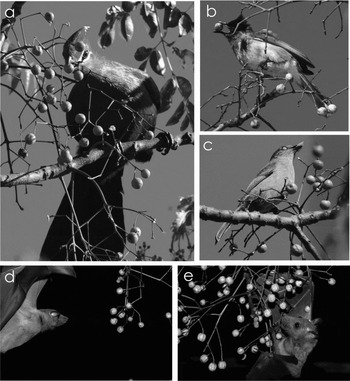
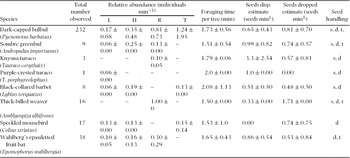
During 264 h of observation, we recorded seven bird species and one bat species foraging on 33 focal trees of Melia azedarach (Figure 1, Table 1). The most common visitors in all four study sites were dark-capped bulbul followed by Wahlberg's epauletted fruit bat in three of the four sites. Knysna turaco dispersed three times as many seeds per minute as any of the other dispersers, but was low in abundance (Table 1). The speckled mousebird could not swallow fruits and was never observed taking fruits out of the tree, and was thus considered to be a fruit thief. We recorded a median of two frugivore species per tree (range = 0–4, N = 33). Species richness differed among the study sites (ANOVA: F3,29 = 5.32, P = 0.0048) with significantly fewer frugivorous species in Louwsberg than Richmond (Tukey HSD: P = 0.0042) and a non-significant difference in species richness between Louwsberg and Thornville (Tukey HSD: P = 0.055). Similarly, the number of frugivore individuals differed among sites (lower abundance in Louwsberg than the other three sites, Tukey HSD: all P < 0.05) and increased with higher crop sizes (ANCOVA site: F3,28 = 15.2, P < 0.001, crop size: F1,28 = 9.97, P = 0.0038). Rarefied species richness did not differ significantly among the study sites (ANOVA site: F3,29 = 2.77, P = 0.060).
The most common frugivores observed feeding on Melia azedarach fruits in South Africa: Knysna turaco (a), dark-capped bulbul (b), sombre greenbul (c), Wahlberg's epauletted fruit bat (d–e).

Abundance and seed-handling behaviour of frugivores observed on fruiting trees of Melia azedarach. Values, other than sample sizes, are mean ± SD. Abbreviations for study sites: L = Louwsberg, H = Hayfields, R = Richmond, T = Thornville. Abbreviations for seed handling behaviour: s = swallowing, d = dropping, t = taken out in beak/mouth.

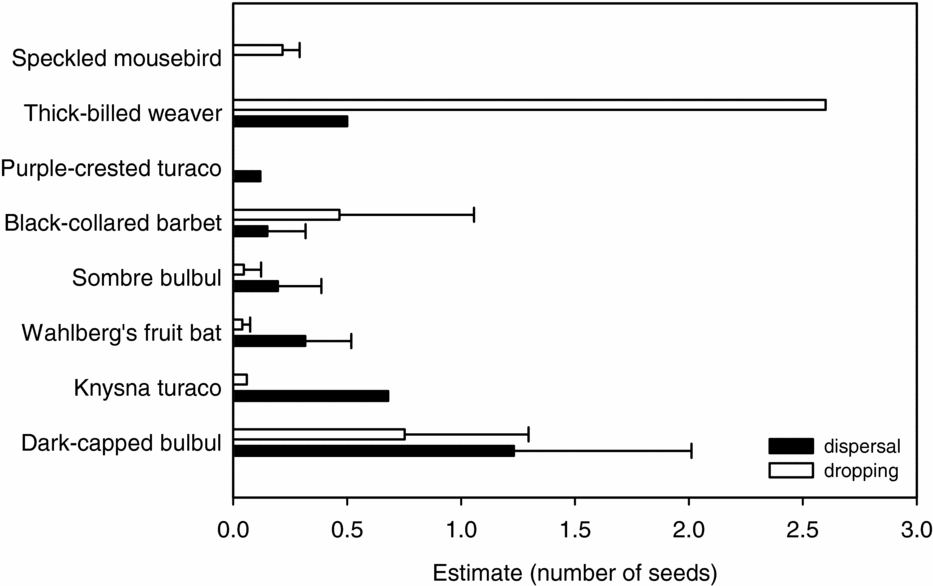
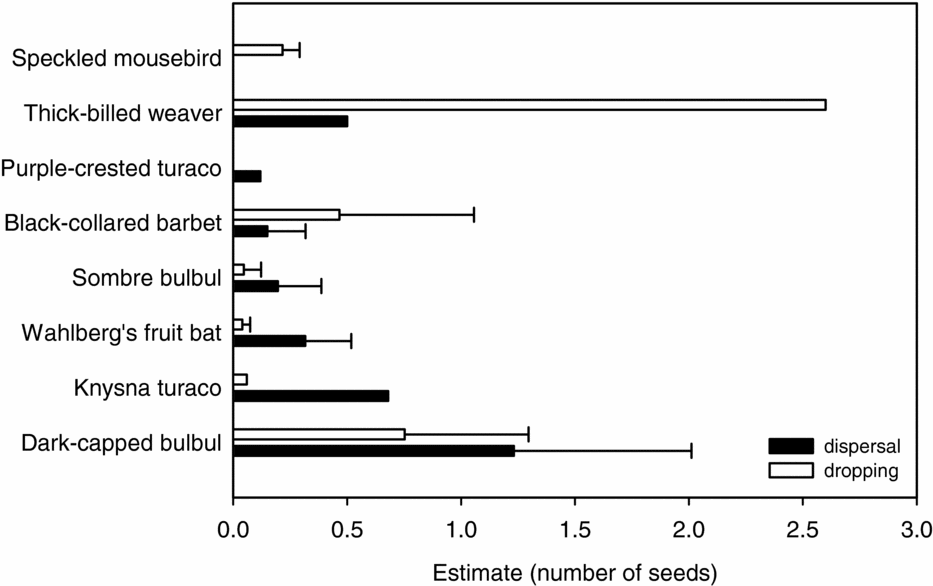
The estimate of dispersal (DiE) did not differ significantly among frugivore species (Kruskal–Wallis ANOVA χ2 = 12.8, df = 7, P = 0.077; Figure 2). Dark-capped bulbul and Knysna turaco had high DiE while DiE of purple-crested turaco and black-collared barbet were low or even absent for the speckled mousebird. Estimates of dropping (DrE) also did not differ significantly among the frugivore species (Kruskal–Wallis ANOVA χ2 = 11.0, df = 7, P = 0.14, Figure 2). Broadbilled weaver and dark-capped bulbul had high DrE while Knysna turaco, purple-crested turaco and Wahlberg's epauletted fruit bat had low DrE.
Mean number of seeds (±SD) as calculated by estimates of dispersal (DiE) and estimates of dropping (DrE) for all species observed feeding on Melia azedarach fruits.
Germination experiments
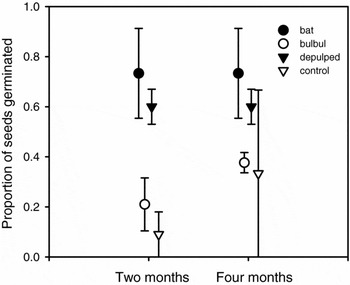
Of the 180 endocarps planted, 42% germinated after 2 mo and 66% after 4 mo (Figure 3). We recorded a significant effect of treatment on germination success (repeated-measures ANOVA: F3,8 = 11.0, P = 0.0033) with significantly higher germination success of bat-handled than control fruits (Tukey HSD: P = 0.043). All other pairwise comparisons were not significant (Tukey HSD: P > 0.11).
The mean (±SD) proportion germination success for 45 endocarps per treatment (bat-, bulbul-handled, hand de-pulped, with flesh) after 2 and 4 mo.

Seedling data
In total we recorded 185 seedlings on 225 m2 (all plots pooled), representing a density of 0.82 seedlings m−2. Seedling density ranged from 0–41 m−2 (median = 0). Twenty-eight of 225 m2 had at least one seedling present. Seedling distribution differed significantly between microhabitats (χ2 = 17.2, df = 2, P = 0.00018, N = 225), with 68% under M. azedarach trees, 29% under other trees and 3% in open areas. Site had only a marginally significant effect on seedling distribution (χ2 = 5.96, df = 2, P = 0.051, N = 225) with slightly more seedlings in Richmond than the two other sites.
DISCUSSION
The results of this study support the hypothesis that M. azedarach has become integrated into local plant-disperser webs. However, a relatively limited number of frugivore species (seven bird and one bat species) were found to interact with M. azedarach. By comparison, frugivore assemblages on native tree species, such as Commiphora harveyi and Ficus spp. appear to be much more species-rich (16 and 22 frugivores, respectively; Bleher & Böhning-Gaese Reference BLEHER and BöHNING-GAESE2001, Compton et al. Reference COMPTON, CRAIG and WATERS1996). It is unlikely that the low diversity of frugivores that interact with M. azedarach is due to a depauperate local bird fauna. A high diversity of birds has been recorded at the study sites (e.g. Thornville: 137 bird species; Richmond: 243 bird species, D. Edwards and J. Tedder, pers. comm.) yet only c. 25% of the frugivores (as defined in Hockey et al. Reference HOCKEY, DEAN and RYAN2005) at these sites included M. azedarach in their diet. It is more likely that the low diversity of frugivores is caused by the fruit traits. The large fruits of M. azedarach may exclude frugivores with small gape widths (Wheelwright Reference WHEELWRIGHT1985). This could explain why speckled mousebirds pecked the flesh of the fruits, but were never observed to swallow them, and why some common smaller avian frugivores, such as white-eyes, were not observed feeding on fruits. Fruits were of a similar size to those recorded in Australia (c. 13 mm; Green Reference GREEN1993), but smaller than in its native range in Thailand (19.1 × 15.1 mm; Kitamura et al. Reference KITAMURA, YUMOTO, POONSWAD, CHUAILUA, PLONGMAI, MARUHASHI and NOMA2002). In addition, the fruit contains a thick skin and a large hard endocarp. It is unlikely that the fruits have a low energy value and thus presumably represent a valuable food resource (Cipollini & Levey Reference CIPOLLINI and LEVEY1998). The fat and protein concentration of M. azedarach fruits (protein: 5.6%, fat 2.9%, total energetic value: 18.3 MJ kg−1, P. Pistorius & C. Downs, unpubl. data) is comparable with that of native South African fruits (Voigt et al. Reference VOIGT, BLEHER, FIETZ, GANZHORN, SCHWAB and BöHNING-GAESE2004). A similar lipid concentration of M. azedarach fruits (lipid 3%, total water-soluble carbohydrate 48%) has been measured in Hong Kong (Corlett Reference CORLETT2005). However, M. azedarach fruits possess many secondary compounds (Oelrichs et al. Reference OELRICHS, HILL, VALLELY, MACLEOD and MOLINSKY1983) which make them toxic to humans, dogs and cats (Botha & Penrith Reference BOTHA and PENRITH2009, Phua et al. Reference PHUA, TSAI, GER, DENG and YANG2008), and possibly not digestible for all bird species (Witmer & van Soest Reference WITMER and VAN SOEST1998). There could also be differences in nutrient value and fruit chemistry among individual trees (Schaefer et al. Reference SCHAEFER, SCHMIDT and WINKLER2003). This could be an explanation for the lack of frugivores on some trees over the whole observation period, which also occurred in an Australian study on M. azedarach (Green Reference GREEN1993). Furthermore, a considerable number of trees in this study had large amount of fruits still attached at the end of the fruiting season.
Frugivore species clearly differed in their effectiveness as dispersal agents for fruits of M. azedarach. The dark-capped bulbul was generally the most abundant frugivore recorded on M. azedarach (Table 1; Figure 2). However, some individuals did not swallow seeds at all resulting in high rates of dropping of seeds below the canopy of the parent tree. The two turaco species (Knysna turaco, purple-crested turaco), on the other hand, swallowed many more seeds per unit time. Unfortunately, no data on gut transition times or home ranges of these birds are published and we thus cannot estimate seed dispersal distances for any of them (Westcott et al. Reference WESTCOTT, BENTRUPPERBAUMER, BRADFORD and MCKEOWN2005). However, bulbuls tend to occur in open savanna and fly across open habitats between patches of fruiting plants (Keith et al. Reference KEITH, URBAN and Fry1992). They are thus likely to disperse seeds into open habitats. The Knysna turaco, on the other hand, prefers forest habitat (Fry et al. Reference FRY, KEITH and URBAN1988) and are thus likely to disperse seeds into less suitable habitat for M. azedarach. However, all three species frequent woody riverine vegetation (Fry et al. Reference FRY, KEITH and URBAN1988, Keith et al. Reference KEITH, URBAN and Fry1992) which is highly infested with M. azedarach trees (Richardson et al. Reference RICHARDSON, MACDONALD, HOFFMANN, HENDERSON, Cowling, Richardson and Pierce1997). Wahlberg's epauletted fruit bat did not swallow the seeds at all. Instead these animals tended to carry fruits to nearby feeding roosts which leads to seed dispersal over short distances (c. 20–60 m) and typically below the canopy of another tree (Westcott et al. Reference WESTCOTT, BENTRUPPERBAUMER, BRADFORD and MCKEOWN2005). Studies in Israel based on faecal analysis have shown that seeds of M. azedarach can comprise 30–50% of the diet of the related bat Rousetta aegypticus during the winter months (Korine et al. Reference KORINE, IZHAKI and ARAD1999). Although this bat species also occurs in the province of KwaZulu-Natal, its distribution is limited to the vicinity of suitable cave roosting sites (Skinner & Chimimba Reference SKINNER and CHIMIMBA2005).
Secondary dispersal of M. azedarach seeds seems likely to occur. We found occasional mongoose droppings along the rivers in our study site which consisted mostly of M. azedarach endocarps. We also regularly observed weevil and rodent predation (bite marks in fruits, eaten up seeds out of endocarp) of fallen fruits. In preliminary trials, a small proportion of fruits (unpubl. data) disappeared overnight. They could either have been preyed upon by small mammals (Gryj & Dominguez Reference GRYJ and DOMINGUEZ1996), or they could be scatter-hoarded by rodents, which would result in secondary seed dispersal (Vander Wall et al. Reference VANDER WALL, KUHN and BECK2005). However, further studies are needed to evaluate the importance of secondary seed dispersal in this species, especially since a considerable number of fruits fall on the ground and are available for further dispersal.
We found only one quantitative study on the seed dispersal of M. azedarach in its native range. In a study in Australia, Green (Reference GREEN1993) recorded only four frugivorous bird species in M. azedarach trees (silvereye Zosterops lateralis, pied currawong Strepera graculina, figbird Sphecotheres vieilloti, Lewin's honeyeater Meliphaga lewinii) of which all but the silvereye swallowed or removed seeds from the crown. Based on literature data, C. Gosper (pers. comm.) has listed 17 bird species and fruit-eating bats that include M. azedarach in their diet in eastern Australia. Additionally, M. azedarach seems to be dispersed by deer species (e.g. muntjak) in China (Chen et al. Reference CHEN, DENG, BAI, YANG, CHEN, LIU and LIU2001) and India (S. Prasad, pers. comm.). No other quantitative data are available from the native or invasive range of M. azedarach. However, in Hong Kong where the species is naturalized but not invasive, the disperser fauna is very similar to South Africa. It includes also fruit-eating bats (Cynopterus sphinx, Rousettus leschenaultii), a variety of birds, with mainly two bulbul species (Pycnonotus sinensis, P. jocosus) and starlings (Sturnus nigricollis, S. cineraceus) (Corlett Reference CORLETT2005). In Japan, M. azedarach is also an important fruit resource for starlings (K. Ueda, pers. comm.). Even though the redwing starling (Onychognathus morio) was common in our South African study sites, we never observed them to take any fruits. It is not yet known whether faunal composition or differences in fruit properties among various forms of M. azedarach (Mabberley Reference MABBERLEY1984) could account for differences in the spectrum of observed dispersers among regions. Interestingly, fruits of M. azedarach in California do not seem to get dispersed at all (Richardson et al. Reference RICHARDSON, ALLSOPP, D'ANTONIO, MILTON and REJMANEK2000).
Our experiments show that germination of M. azedarach seeds is not strictly dependent on their ingestion by frugivores. However, de-pulping resulted in shorter germination times which would reduce the likelihood of post-dispersal seed predation. The low germination success of the dark-capped bulbul-handled seeds in contrast to Wahlberg's epauletted fruit bat-handled seeds could result from not all seeds being swallowed, but some only being pecked and dropped and thus not as clean as bat-handled or hand-depulped seeds before planting. To test for gut passage on germination success, it should be confirmed that bulbuls swallowed seeds. This was tried in another set of experiments in smaller cages. Unfortunately, bulbuls had difficulties swallowing the fruits presented in those feeding experiment. They even showed signs of discomfort and regurgitated the fruits (P. Pistorius & C. Downs, unpubl. data). This behaviour was never observed in the wild nor in the flight cages used for the germination experiments, and hence should not influence our results on seed germination.
Most seedlings were found under M. azedarach trees. These probably experience close to 100% mortality as no saplings were found under such trees. Dispersal of seeds to suitable microhabitats is likely to be critical for establishment in M. azedarach, as was shown in the invasive shrub Ardisia elliptica (Koop Reference KOOP2004). Once established, the ability of M. azedarach to resprout means that plants can tolerate and even benefit from disturbances such as fire, and subsequent eradication thus becomes very difficult (Tourn et al. Reference TOURN, MENVIELLE, SCOPEL and PIDAL1999). A study in Argentina by Tourn et al. (Reference TOURN, MENVIELLE, SCOPEL and PIDAL1999) showed that resprouted plants of M. azedarach have much higher survival (c. 40%) than seedlings (0.5–3%).
In conclusion, primary seed dispersal in M. azedarach is carried out by a small suite of native bird and mammal frugivores that can cope with its large fruits and their secondary compounds. As frugivores differ markedly in their effectiveness as agents of seed dispersal, it is likely that the rate of spread of this alien tree species in different regions will be influenced by the composition of the local frugivore assemblage.
ACKNOWLEDGEMENTS
We want to thank Nora Chevaux, Greg and Alice Goodall, Margaret and David Edwards and Kerry and Dave Paul for their permission to work on their grounds. A special thank you to Nicolas Davis, who collected part of the field data. A warm thank you to Wendy White and Mark Brown for helping and letting us use their facilities for the feeding experiments with the bulbuls and the fruit-eating bats. We thank Penny Pistorius and Colleen Downs for sharing the fruit nutrient data. Field work benefited greatly from the help of Dave Johnson, John Tedder, Pravin Pillay, Shaun King, Magula Nxumale and Vanessa Pasquoletta. The comments of two reviewers improved the quality of an earlier version of this manuscript. The study was funded by The NRF-DST Centre for Invasion Biology.