Introduction
The World Health Organization (2012) reports that the number of persons with dementia (PWD) is expected to double every 20 years, to 65.7 million in 2030 and to 115.4 million in 2050. The degenerative nature of dementia necessitates a significant level of care, which is often provided by family members. Measurement of constructs relevant to this growing global challenge is one of the many considerations for professionals evaluating treatment options and interventions for PWD and their caregivers. For example, the ability to use measurement instruments to identify associations between behavioral and psychological symptoms of dementia (BPSD) and key caregiver outcomes is of immeasurable value to clinicians and researchers who are trying to reduce levels of burden and improve overall well-being of caregivers.
The Revised Memory and Behavior Problems Checklist (RMBPC; Teri et al., Reference Teri, Truax, Logsdon, Uomoto, Zarit and Vitaliano1992) and the Neuropsychiatric Inventory (NPI; Cummings et al., Reference Cummings, Mega, Gray, Rosenberg-Thompson, Carusi and Gornbein1994) measure BPSD and caregiver appraisals of the symptoms. Because BPSD demonstrate consistently strong associations with burden and depressive symptoms in caregivers of PWD (Ballard et al., Reference Ballard, Lowery, Powell, O'Brien and James2000), efforts to modify these behaviors are central to many interventions for PWD and their caregivers (e.g. Ostwald et al., Reference Ostwald, Hepburn, Caron, Burns and Mantell1999). Useful measurement of BPSD and corresponding caregiver appraisals is essential in these efforts. However, because researchers do not typically use the RMBPC and the NPI concurrently in a single study, few comparative resources are available to determine which of the two measurement tools is more appropriately suited for certain investigations. Accordingly, the aim of this research is to compare both measures of BPSD according to their respective associations with key caregiver outcomes (burden and depressive symptoms). The current study complements evidence of the two measures’ validity and reliability and provides clinicians and scholars interested in BPSD and caregiver outcomes with an additional source of information to facilitate their measurement choices.
Associations between BPSD and caregiver outcomes are acknowledged in Pearlin's (Reference Pearlin, Menaghan, Lieberman and Mullan1981, Reference Pearlin, Mullan, Semple and Skaff1990) Stress Process Model, which suggests that elevated depressive symptoms and other negative outcomes in caregivers result from objective stressors, including exposure to BPSD, and subjective stressors, including caregiver appraisal of the stressfulness of BPSD and global perceived burden from the caregiving role. Both objective and subjective sources of stress are therefore targets for educational and psychosocial interventions intended to reduce caregiver burden and depressive symptoms.
Pearlin (Reference Pearlin, Mullan, Semple and Skaff1990) and others (e.g. Lazarus and Folkman, Reference Lazarus and Folkman1984) also suggest that caregiver perceptions of the burden caused by their experiences might be more significantly related to caregiver outcomes than the experiences themselves. To test this idea, some include caregiver-reported burden as a mediator between BPSD and important caregiver outcomes such as depressive symptoms. Clyburn and associates (Reference Clyburn, Stones, Hadjistavropoulos and Tuokko2000) used structural equation modeling to test multiple directions for the relationship of BPSD, burden, and depressive symptoms. They found that the model that best fit their data explained caregiver depressive symptoms through the mediation of caregiver burden. In other words, caregivers frequently experienced depressive symptoms as a result of the presence of BPSD, but primarily as a function of the relationship between BPSD and perceived burden. Pruchno and Resch (Reference Pruchno and Resch1989) and Jeglic et al. (Reference Jeglic, Pepper, Ryabchenko, Griffith, Miller and Johnson2005) report similar findings, suggesting that burden functions as both an outcome of BPSD and a mediator between BPSD and caregiver depressive symptoms.
A growing body of evidence indicates that BPSD in PWD are directly associated with caregiver burden, and are both directly and indirectly associated with caregiver depressive symptoms (via caregiver burden). Accordingly, the purpose of the current paper is to explore the utility of two frequently utilized measures of BPSD, the RMBPC and the NPI to explain caregiver depressive symptoms, both directly and via the mediator of burden. Effectively comparing multiple measures of the same construct and deepening our understanding of their respective associations with salient outcomes may facilitate more informed measurement selection for researchers and clinicians. Brief descriptions of the two measures under investigation follow.
The RMBPC and NPI
Revised memory and behavior problems checklist (rmbpc)
The RMBPC (Teri et al., Reference Teri, Truax, Logsdon, Uomoto, Zarit and Vitaliano1992) is a 24-item measure of BPSD and their corresponding caregiver appraisals. The measure includes three subscales of BPSD: memory problems, depressive symptoms, and disruptive behaviors. Caregivers report the frequency of each symptom on a scale of 0 (problem never occurred) to 4 (occurred daily or more often), and subscale and total-measure frequency ratings are calculated as averages. Caregivers also report their appraisal of BPSD by rating the extent to which each symptom bothered them on a scale of 0 (not at all) to 4 (extremely). Subscale and total-measure ratings of caregiver reactions to presenting BPSD are also calculated as averages.
According to Teri et al. (Reference Teri, Truax, Logsdon, Uomoto, Zarit and Vitaliano1992), until the publication of the RMBPC, arguably no consistent method for assessing BPSD had been established. The RMBPC was created to provide a parsimonious and psychometrically sound instrument for evaluating BPSD and corresponding caregiver appraisals. While the purpose of the measure is to evaluate common BPSD that are distressing to caregivers, the measure does not address rarer neuropsychiatric symptoms. Nevertheless, the brevity of the RMBPC facilitates its administration in a variety of contexts.
Neuropsychiatric inventory (npi)
The NPI (Cummings et al., Reference Cummings, Mega, Gray, Rosenberg-Thompson, Carusi and Gornbein1994) measures the frequency and severity of BPSD and corresponding measures of caregiver distress in the domains of hallucinations, delusions, aggression, depression, anxiety, euphoria, apathy, disinhibition, irritability, and aberrant motor behavior. A more recent 12-item version (Cummings, Reference Cummings1997) also measures the neurovegetative domains of sleep and appetite problems. In the current study, we utilize the ten-item traditional format.
After responding to a screening question and identifying specific demonstrations of a symptom domain, caregivers rate the frequency of the symptom domain on a scale of 1 (occurs rarely – less than once per week) to 4 (occurs very often – once or more per day) and the severity of the symptom domain on a scale of 1 (mild) to 3 (severe). Caregivers then rate their feelings of distress in response to the symptom on a scale of 0 (not at all) to 5 (very severely or extremely). NPI symptom total scores are calculated by multiplying the frequency of each symptom domain by its severity. Symptom total scores and caregiver distress ratings are each summed across all NPI domains, producing an NPI total score and an NPI distress score.
The NPI was “designed specifically to provide a comprehensive evaluation of neuropsychiatric symptomatology in demented patients” (Kaufer et al., Reference Kaufer1998, p. 211). Cummings and associates (Reference Cummings, Mega, Gray, Rosenberg-Thompson, Carusi and Gornbein1994) created the NPI with the intent to evaluate BPSD that existing measures had failed to capture. The ability of the NPI to identify BPSD that are unique to certain forms and stages of dementia makes it a useful diagnostic tool. This characteristic of the measure also allows clinicians and interventionists to observe the extent to which certain products and services alter the presence of specific BPSD. Notably, the caregiver distress scale of the NPI (Kaufer et al., Reference Kaufer1998) became an adjunct component of the measure after the NPI was originally created. Although the NPI's caregiver distress scale is a valuable addition for researchers interested in caregiver stress, capturing caregiver distress associated with BPSD was not the initial intent of Cummings and associates (Reference Cummings, Mega, Gray, Rosenberg-Thompson, Carusi and Gornbein1994).
Comparison of measures
A comparison between the RMBPC and the NPI indicates similarities between the two measures, as well as noteworthy points of contrast. Both measures are designed to measure BPSD through caregiver reports of the frequency of each symptom. Both instruments measure caregivers’ subjective appraisals of BPSD. Individual item overlap is also common with the two measures. Both RMBPC and NPI thoroughly capture symptoms of aggression/agitation and depression in the person with dementia. To a lesser extent, the RMBPC overlaps with the NPI domains of anxiety, disinhibition, irritability, and sleep problems. However, the RMBPC omits the symptoms of delusions, hallucinations, elation, apathy, aberrant motor behavior, and appetite changes, and the NPI omits an explicit domain related to memory problems.
Because both measures assess objective exposure to BPSD and the subjective appraisals of each symptom, both are highly useful in clinical assessment and basic and applied research, particularly in evaluations of interventions and services designed to reduce BPSD and related caregiver stress. Both NPI and RMBPC are employed frequently in such evaluation studies.
At the time of this study, a review of the literature revealed that the RMBPC and the NPI had been cited in the same study on 43 occasions. However, the vast majority of these studies serve purposes other than demonstrating a statistical comparison of the measures’ ability to detect associations between BPSD and key caregiver outcomes. For example, some studies have used only specific components of the measures (e.g. measuring only sleep disturbances; McCurry et al., Reference McCurry, Vitiello, Gibbons, Logsdon and Teri2006). Some researchers have used the NPI and the RMBPC to provide evidence of the validity of newer measures (Harvey et al., Reference Harvey2005; Cameron et al., Reference Cameron, Cheung, Streiner, Coyte, Singh and Stewart2008). In other studies, the NPI and the RMBPC perform completely separate functions (Paukert et al., Reference Paukert2010) or are simply described as optional measures to be used by dementia researchers (Robert et al., Reference Robert, Ferris, Gauthier, Ihl, Winblad and Tennigkeit2010; Preschl et al., Reference Preschl, Wagner, Forstmeier and Maercker2011). Finally, some researchers have described the two measures in order to justify the creation of measures more suitable for their purposes (Draper et al., Reference Draper, Brodaty, Low, Richards, Paton and Lie2002). Only two studies (De Jonghe et al., Reference De Jonghe, Kat, Kalisvaart and Boelaarts2003; Teri et al., Reference Teri, Huda, Gibbons, Young and van Leynseele2005) use the NPI and the RMBPC as multiple, concurrent measures of the same construct. However, their purpose was not to compare the measures in their relationships with key caregiver outcomes.
Summary and purpose of the study
The RMBPC and the NPI are two of the most commonly utilized tools to understand the relationship between BPSD and caregiver outcomes. One reason for their frequent use is that both measures are well respected for their psychometric properties. Nevertheless, besides indications that an instrument reliably assesses constructs of interest, additional measurement qualities – such as the ability to detect a construct's associations with other relevant phenomena – are worthy of consideration when selecting instruments to fulfill research objectives. In an effort to explore such measurement qualities, rather than reinvestigate the psychometric properties of the NPI and the RMBPC, we compare the two instruments empirically in their ability to identify associations between BPSD and key outcomes in caregivers of PWD. This study represents one of the few instances in which both NPI and RMBPC are used concurrently in the same study, thus providing us with an ideal setting in which to conduct such an analysis. This comparison will provide researchers with an additional resource to make more informed decisions in their selection of measurement instruments to suit their investigations. It will also enable us to identify unique explanations for variance in caregiver depressive symptoms and contribute to our understanding of the relationship between BPSD and noteworthy caregiver outcomes.
We anticipate that frequency ratings and caregiver appraisals of BPSD in both NPI and RMBPC will be associated with depressive symptoms in caregivers of PWD both directly (beyond the variance shared with caregiver burden) and indirectly (through the mediator of caregiver burden) and that direct associations will be modest. Further, because the NPI addresses a broader array of BPSD than the RMBPC and differentiates levels of symptom severity, we hypothesize that it will depict more systematic variance in BPSD and thus explain a greater amount of unique association between BPSD and caregivers’ depressive symptoms.
Design and methods
Participants
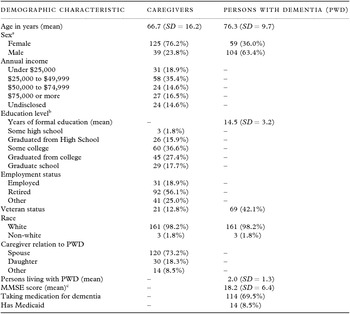
Data for this research come from 164 caregivers of PWD. Of the participants, 76% were female, 98% were white, and 73% were spouses of the PWD. Caregiver ages ranged from 20 to 88 (M = 66.7) years, and PWD ages ranged from 37 to 95 (M = 76.3) years. On average, PWD had attended 2.5 years of college. Additional socio-demographic data for caregivers and PWD are described in Table 1. The characteristics of our caregiver sample diverge slightly from the reported population of caregivers in the United States, where only 66% of caregivers are female, only 72% are white (13% are African American and 12% are Hispanic), and the average age of caregivers of those aged 65 years and older is 63 years (Family Caregiver Alliance, 2012). Caregivers participating in this study had chosen to enroll in one of the two psychoeducational caregiver interventions provided by the Alzheimer's Association Utah Chapter and affiliated programs. Current analyses come from baseline, pre-intervention data.
Socio-demographic data for caregivers and persons with dementia

Notes: aOne caregiver chose not to report the sex of PWD.
bFor PWD, 12 years of formal education is equivalent to high school graduation.
cThe Mini-Mental State Examination was offered to all PWD, but only 120 participants completed the measure. The remainder chose not to complete it (because PWD cognitive ability was too low etc.).
Measures
Prior to the interventions, participants responded to a comprehensive interview, which included, but was not limited to, the following measures.
Revised memory and behavior problems checklist (rmbpc)
The RMBPC (Teri et al., Reference Teri, Truax, Logsdon, Uomoto, Zarit and Vitaliano1992) has been described above. According to Teri and associates, Cronbach's α coefficients for the RMBPC indicate high reliability of the measure. Symptom frequency had an α of 0.84, and caregiver reaction had an α of 0.90. Subscale reliability estimates ranged from 0.67 to 0.89. Comparisons with other well-established measures of BPSD and caregiver distress indicate high levels of construct validity for the subscales of the RMBPC (Teri et al., Reference Teri, Truax, Logsdon, Uomoto, Zarit and Vitaliano1992). For the comparative purposes of the paper, we refer to the components of the RMBPC as RMBPC frequency and RMBPC appraisal.
Neuropsychiatric inventory
The NPI (Cummings et al., Reference Cummings, Mega, Gray, Rosenberg-Thompson, Carusi and Gornbein1994) has also been described above. According to Cummings and colleagues, the measure demonstrates high levels of inter-rater reliability (93.6% and higher) and test–retest reliability (r = 0.79), and subscales have demonstrated high levels of agreement with other well-established measures. For comparative purposes, we refer to the total NPI score as NPI frequency and to the sum of caregiver distress ratings as NPI appraisal.
Zarit burden interview (zbi)
The ZBI (Zarit et al., Reference Zarit, Reever and Bach-Peterson1980) is a 22-item measure of caregiver burden related specifically to the dementia-caregiver role. On a scale of 0 (never present) to 4 (nearly always present), caregivers rate the extent to which both physical and psychological components of burden characterize their experiences as caregivers. Total ZBI scores are calculated by summing responses to all 22 items, producing a score ranging from 0 (low burden) to 88 (high burden). According to Zarit and associates (1980), the ZBI has high reliability (α = 0.92), and correlations between ZBI scores and other indicators of burden were high (Bachner and O'rourke, Reference Bachner and O'Rourke2007), indicating solid construct validity.
Geriatric depression scale (gds)
The GDS (Yesavage et al., Reference Yesavage, Brink, Rose, Lum, Huang, Adey and Leirer1983) is a 30-item measure of depressive symptoms in older adults. Items in this measure relate to global evaluations of the caregiver's psychological well-being, and not just those pertaining to the caregiver role. All items are rated either yes or no, and after 10 items in the scale are reverse-coded and total GDS scores are calculated by summing all responses. Original categories of depressive symptoms are normal (0–9), mild depressives (10–19), and severe depressives (20–30). The GDS correlates significantly with the popular Hamilton Rating Scale for Depression (HRS-D) and the Zung Self-Rating Depression Scale (SDS), and its scores correspond to diagnostic criteria used to designate normal functioning, mild depression, and severe depression. α coefficients and split-half reliabilities were also high (both 0.94; Yesavage et al., Reference Yesavage, Brink, Rose, Lum, Huang, Adey and Leirer1983).
Analyses
We used path analysis in the MPlus software package (Version 6.1; Muthén and Muthén, Reference Muthén and Muthén2010) to observe the extent to which each component of both NPI (symptom total scores and caregiver distress scores) and RMBPC (symptom frequency scores and caregiver reaction scores) demonstrated unique associations with depressive symptoms of family caregivers both directly and through the mediator of caregiver burden. Path analysis was most appropriate for this research for multiple reasons: It allowed us to observe both direct and indirect associations of each measure of BPSD frequency and appraisal with caregiver depressive symptoms; it allowed us to test these variables in a model acknowledging the mediation of caregiver burden in the relationship; and we treated all variables under investigation as continuous variables.
Seven path models with caregiver burden as a mediator and caregiver depressive symptoms as the dependent variable facilitated our comparison of the NPI and the RMBPC. In the first four models, we test each independent variable (NPI frequency, NPI appraisal, RMBPC frequency, and RMBPC appraisal) individually to examine differences in their direct associations with depressive symptoms and indirect associations via caregiver burden when isolated from the other independent variables. These models allow us to detect whether one independent variable could be more useful by itself in observations of the relationship between BPSD and caregiver depressive symptoms. Model 5 tests whether NPI frequency or RMBPC frequency shares more variance with caregiver depressive symptoms, even after accounting for the other. Model 6 tests whether NPI appraisal or RMBPC appraisal more aptly detects associations between BPSD and caregiver depressive symptoms after controlling for the other. Finally, Model 7 tests the direct and indirect associations of all four independent variables with caregiver depressive symptoms. This model allows us to test whether one independent variable shares more unique variance with caregiver depressive symptoms even after accounting for the other three independent variables. In all seven models, indirect associations were tested for statistical significance by using the Sobel test of mediation effects.
Results
Each measure demonstrated adequate levels of reliability in our sample. Cronbach's α was 0.88 for the GDS and 0.91 for the ZBI. α coefficients for RMBPC frequency subscales ranged from 0.82 to 0.86, and those for RMBPC appraisal subscales ranged from 0.84 to 0.92. Because the NPI only includes frequency and appraisal scores for each subscale generally (and scores are not reported for symptoms that are not present in PWD), inter-item consistency in the NPI is of little relevance, given that each symptom is qualitatively distinct from others in this measure. Cummings and colleagues (Reference Cummings, Mega, Gray, Rosenberg-Thompson, Carusi and Gornbein1994) accordingly reported only test–retest reliability and inter-rater reliability for the NPI. Nevertheless, for the cases with complete NPI data (cases in which every NPI symptom was present), Cronbach's α was 0.72. The nature of our study did not permit the evaluation of test–retest or inter-rater reliability of NPI data.
In order to address the possibility of multicollinearity in our regression analyses, we examined the Variance Inflation Factor (VIF) for variables in each model. VIF values did not exceed 2, except for Model 7, in which VIF values for NPI frequency and NPI appraisal were 6.11 and 6.46 respectively. These values indicated a small and uncritical degree of multicollinearity as they fell below the typical VIF cut-off of 10 (Aiken and West, Reference Aiken and West1991).
Mean values, standard deviations, and bivariate correlation coefficients of the six observed variables are reported in Table 2. Bivariate correlations ranged from 0.23 to 0.91, and all associations were statistically significant (p < 0.01), suggesting the presence of overlapping variance between frequency and appraisal indicators within the same measures, between the NPI and the RMBPC, and between caregiver burden and depressive symptoms.
Mean values, standard deviations, and bivariate correlations of six assessed variables

Note: *p < 0.01.
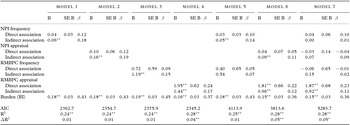
β coefficients, standard errors, and standardized β values for each path model are reported in Table 3. Total R2 values and changes in R2 from the baseline model (which included only caregiver burden and caregiver depressive symptoms) are also reported in Table 3. The first four path models used NPI frequency, NPI appraisal, RMBPC frequency, and RMBPC appraisal separately to explain levels of caregiver depressive symptoms. In these models, each component of the BPSD measures demonstrated a significant indirect association with caregiver depressive symptoms via caregiver burden (p < 0.01). However, because indirect associations describe variance shared with a mediating variable, the indirect relationship (through caregiver burden) between each separately modeled independent variable and depressive symptoms was expectedly not associated with significant increases in R2 (beyond the value of R2 in a model with only caregiver burden and depressive symptoms). Only RMBPC appraisal produced both a significant direct association with depressive symptoms (even after controlling for caregiver burden) and a significant increase in R2 when modeled separately (β = 0.24, p < 0.01; ΔR2 = 0.04, p < 0.01).
Comparison of model abilities to explain caregiver depressive symptoms

Notes: All models include caregiver burden as a mediator and caregiver depressive symptoms as a dependent variable. Model 1 adds only NPI frequency. Model 2 adds only NPI appraisal. Model 3 adds only RMBPC frequency. Model 4 adds only RMBPC appraisal. Model 5 adds both frequency variables. Model 6 adds both appraisal variables. Model 7 adds both frequency and appraisal variables of both measures. All tests were two-tailed. ΔR2 represents amount of variance (in caregiver depressive symptoms) explained by the model beyond that explained by caregiver burden alone. NPI frequency refers to the total NPI score.
Model 5 included RMBPC frequency and NPI frequency to explain caregiver depressive symptoms and omitted caregiver appraisal ratings from both measures. The purpose of this model was to observe whether one measure of BPSD frequency would explain caregiver outcomes in and beyond the presence of the other. Again, RMBPC frequency and NPI frequency demonstrated non-significant direct associations with caregiver depressive symptoms after accounting for caregiver burden. However, in this model, NPI frequency demonstrated a significant indirect association with caregiver depressive symptoms, while the indirect association of RMBPC frequency and caregiver depressive symptoms became non-significant. The change in R2 for this model was non-significant.
Model 6 included the appraisal components of both NPI and RMBPC and omitted frequency components to compare whether either measure of BPSD appraisal would explain caregiver outcomes in and above the presence of the other. Both measures demonstrated significant indirect associations with caregiver depressive symptoms through burden, but only RMBPC caregiver reactions explained depressive symptoms directly (β = 0.22, p < 0.01) even when controlling for NPI appraisal and caregiver burden. The change in R2 for this model was significant (ΔR2 = 0.05, p < 0.01).
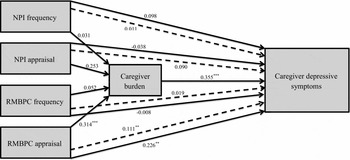
In Model 7, which included frequency and appraisal components from both BPSD measures, only RMBPC appraisal significantly explained caregiver depressive symptoms both directly (β = 0.23, p < 0.01) and indirectly (through the mediator of burden). The relationship between depressive symptoms and both components of the NPI became non-significant in this model. The change in R2 for this model was significant (ΔR2 = 0.05, p < 0.05; see Figure 1).
Model 7 – Caregiver depressive symptoms predicted by components of both RMBPC and NPI through the mediator of caregiver burden. Solid lines represent direct associations, and dashed lines represent indirect associations via caregiver burden. Standardized β values are reported. *p < 0.05. **p < 0.01. ***p < 0.001.

As an indication of the relative parsimony of our models, Akaike Information Criterion (AIC) values ranged from 2345.2 (Model 4) to 5276.5 (Model 7), indicating that Model 4 was the most parsimonious and that Model 7 was the least parsimonious of the seven models. AIC values for all models are reported in Table 3. Model fit indices, another common indicator of the relevance of statistical models, are not applicable when models are saturated (df = 0) as they are in this research, because such models by definition demonstrate perfect fit (Bentler, Reference Bentler1990). A more appropriate indicator of the relevance of our seven models is their R2 values, which ranged from 0.24 to 0.28.
Our prediction that the NPI would explain greater levels of caregiver depressive symptoms than the RMBPC was not supported.
Discussion
We evaluated the relative ability of the NPI (Cummings et al., Reference Cummings, Mega, Gray, Rosenberg-Thompson, Carusi and Gornbein1994) and the RMBPC (Teri et al., Reference Teri, Truax, Logsdon, Uomoto, Zarit and Vitaliano1992) to explain caregiver depressive symptoms directly and through the mediator of caregiver burden. Bivariate associations suggest that the frequency and appraisal components of both NPI and RMBPC are significantly associated with both burden and caregiver depressive symptoms. Through a systematic comparison of different components of each measure, we observed that the RMBPC significantly explained caregiver depressive symptoms beyond the variance explained by the mediator of caregiver burden and while accounting for the variance explained by the NPI. Specifically, results from the complete model (see Table 3, Model 7) indicate that only ratings of RMBPC appraisal show significant direct associations even when accounting for the variance explained by caregiver burden, NPI frequency, and NPI appraisal. Thus, the RMBPC appears to demonstrate additional explanatory utility when compared with NPI.
Both NPI and RMBPC capture important elements of BPSD and corresponding caregiver appraisals. Nevertheless, subtle differences in the two measures may make one more suitable than the other in certain investigations. While both NPI and RMBPC include components to evaluate subjective appraisals of dementia symptomology, the RMBPC was created with the intent to differentiate among caregiver experiences, whereas the NPI was intended most notably as a diagnostic tool to capture a broader range of unique features of various forms of dementia (Teri et al., Reference Teri, Truax, Logsdon, Uomoto, Zarit and Vitaliano1992; Cummings et al., Reference Cummings, Mega, Gray, Rosenberg-Thompson, Carusi and Gornbein1994; Kaufer et al., Reference Kaufer1998). Accordingly, one possible explanation for the findings of this research is that the RMBPC might contain items that more effectively distinguish between caregiver interpretations of BPSD. For example, while the NPI omits the domain of memory problems (which are common to all forms of dementia), the RMBPC includes this domain as a substantial component of the measure's total score. If this domain of the RMBPC shares a significant amount of its variance with caregiver depressive symptoms, the differentiation in caregiver reaction ratings to these problems may indicate that some caregivers (e.g. those who are less familiar with the common features of dementias) find memory problems much more distressing than other caregivers. Accordingly, perhaps caregiver reaction ratings in the RMBPC facilitate the distinction between family caregivers who have anticipated and prepared for coping with certain BPSD and those who have not. In addition, if the RMBPC more effectively distinguishes among caregivers’ subjective appraisals of BPSD, our findings that the RMBPC explains a greater amount of variance in caregiver depressive symptoms provide further support for Pearlin's (Reference Pearlin, Mullan, Semple and Skaff1990) suggestion that caregiver outcomes tend to be more reflective of subjective perceptions of behaviors than of the behaviors themselves.
Alternatively, the RMBPC might demonstrate a more significant unique relationship with caregiver depressive symptoms because this measure assesses fewer domains of BPSD and, as a result, likely produces less error variance than the NPI when the measures’ total scores are used in analyses. Accordingly, the results of our research may highlight the benefit of employing simpler measures of BPSD when the intent of the research is to evaluate caregiver experiences rather than to detect the unique features of certain dementias.
This research has limitations. For example, ordering effects might have produced a certain degree of measurement error. The assessment battery was set up such that the NPI and the RMBPC were assessed during the same interview session. The RMBPC was most often administered before the NPI, although each counselor could exercise discretion to determine this order. Accordingly, caregivers could have become more fatigued by the time they reached the NPI assessment, thus inflating the error variance in the NPI. Future comparisons between these two measures should include strategies to decrease the likelihood of ordering effects.
In addition, the caregivers in this sample were not ethnically diverse. Comparisons between NPI and RMBPC could be replicated in broader samples of caregivers to determine if either the RMBPC or the NPI differed in explanatory utility of caregiver outcomes across ethnic groups.
Another shortcoming of this research is that our data were collected cross-sectionally rather than longitudinally. Thus, without additional waves of data, we have no way of examining changes in the levels of our variables of interest in such a way that we can determine any causal relationships between constructs. Future research should implement a longitudinal design to permit a more sophisticated examination of the relationships between these variables.
Finally, caution should be exercised when interpreting the magnitude of our findings. Although three models explained a significant amount of unique variance in caregiver depressive symptoms after accounting for caregiver burden, the practical significance of these amounts of shared variance might be considered small. For example, when RMBPC appraisal was modeled by itself with caregiver burden and caregiver depressive symptoms, the change in R2 was slightly less than 0.05. Thus, in our sample, RMBPC appraisal only explained 5% of the variance in ratings of caregiver depressive symptoms, beyond that explained by caregiver burden. Further, RMBPC frequency, NPI frequency, and NPI appraisal all failed to explain significant amounts of unique variance in their relationships with caregiver depressive symptoms, although all three demonstrated significant indirect relationships through caregiver burden.
One possible explanation of the limited significance of our findings is that our investigation did not include separate analyses of individual subscales of the NPI or the RMBPC. Thus, because the subscales of both measures assess levels of distinct (albeit related) symptoms, including only composite scores in our analyses likely produced preventable levels of error variance and therefore decreased the magnitude of our findings. This limitation is an indication of the need to analyze the contribution of each of the measure's subscales (or even individual items) as they relate distinctly to other variables of interest. Such a strategy might reveal more specific and significant associations between BPSD and caregiver outcomes. Future research pertaining to the explanatory utility of the NPI and the RMBPC should include more sophisticated analyses of the measures’ subscales and/or individual items.
Another explanation for the limited magnitude of our findings is that each model included caregiver burden as a mediator. In accordance with previous literature highlighting the mediating role of burden in the relationship between BPSD and caregiver outcomes, we expected caregiver burden to explain the most substantial amount of variance in caregiver depressive symptoms, and we expected amounts of unique variance explained by the RMBPC and the NPI to be modest. Indeed, the ability of either measure to explain any significant degree of unique variance in caregiver depressive symptoms, beyond that explained by the mediator of caregiver burden, is worth noting.
Notwithstanding their limitations, our findings provide one more resource for clinicians and researchers to facilitate measurement decisions in the field. Beyond instrument selection based on a measure's psychometric properties (which are strong for both RMBPC and NPI), a measurement quality worthy of consideration is an instrument's ability to explain unique variance of dissimilar (although relevant) constructs. While both NPI and RMBPC demonstrate high levels of reliability and significant correlations with each other and with other measures of BPSD, they appear to differentiate among caregiver perceptions of BPSD in subtly different ways. Specifically, our results indicate that RMBPC appraisal explains slightly greater amounts of unique variance in relevant caregiver outcomes after including the NPI in analyses. Thus, while both measures are appropriate in dementia caregiver investigations, the RMBPC might have greater explanatory utility in research and interventions that involve outcomes such as caregiver burden and depressive symptoms.
Further, our findings highlight the distinction between the primary purposes of the two measures as stated by their authors. While the NPI was initially created to evaluate a broad selection of unique BPSD for the purpose of characterizing multiple forms and stages of dementia (Cummings et al., Reference Cummings, Mega, Gray, Rosenberg-Thompson, Carusi and Gornbein1994; Kaufer et al., Reference Kaufer1998), the RMBPC was specifically created to illuminate caregiver outcomes associated with BPSD (Teri et al., Reference Teri, Truax, Logsdon, Uomoto, Zarit and Vitaliano1992). Thus, while both measures appear to have been employed frequently in investigations of caregiver interventions and outcomes, our finding that the RMBPC depicts more unique association between BPSD and caregiver depressive symptoms supports the authors of both measures in their initial statements of purpose for their measures (Teri et al., Reference Teri, Truax, Logsdon, Uomoto, Zarit and Vitaliano1992; Cummings et al., Reference Cummings, Mega, Gray, Rosenberg-Thompson, Carusi and Gornbein1994; Kaufer et al., Reference Kaufer1998).
Conflict of interest
None.
Description of authors’ roles
M. Jackson formulated the research questions, designed the study, recorded and analyzed the data, and wrote the paper. E. Fauth participated in securing the funding for the project, supervised data recording, assisted in writing the paper, and mentored the first author. C. Geiser consulted the first two authors regarding data analysis and provided general feedback for the paper.