

Published online by Cambridge University Press: 26 February 2004
In 1981, the Oregon State Legislature approved a test of all-mail elections in certain local contests, and, by 1987, a majority of counties began conducting all-mail elections for local races or ballot measures, primarily because of reduced costs.1
In general, the cost of conducting all-mail elections is 1/3 to 1/2 of the amount required for polling place elections. For example, the May 1994 polling place election in Oregon cost $4.33 per ballot while the May 1995 vote by mail election cost $1.24 per ballot. See State of Oregon (1995, 4).
The circumstances of Senator Bob Packwood's resignation, effective October 1, 1995, led to a primary and general election for his replacement. The “special” nature of both this primary in December 1995 and the general election in January 1996 allowed the secretary of state to adopt an all-mail format for these two elections. These were the first federal elections in the nation to be conducted entirely by mail.
From the onset of the campaign for this special election, vote by mail was controversial, increasingly so as the parties became concerned with the possibility of a particular advantage that might accrue to one party or another. The state Republican Party leaders initially supported vote by mail, as they believed that vote by mail would merely institutionalize the Republicans' previous efforts to get absentee ballots to elderly Republican voters. However, Republican activists began to express doubts about this electoral method when a Democrat senator was elected to replace Packwood in this 1996 election. Similarly, Democrats initially feared that vote by mail would be similar to absentee voting, which tends to facilitate the participation of likely Republican voters. (See Jeffe and Jeffe 1990; Hamilton 1988; Karp and Banducci 2001; Mutch 1992; Oliver 1996; Patterson and Caldeira 1988; Rosenfeld 1995). However, others have argued that the expected rise in voter turnout would help the Democrats (Burnham 1982; Piven and Cloward 1988; Radcliff 1994).2
Others have found that the partisan preferences of nonvoters do not differ from actual voters: Calvert and Gilchrist, 1993; Highton and Wolfinger, 1999; Nagel and McNulty, 2000; Quigley, 1995; Teixiera, 1992. DeNardo (1986) found that only the minority party benefits from elevated turnout.
Apart from the uncertainty over partisan advantage, supporters of all-mail elections tend to emphasize reduced costs, expected higher turnout, and the ease of voting for those individuals who have hectic schedules or experience unforeseen crises on election day (see Broder 2000; “Vote-By-Mail is a Winner” 1996; “Oregon's New Idea” 1996; “Mail-In Democracy” 1996). These arguments complement many of those used in defense of the “motor voter” bill.
Opponents of vote by mail are concerned about the possibility of voter fraud,3
In 2000, the Republican Party claimed that 1,204 Oregonians had registered in two counties and voted twice. An investigation by the Oregon Elections Division found that only a handful of voters were registered in two counties, and none cast more than one ballot (Prengaman 2003). These concerns may be tempered by the adoption of a statewide system (set for 2004) of voter registration, facilitated by the Help America Vote Act of 2002.
A certain portion of this controversy arises from the uncertainty of the impact of vote by mail on the nature of the electorate. What types of individuals vote in vote by mail elections, but might not vote if the election were held at the polling place? Are these “vote by mail” voters more likely to be Republican, as with absentee voters, or does this new electoral method draw other types of potential voters into the electorate? Would there be “winners” and “losers” under this new method of voting?
This uncertainty led to reluctance on the part of the 1997 Oregon State legislature to consider legislation that would have made vote by mail permanent (Oregon State Legislature 1997). However, the League of Women Voters then led a successful petition drive to put vote by mail on the 1998 general election ballot. The ballot measure passed with a 67% margin. Since that time, all elections in Oregon have been conducted entirely by mail.4
A vote by mail election officially begins when ballots are mailed to all registered voters approximately three weeks prior to Election Day. Ballots cannot be sent to a forwarding address. The voter marks his ballot, puts it in a “secrecy” envelope, then inserts this envelope inside a mailing envelope which must be signed on the outside. She then has three weeks to mail in (or drop off at a designated site) this signed envelope. Four days before Election Day, voters are advised to deliver their ballots in person to the county courthouse if they have not already been mailed. The voter's signature on the outside envelope is then compared with the signature on record when the voter initially registered to vote.
Public opinion surveys conducted immediately after this 1996 special election indicated widespread support among Oregonians for this new type of electoral format (Southwell and Burchett 1997; Traugott 1996). However, certain observers of vote by mail have suggested that its popularity and subsequent effect on turnout may have been influenced by its novelty. (Jeffe and Jeffe 1990; Magelby 1987). Others have noted that a crucial question about vote by mail is its effect on voting behavior over time (Berinsky et al. 2001). It has now been nearly five years since vote by mail was adopted for all elections in Oregon. This 2003 survey provides substantial public opinion data on vote by mail, as well as an updated analysis of its effect on turnout.
This research uses data from the Oregon Annual Social Indicators Survey, conducted by the Oregon Survey Research Laboratory at the University of Oregon.5
The original collector of the data, OSRL, bears no responsibility for uses of this collection or for interpretations or inferences based upon such uses.
The response rate was 62.28%.
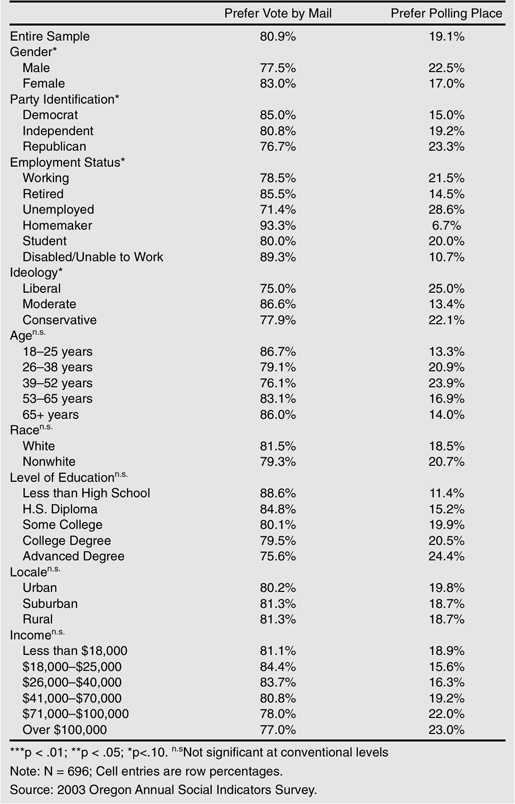
Table I provides a bivariate analysis of the respondents' preferences for either vote by mail or the polling place as a method of conducting elections. The overwhelming support for vote-bymail is apparent (80.9%), and this preference is consistent across all demographic and attitudinal subcategories. While certain groups had an even more positive view of vote by mail—specifically, women, Democrats, moderates, homemakers, retirees, and the disabled—these differences show only weak statistical significance.
These findings are consistent with previous indications of widespread public support for vote by mail, as reported in the surveys conducted in 1996 (Traugott 1996; Southwell and Burchett 1997). Although our recent 2003 survey did not ask the reasons for this preference for vote by mail, we can safely assume that a majority of these respondents favored the ease and convenience of vote by mail, as was mentioned by 78.5% of those who preferred vote by mail in the 1996 survey conducted by Southwell and Burchett (1997, 54). It appears that a majority of Oregon's voters have remained attached to this newly-adopted reform.
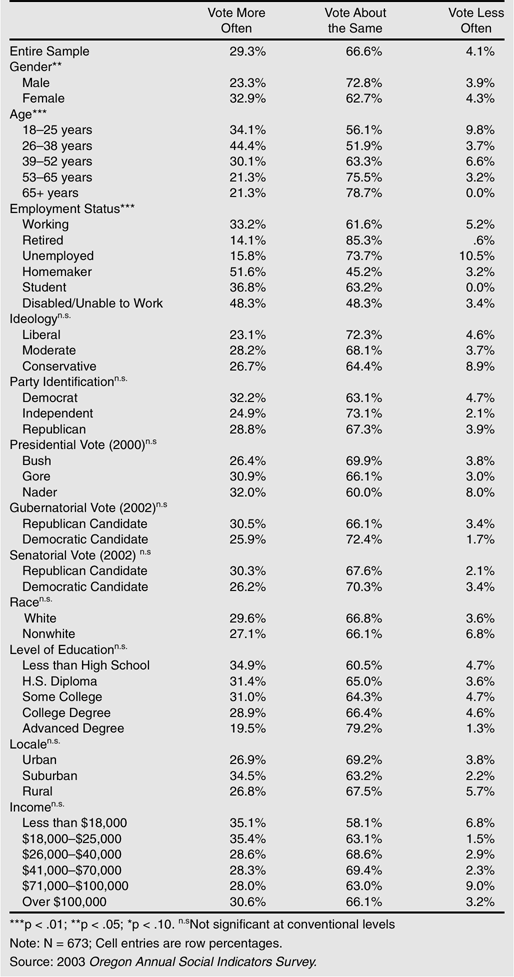
This survey question, of course, only deals with preference; it is equally important to determine if these preferences have any effect on subsequent voting behavior. Table 2 provides a bivariate analysis of the respondents' view on whether they had voted “more often,” “less often,” or “about the same” since Oregon started conducting vote by mail elections. A clear majority of the respondents indicated that their level of participation stayed at the same level under vote by mail as it had been when elections were held at the polling place, and only a small percentage, 4.1%, said they voted less often. However, 29.3% of the respondents indicated that they voted more often since the adoption of vote by mail. Although we cannot determine the accuracy of this reported increase in voting, this elevated turnout is consistent with statewide turnout figures in Oregon since the adoption of vote by mail (see Southwell and Burchett 2000; Secretary of State, State of Oregon 2000).
There were significant differences among certain demographic groups on this question. For women, their preference for vote by mail, reported in Table 1, was also reflected in their perception that they voted more often as a result. Younger voters, in the 26–38 year range, as well as those who were either disabled or a homemaker, also indicated that they voted more often under vote by mail. Perhaps these women are the busy “soccer moms” or employed women who find that voting by mail is simply easier, as may also be the case with younger people who are paid an hourly wage or lack the means of transportation to get to the polling place.


In this analysis, we also included measures of reported vote for specific candidates in various races at the national and state level. There was no discernible difference with regard to partisan identification or candidate preferences. There appear to be no winners or losers with vote by mail, and any reported increase in turnout appears to draw diverse groups into the electorate. These findings suggest that the heightened degree of concern among party leaders about partisan advantage, while understandable, is unfounded.
It appears that voters in Oregon have retained their support for vote by mail, and this support varies only slightly across demographic and partisan groups with the electorate. A majority of all subcategories favor vote by mail over more traditional polling place voting. The consequences of vote by mail on the nature of the electorate is one of the most hotly debated aspects of this electoral reform, but this survey suggests that neither of the two major parties have much to lose or gain from vote by mail. Instead, the groups that reported that they vote more often under vote by mail are simply a set of individuals—women, young people, the disabled, and homemakers—who have found it more convenient to vote under a system that does not require them to be physically present on “the first Tuesday after the first Monday.” Although there may be additional concerns about vote by mail, the main effect on the electorate is primarily to increase its magnitude rather than change its composition.

Preference for Election Type

Self-Reported Effects of Vote by Mail on Frequency of Voting

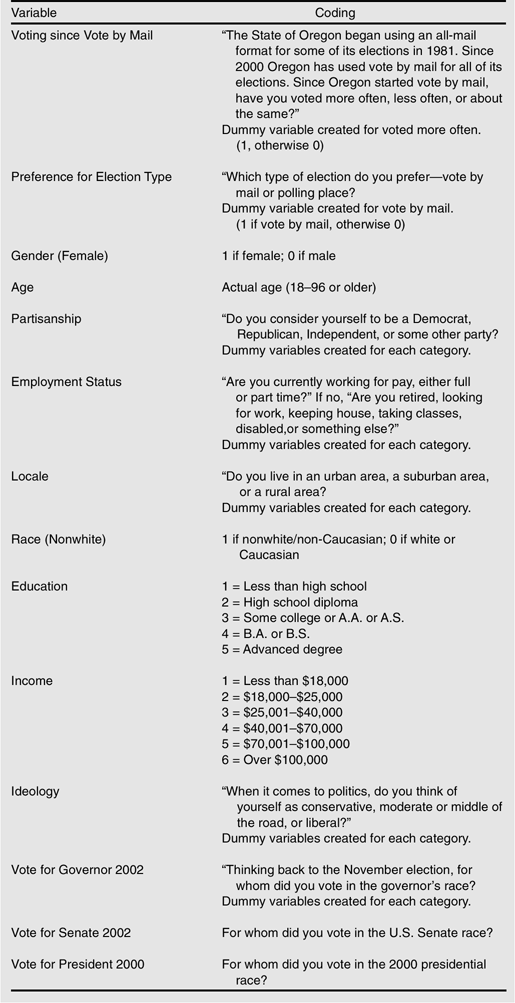
Appendix. Coding of Variables for Analysis