Introduction
The negative vision of aging that is conveyed within modern societies can lead to ageism, causing individuals to see elderly people as weak, cognitively impaired, etc. (Butler, Reference Butler1969). This negative vision is apparent in recent surveys that revealed that the most-cited motive for discrimination in Europe is age, specifically, being more than 55 years old (TNS Opinion and Social, 2012). This discrimination can have important consequences for elderly people. Longitudinal studies have shown that individuals with an initial negative vision of aging (in comparison to those with a positive vision) tend to have poorer memory capabilities (Levy, Reference Levy1996), describe themselves as having worse physical health with age (Levy et al., Reference Levy, Slade and Kasl2002a), develop considerably more cardiovascular disease (Levy et al., Reference Levy, Zonderman, Slade and Ferrucci2009), and have a reduced probability of survival (Levy et al., Reference Levy, Slade, Kunkel and Kasl2002b).
The negative consequences of ageism are not limited to elderly people themselves; ageism also impacts the attitudes of those who interact with elderly people, from the age of three (Kwong See and Nicoladis, Reference Kwong See and Nicoladis2010). More specifically, the interlocutors of elderly people tend to develop pseudo-positive attitudes (also called “benevolent ageism”) such as “elderspeak,” which refers to the belief that elderly people have hearing and/or comprehension problems, so we have to speak louder, slower, and in a patronizing way (as “baby talk”). This kind of communication can negatively impact elderly people from a psychological (reduced self-esteem and feeling of powerlessness) and verbal point of view (Ryan and Butler, Reference Ryan and Butler1996). While no study has investigated the effect of “elderspeak” in the context of geriatric oncology, one study showed that when elderly patients suffering from breast cancer perceived a high level of ageism among professionals (probably noticed in part because of “elderspeak”), they experienced more physical pain, poorer mental health, and decreased general satisfaction with their care (Mandelblatt et al., Reference Mandelblatt2003). In the same vein, older breast cancer survivors with negative beliefs about symptom management perceived that healthcare providers had negative attitudes towards them, reported experiencing difficulties communicating about their symptoms, and had a lower quality of life (Yeom and Heidrich, Reference Yeom and Heidrich2009).
The consequences of agist stereotypes among healthcare professionals is especially important, as these individuals seem particularly vulnerable to these stereotypes. Healthcare professionals are constantly exposed to ill and vulnerable older patients and are thus more likely to have negative and/or pseudo-positive attitudes (Gaymard, Reference Gaymard2006). Several studies have confirmed this observation in the specific context of oncology (Kearney et al., Reference Kearney, Miller, Paul and Smith2000), at both the research and clinical levels. Although the majority of patients suffering from cancer are over 65 years old (Smith et al., Reference Smith, Smith, Hurria, Hortobagyi and Buchholz2009), older patients are often excluded from clinical trials; only 32% of clinical trials include participants aged more than 65 years (Murthy et al., Reference Murthy, Krumholz and Gross2004) and are generally undertreated. For instance, physicians recommend adjuvant chemotherapy for breast cancer in 99% of cases in 55-year-old patients compared to only 60.4% of cases in 76-year-old patients (Protière et al., Reference Protière, Viens, Rousseau and Moatti2010). These differences are surprising given that “advanced” age alone should not be an exclusion criterion for treatments that can increase quality of life (Hurria et al., Reference Hurria2012). Rather, these treatments should be adapted for elderly people (Balducci, Reference Balducci2006). Moreover, no evidence indicates that elderly people are too weak to tolerate chemotherapy (Balducci, Reference Balducci2006), radiotherapy (Thompson et al., Reference Thompson, Cone, Gao, Hammond, Fraser and Back2012), or surgery (Rogne et al., Reference Rogne2009). Such observations are not limited to the curative setting but are also observed for reconstructive interventions: in identical clinical situations, physicians in training recommended breast reconstruction in 95% of cases for patients under 31 years of age but in only 65% of cases in patients over 59 years of age (Madan et al., Reference Madan, Aliabadi-Whale and Beech2001).
Although the relation between these results and the vision of aging has not been directly evaluated, we can legitimately hypothesize that decisions related to a patient's age may be partially explained by nursing and medical staff's negative representation (and stigmatization) of aging. In this context, the present study has two objectives:
-
1. To evaluate the caring attitudes of nurses according to the patient's age. Based on previous studies that focused on physicians (Madan et al., Reference Madan, Aliabadi-Whale and Beech2001, Protière et al., Reference Protière, Viens, Rousseau and Moatti2010), we postulate that older patients will receive less support for oncological treatment than younger patients. Testing nurses rather than physicians seemed us interesting given the increasingly important role of oncological nurses in patient care coordination, information and support (Colussi et al., Reference Colussi2001).
-
2. To analyze whether support for treatments is statistically linked to ageism among nurses, which is the primary feature of this study. We expect that negative attitudes towards older patients will be associated with a more negative vision of aging.
Method
Participants
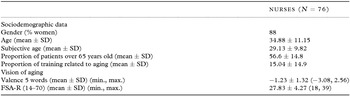
The participants were 76 nurses who specialized in oncology and worked in different units at the CHU Sart Tilman Liège University Hospital in Belgium. In this sample, 88.1% of the participants were women, which is a representative gender breakdown for nurses in Belgium (88.2% in 2010) (Statistics Belgium, 2013). The median age was 32.5 years, with a range from 22 to 63 years old (see Table 1). The participants stated they had regular contact with patients older than 65 years in their practice (they assessed the proportion as 56.6%) but recognized that the proportion of their training that was related to aging was low (evaluated as 15%). The participants were all recruited during a local continuing education courses in oncology in September 2014; the experimenter explained that we wanted to assess the experience of elderly people suffering from cancer and determine what factors influenced this experience.
Mean (SE) characteristics of participants

Materials and procedure
This study was approved by the ethics committees of the Liège University Teaching Hospital and the Psychology Faculty at the University of Liège. First, the healthcare professionals received four written clinical vignettes, which were written in collaboration with the oncologist in charge of the department (see Appendix 1 for more details). The first vignette was about a new immunotherapy with a high societal cost and addressed the question of whether a high economic cost for society might restrict treatment for older patients. For half of the nurses (random distribution), the patient was 40 years old (clinical case A1, N = 39), and for the other half of the nurses, the patient was 70 years old (clinical case A2, N = 37). The other three clinical cases (vignettes B, C, D) were about 35-, 55-, and 75-year-old patients suffering from breast cancer with a good indication for chemotherapy based on tumor characteristics. All participants received these three cases successively in a randomized order. For each vignette, the nurses were asked if they would support the patient in undergoing immunotherapy, chemotherapy, and breast reconstruction on a Likert-type scale from 1 (no support) to 7 (support). The major interest of these vignettes is to compare nurses’ caring attitudes for older patients and for younger patients. We are not interested in the competencies of nurses to prescribe a specific treatment (which is not their role). We are focused on a possible change in caring attitudes (measured by differences in the degree of support) according to patients’ age. As mentioned above, the attitudes of nurses towards older patients are of major interest given their important role in patient care coordination, information, and support (Colussi et al., Reference Colussi2001).
Then, the nurses were asked to complete two different scales (a fluency task and a more explicit measure of ageism) to assess their vision of aging. The fluency task, which is more intuitive measure of ageism, consisted of asking each nurse to write the first five words that came into their mind when they thought about an elderly person. This measure has been used and validated in Levy's studies (Levy et al., Reference Levy, Slade, Murphy and Gill2012). Afterwards, the valence of each word produced was tested with 10 external evaluators (M age = 36.1 years) on a scale from −5 (extremely negative) to 5 (extremely positive). For example, the word “odor” could receive a valence of -5 while the word “experience” could receive a mean valence of +4. This approach enabled us to calculate a total score by adding the valences of each word; a high score indicates a positive vision of aging. The more explicit measure of ageism was performed by using the French version of the Fraboni Scale of Ageism–Revised (FSA-R) (Boudjemad and Gana, Reference Boudjemad and Gana2009), which contains 14 items about ageism that are measured with a Likert-type scale that ranges from 1 (strongly disagree) to 5 (strongly agree). A high score indicates a high level of ageism.
Data analysis
Concerning the clinical vignettes, one-factor ANOVA was used to analyze the effect of the age of patients (40 years vs. 70 years) on new immunotherapy support. For chemotherapy and breast reconstruction support, ANOVA with repeated measures was used (each nurses gave his opinion for the same three clinical situations). Given that spherecity was not respected for breast reconstruction (Test de Mauchly, W = 0.621, p < 0.001) or for chemotherapy (W = 0.633, p < 0.001), the Greenhouse-Geisser correction was applied. To analyze the effect of the vision of age on differences in support, we began by correlating the participants’ level of support and their scores on the FSA-R and the fluency task. Second, concerning immunotherapy for a 70-year-old, we divided our sample into two groups: one group that encouraged patients to receive immunotherapy significantly less [support ≤ 3 (M − 1 SD), N = 8] and one group that provided more support [support ≥ 6 (M + 1 SD), N = 11]. The results were rounded to the higher or lower unit (4.53 - 1.84 = 2.69: rounded to 3). We then performed a one-way ANOVA. The procedure used to analyze the effect of the vision of age on differences in support for chemotherapy and breast reconstruction was different given that all healthcare professionals received vignettes about clinical cases for a patient of 35, 55, and 75 years of age; for each nurse, we calculated a score for the difference between the support they offered to a 75-year-old patient and the support they offered to a 35-year-old. For instance, if a nurse had a support score of 6 for a 35-year-old patient but of only 4 for a 75-year-old patient, the difference score is (4 − 6) = −2. Then, for chemotherapy support, we selected the following: (1) the most similar attitudes towards patients 35 and 75 years old: Group+, difference ≥ 0 (M −1 SD, N = 29), and (2) the most negative attitudes towards a 75-year-old patient versus a 35-year-old: Group-, difference ≤ −3 (M −1 SD, N = 21). The same procedure was used for breast reconstruction support (Group+, N = 25, difference ≥ 0, versus Group-, N = 44, difference ≤ −4). Then, we performed a one-factor ANOVA. Eventually, we analyzed the influence of nurses’ age and experience by using correlations with aging vision and support for treatment. The homogeneity of variances was examined using Levene's test and was always respected (all p > 0.08). However, normality was tested using the Shapiro–Wilk test, and the results were not always satisfying. As a consequence, all of our results were verified by using non-parametric tests, and no changes were observed.
Results
What vision do nurses have of aging?
Concerning the more explicit measure of ageism, the FSA-R, the mean score was 27.83 (SD = 4.27). For comparison, in the article that validated the French version of this scale (Boudjemad and Gana, Reference Boudjemad and Gana2009), the mean score was 31.06 (SD = 2.16; N = 284). These two means are significantly different (p < 0.001), suggesting that our sample has less ageism. However, it is necessary to note that the populations of these two samples differ; while we only tested nurses in oncology, Boudjemad and Gana tested the general population and 52% of their sample was constituted by students (M age = 30.35 years old).
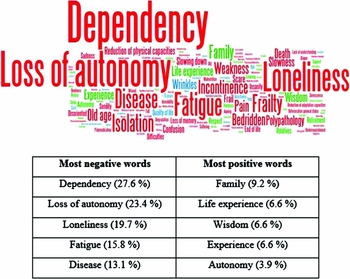
In the fluency task, a total of 372 words were produced. To illustrate the nurses’ vision of aging, we created a word cloud (see Figure 1). The cloud was created using the website http://www.wordle.net/create. For greater readability, we included only the 100 most frequently used words. The size of each word correlates with its frequency (i.e. the more often a word was cited, the bigger is the word appears). The color of each word represents its valence.
Cloud of words. Red = negative words (−1 to −5), green = positive words (+1 to +5) and blue = neutral words (−1 to +1). Top five most-cited negative and positive words (percentage of nurses who cited this word).

As shown by the word cloud, the words cited when nurses think about elderly people are negative in 74% of cases. The three most cited words are “dependency,” “loss of autonomy,” and “loneliness” (produced 21, 18, and 15 times, respectively), which are all negative. In comparison, as shown in Figure 1, “family” is the most frequent positive word and was cited only seven times. We observed a correlation between nurses’ age and the mean valence of their words; the older nurses produced more positive words (r = 0.28, p = 0.01). However, no correlation was observed with years of experience (p = 0.27). In addition, no correlations were observed with these variables in the FSA-R (all p > 0.25).
Do nurses’ attitudes differ according to patient age?
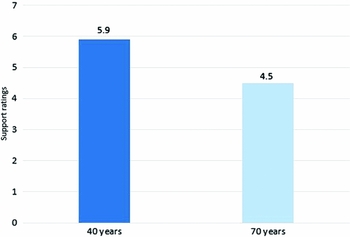
For the first two vignettes (immunotherapy), the results clearly showed that support for immunotherapy is higher when the patient is younger [F(1, 74) = 13.92, p < 0.001, η2 = 0.156] (see Figure 2). Support for a 70-year-old patient correlated with the nurses’ age and years of experience; the more a nurse supported immunotherapy, the older she was (r = 0.4, p = 0.01) and the more experience she had (r = 0.42, p = 0.01).
Immunotherapy support ratings for patients 40 or 70 years old.

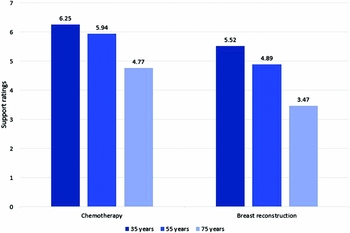
Concerning vignettes B, C, and D (chemotherapy and breast reconstruction, see Figure 3), ANOVA with repeated measures of patients’ age were used. The order of the vignettes was counterbalanced, but no effect of order was observed on encouragement for chemotherapy or reconstruction (all p > 0.11). The results revealed a significant effect of patients’ age on support for chemotherapy [F(1.463, 106.8) = 56.18, p < 0.001, η2 = 0.435] and breast reconstruction [F (1.451, 105.9) = 66.217, p < 0.001, η2 = 0.476]. Planned comparisons revealed less support for chemotherapy [F(1, 73) = 8.61, p < 0.005] and breast reconstruction [F (1, 73) = 26.41, p < 0.001] for patients as young as 55 in comparison to a 35-year-old patient. This decline in support is even more marked for a 75-year-old patient in comparison to a 55-year-old [F(1, 73) = 62.03, p < 0.001 and F (1, 73) = 54.69, p < 0.001, respectively]. Similar to the observation made for immunotherapy, the smaller the difference between support for chemotherapy for a 75-year-old patient and support for chemotherapy for a 35-year-old, the older the nurses (r = 0.27, p = 0.02) and the more experience they have (r = 0.23, p = 0.04). However, for breast reconstruction, no such correlation was observed (all p > 0.59).
Chemotherapy and breast reconstruction support ratings for patients 35, 55, and 75 years old.

Is the nurses’ vision of aging linked to their differential support for treatment according to patient age?
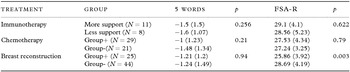
First, we correlated nurses’ support with their scores on the FSA-R and the fluency task. No significant correlations were observed (in both cases, r = 0.08, p = 0.64). We then enhanced the contrast between nurses by creating two groups: one group that encouraged patients to receive immunotherapy significantly less and one group that provided more support. Based on a one-way ANOVA, we did not observe an influence of the vision of aging, as measured using the FSA-R [F (1, 35) = 0.248, p = 0.622, η2 = 0.007] or the fluency task [F (1, 35) = 1.331, p = 0.256, η2 = 0.037] (see Table 2).
Mean (SD) scores for ageism among groups offering less or more support for older patients concerning immunotherapy, chemotherapy, or breast reconstruction

Concerning the relationship between nurses’ support for chemotherapy or breast reconstruction (Vignettes B, C, and D) and their ageism, we observed no significant correlations (all p > 0.11). To increase the statistical power, we selected two groups of nurses: one group with similar attitudes towards patients 35 and 75 years old (Group+) and one group with more negative attitudes toward a 75-year-old patient versus a 35-year-old (Group-). In our analysis of these two different groups, a one-factor ANOVA for chemotherapy support (Group+ vs. Group–) revealed no significant difference in the FSA-R score [F (1, 48) = 0.07, p = 0.79, η2 = 003] or fluency task index [F (1, 48) = 1.58, p = 0.21, η2 = 0.038]. For breast reconstruction support, no difference in the fluency task index [F (1, 67) = 0.005, p = 0.94, η2 = 0.028] was observed. However, a highly significant difference in the FSA-R score was observed, with Group-exhibiting more ageism than Group+ [F (1, 66) = 9.2, p = 0.003, η2 = 0.161]. This finding suggests that if nurses have a negative vision of aging, they are less likely to support a 75-year-old patient than a 35-year-old patient in undergoing breast reconstruction.
Discussion
An increasing number of cancer patients are elderly. Paradoxically, older patients are often excluded from clinical trials. This difference can be partly explained by the negative vision of aging that prevails in our society (i.e. ageism). This vision has many negative consequences for elderly people themselves (e.g. physical and mental health) and for their interlocutors, whose attitudes, although sometimes characterized by positive intentions, can be overprotective. In healthcare, the vision appears to be particularly negative, leading us to wonder about the consequences of this vision in clinical practice. Some studies (Madan et al., Reference Madan, Aliabadi-Whale and Beech2001; Protière et al., Reference Protière, Viens, Rousseau and Moatti2010) reported discrimination against elderly people in the context of chemotherapy and breast reconstruction recommendations. This kind of result suggests that one's vision of aging influences these recommendations; however, this theory has not been tested.
Our results show a global effect of age discrimination on support for reconstructive and curative treatments, with less support for older patients than for younger patients. The effect of ageism starts at a young age: even for 55-year-old patients! These results are similar to those observed in previous studies with physicians (Madan et al., Reference Madan, Aliabadi-Whale and Beech2001; Protière et al., Reference Protière, Viens, Rousseau and Moatti2010) and confirmed our first hypothesis. A very important observation made in this study is that a nurse's view of aging influences her support for breast reconstruction; the more negative the nurses’ vision of aging, the less likely they are to support breast reconstruction for an elderly patient. To our knowledge, this is the first time that a link between vision of aging and healthcare attitudes has been established. It seems likely that this link between aging view and care attitudes can be observed among other healthcare professionals, but this theory should be verified by additional studies. Indeed, some factors such as presence in the field or study level can have important influences. A recent study demonstrated that a negative vision of aging is associated with reduced compassionate attitudes (Bergman and Bodner, Reference Bergman and Bodner2015). More specifically, participants with a high level of ageism express greater emotional distance and reduced belief in their ability to assist frail older patients. Such behavior is a form of dehumanization of care (Thompson and Thompson, Reference Thompson and Thompson2001). However, in our study, this link was only observed for breast reconstruction and not for immunotherapy or chemotherapy recommendations, although in general, all treatments are less encouraged in older patients. One explanation may be that, when we have a negative view of aging, esthetic considerations are judged to be irrelevant for older patients. Nevertheless, regardless of a care provider's vision of aging, differences in treatment recommendations for older patients exist; this kind of observation highlights the necessity to assess elders based not on their chronological age but on their functional age (Hurria et al., Reference Hurria2012). Moreover, it is interesting to note that nurses’ age appears to influence their support of immunotherapy and chemotherapy; the older the nurses are, the more likely they are to support treatment. This tendency was observed in previous studies: old participants have less negative attitudes towards elderly people than young participants, when attitudes are measured explicitly (Nosek et al., Reference Nosek, Banaji and Greenwald2002; Engström and Fagerberg, Reference Engström and Fagerberg2011). Nevertheless, it is important to note that another study found contradictory results, with more ageism among middle-aged (40–67 years old) participants (Bodner et al., Reference Bodner, Bergman and Cohen-Fridel2012). Moreover, we must be cautious about our results given that we do not have an equitable distribution of ages within our sample (46% of nurses were between 22 and 30 years old). This link deserves a thorough examination in future studies. Although these results establish a clearer link between nurses’ vision of aging and their care attitudes towards older patients, we should be careful in view of some limitations of this study. First, the link between the vision of aging and care attitudes was shown only with the FSA-R and not by the fluency task. Second, our sample was quite small: replication of these results with a larger cohort will be interesting. Eventually, it would be interesting to link these results with the Terror Management Theory. Indeed, nurses working in oncology are faced with their own mortality daily and would thus be more likely to harbor ageism (Greenberg et al., Reference Greenberg, Schimel, Martens and Nelson2002; Martens et al., Reference Martens, Greenberg, Schimel and Landau2004). In this way, it will be useful to compare oncology nurses and nurses in other wards, who are less frequently confronted with mortality.
Considering the existence of a link between care attitudes and vision of aging, many practical questions are raised. These results reveal the need for healthcare providers to receive training about the consequences of ageism in the clinical practice of oncology. In particular, nurses and not only physicians play a critical role in patient care. Nurses often have a privileged relationship with the patient and can have a major impact on his or her final decision about undergoing the treatment proposed by the physician (Colussi et al., Reference Colussi2001). Such considerations are highlighted in Levy et al.'s study which demonstrated that the activation of negative stereotypes has an impact on the will to live; in other words, a negative attitude towards older patients can have consequences for their acceptance of a treatment (Levy et al., Reference Levy, Ashman and Dror2000). Nurses’ own stereotypes about aging can have important consequences for their support of treatment. Moreover, as previously described, one study showed that the high level of ageism among professionals that was perceived by elderly patients was associated with more physical pain, poorer mental health, and decreased general satisfaction with their care (Mandelblatt et al., Reference Mandelblatt2003). To combat this ageism, training programs have been shown to induce better attitudes towards older patients (Yu and Chen, Reference Yu and Chen2012) and improved communication (Williams et al., Reference Williams, Kemper and Hummert2003). Healthcare providers need to be better informed about the risk of age-related discrimination so that they can provide the most appropriate patient care.
Conclusion
In conclusion, in this study, nurses engaged in discriminatory behaviors towards older patients: in the same clinical situation, they less frequently encouraged a 70-year-old patient than a 40-year-old patient to undergo an expensive new immunotherapy. Similarly, older patients were less likely to be encouraged to ask for a breast reconstruction or to receive adjuvant chemotherapy treatment. This effect was seen even for a 55-year-old patient in comparison to a 35-year-old patient. While recommendations to engage in systemic treatments (immunotherapy and chemotherapy) are not influenced by nurses’ vision of aging, reconstructive interventions, such as breast reconstruction are less encouraged when nurses have a more negative vision of aging.
Conflict of interest
None.
Description of authors’ roles
S. Schroyen designed the study, collected the data, and wrote the paper. S. Adam and P. Missotten assisted with the design of the study, with the statistical analysis and with writing the article. G. Jérusalem wrote the clinical vignettes and assisted with writing the article. C. Gilles supervised the data collection.
Acknowledgments
This work was supported by a Fund for Scientific Research grant (F. R. S. – FNRS, FRESH grant) (www.frs-fnrs.be) to Sarah Schroyen.
Appendix 1
Clinical cases A1 and A2
A new immunotherapy for lung cancer allows us to treat metastatic lung cancer more efficiently. A clinical study has shown that the likelihood of being alive in 5 years is enhanced by 10% thanks to this treatment. Treatment tolerance is generally good. However, it lasts for one year and has a societal cost of 20,000 euros.
I support my 40-year-old (A1)/70-year-old (A2) patient in undergoing this treatment.
No support 1 2 3 4 5 6 7 Support
Clinical cases B/C/D
A patient aged 35 (B)/ 55 (C)/ 75 (D) years old in excellent general condition has breast cancer treated by mastectomy, 3 cm in size, four lymph nodes invaded, strongly expressing estrogen and progesterone receptors, HER 2-negative, proliferation marker Ki-67 very high (expressed by 80% of tumor cells). She lives at home with her husband and is totally independent. She seems uncertain about whether to ask for breast reconstruction.
To what extent do you think chemotherapy is adequate?
Strongly disagree 1 2 3 4 5 6 7 Strongly agree
How much would you support her in asking for a breast reconstruction?
No support 1 2 3 4 5 6 7 Support