Tom Dishion was first exposed to family dynamics as a research assistant to Jerry Patterson. One of his first jobs at the Oregon Social Learning Center was to transcribe audio recordings that had been obtained as observers in the family homes whispered codes describing sequences of behavior between mothers and their preschool child. The studies were designed to understand the relationship between macro events in the mother's environment (e.g., stressors, social support, and maternal depression) and microsocial coercive interactions. Through these transcriptions, he learned firsthand the patterned dynamics of coercive family interactions and how small perturbations in the form of small gentle parenting instructions could change the coercive cycle (Patterson, Reference Patterson1982). Tom Dishion strongly believed that his work should benefit the lives of families in need and these micro-level interactions in families would be the basic building blocks for his work. He developed an evidence-based family-centered intervention, the Family Check-Up. Central to this work is the identification of functional family dynamics through careful observation of family interactions and providing families with feedback to identify strengths and areas in need of change. Insight into interpersonal dynamics helps researchers to understand and improve intervention and implementation efforts, helps practitioners to identify areas of change when working with families, and it helps families to recognize their strengths. Moreover, he extended coercion theory to the functional dynamics in adolescent peer relationships as promoters of substance abuse, antisocial behaviors, and violence (Van Ryzin & Dishion, Reference Van Ryzin and Dishion2013). In keeping with his spirit, we extend this work to investigate coercive dynamics in adolescent romantic relationships.
Being involved in romantic relationships is a normative experience during adolescence. At least 70% of 17-year-old adolescents have had one romantic relationship, and adolescents report spending more time interacting with romantic partners than with parents or friends (Carver, Joyner, & Udry, Reference Carver, Joyner, Udry and Florsheim2003). Romantic partners are central in adolescents’ lives and become comparable in importance to parents, siblings, and best friends (Furman, Ho, & Low, Reference Furman, Ho, Low, Engels, Kerr and Stattin2007). Adolescent romantic relationships provide positive experiences, such as companionship, intimacy, and social support from partners (Connolly, Craig, Goldberg, & Pepler, Reference Connolly, Craig, Goldberg and Pepler1999; Furman, Simon, Shaffer, & Bouchey, Reference Furman, Simon, Shaffer and Bouchey2002; Ha, Overbeek, de Greef, Scholte, & Engels, Reference Ha, Overbeek, De Greef, Scholte and Engels2010). Unfortunately, negative experiences in adolescent romantic relationships can be potentially disruptive to social and emotional adjustment, creating depressive symptoms and anxiety (Davila, Steinberg, Kachadourian, Cobb, & Fincham, Reference Davila, Steinberg, Kachadourian, Cobb and Fincham2004; Ha & Kim, 2015; Ha, Dishion, Overbeek, Burk, & Engels, Reference Ha, Dishion, Overbeek, Burk and Engels2014; Joyner & Udry, Reference Joyner and Udry2000; La Greca & Harrison, Reference La Greca and Harrison2005; Monroe, Rohde, Seeley, & Lewinsohn, Reference Monroe, Rohde, Seeley and Lewinsohn1999), as well as substance use and intimate partner violence (IPV; Rhule-Louie & McMahon, Reference Rhule-Louie and McMahon2007; Wekerle & Wolfe, Reference Wekerle and Wolfe1999).
IPV starts in adolescence and peaks in late adolescence and early adulthood for both females and males (Johnson, Manning, Giordano, & Longmore, Reference Johnson, Manning, Giordano and Longmore2015). Experiencing IPV during adolescence may increase the vulnerability of young people to experiencing violence in future romantic relationships (Kuijpers, Van der Knaap, & Lodewijks, Reference Kuijpers, van der Knaap and Lodewijks2011). However, there is also significant variability in IPV over time (Johnson, Manning, et al., Reference Johnson, Manning, Giordano and Longmore2015; Shortt et al., Reference Shortt, Capaldi, Kim, Kerr, Owen and Feingold2012; Timmons Fritz & Smith Slep, Reference Timmons Fritz and Smith Slep2009), indicating that these negative relationship experiences are open to change. The importance of early intervention and prevention of IPV is increasingly recognized (Langhinrichsen-Rohling & Capaldi, Reference Langhinrichsen-Rohling and Capaldi2012) with an emphasis on promoting a healthy relationship and the conflict resolution skills of both partners (Pepler, Reference Pepler2012; Shortt et al., Reference Shortt, Capaldi, Kim, Kerr, Owen and Feingold2012). However, it is important to acknowledge that not all conflict is necessarily detrimental. When handled in a constructive way, it provides opportunities for relationship growth. Thus, how romantic partners manage disagreements, rather than conflict itself, may be more related to the development of IPV. More longitudinal and dyadic research is needed to uncover couple dynamics and to explain how initial minor conflicts escalate into more serious forms of conflict, including IPV (Capaldi, Knoble, Short, & Kim, Reference Capaldi, Knoble, Shortt and Kim2012). Therefore, we investigated coercive interactions on a microsocial level during conflict and jealousy discussions within adolescent romantic couples. Specifically, we investigated whether these coercive interactions mediated between earlier levels of conflict and more serious forms of future conflict.
From a social learning perspective, coercion theory describes how parents shape their child's aggressive behavior during critical moments such as parent–child conflicts (Bandura, Reference Bandura1973; Patterson, Reference Patterson1982; Patterson, Reid, & Dishion, Reference Patterson, Reid and Dishion1992). Coercion in parent–child interactions unfolds on a moment-to-moment level often starting with a noncompliant child. If a parent responds with equally aversive behavior, for example yelling or scolding, the child's behavior may escalate into a tantrum or meltdown. To prevent the conflict from getting worse, the parent may give in or disengage from their child's aversive behavior. While parents may experience immediate relief, parental capitulation to a child's aversive behavior socializes children on how to succeed in getting their way (Snyder & Patterson, Reference Snyder and Patterson1995), thereby increasing the likelihood of future coercive parent–child interactions. Parent–child coercion during early childhood leads to more serious long-term antisocial behaviors in adolescence and adulthood (Reid, Patterson, & Snyder, Reference Reid, Patterson and Snyder2002). A key concept in coercion theory is that these small sequences of microsocial events shape future reliance on coercive behaviors through the principles of operant and classical conditioning. Consequently, it becomes increasingly difficult to engage in behaviors that are positive and constructive as alternatives to the coercive cycle (Granic & Patterson, Reference Granic and Patterson2006).
Although marital relationships are very different from parent–child relationships, coercion theory also applies to the understanding of marital functioning (Birchler, Weiss, & Vincent, Reference Birchler, Weiss and Vincent1975). A review by Heyman (Reference Heyman2001) showed that distressed marital couples, as assessed across different samples and using different coding systems, display high levels of anger and are more likely to reciprocate hostility. A coercion cycle within adult couples starts with aversive behavior displayed by one partner. If the other partner reciprocates with aversive behavior it might successfully terminate the anger and aversive behavior of the first partner. This may bring a temporary escape from conflict, but it will increase the likelihood of subsequent coercive conflicts over time. Coercive interaction patterns are a predictor of marital discord and divorce (Gottman & Levenson, Reference Gottman, Levenson, Masters and Yarkin-Levin1984).
Research investigating coercion in adolescent romantic couples and IPV is scarce. A longitudinal study across adolescence and early adulthood found that adolescents who self-reported to be engaged in negative interactions with a romantic partner in the past year were more likely to engage in future IPV (Novak & Furman, Reference Novak and Furman2016). One of the few observational studies among late adolescent and early adult couples found reciprocity between observed psychological and physical aggression during conflict discussions to be related to self-reported IPV (Capaldi & Crosby, Reference Capaldi and Crosby1997). Thus, there is some evidence that coercion, conceptualized as mutual negativity during conflict interactions, is related to IPV in late adolescent/early adult couples. Interestingly, Capaldi and Crosby (Reference Capaldi and Crosby1997) also found that a large portion of the observed aggressive behaviors was coded as playful. Playful aggression was directed to the partner with positive affect, and the authors hypothesized upon reviewing the videos that the playful aggressive acts seemed to be part of sexual intimacy or to be attention-seeking behaviors, often initiated by the female partner and reinforced by the male partner. Importantly, adolescents who engaged in negative aggressive behaviors were also more likely to show these playful forms of aggression. Playful bouts of aggression in these young couples may turn into coercion, leading to IPV when conflict becomes more intense over time. These results highlight the possibility that coercion might be more nuanced and complex in late adolescent couples (Foshee, Bauman, Linder, Rice, & Wilcher, Reference Foshee, Bauman, Linder, Rice and Wilcher2007). Consideration of both mutual negativity and combined negativity and positivity during conflict might be central to improving the current understanding of how relatively small conflicts can escalate into more serious forms of IPV.
The question remains as to how coercion dynamics play out in adolescent romantic relationships in couples who are just starting to date during middle adolescence. Coercive tactics that are readily apparent in parent–child and marital relationships might be less functional for teenage romantic relationships because of the fragile nature of these relationships. Adolescents are highly motivated to be in romantic relationships as is evidenced in the development of sexual attraction and increased relationship involvement over the course of adolescence. A substantial proportion of adolescents’ positive and negative emotions are attributable to romantic relationships (Larson & Asmussen, Reference Larson, Asmussen, Colten and Gore1991; Larsson, Clore, & Wood, Reference Larson, Clore, Wood, Furman, Brown and Feiring1999) and same day experiences of conflict and feelings of jealousy (Rogers, Ha, Updegraff, & Iida, Reference Rogers, Ha, Updegraff and Iida2018). At the same time, the foundations of these relationships are fragile because adolescent romantic relationships are not likely to last, with nearly 50% of 15 to 16 year olds experiencing a breakup in the previous six months (Connolly & McIsaac, Reference Connolly and McIsaac2009), and relationships typically last less than 12 months (Ha, Overbeek, Lichtwarck-Aschoff & Engels, Reference Ha, Overbeek, Lichtwarck-Aschoff and Engels2013). Adolescents may be particularly vulnerable to the prospect of conflict and breakup in these early romantic relationships. They may be willing to go to any length to avoid potential conflicts or disagreements by denying or minimizing differences of opinion to maintain feelings of connection and closeness (Shulman, Tuval-Mashiach, Levran, & Anbar, Reference Shulman, Tuval-Mashiach, Levran and Anbar2006). Feelings of closeness, trust, and intimacy are highly valued in romantic relationships, with an emphasis on mutual enjoyment and fun (Furman & Wehner, Reference Furman, Wehner, Shulman and Collins1997). Therefore, in the context of observed conflict discussions, keeping up mutual positivity in the face of conflict and disagreement as a kind of “positive spiral” permits avoidance of, or escape from, relationship conflicts in the couple's effort to maintain feelings of closeness.
Given adolescents’ lack of experience with navigating and repairing high levels of negativity (Ha et al., Reference Ha, Overbeek, Lichtwarck-Aschoff and Engels2013), it may be more functional to avoid or mask unpleasant relationship experiences than to run the risk of eliciting negativity in the relationship. Coercion processes in adolescent couples may involve a lack of positive reciprocity as a means of avoiding conflict, rather than reinforcement of aversive behaviors as found in marital and in parent–child relationships. To this extent, the unique context of adolescent romantic relationships may suggest a need for an extension of coercion theory.
The Current Study
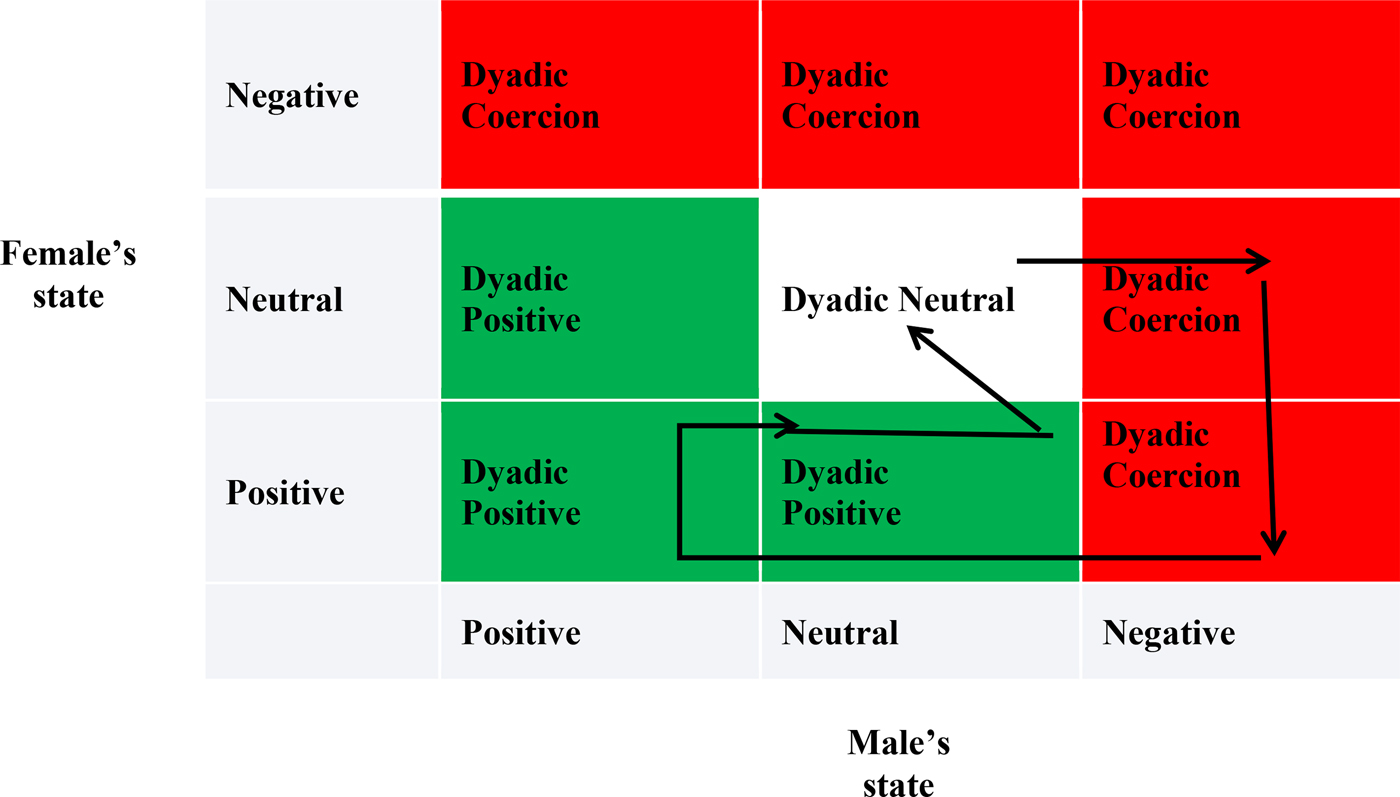
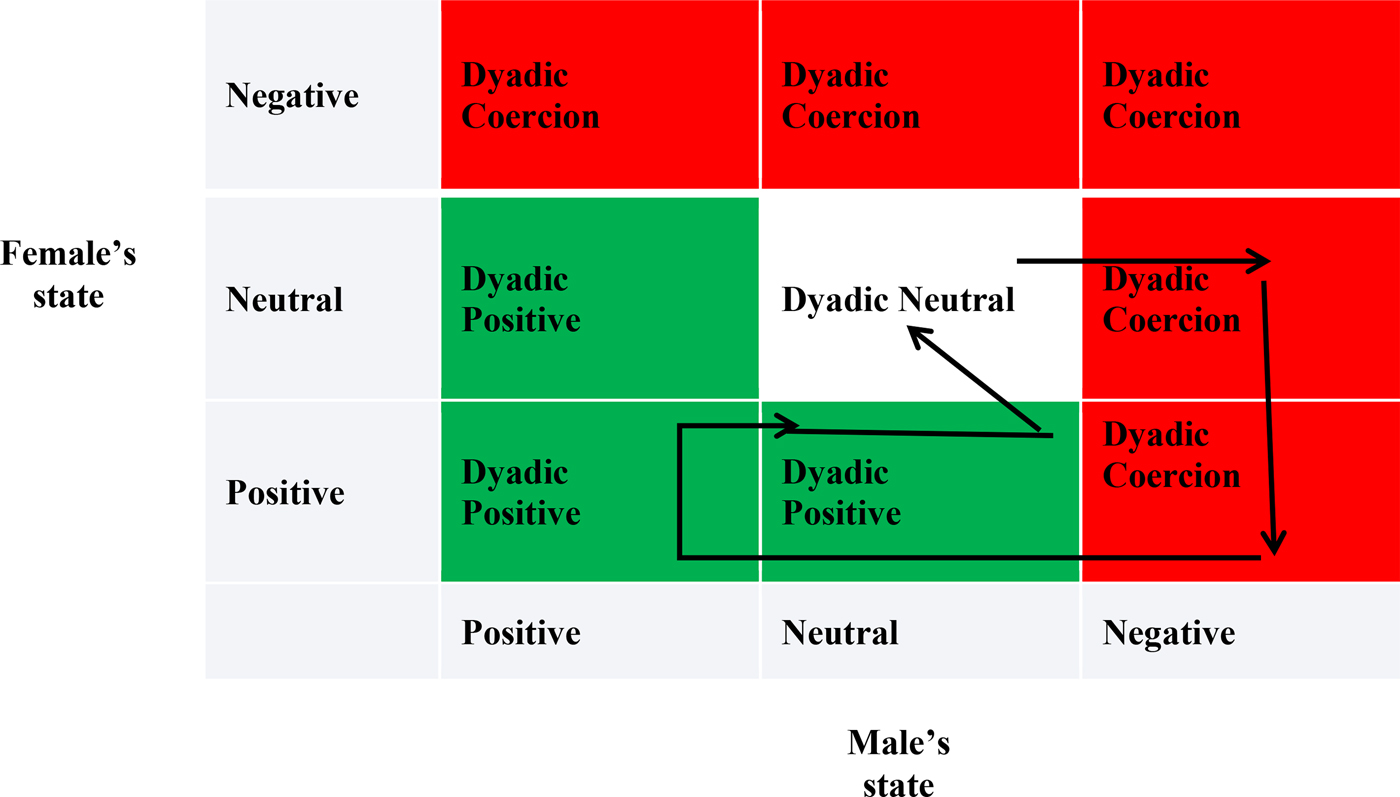
In line with coercion theory, dyadic coercion was defined as one partner's being negative and the other partner's being negative or neutral (the red areas of interest in Figure 1). Based on Capaldi and Crosby's (Reference Capaldi and Crosby1997) findings, we added the negative-positive state as part of coercion, indicating that one partner is negative while the other partner is positive. Dyadic positivity states represented one partner's positive behaviors, while the other partner is positive or neutral (the green areas of interest in Figure 1). The remaining state is dyadic neutral in which both partners are merely talking about something neutral without showing any negative or positive affect. We investigated whether coercion, dyadic positivity, and neutral interaction patterns during conflict discussions with romantic partners mediated between earlier levels of conflict and more serious forms of future conflict including intimate partner violence.
Areas of interest in the State Space Grid: Three dyadic states Dyadic Coercion (DC), Dyadic Positive (DP), and Dyadic Neutral (DN).
We used multivariate multilevel survival analyses (MMSA; Stoolmiller & Snyder, Reference Stoolmiller and Snyder2013) to investigate this research question. Survival analyses originated from the medical field, in which death as an event was the outcome of interest. Since then, survival analyses have been widely developed and applied in psychology research (Singer & Willett, Reference Singer and Willett1993). Recently, MMSA was developed as an extension to be applied to observational data consisting of coded behavior and emotions in real time (Stoolmiller & Snyder, Reference Stoolmiller and Snyder2006). This analytic technique allows for the estimation of hazard rates (HR) for dyadic states, such as coercion and dyadic positivity, and in turn, estimation of whether the HR of coercion and mutual positivity predicts IPV. MMSA controls for the timing and the censoring of events, which is when the observation ends before some of the events occurred for the participants. Thus, MMSA enables the investigation of the likelihood of a recurring dyadic state, such as coercion and dyadic positivity.
In accordance with coercion theory, we specifically investigated whether a lower likelihood of terminating coercion (a lower HR of dyadic coercion), defined as dyadic negative affect and negative-positive affective states, during adolescent couple conflict interactions would, over time, lead to escalation of conflict into IPV. Additionally, we investigated whether a higher likelihood of terminating positive affect (a higher HR of dyadic positivity) during adolescent couple conflict interactions predicted escalations in conflict.
Method
Participants
The participants were 99 adolescent couples. Because the main analysis required distinguishable dyads based on gender (Kenny, Kashy, & Cook, Reference Kenny, Kashy and Cook2006), we excluded eight couples who identified as homosexual (one male and seven female couples). The final analytic sample consisted of 91 heterosexual couples, aged 13–18 years (M = 16.5 years, SD = 0.99; see Ha et al., Reference Ha, Yeung, Rogers, Poulsen, Kornienko and Granger2016). The ethnic and racial composition of the final sample was 42% Hispanic/Latino, 42% White, and 16% African-American, Asian American, Native American, or “Other.” Concerning relationship duration, 37% of the participants reported being in a relationship for less than 6 months, 31% between 6 and 12 months, and 32% for longer than a year. Participants came from households with a relatively low socioeconomic status: 44% of participants’ fathers and 36% of their mothers had, at most, a high school diploma. Moreover, 45% of the participants received free or reduced cost lunches at school, and 54% of the participants reported having not enough, or just enough, money to get by.
Adolescents were recruited through (a) announcements in two high schools in a metropolitan area in the southwestern United States (n = 19); (b) targeted Facebook ads (n = 70); and (c) in-person contact at a local shopping mall (n = 2). Chi-square tests revealed differences in ethnicity and SES based on recruitment. Those recruited through schools were more likely to receive free or reduced cost lunches, χ2 (4, N = 166) = 19.773, p < 0.01. Furthermore, the majority of participants recruited through schools were Hispanic/Latino (74%), 8% White, and 18% were African-American, Native American, or Other ethnicity, whereas the majority of those recruited through Facebook were White (54%), 34% Hispanic/Latino, 12% were either Black, Asian, Native American, Pacific Islander, or Other ethnicity, χ2 (12, N = 179) = 39.749, p < 0.01.
Procedure
After obtaining parental consent and adolescent assent, we contacted and informed romantic partners and their parents about the study goals. Couples were invited to participate in a longitudinal investigation of adolescents’ romantic relationships.
Baseline assessment
Each participant completed online surveys about their relationships with their partner, peers, parents and several behavioral and emotional adjustment indices.
Laboratory assessment
Couples participated in a three-hour laboratory session in which they completed additional surveys and a revised Chatroom Interact Task (Silk et al., Reference Silk, Siegle, Lee, Nelson, Stroud and Dahl2014), during which electroencephalography (EEG) was recorded (this was not the focus of the current research; see Kuo, Ha, Ebbert, Tucker, & Dishion, Reference Kuo, Ha, Ebbert, Tucker and Dishion2017). Following this experiment, couples participated in three assigned videotaped discussion tasks, each lasting 5 minutes. The first discussion was a warm-up task in which couples planned a party. Next, participants discussed a conflict topic that was highly rated by either the male or the female participant. Specifically, participants independently rated the extent to which 18 problems caused conflicts in their relationships over the past 30 days on a 10-point scale (e.g., not liking your partner's attitudes or behaviors, or not liking some of your partner's friends). The highest rated topic was selected via a coin toss to randomize which partner's topic (male or female nominated) would be discussed. Finally, they discussed how jealousy affected their relationship.
Ecological momentary assessment
Couples participated in twice-weekly ecological momentary assessments (EMAs; Rogers et al., Reference Rogers, Ha, Updegraff and Iida2018). Couples received instructions for a texting protocol at the end of the laboratory session. The importance and meaning of confidentiality was discussed, and couples were instructed to complete the EMAs individually; they were informed that the answers were private. On the first Sunday following the lab session, participants received a link to a short online survey to complete for the next 12 weeks on Wednesday and Sunday evenings, resulting in 24 surveys. Participants received EMAs every Sunday and Wednesday evening between 7:00 p.m. and 7:30 p.m. for 12 weeks. At 9:00 p.m., a reminder text was sent to adolescents who had not yet completed the EMA. The EMAs took approximately 5 to 10 minutes to complete. Research assistants monitored the progress of the EMAs and phoned adolescents who had missed two consecutive assessments to remind them to complete the survey. Week-to-week completion of EMAs ranged from 60% to 83%; on average, the adolescents completed 17 of 24 (71%) of their assessments.
Follow-up assessment
Approximately six months after the baseline assessment, all couples were contacted and they completed a similar online survey as the baseline survey. Please note that all participants were invited to participate again whether or not they were still together with their partner. A total of 143 adolescents (72.2%) participated in the follow-up assessment.
Participants each received $50 for the baseline survey and the laboratory session. Participants were paid $1.77 for every EMA for a potential total of $42, with a $5 bonus at the halfway point if they had completed at least half of their EMAs. Participants each received $30 for completing the follow-up survey. The Institutional Review Board of Arizona State University approved the project activities.
Measures
Conflict
The conflict subscale of the Network of Relationships Inventory was used to measure perceptions of conflict in close relationships at T1 and T2 (NRI; Furman & Buhrmester, Reference Furman and Buhrmester1985). The conflict subscale consisted of three questions: “How much do you and this person get upset with or mad at each other?”; “How much do you and this person disagree and quarrel?”; and “How much do you and this person argue with each other?” Participants were asked to rate how much each feature occurred with their romantic partner using a 5-point Likert scale. Response options ranged from 1 (none) to 5 (very much). Participants reported conflict at baseline and follow-up. Items were averaged and Cronbach's α across all items of the scale was .92 for females and .93 for males at T1 and .92 for females and .91 for males at T2.
Intimate Partner Violence
Intimate partner violence was measured with the Conflict in Adolescent Dating Relationships Inventory (CADRI; Wolfe et al., Reference Wolfe, Scott, Reitzel-Jaffe, Wekerle, Grasley and Straatman2001). We adjusted the original 25-item measure to a 17-item measure by including the full emotional and verbal abuse subscale, and the short versions of the physical abuse subscale, threatening behavior subscale, and sexual abuse subscale (Fernández-González, Wekerle, & Goldstein, Reference Fernández-González, Wekerle and Goldstein2012). Example items included “I spoke to him/her in a hostile or mean tone of voice”; “I pushed, shoved, or shook him/her”; “I threatened to hit him/her or throw something at him/her”; and “I kissed her when he/she didn't want me to.” Participants were asked to rate their own behaviors on a 4-point Likert scale from 0 (never) to 3 (always). Items were averaged to yield a global score of IPV. Cronbach's α across all items of the scale was .86 for females and .75 for males at T2.
Daily Conflict
Adolescents reported at each ecological momentary assessment the degree of conflict experienced that day. They responded on a 7-point scale (1 = none, 7 = a lot) to the question, “Today, how much conflict or tension was there between you and your partner?” (Rogers et al., Reference Rogers, Ha, Updegraff and Iida2018). An average score across all measurements was used in the analyses.
Covariates
Age—Adolescents reported their current age in years. Same versus mixed ethnicity status—A dummy code was created for whether a couple was same or mixed ethnicity. Sixty percent of the couples were in a same ethnicity relationship (n = 54). Relationship Length—Participants were asked to indicate the length of their romantic relationship on a scale from 1 (less than a week) to 21 (3 years or more). The average relationship length was 13.05 (SD = 5.14), which translates to around 9 months. Breakup—Breakup was assessed at T2 by asking participants whether they were still with the same partner. Around 25% (n = 23) of couples had broken up at T2.
Observational coding
We coded interactions in real time using Mangold INTERACT software (Mangold, 2017). The Relationship Affect Coding System (Peterson, Winter, Jabson, & Dishion, Reference Peterson, Winter, Jabson and Dishion2008) was used to capture affect, nonverbal, and verbal behaviors in couples. Each participant was coded separately with three streams of continuous data: affect, verbal, and physical codes. These three streams of data were then collapsed into one continuous stream per individual of behaviors, based on a hierarchical system of negative engagement, positive engagement, and lastly, neutral engagement. For example, if a partner showed negative affect (e.g., anger), while simultaneously showing a positive physical behavior (e.g., holding hands), the continuous stream would be classified as negative engagement. This hierarchical system is based on previous work that showed that negative behaviors have more influence on social interactions than positive behaviors do (Gottman, Reference Gottman1994). Negative engagement consisted of the following codes, (a) verbal codes included negative talk, resist, stonewalling, and negative directives; (b) the physical code was negative physical touch; and (c) affective codes included anger, disgust, and distress. Positive engagement consisted of the following codes, (a) verbal codes included positive talk, active listening, appease, positive structuring; (b) the physical code was positive physical touch; and (c) affective codes included positive affect such as smiling and laughter. Neutral engagement consisted of the following codes, (a) verbal codes including, no verbal talk and whispering; (b) physical codes included neutral physical contact; (c) affective codes included neutral affect. One master coder trained four coders, and weekly coder meetings were held to prevent coder drift. Random samples of 23% of the data were used for inter-rater agreement, which remained on average 75.74% agreement (SD = 9.560), which is acceptable.
State space grids
State space grids were used to visually represent adolescents’ affective behaviors (Granic & Hollenstein, 2003). Adolescents’ affective behavioral responses were plotted in real time against their partners’ affective responses on a quasi-ordinal scale, negative, positive, and neutral, with males’ behaviors depicted on the x-axis and females’ behaviors on the y-axis (Figure 1). Areas of interest are highlighted: dyadic coercion (DC), dyadic positive (DP), and dyadic neutral (DN). An example sequence of dyadic states is plotted within the state space grid. A couple started their interaction within the dyadic neutral state, moved into dyadic coercion, and then into dyadic positive.
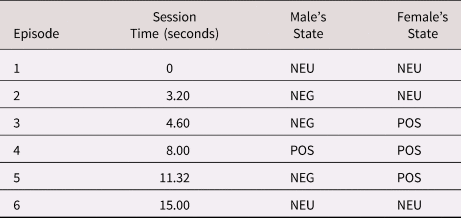
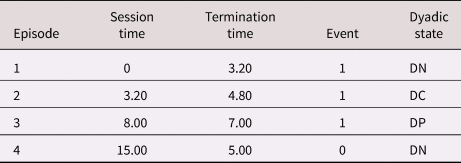
This hypothetical interaction sequence is also represented in Table 1, which shows the initial data format of the male and female states separately. These data are reformatted into a dyadic data structure for the MMSAs (Stoolmiller & Snyder, Reference Stoolmiller and Snyder2013). Table 2 shows the dyadic data structure based on the combination of individual states in Figure 1. It is now possible to calculate the time (seconds) that it takes for the dyad to end a certain state by subtracting the session time of a certain event from the session time of the next event. For example, it took the dyad 15.00 − 8.00 = 7.00 seconds to end the DP state in the hypothetical example (Table 2).
Male and female affective data example for an interaction sequence that ends after 20 seconds
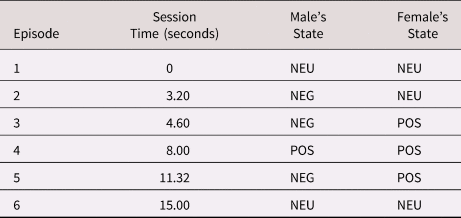
Note: NEG = negative affect; POS = positive affect; NEU = neutral.
Dyadic affective states and termination time. a hypothetical data example for an interaction sequence that ends after 20 seconds
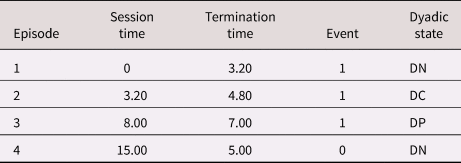
Note: DC = Dyadic Coercion; DP = Dyadic Positive; DN = Dyadic Neutral.
The two conflict discussions were combined to increase observational time to improve the power of the current survival analyses (Stoolmiller & Snyder, Reference Stoolmiller and Snyder2006).
Strategy of analyses
Multivariate multilevel survival analysis (Stoolmiller & Snyder, Reference Stoolmiller and Snyder2013) was employed to answer the current research questions. Survival analysis is a specific type of analysis that investigates the prediction of time-to-event. It considers simultaneously the time variable (when the event happened) and the event occurrence variable (whether the event happened at a specific time or not; Singer & Willett, Reference Singer and Willett2003). The hazard rate is a function of time and event occurrence and indicates the instantaneous rate of an event's occurring at a specific time conditioned on the absence of the event up to the specific time point (Allison, Reference Allison2010). In survival analysis, because of the simplicity of not requiring a specification for the baseline hazard function, the Cox model is a common choice for research questions involving the relationship between a hazard rate and a set of predictors (Cox, Reference Cox1972). It should be noted that there is also an option to specify the baseline hazard function for the Cox model if that is of particular interest (Singer & Willett, Reference Singer and Willett2003).
The “multilevel” part of the MMSA model takes into account that the event (time to end a dyadic state) is a repeated event, and multilevel Cox models deal with the dependency of the repeated events by adding an extra random effect term to the Cox model. The “multivariate” part of the MMSA model is used to study the relationship between the multiple hazard rates of interest (Stoolmiller & Snyder, Reference Stoolmiller and Snyder2013). In this study, the dyadic states were defined as separate, exclusive states. Therefore, the models were separately fitted for the DC, DP, and DN states.
All analyses were conducted in Mplus 8.1 (Muthén & Muthén, Reference Muthén and Muthén1998–2017). Couple ID was the clustering variable in the multilevel analysis. In order to define the hazard rates at the second level (between-level in Mplus), a between-level latent variable was created with the single survival variable as an indicator and restricting the factor loading to 1.0 and the measurement error variance to 0 (zero) (Stoolmiller & Snyder, Reference Stoolmiller and Snyder2013). Then, a mediational model was fitted (Figure 2) with male and female conflict at T1 scores predicting the latent hazard rate, and in turn, the latent hazard rate predicted latent variables for male and female IPV at T2. We controlled for several covariates, male and female age, length of relationship, a binary indicator showing whether couples were of the same ethnicity, and a breakup indicator, which was only controlled for at T2. The latent IPV construct at T2 was measured by three manifest variables, conflict, average daily conflict, and IPV at T2. The model coefficients should be interpreted with care, noting that the latent hazard rate variable was in the natural log metric, which is similar to a Cox model.
Mediational model of male and female conflict at T1 predicting male and female IPV at T2 mediated by the log hazard rate of ending a dyadic state.

Results
Descriptive statistics
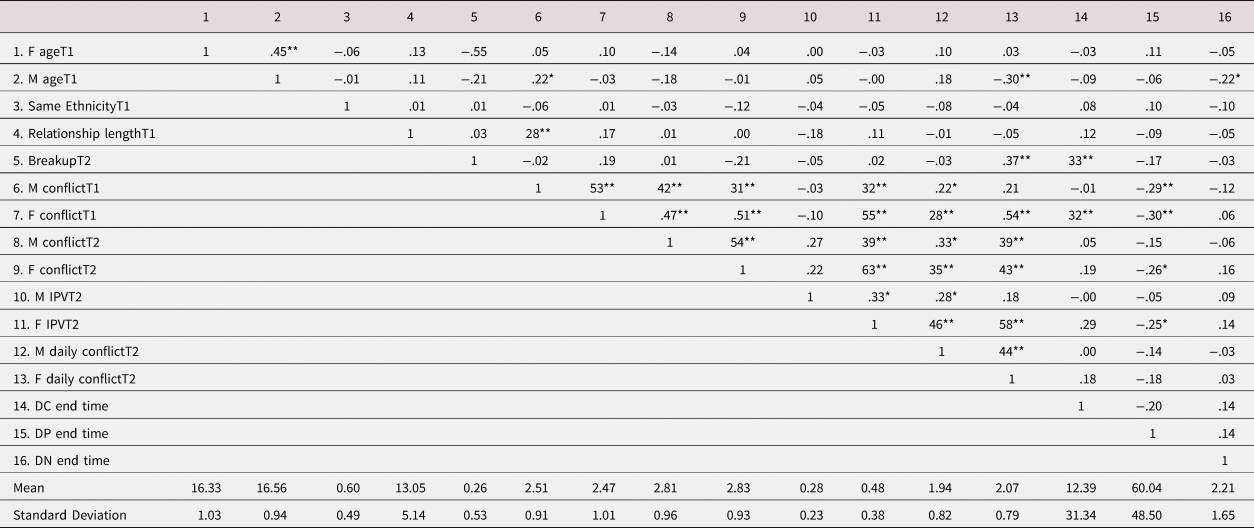
Table 3 shows the descriptive statistics for the sample. The average duration time in Dyadic Coercion (DC), Dyadic Positive (DP), and Dyadic Neutral (DN) were respectively M = 12.39 (SD = 31.34); M = 60.04 (SD = 48.5); and M = 2.21 (SD = 1.65) seconds. The average time in DP and DC were significantly correlated with female conflict at T1 (respectively, r = −.30 and r = .32), indicating that more time spent in DP related to less conflict at T1 as reported by females, while more time spent in DC related to more conflict at T1 as reported by females. Only the average time in DP was significantly correlated with male conflict at T1 (r = −.29), indicating that more time spent in DP related to less conflict at T1. The average time in DP was significantly correlated with female conflict at T2 (r = −.26) and female IPV at T2 (r = −.25), indicating that more time in DP was related to less female conflict and IPV at T2. The average time in DC was significantly correlated with female IPV at T2 (r = .29), so more time spent in DC was related to higher levels of female IPV at T2. None of the male conflict-related variables at T2 were significantly correlated with any of the duration time variables. In addition, none of the conflict-related variables at T1 and T2 were related to the duration in DN state.
Descriptive statistics (correlations, means and standard deviations)
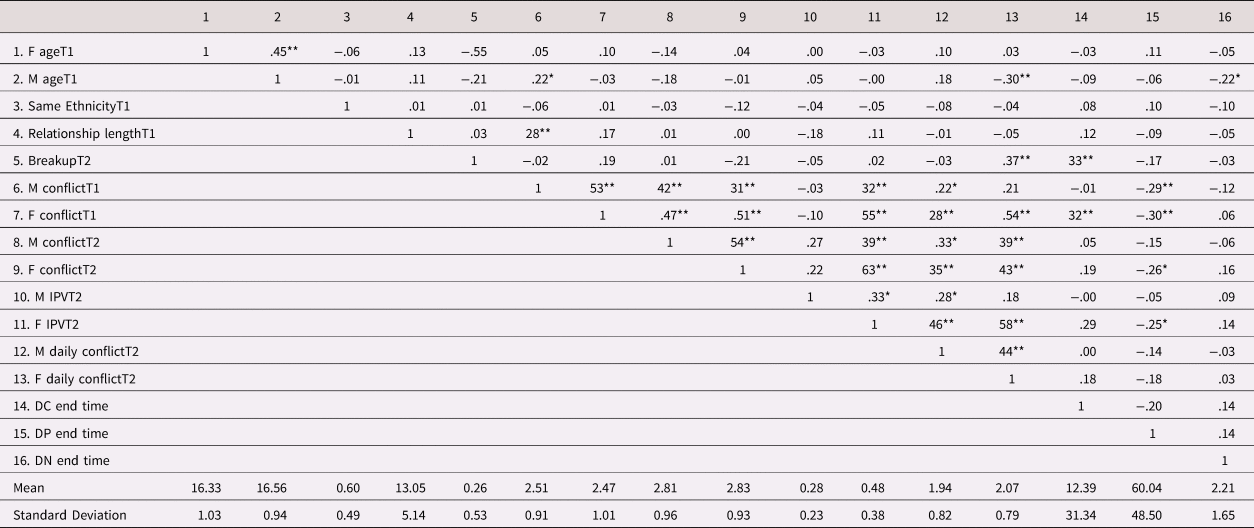
Note: DC = Dyadic Coercion; DP = Dyadic Positive; DN = Dyadic Neutral; M = Male; F = Female.
*p < .05, **p < .01.
Multivariate Multilevel Survival Analysis
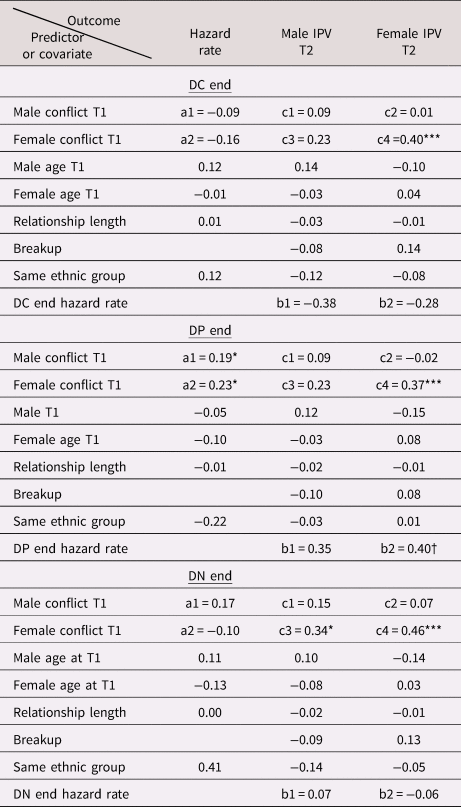
Table 4 shows the results of the MMSA. First, in all three models involving DC, DP, and DN ending hazard rates, female conflict at T1 significantly predicted the female latent IPV construct after controlling for the hazard rates and covariates (c4 paths in Figure 2), indicating stability across time. Additionally, the only other c-path that was significant was the female conflict at T1 predicting the male's latent IPV at T2 after controlling for the DN ending hazard rate and covariates (c3 in path in Figure 2 for the DN model).
Unstandardized estimates of the Multivariate Multilevel Survival Analysis (MMSA) model
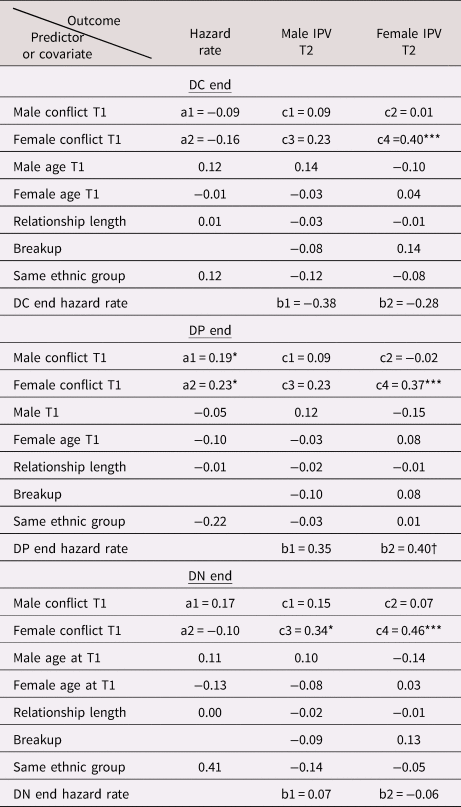
Note: DC = Dyadic Coercion; DP = Dyadic Positive; DN = Dyadic Neutral.
*p < .05, ***p < .001, †p < .10.
We did not find support for DC mediating between earlier conflict and IPV at T2 for males and females. Results regarding DP showed that male conflict at T1 predicted a significantly higher DP ending hazard rate during conflict and jealousy observations, a1 = 0.19, p < .05. After controlling for covariates, on average a 0.19 increase in the log hazard rate in terminating the DP state was observed as a 1-unit increase in male conflict at T1. This can be translated to a exp(0.19) = 1.21 times higher hazard rate or equivalently, a (exp[0.19] - 1) × 100 = 21% increase in the hazard rate as a 1-unit increase in male conflict at T1. Similarly, female conflict at T1 predicted termination of the DP hazard rate, a2 = 0.23, p < .05. After controlling for other covariates in the model, on average a 0.23 increase in the log hazard rate, or equivalently, a exp(0.23) = 1.26 times higher hazard rate, or a (exp[0.23]-1) × 100 = 26% increase in the hazard rate in terminating the DP state was observed as a 1-unit increase in the T1 female's conflict score. In turn, the log DP hazard rate predicted a marginally significant increase in the female's latent IPV construct at T2 after controlling for conflict at T1 and covariates, b2 = 0.40, p = .07. This means as a 1-unit increase in the log DP ending hazard rate occurred, a 0.4-unit increase in the T2 female's latent IPV was observed. All other predictions in the MMSA model were not significant.
Discussion
We investigated how initial conflicts in adolescent romantic couples could escalate into more serious forms of conflict, including IPV. We focused on adolescents’ micro-level interaction patterns during conflict as possible underlying processes. Unexpectedly, we did not find support for dyadic coercion as a risk process leading to escalations in conflict. A lower likelihood to end mutually reinforcing aversive behaviors did not predict higher levels of IPV. However, a higher likelihood to end dyadic positive behaviors mediated between earlier levels of conflict and a latent construct of conflict and IPV six months later. Specifically, males and females reported that conflict predicted higher hazard rates of dyadic positive behaviors, indicating that couples who experienced higher levels of conflict in their relationships were more likely to end mutually positive behaviors during conflict discussions. In turn, a higher hazard rate in dyadic positive behaviors predicted higher levels of a latent construct of conflict and IPV, although this was marginally significant and was only found for female IPV. Lastly, no results for dyadic neutral were found. These results were found while controlling for age, relationship duration, ethnicity, and breakup.
Conflict is an important socialization context because it comprises a social exchange in which two people are forced to come together and work things out (Dishion, Nelson, Winter, & Bullock, Reference Dishion, Nelson, Winter and Bullock2004; Forgatch & Patterson, Reference Forgatch, Patterson, Weisz and Kazdin2010; Heyman, Reference Heyman2001). When not handled well, as in the case of coercive exchanges, frustration accumulates. In turn, this can evoke negative interaction patterns that potentially can lead to violence in relationships. In contrast to previous research on coercion in parent–child and in marital relationships, dyadic coercion was not a risk process for the escalation of conflict in adolescent romantic relationships. Instead, a lack of reinforcement of positive behaviors during conflict was more predictive of escalation in conflict. Classic coercive dynamics may not apply to adolescent romantic relationships for the development of IPV. Being unable to reinforce levels of positivity during conflict predicted conflict and IPV as reported by females. These results underscore the unique context of adolescent romantic relationships, the high level of motivation involved in being in these relationships, and the need to maintain closeness and intimacy.
We included the possibility that negative behaviors were observed in the context of playful aggression (Capaldi & Crosby, Reference Capaldi and Crosby1997) by including the dyadic state of dyadic positive-negative behaviors in coercion. Therefore, our dyadic positive state is expected to reflect only positively engaging behaviors during conflict. Within marital relationships, positive affect during conflict, such as humor and affection, are constructive conflict resolution styles, which predict relationship satisfaction and relate to less conflict (Gottman, Coan, Swanson, and Carrere, Reference Gottman, Coan, Carrere and Swanson1998). From an emotion regulation perspective, positive emotions during conflict indicate effective regulation to resolve relationship problems as experiencing negative emotions during conflictual interaction increases the likelihood of IPV to resolve relationship problems (Crane & Testa, Reference Crane and Testa2014; Finkel, Reference Finkel2007; McNulty & Hellmuth, Reference McNulty and Hellmuth2008; Watkins, DiLillo, Hoffman, & Templin, Reference Watkins, DiLillo, Hoffman and Templin2015). In line with results found among committed couples, adolescents who constructively engaged and regulated their emotions during conflict were less likely to develop IPV in their romantic relationships. Adolescents who were less able to mutually reinforce positivity during an observed conflict interaction may experience difficulties when conflicts play out in real life. Difficulties regulating emotions may lead to conflicts getting out of control, resulting in possible instances of IPV.
However, another possible explanation is that adolescents were not necessarily constructively engaging in conflict, but were downplaying or avoiding conflict in their interactions. Upon inspection of the video recordings, first statements of a conflict discussion often involved one of the partner's directly denying or downplaying the conflict topic. For example, “I do not think we have issues at all, but I had to choose something,” or “We already resolved this a long time ago.” Partners often positively reinforced this initial avoidant response, which initiated a cycle of positive engagement during the conflict discussion. Alternatively, these couples may have less conflict and therefore less intense conflict interactions. Thus, adolescents’ positive behaviors might actually reflect a lack of relationship issues, not conflict avoidance. With the current real-time coding system, we were not able to distinguish between constructively engaging in conflict, avoiding conflict, or just not having much conflict. The current coding system taps into a process level rather than a content level of conflict discussions. Future research could develop coding systems that would include both content (what partners say and do in addition to the affective tone of their behaviors) and process level codes to identify specific mechanisms that are either protective or potentially leading to future IPV. Based on the current findings it would be important to code for potential conflict engagement or conflict denial, which then could be positively or negatively reinforced by the partner. This is similar to Dishion's deviancy training in adolescent friendships, in which deviant talk is reinforced by positivity on the part of the friend, creating deviant values and norms in these friendships. Deviancy training predicted long-term antisocial behaviors and substance abuse long after the original friendships had dissolved and new ones had formed (Dishion, Capaldi, Spracklen, & Li, Reference Dishion, Capaldi, Spracklen and Li1995; Dishion, Eddy, Haas, Li, & Spracklen, Reference Dishion, Eddy, Haas, Li and Spracklen1997; Dishion, Spracklen, Andrews, & Patterson, Reference Dishion, Spracklen, Andrews and Patterson1996).
We found that variation in the likelihood of ending positivity instead of negativity predicted IPV. This highlights the argument that influence and change within these early romantic relationships are a function of positive experiences during conflict. Interestingly, the positive interaction patterns, operationalized as a lower likelihood to end positivity during conflict, were found to increase depressive symptoms two years later in a sample of Dutch dating adolescents (Ha & Kim, Reference Ha, Kim, Dishion and Snyder2016; Ha et al., Reference Ha, Dishion, Overbeek, Burk and Engels2014). Upregulation of positive affect was hypothesized to prohibit effective conflict resolution, resulting in more emotional problems over time, but the current study implies that this pattern is protective of the development of IPV. Investigating important relationship and environmental moderators to better understand when and how these positive dynamics are protective or harmful is important for future research. Moreover, it will be crucial to investigate how the lack of reinforcing positivity during conflict that was observed during 10 minutes of videotaped interactions in this study relates to dealing with conflict and stress in romantic relationships over a longer period. A previous ecological momentary study including the same sample as the current study showed that conflict and feelings of jealousy and doubt increased negative affect on the same day, indicating that conflict has important day-to-day effects on adolescents’ moods (Rogers et al., Reference Rogers, Ha, Updegraff and Iida2018). Linking the current observational findings to conflict engagement in daily life may reveal when the lower levels of reinforcing positivity during observed conflict turn into more classic coercive processes in daily life because of the contextual changes of romantic relationships, such as increased tensions and strains in adolescents’ lives.
We investigated adolescent couples’ interactions, which is in line with Capaldi and Kim's (Reference Capaldi and Kim2007) dynamic developmental systems theory. This theory focuses uniquely on the dyadic nature of IPV to better understand the emergence and course of IPV. When considering both partners’ behaviors during conflict interactions, we found that a higher likelihood of ending dyadic positive states marginally predicted levels of female IPV. More research is needed to investigate which interaction patterns predict male IPV. The current results are in line with recent studies indicating higher engagement of female IPV during adolescence (Capaldi et al., Reference Capaldi, Knoble, Shortt and Kim2012; Johnson, Giordano, Manning, & Longmore, Reference Johnson, Giordano, Manning and Longmore2015). It is of critical importance to extend this research to the study of multiple relationships over time to better understand how the long-term, cross-relationship stability and change in coercion and positive reinforcement of positivity predict later IPV. Recent studies showed low stability of IPV across different relationship partners, which suggests that each new romantic relationship is a learning opportunity and a new experience (Johnson, Manning, et al., 2015; Shortt et al., Reference Shortt, Capaldi, Kim, Kerr, Owen and Feingold2012). This provides unique opportunities for early prevention programs to promote healthy relationships and partner choice among adolescents. It is important to keep in mind that IPV emerges in the context of positive relationship experiences, such as intimacy and a high motivation to be in romantic relationships. Problematic interaction patterns might be particularly nuanced when they encompass the likelihood of ending positivity during conflict. Combined with adolescents’ limited relationship experiences, it might be particularly difficult for adolescents to understand and acknowledge when relationships dynamics are unhealthy. Therefore, the support of parents and important adult figures will be key in the promotion of healthy adolescent romantic relationships.
Limitations
Although this study used micro-level observations to gain insight into how disagreement escalates into more serious forms of conflict (including IPV) in a sample of ethnically diverse adolescent romantic relationships, some limitations should be addressed in future research. First, the current results should be replicated in an independent sample of adolescent romantic relationships. In addition, the sample size is relatively small, especially for the analysis of both coercion and dyadic positivity in determining their relative importance in predicting IPV. Moreover, even though breakup was controlled for in the current analyses, it was not possible to test whether results differ between couples who break up once and those who have unstable relationships in which they break up and get back together multiple times. Future studies could investigate whether the lack of reinforcing dyadic positivity might contribute to a series of breakups followed by getting back together, a relationship pattern that might be vulnerable to the development of IPV. We only assessed adolescents’ IPV perpetration and not their victimization. Although it is increasingly recognized that IPV perpetration and victimization often co-occur within relationships (Capaldi & Kim, Reference Capaldi and Kim2007; Capaldi, Shortt, Tiberio, & Low, Reference Capaldi, Shortt, Tiberio, Low, Wolfe and Temple2019), it will be important to investigate whether results change depending on levels of perpetration and victimization. Due to the small number of same sex couples, we were not able to investigate whether similar patterns would be relevant for IPV in same sex couples (Halpern, Young, Waller, Martin, & Kupper, Reference Halpern, Young, Waller, Martin and Kupper2004). Finally, the current study does not consider the broader context of adolescent relationships, such as friendships, relationships with parents, and previous experiences in romantic relationships. From a prevention perspective there is a need to better understand the etiology of IPV in adolescent romantic relationships.
We investigated how initial conflicts in adolescent romantic couples escalate into more serious forms of conflict, including IPV. We showed that classic coercive dynamics in adolescent romantic relationships were not predictive of IPV. Instead, a higher likelihood to end dyadic positive behaviors mediated between earlier levels of conflict and a latent construct of conflict and IPV six months later. These results underscore the unique context of adolescent romantic relationships. Linking these microsocial partner interactions to experiences in peer and family relationships as well as macro-level developmental outcomes will be essential to understanding when and how adolescent romantic relationships present a risk for IPV. Each new romantic relationship is a potential turning point in adolescent development, creating potentially powerful opportunities for early prevention programs to promote healthy relationships and partner choice among adolescents.
Acknowledgments
We thank Jenene Peterson for assisting with the coding of the observations, Jasmine Sutton for her editorial work, and Dr. Marion Forgatch for her helpful feedback. We greatly appreciate the efforts of the principals and staff in facilitating data collection.
Financial Support
Funding for this research was provided to Ha by the T. Denny Sanford School of Social and Family Dynamics as part of the Lives of Teens Enterprise and from the REACH Institute at Arizona State University. Ha was supported during preparation of this manuscript by a grant from the National Institute on Drug Abuse (DA07031) and a grant from the National Institute on Alcohol Abuse & Alcoholism (AA022071). The content is solely the responsibility of the authors and does not necessarily reflect the official views of the National Institute on Drug Abuse or the National Institute on Alcoholism and Alcohol Abuse.