


Secrecy is the very soul of diplomacy.
—François de Callières, 1716
During the Cuban Missile Crisis, President Kennedy went on TV and publicly confronted Chairman Khrushchev with military threats and a blockade. Eight years later, when the United States discovered that the Soviet Union was constructing a submarine base in Cuba, Henry Kissinger and President Nixon settled the Cienfuegos Submarine Base Crisis through diplomacy that was almost entirely private. Kissinger (1979, 651) later wrote, “Rather than a dramatic confrontation on the order of 1962, we considered that quiet diplomacy was best suited to giving the USSR an opportunity to withdraw without humiliation.” This incident could have escalated to a second Cuban crisis, but secret diplomacy successfully persuaded the Soviet Union to concede without raising the risk of war.
According to the recent rationalist literature on crisis bargaining, the Cienfuegos crisis should not have ended in the way it did. This literature turns to credible revelation of commitments as key to understanding state behavior in crises (e.g., Powell 2002; Schultz 2001a). A well-established way to reveal information or to establish commitments is to invoke the so-called tying-hands mechanism (Schelling 1966), and a common method of doing so is to generate audience costs (e.g., Fearon 1997).1
Fearon (1997) shows that the so-called sunk-cost mechanism can also transmit information in international disputes. Slantchev (2005) shows that purely military instruments can also invoke the tying-hands mechanism in crises without audience costs.
The audience-cost story helps us explain why state leaders go public with military coercion and provoke public confrontations. However, it has yet to explain another class of cases, including the 1970 Cienfuegos crisis, where state leaders go against the logic of the tying-hands mechanism and secrecy plays an important role in settling a dispute. The historical record shows that the use of private tactics and quiet maneuvers is common practice in crisis diplomacy, and raises serious concerns about the robustness of the conclusions on private diplomacy derived from existing studies. This presents a puzzle: When and why do state leaders rationally conclude that staying private is desirable, as opposed to going public, despite the suggested benefits of the tying-hands mechanism?
Despite the importance and prevalence of the private signaling in international crises, few if any studies in international relations address this puzzle. While existing audience-cost models offer some idea about the incentives that leaders face in deciding to go private (e.g., Leventoğlu and Tarar 2005), these models are not best suited for a rigorous investigation of this puzzle because they are not explicit about how crisis diplomacy unfolds in private, but instead assume that crises are public events (Fearon 1994).
This paper presents a formal model to bridge this gap by exploring the rationality and effectiveness of private signaling in international crises. Building on a standard audience-cost model, I show that going private with one's challenge not only can effectively compel an opponent to capitulate, but also can make both parties to a crisis better off. The model offers a reason why leaders cannot rationally ignore private threats simply because they avoid costs of going public.
The model augments the literature on crisis bargaining and audience costs by bringing in several perspectives. First, the explicit analysis of actors' decisions to go public or private allows us to simultaneously explain why earlier models concluded that quiet diplomacy is ineffective in crises and when such a conclusion does not hold. In doing so, I show how the empirical scope of the audience cost literature can be extended to the private aspect of crises in the presence of domestic audiences.
Second, making a threat in crises often has domestic political consequences for a defender as well as for a challenger. This obvious fact has gone unconsidered by the literature. The model is motivated by an empirical claim that crises are carried out before domestic audiences of both the challenger and the defender. As we shall see, the model establishes how the presence of multiple domestic audiences shapes both the challenger and the defender's incentives and gives rise to an interesting mechanism that is neglected by existing models that assume a single audience.
Finally, although audience costs can facilitate information transmission in crises only because they tie hands and raise the risk of war, the literature has mainly focused on their informational implications while paying little attention to their escalatory effects (e.g., Schultz 1998, 2001a; Smith 1998). Taking the dual role of audience costs seriously, the model shows how engaging domestic audiences by going public can have both beneficial and detrimental effects on crisis outcomes, and how this duality of audience costs drives the rationality of private threats.
What emerges from this study is a theoretical rationale for secret diplomacy. Existing studies commonly suggest that quiet diplomacy is ineffective and secondary to military might in crisis. This is puzzling when one considers the fact that secrecy has been a central feature of diplomatic institutions ever since the establishment of diplomacy in the seventeenth century or perhaps earlier (Nicolson 1954, 75). The model shows that an extension of the conventional audience costs story helps explain why secrecy can be rational.
SIGNALING, SECRECY, AND DIPLOMACY
Scholars have long suggested that uncertainty is a fundamental cause of war (e.g., Blainey 1988). Correspondingly, the literature on deterrence and crisis bargaining has searched for credible information-revealing mechanisms that help state leaders overcome uncertainty and hence avoid inefficient fighting (e.g., Powell 1990, 1999). The literature describes how uncertainty about an opponent's resolve can lead to the outbreak of war. In particular, the formal literature on crisis bargaining shows when and how war results from the conscious decisions of the bargainers, even though a mutually preferable peaceful settlement is available (e.g., Fearon 1995; Morrow 1989).
Recent audience-cost models propose the linkage between domestic and international politics as a prominent mechanism that can rationalize a state leader's decision to go to war. By formalizing what is known as tying-hands signals, these models generally posit that the credibility of a threat can be established when leaders go public with their challenge and engage their domestic audiences, so that they can generate political costs that they would have to pay ex post if they fail to carry through on their public commitment (Fearon 1994, 1997; see also Schelling 1966). Because leaders can tie their hands with audience costs, going public helps leaders overcome communication barriers and reveal meaningful information in crises. These models then assert that private, or less public, diplomacy is ineffective because it is relatively costless and nonbinding (e.g., Fearon 1994, 1995; Ramsay 2004; Schultz 1998).
Given this line of reasoning, it is quite logical to conclude that normal forms of diplomatic communication lack the credibility, as secrecy essentially “unlocks” leaders from inefficient outcomes and allows them to maintain their leeway to disavow their commitments. Since Fearon's influential rationalist account of war, diplomacy is routinely cited as “cheap talk” (Fearon 1995; Sartori 2005), which leads to a conventional conclusion that diplomacy by itself is inconsequential or secondary to military might.
Yet the 1970 Cienfuegos crisis challenges this conclusion. This anecdote suggests that President Nixon and Henry Kissinger rationally concluded that staying private was preferable to going public, fully recognizing the potentially adverse effects associated with engaging the American (and Russian) public. Historically, secrecy has been at the heart of modern diplomatic institutions which originate primarily as a conflict-resolution mechanism to overcome the security dilemma (Mattingly 1955; Nicolson 1954).
How can we account for this gap between theoretical expectations and the empirical record? Note that the conventional account of “ineffective” private threats is inferred solely from the informational rationale of public threats. However, as we shall see, the fact that a threat lacks informational efficacy does not necessarily mean that the threat is ineffective in influencing an opponent's crisis behavior and ultimately crisis outcomes. To properly address the puzzle of private threats, it is crucial to fully appreciate the role of audience costs generated by public threats in crisis diplomacy.
To establish the credibility of its threat in a crisis, a state leader can invoke the tying-hands mechanism by raising audience costs. Such credible information-revelation, however, is possible because this mechanism requires “a rational state … to run a real risk of (inefficient) war in order to signal that it will fight” (Fearon 1995, 397). That is, the gist of the tying-hands mechanism is a double-edged sword: generating audience costs by going public simultaneously facilitates separation of types of an informed state (informational effects) and escalates a risk of costly fighting (escalatory effects). Accordingly, the audience-cost story speaks to two closely related puzzles: (1) it helps explain why state leaders can optimally go to inefficient war (Fearon 1995); (2) it also helps explain why some states—typically democracies—can establish the credibility more effectively than others—typically nondemocracies (Fearon 1994).
Although the dual effects of audience costs in crisis bargaining are well recognized, the existing conclusion about private diplomacy focuses exclusively on its informational role (or the lack thereof).2
Analyzing a similar crisis game with complete information, Tarar and Leventoğlu (2006) also demonstrate that engaging domestic audiences has both beneficial and detrimental effects on crisis outcomes. Although generating audience costs helps leaders obtain greater bargaining power, it also increases the risk of inefficient outcomes, such as costly fighting and public concessions. I find the similar effects in the information role of audience costs.
However, describing the duality of audience costs by itself still falls short of addressing the puzzle of private threats. The fact that some states have incentives against going public says nothing about how private threats in crisis diplomacy works. A satisfactory explanation for public versus private threats should not only account for disincentives to go public, but also how private communication can influence crisis behavior and outcomes. That is, to account for the mixed record of public and private diplomacy in crises, we must be able to explain both the 1962 Cuban Missile and the 1970 Cienfuegos crises. However, the existing audience-cost models are not suited for investigating the choice between a public versus a private threat, because these models do not capture the private aspect of crises that are carried out in the public eye, but instead simply assume that crises are public events (Fearon 1994; Ramsay 2004; Schultz 1998). A notable exception is Snyder and Diesing's (1977, 251–54) comparative analysis of public and private communication methods. However, they presume that a public threat is a better credibility-generating mechanism, and conclude that private communication best serves as a supplement to public threats. As we shall see, my model suggests that exactly the opposite can be the case.
The key to successful private crisis diplomacy is that, given a challenger's incentives to go private, a defender must also agree to capitulate in private, rather than dismiss a private threat as a bluff. Hence, to understand the puzzle of private threats, we need to know the incentives that the defender faces in deciding whether to capitulate in public or in private. Although Fearon (1994) and Schultz (2001b) also consider audience costs for both states in their models of international crises, these models are not suitable for the purpose here, because they postulate audience cots as signaling costs in crises. In Fearon's model, audience costs are automatically raised by the onset of a crisis, but not by a rational choice of any states. In Schultz's model, the act of signaling generates audience costs only for the sender, but not for the receiver, of signals. In effect, these models implicitly assume that a signaling action does not affect the subsequent bargaining environment because it has no consequences (or payoffs) on the opponent's side (see also Slantchev 2005). As a result, none of the existing audience cost models capture the fact that both the challenger and the defender have domestic political audiences who observe how crises are carried out and evaluate the performance of their leadership.
The remainder of this paper is an attempt to explore these issues and to look for the credibility condition of private signals in crisis bargaining. The model studied here is a natural extension of common audience cost models, building on a canonical crisis bargaining game that shares basic strategic elements with previous models. I take a standard model and relax two common assumptions, on which the conventional conclusion crucially depends. Because the model is simple, one could easily add further complications. But this simplicity is designed to highlight the questions above, to clarify some of the less intuitive consequences of the strategic problems, and to facilitate comparisons with previous studies.
THE MODEL
A crisis game involves two states—the challenger (C) and the defender (D)—in a dispute over some good whose value to both is normalized to 1.3
I refer to the challenger, C, as “he” and the defender, D, as “she” throughout this paper.
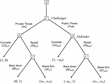
Sequence. In making a challenge, C can choose whether to go public (Pub) or stay private (Pri). Without loss of generality, C has no option of retaining the status quo (SQ) at the outset of the game because the focus here is on C's incentives to make a private threat and the associated credibility condition.4
I will relax this assumption later and show that the main results effectively remain unchanged.
Outcomes and Payoffs. When D makes a public concession, C obtains the value for the good, and D not only loses the good but also incurs audience costs from suffering “diplomatic humiliation” (Fearon 1994; O'Neill 1999). Thus, the payoffs are 1 for C and −aD≤0 for D. If C backs down in public when resisted, C pays audience costs −aC≤0 and D keeps the status quo payoff of 1. When C makes a private threat, neither side incurs audience costs by backing down or conceding. Hence, if D makes a private concession, C gets 1 and D gets 0. If C backs down in private, the game ends as if the crisis never happened, yielding the status quo payoffs 0 for C and 1 for D. In the event of a war, C's payoff is given by his expected value for war wC=p−cC, where p∈[0, 1] and cC≥0 represent C's probability of victory and expected costs, respectively. Notice that the costly lottery assumption underlies the definition of war payoffs, and that the cC term captures C's costs of war relative to the value of the disputed good. Similarly, D's war payoff is given by wD=1−p−cD. Figure 1 illustrates the sequence of moves and the payoffs associated with each outcome in the crisis game.

Crisis Diplomacy with Public versus Private Threats
Information and Beliefs. The crisis game involves two-sided uncertainty: each state has private information about its value for war, wi. To generate this uncertainty, assume that nature randomly selects cC and cD from independent distributions on intervals
and
, respectively. This assumption simplifies the expression for wi and implies that the
are distributed according to the cumulative distribution function Fi(x)=Pr(wi≤x), whose support is the interval
for C and
for D. Each state observes the value of its own wi, but neither observes the other's value for war. The probability distributions are common knowledge, so each state forms precrisis beliefs about wj, j≠i. C's threat is said to be genuine or credible if he follows through with it. Define ppub and ppri as D's precrisis beliefs that C's public and private threats are genuine, respectively.
EQUILIBRIA
All equilibria to this game can be described by a set of cutpoints along the continuum of possible types in the range
, i=C, D. I first define these cutpoint strategies, and then turn to the formal characterization of two equilibria in this game.
By subgame perfection, C would stand firm at the final decision node if and only if his expected payoff from war is greater than or equal to that of backing down. Provided that C made a public threat, this condition holds when wC≥−aC≡α, where α denotes a unique type that is indifferent between standing firm and backing down in public. All types with wC≥α stand firm (resolved types) in public, and all other types with wC<α back down in public if resisted (public bluffers). Similarly, provided that C made a private threat, he would stand firm if and only if wC≥0≡β, where β denotes the critical type that is indifferent between standing firm and backing down in private. All types with wC≥β stand firm (resolved types), and all other types with wC<β back down when resisted in private (private bluffers).
To complete the definition of C's strategy, consider his initial decision. Suppose that there is a unique type that is indifferent between going public and staying private when making a threat. Let κ denote this unique type's value for war such that all types with wC≥κ make a public threat in equilibrium, and all other types with wC<κ make a private threat.
To define D's cutpoint strategy, suppose there exists a critical type that is indifferent between resisting and conceding, on seeing a public threat. Let γ denote such a type, so that all types with wD≥γ resist in public and all other types with wD<γ optimally make a public concession. Likewise, let δ be the type that is indifferent between resisting and conceding when a private threat is observed. All types with wD≥δ resist in private, and all types with wD<δ optimally make a private concession.
Because α and β are determined only by the realized values of the exogenous parameters, there are six configurations of C's cutpoints, for each of which an equilibrium may exist. But because α≡−aC is bounded above by β by definition, we need only to look for solutions for three of these cutpoint configurations: (i) κ<α<β; (ii) α<κ<β, and (iii) α<β<κ.
I define the public equilibrium as a unique equilibrium with κ<β, which encompasses two cases (i) and (ii) and takes a different form for each case. This equilibrium, however, is not mutually exclusive with the private equilibrium when it exists, which is defined for case (iii). As such, the solution for this crisis game is not unique, and these two equilibria exhaust all possible cutpoint configurations described previously.
The Public Equilibrium
In the public equilibrium, a private threat is ineffective in crisis bargaining: all resolved types go public, and the status quo always prevails as a result of a private threat. Upon seeing a private threat, D always detects that the threat is a bluff and hence resists. In response, C always backs down quietly without being caught by his domestic audience. Observe that backing down in private has no consequences different from the status quo. Hence making a private threat is inconsequential in the public equilibrium. As such, C must go public to compel D to concede. Once C goes public, however, equilibrium behavior in the public equilibrium is equivalent to the crisis dynamics generally captured by common audience cost models (e.g., Fearon 1997; Ramsay 2004; Schultz 1998). That is, by going public, C can attract the attention of his domestic audiences and thereby enhance the credibility of his threat by tying his hands. Because a public threat creates audience costs that C would suffer ex post if he backed down, credibility enhancement through hand-tying may have some perverse side effects that increase the risk of inefficient outcomes such as fighting unwanted wars and costly public concessions.
To understand this dynamic, consider the players' equilibrium strategies. A cutpoint strategy of C takes the following form in the public equilibrium. First, all types that make a private threat will back down if resisted because these types have low values for war (i.e., wC<β). Although types below
will never go public in equilibrium, when α<κ, there exist some types in
whose off-the-equilibrium-path strategy is to stand firm in public. Second, all types above
make a public threat. If α<κ, all public threats are genuine because these types above
will carry through on the threat. If κ<α, on the other hand, the mid-valuation types with
will back down if resisted. Hence, public threats are genuine only if they are made by types above α, and the rest of public threats made by types in [κ, α] are bluffs. However, when κ<α, some “publicly genuine” types in [α, β] would back down privately off the equilibrium path if resisted.
Given C's cutpoint strategy, whenever D observes a private threat, she forms the posterior belief that the threat is a bluff, and hence she always resists. When D receives a public threat, on the other hand, she will resist if and only if her expected payoff from doing so is greater than that from conceding. This means that all types of D above
will resist the public threat, whereas all types below
will make a public concession. D chooses her optimal resistance rate
so that that the type of C with
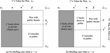
is indifferent between public and private threats. This analysis is illustrated in Figure 2, and summarized in the following proposition.

The Public Equilibrium
Proposition 1. If κ<β, there exists a unique perfect Bayesian equilibrium of the crisis game with the following strategies. C makes a public threat if
, and a private threat otherwise. When
, C always stands firm in public if resisted. When
, on the other hand, C stands firm in public if wC≥α, and backs down otherwise. D resists all private threats and resists a public threat if
.
This crisis dynamic and its outcome depend on the relative magnitude of C's audience costs. If the audience costs for C are high, irresolute types with wC<α will shy away from a public commitment, because a “punishment mechanism” effectively counteracts C's incentives to misrepresent his type. As Figure 2a illustrates, a public threat fully separates types of C in this case. If the audience costs are low, on the other hand, irresolute types will have an incentive to bluff and run a risk of backing down in public. As Figure 2b depicts, this gamble will work if D's valuation of war is low
, but otherwise it will result in costly diplomatic humiliation. Hence, as C's audience cost increases, a public threat conveys more credibility, and thereby the probability of D's resisting decreases.5
Define rpub as D's probability of resisting a public threat. Then,
, where
.
Corollary 1.1. In the public equilibrium, bluffing may occur when
.
The introduction of audience costs for D gives rise to the comparative statics regarding informational effects of a public threat. A threat is said to be informative if it increases D's belief that C will follow through on his threat. Then, the next result follows.
Corollary 1.2. A public threat becomes more informative as audience costs for D get larger. Further, a public threat is fully informative when
.
When audience costs of a public concession are engaged, D finds it harder to concede. So the increase in the magnitude of D's audience costs raises the probability that D is induced to resist if challenged publicly. Facing a higher probability of resisting, only resolute types with wC≥α can afford to make a public threat. Accordingly, imposing audience costs on D improves the ability of higher types, for which
, to distinguish themselves from lower types. This will cause less bluffing than if there were no audience costs for D (i.e., aD=0), as is the case with conventional audience-cost models. In fact, Corollary 1.2 shows that bluffing will never occur when D's audience costs are large enough (i.e.,
). Hence, when D suffers from greater audience costs ex post, C can convey greater credibility.
The Private Equilibrium
There exists another equilibrium, the private equilibrium, to the crisis game, in which a private threat can compel D to concede under certain conditions. In principle, because signals essentially become costless and nonbinding when going private, the credibility problem would be a major obstacle that C faces in attempting to convey information through private communication. In this equilibrium, however, improving the credibility is not necessary for a private threat to persuade D to concede. In fact, a private threat induces D to revise downward her beliefs about the credibility of the threat. Nevertheless D concedes privately under broad conditions.
The driving force of the private equilibrium is the behavior of the midrange valuation types of C, both on and off the equilibrium path. In essence, these types could have gone public in making a threat to enhance the credibility of their threat, but in equilibrium they instead forgo this public option and go private. This “deviation” from a putative equilibrium path implicitly signals that some private threats are genuine and hence induces D to concede as effectively as a public threat.
To see this dynamic more formally, suppose κ>β. Because α≤0 by definition, there is only one feasible cutpoint configuration that satisfies this condition: α≤β<κ. With this configuration, all public challenges are genuine in equilibrium because, by subgame perfection, C backs down privately if wC<β, and backs down publicly if wC<α. Consequently, if qpub denotes D's posterior belief that C will stand firm if resisted conditional on a public threat, C can induce D to form qpub=1 and hence eliminate uncertainty about his type by going public.
In contrast, complete revelation of information does not occur with a private threat in this equilibrium. Recall that C goes private if wC<κ. Then, because α≤β<κ, there exist some types that make a private threat and stand firm if resisted in equilibrium. Hence, there is a positive probability that a private threat to use force is genuine. This leaves residual uncertainty about C's types, and therefore, on seeing a private threat, D updates her beliefs such that qpri=(FC(κ)−FC(β))/(FC(κ))>0.
Given these beliefs, D resists in public if wD≥γ, and in private if wD≥δ. Because qpub=1, D knows that war will ensue when she resists in public; hence her choice reduces to a public concession or war. Subgame perfection implies that the highest type that concedes publicly is
. Likewise, because qpri>0, D can either concede privately for a certain payoff of 0 or resist for a gamble that C is bluffing. If C turns out to be a bluffer (i.e., wC<β), this gamble pays off; if he is genuine (i.e., wC≥β), private resistance results in costly fighting. This dilemma then forces unresolved types of D with wD<δ to concede because they cannot afford to gamble. Hence, letting
denote the highest type of D that concedes privately in equilibrium, it follows that in equilibrium
must solve the indifference condition between a private concession and a private resistance: qpri(wD)+(1−qpri)=0.
Given D's optimal strategy,
and
, C decides whether to go public or private by choosing
so that the critical type wC=κ is indifferent between a public and private threat in equilibrium. Because κ>β, this indifference condition for wC=κ is given by
. In equilibrium C's optimal
must solve this condition. This indifference condition also implies that D must concede at the same rate both in public and in private (i.e.,
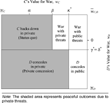
)). This analysis is summarized in the next proposition, and illustrated in Figure 3.

The Private Equilibrium
Proposition 2. If α≤β<κ, there exists a unique perfect Bayesian equilibrium with the following strategies. C makes a public threat if
and a private threat otherwise. C always follows through with a public threat if resisted; he stands firm with a private threat if wC≥β and backs down in private otherwise. D resists, on receiving a threat, whether it be public or private, if
.
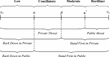
This cutpoint strategy in the private equilibrium generates four sets of types for C, three of which send a private threat. These four sets of types and their corresponding behavior are summarized in Figure 4. First, if
, C always goes public and never backs down from his public threats. This type is so willing to fight that he has no interest in diplomatic solutions whatsoever. I label this type of C “hard-liner.”

Challenger Types and Equilibrium Strategy from Proposition 2
Second, if
, C makes a private threat but stands firm (SFpri) when resisted. I call types in this range “moderate.” Although moderate types' level of resolve is high enough to stand firm both in public and in private, they instead seek private channels that enable low types of D, for which
, to concede privately. Because κ>β, no types in this range would do better by making a public threat.
Third, if wC∈[α, β], C makes a private threat and backs down (BDpri) when resisted. I call this set of types “conciliatory.” Although conciliatory types never make a public threat in equilibrium, subgame perfection implies that their off-the-equilibrium-path strategy is to stand firm (SFpub) should they face a choice between standing firm and backing down in public. The appendix shows that no conciliatory types can profitably deviate by making a public threat.
Finally, if wC<α, the “low” types of C behave in exactly the same manner as the conciliatory type in equilibrium: stay private and back down. But their off-the-equilibrium-path behavior is to back down had they made a public threat instead.
Recall that for private threats to work D must resist a public and private threat with the same probability. This ensures that resolved types (i.e., all types above β) are indifferent between public and private threats. Otherwise, pooling among resolved types occurs, resulting in a higher probability that D faces the choice between a costly public concession and certain war. Yet, if all resolved types are indifferent between public and private threats, why does the cutpoint
partition these types into two regions: moderates going private and hardliners going public?
Observe that
is chosen to include some resolved types in the private-threat-pool so that private resistance still entails a risk of war. Facing the choice between a risk of war and a private concession, D does not always resist in private as she would in the public equilibrium. This means that
splits up resolved types to ensure that D receives a “proper” message that private resistance carries some risk while a private concession incurs no audience cost. Hence, this split among resolved types by
is necessary to send D a private signal that induces beliefs that rationalize private concessions.
We now consider when a private threat works. The next proposition summarizes the conditions for existence of the private equilibrium.
Proposition 3. The private equilibrium exists if the following conditions are met: (i) a public threat is always credible
; (ii) D's audience costs are reasonably high
.
The first condition follows immediately from the cutpoint configurations: α≤β<κ. It is only “hard-liner” types that make a public threat, and therefore every public threat in the private equilibrium must be credible. This condition further implies that a private threat can be effective only in the shadow of a credible public threat.6
This result is analogous to Austen-Smith and Banks' (2000) result that the availability of costly signals (i.e., burned money in their model) renders cheap talk more informative.
The second condition states that D must incur reasonably high costs in the event of a public concession in front of her domestic audience. This condition highlights the key to the private equilibrium: D's sensitivity to her audience costs. As long as D incurs audience costs when conceding in public, a private concession becomes preferable for her, and consequently C can compel more types of D to concede optimally by relinquishing the credibility enhancement device of the public option. It is interesting to note that a viable domestic audience exists on D's side, although it need not exist on C's side (i.e., aC≥0, aD>0). Hence, if a public concession does not impose audience costs on D (i.e., aD=0), the private equilibrium collapses, regardless of C's audience costs.
Moreover, the lower bound on aD illustrates the fact that the public and private equilibria are not mutually exclusive. Recall there is no upper bound on aD for the existence of the public equilibrium, whereas
partitions the public equilibrium into the bluffing and nonbluffing cases. Because the relative magnitudes of this threshold for the public equilibrium and the lower bound of the private equilibrium cannot be determined, the existence condition for any of the two cases of the public equilibrium can overlap with that of the private equilibrium as long as
. Hence, the two equilibria simultaneously exist except for
.
Threats to Go Public and the Status Quo
The analysis so far has confined to the simplest model to establish the rationality of private threats. Such simplicity, however, leaves out many strategic choices that state leaders would make in particular diplomatic circumstances. How robust is the private equilibrium to alternative model specifications? I consider several extensions and argue that none of the results presented here depends on this simplicity.
An obvious restriction of the model is that, unlike common crisis bargaining games, C has no option to retain the status quo (SQ) at the onset of the game. However, it is easy to show that because backing down in private has no consequences for C different from retaining SQ, making private challenges weakly dominates SQ.
A more important assumption of the model is that once C goes private crisis diplomacy is carried on entirely in private because D cannot decide whether to go public or stay private. Yet one distinctive difference between public and private diplomacy is that both parties to a crisis would need to agree on keeping the matter private. Intuitively, if D could go public about C's private challenge, that would essentially tie C's hands and hence a private threat might not be costless for some lower types any more. It then follows that D's threat to go public might deter these types from making private threats. However, this does not hold in equilibrium. Suppose a modified game where D is allowed to go public in resisting C's private challenge. It can be shown that D will never go public once C makes a private threat in any equilibrium in which C carries through on his private threat with positive probability (e.g., the private equilibrium).7
The formal analysis of these extensions is carried out in my dissertation (Kurizaki 2007).
Last, one might argue that D's threat to go public can be effective only if C is allowed to stay out of a crisis. To examine this, suppose another modified crisis game that incorporates both D's option to go public and C's option to keep the status quo. It can be shown that D can never optimally go public in this game either. Although the low types and some portion of the conciliatory types do retain SQ in this setting, this behavior is not induced by D's threat to tie their hands. This is because all the types that make private threats in equilibrium will always stand firm in public if D ever resists publicly off the equilibrium path. Consequently, going public after C's private challenge effectively means that D would have to fight for sure. But because fighting a war is worse than gambling that she is facing a private bluffer, D cannot optimally go public, and hence her threat to go public is not credible. The low and some of the conciliatory types are deterred rather by D's threat to resist in private. Furthermore, recall that backing down in private is strategically equivalent to retaining SQ. Hence, this alternation to the model is inconsequential and the private equilibrium effectively remains unchanged.
EFFICIENT SECRECY
I have shown that there exist two equilibria and they exhaust three possible cutpoint configurations in the crisis game. Each equilibrium captures a distinctive equilibrium mechanism, through which state leaders can signal their private information in international crises: going public and staying private. Given the multiplicity of the equilibria, although the model does not allow us to predict which mechanism state leaders will choose in crisis diplomacy, we could at least ask the question of which mechanism will provide a more efficient solution to crises. I address this question by comparing the welfare values of the two equilibria.
Proposition 4 presents a simple efficiency result. From both an ex ante and “interim” perspective (Holmström and Myerson 1983), the private equilibrium is Pareto superior to the public equilibrium. In general, both C and D are always (at least weakly) better off with the private equilibrium (when it exists) than the public equilibrium regardless of types. In particular, the private equilibrium weakly interim dominates the public equilibrium, in which all types of C above β strictly prefer the private equilibrium.8
On the other hand, types of C with wC>β are indifferent between the public and private equilibria, because their values for war always exceed their audience costs so that they have no need to worry about backing-down publicly.
Proposition 4 (Efficient Secrecy). For any types of C and D, the private equilibrium is ex ante efficient. For all types of C with wC<β and for any types of D, the private equilibrium strictly interim dominates the public equilibrium. If wC≥β, C is indifferent between the two equilibria.
Intuitively, when a private threat works, it can expand the range of peaceful settlements that are mutually acceptable. Comparing Figures 2 and 3, it is obvious that peaceful outcomes are possible under broader conditions in the private equilibrium than in the public equilibrium where only a public threat is credible. This result is driven by two facts. First, a private threat makes a private concession possible, which is unobtainable in the public equilibrium. Second, going private reduces the ex ante risk of war, compared to a public threat.
Turning to the equilibrium probabilities of war in the two equilibria, note that the war outcome is limited to the higher types (i.e., wC≥β) in the private equilibrium, although it can occur even if C has a relatively low valuation of war in the public equilibrium (i.e.,
, where
). To have a war outcome in the private equilibrium, C's value for war must be greater than or equal to his status quo valuation, but it is relatively easier to have war in the public equilibrium. Moreover, a public threat is more likely to induce D to resist at a higher rate overall in the public equilibrium. Together, the expected probability of war across the entire range also falls in the private equilibrium. The next corollary establishes this result.
Corollary 4.1 (Risk of War). The ex ante probability of war is strictly greater in the public equilibrium than in the private equilibrium.
Clearly, a private threat has advantages for both C and D. On the one hand, because staying private allows C to pretend as if nothing had happened, secret diplomacy can generally secure leeway for irresolute types of C to disavow the threat if D resists and avoid domestic political costs associated with backing down. This leeway also allows the midvaluation types of C to avoid getting “locked into” costly fighting due to his relatively high audience costs.
On the other hand, a private threat helps irresolute types of D (i.e.,
) escape from a costly public concession and therefore helps her avoid being forced to fight an unwanted war in order to protect her honor from public humiliation. For this reason, a private concession is attractive for D, as it effectively lowers the costs of a concession. As such, secrecy allows D to rationally make a private concession, which is not attainable in public diplomacy.
Historical norms are that state leaders employ secrecy as face-saving tactics in order to facilitate cooperative outcomes and tension reduction. For example, during the final phase of the Cuban Missile Crisis, President Kennedy wanted to make sure that “Every opportunity was to be given to the Russians to find a peaceful settlement which would not diminish their national security or be a political humiliation” (Kennedy 1969, 81).
Contrary to the popular perception that transparency or “open diplomacy” carries beneficial effects in the age of democracy (Finel and Lord 1999; Nicolson 1963), efficient secrecy posits that the private equilibrium is a more valuable mechanism for almost any type of players, as it can lead to better bargaining outcomes than the public equilibrium can. Moreover, inefficient bargaining failures due to players' incentives to “go public” and signal to an outside audience are ubiquitous not only in international disputes (Kydd 2006) but also in labor bargaining (Cai 2000) as well as legislative politics (Groseclose and McCarty 2001). Likewise, as Louis XIV observed about 3 centuries ago, public diplomacy feeds bargainers with incentives for manipulative political “posturing”:
Open negotiations … incline negotiators to consider their own prestige and to maintain the dignity … with undue obstinacy and prevent them from giving way to the frequently superior arguments of the occasion. (quoted in Nicolson 1954, 61)
DISCUSSION
The public equilibrium captures the conventional audience cost logic of the tying-hands mechanism, which helps explain why states sometimes go public and provoke dramatic confrontations that may lead to inefficient outcomes such as costly backing down and costly fighting. The private equilibrium, on the other hand, demonstrates a new result, in which a private threat can improve Pareto efficiency by expanding the range of peaceful settlements that are mutually acceptable, even though it only conveys limited credibility. Because this result is new to the literature, it is worth discussing its mechanism and implications in a broader perspective.
Effective Compellence without Informational Efficacy
A private threat can be thought of as “cheap talk” because it has no immediate domestic consequence (or payoff) for either side. Yet, in contrast to the Crawford and Sobel (l982) tradition of cheap-talk models, the source of rationality of a private threat does not lie in its informational role affecting D's beliefs. It is also tempting to conjecture that some conditions improve the credibility of a private threat because crisis bargaining is a communication process carried out with threats (Morrow 1989). However, my model demonstrates that increasing credibility is not necessary for a private threat to successfully compel D to concede; in fact, making a threat privately reduces its credibility, even though it still is as compelling as a fully credible public threat.
To understand this, recall that in the private equilibrium the “moderate” and “conciliatory” types of C could have gone public to enhance the credibility of their threats because these types are willing to stand firm in public. Nonetheless, they forgo this credibility-enhancing device and seek a more difficult communication medium instead: a private threat. Because this decision to go private reduces the credibility of C, D revises downward her beliefs that C will follow through on his private threats, so that her posterior belief that a private threat is genuine is indeed lower than the prior:
. Turning to a more general statement of these claims, I first define two properties of a threat.
Definition 1 (Informational Efficacy). A threat has informational efficacy if D's posterior belief about credibility of the threat is greater than her prior, upon receiving the threat. Formally, a threat j has informational efficacy if qj>pj.
Definition 2 (Effectiveness). A threat is more effective if, on receiving a threat, D concedes at a higher rate than otherwise. Formally, a threat j is more effective than a threat i if rj>ri.
The next corollaries establish that a private threat, despite its lack of informational efficacy, is no less effective than a public threat to compel D in the private equilibrium.
Corollary 4.2 (Informational Efficacy). A private threat never has informational efficacy either in the public or private equilibrium, while a public threat is always efficacious in both equilibria.
Corollary 4.3 (Effectiveness). A private threat is equally effective as a public threat
in the private equilibrium, while it can never be effective
in the public equilibrium.
There are two implications of these results on informational efficacy and effective compellence. First, because a public threat always has informational efficacy but a private one never does, should C's sole purpose in crisis diplomacy be to convey greater credibility of his threat to demonstrate his resolve, he would always have to go public and provoke domestic audiences.
In this regard, I agree with the existing rationalist view in that “quiet diplomatic exchanges may be insufficient to allow states to learn what concessions an adversary would in truth be willing to make” and “states resolve this dilemma by ‘going public’—by taking actions such as troop mobilizations and public threats” (Fearon 1994, 586). Diplomatic historians also have emphasized the informational benefits of military threats in coercive diplomacy. As Lauren (1994, 25) observes, “despite its inherent dangers, this extreme variant of coercive diplomacy [i.e., an ultimatum] conveys resolve and urgency better than, say, an ambiguously worded diplomatic protest.” Perhaps for this reason, state leaders may be tempted to rely on costly signals in crisis bargaining, such as troop mobilizations and public threats that generate a real risk of inefficient war; these measures are generally understood to provide a clear and credible means to reveal one's willingness to fight and to compel an opponent to concede.
Second, contrary to the conventional rationalist view, Corollaries 4.2 and 4.3 also indicate that the lack of informational efficacy does not necessarily mean ineffectiveness of a private threat in crisis diplomacy. This gives rise to the second implication, which suggests an often-neglected mechanism of crisis diplomacy. Because the demonstration of one's resolve can hardly be the sole purpose of a state leader during a crisis, improving credibility through conventional coercive tactics may not at all be necessary for effective compellance.
Despite this limited credibility, a private threat succeeds at compellence without raising the risk of inefficient outcomes such as costly fighting and costly public withdrawal. The loss of credibility is compensated by the fact that more types of D will concede to a private threat, while going public makes it more difficult to publicly concede. In other words, because a public threat generates audience costs not only for C but also for D, its informational benefits (i.e., the greater credibility) is counterbalanced by the greater probability that D will have to resist, conditional on a public threat, so as to avoid audience costs associated with a public concession.
It should be stressed that C's seemingly altruistic decision to forgo its credibility-enhancement opportunity has a rational foundation, and is fully compatible with the self-interests of the respective types. Recall that engaging D's domestic audience with a public threat means that she will be locked in to resisting, which then ensures fighting. It follows that the decision made by the moderate and conciliatory types to avoid D's audience costs is equivalent to avoiding the situation where they are locked-in to costly fighting by their own public threats.
A Second Audience and Customized Signals
One implicit assumption held by virtually all existing audience-cost models is that only the sender of the signals is subject to domestic audience costs and the signaling actions are assumed to have no direct consequences on the receiver's payoffs (see also Slantchev 2005). In other words, audience costs are generally postulated as a type of signaling costs. This assumption nicely fits these models' purpose of examining various informational roles of audience costs in crisis bargaining, including how political accountability affects leaders' ability to learn the opponent's preferences (Fearon 1994), why leaders take costly and risky actions in public during crisis situations (Fearon 1997), how opposition signaling shapes a government's ability to send credible signals (Ramsay 2004; Schultz 1998), and how reelection incentives influence the credibility of diplomatic announcements (Guisinger and Smith 2002; Smith 1998). But these models also assume away audience costs that the receiver would suffer ex post if she fails to stand up for her national interest. Hence, this class of models cannot really account for why state leaders sometimes relinquish public and coercive measures, and employ instead less public and nonprovocative diplomacy successfully to settle disputes.
The key to the logic of efficient secrecy is D's sensitivity to audience costs that C could raise in the event of a public concession. This is proven by Proposition 3—the private equilibrium does not exist when D has no audience costs (aD=0). Notice that setting D's audience costs equal to zero effectively changes the present model to a common model with only a one-sided audience. It follows that the private equilibrium proposed here cannot be found in any models that assume away audience costs of the receiver of signals. This result explains why existing audience-cost models conclude that a private signal is inconsequential in crisis bargaining (e.g., Fearon 1997; Ramsay 2004; Schultz 1998). This further implies that the common argument—positing quiet diplomacy ineffective—holds only if D suffers no political costs from diplomatic humiliation.
Because the moderate and conciliatory types of C would never incur audience costs in equilibrium (because they would fight if resisted), the only reason for these types to go public and generate potential ex post audience costs would be to convey credibility (consistent with the conventional story). Then the only reason for these types not to go public but to stay private is to avoid engaging D's domestic audience, so that she will be able to concede without incurring audience costs. Hence, if there is no audience cost for D, the moderate and conciliatory types would have no reason to go private.
One interpretation of C's decision to forgo the credibility-enhancing device by going private is that C customizes his signal so that D can save face conditional on D's audience costs. Because this sort of customized signal may be unavailable in the absence of multiple audiences, C would not have leverage in private diplomacy unless D is politically accountable to her domestic audience, although C himself need not be politically accountable to acquire that leverage.
These results altogether highlight the importance of a second audience in the success and failure of public and private threats. That is, although the rationality of a private threat boils down to D's sensitivity to her audience costs, the rationality of a public threat lies in C's sensitivity to his audience costs generated by his own tying-hands signals. Therefore, because existing models postulate C's audience costs as a devise to reveal his level of resolve in a credible manner, a public threat necessarily requires informational efficacy for successful compellence. On the other hand, because audience costs for D enable C to customize his signals to save face through a private concession, private compellence is possible even without informational efficacy.
Rational Diplomacy
At least in recent years, the contemporary literature of international relations has downplayed the role of diplomacy in shaping international outcomes. As Sartori (2005) points out, the literature on audience costs and crisis bargaining suggests a pessimistic conclusion that diplomatic signals must be costly or sent in public to convey information. In particular, the standard rationalist explanations imply that “normal forms of diplomatic communication may be worthless” in international relations, because they are costless and nonbinding (Fearon 1994, 578). However, this conclusion contradicts the fact that for centuries states have invested time and energy into diplomacy.
Historically, modern diplomatic institutions were created as a stable communication system between states in response to the security dilemma caused by uncertainty (Mattingly 1955, 51–76).9
Modern diplomatic institutions were formulated as the “Italian system” during the Renaissance and established as the “French system” during the reign of Louis XIV (Nicolson 1954, 53–61). The rudiments of what we know today as diplomacy can be traced back to Ancient Greece (Adcock and Mosley 1975) as well as the Ancient Near East (Cohen and Westbrook 2000).
The only exception is Ancient Greece, where diplomatic envoys had to report to public assemblies and argue in public (Adcock and Mosley 1975; Jönsson and Hall 2003).
The logic of efficient secrecy may explain why secrecy still remains as one of the central features of diplomatic institutions. Despite its historical origin of diplomatic institutions as a communication system (e.g., Jönsson and Hall 2003, 195–96), my model suggests that the rationality of diplomacy stems not so much from its informational benefits as from its less provocative nature.
To recap, private diplomacy can be rational because audience costs are not raised for the adversary as long as the demands and threats remain private, and such secrecy does not lock the adversary into a situation where she has no choice but to stand firm. This nonprovocative nature helps to overcome private diplomacy's limited ability to convey information. Hence, I argue that the conventional conclusion about diplomacy overlooks the very nature of diplomatic institutions: by definition, the primary objective of diplomacy is “the promotion of the national interest by peaceful means” (Morgenthau 1948, 505).
ALASKA BOUNDARY DISPUTE, 1903
It is useful to illustrate how the logic of efficient secrecy operates in an actual case. I present a historical episode from the Alaska Boundary Dispute, where President Theodore Roosevelt's “speak softly and carry a big stick” foreign policy was most evident.
In 1902 the United States claimed the Canadian territory adjacent to Alaska along the Pacific coast. The origin of the dispute dated back to the Anglo-Russian Treaty of 1825 drawing the boundary between Britain and Russian territory. This boundary rendered the Russian territory, which the United States later purchased, valueless because it was encompassed by mountains and irregular coastlines. The border became strategically important when gold was claimed to be discovered there. This dispute was eventually resolved in October 1903 in the favor of the United States—and the United States gained a town now known as Juneau—with an appearance of reasonable compromises. In fact, Canada had conceded in the face of Roosevelt's private threats of waging war.
In March 1902, when Secretary of State John Hay warned Roosevelt of the risk of a miner's uprising if gold were discovered in Alaska, Roosevelt decided to send troops in to southern Alaska “as quietly and unostentatiously as possible … to prevent any possible disturbance along the disputed boundary line” (Collin 1985, 174–78). In the meantime, Roosevelt sent a message to Ottawa about the possibility of violence, implicitly challenging Canada with a territorial demand. Knowing that Roosevelt would not pull back the troops from the disputed area, Prime Minister Laurier wanted to make a private concession so as to avoid an apparent surrender of territory to Roosevelt's threats to draw the boundary. So Laurier's government proposed an arbitrational settlement so that his government could at least save face with Canadians. Laurier reportedly “pleaded to Henry White, the head of the American Embassy, that he would like to ‘save his face’ with Canadians by an arbitration” (Nevins 1930, 192–93).
Roosevelt from the beginning, however, refused to arbitrate this dispute or to consider any settlement whatsoever short of a complete victory. Still, he was willing to gesture a compromise as long as the United States obtained the claimed territory (Beale 1956, 115–16). Having been briefed on White's meeting with Laurier, Roosevelt wrote to Hay,
The fact is that they [the Canadians] have set up such an outrageous and indefensible claim and in consequence are likely to be in hot water with their constituents when they back down, does not seem to me to give us any excuse for paying them in money or territory. (Penlington 1972, 64)
Britain also played a role of suzerain power in this territorial dispute because until the 1920s Canada did not have sovereignty over its own foreign affairs.
Britain did not have a strong interest in the territory, and by 1903 it was having difficult foreign relations with France, Germany, Japan, and Russia. So Britain did not want her relations with the United States to suffer from the contestation over the Alaskan border. Britain's decision therefore was primarily based not on Alaska but on the essential need to maintain friendship and détente with the United States (Collin 1985, 183; Francis, Jones, and Smith 1992, 115–16; Penlington 1972, 92). As for the Canadian leaders, they really had only two choices, given Roosevelt's high resolve: either to conclude the tribunal favorably for the American case and save face with fellow Canadians, or to surrender territory to the U.S. forces in public and be humiliated.
Roosevelt chose to threaten Britain rather than Canada because of the six tribunal members the British representative, Lord Alverstone—Chief Justice of England and President of the Alaska Boundary Tribunal, was a pivotal voter on the tribunal. The United States kept sending messages to the British leaders to convince them that Britain's “self-interest would be better served by aligning with America rather than Canada” (Collin 1985, 182), and threatened that should they fail to win the American case, the United States would draw the boundary using military force (Francis, Jones, and Smith 1992, 116; Penlington 1972, 89–90).
Roosevelt gave Senator Henry Lodge not an “official and authoritative” instruction but a private letter to be shown to British leaders including the Prime Minister Arthur Balfour, the Foreign Minister Joseph Chamberlain, and the Liberal Party leader William V. Harcourt, as well as to Justice Alverstone whose vote was decisive in settling the case with a complete American victory. This letter was the first of a series of Rooseveltian threats to intimidate British authorities.
What Roosevelt later identified as “one of the decisive elements in the eventual American victory,” was another personal letter he had delivered through Supreme Court Justice Oliver W. Holmes to Chamberlain at a private meeting (Collin 1985, 179–80). Its message was: settle or fight. Roosevelt instructed Justice Holmes in this letter dated July 25, 1903 that:
… if you happen to meet Chamberlain … you are entirely at liberty to tell him what I say, although of course it must be privately and unofficially. [I]f there is a disagreement I wish it distinctly understood, not only that there will be no arbitration of the matter, but that … I shall take a position … which will render it necessary for Congress to give me the authority to run … the boundary on my own hook … as we claim it. (Munro 1970, 56–57)
In the end, the British representative Alverstone sided with the Americans and accepted their position of the boundary and territorial control as the United States claimed. Although Alverstone had committed himself to a compromised division of the disputed territory, including Canada's ownership of four islands, he reneged on this commitment only five days later and made an arrangement with the three Americans. Alverstone was reportedly instructed either by Prime Minister Balfour or by Foreign Minister Chamberlain to side with the American demands (Penlington 1972, 90–99).
On the surface, the dispute appeared to be resolved through a tribunal settlement. But it was actually Britain's ceding the Canadian territory under the private threats Roosevelt repeatedly issued. During the course of this boundary dispute, Roosevelt spoke softly by publicly holding a tribunal, but he carried a big stick by quietly dispatching troops and privately blackmailing Britain and Canada. That way, Roosevelt made it easier for Laurier to surrender the territory.
CONCLUSION
This study is a natural extension of the audience-cost literature (Fearon 1994, 1997; Ramsay 2004; Schultz 1998; Smith 1998). As noted at the outset, much of the literature on international crises and disputes has developed to explain why states take costly actions in public during a crisis. With a few exceptions (Baum 2004; Leventoğlu and Tarar 2005; O'Neill 2003), research in this area has not addressed questions as to when and why state leaders sometimes go private in the course of international bargaining. Consequently, the historical record of quiet diplomacy and private maneuvers are left unexplained. My solution to this shortcoming is to extend the audience costs logic beyond its original concern to explain the well-established facts of public confrontations during crisis diplomacy and the unaccounted history of private diplomacy simultaneously. In particular, although building on a typical audience-cost model, my model fills this gap by providing a rational account of when and why private diplomacy works. Relaxing the commonly held assumption about the receiver's audience costs allows us to identify the previously unknown “private” equilibrium, in addition to the conventional “public” equilibrium.
The analysis reveals that private threats can convey only limited credibility in crisis bargaining in the private equilibrium. Hence, I agree with the rationalists (e.g., Fearon 1995) and diplomatic historians (e.g., Lauren 1994) that quiet diplomatic communication is less informative than provocative public confrontation. However, I argue that informational inefficacy of private threats does not directly translate into the ineffectiveness of private diplomacy. I establish this claim by identifying the private equilibrium where informational efficacy is not necessary for effective compellence, and by demonstrating efficient secrecy in crisis diplomacy. That is, I demonstrated that private threats can be equally effective as public threats in compelling the opponent to concede, even if going private reduces the credibility of threats. Moreover, because private diplomacy does not invoke a tying-hands mechanism, it can achieve effective compellence without risking one reputations or increasing the risk of costly fighting. For this reason, private diplomacy provides a more efficient mechanism of conflict resolution in a sense of Pareto efficiency. Hence, quiet diplomacy can be effective and, when it is, states are always better off with it than with public confrontations in crisis diplomacy. Thus, state leaders cannot rationally ignore a private threat simply because “talk is cheap.”
The key to this “efficient secrecy” result is the defender's audience costs. Previous models do not find these results not only because those models assume away the audience costs for the receiver of threats, but also because they underestimated the provocative consequences of publicly issued threats and how those threats can engage the receiver's domestic audience, which may eventually lock-in the receiver to resisting.
These results imply that the rationality of efficient secrecy stems not from an informational advantage (i.e., greater credibility) but from diplomatic benefits (i.e., face-saving). And such rationality hinges on the receiver's audience costs, whereas the rationality of the tying-hands mechanism hinges on the sender's audience costs. Moreover, such rationality is embedded in an enduring feature of diplomatic institutions.
What eventually emerges from this insight is a theoretical rationale for secret diplomacy. The fact that private threats can be rational and efficient under reasonable conditions may account for the apparent predominance of secrecy in diplomacy despite the popular perception that secrecy is socially inefficient. Hence, this paper is part of a growing set of formal models that investigate the role of diplomacy in conflict resolution seeking to fill the gap between the empirical facts and theoretical implications of diplomacy (Guisinger and Smith 2002; Sartori 2005). Although current diplomatic institutions were formulated as a stable communication system among city-states in Renaissance Italy, the rationality of private diplomacy resides not so much in its informational benefits as in its secrecy and its face-saving function.
Perhaps more interesting is that I derive the rationale for private diplomacy from a standard rationalist framework that previously downplayed the role of quiet diplomatic communication. By showing that the standard audience costs story can generate the logic of efficient secrecy, I have demonstrated that the rationalist literature can be extended to explain a much wider range of state behavior than originally envisioned. Although the conventional logic of audience costs was developed to explain publicly demonstrated military coercion, it can also be extended to explain privately conducted diplomatic maneuvers.
APPENDIX
Proof of Proposition 1. After a public threat, D's posterior belief that C is a genuine type (wC≥α) is given by qpub=1 if κ>α because in this case the cutpoint configuration is α<κ<β, and if κ<α,

because κ<α<β. After a private threat, D's belief is qpri=0, because κ<β, regardless of α. With these beliefs, D always prefers resisting a private threat to conceding, so
. After a public threat, D resists if and only if the expected payoff from doing so is at least equal to conceding: EUD(RSpub)≥EUD(CDpub). When κ>α, since C always stands firm if resisted, this decision rule implies wD≥−aD≡γ*. When κ<α, this decision rule implies qpub(wD)+(1−qpub)≥−aD ⇒
. Substituting (1), we have

Of C's strategy, α and β immediately follow from the cutpoint definitions by the argument in the text, and κ* must solve EUC(Pub)=EUC(Pri) for the critical type wC=κ* by sequential rationality. The solution takes the following forms. If κ>α, EUC(Pub)=EUC(Pri) ⇒ (1−FD(γ))κ*+FD(γ)=0, or

Similarly, if κ<α, EUC(Pub)=EUC(Pri)⇒(1−FD(γ))α+FD(−aD)=0, or 1+FD(γ*)(1+aC)=0. Inserting (2) and rearranging for κ* give us

Finally, to prove uniqueness, it suffices to show that the solution for each of the two cutpoint configurations within this equilibrium is mutually exclusive. Note that for expression (4) to be a part of PBE, it must be that κ*<α≡−aC, which implies

For the case where κ*>α≡−aC, expression (3) must be greater than −aC:
. Rearranging this yields
. Clearly, the lower bounds on aC and aD do not overlap with (5). Hence, the public equilibrium is unique.
Proof of Corollary 1.1 The partition of the two cases is shown by the proof of Proposition 1.
Proof of Corollary 1.2. To prove the first part of the result, it suffices to show that D's posterior belief is increasing in aD. By Proposition 1, if
, D's posterior is
, where
. Then, because
, differentiating
w.r.t. aD yields
. The second part of the claim is proven by Corollary 1.1.
Proposition A.1. The public equilibrium exists if each of the following conditions is met: (i) κ*<β; (ii)
; and (iii)
.
Proof of Proposition A.1. Condition (i) is shown by the proof of Proposition~1. On (ii) and (iii), C, for which wC∈[k*, β], has an incentive to deviate if any of these conditions is not met. Suppose the contrary, that
. This implies FC(0)=0; hence all the threats are credible. In this case, because D resists in public with higher probability (i.e., Pr(wD≥−aD) in public and Pr(wD≥0) in private), types in [k*, β] prefer going private. Suppose to the contrary
. This implies FD(γ*)=0; hence D always resists regardless of her beliefs or C's signals. In this case, because C can profitably go public iff wC≥0 and go private iff wC<0, types in [k*, β] prefer going private.
Proof of Proposition 2. When receiving a private threat, D's posterior belief on the path is given by
. When receiving a public threat, D's posterior is qpub=1 because α≤β<κ implies that all the types that make a public threat will stand firm in public. With these beliefs, sequential rationality requires that, conditional on a private threat, EUD(RSpri)≥EUD(CDpri)⇒qpriwD+ (1−qpri)≥0, or wD≥
. Similarly, conditional on a public threat, it must be that EUD(RSpub)≥EUD(CDpub)⇒ wD≥−aD≡γ*. Let rpub and rpri be the probabilities that D resists, on receiving a public and private threat, respectively. Then, D's equilibrium strategy is characterized as follows.


In equilibrium D optimizes her strategy to induce the critical type of C with wC=κ* to be indifferent between a public and private threat. Because this type wC=κ* stands firm both in public and in private because α<κ, this indifference condition holds for wC=κ if EUC(Pri)=EUC(Pub)⇒rpri(wC)+(1−rpri)=rpub(wC)+(1−rpub), or

To characterize the cutpoint κ*, I rewrite (8) using (6) and (7):
1−FD(−aD). Solving this resulting equation for FC(κ) and taking the inverse yields:

To complete the proof, it remains to be shown that the proposed cutpoint strategy for C is sequentially rational. First, consider the moderate types with wC∈[β, κ*]. Making a public threat is nonprofitable for any types in this range if
. Substitution and simplification yield:
. Substituting qpri in this inequality yields FC(κ*)≥
. Recall that FC(β)>0 and aD≥0. Then, this incentive compatibility argument implies that κ*≥β in equilibrium, so a private threat is sequential rational for types with wC∈[β, κ*].
Finally, for the conciliatory and low types with wC<β, it is incentive compatible to make a private threat if and only if EUC(Pri)≥EUC(Pub)⇒rpri+(1−rpri)≥ rpub(−aC)+(1−rpub). Plugging (6) and (7) into this inequality yields

Plugging (9) into (10) yields aC≥0, which is consistent with our assumption. Hence, it is rational for all types with wC<β to make a private threat.
Proof of Proposition 3. I first show condition (ii)
. Observe that it must be that FC(κ*)<1 for the private equilibrium to exist. Hence, substituting (9), this condition implies
. Hence the result follows. Next, because −aC≤0 by assumption, it suffices to show that κ*>0 to prove condition (i) κ*>−aC. Suppose to the contrary that κ*≤0. Then, it follows from (9) that
. However, this last inequality never holds because FC(β)>0 and aD>0. This contradiction establishes the claim.
Proof of Proposition 4. I begin with the ex ante efficiency. Because Corollary 1.1 implies that C's expected payoff of the public equilibrium is higher if
, it is sufficient to show that the expected payoff in the private equilibrium is greater than that in the nonbluffing case of the public equilibrium for both players regardless of types. C's ex ante values of the public and private equilibria are
and
, respectively. Because
and
, it follows that
. An analogous inspection of D's ex ante values of the two equilibria shows that
. Next, to prove the interim efficiency, I must show that for all types with wC>β, the expected payoff in the private equilibrium is at least as great as that in the nonbluffing case of the public equilibrium, and that the payoff in the private equilibrium is strictly greater for types with wC≤β. First, because
, we have
for types with wC>β. Similarly, the expected values of the public and private equilibria for types with wC≤β are
and
, respectively, where wC<1 and
. Simple algebra establishes that
. An analogous inspection shows that D's expected payoff is strictly greater in the private equilibrium for any types.
Proof of Corollary 4.1 Let π* denote the expected pro- bability of war. The ex ante probability of war in the private equilibrium is given by
. The ex ante probabilities of war in the public equilibrium are given by

Because
and
if
(Propositions 1 & \ref{Private_equilibrium}), we have
. If
, to prove
, it is sufficient to show that
, where
, because by assumption α<0≡β, which implies FC(α)<FC(β)⇒1−FC(α)>1−FC(β). Rearranging this inequality yields
, which always holds because
by assumption. Thus,
is strictly greater than
.
Proof of Corollary 4.2. The priors that a public and private threat are credible are given by ppri=1−FC(β) and ppub=1−FC(α), respectively, in the public equilibrium. The posteriors in the public equilibrium, given a private and public threat are given, respectively, by qpri=0 and qpub=1 if α>κ* or
if α>κ*.
Because ppub<qpub but ppri>qpri, a public threat has efficacy, whereas a private threat does not in the public equilibrium. Similarly, in the private equilibrium, the posteriors are
and qpub=1 given a private and public threat, respectively. Suppose, to the contrary, a private threat has efficacy in the private equilibrium. Then, it must follow that
1−FC(β). Substitution and rearrangement with (9) give us
. But this inequality contradicts the definition FC([bull ])∈[0, 1]. This contradiction establishes the efficacy result.
Proof of Corollary 4.2. By Propositions 1 and 2.
I am grateful to Ken Schultz, Barry O'Neill, James Morrow, Ahmer Tarar, Andrew Kydd, and three reviewers for valuable discussions and suggestions. I also thank Lisa Blaydes, Marisa Kellam, Leeat Yariv, and participants at the Monday seminar at Harvard University's John Olin Institute for Strategic Studies and the Columbia University International Politics Seminar (CUIPS) for helpful comments. Financial support of the Institute on Global Conflict and Cooperation of the University of California is gratefully acknowledged.



Comments
No Comments have been published for this article.