INTRODUCTION
The ferrugineous limpet Patella ferruginea Gmelin, 1791 is considered one of the most endangered marine invertebrates of the Mediterranean Sea (Laborel-Deguen & Laborel, Reference Laborel-Deguen, Laborel, Boudouresque, Avon and Gravez1991; Templado, Reference Templado, Ramos, Bragado and Fernádez2001). Although its relative abundance in Palaeolithic and Neolithic deposits indicates an extensive former distribution along all western Mediterranean coastlines, its range of distribution has progressively reduced during the 20th Century. Nowadays it is restricted to a few areas, mainly in the westernmost sector of the North African coast, between the Strait of Gibraltar and Cap Bon and Zembra Island (Tunisia) (Templado et al., Reference Templado, Calvo, Garvía, Luque, Maldonado and Moro2004). Some relict populations of this species still persist in southern Spain, western Corsica, Sardinia, Pantellaria and Egadi Islands (Moreno & Arroyo, Reference Moreno, Arroyo, Barea-Azcón, Ballesteros-Duperón and Moreno2008; Arroyo et al., Reference Arroyo, Moreno, Barrajón, de la Linde, Remón, de la Rosa, Fernández-Casado, Gómez, Ruiz-Giráldez, Vivas and Fernández2011; Rivera-Ingraham et al., Reference Rivera-Ingraham, Espinosa and García-Gómez2011; Guallart & Templado, Reference Guallart and Templado2012).
The regression of this species throughout its range of distribution is attributed to human pressure, especially due to collection for consumption, as fishing bait or just as a collector's item. Both the accessibility of its habitat and its large size would have contributed to its decline (Templado, Reference Templado, Ramos, Bragado and Fernádez2001; Paracuellos et al., Reference Paracuellos, Nevado, Moreno, Jiménez and Asesina2003; Moreno & Arroyo, Reference Moreno, Arroyo, Barea-Azcón, Ballesteros-Duperón and Moreno2008; Espinosa et al., 2009). The destruction of their natural habitat due to the coastal development and marine pollution (oil spills and other pollutants) in surface waters are also considered important factors in the decline of this limpet (Ramos, Reference Ramos1998; Templado, Reference Templado, Ramos, Bragado and Fernádez2001; Espinosa et al., Reference Espinosa, Guerra-García and García-Gómez2007; Moreno & Arroyo, Reference Moreno, Arroyo, Barea-Azcón, Ballesteros-Duperón and Moreno2008).
At the present time this species is included in some European conservation statements (Anex II of the Bern and Barcelona Conventions, Anex IV of the Habitats Directive) and it was also included in 1999 in the Spanish National Catalogue of Threatened Species (Templado et al., Reference Templado, Calvo, Garvía, Luque, Maldonado and Moro2004) with the highest protection status, ‘at risk of extinction’. As a consequence, the Spanish Ministry of Environment formulated the Spanish National Strategy for the Conservation of P. ferruginea (MMAMRM, 2008), where the relevance of inventorying the existing populations was highlighted. In this sense a compilation of existing data on the populations of this limpet on the Spanish territory was attempted in some previous publications (MMAMRM, 2008; Guallart & Templado, Reference Guallart and Templado2012). However, none of these compilations provides data on the presence of this species in Peñón de Vélez de la Gomera (hereinafter PVLG), a small Spanish enclave located on the North African coast and included in the area of the Al-Hoceima National Park (hereinafter A-HNP), a Moroccan protected area that includes about 40 km of littoral. The presence of Patella ferruginea in the PVLG was already reported by Guallart et al. (Reference Guallart, Calvo and Acevedo2012a), although its population was not then evaluated. Therefore, the aim of the present study is to achieve a complete description of the population of P. ferruginea in the PVLG, and to estimate the total number of individuals present in it. Available information about populations of this limpet in the vicinity of the PVLG is scarce. Bazaïri et al. (Reference Bazaïri, Salvati, Benhissoume, Tunesi, Rais, Agnesi, Benhamza, Franzosini, Limam, Mo, Molinari, Nachite and Sadki2004) described its population in Cala Iris Island, located about 5.8 km west from the PVLG, and also reported its presence in some other places through the coastline of the A-HNP. Guallart et al. (Reference Guallart, Calvo and Acevedo2012a) reported the density of specimens in some other points in the A-HNP, one of them about 0.5 km east from the PVLG.
MATERIALS AND METHODS
Study site
The PVLG is a Spanish enclave on the North African coast, located within the limits of the A-HNP, Morocco (Alboran Sea, south-west Mediterranean) and about 120 km east of the Strait of Gibraltar. It was a natural island until the 1930s, when an earthquake followed by strong weather conditions washed large quantities of sand into the short channel between the island and the African mainland, turning this small island into a tombolo (Quirós Linares, Reference Quirós Linares1998; Bravo & Bellver, Reference Bravo and Bellver2008). Ever since it has been a peninsula connected to the Moroccan coast by an 80 m long sandy isthmus (Figure 1). With a maximum length of about 400 m north-west–south-east and a maximum width of near 100 m, the PVLG covers about 3.75 Ha and its perimeter is about 1320 m of rocky shore, dominated by middle and high cliffs.
Geographical location of the Peñón de Vélez de la Gomera and sectors defined for study of distribution of Patella ferruginea.

Sampling method
For the purpose of this study the coastline of PVLG was divided into 8 sectors (Figure 1), which excluded the sandy beaches of the isthmus connecting the previous inlet with the mainland (an unsuitable habitat for the limpet). Each sector is relatively homogeneous in terms of coastal morphology (slope and exposure). The cartography used to present the results and to calculate the length of each sector was based on images obtained from Google Earth©. For practical reasons, calculations were made along the general coastal strip, including (in these calculations) some outcrops separated from the mainland (e.g. in sectors A and C). The estimates of the perimeter of each sector were performed using the computer software AutoCad©. Field surveys were carried out in 2012 (A to D sectors in June, and E to H sectors in October). All censuses were carried out at low tide and in calm seas conditions.
Depending on the accessibility of each sector two types of censuses have been performed. In the most accessible areas (sectors A, B, C, D, G and H) comprehensive censuses of specimens were conducted by foot or swimming. All specimens were counted and measured with a Vernier calliper (adjusting the values to lower millimetre) in these sectors. The maximum diameter of the shell (MD) was used as representative of the specimen's size, defined as the maximum length of the shell along its longitudinal axis, including in its profile prominences due to prolongation of the ‘shell ribs’ characteristic of the species.
In the less accessible zones (sectors E and F), observations were made from a boat and only all individuals larger than about 30 mm MD were counted along the entire coastline. The use of this size range to describe populations in poorly accessible sites or along extensive shorelines has been discussed in detail by Guallart et al. (Reference Guallart, Luque, Acevedo and Calvo2013). According to our experience, specimens over 30 mm MD of this species can be easily detected at about 2 m length (working range of approach to the coast from the boat in calm sea conditions), even taking into account epibionts on their shell. Moreover, since the size of 30 mm MD corresponds approximately to the size of sexual maturity of the species (Frenkiel, Reference Frenkiel1975; Guallart et al., Reference Guallart, Calvo and Cabezas2006), in this type of survey it can be considered that the counted specimens over 30 mm MD roughly correspond to the adult contingent of the population.
Throughout the text the density is given as the number of specimens found per linear metre of coastline, detailing in each case whether it is the total number of specimens (spec./m), or those longer than 30 mm MD, presumed to be adults (adults/m).
RESULTS
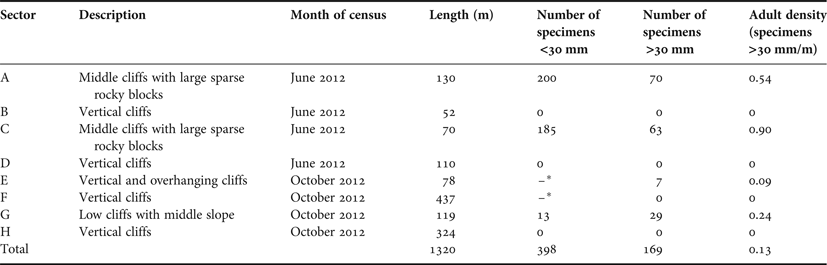
In total, 567 individuals of Patella ferruginea were found in the PVLG during field sampling (Table 1). In sectors A, B, C, D, G and H (more accessible sectors for sampling works, involving about 805 m of coastline) 162 individuals larger than 30 mm MD and 398 specimens smaller than 30 mm MD were counted and measured. On the other hand, only 7 adult specimens (>30 mm MD) were counted in sectors E and F (less accessible sectors, involving about 515 m of coastline).
Characterization and abundance of specimens of Patella ferruginea in sectors of littoral defined in the Peñón de Vélez de la Gomera for study. The asterisk (*) indicates that no search of juveniles specimens (<30 mm maximum diameter of the shell) was carried out due to the low accessibility of the littoral.

Size–frequency distribution of specimens from sectors A, C and G (where specimens of P. ferruginea were found) is shown in Figure 2. Immature specimens (<30 mm MD) dominated the population and accounted for 71.07% of the specimens recorded in those sectors where comprehensive censuses were carried out and samples of this limpet species were found. Among these, most of them were smaller than 20 mm MD, which can be regarded as recruits (likely less than one year old) and represented 86.93% of immature limpets or 61.79% of total specimens counted. Among adults (>30 mm MD) there was a wide range of sizes. Of these, 18.5% were specimens larger than 70 mm MD, and 9.88% were larger than 80 mm MD. The size of the largest specimen measured was 93 mm MD. The mean size (± standard deviation) of all specimens measured was 25.6 ± 21.2 mm (N = 560), and 55.0 ± 16.3 mm if only the adults (>30 mm MD) were taken into account (N = 162).
Size–frequency distribution of Patella ferruginea specimens in the three sectors where a complete census of specimens was carried out and where specimens were found (no plots are presented for sectors B, D and H because no specimens of P. ferruginea were found in them).

The estimated average density of adults for the whole littoral was 0.13 adults/m. An average density of 0.43 adults/m was found for the sectors where the species was present, and an average of 0.70 adults/m for the sectors where comprehensive censuses of specimens were carried out. The maximum density value reached was 0.90 adults/m in sector C (3.54 specimens/m if young limpets were included).
All sectors where P. ferruginea was found correspond to 30.1% of the total coastline of the PVLG, excluding the sandy beaches of the isthmus that joins the inlet to the mainland coast. This limpet was mainly present in zones where rocky surfaces have a moderate slope, and the maximum densities were observed in sectors A and C, where a number of isolated rocks were present close to the coastline. The remaining 69.1% of the coastline, where no specimens were found, mainly corresponds to highly exposed zones with vertical or overhanging cliffs. In addition, sector F is one of the most exposed to wave action.
DISCUSSION
Comparison with other localities
The global distribution of Patella ferruginea is currently very limited. It is mainly concentrated in a very small number of localities where it still persists in good condition while there are some other places where this endangered limpet is present in moderate densities, or even where its presence is reduced to only some scattered specimens. Low density localities, particularly those that are quite isolated geographically, may be considered relict, vanishing, and non-breeding populations (see Guallart & Templado, Reference Guallart and Templado2012).
Criteria for comparisons of values of density of Patella ferruginea between localities have recently been discussed in detail by Guallart et al. (Reference Guallart, Luque, Acevedo and Calvo2013). These authors emphasized that the comparison of densities referring only to adult specimens (>30 mm MD) has the advantage of avoiding the influence of the high temporal variability of abundance of young specimens, due both to differences in recruitment success between years, and to the high mortality rate that occurs seasonally in a significant percentage of juveniles during their first year of life (Guallart et al., Reference Guallart, Acevedo and Calvo2012b).
In those littoral areas that maintain the best current populations of P. ferruginea, its average density (calculated from some definite transects along their coastline) reaches or exceeds values of several specimens/m. This is the case of the Chafarinas Islands, with 5.28 specimens/m or 4.17 adults/m (Aparici-Seguer et al., Reference Aparici-Seguer, Guallart-Furió, Vicent-Rubert, Guerra, Rolán and Rocha1995), Melilla, with 20.55 specimens/m or 14.73 adults/m (Guallart et al., Reference Guallart, Luque, Acevedo and Calvo2013), Habibas Islands, with 4.81 specimens/m or 3.23 adults/m (Espinosa, Reference Espinosa2009) and Ceuta, with 4.09 specimens/m or 1.65 adults/m (Rivera-Ingraham et al., Reference Rivera-Ingraham, Espinosa and García-Gómez2011). There are some other localities which, while harbouring well-structured populations, their total and adult densities are usually less than 1 specimen/m. This is the case of Zembra Island, with 0.85 specimens/m and 0.73 adults/m (Tlig-Zouari et al., Reference Tlig-Zouari, Rabaoui, Fguiri and Ben Hassine2010) or the Lavezzi Islands, with 0.36 specimens/m and 0.33 adults/m (Pascal, Reference Pascal2002). In other littoral zones the average density of this limpet is much lower. These even include some Marine Protected Areas such as Alboran Island, with a density of 0.07 specimens/m (Barba et al., Reference Barba, Nevado, Moreno, de la Linde, Remón, de la Rosa, Arroyo, Fernández-Casado, Gómez, Barrajón and Gordillo2007), Scandola Reserve (Corsica), with 0.080 specimens/m (Meinesz et al., Reference Meinesz, Soulet, Bottin, Cottalorda, Markovic, Thibaut and Meinesz2010), or the Penisola del Sinis–Isola di Mal di Ventre Marine Protected Area in Sardinia, with 0.024 specimens/m (Coppa et al., Reference Coppa, De Lucia, Massaro and Magni2012). Lastly, in other coastal areas the density is extremely low (i.e. below 0.01 specimens/m), which currently corresponds to the presence of very rare specimens, as in most parts of the Andalusian and Tunisian coasts (Tlig-Zouari et al., Reference Tlig-Zouari, Rabaoui, Fguiri and Ben Hassine2010; Arroyo et al., Reference Arroyo, Moreno, Barrajón, de la Linde, Remón, de la Rosa, Fernández-Casado, Gómez, Ruiz-Giráldez, Vivas and Fernández2011).
Therefore, the density values obtained for the PVLG (an average 0.13 adults/m for the whole coastline, and a maximum value of 0.90 adults/m) are intermediate with regard to the aforementioned areas. These results are similar in order of magnitude to those previously obtained for other enclaves of the A-HNP. Bazaïri et al. (Reference Bazaïri, Salvati, Benhissoume, Tunesi, Rais, Agnesi, Benhamza, Franzosini, Limam, Mo, Molinari, Nachite and Sadki2004) registered densities of 0.16 specimens/m in Cala Iris Island and Guallart et al. (Reference Guallart, Calvo and Acevedo2012a) reported densities which did not exceed an average of 2 adults/m in some littoral places of this National Park.
The presence of Patella ferruginea in the PVLG was first reported by Guallart et al. (Reference Guallart, Calvo and Acevedo2012a), although its population was not initially evaluated. According to the present results and regarding to the total number of adult specimens found, when compared to other Spanish coastal enclaves the PVLG would be the fifth locality in importance after the Chafarinas Islands, Melilla, Ceuta and Alboran Island, while it is followed by Algeciras Bay (see compiled data by Guallart & Templado, Reference Guallart and Templado2012; Guallart et al., 2013).
Size distribution
The population of P. ferruginea in the PVLG shows a well-structured size/age distribution, with a wide range of sizes from young to large individuals. Noteworthy is the high number of juveniles found (71.07% of the specimens observed were <30 mm MD in areas where complete censuses were carried out), up to 2.64 juveniles/m in sector C. The high recruitment rate observed is indicative of a sustainable population in terms of reproduction in the PVLG or in the nearby coast of the A-HNP, and could be related to the high inter-annual variability found in the recruitment of this species in other North African localities (Guallart et al., Reference Guallart, Acevedo and Templado2011, 2012b). On the other hand the presence of at least a moderate density of adults is remarkable (i.e. reproductive) specimens (>30 mm MD), that almost reaches the density of 1 adult/m in some places, with a wide size range (Figure 2), including the presence of older specimens larger than 90 mm MD. Low growth rates described for this species (Espinosa et al., Reference Espinosa, González, Maestre, Fa, Guerra-García and García-Gómez2008; Guallart et al., Reference Guallart, Acevedo and Calvo2012c) points out that the presence of these large specimens suggests the existence of a sustainable population in terms of reproduction of P. ferruginea in the PVLG during at least the last two decades.
Habitat selection and accessibility
Specimens of this limpet, as it is usual, were found above mean sea level, mainly in the lower part of the belt of Chthamalus stellatus. It is generally noted that Patella ferruginea prefers areas with moderate to high exposure to wave action (Boudouresque & Laborel-Deguen, Reference Boudouresque, Laborel-Deguen, Boudouresque, Harmelin and Jeudy de Grissac1986; Porcheddu & Milella, Reference Porcheddu, Milella, Boudouresque, Avon and Gravez1991; Boumaza & Semroud, Reference Boumaza and Semroud2001; Guallart et al., Reference Guallart, Templado, Calvo, Cabezas, Acevedo, Machordom and Luque2006b), being uncommon or absent in very protected areas such as the most confined zones within harbours (Guallart et al., Reference Guallart, Luque, Acevedo and Calvo2013). One exception is the harbour of Ceuta, inside which there are large numbers of specimens, which has been attributed to the particular characteristics of this port, open to the sea in two opposite points, allowing water to circulate within it (Guerra-García et al., Reference Guerra-García, Corzo, Espinosa and García-Gómez2004; Rivera-Ingraham et al., Reference Rivera-Ingraham, Espinosa and García-Gómez2011). In the PVLG most specimens were observed in places moderately exposed to wave action, such as sectors A and C. The absence of individuals in sectors D and F, and its scarcity in sector E, may be attributed to the high wave exposure of these sites, together with the morphology of the substrate, formed by vertical cliffs even with overhanging surfaces. Such coastal surfaces would be battered by high energy waves during storms and that would be a limiting factor for the presence of this limpet.
Furthermore, human collection has been suggested as a major cause of regression of the species (Templado, Reference Templado, Ramos, Bragado and Fernádez2001; Paracuellos et al., Reference Paracuellos, Nevado, Moreno, Jiménez and Asesina2003; Moreno & Arroyo, Reference Moreno, Arroyo, Barea-Azcón, Ballesteros-Duperón and Moreno2008; Espinosa et al., Reference Espinosa, Rivera-Ingraham, Fa and García-Gómez2009), and some authors have observed a negative relationship between the accessibility of the coast and the abundance of this limpet (Paracuellos et al., Reference Paracuellos, Nevado, Moreno, Jiménez and Asesina2003; Espinosa et al., Reference Espinosa, Rivera-Ingraham, Fa and García-Gómez2009; Rivera-Ingraham et al., Reference Rivera-Ingraham, Espinosa and García-Gómez2011). This has also been reported for other large and endangered species of limpets (Branch & Odendaal, Reference Branch and Odendaal2003; Kido & Murray, Reference Kido and Murray2003). However, this relationship has not been assessed in the PVLG. In this case the accessibility does not seem to be a limiting factor or a threat for the species. This Spanish enclave is only inhabited by a small military garrison, who know the strict regulations forbidding collection of this limpet.
CONCLUSIONS
Specimens of Patella ferruginea found in the PVLG should be considered as part of the population inhabiting the coastline of the A-HNP. The littoral and seabeds of this National Park have a high value from a conservation point of view because of its geomorphological singularity and its present pristine state. However, its marine biota is still poorly known and research work should be enhanced with regard to its conservation in this valuable coastal area of the south-west Mediterranean. Furthermore, according to what is set down in the Spanish Conservation Strategy for Patella ferruginea, a monitoring plan of the population of the species here described should be established.
ACKNOWLEDGEMENTS
Our work has been partly funded by the project ‘Action plan for Proposals viability of the endangered limpet, Patella ferruginea’ (Project Zero—Endangered Species of the Fundación General CSIC). We thank the Spanish Army for the facilities given to conduct this survey and their contribution to the preservation of the species in this enclave. We also deeply appreciate the comments and suggestions of anonymous referees that have substantially improved this manuscript.