Introduction
Cover crops have become an integral part of many cropping systems and are planted on more than 404,686 ha in the United States (USDA 2012). Benefits of cover crops include weed suppression, enhanced soil quality, reduced soil erosion, and increased cash crop yield (Chen and Weil Reference Chen and Weil2011; Power and Doran Reference Power, Doran and Hargrove1988; Reddy et al. Reference Reddy, Zablotowicz, Locke and Koger2003; Smith et al. Reference Smith, Frye and Varco1987; Teasdale Reference Teasdale1996; Williams et al. Reference Williams, Mortensen and Doran1998). A critical benefit of cover crops is erosion control during the winter months (Van Rijn Reference Van Rijn2011). Rapid establishment and biomass accumulation enables brassicas to reduce soil erosion from late fall to spring (Bowman et al. Reference Bowman, Shirley, Cramer and Clark2007). Winter-planted rapeseed can provide up to 80% ground cover, which is essential for reducing soil erosion (Eberlein et al. Reference Eberlein, Morra, Guttieri, Brown and Brown1998). Cover crops help diversify weed management programs but do not provide season-long weed control or eliminate the need for herbicides in cash crop management (Reddy et al. Reference Reddy, Zablotowicz, Locke and Koger2003; Teasdale Reference Teasdale1996). However, combinations of cover crops and PRE herbicides have been proven to effectively control weeds (Norsworthy et al. Reference Norsworthy, McClelland, Griffith, Bangarwa and Still2011).
Commonly used cover crops include legumes, cereals, and Brassicaceae species in both monocultures and mixtures (Brennan and Smith Reference Brennan and Smith2005; Mannering et al. Reference Mannering, Griffith and Johnson2007). Monoculture cover crops are more popular with producers because of their ease of planting and termination. Selecting a termination method is easier when facing only one species. Brassica species are multifunctional cover crops and a popular choice for producers because of their rapid growth, large taproot, and frost tolerance (Chen et al. Reference Chen, Clark, Kremen, Lawley, Price, Stocking, Weil and Clark2007). However, some brassica species are susceptible to freezing temperatures. For example, tillage radish (Raphanus sativus L.), if planted early, can grow large, increasing its susceptibility to freezing temperatures. Tillage radish susceptibility to freezing temperatures is also dependent upon tuber depth; tubers 7 to 10 cm above the soil surface are more susceptible to freezing temperatures. However, tubers that are closer to the soil surface and more insulated by the soil may survive the winter, mature, and reach reproductive stage. At this stage, tillage radish is difficult to control with herbicides (Roberts Reference Roberts2015).
Mid-Atlantic producers are interested in rapeseed as a cover crop for its taproot, which creates soil macropores that reduce soil compaction and in turn increase water infiltration (Alcantara et al. Reference Alcantara, Sanchez, Pujadas and Saavedra2009; Wolfe Reference Wolfe and Clark2007). Soil compaction has become problematic in response to increased use of heavy machinery and adoption of conservation tillage (Hamza and Anderson Reference Hamza and Anderson2005; Servadio et al. Reference Servadio, Marsili, Vignozzi, Pellegrini and Pagliai2005). Brassica cover crops are capable of alleviating soil compaction. Taproots grow deeply and rapidly during the fall while the soil is relatively moist, allowing them to penetrate compacted layers, unlike fibrous roots of other commonly grown cover crops (Chen and Weil Reference Chen and Weil2010; Williams and Weil Reference Williams and Weil2004). The rapeseed taproot is cylindrical and fast-growing, allowing it to act as a “biodrill” that can reach one or more meters into the soil (Virginia NRCS 2015). Producers in the midwestern United States utilize brassica species to scavenge residual nitrogen left after cash crop harvest (Gieske et al. Reference Gieske, Ackroyd, Baas, Mutch, Wyse and Durgan2016). Gieske et al. (Reference Gieske, Ackroyd, Baas, Mutch, Wyse and Durgan2016) found that brown mustard (Brassica juncea L.), rapeseed, radish (Raphanus sativus L.), and white mustard (Sinapis alba L.) all accumulate comparable amounts of nitrogen and biomass.
Compared to tillage radish, which is often used as a cover crop to reduce soil compaction, the planting date for rapeseed is more flexible. In Virginia, the Natural Resource Conservation Service suggests seeding tillage radish during August or September while corn and soybean remain in the field (Virginia NRCS 2015). However, rapeseed can be planted from September through November, giving producers flexibility to plant a brassica cover crop after cash crop harvest (Virginia NRCS 2015).
Producers are also interested in brassica cover crops for their potential as biofumigants (Haramoto and Gallandt Reference Haramoto and Gallandt2005). Glucosinolates, produced in great quantity by some brassica species, are sulfur-containing molecules that when hydrolyzed form toxic compounds (e.g., isothiocyanates) that are capable of controlling some soilborne organisms such as nematodes, fungi, and weeds (Bell and Muller Reference Bell and Muller1973; Blau et al. Reference Blau, Feeny, Contardo and Robson1978; Brown and Morra Reference Brown and Morra1997; Haramoto and Gallandt Reference Haramoto and Gallandt2005; Mojtahedi et al. Reference Mojtahedi, Santo, Wilson and Hang1993; Muehlchen et al. Reference Muehlchen, Rand and Parke1990; Petersen et al. Reference Petersen, Belz, Walker and Hurle2001; Teasdale and Taylorson Reference Teasdale and Taylorson1986; Wolf et al. Reference Wolf, Spencer and Kwolek1984). ‘Caliente’ mustard, a mixture of white and brown mustard, is the main species of interest for production of isothiocyanates; however, research has determined that rapeseed has a similar ability to inhibit weed seed germination (Bangarwa et al. Reference Bangarwa, Norsworthy and Gbur2009; Brown and Morra Reference Brown and Morra1996). To maximize biofumigant activity of rapeseed and other brassica species, special management is required. This includes careful timing of termination, thorough chopping of residue to release the biofumigant, and subsequent incorporation of the residue into the soil (Virginia NRCS 2015).
As a result of its high growth rate and pod-shattering characteristics (Krato and Petersen Reference Krato and Petersen2012), rapeseed can be a problem for the subsequent crop when termination is unsuccessful. Although rapeseed is a useful cover crop, plants that survive termination can compete with cash crops. Uncontrolled weedy brassica species like wild mustard (Sinapis arvensis L. subsp. arvensis) can reduce wheat yields up to 62% (Behdarvand et al. Reference Behdarvand, Chinchanikar, Dhumal and Baghestani2013). Specifically, previous research determined that volunteer rapeseed can reduce wheat yield by as much as 49% (O’Donovan et al. Reference O’Donovan, Harker and Dew2008). Prior to cash crop establishment, producers have numerous chemical options available for use before plant burndown. However, research is limited on efficacy of herbicides for rapeseed termination (AOF 2014). However, control of other brassica species such as wild mustard and wild radish (Raphanus raphanistrum L.) is better understood (DiTomaso et al. Reference DiTomaso, Kyser, Oneto, Wilson, Orloff, Anderson, Wright, Roncoroni, Miller, Prather, Ransom, Beck, Duncan, Wilson and Mann2013; Ferrell et al. Reference Ferrell, Sellers, MacDonald and Leon2015). Timing is critical when controlling these species (Cahoon Reference Cahoon2016; Culpepper Reference Culpepper2009; DiTomaso et al. Reference DiTomaso, Kyser, Oneto, Wilson, Orloff, Anderson, Wright, Roncoroni, Miller, Prather, Ransom, Beck, Duncan, Wilson and Mann2013). Recommendations for most herbicides are to apply when wild mustard and wild radish are small and rapidly growing or while still in the rosette stage (DiTomaso et al. Reference DiTomaso, Kyser, Oneto, Wilson, Orloff, Anderson, Wright, Roncoroni, Miller, Prather, Ransom, Beck, Duncan, Wilson and Mann2013). However, terminating a rapeseed cover crop at these stages would defeat its purpose as a cover crop. Small wild radish (<15 cm in height) control by 2,4-D is excellent (>90%); control declines to approximately 70% when applied to wild radish 30 cm or taller, and once wild radish begins to flower, control by 2,4-D is unacceptable (<40%) (Ferrell et al. Reference Ferrell, Sellers, MacDonald and Leon2015). Culpepper (Reference Culpepper2009) reported similar wild radish control with 2,4-D in Georgia. Wild mustard and wild radish control in the mid-Atlantic region can typically be accomplished by applying 2,4-D in March or early April; other options are available depending on rotation restrictions and cash crop choice (Cahoon Reference Cahoon2016).
The objective of this research was to evaluate various herbicides and herbicide combinations for termination of rapeseed cover crop prior to simulated planting of corn and soybean.
Materials and Methods
Experiments were conducted at the Eastern Shore Agriculture Research and Extension Center near Painter, VA (37.5892°N, 75.8226°W) and at the Carvel Research and Education Center near Georgetown, DE (38.6419°N, 75.4603°W) during 2016–2017 and 2017–2018. Soil descriptions are listed in Table 1. The experimental design was a randomized complete block with treatments replicated four times. Plot size in both Virginia and Delaware was 3 m long by 2 m wide.
Locations, soil descriptions, and herbicide application dates.

a Coarse-loamy, mixed, semiactive, thermic Typic Hapludults.
b Coarse-loamy, siliceous, semiactive, mesic Aquic Hapludults.
c Loamy, siliceous, semiactive, mesic Arenic Hapludults.
d Percent organic matter determined according to Dean (Reference Dean1974).
Rapeseed cultivar ‘Dwarf Essex’ was planted at each site on dates listed in Table 1. Rapeseed was drilled at 6.7 kg ha–1 into a conventional-tillage field in Virginia. Trifuralin (Treflan® 4L; Corteva AgroSciences, Indianapolis, IN) was applied at 560 g ai ha–1 along with 56 kg ha–1 of nitrogen, immediately followed by shallow incorporation with a rototiller just prior to planting in Virginia in 2017; no additional nitrogen was added during 2018. In Delaware, rapeseed was drilled into a no-tillage field, and paraquat (Gramoxone® SL; Syngenta, Greensboro, NC) was applied at 840 g ai ha–1 prior to planting.
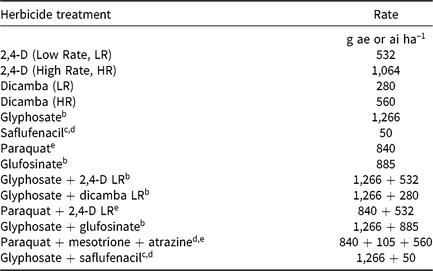
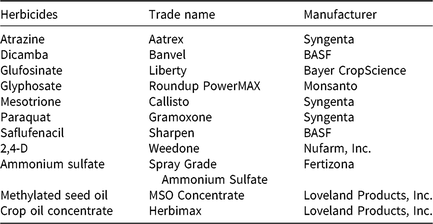
Two separate experiments, adjacent to each other, were established to evaluate rapeseed termination by 14 herbicide treatments at two timings. Termination timings included an early and late termination to simulate rapeseed termination prior to planting corn and soybean, respectively, for the region. Termination dates can be found in Table 1. Herbicide treatments and rates can be found in Table 2 and source information in Table 3. Additionally, a nontreated control was included for comparison. The lowest rate of 2,4-D and dicamba was used in combination with other herbicides. In Virginia during 2017, rapeseed height averaged 41 cm at early termination and 107 cm at late termination, whereas rapeseed height averaged 10 and 38 cm at early and late termination, respectively, in Virginia during 2018. In Delaware during 2017, early and late termination treatments were applied when rapeseed height averaged 13 and 76 cm, respectively, and when rapeseed height averaged 13 and 41 cm during 2018.

Source information for herbicides used in experiments.a

a Specimen labels for each product and mailing addresses and website addresses of each manufacturer can be found at www.cdms.net.
Herbicides were applied using a CO2-pressurized backpack sprayer equipped with flat-fan nozzles (AIXR 11002 TeeJet® Air Induction XR flat-spray nozzles; TeeJet Technologies, Wheaton, IL). In Virginia, applications were made at 140 L ha–1 of solution delivered at 165 kPa. In Delaware, applications were made at 186 L ha–1 of solution delivered at 214 kPa.
Visible control of rapeseed was recorded 7, 14, and 28 d after early termination (DAET) and 7, 14, and 28 d after late termination (DALT) using a 0 to 100% scale, where 0% = no control and 100% = complete control. Rapeseed aboveground biomass was harvested from a 0.25-m2 section at 28 d after each termination timing, dried for 28 d in a dryer, and then weighed to determine rapeseed dry biomass. Data for rapeseed biomass were extrapolated to present biomass as kilograms per hectare.
Data were subjected to ANOVA using the PROC GLIMMIX procedure in SAS software (version 9.4; SAS Institute Inc., Cary, NC). Herbicide treatment was treated as a fixed factor, whereas location and replications were treated as random. Rapeseed was much larger at both termination timings at Virginia during 2017. Exclusion of Virginia 2017 data allowed for pooling across all other locations. Therefore, data are presented pooled across Delaware 2017 and 2018 and Virginia 2018, with data for Virginia 2017 presented separately. The main effect of herbicide treatment was significant for both termination timings at Virginia 2017 and pooled locations. Means were separated using Fisher’s protected LSD at P = 0.05 when appropriate. Data for nontreated plots were excluded from analyses, except in a separate analysis for which Dunnett’s procedure (Dunnett Reference Dunnett1955) was used to compare rapeseed biomass in the nontreated plot to all other treatments.
Results and Discussion
Rapeseed was much smaller at Delaware and Virginia in 2018. At these locations, rapeseed height averaged 12 cm at early termination compared to 41 cm at Virginia in 2017. At late termination, rapeseed averaged 52 cm at Delaware and Virginia in 2018, whereas rapeseed at Virginia in 2017 was 107 cm tall. At-planting nitrogen applied in 2017, coupled with a warm February, are probably responsible for large rapeseed at Virginia in 2017. Early-termination and late-termination timings were separated by 12, 15, 21, and 20 d at Delaware 2017, Delaware 2018, Virginia 2017, and Virginia 2018, respectively. During that time, rapeseed increased approximately four-fold in size at Delaware and Virginia in 2018 and three-fold at Virginia in 2017.
Early-Termination Experiment
Delaware and Virginia 2018
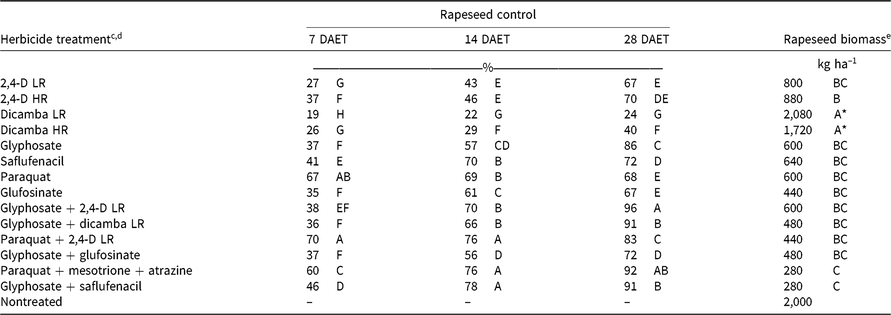
As expected, herbicides terminated rapeseed more effectively when rapeseed was shorter. At Delaware and Virginia 2018, rapeseed control by most herbicide treatments was poor 7 DAET; paraquat alone or paraquat combinations controlled rapeseed 60% or better, whereas rapeseed termination by all other herbicide treatments was ≤46% (Table 4). Rapeseed control generally improved at later rating dates. Systemic herbicide activity can be slow, especially when air temperatures are cool during late winter and early spring (Caseley Reference Caseley1983). Given sufficient time to work, with the exception of dicamba alone, rapeseed termination ranged from 67% to 96% at 28 DAET at Delaware and Virginia 2018. Of herbicides applied alone, glyphosate (86%) was most effective in terminating rapeseed 28 DAET. Although less than glyphosate, rapeseed control by 2,4-D, saflufenacil, paraquat, and glufosinate were moderately effective, controlling the cover crop 67% to 72%, whereas rapeseed termination by dicamba was poor (24% to 40%). Adding 2,4-D low rate (LR), dicamba LR, and saflufenacil to glyphosate improved efficacy 5% to 10% compared to glyphosate alone. However, glyphosate + glufosinate was 14% less effective than glyphosate alone. Cahoon and others (Reference Cahoon, York, Jordan, Seagroves, Everman and Jennings2015) reported that large crabgrass (Digitaria sanguinalis L.) and goosegrass (Eleusine indica L.) control was reduced when glyphosate was co-applied with glufosinate compared to glyphosate alone. Similar to how 2,4-D LR improved rapeseed control by glyphosate, 2,4-D + paraquat was 15% more effective than paraquat alone. Curran et al. (Reference Curran, Lingenfelter, Johnson, VanGessel, Vollmer, Schulz, Besancon, Cahoon, Flessner, Hines and Chandran2018) reported that 2,4-D added to paraquat improves cutleaf evening-primrose (Oenothera laciniata Hill), horseweed (Conyza canadensis L.), and brassica species control relative to paraquat alone. Comparing all herbicide treatments 28 DAET, glyphosate + 2,4-D LR (96%) and paraquat + mesotrione + atrazine (92%) were most effective.
Rapeseed control 7, 14, and 28 d after early termination (DAET) and rapeseed biomass 28 DAET in Georgetown, DE, 2017 and 2018, and Painter, VA, 2018.a, b

a Means within a column followed by the same letter are not different according to Fisher’s protected LSD test at P = 0.05.
b Rapeseed height averaged 12 cm at time of early termination at Georgetown, DE during 2017 and 2018 and at Painter, VA during 2018.
c Abbreviations: HR, high rate; LR, low rate.
d 2,4-D LR, 2,4-D HR, dicamba LR, dicamba HR, glyphosate, saflufenacil, paraquat, glufosinate, glyphosate + 2,4-D LR, glyphosate + dicamba LR, paraquat + 2,4-D LR, glyphosate + glufosinate, paraquat + mesotrione + atrazine, and glyphosate + saflufenacil were applied at 532, 1,064, 280, 560, 1,266, 50, 840, 885, 1,266 + 532, 1,266 + 280, 840 + 532, 1,266 + 885, 840 + 105 + 560, and 1,266 + 50 g ae or ai ha–1, respectively.
e Means for rapeseed biomass followed by an asterisk (*) are not different from the nontreated according to Dunnett’s procedure at P = 0.05.
In general, rapeseed biomass 28 DAET mirrored visible rapeseed control at the same time. Rapeseed biomass in nontreated plots averaged 2,000 kg ha–1. All treatments, except dicamba (1,702 to 2,080 kg ha–1) reduced rapeseed biomass relative to the nontreated. All other herbicide treatments reduced rapeseed biomass 56% to 86% compared to the nontreated.
Virginia 2017
Rapeseed termination was generally poor at Virginia during 2017 and was probably due to rapeseed size. Previous research noted control of wild radish and wild mustard, weeds related to rapeseed, is more difficult as the weeds mature (Cahoon Reference Cahoon2016; Culpepper Reference Culpepper2009; DiTomaso et al. Reference DiTomaso, Kyser, Oneto, Wilson, Orloff, Anderson, Wright, Roncoroni, Miller, Prather, Ransom, Beck, Duncan, Wilson and Mann2013; Ferrell et al. Reference Ferrell, Sellers, MacDonald and Leon2015). Ferrell et al. (Reference Ferrell, Sellers, MacDonald and Leon2015) reported that wild radish ≤15 cm tall was controlled ≥90% by 2,4-D; control of the weed when 30 cm tall or flowering by 2,4-D was approximately 70% and 50% or less, respectively. In Virginia 2017, rapeseed was 41 cm tall at early termination.
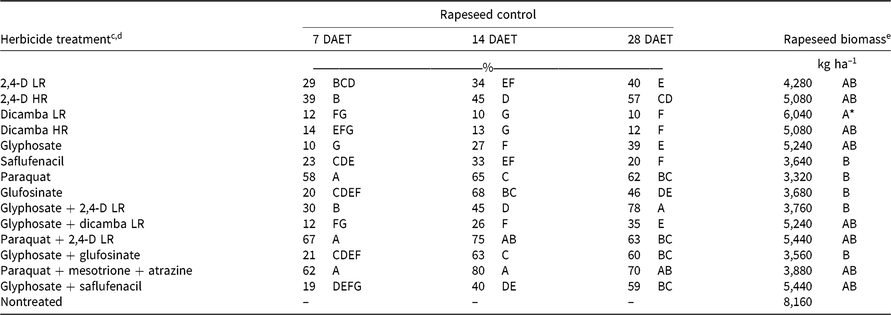
Like Delaware and Virginia in 2018, paraquat (58%), paraquat + mesotrione + atrazine (62%), and paraquat + 2,4-D (67%) were more effective than other herbicide treatments 7 DAET at Virginia 2017 (Table 5). Although rapeseed control improved later in the season, no herbicide treatment terminated the cover crop greater than 78% at 28 DAET, whereas at Delaware and Virginia 2018, the following six herbicide treatments controlled rapeseed at least 83%: glyphosate alone, glyphosate + 2,4-D, glyphosate + dicamba, glyphosate + saflufenacil, paraquat + 2,4-D, and paraquat + mesotrione + atrazine. At Virginia 2017, the higher rate of 2,4-D was 17% more effective than 2,4-D LR. Like other locations, 2,4-D LR improved efficacy of glyphosate 39% at 28 DAET; glyphosate + 2,4-D (78%) was the most effective herbicide treatment at Virginia 2017. However, paraquat + 2,4-D was no more effective than paraquat alone at the same timing. Dicamba (10% to 12%) was less effective than 2,4-D and did not improve glyphosate efficacy.
Rapeseed control 7, 14, and 28 d after early termination (DAET) and rapeseed biomass 28 DAET in Painter, VA, 2017.a, b

a Means within a column followed by the same letter are not different according to Fisher’s protected LSD test at P = 0.05.
b Rapeseed height averaged 41 cm at time of early termination at Painter, VA, during 2017.
c Abbreviations: LR, low rate; HR, high rate.
d 2,4-D LR, 2,4-D HR, dicamba LR, dicamba HR, glyphosate, saflufenacil, paraquat, glufosinate, glyphosate + 2,4-D LR, glyphosate + dicamba LR, paraquat + 2,4-D LR, glyphosate + glufosinate, paraquat + mesotrione + atrazine, and glyphosate + saflufenacil were applied at 532, 1,064, 280, 560, 1,266, 50, 840, 885, 1,266 + 532, 1,266 + 280, 840 + 532, 1,266 + 885, 840 + 105 + 560, and 1,266 + 50 g ae or ai ha–1, respectively.
e Means for rapeseed biomass followed by an asterisk (*) are not different from nontreated according to Dunnett’s procedure at P = 0.05.
As further evidence of taller rapeseed at Virginia 2017 compared to other locations, rapeseed biomass in nontreated plots (8,160 kg ha–1) was approximately four-fold greater than at Delaware and Virginia 2018 (Tables 4 and 5). Most treatments did reduce rapeseed biomass relative to the nontreated; however, reductions were minimal, ranging 37% to 59%.
Late-Termination Experiment
Delaware and Virginia 2018
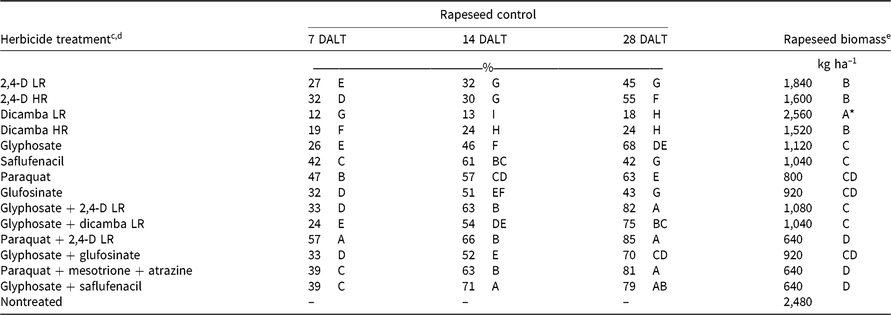
Rapeseed was larger at late-termination dates, and control was less with the late-termination applications. No herbicide treatment controlled the cover crop better than 57% at 7 DALT (Table 6). Similar to early termination, herbicide treatments containing paraquat (39% to 57%) terminated rapeseed best at 7 DALT. Surprisingly, at this timing, saflufenacil (42%) and glyphosate + saflufenacil (39%) controlled rapeseed similar to paraquat + mesotrione + atrazine (39%). Again, rapeseed termination improved with time. Rapeseed control by all herbicide treatments, except dicamba, ranged 30% to 71% 14 DALT compared to 26% to 57% control at 7 DALT.
Rapeseed control 7, 14, and 28 d after late termination (DALT) and rapeseed biomass 28 DALT in Georgetown, DE, 2017 and 2018, and Painter, VA, 2018.a, b

a Means within a column followed by the same letter are not different according to Fisher’s protected LSD test at P = 0.05.
b Rapeseed height averaged 52 cm at time of late termination at Georgetown, DE during 2017 and 2018 and at Painter, VA during 2018.
c Abbreviations: LR, low rate; HR, high rate.
d 2,4-D LR, 2,4-D HR, dicamba LR, dicamba HR, glyphosate, saflufenacil, paraquat, glufosinate, glyphosate + 2,4-D LR, glyphosate + dicamba LR, paraquat + 2,4-D LR, glyphosate + glufosinate, paraquat + mesotrione + atrazine, and glyphosate + saflufenacil were applied at 532, 1,064, 280, 560, 1,266, 50, 840, 885, 1,266 + 532, 1,266 + 280, 840 + 532, 1,266 + 885, 840 + 105 + 560, and 1,266 + 50 g ae or ai ha–1, respectively.
e Means for rapeseed biomass followed by an asterisk (*) are not different from nontreated according to Dunnett’s procedure at P = 0.05.
Rapeseed termination was even greater 28 DALT. At this time, saflufenacil, glufosinate, 2,4-D LR, 2,4-D HR, paraquat, and glyphosate controlled rapeseed 42%, 43%, 45%, 55%, 63%, and 68%, respectively. Dicamba terminated rapeseed only 18% to 24% at this time. Unlike early termination, the rate of 2,4-D applied influenced termination of larger rapeseed. The higher rate of 2,4-D (1,064 g ai ha–1) was 10% more effective than 532 g ha–1. Higher rates of 2,4-D have been reported to provide more consistent control of some weeds. Keeling et al. (Reference Keeling, Henniger and Abernathy1989) noted that 2,4-D at 1.1 kg ha–1 controlled 10- to 15-cm horseweed 16% to 30% better than the herbicide applied at 0.6 kg ha–1. Despite poorer rapeseed control when herbicide application was delayed, paraquat + 2,4-D, glyphosate + 2,4-D, paraquat + mesotrione + atrazine, and glyphosate + saflufenacil controlled rapeseed 79% to 85% at 28 DALT.
All herbicide treatments, except dicamba LR (256 kg ha–1), reduced rapeseed biomass at 28 DALT relative to the nontreated (Table 6). Compared to the nontreated, rapeseed biomass resulting from all other treatments ranged 640 to 1,840 kg ha–1. Akin to visible rapeseed control 28 DALT, paraquat + 2,4-D, glyphosate + 2,4-D, paraquat + mesotrione + atrazine, and glyphosate + saflufenacil reduced rapeseed biomass 56% to 74%.
Virginia 2017
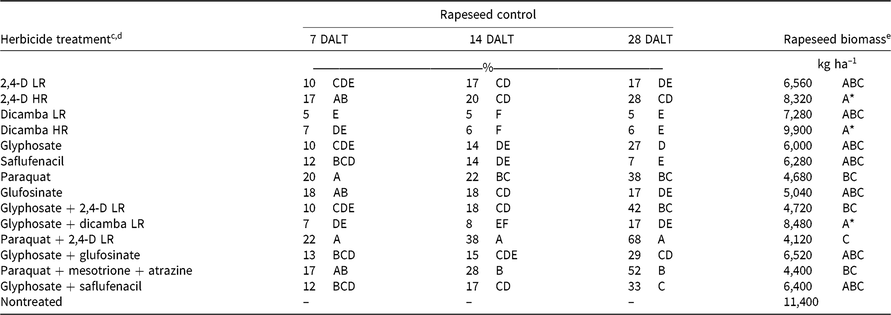
When rapeseed reached 107 cm in height at Virginia 2017, no herbicide treatment terminated rapeseed better than 22% and 38% at 7 and 14 DALT, respectively (Table 7). At this termination timing, rapeseed was flowering. Ferrell and others (Reference Ferrell, Sellers, MacDonald and Leon2015) observed that efficacy of 2,4-D decreased 40% or more when the herbicide was applied to flowering wild radish compared to wild radish ≤15 cm tall. At 28 DALT, paraquat + 2,4-D terminated rapeseed 68%; all other treatments controlled the cover crop ≤52%.
Rapeseed control 7, 14, and 28 d after late termination (DALT) and rapeseed biomass 28 DALT in Painter, VA, 2017.a, b

a Means within a column followed by the same letter are not different according to Fisher’s protected LSD test at P = 0.05.
b Rapeseed height averaged 107 cm at time of late termination at Painter, VA, during 2017.
c Abbreviations: LR, low rate; HR, high rate.
d 2,4-D LR, 2,4-D HR, dicamba LR, dicamba HR, glyphosate, saflufenacil, paraquat, glufosinate, glyphosate + 2,4-D LR, glyphosate + dicamba LR, paraquat + 2,4-D LR, glyphosate + glufosinate, paraquat + mesotrione + atrazine, and glyphosate + saflufenacil were applied at 532, 1,064, 280, 560, 1,266, 50, 840, 885, 1,266 + 532, 1,266 + 280, 840 + 532, 1,266 + 885, 840 + 105 + 560, and 1,266 + 50 g ae or ai ha–1, respectively.
e Means for rapeseed biomass followed by an asterisk (*) are not different from nontreated according to Dunnett’s procedure at P = 0.05.
Akin to visible rapeseed control 28 DALT, rapeseed biomass reduction was variable. Rapeseed biomass in the nontreated plots totaled 11,400 kg ha–1(Table 7). Like rapeseed biomass reductions at early termination, all herbicide treatments, except 2,4-D HR and dicamba HR, reduced rapeseed biomass 36% to 64%. Similar to visible ratings collected at the same time, paraquat + 2,4-D caused the greatest rapeseed biomass reduction.
Rapeseed, as a cover crop, has many potential benefits (Chen et al. Reference Chen, Clark, Kremen, Lawley, Price, Stocking, Weil and Clark2007; Chen and Weil Reference Chen and Weil2010; Gieske et al. Reference Gieske, Ackroyd, Baas, Mutch, Wyse and Durgan2016; Virginia NRCS 2015; Williams and Weil Reference Williams and Weil2004). However, termination can be difficult, as demonstrated in these experiments and reported by growers. Successful rapeseed termination is mostly predicated on size. Rapeseed 12 cm tall at Delaware and Virginia in 2018 was easily controlled with many herbicide treatments; glyphosate, glyphosate + 2,4-D, glyphosate + dicamba, glyphosate + saflufenacil, paraquat + 2,4-D, and paraquat + mesotrione + atrazine controlled rapeseed >86% at 28 DAET. Comparatively, these same treatments were less effective when rapeseed was taller. The aforementioned herbicide treatments controlled 41- to 107-cm rapeseed 17% to 85% at 28 d after application at either Delaware and Virginia 2018 or Virginia 2017. Other research from Virginia investigating rapeseed termination by various herbicides confirms that rapeseed size is critical to successful termination (Michael Flessner, personal communication). Likewise, control of many weedy brassica species is dependent upon weed size (Cahoon Reference Cahoon2016; Culpepper Reference Culpepper2009; DiTomaso et al. Reference DiTomaso, Kyser, Oneto, Wilson, Orloff, Anderson, Wright, Roncoroni, Miller, Prather, Ransom, Beck, Duncan, Wilson and Mann2013; Ferrell et al. Reference Ferrell, Sellers, MacDonald and Leon2015). Rate of 2,4-D also seemed to influence rapeseed termination, especially when the cover crop was larger. The high rate of 2,4-D controlled 41- and 52-cm rapeseed 17% and 10% better than 2,4-D LR at 28 d after application, respectively. Similarly, moderate to large (10 to 15 cm tall) horseweed is more consistently controlled with 1.1 kg ha–12,4-D than the 0.6 kg ha–1 rate of the herbicide (Keeling et al. Reference Keeling, Henniger and Abernathy1989).
Weed suppression by cover crops is determined by biomass accumulation; greater cover crop biomass increases weed suppression (Bybee-Finley et al. Reference Bybee-Finley, Mirsky and Ryan2017; Finney et al. Reference Finney, White and Kaye2016; Mirsky et al. Reference Mirsky, Ryan, Teasdale, Curran, Reberg-Horton, Spargo, Wells, Keene and Moyer2013). To maximize rapeseed biomass, the cover crop would have to be grown in a monoculture system. However, in a monoculture system, rapeseed would probably be too large in the spring to successfully terminate. Producers may mitigate the risk of tall rapeseed by growing the brassica in cover crop mixtures with other species like cereal rye (Secale cereale L.). Producers can further ensure that rapeseed is not too large at termination by effectively managing other crop species grown in competition with rapeseed. If cereal rye grown in competition with rapeseed is healthy, rapeseed is unlikely to reach 41 to 107 cm in height by termination as we observed in these monoculture rapeseed experiments. In years favoring growth of rapeseed over other cover crop species, producers should plan to terminate early before rapeseed becomes unmanageable with herbicides.
Author ORCID
Charles W. Cahoon Jr. https://orcid.org/0000-0001-9460-6350
Acknowledgments
Funding for this research was provided by the Virginia Natural Resources Conservation Service through a Conservation Innovation Grant (Agreement No. 69-33A7-16-1160). No conflicts of interest have been declared.