One of the most challenging clinical issues for schools and child treatment programs is determining the factors contributing to severe aggression in school-aged children so that effective treatments can be developed (Scott & Dadds, Reference Dadds, Hawes, Frost, Vassallo, Bunn, Hunter and Merz2009). The prevalence rates of aggression are relatively high within the school-age population, and the consequences for the individual and society at large can be devastating.
Child aggression that cannot be managed by parents and teachers creates significant distress for caregivers, alienates the child from others, and may place other children at risk. Research shows that approximately 65% of children who initially present with clinical levels of aggression in the preschool years and are still aggressive at 7 years of age, will continue to have problems into adolescence and adulthood, often becoming involved in delinquent and criminal activities (Broidy et al., Reference Broidy, Tremblay, Brame, Fergusson, Horwood, Laird and Vitaro2003; Moffitt, Caspi, Harrington, & Milne, Reference Moffitt, Caspi, Harrington and Milne2002).
Both the etiology and course of severely aggressive behaviour remain poorly understood (Dadds, Fraser, Frost, & Hawes, Reference Dadds, Fraser, Frost and Hawes2005; Dodge, Coie, & Lynam, Reference Dodge, Coie, Lynam and Eisenberg2006). In many cases, severely aggressive behaviour is diagnosed as a symptom of attention deficit/hyperactivity disorder (ADHD), oppositional defiant disorder, or conduct disorder (CD; Lahey & Waldman, Reference Lahey, Waldman, Lahey, Moffitt and Caspi2003). However, a recent taskforce of the National Institute of Mental Health in the United States concluded that aggression is a meaningful clinical construct in and of itself, and that research into its origins and treatment is critical (Connor, Reference Connor2002; Jensen et al., Reference Jensen, Youngstram, Steiner, Findling, Meyer, Malone and Vitiello2007).
At present, there exist several potentially helpful approaches to conceptualising the disparate pathways to aggressive behaviour, including distinguishing between proactive (planned) aggression and reactive (impulsive) aggression (Blair, Budhani, Colledge, & Scott, Reference Blair, Budhani, Colledge and Scott2005; Crick & Dodge, Reference Crick and Dodge1996; Dodge, Reference Dodge, Pepler and Rubin1991; Fite, Raine, Stouthamer-Loeber, Loeber, & Pardini, Reference Fite, Raine, Stouthamer-Loeber, Loeber and Pardini2010; Forth & Book, Reference Forth, Book, Salekin and Lynam2010; Raine et al., Reference Raine, Dodge, Loeber, Gatzke-Kopp, Lynam, Reynolds, Stouthamer-Loeber and Liu2006), and between children with psychopathic (callous unemotional) traits and children who are capable of empathic responses (Arsenio, Adams, & Gold, Reference Arsenio, Adams and Gold2009; Dadds et al., Reference Dadds, Hawes, Frost, Vassallo, Bunn, Hunter and Merz2009; Frick et al., Reference Frick, Cornell, Bodin, Dane, Barry and Loney2003; Viding, Reference Viding2004).
Currently, there are very few evidence- and skill-based treatments for working individually with aggressive school-aged children that can be provided in schools or other community settings. Commonly available ‘behaviour management’ approaches are often the only treatments offered by school and community agencies. Unfortunately, between 25% and 50% of children do not benefit from these treatments, particularly when severely disruptive child behaviour or a diagnosis of CD is present (Scott & Dadds, Reference Dadds, Hawes, Frost, Vassallo, Bunn, Hunter and Merz2009), often due to parental drop-out or parental failure to effectively implement strategies (Kazdin, Reference Kazdin2005; Reyno & McGrath, Reference Reyno and McGrath2006). As a result, many severely aggressive children and their families are denied acceptance into intervention programs altogether (Frick, Reference Frick2001).
New approaches to working with the aggressive child population must seek to engage, understand, and support all members of an affected family; acknowledge the effects of attachment difficulties and trauma on child behaviour; and integrate strategies to address central difficulties with emotion regulation (Ford et al., Reference Ford, Racusin, Ellis, Daviss, Reiser, Fleischer and Thomas2000). The present study attempts to provide important familial information in order to enhance the treatment of aggressive children in schools.
The Study
The first aim of the study was to explore the responses of a sample of Australian families on a diverse range of parent- and child-reports, each designed to measure underlying developmental and clinical variables identified in the literature as predictors of aggressive child behaviour. Responses were used to identify group differences between a clinical sample (families with a clinically aggressive child) and a community (control) sample on a number of child, parent, and parent–child relationship variables. Variables were examined simultaneously in order to determine which contributed the most unique variance to aggressive child behaviour.
The second aim of the study was to use the findings of the exploration phase to make recommendations for treatments pertinent to aggressive children and their families that might be efficaciously used within an Australian school or community context.
In order to achieve these two aims, the research objectives were to:
• collect data on the emotional, social, familial, and behavioural characteristics of a sample of clinically aggressive Australian children, and a comparison sample of non-aggressive Australian children, across domains of risk factors identified in the literature, including family history, family functioning, child developmental history, child trauma factors, and parent–child relationship factors
• identify between-group differences on the child, parent, parent–child relationship, and family functioning variables.
• identify a subset of variables that could be used to best predict aggressive group membership
• explore additional variables within the sample of clinically referred aggressive children, including anxiety, depression, effects of trauma, comorbid diagnoses, child and familial risk factors, and developmental and family histories
• determine how the findings of this Australian study compare with results from previous research, and how they fit within established theories and interventions
• use the findings to suggest recommendations for principles of treatment for aggressive children and their families.
Method
Participants
Children and their mothers (the primary caregivers in all cases) were recruited from: (1) Family Pathways, a service that provides a specialised classroom and intensive in-home treatment for children with severe and complex mental health issues; and (2) five public schools in Perth, Western Australia, connected with the Family Pathways service.
The recruitment strategy served three purposes: (1) it was likely that a number of children attending Family Pathways would meet the criteria for aggressive behaviour, (2) it was likely that a number of children from the public school system would not meet the criteria for aggressive behaviour, and (3) the children would likely be matched on socioeconomic factors, given that the families of the children attending these schools resided in similar suburbs.
Recruited children were assigned to one of two groups. The aggressive group comprised children whose parent-reported score on the Aggression scale of the Child Behaviour Checklist (CBCL; Achenbach, Reference Achenbach2001) fell within the clinical range. Thirty-one children met the criteria for inclusion in this group (M = 8.97 years, SD = 2.07, range = 4–12), with 25 boys (23 Family Pathways, 2 community) and 6 girls (5 Family Pathways, 1 community). The non-aggressive (control) group comprised children whose parent-reported score on the Aggression scale of the CBCL (Achenbach, Reference Achenbach2001) fell below the clinical range. Twenty-six children met the criteria for inclusion in this group (M = 8.57 years, SD = 2.28, range = 4–12 years), with 19 boys (9 Family Pathways, 10 community) and 7 girls (2 Family Pathways, 5 community). On the CBCL Aggression scale, the between-group difference was significant, t(55) = 12.47, p < .001 (two-tailed). The data-sets of three children (1 control, 2 aggressive) were excluded from the analyses due to incomplete data.
Measures
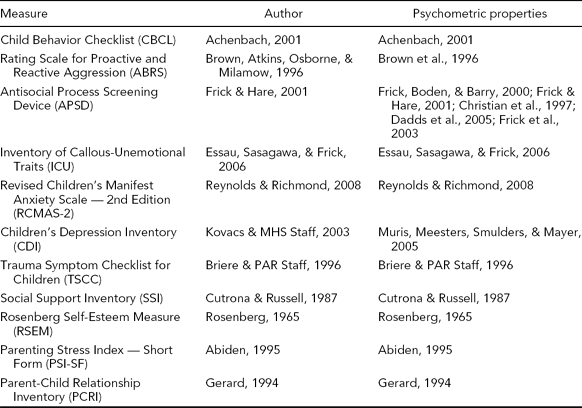
The measures used in the current study are listed in Table 1. Included citations detail the psychometric properties for each measure.
Measures

Two additional measures were completed with families attending the Family Pathways service. A Risk Assessment Measure (Landy, Reference Landy2006), listing a number of current and previous familial risk factors, was administered during intake interviews with the parents of referred children. A Developmental and Family History Interview was also conducted during intake.
Procedure
For the portion of the sample recruited from Family Pathways, during intake, clinicians administered the child-report measures to referred children, and the parent-report measures to their mothers. For the portion of the sample recruited from the community, nine school principals were offered the opportunity to have their school participate in the study. Five agreed to send letters home to parents inviting mothers to take part, and included information about the study in the school newsletter. A sample of parents from all five schools agreed to participate, and were sent a CBCL extract (Aggression scale items) to complete. Thirty-two interested parents returned the CBCL extract and were mailed the questionnaire pack with a reply-paid envelope for the return of completed questionnaires. Assistance with completing the questionnaires was offered. Three parents requested help, and a research assistant went to their home in order to provide support. Thirteen parents did not return the questionnaires, and 19 participated. On receipt of the completed questionnaires the families were sent movie tickets.
A research assistant scored the de-identified questionnaires, and entered the data into a database which was used to assign participants to either the aggressive or non-aggressive group, and to conduct all analyses.
Results
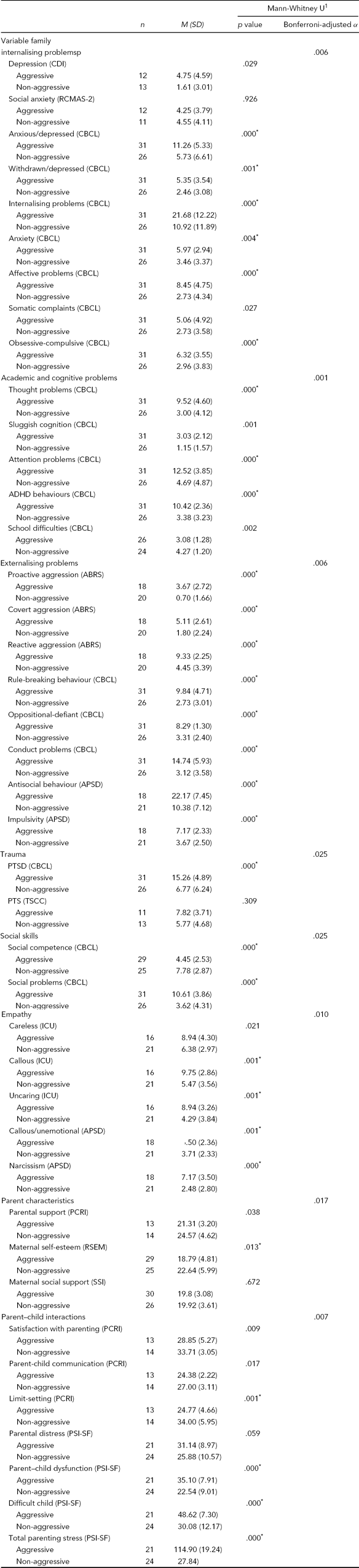
All analyses were performed in SPSS (Version 18.0, IBM Australia, Sydney, NSW, Australia). Table 2 reports the descriptive statistics for the measures completed by both groups.
Descriptive Statistics and Results of Mann-Whitney U-Tests
Note: *Significant group differences at the Bonferroni-adjusted alpha level; 1Due to different group-sizes, not all the Mann-Whitney's are equally powerful.
On the Risk Assessment measure completed by Family Pathways mothers, total scores ranged from 0 to 13 (M = 6.65, SD = 3.50). Two children met the criteria for low risk (<4 risks), nine met the criteria for medium-to-high risk (4–7 risks), and nine met the criteria for extreme risk (>7 risks).
Due to the exploratory nature of the study, a priori predictions about between-group differences would have been premature. A three-step exploratory analytical strategy was adopted in an attempt to identify the specific variables from the variable domains that exhibited statistically significant group differences.
Step 1. In order to accommodate the skewed distributions that characterised a large proportion of the variables, non-parametric Mann-Whitney U-tests were conducted to compare the aggressive and non-aggressive groups.
Step 2. An attempt was made to control the inflated Type-I error rate associated with conducting multiple univariate statistical tests. Variables were partitioned into eight families of conceptually related measures, including (1) internalising problems, (2) academic and cognitive problems, (3) externalising problems, (4) trauma, (5) social skills, (6) empathy, (7) parent characteristics, and (8) parent–child interactions (see Table 2). Each Mann-Whitney U-test was subsequently evaluated against a within-family Bonferroni adjusted alpha-level. The results of these analyses are summarised in Table 2.
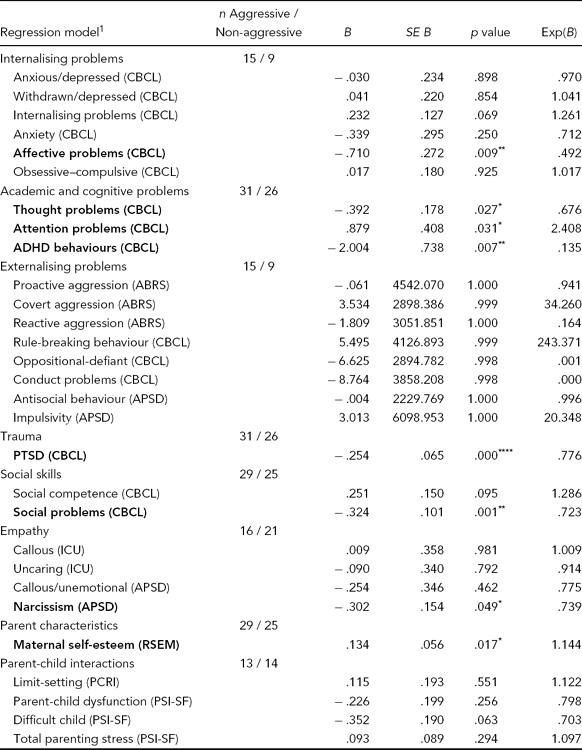
Step 3. The variables that indicated significant differences between the aggressive and non-aggressive group in Step 2 were entered as predictors in a series of eight binary logistic regression models, one for each of the eight families of predictors. The logistic regression model was chosen over the discriminant function model as its assumptions are less restrictive (Tabachnick & Fidell, Reference Tabachnick and Fidell2001). These analyses were undertaken in order to identify the variable(s) within each family that best predicted the probability of belonging to the aggressive group. The results of the eight binary logistic regressions are summarised in Table 3. Eight variables from six of the eight variable families were identified as significant predictors of the probability of belonging to the aggressive group.
Logistic Regression Models of Families of Predictors
Note: *p < .05; **p < .01; ***p < .001; ****p < .0001; 1Due to different group-sizes, not all regressions are equally powerful. Bold type indicates the variables that reach significance.
Discussion
The first aim of this pilot study was to use parent and child reports to explore a diverse range of underlying developmental and clinical variables identified in the literature as predictors of aggressive child behaviour, among a sample of clinically aggressive and non-aggressive Australian children. Noting that children with aggression are characterised by their externalising behaviours (Frick, Bodin, & Barry, Reference Frick, Bodin and Barry2000; Frick et al., Reference Frick, Cornell, Bodin, Dane, Barry and Loney2003), in the present study, the aggressive group reportedly exhibited significantly higher levels of proactive aggression, covert aggression, reactive aggression, rule-breaking behaviour, oppositional-defiant behaviour, conduct problems, antisocial behaviour, and impulsivity than the non-aggressive group. The significantly higher levels of proactive and covert aggression reported for the aggressive group suggested that the type of aggressive behaviour exhibited by these children was more likely to be related to a lack of empathy. Concordantly, the aggressive group scored significantly higher than the non-aggressive group on measures of callous, uncaring, unemotional, and narcissistic behaviours. Among variables measuring empathy, level of narcissism emerged as the most robust predictor of aggressive group membership. In contrast to aggression that is more reactive and impulsive in nature, this type of proactive aggression has been found to identify children who possess greater overall symptomatology, and who are most likely to continue to exhibit high levels of aggression, unless intensive and focused treatment can be provided (Christian, Frick, Hill, Tyler, & Frazer, Reference Christian, Frick, Hill, Tyler and Frazer1997; Crick & Dodge, Reference Crick and Dodge1996; Dadds et al., Reference Dadds, Fraser, Frost and Hawes2005; Essau, Sasagawa, & Frick, Reference Essau, Sasagawa and Frick2006; Frick et al., Reference Frick, Bodin and Barry2000, Reference Frick, Cornell, Bodin, Dane, Barry and Loney2003).
Relative to the non-aggressive children, children with clinical levels of aggression were more likely to have a number of comorbid emotional, social, and mental health issues in addition to externalising problems. Children in the aggressive group were significantly more likely to be reported as exhibiting symptoms of internalising and affective problems, as well as clinical levels of anxious, depressed, withdrawn, and obsessive–compulsive behaviours. Among variables measuring internalising problems, level of affective problems emerged as the most robust predictor of aggressive group membership. Recent research is increasingly finding that aggression and antisocial behaviour in adolescence is strongly associated with depression and/or anxiety, which can lead to increased severity of the aggression and poorer long-term outcomes. This comorbidity has been purported by some researchers to point to an overall problem with emotion regulation (Lewis et al., Reference Lewis, Granic, Lamm, Zelazo, Stieben, Todd and Pepler2008). In light of these findings, it is concerning that within the aggressive child population, internalising symptoms are often ignored, with externalising behaviours such as oppositionality, conduct problems, and rule-breaking often receiving the most time and attention in both the home and school (Rowe, Rijsdijk, Maughan, Hosang, & Eley, Reference Rowe, Rijsdijk, Maughan, Hosang and Eley2008).
Children in the aggressive group were significantly more likely to have social problems and difficulties with social competence. Among variables measuring social skills, social problems emerged as the most robust predictor of aggressive group membership. Among variables measuring academic and cognitive problems, children in the aggressive group were significantly more likely to exhibit thought problems, attention problems, and symptoms of ADHD, than were children in the non-aggressive group.
Children in the aggressive group in the current study were reported to exhibit a significantly higher level of post-traumatic stress disorder (PTSD) symptoms than the children in the non-aggressive group. This finding was consistent with previous research, which has found that children who exhibit aggressive outbursts have often been exposed to traumatic events in childhood, leading to chronic over-arousal of the autonomic nervous system (American Psychiatric Association, 2000). Research on the effects of trauma, particularly in the early years, and developmental trauma theory, would suggest that effects of early trauma may be contributing to the symptoms of aggression as well as those of anxiety, depression, and PTSD found for the aggressive group (Perry, Reference Perry, Beauchaine and Henshaw2008; van der Kolk, Reference van der Kolk, van der Kolk, McFarlane and Weissaeth1998).
Together, the above findings fit with previous studies reporting that aggression is commonly associated with factors characteristic of ADHD, particularly hyperactivity and impulsivity, anxiety, and depression (Hinshaw, Reference Hinshaw2002; Rowe et al., Reference Rowe, Rijsdijk, Maughan, Hosang and Eley2008). Comorbidity with ADHD is prevalent and predicts poorer outcomes, with the young person more likely to become antisocial (Lahey & Waldman, Reference Lahey, Waldman, Lahey, Moffitt and Caspi2003).
Among variables measuring parent characteristics and parent–child interactions, the mothers of children in the aggressive group were significantly more likely to report lower maternal self-esteem, and higher levels of parent–child dysfunction, child difficulties, total parenting stress, and difficulties setting limits with their child. These familial issues are likely to have adverse, bidirectional effects on parenting that will, in turn, impact on child behaviour (Fearon, Bakersmans-Kranenburg, van IJzendoorn, Lapsley, & Roisman, Reference Fearon, Bakersmans-Kranenburg, van IJzendoorn, Lapsley and Roisman2010).
In line with the extensive body of research demonstrating that the number and type of risk factors to which children are exposed contributes to the development of various disorders and difficulties (Rutter, Reference Rutter2009; Sameroff & Fiese, Reference Sameroff, Fiese, Meisels and Shonkoff2000), the aggressive children in the Family Pathways sample had encountered an average of seven familial risk factors that were likely to be contributing to their complex presentations and multiple diagnoses. At least half were rated as having experienced anxious/disorganised/reactive attachment, difficult temperament, developmental delay/learning disability, loss and separation, maternal depression or suicidal thoughts, punitive parenting/harsh criticism, and familial poverty/reliance on welfare, respectively. Together, these risk factors are likely to have affected early neurological development and contributed to the various child symptoms reported, including aggression (Perry, Reference Perry, Beauchaine and Henshaw2008). The results are also compatible with theories of transactional and developmental psychopathology, which have found that encountering four or more risk factors is related to the development of psychopathology (Rutter, Reference Rutter2009; Sameroff & Fiese, Reference Sameroff, Fiese, Meisels and Shonkoff2000).
The second aim of the present research was to use the findings of this exploration to make recommendations for treatments targeting aggressive children and their families that might be employed in an Australian school or community context. In Australia, much of the current practice of treating aggressive children in the home and school focuses on ‘behaviour management’ strategies (Scott & Dadds, Reference Scott and Dadds2009). Therefore, the findings of the current study may have important implications for including additional components to this style of treatment. Based on the results, the following five principles of treatment are recommended.
Principles of Treatment
1. Approaches to treatment. Given the complexity of the presentation of aggressive children and their families, it is critical that an in-depth assessment with a multi-disciplinary team is provided to determine the nature of the child's functioning, and what may be contributing to the child's aggression and other emotional and behavioural issues. Because it is clear that there are likely a number of factors contributing to the child's aggression, approaches to treatment need to be multimodal, multidisciplinary, and individualised as much as possible. This is especially so given the findings of the current study, which has highlighted the internalising problems, including anxiety, depression and trauma symptoms experienced by children with aggression.
2. Providing assessment results and discussing implications for the child's functioning. In the developmental history interviews, a majority of parents related that they had perceived their child as difficult from very early on, and often ascribed negative attributions to their children, seeing them as intentionally bad. In order to help parents begin to become more understanding of their child's difficulties, it is important to address unhelpful attributions. One method of shifting unhelpful attributions involves sharing the results of a multidisciplinary assessment. After parents learn that their child may be struggling with problems related to cognition, receptive and expressive language, gross and fine motor functioning, and/or sensory integration, they may begin to gain some insight into the pervasive challenges their child is attempting to cope with. Parents may subsequently be more willing to adjust their parenting strategies accordingly, and be more empathic towards their child.
3. Increasing the responsiveness and sensitivity of parent's interactions with their children. Supporting parents is crucial. By the time their children were referred for aggression and severe behaviour problems, parents reported difficulties with limit-setting and communicating with their child, high distress, and low levels of satisfaction in the parenting role. These factors appear to contribute to parent–child interactions that may serve to increase the child's aversive behaviour. It is therefore critical to try break these patterns, and increase both the child's and the parents’ capacity for positive engagement. There are a number of promising approaches toward this goal. In one- to three-year-old children, video-feedback can be used to reduce child externalising behaviour and daily cortisol production (Juffer, Bakermans-Kranenburg, & Van IJzendoorn, Reference Juffer, Bakermans-Kranenburg and van IJzendoorn2008) and to improve parent-child relationships (Priddis & Kane, Reference Priddis and Kane2013). Video-feedback can also be helpful with older children, as a way to encourage parents to think about what their child is thinking and feeling, and to talk about how they felt during the interaction with their child. This can increase the parent's self-reflectivity, and subsequently, sensitivity toward their child (Juffer et al., Reference Juffer, Bakermans-Kranenburg and van IJzendoorn2008). Working in a direct and collaborative manner with parents, helping them with the parenting role, providing them with new approaches to parenting their child and strategies for containing their own emotions, will also serve to alleviate identified difficulties with self-esteem and stress.
4. Encouraging the development of empathy. Research has shown that by about 5 years of age, children have internalised a conscience or a sense of right and wrong, can follow rules, and show remorse and empathy (Belsky, Reference Belsky, Balter and Tamis-LeMonda1999). A number of theorists and researchers have proposed that the early parent–child relationship can encourage the development of conscience, and have described parental responsiveness, sensitivity to the child's needs, and reciprocity as the characteristics that are necessary for this to occur (Belsky, Reference Belsky, Balter and Tamis-LeMonda1999).
The results of this study suggest that clinically aggressive children have a type of aggression that is more proactive, callous, unemotional, and uncaring, suggesting impairment in the development of a conscience and empathy towards others. It is important, therefore, that parents are supported to provide interactions and strategies with their aggressive children that can help them with conscience development, perspective-taking, and empathy towards others.
Kochanska and colleagues have described a mutually responsive orientation (MRO) that supports the child's desire to be cooperative and to follow rules (Kochanska & Aksan, Reference Kochanska and Aksan2006). The use of induction has been shown to contribute to the development of a conscience (Kochanska, Reference Kochanska2002), and the use of mental state talk when communicating with children can be helpful in developing empathy (Baron-Cohen, Golan, Chakrabarti, & Belmonte, Reference Baron-Cohen, Golan, Chakrabarti, Belmonte, Sharp, Fonagy and Goodyer2008). Mental state-related discourse has been linked to secure attachment, and higher levels of child perspective-taking, prosocial behaviour, and social competence (Asen & Fonagy, Reference Asen, Fonagy, Bateman and Fonagy2012).
5. Improving emotion regulation. The aggressive children in this study were reported as having problems regulating negative emotions, and were more likely to have anxiety, depression, and trauma symptoms than non-aggressive children. Emotion socialisation processes within the family may contribute to these difficulties (Chaplin & Cole, Reference Chaplin, Cole, Hankin and Abela2005). Gottman, Katz, and Hooven (Reference Gottman, Katz and Hooven1997) have outlined an approach know as emotion coaching, in which parents are encouraged to notice small emotions in their child before the child either explodes if the emotion is anger or frustration, or withdraws if the emotion is fear, sadness, or depression. Parents are encouraged to set limits and discipline their child for aggressive behaviour, but also to foster problem-solving as a way to deal with the triggering situation and associated emotion. Over time, this approach can shift an immediate, limbic system emotional response to a more cognitive response that employs the frontal cortex. Parents are also encouraged to help their child express their feelings, and to provide their child with guidance as to healthier ways to express affect.
Conclusions, Limitations, and Future research
The results of this pilot study were in line with previous research and theories of aggression. While externalising behaviours were the most salient symptom of children in the aggressive group, it is important to emphasise that these children and their parents were also significantly different to the non-aggressive group on a number of additional variables that may not be currently considered in Australian school or community agency treatment programs. Both at home and at school, the approaches most typically used with children with aggression are likely to have behavioural management focus, which overlooks affective problems such as anxiety and depression, attention problems, poor social competence, lack of empathy, and the effects of trauma on emotion regulation and reactivity, potentially rendering the child's prognosis considerably more problematic. Addressing these gaps in current approaches to intervention represents an important goal for future research and treatment design, with the aim of helping affected children avoid a trajectory that includes escalating aggressive outbursts, and the beginning of antisocial behaviour during adolescence and beyond.
Importantly, the results of this exploratory study need be interpreted within the context of several design limitations. First, the study employed a relatively limited sample size, partly driven by restrictions on the number of clinical cases that can be admitted to the Family Pathways service due to the intensive nature of working with high-risk populations. Small samples raise issues pertaining to generalisability to the wider clinical population and community. Though the analyses undertaken were likely underpowered, anticipated patterns of between-group differences emerged. Additional variables may be found to significantly predict aggression group membership given a larger sample. Second, maternal-report constituted the major source of data. This may have improved reliability due to the mothers being the primary caregiver in each case; however, it restricted observations to a single environment (the family home), and potentially magnified the confounding effects of mothers’ perceptions of child behaviour, which are susceptible to the influence of her own subjective stress and mental health. This is particularly pertinent for the mothers of clinically aggressive children, who tended to report elevated stress levels and reduced self-esteem. Future research could reduce the impact of single-rater biases by collecting data from a number of sources, both inside and outside the home. Third, the research did not include paternal responses or variables, though some paternal risk factors were included in the family history and risk assessment. Finally, the statistical analyses undertaken in this study did not permit causal relationships to be inferred. Longitudinal research, particularly intervention studies, may be employed in future research to assess the presence of casual relationships between the critical variables highlighted in this study and pertinent outcomes.
Acknowledgments
This project was supported by a Curtin Linkage grant with contributions from Curtin University and Princess Margaret Hospital as partners.