INTRODUCTION
The genus Mallacoota is known predominantly from Australian waters with only a few additional species described from the Indo-Pacific Ocean and the unusually placed M. carasui Ortiz, 1976 from the Caribbean Sea (Hughes, Reference Hughes2011). This paper documents three additional new species of Mallacoota from the South Pacific locations of Papua New Guinea, New Caledonia, including the Loyalty Islands, and the Kermadec Islands.
Mallacoota mizegwaden sp. nov. represent the first record of the genus Mallacoota from Papua New Guinea. The new species M. lifou and M. xepenehe are only known from the New Caledonia Islands group. Specimens of Mallacoota nananui Myers, Reference Myers1985 are identified from New Caledonia, supporting previous records by Ledoyer (Reference Ledoyer1984).
Material identified from the Kermadec Islands is attributed to known species, previously recorded from various other Pacific locations. Mallacoota capricornia Lowry & Hughes, Reference Lowry, Hughes, Lowry and Myers2009 has been reported from New Caledonia, Fiji and the Great Barrier Reef, Australia. The distribution of M. chiltoni Kilgallen & Ahyong, Reference Kilgallen and Ahyong2011 is extended north from the Chatham Islands and mainland New Zealand to the Kermadec Islands. Specimens of M. chiltoni from the Kermadec Islands include a range of growth stages and development of the male gnathopod 2 is documented with size. Mallacoota sirius Hughes, Reference Hughes2011 originally described from Norfolk Island, Tasman Sea, is also reported from the Kermadec Islands. There are currently 19 known species of Mallacoota occurring in tropical to subtropical locations, compared with 14 species documented from temperate waters. Although established as a predominantly Indo-Pacific taxon, the distribution of Mallacoota species within this region remains largely under-sampled for both tropical, Coral Triangle, and temperate, New Zealand, waters.
MATERIALS AND METHODS
Material examined for this study included amphipod samples from New Caledonia (Organisation de Recherche Scientifique Territoire Outre-Mer), Kermadec Biodiscovery Expedition and Papua New Guinea material held at the Australian Museum, Sydney (AM) and Auckland War Memorial Museum (AIM), New Zealand. All samples were collected by hand on snorkel or SCUBA. Samples were fixed in 5% formalin and later transferred to 80% ethanol. Types are deposited with the Australian Museum, Sydney. Material was dissected in 80% ethanol. Permanent slides were made using Aquatex™ mounting agent. Scientific drawings were inked by hand, with illustrated plates constructed using Adobe Photoshop CS5 software. Descriptions were generated from a DELTA (DEscriptive Language for TAxonomy) database of the Maeridae containing world Mallacoota species. ZooBank registration for this publication is LSID urn:lsid:zoobank.org:pub:0BC7A43B-AA0C-48F1-A1BD-913073161150. New species names are registered with Zoobank: Mallacoota mizegwaden sp. nov. LSID urn:lsid:zoobank.org:act:E542F55B-2B18-4D2A-9771-A8A06532C839; Mallacoota lifou sp. nov. LSID urn:lsid:zoobank.org:act:079B453-6A42-4AFA-BEED- 4DD2E22253EC; and Mallacoota xepenehe sp. nov. LSID urn:lsid:zoobank.org:act:F856A324-3717-4589-A461- DeBB1BE85F11.
RESULTS
SYSTEMATICS
Order AMPHIPODA Latreille, Reference Latreille1816
Suborder GAMMARIDEA Latreille, Reference Latreille1802
Family MAERIDAE Krapp-Schickel, Reference Krapp-Schickel2008
Genus Mallacoota J.L. Barnard, Reference Barnard1972a
Mallacoota capricornia Lowry & Hughes, Reference Lowry, Hughes, Lowry and Myers2009
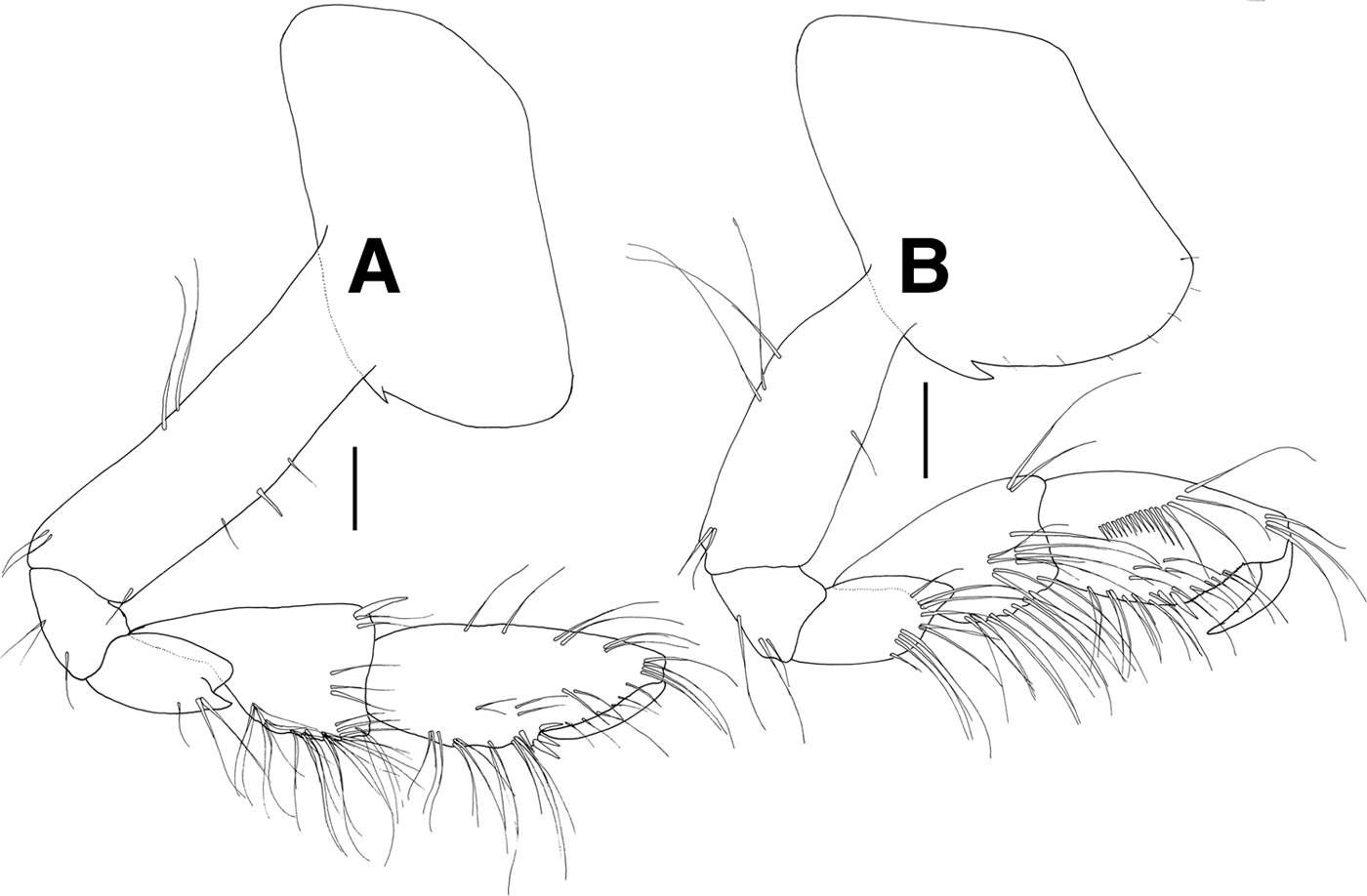
(Figure 1)
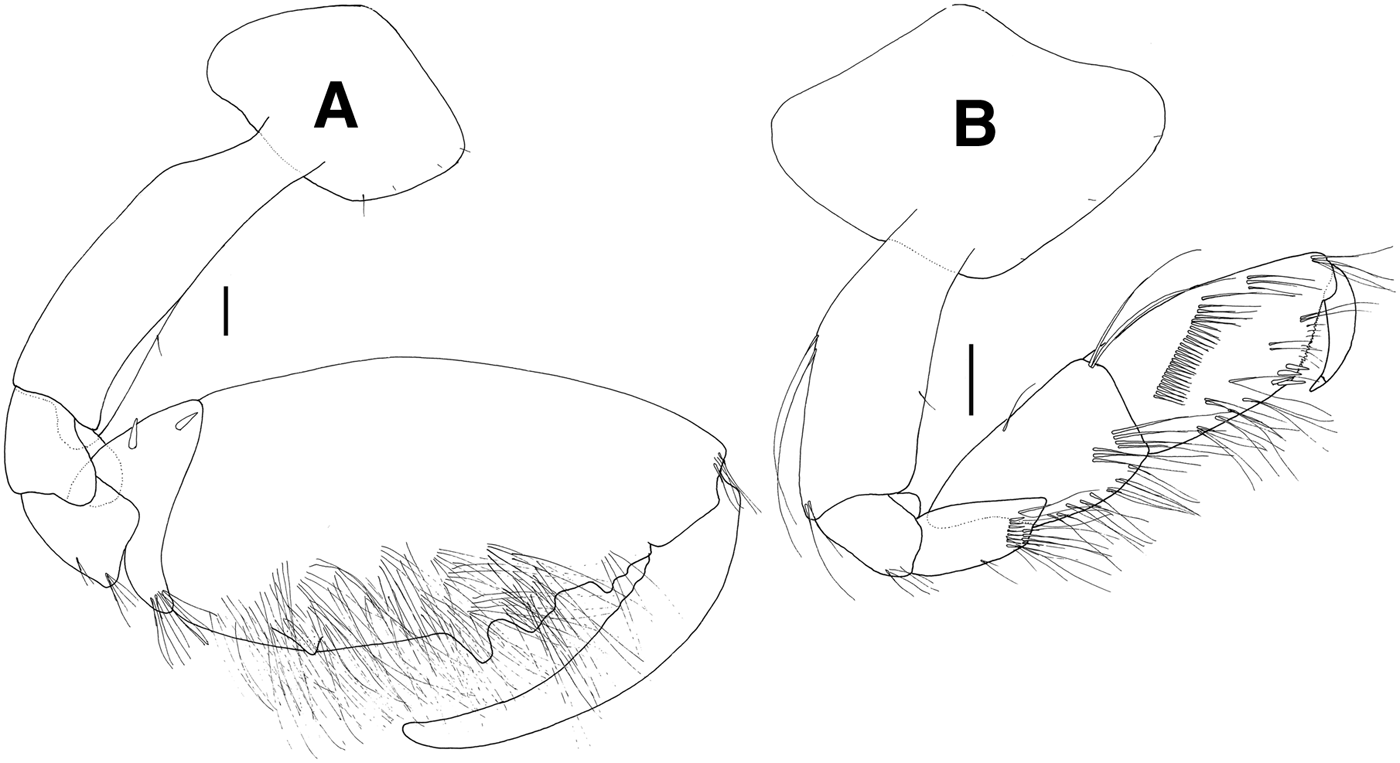
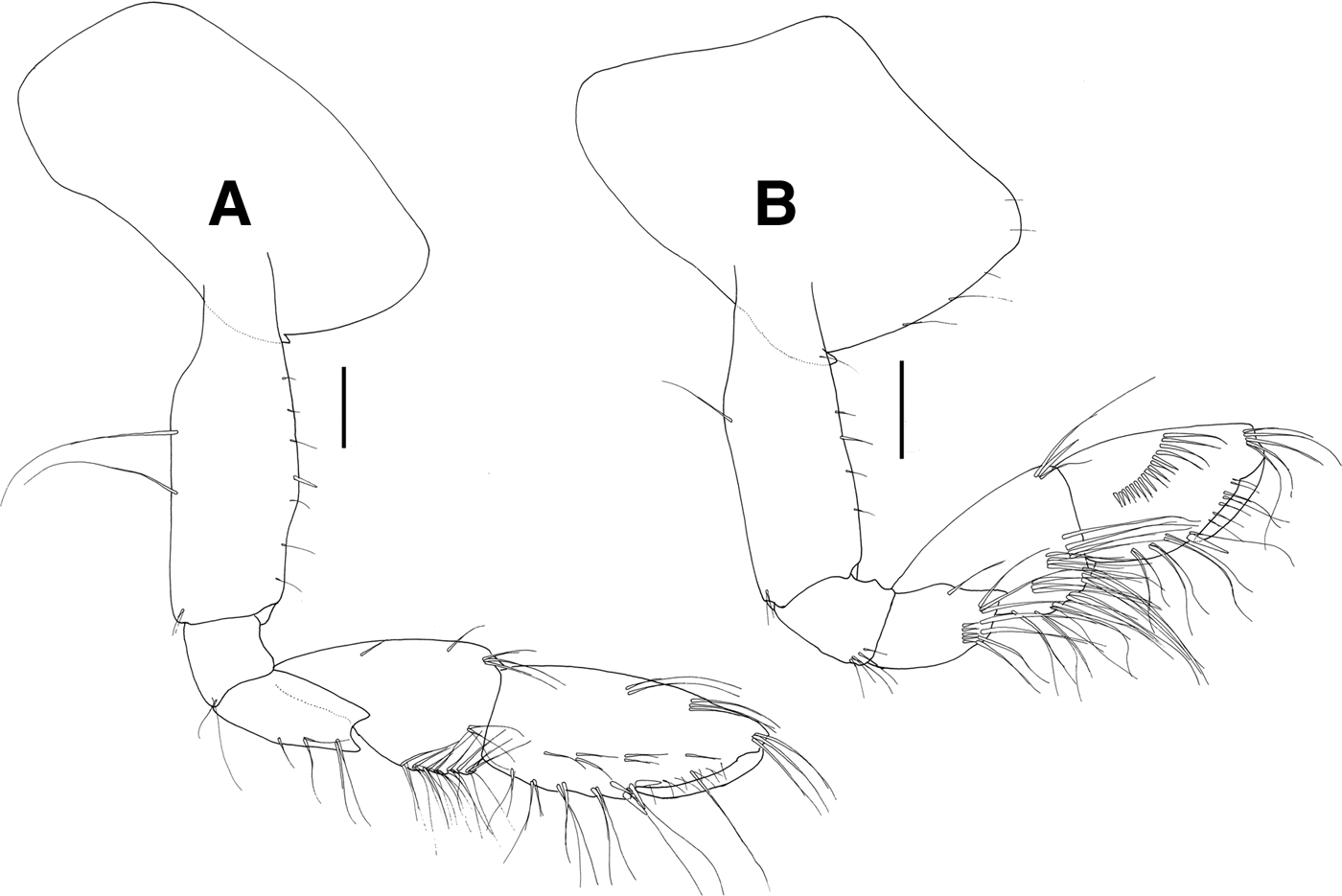
Mallacoota capricornia Hughes & Lowry, 2009, adult male, AM P.90073, 6.5 mm, Raoul Island, Kermadec Islands: (A) gnathopod 2; (B) gnathopod 1. Scales bars: A, B, 0.1 mm.

Mallacoota insignis Ledoyer, Reference Ledoyer1984: 552, figure 210 (in part); Myers, Reference Myers1985: 117, figures 93, 94.
Mallacoota capricornia Lowry & Hughes, Reference Lowry, Hughes, Lowry and Myers2009: 673, figures 17, 18; Hughes, Reference Hughes2011: 42.
TYPE LOCALITY
Picnic Beach, Palfrey Island, Lizard Island, Queensland, Australia (14°41.69′S 145°26.89′E).
MATERIAL EXAMINED
Kermadec Islands: 1 ♂ ‘a’, 6.5 mm, dissected, 4 slides, K2011-29-1, Boat Cove, Herald Islands Group, near Raoul Island, 29°16′40″S 177°53′43″W, 10 m, encrusted rubble, AM P.90073, coll. A. Balance, M. Francis and A. Reid, 15 May 2011; 1 hyperadult ♂, 8.6 mm, K2011-42-2, western side of North Chanter Island, Herald Islands Group, near Raoul Island, 29°15′06″S 177°51′21″W, 10 m, AM P.90074, coll. A. Ballance and S.J. Keable, 16 May 2011; 8 specimens (2 ♂, 3 ♀, 3 juveniles), K2011-54-4, Fishing Rock Landing, Herald Islands Group, near Raoul Island, 29°15′03″S 177°54′12″W, 1 m, under boulders, rockpools, AIM MA31148, coll. M. Francis, S.J. Keable, M.A. McGrouther, A. Reid, C. Struthers, T. Trnski, S. Ullrich and L.G. Wiren, 18 May 2011; 1 ♂, K2011-49-7, Fishing Rock Landing, Herald Islands Group, near Raoul Island, 29°15′03″S 177°54′12″W, 5 m, scrapings from rock wall, AM P.90075, coll. C. Bedord, S.J. Keable, A. Reid and V. Zintzen, 17 May 2011; 10 specimens (2 ♂, 6 ♀, 2 juveniles), K2011-23-4, Milne Rocks, Milne Islets, Herald Islands Group, near Raoul Island, 29°16′57″S 177°54′10″W, 21 m, rocks, cobble, coarse sand, tufting algae, AM P.90076, coll. C. Bedford, S.J. Keable, M.A. McGrouther, A. Reid, C. Struthers, T. Trnski, S. Ullrich, L.G. Wiren and V. Zintzen, 15 May 2011.
REMARKS
Mallacoota capricornia has been documented from nearby New Caledonia and Norfolk Island. These new records from the Kermadec Islands are the most easterly Pacific Ocean distribution records for the species.
DITRIBUTION
New Zealand: Kermadec Islands, Herald Islands Group, Raoul Island (current study). Tasman Sea: Norfolk Island (Hughes, Reference Hughes2011). New Caledonia (Ledoyer, Reference Ledoyer1984). Fiji: Viti Levu (Myers, Reference Myers1985). Australia: Lizard Island, One Tree Island, Queensland (Lowry & Hughes, Reference Lowry, Hughes, Lowry and Myers2009). Indian Ocean: Cocos (Keeling) Islands (Hughes, Reference Hughes2011).
Mallacoota chiltoni Kilgallen & Ahyong, Reference Kilgallen and Ahyong2011
(Figure 2)
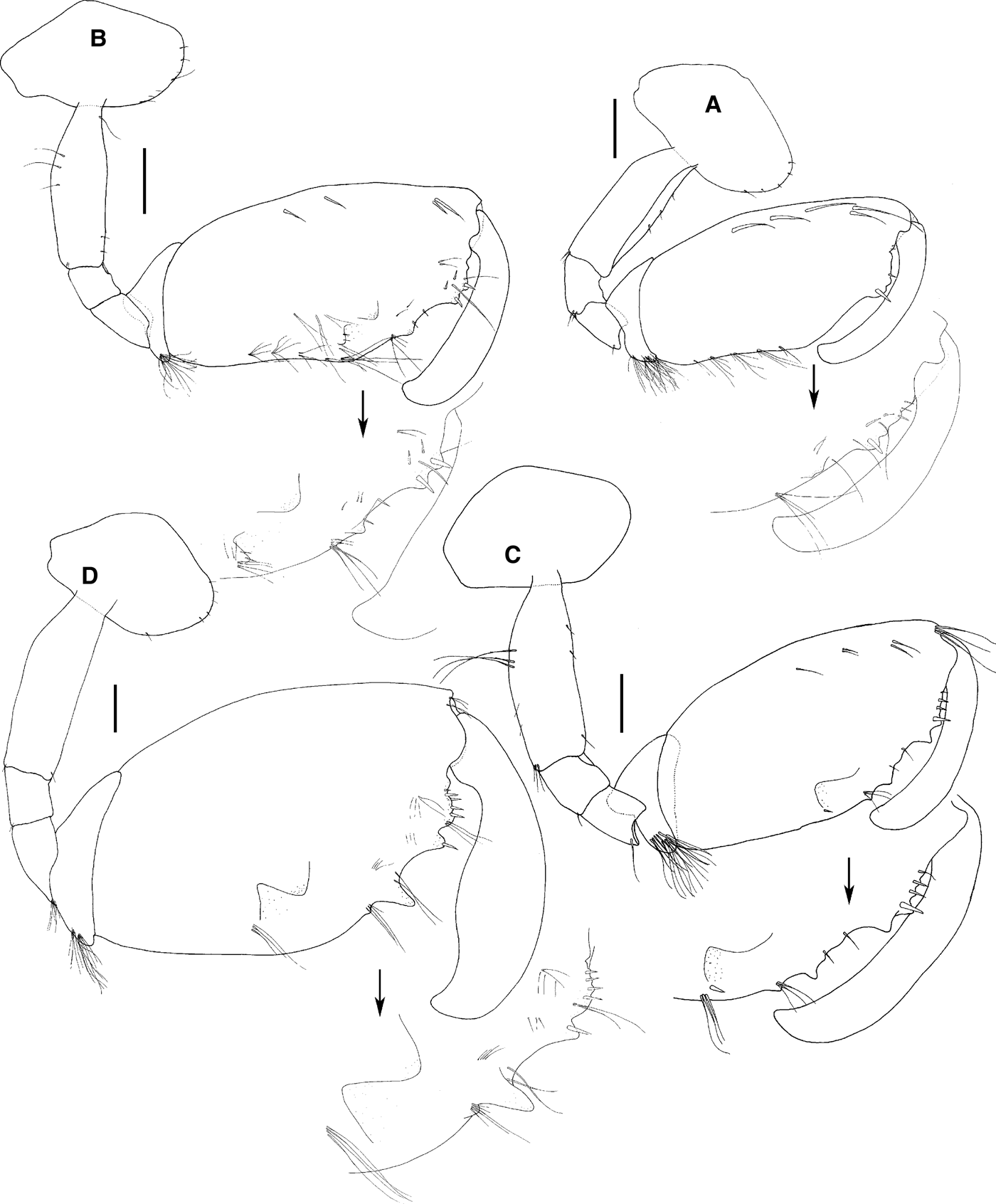
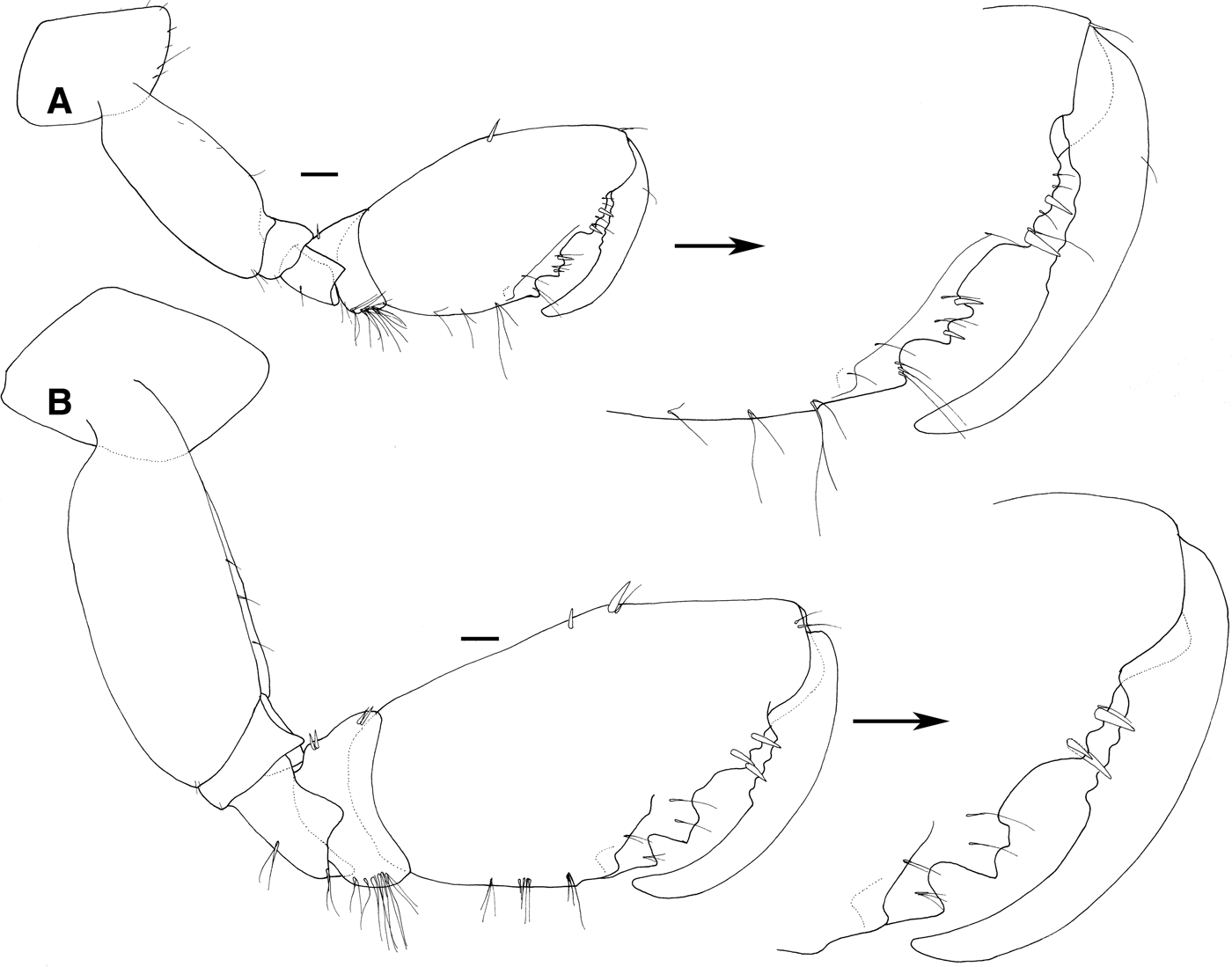
Mallacoota chiltoni Kilgallen & Ahyong, Reference Kilgallen and Ahyong2011 (A) juvenile male, gnathopod 2, AM P.90077, 5 mm; (B) adult male, gnathopod 2, AM P.90078, 5 mm; (C) adult male, gnathopod 2, AM P.90148, 4.1 mm; (D) hyper-adult male, gnathopod 2, AM P.90079, 6.2 mm, north-west corner of North Meyer Island, Kermadec Islands. Scale bars: A–D, 0.1 mm.

Moera petriei Chilton, Reference Chilton1883: 82, plate 2, figure 4 (Not M. petriei Thomson, Reference Thomson1882).
Moera subcarinata Chilton, Reference Chilton1884: 230; Reference Chilton1885: 369 (Lyttelton specimens).
Elasmopus subcarinatus Chilton Reference Chilton1915: 321, figures 5–6 (‘form 2’).
Maera subcarinata Hurley, Reference Hurley1954: 603 (list, in part).
Mallacoota subcarinata Barnard, Reference Barnard1972b: 114, figures 59, 60.
Mallacoota nananui Webber et al., Reference Webber, Fenwick, Bradford-Grieve, Eagar, Buckeridge, Poore, Dawson, Watling, Jones, Wells, Bruce, Ahyong, Larsen, Chapman, Olesen, Ho, Green, Shiel, Rocha, Lörz, Bird, Charleston and Gordon2010: 220 (not M. nananui Myers, Reference Myers1985).
Mallacoota chiltoni Kilgallen & Ahyong, Reference Kilgallen and Ahyong2011: 23, figures 1–3.
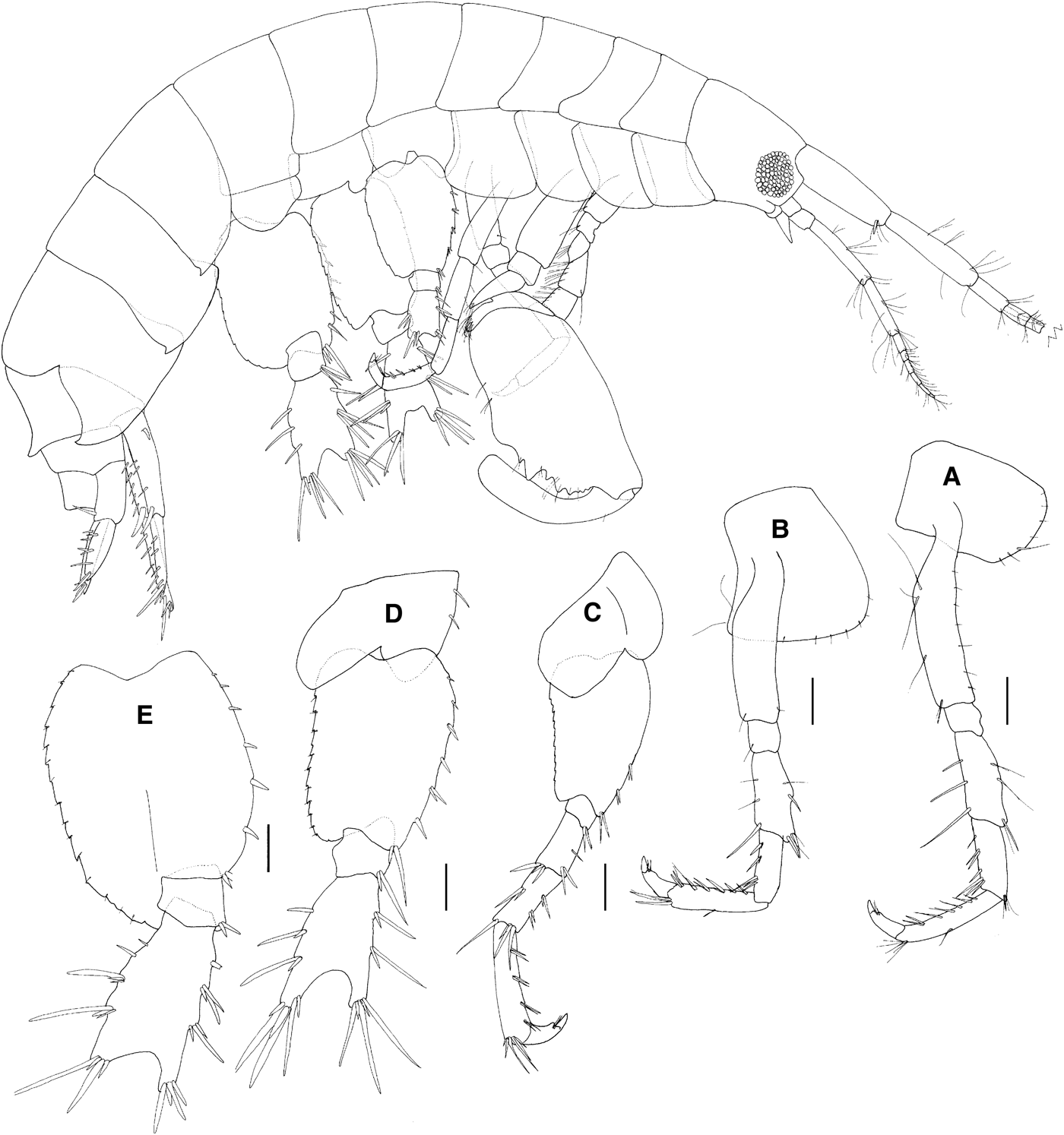
Mallacoota lifou sp. nov., holotype male, AM P.90102, 5.9 mm, Pointe de Easo, Sandal Bay, Lifou Island, Loyalty Islands, New Caledonia: (A) pereopod 3; (B) pereopod 4; (C) pereopod 5; (D) pereopod 6; (E) pereopod 7. Scale bars: A–E, 0.1 mm.

TYPE LOCALITY
Port Waitangi Wharf, Chatham Islands, New Zealand (43°56.736′S 176°33.570′E).
MATERIAL EXAMINED
Kermadec Islands: 1 ♂, 6.2 mm, dissected, 1 slide, K2011-56-9, north-west corner of North Meyer Island, 29°14′25″S 177°52′40″W, 15 m, rock walls with narrow 1–2 m wide canyon, AM P.90077, coll. S.J. Keable and A. Reid, 19 May 2011; 1 ♂, 5.0 mm, dissected, 1 slide, K2011-56-9, north-west corner of North Meyer Island, 29°14′25″S 177°52′40″W, 15 m, in rock walls with narrow 1–2 m wide canyon, AM P.90078, coll. S.J. Keable and A. Reid, 19 May 2011; 1 ♂, 5.0 mm, dissected, 1 slide, K2011-56-9, north-west corner of North Meyer Island, 29°14′25″S 177°52′40″W, 15 m, rock walls with narrow 1–2 m wide canyon, AM P.90079, coll. S.J. Keable and A. Reid, 19 May 2011; 39 specimens (13 ♂, 9 ♀, 17 juveniles), K2011-56-9, north-west corner of North Meyer Island, 29°14′25″S 177°52′40″W, 15 m, rock walls with narrow 1–2 m wide canyon, AIM MA31149, coll. S.J. Keable and A. Reid, 19 May 2011; 29 specimens (6 ♂, 8 ♀, 15 juveniles), K2011-29-1, Boat Cove, Herald Islands Group, near Raoul Island, 29°16′40″S 177°53′43″W, 10 m, encrusted rubble, AM P.90080, coll. A. Balance, M. Francis and A. Reid, 15 May 2011; 1 ♂, 4.1 mm, dissected, 3 slides, K2011-10-5, north-west corner of North Meyer Island, Herald Islands Group, near Raoul Island, 29°14′30″S 177°52′40″W, 13 m, clumping red algae, AM P.90148, coll. M. Francis, S.J. Keable, M.A. McGrouther, A. Reid, T. Trnski, S. Ullrich, and L.G. Wiren, 13 May 2011; 14 specimens (3 ♂, 2 ♀, 9 juveniles), K2011-10-5, north-west corner of North Meyer Island, Herald Islands Group, near Raoul Island, 29°14′30″S 177°52′40″W, 13 m, clumping red algae, AM P.90081, coll. M. Francis, S.J. Keable, M.A. McGrouther, A. Reid, T. Trnski, S. Ullrich, and L.G. Wiren, 13 May 2011; 12 specimens (3 ♂, 2 ♀, 7 juveniles), K2011-3-2, western side of South Meyer Island, Herald Islands Group, near Raoul Island, 29°14′47″S 177°52′53″W, 10–12 m, rubble, AM P.90082, coll. A. Ballance, C.A.J. Duffy, M. Francis, S.J. Keable, M.A. McGrouther, A. Reid, T. Trnski, S. Ullrich and L.G. Wiren, 12 May 2011; 8 specimens (1 ♂, 2 ♀, 5 juveniles), K2011-2-1, western side of South Meyer Island, Herald Islands Group, near Raoul Island, 29°14′48″S 177°52′54″W, 20–22.4 m, algae, AM P.90083, coll. A. Ballance, C.A.J. Duffy, M. Francis, S.J. Keable, M.A. McGrouther, A. Reid, T. Trnski, S. Ullrich and L.G. Wiren, 12 May 2011; 8 specimens (1 ♂, 3 ♀, 4 juveniles), K2011-42-1, western side of North Chanter Island, Herald Islands Group, near Raoul Island, 29°15′06″S 177°51′21″W, 10 m, rubble, AM P.90084, coll. A. Ballance and S.J. Keable, 16 May 2011; 7 specimens (3 ♂, 2 ♀, 2 juveniles), K2011-23-4, Milne Islet, Milne Rocks, Herald Islands Group, near Raoul Island, 29°16′57″S 177°54′10″W, 21 m, rocks, cobble and coarse sand at base, tufting algae, AM P.90085, coll. C. Bedford, S.J. Keable, M.A. McGrouther, A. Reid, C. Struthers, T. Trnski, S. Ullrich, L.G. Wiren and V. Zintzen, 15 May 2011; 3 specimens (1 ♂, 2 ♀), K2011-99-3, western side of L'Esperance Island, 31°21′15″S 178°49′36″W, 12–20 m, rock wall, shelly sediment, sponges and coral scrapings, AM P.90086, coll. S.J. Keable and A. Reid, 26 May 2011; 1 ♂ specimen, K2011-23-3, Milne Rocks, Milne Islet, Herald Islands Group, near Raoul Island, 29°16′57″S 177°54′10″W, 21 m, among encrusted algae, AM P.90087, coll. C. Bedford, S.J. Keable, M.A. McGrouther, A. Reid, C. Struthers, T. Trnski, S. Ullrich, L.G. Wiren and V. Zintzen, 15 May 2011; 5 specimens (1 ♂, 1 ♀, 3 juveniles), K2011-70-3, Macauley Island, 30°13′40″S 178°26′20″W, 21.2 m, rock with Porifera, AM P.90088, coll. S.J. Keable and A. Reid, 21 May 2011; 1 specimen (juvenile), K2011-28-1, Boat Cove, Herald Islands Group, near Raoul Island, 29°16′40″S 177°53′43″W, 10 m, airlift of boulder, AM P.90089, coll. S.J. Keable, 15 May 2011; 1 specimen (juvenile), K2011-11-2, north-west side of North Meyer Island, Herald Islands Group, near Raoul Island, 29°14′40″S 177°52′41″W, 1.4 m, rockpools, AM P.90090, coll. M.A. McGrouther, T. Trnski, S. Ullrich and L.G. Wiren, 13 May 2011.
REMARKS
The Kermadec Islands collection includes a large range of male individuals at various growth stages. In juvenile males, ~5.0 mm, the gnathopod 2 propodus palm has weak sculpting, with the palmar teeth and subpalmar medial protrusion weakly developed. The dactylar socket at the end of the palm is not present in juvenile individuals. The gnathopod 2 dactylus medial bulge develops in males between 4.2 and 5.0 mm. The hyperadult males, ~6.2–6.8 mm, have more pronounced palmar teeth, well defined dactylar socket and a dactylus posterior margin with a medial bulge and apical hook. The development of the male gnathopod 2 dactylus transitioning from recurved to falcate in large hyperadult male specimens is known for several Mallacoota species (Hughes, Reference Hughes2011). Mallacoota chiltoni is the first record of a dactylus with a bulge and apical hook morphological development for hyperadult males.
Material of M. chiltoni from the Kermadec Islands is much smaller in size ~6.2–6.8 mm which include hyperadult specimens, than males figured from more southerly New Zealand locations at 8.0–15.0 mm (Kilgallen & Ahyong, Reference Kilgallen and Ahyong2011), which are not documented as including hyperadult males (where a hyperadult male is defined by the distinctive gnathopod 2 dactylus with medial bulge and apical hook, see Figure 3D). The consistency of important species level characters, including antennae 1 peduncle article 1 with 3 robust setae, on pereopods 5 to 7 basis margin straight and telson with 4 apical robust setae, supports the placement of the Kermadec Island material as M. chiltoni.
DISTRIBUTION
New Zealand: Kermadec Islands, North Meyer Island, South Meyer Island, North Chanter Island, Raoul Island, Macauley Island (current study); Chatham Islands (Kilgallen & Ahyong, Reference Kilgallen and Ahyong2011); South Island, Bluff, Kaikoura, Golden Bay, Dunedin and Stewart Island (Kilgallen & Ahyong, Reference Kilgallen and Ahyong2011).
Mallacoota lifou new species
(Figures 3–5)
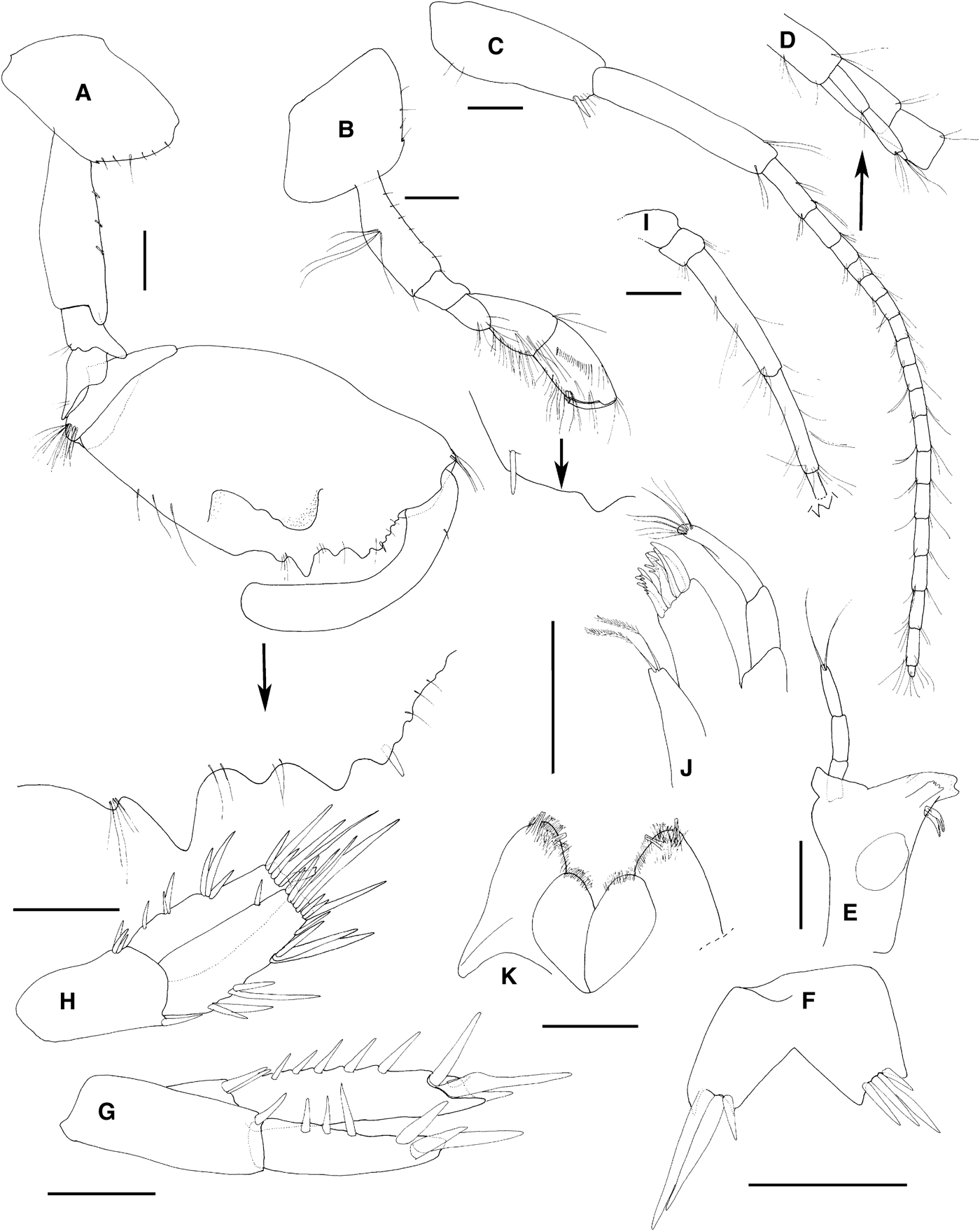
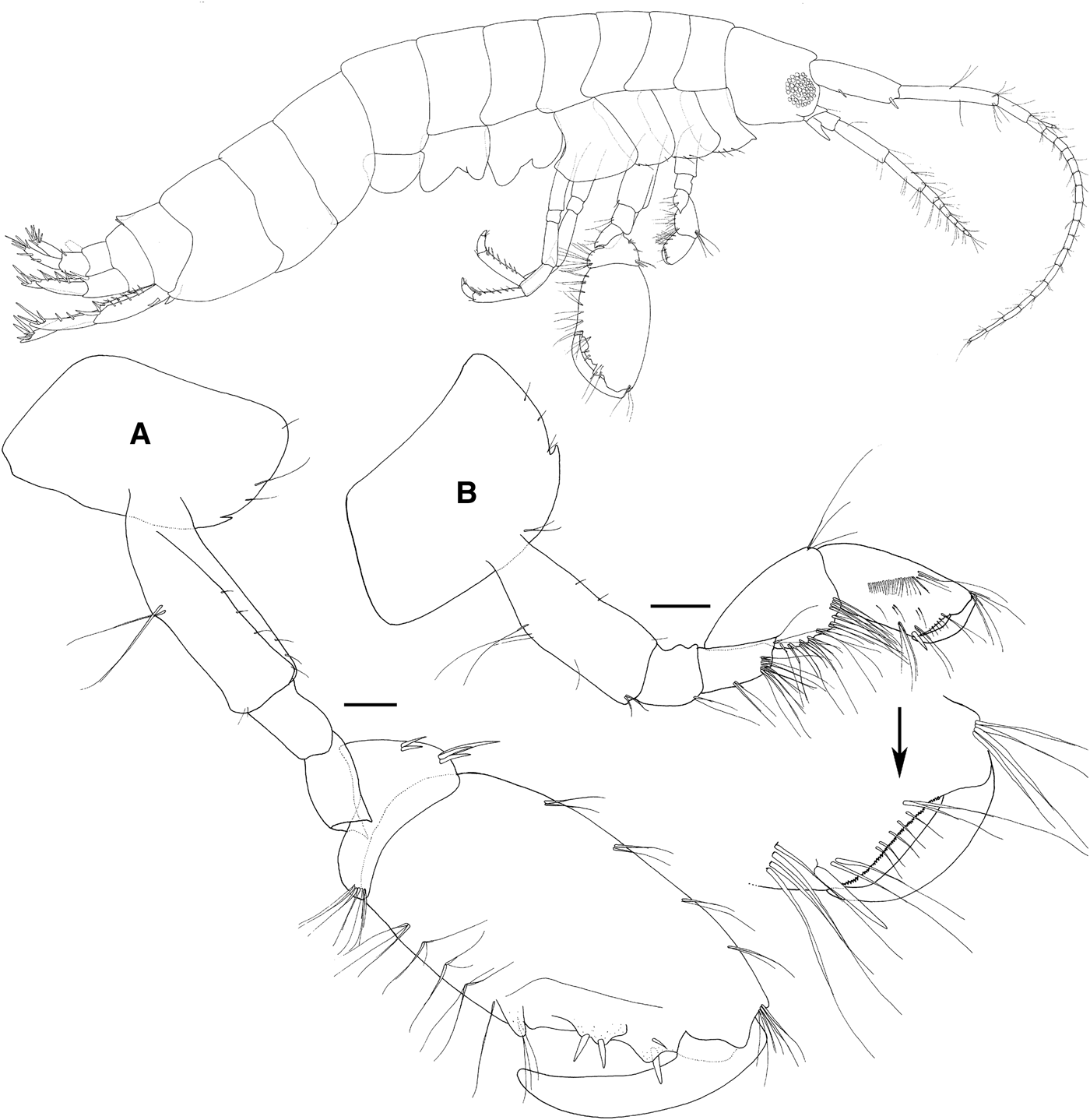
Mallacoota lifou sp. nov., holotype male, AM P.90102, 5.9 mm, Pointe de Easo, Sandal Bay, Lifou Island, Loyalty Islands, New Caledonia: (A) gnathopod 2; (B) gnathopod 1; (C) antenna 1; (D) accessory flagellum of antenna 1; (E) mandible; (F) telson; (G) uropod 2; (H) uropod 3; (I) antenna 2; (J) maxilla 1; (K) lower lip. Scale bars: A–K, 0.1 mm.

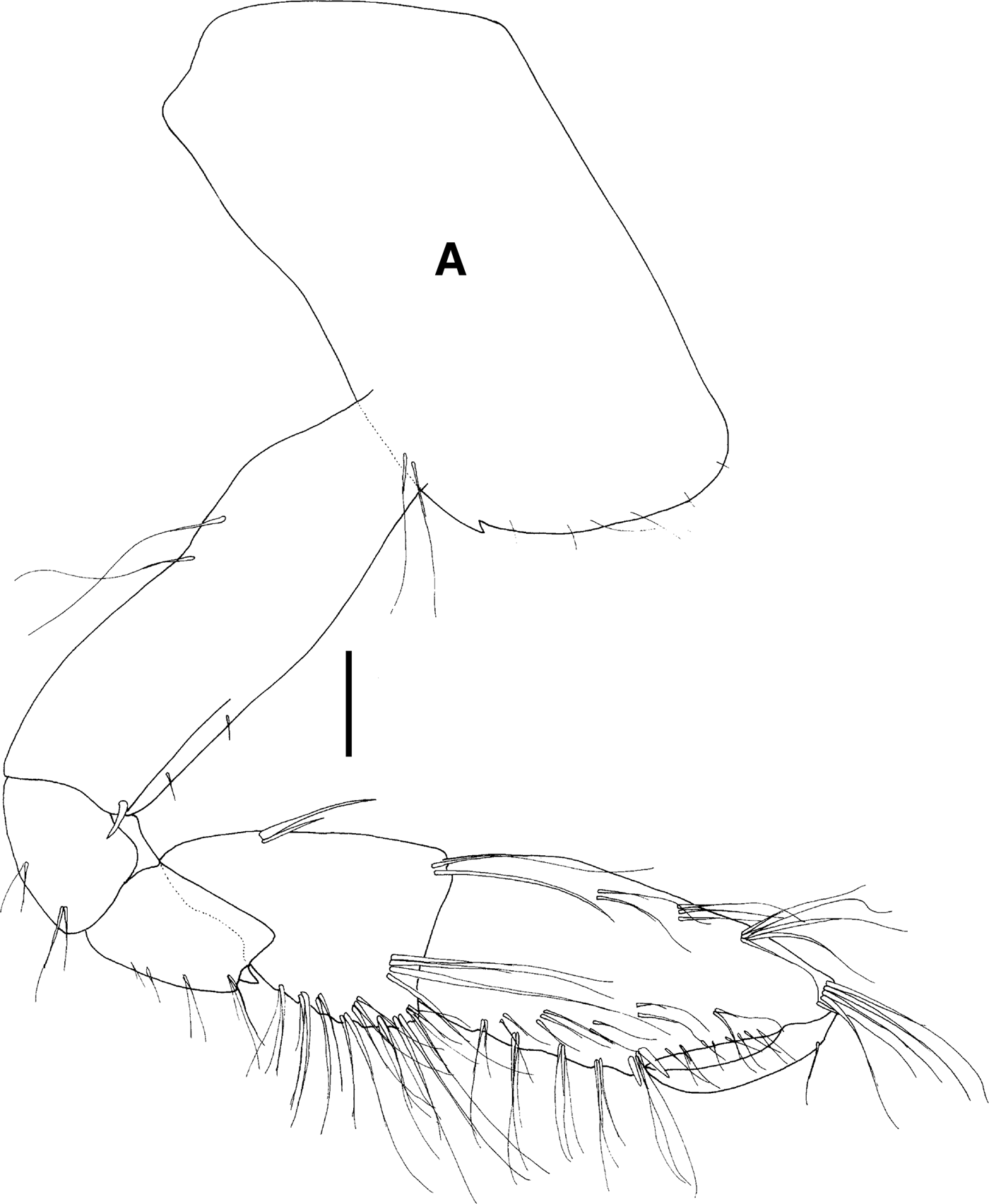
Mallacoota lifou sp. nov., paratype female, AM P.90103, 4.4 mm, Pointe de Easo, Sandal Bay, Lifou Island, Loyalty Islands, New Caledonia: (A) gnathopod 2; (B) gnathopod 1. Scale bars: A, B, 0.1 mm.

Mallacoota sp. Kilgallen & Ahyong, Reference Kilgallen and Ahyong2011: 28, figure 4B.
TYPE MATERIAL
Holotype: 1 ♂, 5.9 mm, dissected, 4 slides, NCL-229, Pointe de Easo (=Easho), Sandal Bay, Lifou Island, Loyalty Islands, New Caledonia, 20°47′27″S 167°07′34″E, 10 m, green alga, white sandy bottom near coral reef, AM P.90102, coll. I. Takeuchi, 27 November 1995.
Paratype: 1 ♀, 4.4 mm, dissected, 1 slide, NCL-229, Pointe de Easo (=Easho), Sandal Bay, Lifou Island, Loyalty Islands, New Caledonia, 20°47′27″S 167°07′34″E, 10 m, white sandy bottom near coral reef, green alga (meshed type), AM P.90103, coll. I. Takeuchi, 27 November 1995; 12 specimens (6 ♂, 2 ♀, 4 juveniles), NCL-229, Pointe de Easo (=Easho), Sandal bay, Lifou Island, Loyalty Islands, New Caledonia, 20°47′27″S 167°07′34″E, 10 m, green alga, white sandy bottom near coral reef, AM P.48000, coll. I. Takeuchi, 27 November 1995.
TYPE LOCALITY
Pointe de Easo (=Easho), Sandal Bay, Lifou Island, Loyalty Islands, New Caledonia (20°47′27″S 167°07′34″E).
ETYMOLOGY
Named from the type locality, as a noun in apposition.
DIAGNOSIS
Antennae 1 peduncular article 1 posterior margin with 1 distal robust seta. Gnathopod 2 basis anterior margin with line of 3 robust setae; propodus palm with 3 subacute teeth, subpalmar surface with medial protrusion and seam, palm defined by posteroventral excavation, post-palmar posterior margin straight; dactylus apically truncated, hammer-like, closing into dactylar socket. Pereopods 5–6 basis posterior margin straight. Pereopod 7 basis posterior margin convex.
DESCRIPTION
Based on holotype male, 5.9 mm, AM P.90102.
Head: lateral cephalic lobe broadly truncate, anteroventral corner with notch slit. Antenna 1 longer than antenna 2; peduncular article 1 subequal to article 2, posterior margin with 1 distal robust seta; article 2 longer than article 3; primary flagellum articles longer than broad with 16 articles; accessory flagellum minute, 2-articulate. Antenna 2 peduncular article 2 cone gland reaching to end of peduncular article 3. Mandible accessory setal row with 2 setae (right with 3 setae); molar well-developed, triturative; palp 3-articulate; article 1 twice as long as broad, subequal to article 2; article 2 subequal to article 3; article 3 rectolinear, 3.2 times as long as broad, subequal to article 1, with 2 apical setae. Lower lip outer lobes with two pairs of ducts, mandibular lobes apically subacute. Maxilla 1 inner plate subrectangular with 2 apical plumose setae; outer plate with 7 setae, palp 2-articulate, article 2 with apical slender setae.
Pereon: gnathopod 1 coxa anterior margin straight, anteroventral corner slightly produced, rounded, posteroventral corner with notch; merus without posterodistal tooth; carpus twice as long as broad, subequal in length to propodus; propodus with medial surface setal comb, palm subacute, straight, posterodistal corner with 1 robust seta. Gnathopod 2 subchelate; coxa posteroventral corner with notch; basis slender, anterior margin with line of 3 robust setae, anterodistal corner with lobe; ischium anterodistal corner with produced lobe; carpus compressed, lobate, projecting between merus and propodus; propodus subovate, palm subacute, sculptured, half the length of propodus posterior margin, distomedial shelf with 1 robust seta, palm with 3 subacute teeth, subpalmar surface with medial protrusion and seam, palm defined by posteroventral excavation, post palmar posterior margin straight; dactylus apically truncated, hammer-like, reaching end of palm, closing into dactylar socket. Pereopod 4 coxa posteroventral lobe weakly developed, subquadrate. Pereopods 5–7 basis posterior margins weakly crenulate; merus and carpus not broadened. Pereopod 5 basis proximally expanded, tapering distally, posterior margin straight, posteroventral corner narrowly rounded. Pereopod 6 basis posterior margin straight, posteroventral corner narrowly rounded. Pereopod 7 basis posterior margin convex, posteroventral corner broadly rounded.
Pleon: epimera 1–3 posteroventral corner with small acute tooth. Urosomite 1 bicarinate; carina subtriangular. Uropod 1 peduncle with basofacial robust seta; rami shorter than peduncle length; inner ramus longer than outer ramus. Uropod 2 inner ramus longer than peduncle, longer than outer ramus. Uropod 3 rami distally truncate; inner ramus length 2.5 times breadth, longer than peduncle, subequal in length to outer ramus. Telson broader than long, deeply cleft (greater than 66%), lobes divergent with 2 long and 1 short apical robust setae (left lobe 4 short robust setae, regenerating).
Female (sexually dimorphic characters) based on 4.4 mm, AM P.90103.
Pereon: gnathopod 2 basis anterodistal corner subquadrate; ischium anterodistal corner without lobe; carpus subtriangular, enclosed by merus and propodus; propodus linear, 1.2 times carpus length, palm subacute, straight, without distomedial shelf, defined by corner with 4 robust setae; dactylus apically subacute, tapering evenly.
REMARKS
Mallacoota lifou sp. nov. along with M. chiltoni Kilgallen & Ahyong, Reference Kilgallen and Ahyong2011 (Chatham Islands, New Zealand); M. latidactylus Ledoyer, Reference Ledoyer1982 (Madagascar); M. nananui Myers, Reference Myers1985 (Fiji) and M. worimi Hughes, Reference Hughes2011 (Boondelbah Island, New South Wales) exhibit the male gnathopod 2 blunt, hammer-like dactylus. Of these species, Mallacoota lifou sp. nov. is most similar to M. chiltoni in the male gnathopod 2 propodus palm distal shelf and single large palmar tooth but can be readily distinguished by the excavation defining the end of the palm. Mallacoota lifou sp. nov. differs further from M. chiltoni in the presence of only a single robust seta on antennae 1 peduncle article 1 ventrodistal corner, where the latter species has 3 robust setae evenly placed along the ventral margin.
DISTRIBUTION
New Caledonia: Lifou Island, Loyalty Islands (current study).
Mallacoota mizegwaden sp. nov.
(Figures 6–8)
Mallacoota mizegwaden sp. nov., holotype male, AM P.75284, 5.7 mm, Padoz Natun, Madang Lagoon, Papua New Guinea: (A) antenna 2; (B) antenna 1; (C) accessory flagellum of antenna 1; (D) lower lip; (E) maxilla 1; (F) telson; (G) uropod 1; (H) uropod 2; (I) uropod 3; (J) left mandible; (K) right mandible. Scale bars: A–K, 0.1 mm.

Mallacoota mizegwaden sp. nov., holotype male, AM P.75284, 5.7 mm, Padoz Natun, Madang Lagoon, Papua New Guinea: (A) gnathopod 2; (B) gnathopod 1; (C) pereopod 4; (D) pereopod 5; (E) pereopod 6; (F) pereopod 7. Scale bars: A–F, 0.1 mm.

Mallacoota mizegwaden sp. nov., paratype female, AM P.90091, 5.1 mm, Padoz Natun, Madang Lagoon, Papua New Guinea: (A) gnathopod 2. Scale bar: A, 0.1 mm.

TYPE MATERIAL
Holotype: 1 ♂, 5.7 mm, dissected, 4 slides, JDT/PNG-24, Padoz Natun, Madang Lagoon, Papua New Guinea, 5°09′24″S 145°49′24″E, formalin wash of attached rubble and broken pieces of coral Acropora sp., AM P.75284, coll. J.D. Thomas, 27 January 1990.
Paratype: 1 ♀, 5.1 mm, dissected, 1 slide, JDT/PNG-24, Padoz Natun, Madang Lagoon, Papua New Guinea, 5°09′24″S 145°49′24″E, formalin wash of attached rubble and broken pieces of coral Acropora sp., AM P.90091, coll. J.D. Thomas, 27 January 1990.
ADDITIONAL MATERIAL EXAMINED
Papua New Guinea, Madang Lagoon: 4 specimens (2 ♂, 2 juveniles), JDT/PNG-73, in line on reef front with Mizegwaden (Tripod) Reef marker (South Rasch Passage), Dam Awan, 5°09′16″S 145°49′52″E, 12–18 m, overhanging coral Acropora sp., AM P.76088, coll. J.D. Thomas, 20 April 1991; 4 specimens (2 ♂, 2 juveniles), JDT/PNG-48, Mizegwaden (Tripod) Reef, 5°09′34″S 145°49′22″E, 3–4 m, rubble, AM P.76059, coll. J.D. Thomas, 16 February 1990; 4 specimens (1 ♂, 3 juveniles), JDT/PNG-32, Mizegwaden Reef, 5°09′34″S 145°49′22″E, 3–4 m, rubble and soft corals, AM P.75924, coll. J.D. Thomas, 2 February 1990; 3 specimens (1 ♂, 2 juveniles), JDT/PNG-57, gully in south entrance of Dam Awan, 5°09′16″S 145°49′52″E, 6 m, rubble and sediment, AM P.76421, coll. J.D. Thomas, 22 February 1990; 1 ♀ specimen, JDT/PNG-25, Wangad Natun Reef, 5°08′19″S 145°49′52″E, 12–15 m, formalin wash of rubble, AM P.76043, coll. J.D. Thomas, 28 January 1990; 2 specimens (1 ♂, 1 ♀), JDT/PNG-86, Mazamoz Reef, east and north ends of Riwo Island, 5°08′34″S 145°49′05″E, 3 m, deep rubble sample from underlying flat coral Acropora sp. pavement over rubble underneath, AM P.76330, coll. J.D. Thomas, 7 May 1991; 6 specimens (2 ♂, 1 ♀, 3 juveniles), JDT/PNG-74, outer reef slope, north of Awan Biziwan, 5°11′04″S 145°49′42″E, 12–15 m, coral rubble, AM P.76160, coll. J.D. Thomas, 21 April 1991; 5 specimens (1 ♂,1 ♀, 3 juveniles), JDT/PNG-76, south-east shore of Tab, 5°10′18″S 145°50′26″E, 3–4 m, rubble, AM P.74673, coll. J.D. Thomas, 23 April 1991; 5 specimens (2 ♀, 3 juveniles), JDT/PNG-90, North Rasch Passage, 5°09′00″S 145°49′00″E, 27–30 m, algal covered rubble, AM P.76342, coll. J.D.Thomas, 16 May 1991; 1 ♀ specimen, JDT/PNG-85, southern end of Wangad, 5°08′11″S 145°49′21″E, 1.2 m, reef flat rubble, AM P.75966, coll. J.D. Thomas, 2 May 1991.
TYPE LOCALITY
Padoz Natun, Madang Lagoon, Papua New Guinea (5°09′24″S 145°49′24″E).
ETYMOLOGY
Named for the collection locality Mizegwaden Reef, as a noun in apposition.
DIAGNOSIS
Antennae 1 peduncular article 1 posterior margin with 1 distal robust seta. Gnathopod 2 coxa ventral margin lined with many long slender setae; merus posterior margin with row of robust setae; carpus anterior margin with 2 clusters of robust setae; propodus palm half the length of propodus, distomedial shelf with of 4 robust setae, palm with 2 teeth, 1 robust seta and defined by posteroventral tooth. Pereopods 5–7 merus and carpus broad distally, margins lined with many long slender setae. Pereopod 5 basis posterior margin straight. Pereopods 6–7 basis posterior margin weakly convex.
DESCRIPTION
Based on holotype male, 5.7 mm, AM P.75284.
Head: lateral cephalic lobe rounded, anteroventral corner with notch slit. Antenna 1 longer than antenna 2; peduncular article 1 subequal in length to article 2, posterior margin with 1 distal robust seta; article 2 longer than article 3; primary flagellum articles longer than broad with 15 articles; accessory flagellum minute, 2-articulate. Antenna 2 peduncular article 2 cone gland not reaching end of article 3; article 4 longer than article 5; flagellum with 8 articles. Mandible accessory setal row with 4 setae; molar well-developed, triturative; palp well-developed, 3-articulate; article 1 twice as long as broad, subequal in length to article 2; article 2 subequal to article 3; article 3 rectolinear, 3 times as long as broad, subequal to article 1 with 2 apical setae. Lower lip outer lobes with two pair of ducts, mandibular lobes apically subacute. Maxilla 1 inner plate subrectangular with 2 apical plumose setae, outer plate with 7 setae, palp 2-articulate, article 2 with apical slender setae.
Pereon: gnathopod 1 coxa anterior margin straight, anteroventral corner weakly produced, rounded, posteroventral corner with notch, ventral margin with many long slender setae; merus with acute posterodistal tooth; carpus twice as long as broad, subequal in length to propodus; propodus medial surface with setal comb, palm subacute, convex, posterodistal corner with 2 robust setae. Gnathopod 2 subchelate; coxa ventral margin lined with many long slender setae, posteroventral corner with notch; basis slender, anterior margin with slender setae, anterodistal corner subquadrate; ischium anterodistal corner without lobe; merus anterior margin produced subacute, posterior margin with row of robust setae; carpus lobate, projecting between merus and propodus, anterior margin with 2 clusters of robust setae; propodus subovate, posterior margin with clusters of slender setae, palm subacute, half the length of propodus, distomedial shelf with of 4 robust setae, palm with 2 teeth, 1 robust seta and defined by posteroventral tooth; dactylus tapering distally, reaching end of and closing along palm. Pereopod 4 coxa posteroventral lobe weakly developed, rounded. Pereopods 5–7 basis posterior margin smooth, posteroventral corner broadly rounded; merus and carpus broad distally, margins lined with many long slender setae. Pereopod 5 basis posterior margin straight. Pereopods 6–7 basis posterior margin weakly convex.
Pleon: epimera 1–3 posteroventral corner with small acute tooth. Urosomite 1 bicarinate, carina subtriagular. Uropod 1 peduncle with basofacial robust seta; inner ramus subequal to peduncle length, longer than outer ramus. Uropod 2 inner ramus subequal to peduncle length, subequal to outer ramus. Uropod 3 rami distally truncate; inner ramus length 2.2 times breadth, longer than peduncle, subequal to outer ramus. Telson broader than long, deeply cleft (greater than 66%), lobes divergent, each lobe with 1 short and 2 long apical robust setae.
Female (sexually dimorphic characters) based on 5.1 mm, AM P.90091.
Pereon: gnathopod 2 basis anterodistal corner subquadrate, with single robust seta; merus posterior margin without robust setae; carpus subtriangular, enclosed by merus and propodus; propodus linear, 1.2 times carpus length, palm subacute, straight, without distomedial shelf or teeth, defined by corner with 2 robust setae; dactylus apically subacute, tapering evenly.
REMARKS
Mallacoota mizegwaden sp. nov. is most similar to Mallacoota subinsignis Ledoyer, 1979 from Madagascar and M. barnardi Hughes, Reference Hughes2011 from Cocos (Keeling) Islands, Indian Ocean, based on the gnathopod 2 propodus palm with three large teeth and the pereopods 5–7 with broad merus and carpus articles. In M. mizegwaden sp. nov. the antennae 1 peduncle article 1 has a smooth posterior margin without robust setae while M. barnardi and M. subinsignis have 1 and 2 robust setae, respectively. Mallacoota mizegwaden sp. nov. can also be separated from the two latter species by the male gnathopod 2 dactylus posterior margin which is smooth rather than sculpted by proximal denticles. In M. mizegwaden sp. nov. the male gnathopod 2 merus and carpus have several medial and anterior robust setae, while in M. subinsignis and M. barnardi only the anterior margin of the carpus has robust setae. In both M. mizegwaden sp. nov. and M. barnardi the pereopods 5–7 propodus is relatively narrow and lined with clusters of long slender setae while in M. subinsignis the propodus articles are broad without long setae.
DISTRIBUTION
Papua New Guinea: Madang Lagoon (current study).
Mallacoota nananui Myers, Reference Myers1985
Mallacoota subcarinatus Ledoyer, Reference Ledoyer1984: 72, figure 34.
Mallacoota nananui Myers, Reference Myers1985: 121, figure 95; Myers, Reference Myers1986a: 1389, figure 8; Myers, Reference Myers1986b: 277, figure 8; Springthorpe & Lowry, Reference Springthorpe and Lowry1994: 26 (catalogue); Lowry & Springthorpe, Reference Lowry and Springthorpe2005: 267; Lowry & Hughes, Reference Lowry, Hughes, Lowry and Myers2009: 680, figures 21–22; Hughes, Reference Hughes2011: 55, figures 34–36.
TYPE LOCALITY
Lagoon, Nananui Ra, Viti Levu, Fiji (17°15′S 178°12′E).
MATERIAL EXAMINED
New Caledonia: 1 ♂ specimen, NCL-130, Pointe Bagay, Anse Vata, 22°18′14″S 166°26′09″E, 0.5 m, brown alga Sargassum sp., AM P.47355, coll. I. Takeuchi, 18 November 1995; 12 specimens (4 ♂, 8 ♀), NCL-116, midway between Ilot des Goelands and Grand Recif Abore, 22°24′06″S 166°20′54″E, 10 m, green calcareous alga Halimeda sp. with small leaves, AM P.47501, coll. ORSTOM divers, 16 November 1995; 1 ♂ specimen, NCL-115, midway between Ilot des Goelands and Grand Recif Abore, 22°24′06″S 166°20′54″E, 10 m, green sponge, AM P.47502, coll. P. Hamel, 16 November 1995; 10 specimens (4 ♂, 2 ♀, 4 juveniles), FRP-46, near edge of inner lagoon at Rairua, Raivavae, Austral Isles, 23°51′56″S 147°41′12″W, 1.5 m, thick short-branching brown alga, dense cover, AM P.48267, coll. J.K. Lowry, 14 August 1991; 2 specimens (1 ♂, 1 juvenile), NCL-113, midway between Ilot des Goelands and Grand Recif Abore, 22°24′06″S 166°20′54″E, 10 m, coral rubble, AM P.47504, coll. J.K. Lowry, 16 November 1995.
REMARKS
Mallacoota nananui has been previously recorded from New Caledonia (Ledoyer, Reference Ledoyer1984). The material examined here provides additional distribution records.
DISTRIBUTION
New Caledonia: I'ilot Maitre (current study; Ledoyer, Reference Ledoyer1984). Fiji: Viti Levu (Myers, Reference Myers1985). Tonga (Myers, Reference Myers1986b). Niue Island (Myers, Reference Myers1986a). Tasman Sea: Norfolk Island (Hughes, Reference Hughes2011), Lord Howe Island (Lowry & Springthorpe, Reference Lowry and Springthorpe2005). Australia, Queensland: Heron Island, One Tree Island (Lowry & Hughes, Reference Lowry, Hughes, Lowry and Myers2009).
Mallacoota sirius Hughes, Reference Hughes2011
(Figures 9–10)
Mallacoota sirius Hughes, Reference Hughes2011 male, AM P.90092, 5.3 mm, west side of North Chanter Island, near Raoul Island, Herald Islands: (A) antenna 2; (B) antenna 1; (C) maxilla 1; (D) right mandible; (E) telson; (F) uropod 2; (G) uropod 1; (H) uropod 3; (I) lower lip; (J) left mandible. Scale bars: A–J, 0.1 mm.

Mallacoota sirius Hughes, Reference Hughes2011 male, AM P.90092, 5.3 mm; female, AM P.90093, 7.2 mm, west side of North Chanter Island, near Raoul Island, Herald Islands: (A) male gnathopod 2; (B) male gnathopod 1; (C) female gnathopod 1; (D) pereopod 4; (E) pereopod 5; (F) pereopod 6; (G) female gnathopod 2. Scale bars: A–G, 0.1 mm.

Mallacoota sirius Hughes, Reference Hughes2011: 62, figures 40–41.
TYPE LOCALITY
‘Swiss Cheese Reef’ dive site, near Kingston Wharf, Norfolk Island, Tasman Sea (29°00′22″S 167°56′50″E).
MATERIAL EXAMINED
Kermadec Islands: 1 ♂, 5.3 mm, dissected, 3 slides, K2011-42-2, western side of North Chanter Island, Herald Islands Group, near Raoul Island, 29°15′06″S 177°51′21″W, 10 m, AM P.90092, coll. A. Ballance and S.J. Keable, 16 May 2011; 1 ♀, 7.2 mm, dissected, 4 slides, K2011-42-2, western side of North Chanter Island, Herald Islands Group, near Raoul Island, 29°15′06″S 177°51′21″W, 10 m, AM P.90093, coll. A. Ballance and S.J. Keable, 16 May 2011; 4 specimens (1 ♂, 1 ♀, 2 juveniles), K2011-42-2, western side of North Chanter Island, Herald Islands Group, near Raoul Island, 29°15′06″S 177°51′21″W, 10 m, AM P.90094, coll. A. Ballance and S.J. Keable, 16 May 2011; 6 specimens (2 ♂, 3 ♀, 1 juvenile), K2011-49-7, Fishing Rock Landing, Herald Islands Group, near Raoul Island, 29°15′03″S 177°54′12″W, 5 m, scrapings from rock wall, AIM MA31150, coll. C. Bedford, S.J. Keable, A. Reid and V. Zintzen, 17 May 2011; 1 ♂, K2011-3-2, western side of South Meyer Island, Meyer Islands Group, near Raoul Island, 29°14′47″S 177°52′53″W, 10–12 m, rubble, AM P.90095, coll. A. Ballance, C.A.J. Duffy, M. Francis, S.J. Keable, M.A. McGrouther, A. Reid, T. Trnski, S. Ullrich and L.G. Wiren, 12 May 2011; 5 specimens (3 ♂, 2 juveniles), K2011-99-3, western side of L'Esperance Island, 31°21′15″S 178°49′36″W, 12–20 m, shelly sediment, sponges and coral scrapings, AM P.90096, coll. S.J. Keable and A. Reid, 26 May 2011.
REMARKS
Mallacoota sirius Hughes, Reference Hughes2011 was originally described from Norfolk Island, Tasman Sea based on a single male. Specimens of M. sirius from the Kermadec Islands agree with the original specimen. Additional specimens of M. sirius provide information on intraspecfic characters variation. These minor differences include: mandibular palp article 1, which is three times as long as broad in Kermadec Islands material, while in the Norfolk Island specimen the article is only as long as broad; on the male gnathopod 2 propodus shelf there are only 3 robust setae in Kermadec specimens rather than 7 robust setae; and finally the cuticle along the dorsum of the Kermadec Island specimens has numerous setules not observed on the Norfolk specimen.
DISTRIBUTION
New Zealand: North Chanter Island, Herald Island Group, near Raoul Island, Kermadec Islands; South Meyer Island, Meyer Islands Group; L'Esperance Island (current study). Tasman Sea: Norfolk Island (Hughes, Reference Hughes2011).
Mallacoota xepenehe sp. nov.
(Figures 11–14)
Mallacoota xepenehe sp. nov., holotype male, AM P.90097, 5.5 mm, Pointe de Easo, Sandal Bay, Lifou Island, Loyalty Islands, New Caledonia: (A) gnathopod 2; (B) gnathopod 1. Scale bars: A, B, 0.1 mm.

Mallacoota xepenehe sp. nov., holotype male, AM P.90097, 5.5 mm, Pointe de Easo, Sandal Bay, Lifou Island, Loyalty Islands, New Caledonia: (A) antenna 2; (B) antenna 1; (C) accessory flagellum of antenna 1; (D) pereopod 4; (E) telson; (F) uropod 2; (G) uropod 1; (H) pereopod 7; (I) lower lip; (J) mandible; (K) maxilla 1; (L) pereopod 5; (M) pereopod 6. Scale bars: A–M, 0.1 mm.

Mallacoota xepenehe sp. nov. (A) male gnathopod 2, AM P.90101, 5.4 mm; (B) hyper-adult male gnathopod 2, AM P.90100, 9.0 mm, Recif Goro, New Caledonia. Scale bars: A, B, 0.1 mm.

Mallacoota xepenehe sp. nov., female, AM P.90099, 5.5 mm, Recif Goro, New Caledonia: (A) gnathopod 2; (B) gnathopod 1. Scale bars: A, B, 0.1 mm.

TYPE MATERIAL
Holotype: 1 ♂, 5.5 mm, dissected, 4 slides, NCL-229, Pointe de Easo (=Easho), Sandal Bay, Lifou Island, Loyalty Islands, New Caledonia, 20°47′27″S 167°07′34″E, 10 m, green alga, white sandy bottom near coral reef, AM P.90097, coll. I. Takeuchi, 27 November 1995.
Paratype: 2 specimens (1 ♂, 1 juvenile), NCL-229, Pointe de Easo (=Easho), Sandal Bay, Lifou Island, Loyalty Islands, 20°47′27″S 167°07′34″E, 10 m, white sandy bottom near coral reef, green alga (meshed type), AM P.90098, coll. I. Takeuchi, 27 November 1995.
ADDITIONAL MATERIAL EXAMINED
New Caledonia: 1 ♀ ‘b’, dissected, 5.5 mm, 1 slide, NCL-29, Recif Goro, 22°19′14″S 166°23′18″E, 1 m, brown alga Sargassum sp., AM P.90099, coll. I. Takeuchi, 5 November 1995; 1 ♂ ‘b’ hyperadult, dissected, 9.0 mm, 4 slides, NCL-29, Recif Goro, 22°19′14″S 166°23′18″E, 1 m, brown alga Sargassum sp., AM P.90100, coll. I. Takeuchi, 5 November 1995; 1 ♂ ‘c’, dissected, 5.4 mm, 4 slides, NCL-23, Recif Goro, 22°19′14″S 166°23′18″E, 1 m, dead coral, Acropora sp., AM P.90101, coll. A.A. Myers, 5 November 1995; 5 specimens (1 ♂, 1 ♀, 3 juveniles), NCL-29, Recif Goro, 22°19′14″S 166°23′18″E, 1 m, brown alga Sargassum sp., AM P.47338, coll. I. Takeuchi, 5 November 1995; 10 specimens (2 ♂, 4 ♀, 4 juvenile), NCL-2, Recif Ricaudy, 22°18′14″S 166°26′09″E, 1 m, brown alga Sargassum sp., AM P.48289, coll. A.A. Myers, 4 November 1995; 6 specimens (3 ♀, 3 juveniles), NCL-23, Recif Goro, 22°19′14″S 166°23′18″E, 1 m, dead coral Acropora sp., AM P.48298, coll. A.A. Myers, 5 November 1995.
TYPE LOCALITY
Pointe de Easo (=Easho), Sandal Bay, Lifou Island, Loyalty Islands, New Caledonia (20°47′27″S 167°07′34″E).
ETYMOLOGY
Xepenehe is the indigenous name for Sandal Bay in the Drehu language, applied as a noun in apposition.
DIAGNOSIS
Antennae 1 peduncular article 1 posterior margin with 2 robust setae; accessory flagellum 3-articulate. Gnathopod 2 coxa posteroventral corner with notch; carpus anterior margin with 2 clusters of robust setae; propodus posterior margin with clusters of long, slender setae, palm half the length of propodus posterior margin, distal shelf with 2 robust setae, midmedial tooth with two robust setae and palm margin defined by posteroventral tooth. Pereopods 5–6 posterior margin straight. Pereopod 7 basis posterior margin convex.
DESCRIPTION
Based on holotype male, 5.5 mm, AM P.90097.
Head: lateral cephalic lobe broadly truncate, anteroventral corner with notch slit. Antenna 1 longer than antenna 2; peduncular article 1 subequal in length to article 2, posterior margin with 2 robust setae; article 2 longer than article 3; primary flagellum articles longer than broad with 12 articles; accessory flagellum minute, 3-articulate. Antenna 2 article 2 cone gland reaching beyond article 3; article 4 longer in length than article 5; flagellum with 7 articles. Mandible accessory setal row with 4 seta; molar well-developed, triturative, palp well-developed, 3-articulate; article 1 length 3 times as long as broad, subequal in length to article 2; article 2 subequal to article 3; article 3 rectolinear, 3 times as long as broad, with 2 apical setae. Lower lip outer lobes with 2 pair of ducts, mandibular lobes apically acute. Maxilla 1 inner plate subquadrate with 2 apical plumose setae.
Pereon: gnathopod 1 coxa anterior margin straight, anteroventral corner weakly produced, rounded, posteroventral corner with notch; merus posterodistal margin subquadrate; carpus twice as long as broad, subequal to propodus; propodus medial surface with setal comb, palm subacute, straight, posterodistal corner with 1 robust seta. Gnathopod 2 subchelate; coxa posteroventral corner with notch; basis slender, anterodistal corner subquadrate; ischium anterodistal corner without lobe; merus anterodistal corner subacute; carpus lobate, projecting between merus and propodus, anterior margin with 2 cluster of robust setae; propodus subovate, posterior margin with clusters of long, slender setae, palm subacute, half the length of propodus posterior margin, distal shelf with 2 robust setae, midmedial tooth with two robust setae and palm margin defined by posteroventral tooth; dactylus tapering distally, reaching end of and closing along palm. Pereopod 4 coxa posterior lobe weakly developed, subquadrate. Pereopods 5–7 basis slightly expanded, posterior margin crenulate, posteroventral corner broadly rounded; merus and carpus not broadened. Pereopods 5–6 posterior margin straight. Pereopod 7 basis posterior margin convex.
Pleon: epimera 1–3 posteroventral corner with small acute tooth. Urosomite 1 bicarinate, carina subtriangular. Uropod 1 peduncle with 1 basofacial robust seta; inner ramus subequal to peduncle length, longer than outer ramus. Uropod 2 inner ramus longer than peduncle, longer than outer ramus. Uropod 3 rami apically truncate; inner ramus length 3 times breadth, longer than peduncle, subequal to outer ramus. Telson as long as broad, deeply cleft (greater than 66%), lobes divergent, each lobe with 1 short and 2 long apical robust setae.
Female (sexually dimorphic characters) based on 5.5 mm, AM P.90099.
Pereon: gnathopod 2 basis anterodistal corner subquadrate; carpus subtriangular, enclosed by merus and propodus; propodus linear, 1.2 times carpus length, palm subacute, straight, without distomedial shelf or teeth, defined by corner with 4 robust setae; dactylus apically subacute, tapering evenly.
REMARKS
Mallacoota xepenehe sp. nov. is most similar to M. balara Berents, Reference Berents1983; M. euroka Lowry & Springthorpe, Reference Lowry and Springthorpe2005 and M. malua Lowry & Springthorpe, Reference Lowry and Springthorpe2005 in male gnathopod 2 propodus palm sculpting of 2 midpalmar teeth with robust setae and palm defining tooth. Mallacoota xepenehe sp. nov. can be easily distinguished from the latter two species by the lack of dense setae along the gnathopod 2 propodus palm. Mallacoota xepenehe sp. nov. differs from M. balara in the absence of robust setae on the gnathopod 2 propodus palm corner and the more shallow subpalmar seam.
DISTRIBUTION
New Caledonia: Lifou Island, Loyalty Islands (current study).
ACKNOWLEDGEMENTS
Funding for the marine invertebrate collections from the Kermadec Biodiscovery Expedition came from the Australian Museum Foundation Patricia M. Porritt bequest. We thank Helen Stoddart (AM) and Severine Hannam (AIM) for curation of collections. We are grateful to the two anonymous referees for their comments.