Introduction
Since the launching of the first academic personality theory by Gordon Allport in 1937 (Allport, Reference Allport1937), personality has been seen as a dynamic organization that determines one's unique adjustment to the environment. While the themes of this dynamic organization are not shared by all personality theories, they all suggest that personality is subject to biological and psychological influences. Thus, the personality-determined adaptations are unique to each individual because of differences in heredity and environment.
The most recent personality theory that shares Allport's concept of personality as an adaptation system is Cloninger's psychobiological personality concept (Cloninger et al. Reference Cloninger, Svrakic and Przybeck1993). According to this theory, personality consists of seven dimensions that are postulated to cover the structure and development of human personality. The model differentiates between temperament and character traits. Temperament traits are thought to reflect individual differences in automatic responses to emotional stimuli. Character traits reflect differences in personal aims and values and are more influenced by environmental factors such as social learning and mature in a stepwise manner during development (Cloninger et al. Reference Cloninger, Svrakic and Przybeck1993).
Cloninger proposed a division of temperament into four different dimensions: ‘harm avoidance’ (HA), ‘novelty seeking’, ‘reward dependence’ and ‘persistence’. HA is a bias to respond intensely to aversive stimuli and to inhibit behaviour, ‘novelty seeking’ is a bias in initiation of behaviours, like exploratory activity in response to novelty, ‘reward dependence’ is a tendency to respond intensely to social approval and ‘persistence’ means perseverance despite frustration and fatigue (Cloninger, Reference Cloninger1987). Temperament is the emotional core of personality and these traits are thought to be genetically homogeneous, moderately and independently heritable and normally distributed in the general population. The first three temperament traits, HA, ‘novelty seeking’ and ‘reward dependence’ were also suggested to have their corresponding neurobiological substrates: serotonin, dopamine and noradrenalin, respectively (Cloninger, Reference Cloninger1986).
HA has been shown to be a trait that is especially predictive of risk for affective psychopathology (Farmer & Seeley, Reference Farmer and Seeley2009). It is thought to represent the behavioural inhibition system of the brain (Cloninger, Reference Cloninger1986) and by definition high harm-avoidant individuals tend to be cautious, fearful, insecure and pessimistic. From the evolutionary point of view, high HA is advantageous in the face of danger, because it leads to greater care and caution. On the other hand, when danger is unlikely, excessive pessimism and worry are thought to predispose to affective disorders (Cloninger et al. Reference Cloninger, Przybeck, Svrakic and Wetzel1994, Reference Cloninger, Svrakic and Przybeck2006) and this has been demonstrated in a large body of studies (Farmer et al. Reference Farmer, Mahmood, Redman, Harris, Sadler and McGuffin2003; Cloninger et al. Reference Cloninger, Svrakic and Przybeck2006; de Winter et al. Reference de Winter, Wolterbeek, Spinhoven, Zitman and Goekoop2007; Wachleski et al. Reference Wachleski, Salum, Blaya, Kipper, Paludo, Salgado and Manfro2008; Minaya & Fresán, Reference Minaya and Fresán2009). The robust associations between HA and anxiety disorders, affective disorders as well as other psychiatric disorders such as schizophrenia are summarized in a recent meta-analysis (Miettunen & Raevuori, Reference Miettunen and Raevuori2012).
However, not all individuals that have high HA scores manifest psychiatric disorders. This observation led Cloninger to extend his temperament model with three character dimensions that reflect the maturity and integration of personality, and are accordingly supposed to better reflect an individual's adaptation and social adjustment (Cloninger et al. Reference Cloninger, Svrakic and Przybeck1993). These three character dimensions are ‘self-directedness’, ‘cooperativeness’ and ‘self-transcendence’ and they modify the role of temperament in an adult personality. ‘Self-directedness’ is defined as the extent to which a person identifies himself as an autonomous individual and as the ability to adapt behaviour according to chosen goals and values. ‘Self-directedness’ is a trait that gives rise to the feelings of personal integrity and self-esteem. ‘Cooperativeness’ refers to a person's ability to accept and identify with other people. ‘Self-transcendence’ is a character trait that refers to experiences of spirituality and feelings of unity with the universe (Cloninger et al. Reference Cloninger, Svrakic and Przybeck1993).
Especially low ‘self-directedness’ seems to be involved in different forms of psychopathology such as personality disorders (Svrakic et al. Reference Svrakic, Whitehead, Przybeck and Cloninger1993; Gutierrez et al. Reference Gutierrez, Sangorrin, Martin-Santos, Torres and Torrens2002), depression (Smith et al. Reference Smith, Duffy, Stewart, Muir and Blackwood2005; Cloninger et al. Reference Cloninger, Svrakic and Przybeck2006; Minaya & Fresán, Reference Minaya and Fresán2009) and anxiety-related disorders (Wachleski et al. Reference Wachleski, Salum, Blaya, Kipper, Paludo, Salgado and Manfro2008). Considering the associations between personality traits and psychopathology, a greater understanding of their biology might also increase the understanding of the aetiology of emotional disorders.
The relationship between high HA and high activity of the serotonin system was first proposed in 1986 based on the findings in basic biochemical studies and studies on animals. Evidence on humans that led to the hypothesis was the findings that aggression and violent suicidal behaviour are both related to low serotonergic activity and these again are examples of low harm-avoidant behaviour. Also some evidence supported the idea that the serotonin system was related to the trait called ‘validity’ in Henrik Sjobring's model for personality, which is the antecedent of HA (Banki & Arato, Reference Banki and Arato1983; Cloninger et al. Reference Cloninger, Przybeck, Svrakic and Wetzel1994).
Ever since this association was hypothesized it has been the subject of numerous studies, including those using indirect methods to define serotonergic activity such as platelet imipramine-binding tests (Pfohl et al. Reference Pfohl, Black, Noyes, Kelley and Blum1990), platelet 5-hydroxytryptamine (5-HT)2 receptor sensitivity tests (Peirson et al. Reference Peirson, Heuchert, Thomala, Berk, Plein and Cloninger1999), monoamine challenging tests (Gerra et al. Reference Gerra, Zaimovic, Timpano, Zambelli, Delsignore and Brambilla2000), urinary monoamine excretion tests (Curtin et al. Reference Curtin, Walker, Peyrin, Soulier, Badan and Schulz1997), cerebrospinal fluid 5-hydroxyindoleacetic acid (5-HIAA) assays (Limson et al. Reference Limson, Goldman, Roy, Lamparski, Ravitz, Adinoff and Linnoila1991) and clinical trials with antidepressants (Allgulander et al. Reference Allgulander, Cloninger, Przybeck and Brandt1998; Boz et al. Reference Boz, Gazioglu, Altunayoglu and Hocaoglu2007). In addition to HA, ‘self-directedness’ has often been correlated with serotonergic markers (Allgulander et al. Reference Allgulander, Cloninger, Przybeck and Brandt1998; Peirson et al. Reference Peirson, Heuchert, Thomala, Berk, Plein and Cloninger1999; Boz et al. Reference Boz, Gazioglu, Altunayoglu and Hocaoglu2007). Results from these studies should be seen as circumstantial evidence for the hypothesis and inconsistencies remain, as they do in genetic studies on HA and the serotonin system (Lesch et al. Reference Lesch, Bengel, Heils, Sabol, Greenberg, Petri, Benjamin, Müller, Hamer and Murphy1996; Schinka et al. Reference Schinka, Busch and Robichaux-Keene2004; Sen et al. Reference Sen, Burmeister and Ghosh2004; Munafò et al. Reference Munafò, Freimer, Ng, Ophoff, Veijola, Miettunen, Järvelin, Taanila and Flint2009).
In vivo imaging techniques, such as positron emission tomography (PET), are now able to directly measure the serotonergic system in the living human brain. A total of six published studies have used PET or single photon emission computed tomography to examine the correlation of serotonergic neurotransmission with HA (Rabiner et al. Reference Rabiner, Messa, Sargent, Husted-Kjaer, Montgomery, Lawrence, Bench, Gunn, Cowen and Grasby2002; Moresco et al. Reference Moresco, Dieci, Vita, Messa, Gobbo, Galli, Rizzo, Panzacchi, De Peri, Invernizzi and Fazio2002; Borg et al. Reference Borg, Andree, Soderstrom and Farde2003; Van Heeringen et al. Reference Van Heeringen, Audenaert, Van Laere, Dumont, Slegers, Mertens and Dierckx2003; Reimold et al. Reference Reimold, Batra, Knobel, Smolka, Zimmer, Mann, Solbach, Reischl, Schwärzler, Gründer, Machulla, Bares and Heinz2008; Karlsson et al. Reference Karlsson, Hirvonen, Salminen and Hietala2009). Van Heeringen et al. (Reference Van Heeringen, Audenaert, Van Laere, Dumont, Slegers, Mertens and Dierckx2003) found a negative correlation between HA and 5-HT2A receptor marker [123I]5-I-R91150 binding in nine suicidal subjects. Another study (Moresco et al. Reference Moresco, Dieci, Vita, Messa, Gobbo, Galli, Rizzo, Panzacchi, De Peri, Invernizzi and Fazio2002) also found a negative correlation between 5-HT2A receptor tracer 3-(2′-[18F]fluoroethyl)spiperone ([18F]FESP) and HA in healthy subjects, giving some support for the hypothesis. Finally, three studies examining 5-HT1A receptors with [carbonyl-11C]WAY100635 (Rabiner et al. Reference Rabiner, Messa, Sargent, Husted-Kjaer, Montgomery, Lawrence, Bench, Gunn, Cowen and Grasby2002; Borg et al. Reference Borg, Andree, Soderstrom and Farde2003; Karlsson et al. Reference Karlsson, Hirvonen, Salminen and Hietala2009) and one examining serotonin transporter 5-HTT with [11C]-3-amino-4-(2-dimethylaminomethyl-phenylsulfanyl)-benzonitrile ([11C]DASB) (Reimold et al. Reference Reimold, Batra, Knobel, Smolka, Zimmer, Mann, Solbach, Reischl, Schwärzler, Gründer, Machulla, Bares and Heinz2008) in healthy subjects found no correlation between serotonin function and HA.
5-HTT is the main mechanism for terminating synaptic 5-HT transmission (Bengel et al. Reference Bengel, Murphy, Andrews, Wichems, Feltner, Heils, Mössner, Westphal and Lesch1998). Studies on 5-HTT knock-out mice and rats (Wellman et al. Reference Wellman, Izquierdo, Garrett, Martin, Carroll, Millstein, Lesch, Murphy and Holmes2007; Kalueff et al. Reference Kalueff, Olivier, Nonkes and Homberg2010) show that a dysregulated serotonin system plays a role in the modulation of both negative emotionality and aggressive behaviour, i.e. the two ends of the HA dimension. Except for the raphe nuclei, 5-HTT is located predominantly in axon terminals of serotonergic neurons (Sur et al. Reference Sur, Betz and Schloss1996), making a 5-HTT tracer an excellent tool to study serotonergic innervation.
The present study is designed to test an association of HA and serotonin function in high- and low-HA subjects specifically selected to be free of psychiatric disorders in order to avoid possible state phenomena associated, e.g. with affective disorders (Reimold et al. Reference Reimold, Batra, Knobel, Smolka, Zimmer, Mann, Solbach, Reischl, Schwärzler, Gründer, Machulla, Bares and Heinz2008; Selvaraj et al. Reference Selvaraj, Venkatesha Murthy, Bhagwagar, Bose, Hinz, Grasby and Cowen2011). A validated tracer [11C]N,N-dimethyl-2-(2-amino-4-methylphenylthio)benzylamine ([11C]MADAM) and a three-dimensional PET technique were used to assess the 5-HTT density (binding potential; BPND) (Lundberg et al. Reference Lundberg, Odano, Olsson, Halldin and Farde2005, Reference Lundberg, Halldin and Farde2006). To create high- and low-HA subpopulations we used an ‘oversampling’ method in a large population cohort with pre-existing Temperament and Character Inventory (TCI) scores (Raitakari et al. Reference Raitakari, Juonala, Rönnemaa, Keltikangas-Järvinen, Räsänen, Pietikäinen, Hutri-Kähönen, Taittonen, Jokinen, Marniemi, Jula, Telama, Kähönen, Lehtimäki, Akerblom and Viikari2008). The idea was to enrich the differences between the groups and hence increase the statistical power to detect any links between 5-HTT density and HA. We expected to detect higher 5-HTT density in the high-HA group. We also investigated the biology (5-HTT density) of character dimensions as postulated by the model and also as recent studies show that genetic factors play a greater role in character development than originally suggested (see Cloninger, Reference Cloninger2004).
Method
This study is a part of a larger ‘Neurobiology of Personality’ project at the University of Turku and University of Helsinki, Finland. The current study protocol was approved by the Joint Ethical Committee (EC) of the University of Turku and the Turku University Central Hospital. After having received all the relevant information in written form from the investigators, all study subjects gave EC-approved written consents. This study followed the ethical guidelines of the Declaration of Helsinki.
Subjects
The subjects were derived from a population-based, prospective cohort study called The Cardiovascular Risk in Young Finns Study (Akerblom et al. Reference Akerblom, Viikari, Uhari, Räsaäen, Byckling, Louhivuori, Pesonen, Suoninen, Pietikäinen, Lähde, Dahl, Aromaa, Sarna and Pyörälä1985). The cohort originally consisted of 3596 randomly selected healthy individuals from six age cohorts (3, 6, 9, 12, 15 and 18 years) at baseline in 1980. This cohort has now been followed up for 29 years, and examined up to eight times during this interval (Raitakari et al. Reference Raitakari, Juonala, Rönnemaa, Keltikangas-Järvinen, Räsänen, Pietikäinen, Hutri-Kähönen, Taittonen, Jokinen, Marniemi, Jula, Telama, Kähönen, Lehtimäki, Akerblom and Viikari2008). The loss-to-follow-up rate is low in the cohort; at the time of the subject selection (2001), still 68% of the original sample was participating.
Subjects belonging consistently to the highest or lowest quartiles on HA in both follow-ups (in 1997 and 2001) and having complete TCI data available were included (n = 2075). For logistic reasons, only subjects living in Turku or Helsinki area and from rural communities in their vicinity were included into this selection. Background information gathered in the cohort study (Raitakari et al. Reference Raitakari, Juonala, Rönnemaa, Keltikangas-Järvinen, Räsänen, Pietikäinen, Hutri-Kähönen, Taittonen, Jokinen, Marniemi, Jula, Telama, Kähönen, Lehtimäki, Akerblom and Viikari2008) was used to exclude subjects with known chronic somatic diseases, psychiatric illnesses, excess alcohol consumption or body mass index over 35 kg/m2 from the initial selection. The subjects were then matched for age (six original age cohorts were combined into three), gender and education (low, intermediate, high). This resulted in a group of 82 matched subjects from which recruiting for this study was made.
From the group of 82 matched subjects, 12 were unobtainable and 34 were excluded based on telephone interview (15 refused, 10 had somatic diseases, seven were regular smokers and two were pregnant). Of the 82 eligible subjects, five were not contacted at all, because the matched groups they would have been representing were already fulfilled by other subjects. A total of 31 subjects were interviewed by a psychiatrist (P.L. or T.M.) using the Structured Clinical Interview for DSM-IV and Hamilton Depression Rating Scale. A total of nine subjects were excluded for fulfilling Diagnostic and Statistical Manual of Mental Disorders, Fourth Edition (DSM-IV) diagnostic criteria for one or more psychiatric disorders: major depression (n = 5), panic disorder (n = 2), social phobia (n = 1) and alcohol abuse (n = 1). All the subjects excluded on the basis of psychiatric diagnosis had high HA scores. Somatic health was confirmed prior to PET study with blood and urine tests, electrocardiogram and clinical examination.
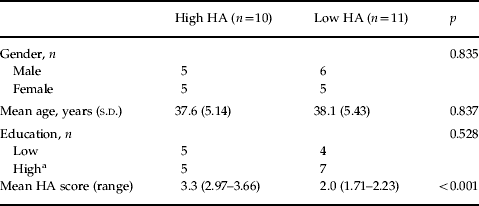
The final study group consisted of 22 subjects – 10 subjects in the high-HA group and 12 subjects in the low-HA group. Characteristics of the high- and low-HA groups are presented in Table 1. One low- and one high-HA subject used nicotine products whereas the others did not. None of the volunteers was taking any medications at the time of the study and one low-HA subject was excluded from the final analysis because of considerable movement indicated by the external motion detector during the PET scan resulting in a low-HA group of 11 subjects. All subjects underwent T1- and T2-weighted magnetic resonance (MR) imaging at 1.5 T to rule out structural brain abnormalities and to obtain an anatomical reference for quantification of PET images (T1).
Characteristics of high- and low-HA groups
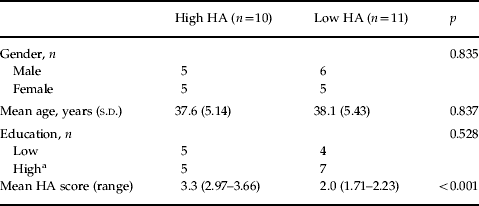
HA, Harm avoidance; s.d., standard deviation.
a High education refers to graduation from university.
TCI
Temperament and character traits were self-rated by the participants using the Finnish translation of the ninth version of Cloninger's Temperament and Character Inventory (Cloninger et al. Reference Cloninger, Svrakic and Przybeck1993). The inventory consists of four temperament scales (HA, ‘novelty seeking’, ‘reward dependence’ and ‘persistence’) and three character scales (‘self-directedness’, ‘cooperativeness’ and ‘self-transcendence’), which were assessed with 40, 35, 24, 8, 44, 42 and 33 items, respectively; 226 items in total. Instead of the original dichotomous true/false format, the items were rated on a five-point Likert scale ranging from totally disagree (1) to totally agree (5). We calculated a mean score for every participant for each of the seven scales by averaging each participant's answers over all of the items comprising one scale, thus resulting in an average score for each scale that ranged from 1 to 5. The Cronbach α reliabilities for the scales in the total Cardiovascular Risk in Young Finns Study sample were: HA, α = 0.92; ‘novelty seeking’, α = 0.85; ‘reward dependence’, α = 0.80; ‘persistence’, α = 0.64; ‘self-directedness’, α = 0.91; ‘cooperativeness’, α = 0.91; and ‘self-transcendence’, α = 0.91. The content and construct validity of the measure has been shown to be high in previous studies with Finnish samples (Keltikangas-Jarvinen et al. Reference Keltikangas-Jarvinen, Ravaja and Viikari1999).
Radiochemistry
N-desmethyl-MADAM and and MADAM were obtained from PharmaSynth AS (Estonia). High specific radioactivity [11C]methyl iodide was prepared from [11C]methane (Larsen et al. Reference Larsen, Ulin, Dahlstrøm and Jensen1997; Någren et al. Reference Någren, Truong, Helin, Amir and Halldin2003).
Preparation of [11C]MADAM
The preparation of [11C]MADAM from [11C]methyl triflate was performed according to a published procedure (Halldin et al. Reference Halldin, Lundberg, Sóvágó, Gulyás, Guilloteau, Vercouillie, Emond, Chalon, Tarkiainen, Hiltunen and Farde2005) with minor modifications. [11C]methyl triflate, prepared on-line from [11C]methyl iodide, was reacted with 0.4–0.6 mg of N-desmethyl-MADAM in 200 μl acetone. The crude product was purified using high-performance liquid chromatography (HPLC) on a μBondapak® column (Waters, USA) using 40% acetonitrile in 0.1 m-ammonium formiate. After the addition of 0.3 ml of sterile propylene glycol–ethanol (7:3, v/v) the fraction containing the product was evaporated and re-dissolved in 8 ml physiological phosphate buffer (0.1 m, pH 7.4) and filtered through a 0.2 μm Gelman Acrodisc® 4192 sterile filter. The radiochemical purity and the specific radioactivity of the product were determined using HPLC and ultra-violet detection at 242 nm. The volume of the final product solution was calculated by weighing the sterile product vessel before and after sterile filtration and division with the density of the sterile solvent.
PET procedures
PET imaging was carried out using a brain-dedicated high-resolution PET scanner (ECAT HRRT; Siemens Medical Solutions, USA) (Rahmim et al. Reference Rahmim, Cheng, Blinder, Camborde and Sossi2005). Methods used for attenuation correction, acquiring emission data and reconstruction are described in an earlier report by our group (Hirvonen et al. Reference Hirvonen, Johansson, Teräs, Oikonen, Lumme, Virsu, Roivainen, Någren, Halldin, Farde and Hietala2008). Head fixation was achieved by using an individually moulded thermoplastic mask. External motion data was acquired using the Polaris Vicra showing movements within the spatial resolution (FWHM) of the scanner.
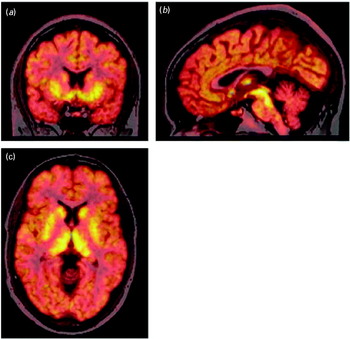
Serotonin transporter (5-HTT) density was measured using the highly specific [11C]MADAM tracer (Lundberg et al. Reference Lundberg, Odano, Olsson, Halldin and Farde2005) (see Fig. 1). An intravenous bolus of [11C]MADAM was injected and flushed with saline. The injected dose and mass of [11C]MADAM were 475 (s.d. = 70.6) MBq and 0.42 (s.d. = 0.19) μg for the high-HA group and 484 (s.d. = 33.6) MBq and 0.73 (s.d. = 0.50) μg for the low-HA group. There were no statistically significant differences in injected mass or dose. Emission data was collected in list mode for 75 min as 17 frames of increasing length (3 × 1 min, 4 × 3 min and 10 × 6 min).
Uptake of [11C]N,N-dimethyl-2-(2-amino-4-methylphenylthio)bene ([11C]MADAM) in the human brain showing (a) coronal, (b) sagittal and (c) axial slices (integrated images from 0–75 min). The highest uptake is observed in the midbrain and the lowest in the cerebellum.

Image analysis
To correct for head motion during the scan a frame-to-frame correction was done using external motion data to assess the frames of least motion. These frames were then summed and used as a reference for realignment. The MR images were co-registered to PET images. All realignment and co-registration procedures were performed using Statistical Parametric Mapping software version 2 (SPM2; Friston et al. Reference Friston, Holmes, Worsley, Poline, Frith and Frackowiak1995).
Quantification of tracer binding
The a priori regions of interest (ROIs) were manually delineated on T1-weighted transaxial MR images that had been co-registered to PET images into 22 different regions using Imadeus software (version 1.4; Forima Inc., Finland). ROIs were drawn onto the dorsal, pregenual and subgenual anterior cingulate cortex, which was defined as suggested by Drevets et al. (Reference Drevets, Bogers and Raichle2002). In the prefrontal cortex, dorsolateral and ventrolateral prefrontal cortex, medial frontal cortex, lateral and medial orbital frontal cortex were delineated. ROIs on the dorsal caudate, dorsal putamen and ventral striatum were defined as described (Hirvonen et al. Reference Hirvonen, Johansson, Teräs, Oikonen, Lumme, Virsu, Roivainen, Någren, Halldin, Farde and Hietala2008). The insular cortex was separated into two parts, anterior and posterior (Cannon et al. Reference Cannon, Ichise, Rollis, Klaver, Gandhi, Charney, Manji and Drevets2007). ROIs were also drawn onto the thalamus, amygdala, hippocampus, inferior, medial and superior temporal gyrus, supramarginal gyrus, angular gyrus and posterior cingulate cortex and cerebellum. Because specific serotonin-rich areas/nuclei in the midbrain, pons and medulla cannot be differentiated in MR images, the analysis of this region was conducted solely with a voxel-based approach. The term ‘midbrain’ in this paper refers to a search area including the midbrain, pons and upper medulla unless otherwise indicated.
ROIs were used to calculate regional time–radioactivity curves (TACs) from dynamic PET images. The simplified reference tissue model (Lammertsma & Hume, Reference Lammertsma and Hume1996) was applied to TACs to derive 5-HTT BPND (Innis et al. Reference Innis, Cunningham, Delforge, Fujita, Gjedde, Gunn, Holden, Houle, Huang, Ichise, Iida, Ito, Kimura, Koeppe, Knudsen, Knuuti, Lammertsma, Laruelle, Logan, Maguire, Mintun, Morris, Parsey, Price, Slifstein, Sossi, Suhara, Votaw, Wong and Carson2007), which represents the ratio at equilibrium of specific to non-displaceable ligand binding in brain tissue and is linearly related to receptor density. The cerebellum was used as a reference region.
Statistical analysis of ROI-based data
To examine the group difference in [11C]MADAM BPND we used repeated-measures analysis of variance (ANOVA) with region as a within subject factor and group as a between-subjects factor. Because HA correlated with ‘novelty seeking’, ‘self-directedness’ and ‘cooperativeness’, we also performed an exploratory analysis of covariance to examine whether a group difference could be detected when ‘self-directedness’, ‘cooperativeness’ and ‘novelty seeking’ were controlled for.
To explore the associations of other temperament and character traits with [11C]MADAM BPND, we combined the two groups into one and in ROI-based data the associations were tested using partial correlation coefficient while controlling for age and gender. Age was selected because of its demonstrated effect on 5-HTT density (Van Dyck et al. Reference Van Dyck, Malison, Seibyl, Laruelle, Klumpp, Zoghbi, Baldwin and Innis2000) and effects on character scores (Cloninger et al. Reference Cloninger, Svrakic and Przybeck1993). Gender was chosen because it had an effect on 5-HTT binding in our sample as well as in earlier studies (Jovanovic et al. Reference Jovanovic, Lundberg, Karlsson, Cerin, Saijo, Varrone, Halldin and Nordström2008).
In this study, a p value below 0.05 was considered statistically significant and normality of distribution was confirmed using the Shapiro–Wilk test. All ROI-based statistical analyses were carried out with version 17 of SPSS statistical software for Windows (release 17.0.0; SPPS Inc., USA).
Voxel-based analysis
Because of the complex anatomy of serotonergic nuclei in the midbrain, this region was analysed separately from the rest of the brain. Thus two voxel-wise analyses were conducted using SPM5 (Wellcome Department of Cognitive Neurology, London, UK) running on Matlab for Windows (version 7.4.0.287; MathWorks, USA). First, a ROI containing the midbrain, pons and medulla [defined with Wake Forest University (WFU) PickAtlas software;http://www.nitrc.org/projects/wfu_pickatlas/] was analysed and then another, confirmatory voxel-wise analysis was carried out on the whole brain excluding the midbrain ROI.
The confirmatory analysis was carried out as previously described (Hirvonen et al. Reference Hirvonen, van Erp, Huttunen, Aalto, Någren, Huttunen, Lönnqvist, Kaprio, Hietala and Cannon2005). Pre-processing of parametric images and statistical analyses were performed using SPM5. Parametric images were calculated with a simplified reference tissue model applied to all voxels with the cerebellum as a reference region. Images were spatially normalized to Montreal Neurological Institute (MNI) space using summed PET images and a ligand-specific template for [11C]MADAM. Spatially normalized parametric images were smoothed using an 8-mm Gaussian kernel.
Differences between high-HA and low-HA groups were analysed using an independent two-sample t test. To test the association of other TCI traits and [11C]MADAM BPND in the combined group, a multiple regression analysis was performed with age and gender as nuisance variables. In the midbrain ROI analysis false discovery rate (0.05) was used to correct for multiple comparisons. Cluster-level-corrected p values <0.05 were considered statistically significant.
Results
[11C]MADAM BPND in high- and low-HA groups
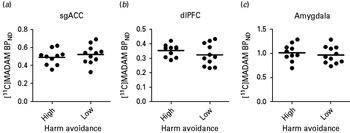
A ROI-based repeated-measures ANOVA indicated that [11C]MADAM BPND did not differ in any brain region between the high- and low-HA groups (F = 0.961, p = 0.408) (Fig. 2). In addition, there was no significant region × group interaction in this analysis. A voxel-based analysis confirmed the negative result. Finally, a separate analysis on the midbrain indicated no differences between the high- and low-HA groups. Because of the known intercorrelations between HA and ‘novelty seeking’, ‘cooperativeness’ and ‘self-directedness’, we included also these TCI dimensions in the statistical model but the results did not change.
Examples of [11C]N,N-dimethyl-2-(2-amino-4-methylphenylthio)benzylamine ([11C]MADAM) binding potential (BPND) in three different brain regions: (a) subgenual anterior cingulate cortex; (b) dorsolateral prefrontal cortex; (c) amygdala. Statistically significant differences were not found in any region (p > 0.05).

Correlations between TCI character dimensions and [11C]MADAM BPND
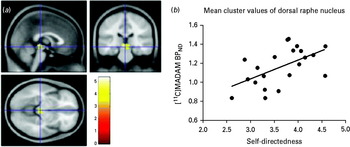
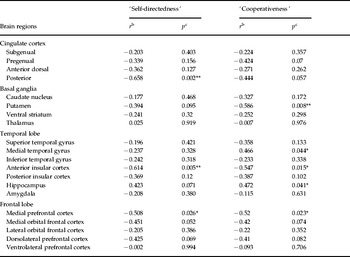
Voxel-based analysis restricted to the midbrain revealed a significant positive correlation between ‘self-directedness’ and [11C]MADAM BPND in a cluster of voxels localized in the dorsal raphe nucleus (r = 0.555, p = 0.004 after correction for multiple comparisons) (Fig. 3). In contrast, partial correlation analysis of ROI-based data revealed negative correlations between [11C]MADAM BPND and ‘self-directedness’ as well as between [11C]MADAM BPND and ‘cooperativeness’ in several brain regions such as the anterior insula and posterior cingulate cortex (Table 2). Nevertheless, these correlations did not survive correction for multiple comparisons. ‘Self-transcendence’ did not correlate with [11C]MADAM BPND in any region. A voxel-based analysis was in line with the ROI-based findings.
‘Self-directedness’ correlates with serotonin transporter (5-HTT) binding potential in the dorsal raphe nucleus (n = 21). (a) The results are visualized on an anatomically standardized T1-weighted magnetic resonance image. Cluster-level p = 0.004 (corrected for multiple comparisons). Cluster size = 199 voxels. Montreal Neurological Institute (MNI) x, y, z coordinates in millimetres of peak voxel −4, −26, −4. (b) Individual mean binding potential (BPND) values extracted from the cluster using the SPM MARSbar toolbox and plotted against ‘self-directedness’ score. Pearson correlation coefficient (r) = 0.555. [11C]MADAM, [11C]N,N-dimethyl-2-(2-amino-4-methylphenylthio)benzylamine.

‘Self-directedness’ and ‘cooperativeness’ partial correlations with regional [11C]MADAM BPND (n = 21)a

[11C]MADAM, [11C]N,N-dimethyl-2-(2-amino-4-methylphenylthio)benzylamine; BPND, binding potential.
a Relevant midbrain results are shown in Fig. 3.
b Partial correlation coefficient (partial correlation analysis corrected for age and gender).
c Significance values were not corrected for multiple comparisons.
* p < 0.05, ** p < 0.01.
TCI scores
The mean HA scores were 3.32 (range 2.97–3.66) in the high-HA group and 2.00 (range 1.71–2.23) in the low-HA group (p < 0.001). All correlations between TCI dimensions in the current subsample and in the whole cohort are shown in Supplementary Tables S1 a and S1 b. HA scores showed excellent stability over time, demonstrated by a Pearson correlation of 0.852 between HA scores obtained on the PET study day and those obtained in the year 2001. Age or gender did not affect TCI scores in our sample.
TCI mean character scores in our subsample were as follows: ‘self-directedness’, 3.65 (range 2.60–4.58); ‘cooperativeness’, 3.76 (range 3.15–4.31); ‘self-transcendence’, 2.37 (range 1.35–3.42). These scores were not statistically different from those observed in the whole cohort (n = 2075 in the year 2001), which were as follows: ‘self-directedness’, 3.70 (range 1.94–4.88); ‘cooperativeness’, 3.74 (range 1.50–4.84); ‘self-transcendence’, 2.49 (range 1.18–4.38) and the scores in the subsample were normally distributed. ‘Self-directedness’, ‘cooperativeness’ and ‘self-transcendence’ also showed stability over the two measurement points (1997 and 2001), with Pearson correlation coefficients of 0.926, 0.875 and 0.787, respectively.
[11C]MADAM BPND in the brain – effect of gender and age
Voxel-based analysis in the midbrain indicated that females had significantly higher [11C]MADAM BPND in the midbrain (p < 0.001, corrected). This same pattern was seen in several other brain regions but these differences were not statistically significant after correction for multiple comparisons.
We observed a trend towards negative correlations with age and [11C]MADAM BPND, e.g. in the angular gyrus (r = − 0.471, p = 0.031) and in the posterior insula (r = − 0.433, p = 0.05), but these correlations did not survive correction for multiple comparisons. The failure to detect an age-related decline in [11C]MADAM BPND is probably due to the small age range (15.8 years) in the subsample.
Discussion
Serotonin transporter and HA in screened healthy subjects
Serotonin is a predominantly inhibitory neurotransmitter in the adult human brain. Outside the raphe nucleus 5-HTTs are located presynaptically in the serotonergic axon terminals where they critically regulate the amount of serotonin in the synaptic cleft by reuptake. In this study our hypothesis was not supported, i.e. the temperament dimension HA was not associated with 5-HTT density (BPND) in healthy volunteers. This was the case despite the specific study design to detect differences in the age- and gender-matched high- and low-HA groups. Results did not change after including other modifying TCI personality traits in the model (‘novelty seeking’, ‘self-direcetedness’, ‘cooperativeness’). Our result is in line with the study by Reimold et al. (Reference Reimold, Batra, Knobel, Smolka, Zimmer, Mann, Solbach, Reischl, Schwärzler, Gründer, Machulla, Bares and Heinz2008), which did not detect an association between HA and [11C]DASB BPND in 19 healthy volunteers. We intentionally excluded subjects with past or current DSM-IV-defined psychiatric disorders in order to avoid effects of, for example, affective disorder diagnosis or its treatment on our results. Excluding subjects with mental disorders from this study limits the generalizability of the results to the healthy population. Exclusion of subjects with mental disorders is a valid approach, as some reports suggest decreased in vivo 5-HTT binding in major depression although this remains controversial with possible state-dependent phenomena involved (Bhagwagar et al. Reference Bhagwagar, Murthy, Selvaraj, Hinz, Taylor, Fancy, Grasby and Cowen2007; Cannon et al. Reference Cannon, Ichise, Rollis, Klaver, Gandhi, Charney, Manji and Drevets2007; Meyer, Reference Meyer2007; Reimold et al. Reference Reimold, Batra, Knobel, Smolka, Zimmer, Mann, Solbach, Reischl, Schwärzler, Gründer, Machulla, Bares and Heinz2008; Selvaraj et al. Reference Selvaraj, Venkatesha Murthy, Bhagwagar, Bose, Hinz, Grasby and Cowen2011). It is known that high HA predisposes to psychiatric disorders, especially in the mood and anxiety spectrum (see Miettunen & Raevuori, Reference Miettunen and Raevuori2012). Our results are useful in the interpretation of serotonin imaging studies in patients with affective disorders and the related state–trait discussion. Future serotonin imaging studies should examine high- and low-HA subjects with and without psychiatric disorders in order to explore the interaction between temperament and, for example, mood and anxiety spectrum diagnosis. Clearly, such a study would also be of high relevance for further testing of Cloninger's psychobiological model of personality and the original hypothesis on the link between serotonin and HA in the general population.
Neither ROI-based data nor voxel-based analysis of parametric BPND images showed difference between high- and low-HA groups in [11C]MADAM BPND in any brain region. Power analysis of ROI-based data (at α = 0.05, β = 0.20) indicated that we can exclude 17% difference in striatum and 16% difference in anterior cingulate cortex in [11C]MADAM BPND between the groups.
BPND is a composite measure of affinity and density (Innis et al. Reference Innis, Cunningham, Delforge, Fujita, Gjedde, Gunn, Holden, Houle, Huang, Ichise, Iida, Ito, Kimura, Koeppe, Knudsen, Knuuti, Lammertsma, Laruelle, Logan, Maguire, Mintun, Morris, Parsey, Price, Slifstein, Sossi, Suhara, Votaw, Wong and Carson2007), which are not separable from the PET procedure used here. Our interpretation of the finding is that HA does not affect 5-HTT density. An acute change in serotonin levels does not affect 5-HTT binding in vivo in humans (Praschak-Rieder et al. Reference Praschak-Rieder, Wilson, Hussey, Carella, Wei, Ginovart, Schwarz, Zach, Houle and Meyer2005; Talbot et al. Reference Talbot, Frankle, Hwang, Huang, Suckow, Slifstein, Abi-Dargham and Laruelle2005). Unchanged 5-HTT level, albeit a key regulator of serotonin drive, does not exclude a change in endogenous 5-HT levels between the two HA groups. Unfortunately, there are currently no established methods of measuring 5-HT levels directly or indirectly in man despite promising new results with a 5-HT1B receptor tracer (Finnema et al. Reference Finnema, Varrone, Hwang, Gulyás, Pierson, Halldin and Farde2010). Moreover, our result does not exclude the possibility that HA is linked to the density or function of 5-HT receptors. To our knowledge there are four earlier imaging studies on HA and serotonin receptor density in healthy volunteers (Moresco et al. Reference Moresco, Dieci, Vita, Messa, Gobbo, Galli, Rizzo, Panzacchi, De Peri, Invernizzi and Fazio2002; Rabiner et al. Reference Rabiner, Messa, Sargent, Husted-Kjaer, Montgomery, Lawrence, Bench, Gunn, Cowen and Grasby2002; Borg et al. Reference Borg, Andree, Soderstrom and Farde2003; Karlsson et al. Reference Karlsson, Hirvonen, Salminen and Hietala2009). Of these studies, three used a 5-HT1A receptor tracer [carbonyl-11C]WAY-100635 (Rabiner et al. Reference Rabiner, Messa, Sargent, Husted-Kjaer, Montgomery, Lawrence, Bench, Gunn, Cowen and Grasby2002; Borg et al. Reference Borg, Andree, Soderstrom and Farde2003; Karlsson et al. Reference Karlsson, Hirvonen, Salminen and Hietala2009) and none of them found an association between receptor density and HA. Considering that the combined number of healthy subjects in these studies is 96, we think that it is unlikely that HA is related to 5-HT1A receptor density in the healthy population. The fourth study (Moresco et al. Reference Moresco, Dieci, Vita, Messa, Gobbo, Galli, Rizzo, Panzacchi, De Peri, Invernizzi and Fazio2002) using [18F]FESP found a negative correlation between [18F]FESP binding and HA bilaterally in the frontal cortex and in the left parietal cortex. [18F]FESP is a ligand that binds to both 5-HT2A and dopamine D2 receptors, and is thus not an ideal tracer for imaging the serotonin 5-HT2A receptors.
Interestingly, in an [18F]altanserin PET study on NEO Personality Inventory (NEO-PI) – Revised ‘neuroticism’, Frokjaer et al. (Reference Frokjaer, Mortensen, Nielsen, Haugbol, Pinborg, Adams, Svarer, Hasselbalch, Holm, Paulson and Knudsen2008) found a positive correlation between ‘neuroticism’ and 5-HT2A receptor binding in frontolimbic regions. Although HA and ‘neuroticism’ are not directly comparable, they are highly intercorrelated (De Fruyt et al. Reference De Fruyt, Van De Wiele and Van Heeringen2000; Jokela & Keltikangas-Järvinen, Reference Jokela and Keltikangas-Järvinen2011) and may both be seen as vulnerability markers for affective disorders. One might thus expect somewhat related biology, not the opposite as seen in the studies by Moresco et al. (Reference Moresco, Dieci, Vita, Messa, Gobbo, Galli, Rizzo, Panzacchi, De Peri, Invernizzi and Fazio2002) and Frokjaer et al. (Reference Frokjaer, Mortensen, Nielsen, Haugbol, Pinborg, Adams, Svarer, Hasselbalch, Holm, Paulson and Knudsen2008). It is possible that this controversy simply demonstrates the possible pitfalls of association studies where some neurobiological marker is correlated with numerous psychological traits in a relatively small study sample. ‘Neuroticism’ is also strongly correlated with ‘self-directedness’ (De Fruyt et al. Reference De Fruyt, Van De Wiele and Van Heeringen2000). Hence the findings by Frokjaer et al. (Reference Frokjaer, Mortensen, Nielsen, Haugbol, Pinborg, Adams, Svarer, Hasselbalch, Holm, Paulson and Knudsen2008) may be in agreement with our results on ‘self-directedness’. Overall, our results and the current literature do not support the hypothesized association between HA and 5-HTT or receptor binding in subjects selected for an absence of psychiatric disorders.
As the serotonergic system is intertwined with several other neurotransmitters such as dopamine and γ-amino butyric acid (GABA), the HA trait may be correlated with the balance of a complex neurotransmitter network instead of just serotonin. There is one study that associates HA with dopamine D2/D3 receptor availability in the associative and sensorimotor striatum (Kim et al. Reference Kim, Son, Kim, Lee, Cho, Kim and Cho2011). In future, neurobiological correlates of human personality should be studied with a multiple neurotransmitter approach as postulated earlier by Cloninger (Reference Cloninger1986). Such differences in neurotransmitter balances are now widely being searched (Nakamura et al. Reference Nakamura, Sekine, Ouchi, Tsujii, Yoshikawa, Futatsubashi, Tsuchiya, Sugihara, Iwata, Suzuki, Matsuzaki, Suda, Sugiyama, Takei and Mori2010).
Serotonin transporter and character in screened healthy subjects
Our secondary analyses indicated that ‘self-directedness’ correlates positively with [11C]MADAM BPND in the raphe nucleus. Negative correlations between 5-HTT BPND values and ‘self-directedness’ as well as ‘cooperativeness’ were seen in multiple brain areas, but these correlations did not survive a conservative correction for multiple comparisons.
‘Self-directedness’ is related to self-concepts and defined as the extent to which a person identifies himself as an autonomous individual (Cloninger et al. Reference Cloninger, Svrakic and Przybeck1993) and as the ability to adapt behaviour according to chosen goals and values. The heritability of ‘self-directedness’ is high and in several studies it may be even higher than that for the four temperament traits (Comings et al. Reference Comings, Gade-Andavolu, Gonzalez, Wu, Muhleman, Blake, Mann, Dietz, Saucier and MacMurray2000; Ando et al. Reference Ando, Ono, Yoshimura, Onoda, Shinohara, Kanba and Asai2002, Reference Ando, Suzuki, Yamagata, Kijima, Maekawa, Ono and Jang2004; Gillespie et al. Reference Gillespie, Cloninger, Heath and Martin2003; Isen et al. Reference Isen, Baker, Raine and Bezdjian2009). However, little is known about the biology of character dimensions. There is some evidence for a link between serotonin systems and character dimensions. Borg et al. (Reference Borg, Andree, Soderstrom and Farde2003) found an association between ‘self-transcendence’ and 5-HT1A binding, but this has not been confirmed by other studies (Rabiner et al. Reference Rabiner, Messa, Sargent, Husted-Kjaer, Montgomery, Lawrence, Bench, Gunn, Cowen and Grasby2002; Karlsson et al. Reference Karlsson, Hirvonen, Salminen and Hietala2009). None of the 5-HT1A PET imaging studies found correlations between 5-HT1A and ‘self-directedness’ or ‘cooperativeness’. As far as we know, this is the first in vivo imaging study that demonstrates the role of serotonin in ‘self-directedness’. We found no statistically significant correlations between [11C]MADAM BPND and other character dimensions.
Higher ‘self-directedness’ was robustly associated with higher 5-HTT binding in the dorsal raphe nucleus. Even if the result must be regarded as preliminary, the correlation was found in a relevant brain region, survived correction for multiple comparisons and was found in small volume-corrected and even in a whole-brain SPM analysis. In addition, the distribution of ‘self-directedness’ scores in the current sample was comparable with that in the larger population sample. Serotonergic neurons projecting to other areas of the brain originate mainly from this region (Hornung, Reference Hornung2003). The firing rate of the serotonergic neurons in the dorsal raphe nucleus is controlled by autoregulatory 5-HT1A receptors by negative feedback. 5-HTT in the raphe nucleus is located in the somatodendritic part of the neuron in contrast to other brain areas where 5-HTT is found on the presynaptic axon terminals. High levels of 5-HTT in the dorsal raphe nucleus is likely to cause less negative autoregulation via the 5-HT1A receptor and a higher serotonin drive in the terminal areas, e.g. in the orbitofrontal or cingulate cortices. Our interpretation of the finding is that higher ‘self-directedness’ is related to less negative feedback in the dorsal raphe nucleus and thus with higher serotonergic drive in terminal areas, e.g. in the orbitofrontal and cingulate cortices.
Low levels of serotonin are thought to be essential in the pathophysiology of affective disorders. As noted in the introduction, a low ‘self-directedness’ score may also predispose to these disorders. Although the results from imaging studies on serotonin and depression are still somewhat inconsistent (for a review, see Meyer, Reference Meyer2007), the latest reports using [11C]DASB report lower 5-HTT binding in the midbrain and higher 5-HTT binding in cortical areas in depressed patients compared with healthy controls (Parsey et al. Reference Parsey, Hastings, Oquendo, Huang, Simpson, Arcement, Huang, Ogden, Van Heertum, Arango and Mann2006; Cannon et al. Reference Cannon, Ichise, Fromm, Nugent, Rollis, Gandhi, Klaver, Charney, Manji and Drevets2006, Reference Cannon, Ichise, Rollis, Klaver, Gandhi, Charney, Manji and Drevets2007; Reimold et al. Reference Reimold, Batra, Knobel, Smolka, Zimmer, Mann, Solbach, Reischl, Schwärzler, Gründer, Machulla, Bares and Heinz2008; Selvaraj et al. Reference Selvaraj, Venkatesha Murthy, Bhagwagar, Bose, Hinz, Grasby and Cowen2011). Our results are consistent with these findings. In fact, in future imaging studies on mood and anxiety disorders, it would be useful to consider the personality traits in the design and analysis in order differentiate between predisposing factors and factors related to the active disease process itself.
Character scales were first designed as targets of psychotherapeutic interventions (Cloninger et al. Reference Cloninger, Przybeck, Svrakic and Wetzel1994). However, some evidence indicates that treatment of affective disorders with tricyclic antidepressants and selective serotonin reuptake inhibitors, drugs that increase the levels of synaptic serotonin, also increases ‘self-directedness’ (Black & Sheline, Reference Black and Sheline1997; Allgulander et al. Reference Allgulander, Cloninger, Przybeck and Brandt1998; Agosti & McGrath, Reference Agosti and McGrath2002; Hirano et al. Reference Hirano, Sato, Narita, Kusunoki, Ozaki, Kimura, Takahashi, Sakado and Uehara2002; Joyce et al. Reference Joyce, Mulder, Luty, McKenzie, Sullivan and Cloninger2003; Boz et al. Reference Boz, Gazioglu, Altunayoglu and Hocaoglu2007). One study has even indicated that this increase in ‘self-directedness’ has also predictive value for changes in depressive symptoms as measured with BDI (Mazza et al. Reference Mazza, Mazza, Pomponi, Di Nicola, Padua, Vicini, Bria and Mazza2009). Therefore, character dimensions may modulate the expression of mood states (Farmer et al. Reference Farmer, Mahmood, Redman, Harris, Sadler and McGuffin2003; Cloninger, Reference Cloninger2004; Cloninger et al. Reference Cloninger, Zohar and Cloninger2010) and our results may shed light on why both depressive symptoms and ‘self-directedness’ improve during serotonin-altering psychopharmacological treatment.
Finally, it should be noted that the validity of the distinction between temperament and character traits has been questioned, as factor analyses show a high degree of cross-loading between the traits (Ball et al. Reference Ball, Tennen and Kranzler1999; Herbst et al. Reference Herbst, Zonderman, McCrae and Costa2000; Gana & Trouillet, Reference Gana and Trouillet2003). In line with these factor analyses, the Pearson correlation coefficient between HA and ‘self-directedness’ in the whole Young Finns Study cohort was high (r = − 0.63, see Supplementary Table S1 a). De Fruyt et al. (Reference De Fruyt, Van De Wiele and Van Heeringen2000) reported an equally high Pearson correlation coefficient (r = − 0.63) between NEO-PI ‘neuroticism’ and TCI ‘self-directedness’. However, even if two traits do correlate and load on the same factor, they may still represent psychologically distinct constructs (Block, Reference Block1995). Future studies investigating the role of the serotonin system in human personality should take these limitations in the TCI model into consideration, but also appreciate that the NEO-PI and TCI have high intercorrelations.
Conclusions
We found no support for an association of HA and serotonin transporter density in subjects free of psychiatric disorders as measured with [11C]MADAM and PET. The result has implications in the research for biological factors in affective disorders. Higher serotonin transporter density in the dorsal raphe nucleus predicted higher ‘self-directedness’ scores. This relationship was robust and warrants further studies of serotonin function, differential aspects of character development and psychopathology.
Supplementary material
For supplementary material accompanying this paper visit http://dx.doi.org/10.1017/S003329171200164X.
Acknowledgements
The authors thank Helena Service, M.Sc., Department of Psychology, University of Helsinki, for help with recruiting the subjects and organizational help, Maria Sipilä, B.M., Department of Psychiatry, University of Turku, for help with ROI-based analysis, Professor Christer Halldin, Department of Clinical Neuroscience, Karolinska Institutet, for help with the production of [11C]MADAM, and the staff of Turku PET Centre.
The study was supported by the Academy of Finland (116321), the Hospital District of Southwest Finland (P3848) and by grants (to L.T.) by the Varsinais-Suomi Regional Fund of the Finnish Cultural Foundation, Finnish Psychiatric Research Fund and The National Graduate School of Clinical Investigation.
Declaration of Interest
None.