Introduction
Reproductive isolation in nature is often maintained by biological barriers that prevent the cross between individuals of different species. However, in some cases copulation can occur between closely related individuals because females are unable to avoid mating or are coerced by males to copulate. There is growing evidence that in cases where pre-copulatory reproductive barriers fail, a series of mechanisms that prevent hybridization after copulation (and before fertilization) can evolve (Eberhard, Reference Eberhard1996). The mechanisms that prevent fertilization of the eggs after a successful copulation are known as post-copulatory reproductive barriers, and allow females to retain control over paternity despite being unable to exert complete control over their mating partner. One of these mechanisms relies on differential sperm movement and storage (Eberhard, Reference Eberhard1996). When this occurs, females may store less sperm of heterotypic than homotypic males during copulation (Larson et al., Reference Larson, Hume, Andres and Harrison2012) if using such sperm results in a reduction of offspring viability and therefore in a reduced reproductive success of the parents. As a consequence of a reduction in the amount of sperm stored, females may need to remate, either to replenish sperm supplies or because of the smaller quantities of ejaculate compounds that normally decrease female sexual receptivity after copulation (Simmons, Reference Simmons2001).
Within the Tephritidae (Diptera), the South American fruit fly, Anastrepha fraterculus (Wiedemann), was long considered to be a wide-ranging pest exploiting more than 100 host plants (Norrbom, Reference Norrbom2004) along a distributional range spanning from Southern USA to Central Argentina (Salles, Reference Salles1995; Malavasi et al., Reference Malavasi, Zucchi, Sugayama, Malavasi and Zucchi2000). Currently, A. fraterculus has been recognized as a complex of cryptic species composed of several morphotypes (Stone, Reference Stone1942; Steck, Reference Steck1991; Steck & Sheppard, Reference Steck, Sheppard, Aluja and Liedo1993; Selivon et al., Reference Selivon, Perondini and Morgante1999; Smith-Caldas et al., Reference Smith-Caldas, McPheron, Silva and Zucchi2001; Hernández-Ortiz et al., Reference Hernández-Ortiz, Gómez-Anaya, Sánchez, McPheron and Aluja2004). Specifically, seven morphotypes have been identified (Hernández-Ortiz et al., Reference Hernández-Ortiz, Bartolluci, Morales-Valle, Frías and Selivon2012). Pre-copulatory reproductive isolation has been documented among some of these morphotypes (Selivon et al., Reference Selivon, Perondini and Morgante1999; Vera et al., Reference Vera, Cáceres, Wornoayporn, Islam, Robinson, de la Vega, Hendrichs and Cayol2006; Rull et al., Reference Rull, Abraham, Kovaleski, Segura, Mendoza, Liendo and Vera2013) and some insights on the mechanisms that keep these morphotypes isolated were reported between the Peruvian and the Brazilian 1 (which includes Argentinean populations) morphotypes (Cáceres et al., Reference Cáceres, Segura, Vera, Wornoayporn, Cladera, Teal, Sapountzis, Bourtzis, Zacharopoulou and Robinson2009). Even though there is strong pre-copulatory isolation between these two morphotypes, these barriers do not always prevent copulation between insects of different morphotypes, as heterotypic crosses between Peruvian and Argentinean adults can be obtained under artificial conditions. Although these two morphotypes were originally sourced from allopatric populations and there is presumably little selective pressure to evolve post-copulatory ‘isolating mechanisms’ under a reinforcement scenario, reduced egg hatch has been recorded within these crosses, particularly when Peruvian males mate with Argentinean females (Cáceres et al., Reference Cáceres, Segura, Vera, Wornoayporn, Cladera, Teal, Sapountzis, Bourtzis, Zacharopoulou and Robinson2009). This reduced hatchability (27% compared with more than 80% in the other three crosses) could be the result of a smaller amount of sperm stored by females. Given the presumed role of stored sperm in inducing female post-copulatory refractoriness in this fly species (Abraham et al., Reference Abraham, Goane, Cladera and Vera2011b ), this could lead to differences in female remating propensity. However, female sexual receptivity is influenced not only by the amount of sperm stored (Abraham et al., Reference Abraham, Goane, Cladera and Vera2011b ) and the accessory gland products (AGPs) transferred during copulation (Abraham et al., Reference Abraham, Cladera, Goane and Vera2012), but also by intrinsic factors such as high female fecundity (Abraham et al., Reference Abraham, Goane, Rull, Cladera, Willink and Vera2011a ) and extrinsic factors such as male nutritional status, male strain rearing history and male juvenile hormone analogue treatment (Abraham et al., Reference Abraham, Goane, Cladera and Vera2011b , Reference Abraham, Liendo, Devescovi, Peralta, Yusef, Ruiz, Cladera, Vera and Segura2013). Thus, as for other insects, A. fraterculus female remating receptivity appears to be plastic (Harano & Katsuki, Reference Harano and Katsuki2012).
In this study, we investigated the effects of mating with a male of a different morphotype on the remating propensity of A. fraterculus females of the Brazilian 1 (Argentinean population) and the Peruvian morphotypes. We also examined whether male or female morphotype affected sperm storage patterns. We predicted that for the cross involving Peruvian males and Argentinean females, which results in reduced offspring fitness, females would store the least amount of sperm and would exhibit the highest remating propensity when compared to females involved in homotypic crosses and crosses of Argentinean males and Peruvian females.
Materials and methods
Source of flies
Female remating propensity and sperm storage were determined for crosses involving populations originally collected from infested fruit in Argentina and Peru and established at the laboratories of the Entomology Unit, FAO/IAEA Agriculture and Biotechnology Laboratory, in Seibersdorf, Austria. The Argentinean strain was derived from pupae sent from a laboratory colony originally held at the Estación Experimental Agroindustrial Obispo Colombres, Tucumán, Argentina and the Peruvian strain from pupae sent from the La Molina facility, Lima, Peru (for details about the colonization procedure followed for each strain see Vera et al., Reference Vera, Cáceres, Wornoayporn, Islam, Robinson, de la Vega, Hendrichs and Cayol2006). The flies from Argentina belong to the Brazilian 1 morphotype, whereas flies from Peru belong to the Peruvian morphotype (according to Hernández-Ortiz et al., Reference Hernández-Ortiz, Bartolluci, Morales-Valle, Frías and Selivon2012). Despite the fact that both strains have been maintained under artificial rearing conditions for several years, postzygotic mating isolation in the form of reduced F1 egg hatch between different A. fraterculus morphotypes appears to be retained (Cáceres et al., Reference Cáceres, Segura, Vera, Wornoayporn, Cladera, Teal, Sapountzis, Bourtzis, Zacharopoulou and Robinson2009; Rull et al., Reference Rull, Abraham, Kovaleski, Segura, Mendoza, Liendo and Vera2013).
General procedure
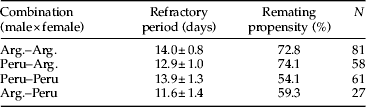
At emergence, flies of both origins were sexed and placed in 15 cm diameter×45 cm high cylindrical Plexiglass cages with water and food (consisting in wheat germ, hydrolyzed yeast and sugar at a 1:1:3 ratio) provided ad libitum until adults reached sexual maturity (10–15 days old, according to Petit-Marty et al., Reference Petit-Marty, Vera, Calcagno, Cladera, Segura, Allinghi, Rodriguero, Gómez Cendra, Viscarret and Vilardi2004). On test days, between 9:00 and 10:00 am, 60 sexually mature virgin females of one of the populations were released into a Plexiglass cage (30×30×30 cm) which contained 120 sexually mature virgin males, also of a single population. For each mating combination, three cages were set up under no choice conditions resulting in four male–female treatment combinations as follows: Peru males×Peru females; Argentina males×Argentina females; Peru males×Argentina females; Argentina males×Peru females. After female release, cages were observed for copulating pairs at 10-min intervals for a period of 4 h. These pairs were carefully coaxed into test tubes, which were then plugged, numbered and labelled with the time of detection of copulation. Pairs were checked every 5 min until copulation finished and this time was also recorded. After the end of copulation, one set of 20 females per combination was randomly assigned to estimate the amount of sperm stored in the spermathecae. The remaining 81 (♂Arg.×♀Arg.), 58 (♂Peru×♀Arg.), 61 (♂Peru×♀Peru) and 27 (♂Arg.×♀Peru) females were assigned to an assay to evaluate female remating propensity and the length of the refractory period.
Remating test
Females separated for evaluation of both remating propensity and the length of the refractory period were kept singly in a plastic cup (250 ml) supplied with water and food (as described above) ad libitum. Two days later, females were offered two sexually mature virgin males of their same origin for 4 h. If no copulation occurred during this period, the two males were removed from the container and replaced with two different males 2 days later. This procedure was repeated every Monday, Wednesday and Friday until completion of ten observation periods. During the experiment, one oviposition substrate consisting of an agar (30 g of agar in 500 ml of water) cylinder (3 cm in diameter and 2 cm high) wrapped in Parafilm M (Pechiney Plastic Packaging, Chicago USA), was placed on the cup where the female was held. The oviposition substrate was supplied to favour sperm utilization and natural renewal of female receptivity and was replaced every 48 h.
Sperm count
The second set of females was dissected between 2 and 8 h from the end of copulations under a dissecting microscope (Leica MZ 95) using a 60× magnification, following Taylor et al. (Reference Taylor, Kaspi and Yuval2000) and Twig and Yuval (Reference Twig and Yuval2005). Reproductive tracts were removed and placed over a microscope slide with a 50 μl drop of sterilized water. The three spermathecae were dissected and transferred together to a second slide with 7 μl of sterilized water containing 0.1% of soap (Triton®). Spermatheca walls were broken with the aid of fine forceps to release the spermatozoa, which were then stained with 3 μl of acetic orcein. The orcein was vigorously stirred with entomological pins for 1 min. An 18×18 mm coverslip was then placed on top of the disaggregated spermatheca and sealed at each corner with a drop of transparent nail polish. Spermatozoa were allowed to stain for at least 5 days and then were counted under a 400× magnification lens with a microscope (Leica DM 500). The whole slide was covered by counting all spermatozoa in 204 randomly selected fields, which correspond to 10% of the total area. To obtain the total amount of sperm stored, a conversion factor of 10 was applied to the counted sperm (Pérez-Staples & Aluja, Reference Pérez-Staples and Aluja2006).
Data analysis
To analyse latency to mate and copulation duration, we applied a generalized linear model (GLM) using the gamma distribution and a log link function, with male origin, female origin and their interaction as explanatory variables and the time between female release and the time at which pairs engaged (latency) or the time the pair engaged and the time it separated (duration) as a response variable. To analyse total amount of sperm stored, we applied a GLM using the gamma distribution and a log link function, with male origin, female origin and their interaction as explanatory variables and the number of spermatozoa as a response variable. In this case, only females with sperm in their spermathecae were included in the model. To analyse the probability of female remating and the probability of sperm storage, we applied a GLM using the binomial distribution and a logit link function, with male origin, female origin and their interaction as explanatory variables and whether or not a female remated or whether or not a female-stored sperm as a response variable. To analyse the length of the refractory period, we applied a GLM using the gamma distribution and a log link function, with male origin, female origin and their interaction as explanatory variables and the time between the first and the second copulation as a response variable. The significance of the explanatory variables was assessed by means of a likelihood ratio test. All analyses were performed using Statistica 7 software (Statsoft, Inc., Tulsa, USA).
Results
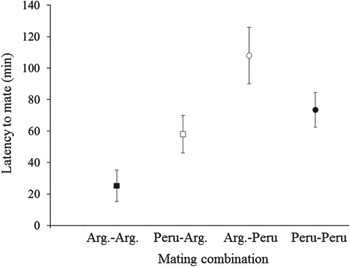
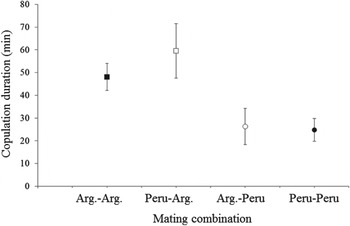
Latency to mate was significantly affected by female origin (likelihood ratio χ2=62.205; d.f.=1; P<0.001), by male origin (χ2=5.171; d.f.=1; P=0.022) and the interaction between the male and female origin (χ2=42.087; d.f.=1; P<0.001). Argentinean females mated with Argentinean males earlier than the rest of the combinations and were followed by Argentinean and Peruvian females that mated with Peruvian males. Matings between Peruvian females and Argentinean males were the last to occur (fig. 1). Copulation duration was significantly affected by female origin (χ2=131.634; d.f.=1; P<0.001) and the interaction between male and female origin (χ2=5.032; d.f.=1; P=0.024) but not by male origin (χ2=0.102; d.f.=1; P=0.749). Peruvian females engaged in shorter copulations, regardless of male origin. Argentinean females engaged in shorter copulation when mated with Argentinean males (fig. 2).
Mean latency to mate (min) from pairs involving Argentina and Peru females of Anastrepha fraterculus mated with Argentina or Peru males. Bars show the standard error of the mean. Mating combinations name first the male, then the female.

Mean copulation duration (min) from pairs involving Argentina and Peru females of Anastrepha fraterculus mated with Argentina or Peru males. Bars show the standard error of the mean. Mating combinations name first the male, then the female.

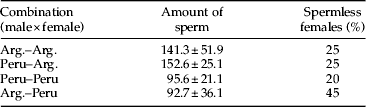
The amount of sperm stored and the probability of sperm storage were not significantly affected by male origin (likelihood ratio χ2=0.006; d.f.=1; P=0.937 and χ2=1.534; d.f.=1; P=0.215, respectively), female origin (χ2=3.034; d.f.=1; P=0.081 and χ2=0.561; d.f.=1; P=0.453, respectively) nor their interaction (χ2=0.008; d.f.=1; P=0.927 and χ2=1.359; d.f.=1; P=0.243, respectively). However, Peruvian females stored numerically less sperm than Argentinean females, irrespective of male origin (table 1). It is important to highlight that almost 50% of the Peruvian females that mated with an Argentinean male had no spermatozoa in their spermathecae.
Amount of sperm stored (mean±S.E.) and percentage of spermless females in the four combinations of two morphotypes of Anastrepha fraterculus. Twenty females from each combination were analysed.

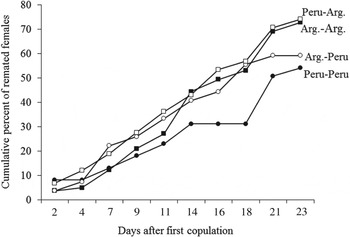
Male origin (likelihood ratio χ2=0.017; d.f.=1; P=0.895), female origin (χ2=0.074; d.f.=1; P=0.785) and their interaction (χ2=1.649; d.f.=1; P=0.198) had no significant effect in the length of female refractory period (table 2). Female origin had a significant effect on female remating propensity (χ2=6.732; d.f.=1; P=0.009), but male origin and their interaction had no significant effects (χ2=0.792; d.f.=1; P=0.373 and χ2=0.207; d.f.=1; P=0.648, respectively). Argentinean females were more likely to remate than Peruvian females, irrespective of the origin of the first male they mated with (fig. 3, table 2).
Cumulative remating curves for Anastrepha fraterculus females from Argentina and Peru mated for the first time with males of their same origin (Arg.×Arg.; Peru×Peru) or with males from the other population (Arg.×Peru; Peru×Arg.). Mating combinations name first the male, then the female.

Refractory period (mean±S.E.) between first and second copulation and percentage of females that remated (remating propensity) in the four combinations of two morphotypes of Anastrepha fraterculus.

Discussion
Our results demonstrate that latency to mate, copulation duration and remating propensity differ between the Peruvian and Brazilian 1 (Argentinean population) morphotypes of A. fraterculus and appear to be mainly under female control. We found that the time between the first and second copulation was similar for females that mated with homotypic and heterotypic males; and this pattern was the same for the females of the two morphotypes analysed. There was however an interesting trend towards no spermatozoa transfer by males during, or no sperm storage by females after, a heterotypic cross between Argentinean males×Peruvian females, with 45% of females having no sperm in their spermathecae.
The effect of mating on gene flow often depends on the complex dynamics of sperm transfer, storage and use (Price et al., Reference Price, Kim, Gronlund and Coyne2001). Using these same morphotypes Cáceres et al. (Reference Cáceres, Segura, Vera, Wornoayporn, Cladera, Teal, Sapountzis, Bourtzis, Zacharopoulou and Robinson2009) found that crosses involving Peruvian males and Argentinean females produced less viable offspring measured as F1 egg hatch. However, this reduction in fertility does not appear to be the result of low-sperm storage by females mating with males of different morphotypes. Another mechanism related to the use of sperm (post-copulatory prezygotic isolation) or the mortality of embryos (post-copulatory postzygotic isolation) may be involved. For example, in crosses involving Drosophila mauritiana (Tsacas and Davis) females and Drosophila simulans (Sturtevant) males, sperm is transferred and stored in abundance, but is lost rapidly from the reproductive tract and is therefore used inefficiently (Price et al., Reference Price, Kim, Gronlund and Coyne2001). These authors suggested that the term ‘cryptic reproductive isolation’ should be used in situations where the limit between prezygotic and postzygotic isolation becomes blurred. Alternatively, the reduction in the number of viable offspring for insects involved in those crosses may not be true post-copulatory isolation, but rather the result of females choosing not to use the sperm obtained during copulation (Masta & Maddison, Reference Masta and Maddison2002). On the other hand, there was a trend for reduced sperm storage in crosses involving Peruvian females, suggesting that the amount of sperm stored would be also under female control and would differ between morphotypes. Although the differences were marginally non-significant (P=0.081), this may be due to small sample size and merits further exploration.
Determining which sex controls latency to mate and copulation duration can be experimentally difficult because sexual selection may favour mechanisms that allow either sex to extend the latency to mate and continue or terminate copulation. Latency to mate, which can be considered as a measure of a female's pre-copulatory preference, was influenced by female morphotype, male morphotype and the interaction between female and male morphotypes. That is, not only are Argentinean females sexually receptive earlier than Peruvian females, but they tend to mate first with homotypic rather than with heterotypic males. Similarly, Peruvian females, when receptive, tended to mate first with Peruvian than with Argentinean males. This behavioural tendency could be related to a chemical recognition mediated by pheromones and cuticular hydrocarbons produced by the male and that differ between morphotypes (Cáceres et al., Reference Cáceres, Segura, Vera, Wornoayporn, Cladera, Teal, Sapountzis, Bourtzis, Zacharopoulou and Robinson2009). For example, a Drosophila melanogaster (Meigen) male specific cuticular hydrocarbon called 7-Tricosene (7-T) can stimulate female receptivity since females show a low latency to mate towards males producing high levels of 7-T or males that are artificially perfumed with high levels of the pheromone (Grillet et al., Reference Grillet, Dartevelle and Ferveur2006). In any case, it seems difficult to postulate that latency is under male control based on our results, at least for the Peruvian males. It seems more likely that some females of each morphotype displace their daily mating peak (Vera et al., Reference Vera, Cáceres, Wornoayporn, Islam, Robinson, de la Vega, Hendrichs and Cayol2006) when they have access only to heterotypic males.
Copulation duration appeared to be mainly under female control, with marked differences between morphotypes. Female control over copulation duration has been gathering empirical support as suggested by studies on the bean beetle Callososbruchus maculatus (F.) (Savalli & Fox, Reference Savalli and Fox1998), the red flour beetle Tribolium castaneum (Herbst) (Pai & Bernasconi, Reference Pai and Bernasconi2007), the spider Argiope keyserlingi (Karsch) (Elgar et al., Reference Elgar, Schneider and Herberstein2000) and the Queensland fruit fly Bactrocera tryoni (Froggatt) (Pérez-Staples et al., Reference Pérez-Staples, Weldon, Radhakrishnan, Prenter and Taylor2010), among others. In the last example, results suggest that female cephalic ganglia regulate copulation duration. In our study, copulation duration was longer when Argentinean females mated with Peruvian males, but the consequence on females’ post-mating behaviour remains unclear. Neither female remating propensity nor the refractory period was affected by this parameter. Although the latency to mate and the duration of copulation were documented for these populations by Cáceres et al. (Reference Cáceres, Segura, Vera, Wornoayporn, Cladera, Teal, Sapountzis, Bourtzis, Zacharopoulou and Robinson2009), it was important to measure and confirm the trends reported 4 years ago for two reasons: (1) it is a way to ensure that the morphotypes are not contaminated (as the morphotypes exhibit very few morphological differences) and (2) it is confirmed that some variables related to reproductive behaviour of the morphotypes do not change over time under artificial laboratory rearing.
The proportion of females that remated also appeared to be under female control and differed between morphotypes given that Argentinean females exhibited a higher remating frequency than Peruvian females. Differences in female remating propensity between strains or populations have also been found for the beetles T. castaneum (Nilsson et al., Reference Nilsson, Fricke and Arnqvist2002, Reference Nilsson, Fricke and Arnqvist2003; Attia & Tregenza, Reference Attia and Tregenza2004) and Callosobruchus chinensis (L.) (Miyatake & Matsumura, Reference Miyatake and Matsumura2004; Harano & Miyatake, Reference Harano and Miyatake2005). Four possible explanations for such differences were proposed by the authors: (1) geographic variation that also was reported in Drosophila ananassae (Doleschall) (Singh & Singh, Reference Singh and Singh1999) and Drosophila teissieri (Tsacas) (Joly & Lachaise, Reference Joly and Lachaise1993), (2) a founder effect during sampling from a wild population, (3) the effect of random genetic drift that might operate during successive rearing in the laboratory and/or (4) laboratory adaptation. The second and fourth explanations seem unlikely in our case, because both colonies were initiated with large number of individuals and have been kept under identical laboratory rearing conditions during several years. In any case, the differences in the frequency of female remating between populations imply heritable variation for some traits affecting female remating. This fact has been reported in crickets (Simmons, Reference Simmons2003), butterflies (Wedell, Reference Wedell2001), moths (Torres-Vila et al., Reference Torres-Vila, Rodríguez-Molina, Gragera and Bielza-Lino2001, Reference Torres-Vila, Gragera, Rodríguez-Molina and Stockel2002) and beetles (Harano & Miyatake, Reference Harano and Miyatake2005). In Drosophila buzzatii (Patterson & Wheeler) and D. koepferae (Fontdevila & Wasserman), female genotype affected latency to remating among strains of both species (Hurtado & Hasson, Reference Hurtado and Hasson2013). Our results suggests that for A. fraterculus there is also heritable variation in female remating behaviour and this is attributable to female origin. This is very surprising given the control that males exert on female post-mating behaviour reported previously for this species (Abraham et al., Reference Abraham, Goane, Rull, Cladera, Willink and Vera2011a , Reference Abraham, Cladera, Goane and Vera2012). However, it is possible that males are capable of modulating female remating response within certain limits imposed by the females. That is, high-quality ejaculates could decrease female receptivity or delay female renewal of receptivity in Argentinean females but never produce such low levels of remating as those observed in Peruvian females. Another possibility worth examining is that males could exert some control over the moment at which sexual receptivity returns, i.e., female refractory period, but there would be intrinsic female factors (e.g., morphotype, population and strain) that determine individual remating propensity (Abraham et al., Reference Abraham, Goane, Rull, Cladera, Willink and Vera2011a ).
Acknowledgements
We are grateful to Amirul Islam, Viwat Wornoayporn, Thilakasiri Dammalage and Ulysses Santo Tomas for outstanding technical assistance, to Andrew Jessup, Marc Vreysen, Jorge Hendrichs, Jesús Reyes, Rui Pereira and Carlos Cáceres for their support during the entire experimental process at the FAO/IAEA Agriculture and Biotechnology Laboratories in Seibersdorf, Austria and to Magali Evrard, Adrene Despars, and Anne Lorenz for helping with permits, transfers, paperwork and supplies. Funding was provided through a Research Contract (16038) as part of the FAO/IAEA Coordinated Research Project on ‘Resolution of cryptic species complexes of Tephritid pests to overcome constraints to SIT and international trade’ as well as a FAO/IAEA consultancy to JR and a sabbatical leave fellowship provided by EMBRAPA to AK.