Introduction
The territory of modern Georgia has long been on the fault-lines of political influence and expansionist ambitions of major western, eastern and northern powers. Subdivided by mountainous terrain, the west of Georgia was frequently under western influence and the east (the Kingdom of Iberia) sometimes under eastern influence in Antiquity. Yet Iberia was able to reassert a remarkable degree of cultural and political autonomy as its rich economic assets were protected by mountain ranges and it controlled the Dariali Gorge. The interest of neighbouring powers in sealing off the main invasion route across the central Caucasus elevated this remote mountain valley to extraordinary fame across the ancient and medieval world. Pliny the Elder (6.30, 6.40; Brodersen Reference Brodersen1996: 30–31, 36–37, cf. 175 & 179), Ptolemy (Geography 5.9.11; Stückelberger & Graßhoff Reference Stückelberger and Grasshoff2006: 534–35, cf. 536–37 with no. 164, 850–51 map 2), Procopius (Wars 1.10.3–12; Veh Reference Veh1970: 64–67, cf. 465–66), various sources in Arabic and numerous other texts make reference to it. It also features in inscriptions of the Sasanian King Shapur I (c. AD 240–272) (e.g. Huyse Reference Huyse1999: 22–23), as well as in the medieval Georgian chronicles (Thomson Reference Thomson1996). The narrow gorge resembled gates and was controlled by gated barriers. It was known as the ‘Caucasian’, ‘Sarmatian’ or ‘Caspian Gates’; the latter name was shared with at least two other mountain passes; additional appellations were the ‘Gates of Hiberia’ (i.e. Iberia) and the ‘Gates of the Alans’, an ethnic group north of the Caucasus. The modern name, ‘Dariali’, derives from the Persian for ‘Gates of the Alans’. Persia had temporarily been in control of the Gates in Late Antiquity and the Alans spoke a Persian language, as the Ossetes still do today.
The Gates provided one of very few viable traffic routes from the steppes of Eurasia to Transcaucasia and the Near East. Ancient and medieval sources imply that most hostile forces crossing the central and eastern Caucasus did so via the Dariali and Derbent routes, the latter along the coast of the Caspian Sea. Although not impossible to bypass (Braund Reference Braund2001), other routes involved significantly greater difficulties and risks. It is unsurprising that much effort was invested in controlling movement through the pass, which was first occupied and supposedly fortified by the Iberians (Tacitus, Annals 6.33; Wuilleumier Reference Wuilleumier1975: 113–14; Life of Kartli 28; Thomson Reference Thomson1996: 41). Later, the famous Gates were the target of a planned military expedition of Nero (Heil Reference Heil1997: 170–82, 224–31, with sources). Some scholars (Gamkrelidze Reference Gamkrelidze, Zerbini, Gamkrelidze and Todua2012: 91, 97–98; Zerbini Reference Zerbini2013: 36–37, 39) argue that Roman troops were stationed in the strategic mountain pass in the later first and second centuries AD; whether correct or not, the Gates appear to have remained part of Iberia. From the third to the seventh centuries the Gates were repeatedly under the direct or indirect control of the Sasanian Empire. The Iberians, then more often in the Persian than Roman sphere of control, still appear to have played a prominent role in the defence of the Gates, and in the late fifth and/or early sixth century a ‘Hun’ named Ambazoukes was in charge before they were reconquered by the Persians (Procopius, Wars 1.10.9–12; Veh 1970). The Persian defences in the Caucasus, and demands for major Roman contributions, feature prominently in negotiations with the Eastern Roman Empire in Late Antiquity (Blockley Reference Blockley1985, with sources). Effective control of the Gates kept both Persia's and Rome's Near Eastern possessions secure from the northern threat.
The natural mountain barrier of the Caucasus retained its strategic significance throughout the Middle Ages and beyond. In the eighth century, the mountain chain became the boundary between the Caliphate (the largest empire the Mediterranean and Near Eastern worlds had ever seen, stretching from the Atlantic Ocean to the edge of the Indian Subcontinent) and the Khazar Khaganate, a powerful political entity in the steppes. As the Caliphate fractured, the Dariali Gorge became the northern boundary first of the Emirate of Tbilisi and, in c. AD 1118, of the Kingdom of Georgia. In the Mongol era it separated the zones of influence of the Ilkhanid Empire and the Golden Horde. As recently as 1942, the strategic significance of the gorge became apparent when German troops, headed for the same route that so many invaders from the north had chosen before them to cross the Caucasus, suffered defeat just 20 miles north of the gorge. Today, a narrow section of the Dariali Gorge, having been borderland for most of the past two millennia, again forms the border of Georgia (Figure 1).
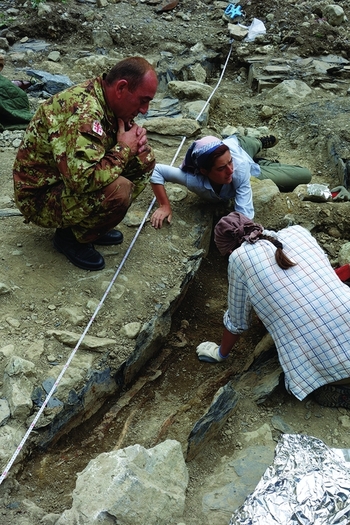
Geographically determined continuity: the sword-bearer in Grave G9 inspected by a member of the Georgian border police: two frontier guards a millennium apart?

The archaeology of the ‘Alan Gates’
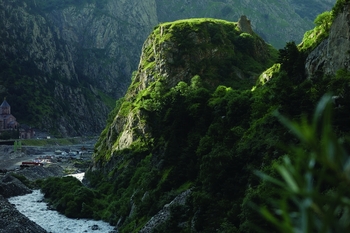
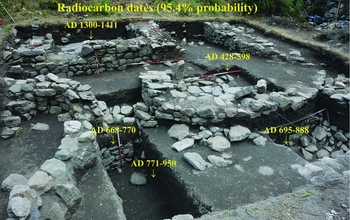
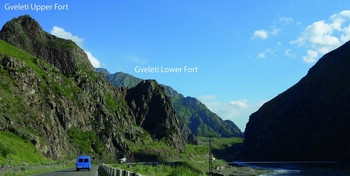
Despite its strategic significance, as reflected by prominent coverage in ancient and medieval sources, the gorge has received little archaeological attention. Pioneering work has been carried out by Georgian archaeologists, most notably by Dr Davit Mindorashvili (Reference Mindorashvili2005) who excavated a sondage at Dariali Fort from 1988–1991, as well as parts of an associatedmedieval cemetery and a second, early medieval cemetery 2.5km farther south. Dariali Fort is a multi-period stronghold dominating the gorge, c. 1km south of a wall on a precipitous ridge (Figure 2). It is widely agreed (e.g. Reineggs Reference Reineggs1796: 225–26; Klaproth Reference Klaproth1812: 671–75; Marquart Reference Marquart1903: 166; Braund Reference Braund and Talbert2000, Reference Braund2001: 40–41; Gagoshidze Reference Gagoshidze, Furtwängler, Gagoshidze and Löhr2008: 19) that this is the key fortification named Cumania by Pliny (6.30) in the first century and the ‘Alans’ Castle’ by Mas’udi (17; Barbier de Meynard & Pavet de Courteille Reference Barbier de Meynard and Pavet de Courteille1863: 43–45) in the tenth century. Both authors offer topographical descriptions that are perfectly compatible with Dariali Fort (Figure 3), with Mas’udi referring to an impregnable fort on a massive rock that towers over a substantial river and a bridge, and was capable of blocking all traffic. That the fort indeed housed a sizeable garrison in and before Mas’udi's time has now been demonstrated by means of a 10 × 10m trench excavated in 2013. A significant quantity of animal bone and pottery from substantial early medieval layers (with radiocarbon assays, dated using IntCal13 at 95.4% probability to AD 668/770–771/950; Figure 4) provides evidence for the stronghold being densely occupied, at the same time as parts of the nearby cemetery were in use (see below). It also shows occupation until at least AD 1300/1411, when Dariali Fort was under Georgian control and formed the border against the Golden Horde. A re-deposited bone of AD 428/598 (Figure 4) indicates, unsurprisingly, that Dariali Fort had been occupied in Late Antiquity, the period most extensively covered by the written sources, and we expect more early samples as our research progresses. An ancient stone barrier across the old road west of the fort (Figure 5) proves that it was indeed designed to control traffic. Flash-floods caused by the damming of the River Tergi as a result of repeated landslides (most recently in May and August 2014), together with modern road construction, appear to have destroyed any archaeological remains in the valley east of Dariali Fort. The fort was only part of a complex defensive system: a narrow stretch of the valley c. 1.5km south of the fort may have been fortified, and a second stronghold, Gveleti Fort, dominated the valley 3.5km south (Figure 6). Intriguingly, the earliest radiocarbon date (AD 776/969, at 95.4% probability, dated using the IntCal13 atmospheric curve) from Trench D, one of our two trenches on Gveleti Fort, also dates to the early medieval era, proving simultaneous occupation of the two forts.
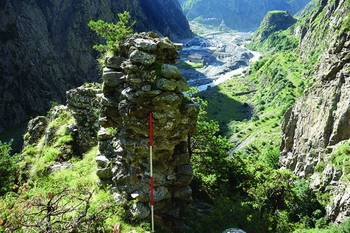
Part of the ‘Alan Gates’: a wall on a precipitous ridge, with Dariali Fort in the background.

Dariali Fort.

Trench F at Dariali Fort: early layers with radiocarbon dates (95.4%, using the IntCal13 atmospheric curve).

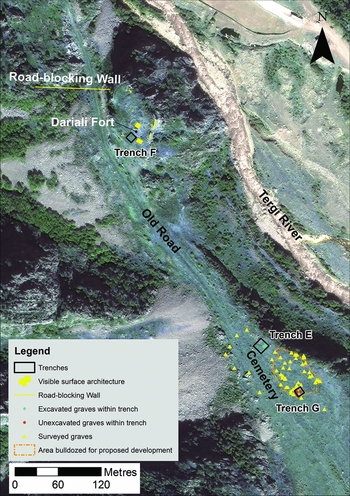
Plan of Dariali Fort and Cemetery, with Trenches E–G, by Kristen Hopper, Dan Lawrence and Graeme Erskine (imagery: WorldView-2, acquired 1 September 2010 © DigitalGlobe, Inc. All Rights Reserved).

Gveleti Fort dominating the valley.

Environmental constraints
How could the garrison have been sustained? Within the immediate vicinity of Dariali Fort (c. 10km), flat land is at a premium. The braided River Tergi flows through a steep gorge and regular avulsions made agriculture within its narrow flood plain very risky. Annual rainfall currently, and probably over the past 2000 years, amounts to 800–1000mm (Connor & Kvavadze Reference Connor and Kvavadze2008: figs 8 & 9), and only 124 days per year on average are frost-free. Temperatures during the winter months regularly plummet below 0°C, with deep snowfall restricting movement and agricultural possibilities (Radvanyi & Theroz Reference Radvanyi and Thorez1977: 309; Nakhutsrishvili Reference Nakhutsrishvili, Nagy, Thompson, Grabherr and Körner2003: tab. 3.8). Large, flat, low-lying areas of much greater agricultural potential only appear more than 10km south of Dariali Fort (Radvanyi & Theroz Reference Radvanyi and Thorez1977: 311; Connor & Kvavadze Reference Connor and Kvavadze2008: fig. 2). The Dariali Pass lies at the extreme limit of possible cultivable elevations, a limit considered to be reached at around 2000m above sea level, with areas above this altitude normally utilised for upland grazing (Wilkinson Reference Wilkinson2003: 197–98). In the early 1970s some 50% of arable land was used for pastoralism and only 6% for cultivation (Radvanyi & Thorez Reference Radvanyi and Thorez1977: 318).
A combination of remote sensing and topographically informed ground-based survey enabled us to record nine archaeological sites and three extensive terraced field systems, indicating substantial agricultural investment. Dating the sites and features currently visible is difficult because of the lack of surface finds and the probable repeated reuse of the limited stable landforms suitable for agriculture.
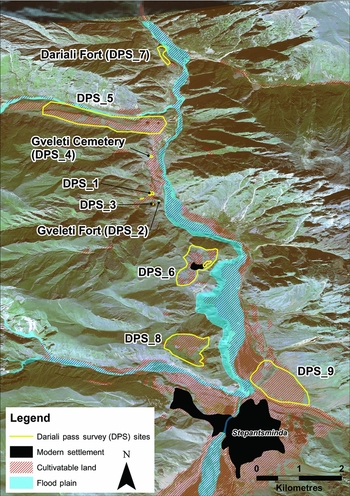
A Digital Elevation Model based on data from the ASTER Global Digital Elevation Model was used to predict possible cultivation areas based on slope gradient (<15°), altitude (<2000m above sea level) and accessibility from the base of the gorge (Figure 7). The benchmark figure of 15° reflects the average maximum slope gradient suitable for cultivation without terracing (FAO 1990). Based on these criteria, the maximum area that could be cultivated within a 10km radius of the fort is approximately 3100ha, although the actual figure is probably significantly smaller as small patches of land could not be utilised efficiently. The validity of the model is strengthened by the positive correlation between the sites and terrace systems discovered through the survey.
Map of the Dariali Gorge by Kristen Hopper and Dan Lawrence (imagery: WorldView-2, acquired 1 September 2010 © DigitalGlobe, Inc. All Rights Reserved).

On the above calculation of arable potential, it seems that there was sufficient land in the vicinity of the fort to provision between 775 and 6200 people, depending on the yield per hectare reaching that normally sufficient to support between 0.25 and 2 individuals (Wilkinson Reference Wilkinson1994: 495). Given the harsh climate and difficult terrain, however, we would favour an estimate closer to the lower limit. This could have been supplemented by agricultural production in the more favourable bioclimatic zone immediately to the south of the gorge and farther afield.
Human remains of an Early Medieval frontier community
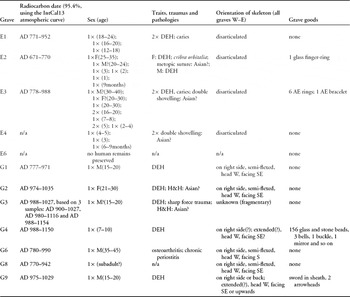
A cemetery south of Dariali Fort offered a unique opportunity to inform us about parts of this small frontier community: the garrison and their dependants. We excavated two trenches, Trench E (Figure 8), close to the fort, and Trench G (Figure 9), 75m farther south. It appears that the cemetery expanded away from the fort and therefore the earliest burials are in Trench E, and the later in Trench G. Even if the radiocarbon dates (see Table 1) are not precise enough to exclude the possibility that there may have been a period of overlap, it seems probable that burials in Trench E are all earlier than those in Trench G.
Darial Fort: excavated burials identified by Anthi Tiliakou, Annamaria Diana, Elena Kranioti and Catherine Shupe.

Key. F: female; M: male (sex unknown where not specified); DEH: dental enamel hypoplasia; H&H: hypocone & hypoconulid. In Trench E's collective burials bones were poorly preserved and had partially dissolved, whereas skeletal material from individual burials in Trench G was better preserved and did not show evidence for post-mortem handling. The osteological analysis was conducted using traditional macroscopic and microscopic methods for the estimation of demographic and pathological features (e.g. Buikstra & Ubelaker Reference Buikstra and Ubelaker1994; Ortner Reference Ortner2003).
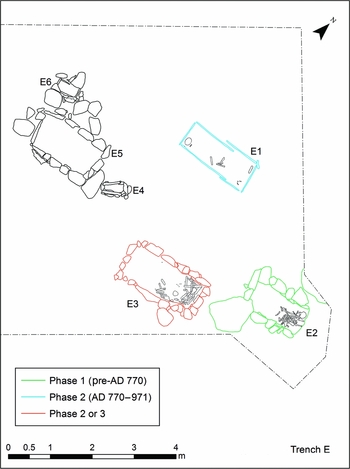
Plan of Trench E by Graeme Erskine and Gabriela Ingle.

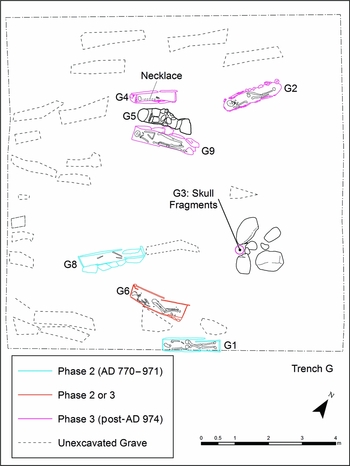
Plan of Trench G by Lana Chologauri, Annamaria Diana, Graeme Erskine, Ana Gabunia and Fiona Mowat.

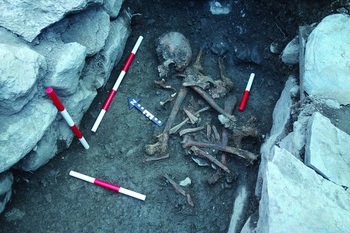
We observed a significant shift in burial practice between the two trenches: the four graves with preserved human remains in Trench E were all collective burials. When a new burial was introduced, the remains of those buried previously were moved, and not even the most recent skeletal elements were found in anatomical connection (Figure 10). By contrast, all six excavated burials in Trench G were undisturbed individual inhumations. A seventh grave (G3) had been disturbed.
The earliest burial: collective Grave E2.

Statistically less compelling, but worth noting, are changes in grave architecture and burial practice.
-
• Only one grave in Trench E was lined with slate plaques, as opposed to all of the graves in Trench G.
-
• Graves in Trench E, excluding two miniature graves for infants, were wider than those in Trench G.
-
• At least seven infants (and four children aged 4–8) were recovered from Trench E, with two small stone cists (E4 and E6) intended exclusively for small children, whereas the youngest individual in Trench G was 7–10 years old (and there were no miniature stone cists amongst the 27 visible graves).
-
• While the majority of excavated graves in both trenches were devoid of grave goods, the quantity of grave goods per individual (and in some cases also the quality) was substantially greater in Trench G.
The recovered skeletal population, of at least 28 individuals from the two trenches, mainly consisted of young individuals. An adult male of 35–45 years of age from Grave G6 represents the oldest person in the assemblage with clearly identified and diagnosed pathological lesions associated with osteoarthritis and signs of repeated infection on the lower limbs.
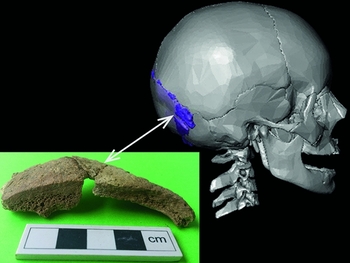
Of particular interest is a case of sharp force trauma from disturbed context G3 (Figure 11). Five cranial fragments were retrieved and there was a clear cut mark in the superior right occipital region. Its morphology and depth indicates that the injury was probably caused by an assailant approaching from behind and wielding a heavy, sharp weapon in a chopping action (Spitz Reference Spitz and Spitz2006). The curvature of the cut suggests that it was inflicted with a sabre, rather than a sword. No evidence of healing was observed on the surface or the margins of the wound, indicating that the individual, possibly a male aged 15–20 years, died shortly after the attack.
Fatal injury caused by a bladed weapon (G3); photograph by Elena Kranioti.

Malnutrition and long-distance food supplies?
Life may have been violent, and it was certainly harsh. Stress, illness or malnutrition caused linear or pitted defects in the dental enamel (dental enamel hypoplasia, see Table 1), reflecting growth interruption, and one case of pitting of the top of the eye socket, the orbital roof (cribra orbitalia). Such events seem to have taken place frequently during childhood, affecting at least 12 out of the 24 individuals examined.
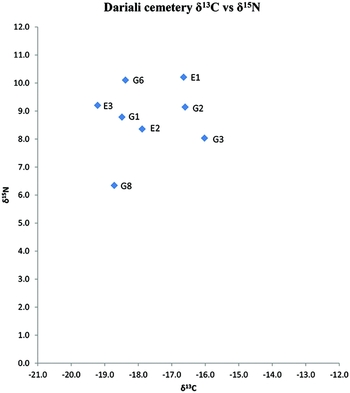
Hardship may have been caused by limited resources in an Alpine environment; it is probable that, to judge by sulphur stable isotope analysis, the individuals had always lived here and had not just recently migrated to the area. The δ34S (atmospheric sulphur) values (based on just six samples) occur in a narrow range from 0.2–4.7‰, with an average value of 2.7±1.7‰. The geology of this region is predominantly composed of metamorphic and igneous rocks (Bock et al. Reference Bock, Jolls and Lewis1995). Sulphur in igneous rocks of primary origin has δ34S values in a narrow range close to 0‰ (Thode Reference Thode, Krouse and Grinenko1991). The δ34S values of the Dariali cemetery population are, therefore, consistent with local domiciles or migration from a region with similar geological δ34S values. Overall, the δ15N values are quite consistent too. The individual buried in G8 had a relatively depleted δ15N value, 2.5‰ below the site average of 8.8‰, perhaps indicating different dietary intake. Alternatively, this individual may have originated from a region with distinctive soil δ15N values that were transmitted through the food chain.
Analysis of carbon and nitrogen stable isotopes, whose ratios in bone collagen have been demonstrated to be reliable indicators of dietary protein intake at the level of the individual over at least the last ten years of their lifetime, suggests that the garrison was not solely dependent on local resources. The eight individuals sampled had an average δ13C value of -17.7±1.2‰ (1σ) and δ15N value of 8.8±1.2‰ (1σ) (Figure 12). The δ13C standard deviation (1σ) greatly exceeds that associated with monotonous diets (DeNiro & Schoeninger Reference DeNiro and Schoeninger1983). Generally, intra-population differences in δ13C values indicate the consumption of varying proportions of foods from the C3 and C4 plant food-webs, or aquatic resources; the latter were in short supply in the area, and their consumption is normally associated with an attendant enrichment in δ15N values. This enrichment is not evident in the population; those individuals with relatively enriched δ13C values have similar δ15N values to those with relatively depleted δ13C values. Consumers of resources from only the C4 food web have average values of c. -7.5‰ (Van der Merwe & Vogel Reference Van der Merwe and Vogel1978). The average δ13C values of C3 food-web consumers may, by contrast, vary geographically from c. -21.5‰ to -18.0‰. Pearson et al. (Reference Pearson, Buitenhuis, Hedges, Martin, Russell and Twiss2007) and Bonsall et al. (Reference Bonsall, Cook, Pickard, McSweeney, Bartosiewicz, Crombé, Van Strydonck, Sergant, Boudin and Bats2009) quoted a threshold value for consumption of foods from the C4 plant food-web of δ13C >18.0‰. Applying this value to the Dariali cemetery data suggests that three of the sampled individuals (E1, G2 and G3) had a significant contribution of C4 resources to their diets, i.e. food grown in a climate with a warm temperature and a long growing season.
Isotope analysis by Catriona Pickard.

This may be supported by information provided by Mas’udi (17). In the tenth century the garrison was still supplied in part by frequent food provisions from Tbilisi, an area of favourable climatic conditions. These supplies, arriving via convoys travelling for five days through ‘infidel’ lands, were apparently not particularly lavish or dependable, to judge by the evidence mentioned above for frequent episodes of malnutrition affecting most of the population. It has been suggested that the provisions were supplied by pious Muslims for their fellow believers (Minorsky Reference Minorsky1958: 157), rather than via a tightly organised military supply chain. Along with the difficulties in getting convoys across the mountains through potentially hostile territory, not to mention frequent road-blockage by snowfall and landslides, this may explain why they were insufficient to ensure a healthy diet. If that interpretation is correct then the links between the Muslim garrison and its southern masters or fellow believers must have lasted beyond Mas’udi's time, at least until AD 988 and possibly later.
Religion and ethnicity of the medieval guardians of the Gates
Mas’udi (17) indicates that an Arab garrison, whose descendants still guarded the Gates in his own time (c. AD 943) and still in receipt of the supplies discussed above, was already posted at the Gates in AD 727/732. Baladhuri (210; Hitti Reference Hitti1916: 328–29) refers to a (supplementary?) garrison posted here in AD 758. Although the community's postulated Arab ancestry cannot be proven or disproven, it is worth noting that five individuals (see Table 1) displayed dental traits possibly associated with Asian ancestry (Carbonell Reference Carbonell and Brothwell1963; Pacelli & Márquez-Grant Reference Pacelli and Márquez-Grant2010), albeit neither certain nor geographically limited to any particular region. One additional individual, a female from E2 who may have belonged to the first or second generation of the community (based on the terminus ante quem of AD 770, provided by radiocarbon dating: Table 1), presented cranial traits (prominently flat frontal bone, prominent zygomatics and well-defined round orbits) that may be associated with Mongoloid (Asiatic) ancestry (Gill Reference Gill and Reichs1998; İşcan & Steyn Reference İşcan and Steyn2013: 195–226). The reported arrival date of the garrison, AD 727/732 (Mas’udi 17), would in any case be compatible with the radiocarbon date for the earliest burial (AD 671/770), implying that the cemetery was established for the new garrison. Land suitable for burial was in short supply, perhaps suggesting that there had been no cemetery, or at least not a large one, in the vicinity of the fort for the previous (Zoroastrian?) garrison.
The small number of grave goods, confined to basic items of personal jewellery, in Trench E is typical for early medieval burials in Georgia. Such burials have been interpreted as Christian (Ramishvili Reference Ramishvili1969; Vickers & Kakhidze Reference Vickers and Kakhidze2004: 209–10; Chikhladze Reference Chikhladze, Gamkrelidze and Vickers2010), but Islam shares similar traditions. The graves are oriented west–east, as are those in Trench G. In all six complete burials in Trench G the head of the skeleton was to the west, and faced south or south-east in at least four or five cases. (The crania in G4 and G9 were poorly preserved, but grave goods clustered in the south of G4.) Such an orientation may mark out Muslim burials facing Mecca (Simpson Reference Simpson, Campbell and Green1995; Halevi Reference Halevi2007: 1–2, 187–91, 320–21), but late antique and early medieval Christian graves in Georgia often show an identical orientation, as do ostensibly pagan burials outside the likely sphere of influence of Abrahamic religions (Khalikova Reference Khalikova1976). It is therefore not easy to ascertain the religion of the deceased. The scarcity of grave goods, and the particular orientations, does point, however, to them having been either Muslims or Christians.
The possible male from Grave G3, killed by an injury inflicted with a bladed weapon to the back of his head in AD 988/1027, and apparently afforded no more than a basic burial, is amongst those evidently having access to some food from the south (as shown by isotope analysis) and was thus perhaps still a member of the Muslim garrison. He may have been a victim of violence within the community, a skirmish or hostile takeover.
The two most lavishly furnished burials (G4 and G9) of c. AD 1000 were roughly contemporary with G3. Grave G4 contained the remains of a girl(?), buried with jewellery, including 156 glass and stone beads, three bronze bells and other personal items, such as a belt buckle and broken bronze mirror, which have numerous parallels across early and high medieval Eurasia. The young man in G9 was buried with two arrowheads and a sword in its sheath. The two D-shaped suspension loops of the sheath mark an innovation that spread across the steppes of Eurasia, as well as China and the Islamic world (Khalikova Reference Khalikova1976: 163–64, 172–73; Nicolle Reference Nicolle2002: 127–47, pls XI–XII passim; Koch Reference Koch, Mode and Tubach2006; Stark Reference Stark2008: 153–56; Stöllner & Samašev Reference Stöllner and Samašev2013: 857, 936, 950). Such diagonal suspension from a warrior's belt would have allowed the sword or sabre to be drawn more rapidly. Similar bladed weapons and arrows are common amongst grave goods in early medieval burials in northern Europe. We cannot be sure, however, whether the armed male was a descendent of the original garrison who adapted to northern customs, whether he may have been a (pagan or Christian?) mercenary in Muslim service or perhaps a member of an entirely new garrison, of northern origins, which had taken over the Gates around the turn of the millennium.
The continuous use of the same area of the cemetery and the evidence from sulphur isotopes pointing to the deceased having grown up locally, or in a similar geological area, may be arguments for continuity, albeit tenuous ones—especially as no isotope data are available for the very young individuals buried following northern traditions (G4 and G9). We do not know how long the garrison remained in command beyond AD 988, or how long the increasingly isolated Emirate of Tbilisi was able to provision an outpost. The Alans reportedly crossed the Gates repeatedly, notably in AD 1062 and 1065 (Minorsky Reference Minorsky1953: 20–22), but we do not know whether they broke through by force, with or without ousting and replacing the garrison, or whether there was a shift of alliance. Whatever the religious and ethnic composition of the eleventh-century garrison, there is no evidence to date that the cemetery was still in use after Dariali Fort was conquered by King Davit II of Georgia in c. AD 1118 (Life of Kartli 336; Thomson Reference Thomson1996: 326–28).
Conclusions
Archaeology appears to corroborate the written sources, attesting that the defences were under the control of southerners of Muslim faith from the eighth century onwards, and that they retained this garrison until at least the AD 980s and possibly beyond. Life at the frontier post was harsh, as suggested by the present climate, evidence for malnutrition and the violent death of one individual. The contemporary occupation of Dariali and Gveleti Forts, with no evidence as yet that Gveleti Fort dates back to Antiquity, suggests that the efforts devoted to defending the Dariali Gorge were at least as great in the later first millennium AD as they had been in Late Antiquity, the period most prominently covered by the sources and modern scholarly literature. It is possible that a temporary peak in population levels on the north side of the Caucasus from the middle to later first millennium AD (Kazanski & Mastykova Reference Kazanski and Mastykova2003; Korobov & Borisov Reference Korobov and Borisov2013) led to increased pressure; the contemporary occupation of the two strongholds may reflect a strategic response. Dariali Fort and the wall 1km farther north, built on a ridge with a steep, north-facing cliff face (Figure 2), would have been particularly hard to capture when approaching from the north. Gveleti Fort on the other hand, while not easy to access from the north, would have proved equally difficult to approach from the south, where there is a vertical cliff (Figure 6). According to Mas’udi, it was impossible to pass ‘the Alans’ Castle’ (Dariali Fort) without the permission of its garrison, yet several Khazar invasions in the eighth and ninth centuries succeeded (Dunlop Reference Dunlop1954; Bosworth Reference Bosworth1978; Czeglédy Reference Czeglédy1960; Golden Reference Golden1980; Golden et al. Reference Golden, Ben-Shammai and Róna-Tas2007, with sources). The risks of a raid into Transcaucasia would have further decreased if hostile forces knew that the garrison in the Dariali Gorge was not only able to inflict heavy losses on anybody attempting to break through from north to south, but also had the capability to cut off their return and escape route, thus leaving them stranded in a hostile environment. While perhaps not entirely impenetrable by a strong and determined foe, the significant investment in blocking the key mountain pass across the central Caucasus in the Early Middle Ages, notwithstanding food shortages and harsh living conditions, is a testament to the major role it played in trying to keep Transcaucasia secure from its powerful northern neighbours.
Acknowledgements
We are most grateful to the European Research Council for funding our fieldwork as part of the ‘Persia and its Neighbours’ project. Without the kind support of Professor Vakhtang Licheli, Professor Michael Vickers, Dr Manana Odisheli, Davit Naskidashvili and our great team (Lana Chologauri, Graeme Erskine, Ana Gabunia, Davit Gagoshidze, Ketevan Gotsiridze, David Greenwood, Gabriela Ingle, Emanuele Intagliata, Koba Koberidze, Dr Eve MacDonald, Fiona Mowat, Dr Seth Priestman, Steve Usher-Wilson, Dr Julian Jansen Van Rensburg, our workmen and co-authors) none of this could have been achieved. The comments of Dr Paul Everill and a second, anonymous reviewer have improved the article. Oxford's Research Laboratory for Archaeology and the History of Art provided the radiocarbon dates. We are also indebted to Professor David Braund, the late Professor Tony Wilkinson and many others that space does not allow us to list.