Introduction
The aim of our research is to develop a comprehensive, coherent and consistent description of the relationship between sheep and their gastrointestinal nematodes; then to use this understanding to produce sustainable methods of parasite control. Nematode infections are responsible for the some of most serious diseases faced by sheep (Perry & Randolph, Reference Perry and Randolph1999; Nieuwhof & Bishop, Reference Nieuwhof and Bishop2005). In cool, temperate areas of the world, such as Scotland, there are over a dozen gastrointestinal nematode species that infect sheep but the dominant species is Teladorsagia circumcincta. For example, on one Scottish farm, over 80% of all the parasitic nematodes belonged to this species (Stear et al., Reference Stear, Bairden, Bishop, Gettinby, McKellar, Park, Strain and Wallace1998). A typical Scottish hill farm might contain 2000 sheep and 200,000,000 nematodes. If animals are left untreated, nematode infections can kill, but perhaps their major impact is the reduction in growth rates that occur in infected lambs (Coop et al., Reference Coop, Sykes and Angus1982, Reference Coop, Graham, Jackson, Wright and Angus1985). Clearly, efficient and welfare-friendly sheep production demands the control of nematode infection.
We have explored several aspects of the host–parasite relationship, including descriptive epidemiology (Stear et al., Reference Stear, Bairden, Bishop, Buitkamp, Duncan, Gettinby, McKellar, Park, Parkins, Reid, Strain and Murray1997a), host genetic variation (Bishop et al., Reference Bishop, Bairden, McKellar, Park and Stear1996; Stear et al., Reference Stear, Bairden, Duncan, Holmes, McKellar, Park, Strain, Murray, Bishop and Gettinby1997b, Reference Stear, Boag, Cattadori and Murphy2009; Stear & Wakelin, Reference Stear and Wakelin1998; Bishop & Stear, Reference Bishop and Stear2001), the mechanisms of protection (Stear et al., Reference Stear, Bishop, Doligalska, Duncan, Holmes, Irvine, McCririe, McKellar, Sinski and Murray1995, Reference Stear, Strain and Bishop1999a, Reference Stear, Strain and Bishopb), the pathogenesis of infection (Stear et al., Reference Stear, Bishop, Henderson and Scott2003) and different methods of nematode control (Stear et al., Reference Stear, Doligalska and Donskow-Schmelter2007). However, there is a limit to the amount of information that can be gained by experimentation alone. It is not possible to examine all possible combinations of variables in the field. Mathematical modelling has an essential role to play in developing and testing predictions about different methods of control. In addition, modelling can synthesize the results from different experiments and provide a general testable framework for understanding the dynamics of infection.
Mathematical modelling
A variety of excellent models of nematode infection in livestock are available and these have been reviewed recently (Cornell, Reference Cornell2006). We now have a fairly clear idea of the key processes underlying the mechanisms of protection, particularly to abomasal infections (Stear et al., Reference Stear, Boag, Cattadori and Murphy2009). Immunity develops slowly over several months as a response to infection and parasite fecundity is regulated before parasite establishment and survival. Variation in parasite fecundity is strongly and consistently associated with variation in IgA activity against fourth-stage larvae, while variation in the number of nematodes is associated with variation in immediate hypersensitivity reactions, especially the number of globule leucocytes (Stear et al., Reference Stear, Bishop, Doligalska, Duncan, Holmes, Irvine, McCririe, McKellar, Sinski and Murray1995).
We have incorporated this knowledge into a mechanistic model of the immune response to nematode infection (Singleton et al., Reference Singleton, Stear and Matthews2010). In this model we followed the course of nematode infection in newborn lambs through the grazing season, explicitly modelling the role of IgA and density dependence in regulating worm fecundity, and parameterizing the rate of parasite establishment by using a recent meta-analysis (Gaba et al., Reference Gaba, Gruner and Cabaret2006). The model parameters were based on published data on the nematode life cycle and host–parasite interactions. The immune-related parameters were mostly informed by a large data set from commercially managed populations of Scottish Blackface sheep. With this model we were able to emulate observed patterns of faecal egg counts over the season.
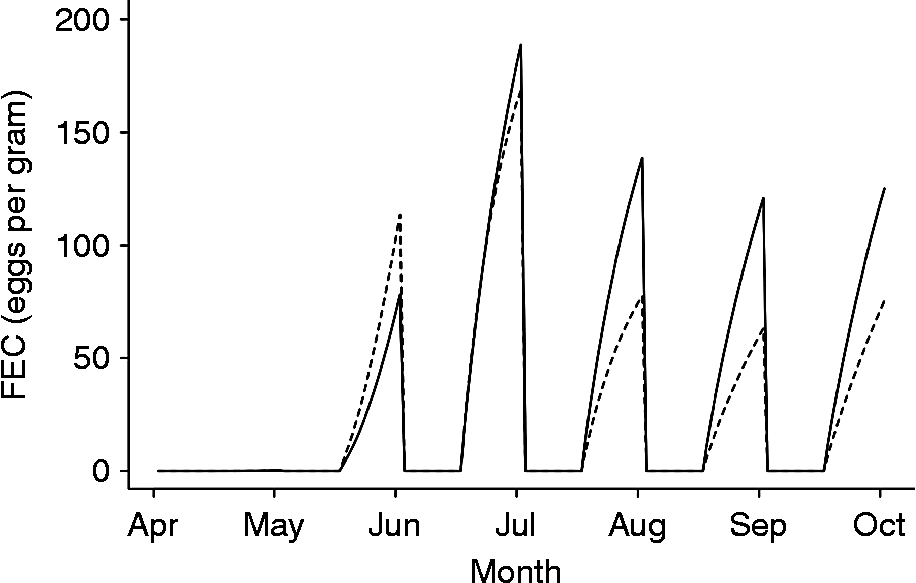
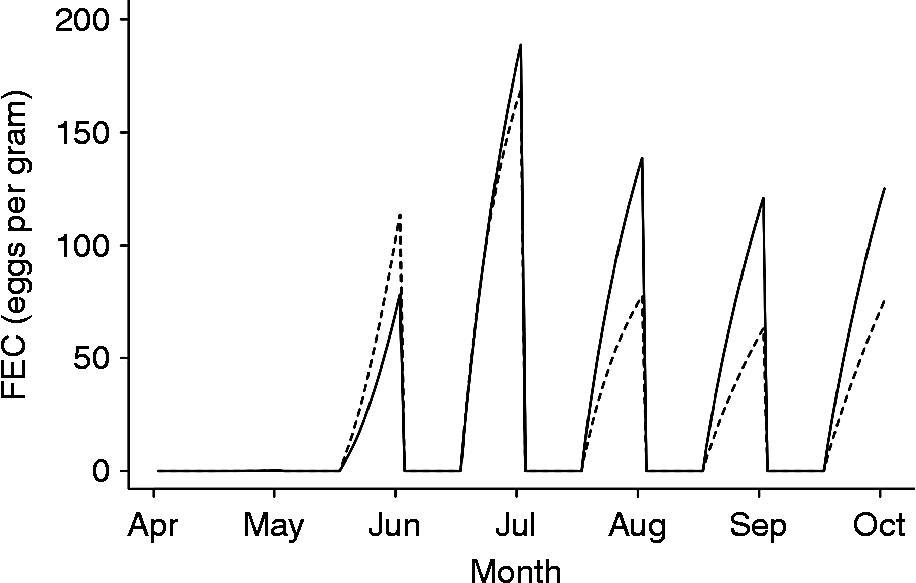
One remarkable feature of the system described by this model is its robustness to perturbations in the majority of parameters. This may be due to feedback loops between the intensity of exposure and the immune response, although density-dependence may play a role. For example, if the intensity of infection is increased, a stronger immune response develops and the severity of infection is reduced. If the number of ewes and lambs on pasture is reduced, the lambs ingest fewer eggs, produce weaker immune responses and end up producing higher numbers of parasite eggs (fig. 1).
The influence of stocking density on faecal egg count (FEC). The solid line represents a stocking density of 30 lambs per hectare while the dashed line represents 50 lambs per hectare. Reducing the stocking density leads to decreased egg counts but this is short-lived. Reduced infection rates lead to decreased immune responses and this allows parasite numbers to recover.
Feedback loops describe why the host–parasite relationship is robust but this is, in the terms of evolutionary biology, a proximate, mechanistic explanation. Ultimately, the system is robust because it has evolved that way. In other words, host and parasite have coevolved together to produce a system that ensures infection occurs at an intermediate level nearly every year. Alternatively, any host–parasite system that is not robust is unlikely to survive over millennia; if the intensity of infection drops too low, then the parasite population may go extinct, while if the intensity is too high, this could result in the extirpation of the host population.
Coevolution
Teladorsagia circumcincta and its ancestors in the subfamily Ostergiinae appear to have been infecting sheep and their ancestors for millions of years. The Bovidae (cattle, sheep and their relatives) family contains over 130 different living species and occurs in the suborder Ruminantia (Fernández & Vrba, Reference Fernández and Vrba2005). The earliest fossils in this family are found in the early Miocene over 20 million years ago (Janis, Reference Janis1993). At this time the climate was becoming warmer and much drier, leading to the development of open woodland and grasslands (Janis, Reference Janis1993). These ecological changes coincided with the rapid radiation of the Bovidae into different tribes including the Caprinae (sheep and goats) and the Bovinae (cattle and bison). The coevolution of grazing Bovidae and grass has been well-described (Stebbins, Reference Stebbins1981). The coevolution of nematodes and their bovid hosts has also led to coadapted species.
The Ostertagiinae are a subfamily of the Trichostrongylidae and the three subfamilies Graphidiinae, Ostertagiinae and Haemonchinae form a clade of nematodes that infect the stomach or abomasum (Hoberg & Lichtenfels, Reference Hoberg and Lichtenfels1994). As nematodes seldom leave fossil evidence, it can be difficult to date the times of divergence. The widespread occurrence of the Haemonchinae and Ostertagiinae among Bovidae and Cervidae (Hoberg & Lichtenfels, Reference Hoberg and Lichtenfels1994) suggests that the ancestral nematode species was already a parasite of pecoran artiodactyls (Hoberg & Lichtenfels, Reference Hoberg and Lichtenfels1994). In sheep, coevolution and cospeciation, rather than host switching, is supported by the occurrence of morphologically similar nematode species in sheep (T. circumcincta) and the closely related muskoxen (Teladorsagia boreoarcticus ) (Hoberg et al., Reference Hoberg, Monsen, Kutz and Blouin1999). Goats too, probably have a distinct species of Teladorsagia (Leignel et al., Reference Leignel, Cabaret and Humbert2002). Taken together, this evidence suggests that coevolution between the Bovidae and the Ostertagiinae has been occurring for at least 10–20 million years. Therefore there has been ample time for the host–parasite system to evolve.
There are two competing hypotheses for the relative impact of host and parasite on the outcome of coevolution. Hypothesis 1 states that coevolution is driven by the faster response of the parasite. This hypothesis is widely believed and suggests, for example, that selection for disease resistance will fail because the faster response of the parasite will subvert the host immune system. Hypothesis 2 suggests that both host and parasite are evolving to maximize their reproductive success. The existing relationship represents a compromise between the requirements of both host and parasite.
The results of coevolution of host and nematode can be inferred from studying existing breeds of sheep. The abomasal nematode Haemonchus contortus is a major problem for sheep in East Africa. The indigenous Red Maasai breed appears much more resistant to infection than recently imported breeds (Mugambi et al., Reference Mugambi, Wanyangu, Bain, Owango, Duncan and Stear1996; Baker et al., Reference Baker, Mwamachi, Audho, Aduda and Thorpe1999; Nginyi et al., Reference Nginyi, Duncan, Mellor, Stear, Wanyangu, Bain and Gatongi2001). The Red Maasai were probably introduced into Kenya from the north about 2000 years ago; subsequent coevolution has produced a relatively resistant breed. There are a large number of additional breeds of sheep that are resistant to nematodes. These breeds include the Gulf Coast Native (Bahirathan et al., Reference Bahirathan, Miller, Barras and Kearney2000; Miller & Horohov, Reference Miller and Horohov2006), St Croix (Gamble & Zajac, Reference Gamble and Zajac1992), Barbados Blackbelly (Yazwinski et al., Reference Yazwinski, Goode, Moncol, Morgan and Linnerud1979, Reference Yazwinski, Goode, Moncol, Morgan and Linnerud1981) and Texel (Sayers et al., Reference Sayers, Good, Hanrahan, Ryan, Angles and Sweeney2005a, Reference Sayers, Good, Hanrahan, Ryan and Sweeneyb; Sayers & Sweeney, Reference Sayers and Sweeney2005). In each case the resistant breed appears to have developed resistance as a consequence of long exposure to the parasite.
Examples of breed differences in disease resistance are not confined to nematodes. Other examples where the host has evolved resistance to disease or infection include cattle and trypanosomes as well as zebu cattle and the cattle tick Rhipicephalus microplus (Stear et al., Reference Stear, Bishop, Mallard and Raadsma2001). Perhaps the best-documented example of coevolution is the deliberate introduction during the 20th century of myxoma virus into European rabbits in Australia (Nicholas, Reference Nicholas1987). Here, rabbits have evolved greater resistance to myxoma virus while the myxoma virus has become less virulent. The virus is transmitted by fleas and highly virulent strains of myxoma virus have lower rates of transmission because they kill their hosts too quickly.
Care is needed when examining domesticated animals because deliberate selection for production traits could overwhelm natural selection for disease resistance. However, modern breeds were only formed in the past 200 years and intensive selection for increased production has only been applied in the past 50 years to a small number of breeds in the richer countries of the world. The existence of parasite-resistant breeds almost certainly reflects natural selection over millennia rather than correlated responses to deliberate selection. These patterns clearly demonstrate that hosts are able to evolve resistance to infection; host–nematode coevolution is not driven solely by the parasite. Both host and parasite are able to shape the relationship.
Rates of molecular evolution
There is little doubt that nematodes have the potential to evolve more rapidly than their hosts. Three of the forces that determine the response to selection are the generation interval, effective population size and the intensity of selection (Nicholas, Reference Nicholas1987). Nematodes have shorter generation intervals and larger population sizes than their hosts. In addition, they can suffer much higher mortality rates than their vertebrate hosts and consequently the intensity of selection can be much greater. One possible reason that hosts are able to evolve resistance despite the greater evolutionary potential of parasites is because selection pressure on individual nematode antigens is low. In order to examine the rate of evolution, we decided to explore the evolution of parasite antigens at the molecular level. There are surprisingly few studies of molecular evolution between the immune system of ruminants and nematode antigens. Therefore we set out to identify, clone, sequence, express and study nematode molecules. As IgE activity is associated with resistance to infection with T. circumcincta (Murphy et al., Reference Murphy, Eckersall, Bishop, Pettit, Huntley, Burchmore and Stear2010), we chose to study the allergens that generate IgE responses.
We separated molecules from third-stage larvae of T. circumcincta by two-dimensional electrophoresis then carried out Western blotting with a monoclonal antibody to ovine IgE (Murphy et al., Reference Murphy, Eckersall, Bishop, Pettit, Huntley, Burchmore and Stear2010). Positive spots were subjected to tandem mass spectrometry, which identified nine different parasite molecules that were detected by sheep IgE. One molecule, tropomyosin, was then cloned, sequenced and expressed. The molecule had 284 amino acids and only one amino acid was different in tropomyosin from the nematode Trichostrongylus colubriformis. The genera Trichostrongylus and Teladorsagia both belong to the order Strongylida and are in the same clade V (Dorris et al., Reference Dorris, De Ley and Blaxter1999; Blaxter et al., Reference Blaxter, Dorris and De Ley2000). In general, there is little genetic divergence among taxa in the Strongylida (Dorris et al., Reference Dorris, De Ley and Blaxter1999). Therefore the similarity between tropomyosin from T. circumcincta and T. colubriformis is unlikely to be a consequence of convergent evolution and probably reflects shared ancestry. The similarity between the two tropomyosins is, however, surprisingly high.
The similarity in sequence suggests that there has not been intense selection for diversity in allergenic structures. Hosts and parasites are widely assumed to be in an arms race (Dunne & Cooke, Reference Dunne and Cooke2005; Pál et al., Reference Pál, Papp and Lercher2006). Arms races lead to rapid changes in protein sequence but there does not appear to be a race between the sheep immune system and nematode antigens. It appears less of an arms race than a slow amble through evolutionary time.
Another molecule from T. circumcincta that generates an IgE response is paramyosin (Murphy et al., Reference Murphy, Eckersall, Bishop, Pettit, Huntley, Burchmore and Stear2010). The closest match to our protein sequence from the tandem mass spectrometry was with paramyosin from Dictyocaulus viviparous. Paramyosin from T. circumcincta has 99% identity with the homologous molecule from Caenorhabditis elegans – a non-parasitic model organism from the nematode order Rhabditina, which is also in clade V. Again, there is no evidence of extensive sequence changes to support an arms race between the host immune system and nematode allergens. A third allergen is heat-shock protein 70 (Murphy et al., Reference Murphy, Eckersall, Bishop, Pettit, Huntley, Burchmore and Stear2010). There is no protein sequence in the databases for any of the nematodes in the family Ostertagiinae and the closest match is a partial, single-read cDNA sequence from H. contortus (accession number CB192257). After translation this sequence was aligned with HSP70A from C. elegans; there are nine amino acids different out of 283. At first sight, this is consistent with an arms race, but there are five different amino acids between C. elegans and Caenorhabditis briggsae. Therefore the longer evolutionary distance between C. elegans and H. contortus has not produced any more changes than the relatively short time since divergence of C. elegans and C. briggsae. Again, there is no evidence to suggest that nematode parasites in sheep have been subject to an arms race with the host immune system.
There are several possible explanations for the slow evolution of the allergen tropomyosin. There may be strong evolutionary pressure but tropomyosin is constrained by its structure and is unable to mutate without affecting its primary function. A comparison of the structure of tropomyosin with tropomyosin from Onchocerca volvulus, Trichinella spiralis and Acanthocheilnema viteae shows 16, 25 and 21 differences in the 284 amino acids. Trichinella spiralis is a clade 1 nematode from the order Trichocephalida while the filarial nematodes, O.volvulus and A. viteae are in clade III. As such, these nematodes are separated by much longer time periods than the two clade V nematodes T. circumcincta and T. colubriformis. However, the relatively large number of amino acid differences suggests that structural constraints are not the major reason for the similarity between tropomyosin from T. circumcincta and T. colubriformis.
Alternatively, there may be little selective pressure on tropomyosin because it is unimportant in protective immunity. This explanation was explored by developing an antigen-specific enzyme-linked immunosorbent assay (ELISA) and testing 222 lambs from the same flock of Texel sheep. A general linear model that fitted year of birth and sex as fixed effects and transformed IgE activity (X0.25) as a covariate was used to examine the relationship with log-transformed egg counts (Murphy et al., Reference Murphy, Eckersall, Bishop, Pettit, Huntley, Burchmore and Stear2010). This analysis showed that increased IgE activity against tropomyosin was associated with decreased egg counts (P = 0.03). Therefore, recognition of tropomyosin appears to contribute to protection.
In addition to the antigen-specific ELISA for tropomyosin, two other antigen-specific ELISAs have been published for sheep nematodes. Increased IgE activity against a high molecular weight allergen from T. circumcincta was also associated with decreased egg counts (Huntley et al., Reference Huntley, Redmond, Welfare, Brennan, Jackson, Kooyman and Vervelde2001). Similarly, high IgE activity in New Zealand sheep against an aspartyl protease inhibitor from T. colubriformis was also associated with low egg counts (Shaw et al., Reference Shaw, McNeill, Maass, Hein, Barber, Wheeler, Morris and Shoemaker2003). Together these results indicate that protection against nematodes involves the recognition of a variety of molecules, each of which is partially protective. Consequently, a mutation in a single parasite molecule, such as tropomyosin, may reduce the efficacy of the host immune response only slightly. Therefore the selective pressure on each parasite molecule will be slight. A related explanation involves variation among animals in the immune response. This requires a more detailed explanation.
Inter-animal variation in resistance to nematode infection
There is considerable variation among animals in resistance to nematode infection. This variation is typically overdispersed (Stear et al., Reference Stear, Bairden, Bishop, Gettinby, McKellar, Park, Strain and Wallace1998). Most hosts have relatively low levels of infection and shed few transmission stages such as eggs or larvae. A small proportion of individuals harbour relatively high numbers of parasites or produce a disproportionate number of transmission stages. The majority of the next generation of parasites come from a relatively small proportion of susceptible hosts with relatively weak immune responses. Additionally, each parasite molecule only makes a small contribution to resistance. Consequently, the selection pressure on individual antigenic parasite molecules may be relatively weak. Weak selection pressure could cause parasite molecules to evolve slowly.
The relatively slow evolution of parasite molecules will help to ensure that nematodes remain susceptible to host immune responses. In contrast, hosts will be under strong selection pressure to mount effective immune responses against nematodes. This asymmetric selection pressure could explain why hosts are able to evolve resistance despite the greater evolutionary potential of parasites.
There is considerable debate about the importance of heritable variation as a source of individual heterogeneity in resistance to disease. There are essentially two hypotheses. Hypothesis 1 states that fitness traits have very low heritability. Hypothesis 1 derives from the fundamental theorem of natural selection (Fisher, Reference Fisher1930). This theorem states that genes that positively influence fitness traits such as disease resistance will be subject to natural selection and increase in frequency until they become fixed. This will lead to loss of heritable genetic variation and consequently low heritabilities for fitness traits. In farm animals, traits associated with viability and reproductive ability (fitness traits) often show lower heritabilities than production traits (Nicholas, Reference Nicholas2010). The alternative hypothesis postulates substantial genetic variation among individuals in fitness traits.
A variety of studies have clearly shown that faecal nematode egg counts in sheep are heritable, with heritabilities usually in the range 0.2 to 0.4 (Bishop et al., Reference Bishop, Bairden, McKellar, Park and Stear1996; Baker et al., Reference Baker, Mwamachi, Audho, Aduda and Thorpe1999; Smith et al., Reference Smith, Wilson, Pilkington and Pemberton1999; Bishop & Stear, Reference Bishop and Stear2001; Bisset et al., Reference Bisset, Morris, McEwan and Vlassoff2001; Woolaston & Windon, Reference Woolaston and Windon2001). For natural infections in cool temperate climates, such as Scotland, the nematode population is dominated by T. circumcincta. Here the heritability of egg counts increases from 0.10 in 3-month-old lambs to 0.33 in 6-month-old lambs over the grazing season (Bishop et al., Reference Bishop, Bairden, McKellar, Park and Stear1996; Stear et al., Reference Stear, Bairden, Bishop, Buitkamp, Duncan, Gettinby, McKellar, Park, Parkins, Reid, Strain and Murray1997a). Presumably, the increase in heritability reflects the development of immune responses against nematodes. Lambs vary in the intensity, specificity and effectiveness of their immune responses against nematodes (Stear et al., Reference Stear, Fitton, Innocent, Murphy, Rennie and Matthews2008). Genetic variation in immune responses will produce genetic variation in faecal egg counts (Strain et al., Reference Strain, Bishop, Henderson, Kerr, McKellar, Mitchell and Stear2002).
The heritability of worm number and worm length, a measure of parasite fecundity as longer worms produce more eggs (Stear & Bishop, Reference Stear and Bishop1999), has also been investigated in sheep. For naturally infected lambs at the end of the grazing season, the heritability of the number of adult T. circumcincta is only 0.14 and not significantly different from zero, but the heritability of adult female worm length is remarkably high at 0.62 (Stear et al., Reference Stear, Bairden, Duncan, Holmes, McKellar, Park, Strain, Murray, Bishop and Gettinby1997b). This high heritability of worm length means that genetic variation in the host has almost twice as much influence on the mean length of nematodes as everything else put together.
The situation may be different for H. contortus. A separate study found the heritability of worm burden was 0.54 in Rhon sheep but only 0.06 in Merinoland sheep, while the heritability of worm length was not significantly different from zero in both breeds (Gauly et al., Reference Gauly, Kraus, Vervelde, van Leeuwen and Erhardt2002).
The most important antibody responses in protection against T. circumcincta appear to be IgA activity against fourth-stage larvae and IgE activity against third-stage larvae. Both these responses are overdispersed, with most animals producing relatively weak responses. The heritability of peripheral IgA activity against fourth-stage larvae in 5-month-old Scottish Blackface lambs was 0.56 (Strain et al., Reference Strain, Bishop, Henderson, Kerr, McKellar, Mitchell and Stear2002) while the heritability of IgE activity against third-stage larvae in 6-month-old Texel lambs was 0.39 (Murphy et al., Reference Murphy, Eckersall, Bishop, Pettit, Huntley, Burchmore and Stear2010). In New Zealand lambs the heritability of IgE responses to T. colubriformis was 0.36. These moderate to high heritabilities indicate that much of the variation among animals in resistance to nematode infection is under genetic control.
Fisher's fundamental theorem of natural selection predicts that heritable variation in fitness traits will be very low. The existence of substantial heritable variation in resistance to nematodes and in the immune response to nematodes indicates that the fundamental theorem of natural selection does not apply to nematode infections of sheep. However, it is not clear why. One possibility is that sheep are under deliberate selection for production traits and deliberate selection coupled with anthelmintic treatment and disease management prevents the action of natural selection. This is possible, but intensive selection and effective anthelmintic treatment have only been practised for less than 50 years and are probably too recent to explain the substantial amounts of heritable variation that are observed.
The existence of heritable variation is certainly not because nematode infections are relatively harmless and do not contribute to fitness. It may be that the system is not at equilibrium and is slowly moving towards improved disease resistance. Another possibility is that balancing selection could prevent the fixation of alleles that influence fitness traits. However, the rapid response to selection for resistance to nematode infection (Woolaston et al., Reference Woolaston, Barger and Piper1990; Woolaston & Windon, Reference Woolaston and Windon2001; Raadsma et al., Reference Raadsma, Gray and Woolaston2009) and the absence of adverse consequences indicates that only a small proportion of the existing heritable variation in resistance to nematodes is under balancing selection. Perhaps there is a trade-off between resistance to different diseases, or between resistance and immunopathology. Additionally, there could be a trade-off with maternal immunity. Selection for stronger immune responses could mean that mothers have higher concentrations of antibody in milk. These higher levels could increase protection in the young but interfere with the development of immune responses as lambs mature. A final possibility is that genetic variation simply reflects the genetic load. The immune response is very complex and a large number of genes and proteins are involved in generating immunity. Consequently, a large number of mutations could affect the immune response and natural selection will take time to eliminate deleterious mutations.
These questions are important. Selection for disease resistance is becoming widespread in the livestock industries (Stear et al., Reference Stear, Bishop, Mallard and Raadsma2001). If immune responses are optimal and maintained by balancing selection, then selection for increased immune responses could paradoxically lead to more disease. More research is necessary to solve this problem.
Example of coevolution
One situation where the host–parasite relationship in livestock and their nematodes appears to have been shaped by coevolution is the periparturient rise in egg counts. Around parturition, there is a marked rise in faecal egg output by ewes (Bishop et al., Reference Bishop, Jackson, Coop and Stear2004). This is driven by a relative protein deficiency in heavily pregnant or lactating ewes (Donaldson et al., Reference Donaldson, van Houtert and Sykes1998). The periparturient rise ensures that large numbers of parasites are available to infect the susceptible lambs. Traditionally, the periparturient rise has been seen to benefit the parasite by ensuring the propagation of the worm species. However, if we accept that coevolution is driven by both host and parasite, there should also be compensating benefits to the host. These benefits include the controlled exposure of susceptible animals to nematodes at a time when they are suckling. Suckling animals are on a relatively high plane of nutrition and exposure to nematodes is limited. As the pathology is largely due to a relative protein deficiency and is dependent on the size of the worm burden (Stear et al., Reference Stear, Bishop, Henderson and Scott2003), the periparturient rise ensures that lambs develop immunity in a way that minimizes the pathological consequences of infection.
Conclusion
This brief survey of the gastrointestinal nematode community in sheep has shown that the host–parasite system appears remarkably stable. The infection intensity is robust to perturbation of most of the parameters in the mathematical model. This stability may be a consequence of long coevolution. Coevolution benefits both host and parasite, and for helminth parasites, such as nematodes and ticks, there are several examples where hosts have evolved resistance to infection or disease. Although there has been rapid radiation of nematodes within the order Strongylida, this rapid radiation has not been accompanied by rapid divergence among nematode antigens. Possibly, even a mutation that reduces the antigenicity of a nematode molecule has little selective advantage because the resistant host recognizes a large number of parasite molecules and most nematodes are transmitted by a relatively susceptible fraction of relatively susceptible lambs. Finally, the periparturient rise in faecal egg counts has a plausible evolutionary explanation. Evolution has shaped host–parasite relationships and an evolutionary perspective can deepen our understanding of the relationship between domestic sheep and their parasite community.
Acknowledgements
We thank Mark Braceland, Fiona Houston, Jan Lindstrom, Barbara Mable and Catherine Nakielny for helpful discussions. We also thank the BBSRC, Wellcome Trust and DEFRA for financial support.