Introduction
In spontaneous conversations, bilinguals seem to easily switch back and forth between languages, but controlled studies of language switching reveal that switching usually incurs processing costs (in the form of slower response times) even when switches are predictable (Festman, Rodriguez-Fornells & Münte, Reference Festman, Rodriguez-Fornells and Münte2010) or voluntary (de Bruin, Samuel & Duñabeitia, Reference de Bruin, Samuel and Duñabeitia2018; Gollan & Ferreira, Reference Gollan and Ferreira2009; but see Kleinman & Gollan, Reference Kleinman and Gollan2016). Language switch costs are also often asymmetrical, i.e., switching from the nondominant language (L2) to the dominant language (L1) incurs larger costs than vice versa (e.g., Meuter & Allport, Reference Meuter and Allport1999). Prominent models of bilingual language processing attribute switch costs to inhibitory control mechanisms. According to the Inhibitory Control Model (ICM; Green, Reference Green1998), bilinguals switch languages by inhibiting the non-target language in proportion to the activation level of the competing language. When the inhibited language needs to be produced again, the time needed to release inhibition is proportional to how much inhibition was previously applied, explaining the switch-cost asymmetry. Similarly, according to the Bilingual Interactive–Activation model (i.e., BIA model, van Heuven, Dijkstra & Grainger, Reference van Heuven, Dijkstra and Grainger1998), the activation of lexical items is modulated by language nodes which activate representations in the relevant language and inhibit non-target language representations. Importantly, both exogenous and endogenous factors (e.g., respectively, comprehending a written word vs. intention to speak in one language; Grainger, Midgley & Holcomb, Reference Grainger, Midgley, Holcomb, Kail and Hickmann2010) modulate the activation of the language nodes. Accordingly, language switch costs should be found between comprehension in one language and production in the other as a result of a shared language control system.
Supporting the view of a shared language control system, Peeters, Runnqvist, Bertrand, and Grainger (Reference Peeters, Runnqvist, Bertrand and Grainger2014) found that French–English bilinguals named pictures more slowly in L1 after processing written words in L2 than after processing written words in L1. In that study bilinguals switched back and forth between two tasks: picture-naming and language decision (classifying written words as belonging to L1/L2; Experiment 1), or semantic categorization (classifying written words as Animals or not; Experiment 2). In both experiments, bilinguals named pictures only in one language in a block while written words appeared in either language (i.e., pictures were univalent and words were bivalent with respect to language selection). For picture-naming, all trials were task switch trials that involved intention change because they were always presented after a word comprehension trial, and significant language switch costs were shown in L1 (but not in L2) in both experiments. Gambi and Hartsuiker (Reference Gambi and Hartsuiker2016) also reported language switch costs from comprehension to production in Dutch (L1). In that study, two bilinguals took turns naming pictures so that for each participant every trial involved a kind of task switch (i.e., to name or not to name). Critically, nonswitching participants named pictures only in Dutch, but switching participants voluntarily chose either Dutch or English (L2) to name pictures. The results of that study showed that nonswitching participants named pictures more slowly in Dutch after hearing the switching participant name the previous picture in English.Footnote 1
Reviewing this evidence, it seems that even just thinking in another language might induce language switch costs on a subsequent attempt to speak, i.e., that language control mechanisms are shared widely across all modes of processing including language comprehension and production. However, both studies also involved changes in the required response from trial to trial, so that participants had to keep track of their intention, i.e., what to do, on every trial. In Peeters et al. (Reference Peeters, Runnqvist, Bertrand and Grainger2014), participants had to switch back and forth between classifying words and naming, and in Gambi and Hartsuiker the nonswitching participants needed to switch between responding and not responding (a Go/No-Go task). Thus, language switch costs from comprehension to production in these studies might have been dependent on or modulated by change in intention instead of by language switching per se.Footnote 2
Supporting this speculation, language switch costs may be absent when the stimulus itself provides a cue to the speaker's intention. Finkbeiner, Almeida, Janssen, and Caramazza (Reference Finkbeiner, Almeida, Janssen and Caramazza2006) asked native English-speaking bilinguals who speak various second languages (including Chinese, French, German, Italian, Japanese, and Spanish) to name digits in both languages according to a color cue and to name pictures (or arrays of dots) only in English in the same block. Thus, within this study, pictures and dot displays were univalent and digits were bivalent, similar to the design in Peeters et al. (Reference Peeters, Runnqvist, Bertrand and Grainger2014), in which pictures were univalent and words were bivalent. However, a critical difference was that participants in Finkbeiner et al. produced an object naming response on every trial, so that their intention (i.e., what to do) in each trial never changed – each trial began with processing of the concept, followed by retrieval of lexical information in the target language, accessing phonological information, and finally articulating the name. Although switching between such similar tasks can elicit task switch costs (e.g., Monsell, Lavric, Strivens & Paul, Reference Monsell, Lavric, Strivens and Paul2019 found switch costs when listening to male vs. female voices), it may take less cognitive resources in some circumstances. In contrast, in Peeters et al. (Reference Peeters, Runnqvist, Bertrand and Grainger2014) and Gambi and Hartsuiker (Reference Gambi and Hartsuiker2016), participants’ intention was different from trial to trial (i.e., naming vs. decision making and naming vs. not naming, respectively). These task switches required participants to decide what to do with each stimulus, which might require more cognitive resources. The absence of costs in the Finkbeiner et al. paradigm challenged the inhibition account because digit naming should have elicited inhibition and language switch costs, as did word processing in Peeters et al. (Reference Peeters, Runnqvist, Bertrand and Grainger2014). Finkbeiner et al. suggested that bivalent stimuli introduce response uncertainty as to which language to speak triggering a double-checking procedure on difficult trials for any responses that become available very quickly (i.e., L1 responses). On switch trials, bilinguals must re-establish response selection criteria, thus leading to switch costs. Because L1 responses are more available than L2 responses, bilinguals are reluctant to select them (the costly checking procedure is triggered), leading to larger switch costs in L1 than L2. By contrast, univalent stimuli that maintained uniform response selection criteria (i.e., to only use one language throughout a block) never triggered the checking procedure, and therefore elicited no language switch costs.
The absence of language switch-costs in Finkbeiner et al. (Reference Finkbeiner, Almeida, Janssen and Caramazza2006) is particularly striking given that all responses were spoken, and thus switch costs could have arisen both during lexical selection and afterwards during selection of phonology and planning of articulation of words (Declerck & Philipp, Reference Declerck and Philipp2015a; Goldrick, Runnqvist & Costa, Reference Goldrick, Runnqvist and Costa2014; Gollan, Schotter, Gomez, Murillo & Rayner, Reference Gollan, Schotter, Gomez, Murillo and Rayner2014; Olson, Reference Olson2013). If language switch costs are not always found even when all responses are spoken, it raises questions as to why Peeters et al. (Reference Peeters, Runnqvist, Bertrand and Grainger2014) found language switch costs from reading to speaking given that in their experiment pictures were also univalent.
The present study aimed to reconcile the seemingly disparate results of Finkbeiner et al. (Reference Finkbeiner, Almeida, Janssen and Caramazza2006) and Peeters et al. (Reference Peeters, Runnqvist, Bertrand and Grainger2014) by asking whether language switch costs from comprehension to production reflected a shared language control mechanism or were an artifact of intention change between comprehension and production tasks. Following Peeters et al. (Reference Peeters, Runnqvist, Bertrand and Grainger2014), in two experiments we instructed bilinguals to name pictures only in one language. Interleaved with picture-naming in the present study bilinguals either named written words (i.e., reading aloud in Experiment 1) or classified words as animal/non-animal (in Experiment 2). Thus, bilinguals switched languages between comprehension and production in both experiments but the potential influence from task switching was minimized in Experiment 1, as follows: although reading aloud and naming pictures are different tasks, their ensemble processes are more similar compared to classifying words and naming pictures. In both reading aloud and picture-naming, participants must retrieve and assemble phonology in response to a stimulus in the correct target language. The difference is the starting point of processing, which is recognition of orthography in reading aloud versus activation of a concept in picture-naming. On each trial, only one type of stimulus was presented (either a word or a picture), so that participants would not need to decide what task to perform, and could maintain the same intention – i.e., naming in Experiment 1. By contrast, following Peeters et al. (Reference Peeters, Runnqvist, Bertrand and Grainger2014) in Experiment 2, on each trial participants had to make semantic judgements when words were presented, and switch to naming when pictures were presented. Thus, the form of response also differed from trial to trial in Experiment 2: to classify a word, after deciding if the stimulus fits the category or not, a relevant button-press would need to be planned and executed. In both experiments, the critical trials were picture-naming trials with or without language switching, and always involved a task switch relative to the previous trial (from comprehension to production, as pictures always followed words). If language switches are controlled by a mechanism that is shared across comprehension and production (such as the language nodes in the BIA), then language switch costs should be found in picture-naming responses in both experiments – and might even be larger in Experiment 1, which also involved overt switches in speech, whereas in Experiment 2 no language switches were produced overtly. Alternatively, if language switch costs from comprehension to production are an artifact of intention change in task switching, then language switch costs should be more robust in Experiment 2 than Experiment 1.
Experiment 1: word reading and picture-naming
In Experiment 1 we attempted a conceptual replication of Peeters et al. (Reference Peeters, Runnqvist, Bertrand and Grainger2014) with a change in design that largely eliminated or minimized the extent to which it involved task switching. Following Peeters et al. (Reference Peeters, Runnqvist, Bertrand and Grainger2014), bilinguals named pictures in just one language while every other response was initiated by a written word in the same or the other language. Bilinguals were instructed to read words aloud, thus maintaining the same intention on every trial – to produce a naming response. We hypothesized that switch costs should be more robust in Experiment 1 than they were in Peeters et al. (Reference Peeters, Runnqvist, Bertrand and Grainger2014) because participants in Experiment 1 would actually be switching languages in their speech while they never did in Peeters et al. (Reference Peeters, Runnqvist, Bertrand and Grainger2014) and switch costs can arise both during lexical selection and afterwards in speech planning (e.g., to ensure application of the intended accent; Declerck & Philipp, Reference Declerck and Philipp2015b; Gollan et al., Reference Gollan, Schotter, Gomez, Murillo and Rayner2014). Alternatively, since reading aloud and picture-naming are both naming tasks, this would reduce switch costs if previous reports of language switch costs from comprehension to production were an artifact of task switching.
Method
Participants
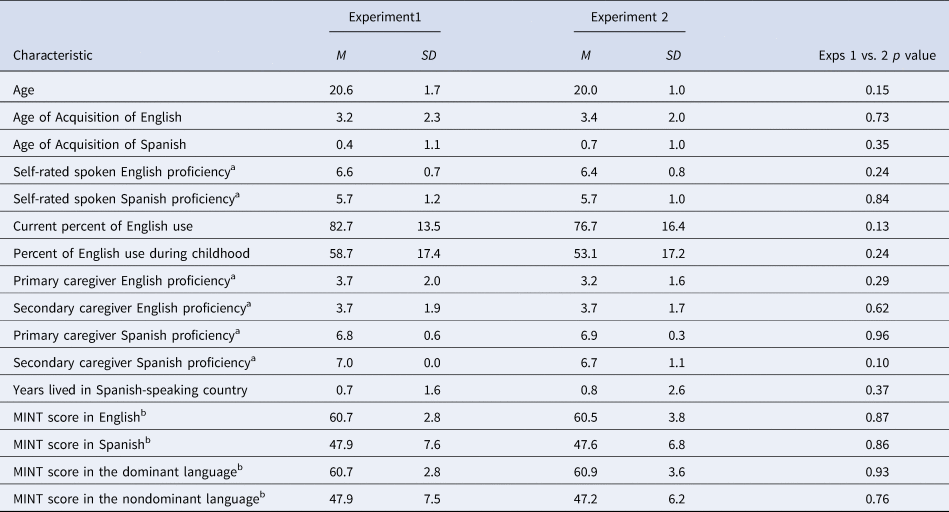
Thirty-two Spanish–English bilingual undergraduates at the University of California, San Diego participated for course credit; each participant signed an IRB approved informed consent form. Table 1 shows participant characteristics and Multilingual Naming Test scores in both languages (MINT; Gollan, Weissberger, Runnqvist, Montoya & Cera, Reference Gollan, Weissberger, Runnqvist, Montoya and Cera2012). Thirty-one bilinguals were English-dominant bilinguals who named more pictures correctly in English than in Spanish, while one was a Spanish-dominant bilingual who named more correctly in Spanish than in English. We present data by language dominance (dominant vs. nondominant) instead of by language (English vs. Spanish).
Means and Standard Deviations of Participant Characteristics

a Proficiency-level self-ratings were obtained using a scale from 1 (almost none) to 7 (like a native speaker).
b The maximum possible MINT score is 68
Design & materials
Each participant completed two testing blocks. In each block, the same fifty pictures were presented twice, once preceded by an English word and once preceded by a Spanish word, so that 50 English words and their translation equivalent Spanish words were presented (see Appendix A). Bilinguals were instructed to read aloud written words, but to name pictures only in English in one block and only in Spanish in the other block. The order of picture-naming language was counterbalanced between participants. There were always at least 25 trials between the first and the second presentation of the same picture. All the pictures were line drawings from the CRL International Picture Naming Project (Bates, Andonova, D'Amico, Jacobsen, T., Kohnert, Lu, Székely, Wicha, Federmeier, Herron, Iyer, Pechmann, Devescovi, Orozco-Figueroa, Gutierrez, Hung, Hsu, Tzeng, Gerdjikova, Mehotcheva & Pleh, Reference Bates, Andonova, D'Amico, Jacobsen, Kohnert, Lu, Székely, Wicha, Federmeier, Herron, Iyer, Pechmann, Devescovi, Orozco-Figueroa, Gutierrez, Hung, Hsu, Tzeng, Gerdjikova, Mehotcheva and Pleh2000). None of the pictures had cognate or cross-language homograph names. The English and Spanish words were four to six letters long, and word length and frequency were matched between the two languages (ps ≥ .18). Word frequency information was acquired from the SUBTLEX-US (Brysbaert & New, Reference Brysbaert and New2009) and SUBTLEX-ESP (Cuetos, Glez-Nosti, Barbón & Brysbaert, Reference Cuetos, Glez-Nosti, Barbón and Brysbaert2011) databases for English and Spanish words, respectively.
Procedure
Following Peeters et al. (Reference Peeters, Runnqvist, Bertrand and Grainger2014), in each block, each trial began with a fixation point (+) for 200 ms, followed by a blank (100 ms), a word (1,500 ms), a blank (500 ms), and finally a picture (3,000 ms). Bilinguals were instructed to read words aloud and name pictures as quickly and accurately as possible. Stimuli disappeared when a spoken response was registered by the voice-key. Also following Peeters et al., before each block, bilinguals received a training session, in which they saw all pictures one by one with the corresponding picture name above it. The language of the picture names was consistent with the language to be used in the subsequent testing block. Afterwards, they saw the pictures in a different order without their corresponding names and were asked to name the pictures again. All mistakes, which were rare, were corrected. After the training session, participants completed 10 practice trials with words and pictures that would not appear in the formal testing block. The training session was repeated after the first testing block but with names in the language to be used to name pictures in the second block.
Results
Analyses were carried out in R, an open source programming environment for statistical computing (R Core Team, 2013) with the lme4 package (Bates, Maechler, Bolker, Walker, Christensen, Singmann, Dai & Grothendieck, Reference Bates, Maechler, Bolker, Walker, Christensen, Singmann, Dai and Grothendieck2015) for linear mixed effects modeling (LMM) and general linear mixed effects modeling (GLMM). For both picture-naming and word reading, response times (RT) data for incorrect responses were excluded. Correct RTs were trimmed if any one or more of the following conditions were met: hesitation, disfluency, the correct answer failed to trigger the voice key, or an error was produced on the previous item. Responses less than 200 ms were removed (as were any responses above 3,000 ms; these were not recorded).
Picture-naming
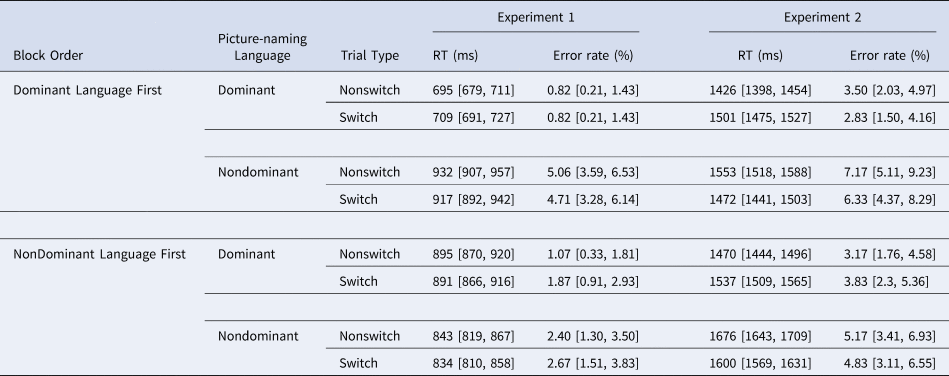
For the picture-naming task, contrast-coded fixed effects included language (dominant vs. nondominant), trial type (switch vs. nonswitch), block order (picture-naming in the dominant language first vs. nondominant first), and all of the two-way and three-way interactions. Subjects and items were entered as two random intercepts with related random slopes. The same fixed effects and random intercepts were included in the logistic regression for error rates analyses, but random slopes were removed due to the failure to converge. The significance of each fixed effect was assessed via likelihood ratio tests (Barr, Levy, Scheepers & Tily, Reference Barr, Levy, Scheepers and Tily2013). Table 2 shows the mean RTs and error rates per condition.
Mean Reaction Times and Error Rates (95% Confidence Intervals in Brackets) for Pictures in Experiments 1 and 2

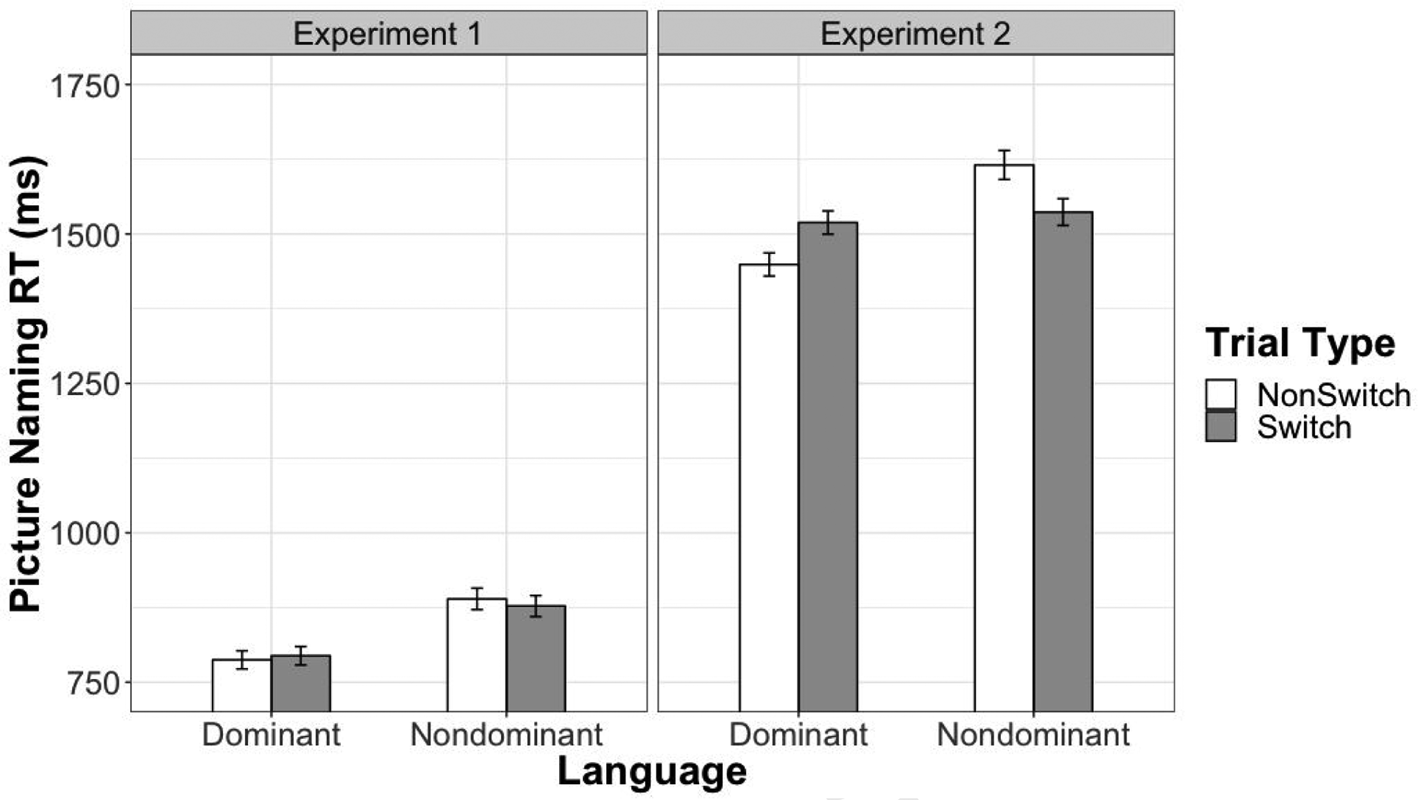
In the analysis of RTs, we removed 2.4% incorrect responses, and another 5.4% of trials due to trimming procedures. Figure 1 shows the by participant mean RTs per language and per trial type. Bilinguals named pictures faster in the dominant than the nondominant language (M = 791 ms vs. 884 ms, β = -94 ms; 95% CI = [-145 ms, -43 ms]; χ 2 (1) = 11.93, p < .001). However, this was qualified by a significant language * order interaction (β = 279 ms; 95% CI = [184 ms, 373 ms]; χ 2 (1) = 23.83, p < .001). Only bilinguals who completed the dominant language picture-naming block first named pictures faster in their dominant than in their nondominant language (M = 701 ms vs. 924 ms; β = -233 ms; 95% CI = [-284 ms, -183 ms]; χ 2 (1) = 32.89, p < .001), while bilinguals who named pictures in the nondominant language first named pictures equally quickly in their two languages (M = 893 ms vs. 839 ms; β = 46 ms; 95% CI = [-42 ms, 133 ms]; χ 2 (1) = 1.08, p = .30). None of the other fixed effects were significant (ps ≥ .22), among which the most surprising one was that bilinguals named pictures equally quickly whether the previous trial was a word in the same (nonswitch) or the other (switch) language (M = 837 ms vs. 836 ms; β = -3 ms; 95% CI = [-16 ms, 10 ms]; χ 2 (1) < 1, p = .65). That is, even though bilinguals switched between languages overtly in their spoken responses, we obtained no switch costs in either language, contra Peeters et al. (Reference Peeters, Runnqvist, Bertrand and Grainger2014).
Mean Picture-naming Response Time for Each Trial Type and Language in Experiment 1 (Word Reading + Picture-naming) and Experiment 2 (Semantic Categorization + Picture-naming). Error Bars Represent 95% Confidence Intervals.

The analysis of error rates showed that bilinguals produced more errors in the nondominant than the dominant language overall, (M = 3.8% vs. 1.1%; β = 1.26%; 95% CI = [0.89%, 1.63%]; χ 2 (1) = 43.99, p < .001). Consistent with the RT results, the language dominance effect was stronger when bilinguals completed the dominant language block first than when they did the nondominant language block first (M difference = 4.0% vs. 1.0%), as shown by a significant language * order interaction (β = 1.27%; 95% CI = [0.52%, 2.01%]; χ 2 (1) = 9.83, p = .002). All other effects were not significant (ps ≥ .24).
Word reading
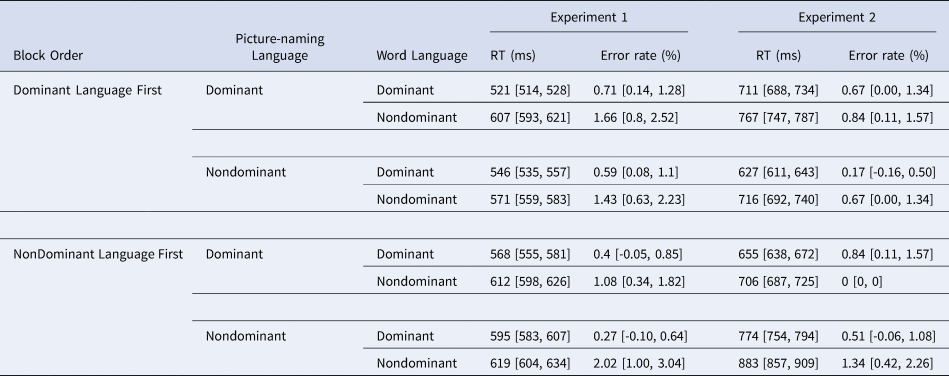
Table 3 shows RTs and error rates for word-reading responses. The method of analysis of word reading data was similar to that of picture-naming, except that contrast-coded fixed effects included word language (dominant vs. nondominant), picture-naming language (dominant vs. nondominant), block order (picture-naming in the dominant language first vs. nondominant first), and all of the two-way and three-way interactions. In these analyses picture-naming language determined the trial type of words in each block (because following Peeters et al., Reference Peeters, Runnqvist, Bertrand and Grainger2014 pictures and words alternated on every trial). For example, when bilinguals named pictures in the dominant language, all the words in the same language were nonswitch trials, while all other words were switch trials. Therefore, it is impossible to differentiate trial type from language dominance effects for word responses, making the interpretation of these data less informative. As a result, we reported the results on word processing, but we focused our discussion primarily on picture-naming results (as did Peeters et al., Reference Peeters, Runnqvist, Bertrand and Grainger2014).
Mean Reaction Times and Error Rates (95% Confidence Intervals in Brackets) for Word Stimuli in Experiments 1 and 2

In the analysis of RTs, bilinguals read words aloud more quickly in the dominant than the nondominant language (M = 556 ms vs. 602 ms; β = -46 ms; 95% CI = [-70 ms, -21 ms]; χ 2 (1) = 12.80, p < .001). This dominance effect was stronger in blocks in which bilinguals named all the pictures in the dominant language than the nondominant language, as shown by a significant interaction between word language and picture-naming language (M Difference = 67 ms vs. 24 ms; β = 39 ms; 95% CI = [22 ms, 57 ms]; χ 2 (1) = 15.23, p < .001). In addition, this difference was even stronger for bilinguals who completed the dominant picture-naming block first, as shown by a significant three-way interaction (β = -52 ms; 95% CI = [-89 ms, -14 ms]; χ2 (1) = 7.12, p = .007). All other effects were nonsignificant (ps .13). In the analysis of error rates, bilinguals produced more errors in the nondominant than the dominant language (M = 1.54% vs. 0.51%; β = 1.57%; 95% CI = [0.53%, 2.61%]; χ 2 (1) = 9.64, p = .002). All other fixed effects were nonsignificant (ps ≥ .27).
Discussion
Word reading did not produce language switch costs on subsequent picture-naming trials, raising questions as to the cognitive mechanisms underlying language switch costs in the Peeters et al. (Reference Peeters, Runnqvist, Bertrand and Grainger2014) paradigm. Before considering whether the absence of task switching was the critical factor that led to cost-free switches, we attempted to replicate Peeters et al. (Reference Peeters, Runnqvist, Bertrand and Grainger2014) more closely by replacing word reading with semantic categorization. Additional findings were that bilinguals named pictures faster in the dominant than in the nondominant language, but only if they first completed the dominant-language picture-naming block (while dominance effects were in the opposite direction, but not significantly so, for bilinguals who first completed the nondominant-language picture-naming block. In word reading responses, bilinguals read more quickly in the dominant than in the nondominant language, especially in the dominant-language picture-naming block, and if they did the dominant language first, but we do not interpret these results at length because of the confound between language dominance and trial type for word responses in the present study (and in Peeters et al., Reference Peeters, Runnqvist, Bertrand and Grainger2014).
Experiment 2: semantic categorization and picture-naming
Method
Participants
Twenty-four unbalanced Spanish–English bilingual undergraduates who did not participate in Experiment 1 were recruited from the same subject pool and participated for course credit. Table 1 shows self-reported participant characteristics and MINT scores in English and Spanish. Twenty-two participants were English-dominant. Participants from Experiments 1 and 2 did not differ in either self-reported or objectively measured proficiency levels of the two languages or any other variables (ps ≥ .10; see Table 1). Therefore, any difference between Experiments 1 and 2 should not be due to participants’ characteristics.
Design, materials & procedure
The design, materials, and procedure are same as those in Experiment 1, except that a) participants were required to judge if each word is an animal or not by pressing a “yes” or “no” button, and b) following Peeters et al. (Reference Peeters, Runnqvist, Bertrand and Grainger2014), we added ten non-animal filler pictures that were preceded by 10 different animal names (half Spanish and half English) to elicit “yes” response for words, while all words before the 50 original pictures were non-animals (see Appendix B). Although 7 out of the 50 critical pictures were animals, there was no overlap between word and picture stimuli. As a result, a total of 100 critical picture-naming trials and 10 filler picture-naming trials were included.
Results
The procedure of data trimming and analyses was same as that in Experiment 1, except that the additional trials used to elicit “yes” response for semantic categorization were also excluded from analyses. In addition, trials in which participants completed an incorrect task (e.g., reading a word aloud or categorizing a picture) were also excluded.
Picture-naming
Table 2 shows the mean RTs and error rates per condition. In the analysis of RTs, in addition to 4.6% incorrect responses, another 1.9% of the data was removed in data trimming. Figure 1 shows by participant mean RTs per language and per trial type. Bilinguals named pictures more quickly in the dominant than in the nondominant language (M = 1484 ms vs. 1575 ms; β = -101 ms; 95% CI = [-156 ms, -45ms]; χ2 (1) = 11.23, p < .001). More importantly, bilinguals showed a significant interaction between trial type and language (β = 150 ms; 95% CI = [96 ms, 204 ms]; χ2 (1) = 21.98, p < .001); they exhibited significant switch costs in the dominant language (M = 1519 ms vs. 1449 ms on switch vs. nonswitch trials; β = 67 ms; 95% CI = [34 ms, 101 ms]; χ2 (1) = 13.01, p < .001), while the nondominant language instead showed switch benefits/nonswitch costs (M = 1537 ms vs. 1615 ms on switch vs. nonswitch trials; β = -82 ms; 95% CI = [-114 ms, -50 ms]; χ2 (1) = 18.91, p < .001). All other effects were nonsignificant (ps ≥ .12). Given that 7 pictures were animals, we reanalyzed the data of animal vs. nonanimal pictures separately, and found the same results as reported above.
To further explore the nature of switch effects in Experiment 2, two effects that were absent in Experiment 1, we asked if these were modulated by bilingual language proficiency. To this end we calculated bilingual index scores by dividing MINT scores in the nondominant language by the dominant language MINT score (Gollan et al., Reference Gollan, Weissberger, Runnqvist, Montoya and Cera2012). Bilingual index scores closer to 1 indicate more balanced bilinguals (with closer to identical scores in the two languages), while lower scores indicate less balanced bilinguals (i.e., with one clearly dominant language). As shown in Figure 2, both switch costs and switch benefits were modulated by the degree of bilingualism. For both languages, the difference between switch and nonswitch trials were larger in less balanced bilinguals than in balanced bilinguals; this interaction between trial type (switch, nonswitch) and bilingual index score was significant for switch costs in the dominant language, β = -681 ms; 95% CI = [-1111 ms, -250 ms]; χ2 (1) = 9.62, p = .002, and marginally significant for switch benefits in the nondominant language, β = 421 ms; 95% CI = [-12 ms, 853 ms]; χ2 (1) = 3.63, p = .056). Repeating the same analyses in Experiment 1, switch effects were not modulated by bilingual index score in either language (ps ≥ .34), i.e., switch effects were consistently absent for bilinguals of all proficiency levels in Experiment 1.
Mean Picture-naming Response Times by Trial Type and Language as a Function of Bilingual Index Score in Experiment 2 (More Balanced Bilinguals Have Higher Index Scores).

In the analysis of error rates, bilinguals produced more errors on nondominant than dominant trials (M = 5.9% vs. 3.3%; β = 0.60%; 95% CI = [0.33%, 0.87%]; χ2 (1) = 17.66, p < .001). All other fixed effects were nonsignificant (ps ≥ .13).
Semantic categorization
Table 3 shows by participant RTs and error rates from the semantic categorization task. In the analysis of RTs, bilinguals categorized words faster in the dominant language than the nondominant language (M = 692 ms vs. 768 ms; β = -41 ms; 95% CI = [-67 ms, -14 ms]; χ2 (1) = 18.88, p < .001), a language dominance effect that was stronger in blocks of trials in which bilinguals named pictures in the nondominant than in the dominant language (M Difference = 99 ms vs. 53 ms; β = 46 ms; 95% CI = [17 ms, 74 ms]; χ2 (1) = 9.05, p = .003). This was in contrast to the word reading results in Experiment 1, in which language dominance effects were stronger in blocks in which bilinguals named pictures in the dominant language. Stated differently, classifying words in the nondominant language was more difficult after naming pictures in the nondominant language than after naming pictures in the dominant language, indicating switch benefits (i.e., the same effect found for picture-naming responses), while reading words aloud in the nondominant language was more difficult after naming pictures in the dominant than nondominant language, i.e., switch costs. In addition, bilinguals categorized words more quickly when alternating between semantic categorization and naming pictures in the dominant than in the nondominant language (M = 709 ms vs. 750 ms; β = 41 ms; 95% CI = [14 ms, 67 ms]; χ2 (1) = 8.36, p = .004). However, only bilinguals who completed the block of trials with picture-naming in the dominant language first showed this pattern, while bilinguals who named pictures in the nondominant language first exhibited the opposite pattern (ps < .008), a significant picture-naming language * order interaction (M Difference = 148 ms vs. -67 ms; β = 216 ms; 95% CI = [163 ms, 269 ms]; χ2 (1) = 6.10, p = .013). All other effects were nonsignificant (ps ≥ .30). The analysis of error rates did not reveal any significant result (ps ≥ .61).
Discussion
In Experiment 2 we replicated the critical results in Peeters et al. (Reference Peeters, Runnqvist, Bertrand and Grainger2014), that language switching was costly when bilinguals switched from categorizing words to picture-naming in the dominant language. Unexpectedly, in the nondominant language such switching was beneficial. Further analyses suggested that both effects were mainly driven by less balanced bilinguals. Similar to Experiment 1, overall participants named pictures faster in the dominant language, but this time the language dominance effect was not modulated by block order. Finally, in semantic categorization of words bilinguals exhibited some similar but also some very different patterns relative to Experiment 1. In particular, although word responses were faster in the dominant language in both Experiments, in Experiment 2 this was especially true in nondominant-language picture-naming blocks while in Experiment 1 dominance effects were stronger in dominant-language picture-naming blocks. Again, we do not interpret word processing results at length because of the confound between language dominance and trial type (see also Peeters et al., Reference Peeters, Runnqvist, Bertrand and Grainger2014) but note that this finding of substantial differences in how block type modulated language dominance effects across Experiments 1 and 2 seems generally consistent with our suggestion below that language control mechanisms do not overlap 100% across bilingual language comprehension and production.
General discussion
In two experiments Spanish–English bilinguals processed written words in both languages but named pictures in just one language per testing block. Focusing on picture-naming performance, we examined whether language switch costs could arise from comprehension to production. Replicating Peeters et al. (Reference Peeters, Runnqvist, Bertrand and Grainger2014) which showed language switch costs from comprehension to production in L1, in Experiment 2 bilinguals, especially less balanced bilinguals, exhibited language switch costs when switching from categorizing words to naming pictures in the dominant language. Thus, in Experiment 2 language switch costs emerged on picture-naming responses in the dominant language, even though bilinguals never actually switched languages in their speech. Unexpectedly, Experiment 2 also showed language switch benefits, again especially in less balanced bilinguals, on picture-naming responses in the nondominant language. Most importantly, bilinguals exhibited no switch costs in either language when bilinguals actually switched languages in their speech between reading aloud and picture-naming in Experiment 1.Footnote 3 Additionally, bilinguals named pictures faster in their dominant language in both experiments, although in Experiment 1 this language dominance effect was only significant when bilinguals completed the dominant language picture-naming block first. Lastly, in word processing trials (i.e., reading aloud and semantic categorization), we also observed some significant block order effects and language dominance effects varied across testing order and with block type (whether pictures were named in the dominant or nondominant language).
What drives language switch costs from comprehension to production?
We asked whether language switch costs from comprehension to production reflected shared language control mechanisms between comprehension and production, or if previous reports of such switch costs might be an artifact of task switching. On a shared control mechanisms account, language switch costs from comprehension to production should be observed when bilinguals process a written word in one language and then name a picture in another language, regardless of what task is done with the written word. But if instead this type of switch costs arises only in special circumstances – in this case when language switches also involve a task switch – then language switch costs on picture-naming might be reduced or even eliminated after reading aloud. On this view, the critical definition of the word “task” hinges on whether or not the intention can remain the same from trial to trial. Our results supported the latter hypothesis. In Experiment 1, bilinguals produced a naming response on every trial and showed no language switch costs. In contrast, in Experiment 2, bilinguals alternated naming responses with semantic classification on every other trial and exhibited language switch costs from comprehension to production in the dominant language. Thus, the requirement to switch intention on every trial may have introduced switch costs, and also appeared to demand more cognitive resources overall. Indeed Experiment 2 appeared to be much more difficult overall than Experiment 1; picture-naming times in Experiment 2 were almost twice as long as in Experiment 1 (M = 1529 ms vs. 836 ms), and semantic categorization times in Experiment 2 were also longer than word reading times in Experiment 1 (M = 730 ms vs. 579 ms).
The total absence of language switch costs in Experiment 1 cannot simply be explained by assuming that language switching costs do not transfer from comprehension to production –because, in addition to reading words in one language and naming pictures in another, bilinguals also switched languages overtly in their speech: which should have required more planning and preparation than not switching. Thus, it seems that bilinguals can rely on salient cues to guide language selection minimizing or even eliminating all language switch costs. In Experiment 1 the salient cue was stimulus type. Within each testing block pictures that were only named in one language were contextually univalent cues to language selection (even though in normal circumstances pictures are bivalent stimuli that could activate responses in both languages). Having the intention to always choose a single language to name pictures, i.e., top-down single language selection, bilinguals could minimize activation of both languages in advance for all picture-naming responses, eliminating the need to inhibit the dominant language, and enabling cost free language switches in picture-naming responses. Consistent with this view, other recent studies also reported cost-free or minimal language switch costs if language production was cued by interlocuter identity (Blanco-Elorrieta & Pylkkänen, Reference Blanco-Elorrieta and Pylkkänen2017), text-color (Fadlon, Li, Prior & Gollan, Reference Fadlon, Li, Prior and Gollan2019), or when each picture is only named in one language based on bilinguals' own preferred choices throughout a block (Kleinman & Gollan, Reference Kleinman and Gollan2016).
By contrast, when switching between two very different tasks (Experiment 2), bilinguals had to use cognitive resources to keep track of their intention – namely, to decide which task was relevant on every trial, and whether to respond with a button-press or spoken response, and to switch between these tasks (making it harder to rely on available cues to guide language selection). Similarly, Philipp and Koch (Reference Philipp and Koch2006) also found stronger evidence for inhibition when task-switches were more frequent, which would also make it harder to keep track of intention from trial to trial (in this study N-2 repetition costs were larger when switches were more frequent; the N-2 effect represents the relative cost of task repetition in an ABA task sequence compared to a task switch in a CBA task sequence). In addition, semantic categorization is a less naturalistic task compared to reading aloud, an additional factor that made Experiment 2 more demanding than Experiment 1. Thus, inhibition may be applied to the dominant language only under challenging task demands, especially in unbalanced bilinguals to ensure they avoid using the more accessible dominant language by mistake (Declerck, Kleinman & Gollan, Reference Declerck, Kleinman and Gollan2020), thus eliciting switch costs only in the dominant language.
This interpretation is consistent with the Adaptive Control hypothesis, which posits that the nature of control mechanisms applied varies with context (Green & Abutalebi, Reference Green and Abutalebi2013; Green & Wei, Reference Green and Wei2014). Importantly, however, what triggered inhibition on this interpretation was not comprehension or recognition of words in another language in previous trials, but the change of intention on different trials. Thus, our data (and those of Peeters et al., Reference Peeters, Runnqvist, Bertrand and Grainger2014) do not necessarily support shared language control mechanisms across comprehension and production, but instead reveal task-dependent changes in the nature of language control. This interpretation can also explain the results in Gambi and Hartsuiker (Reference Gambi and Hartsuiker2016) and Finkbeiner et al. (Reference Finkbeiner, Almeida, Janssen and Caramazza2006). In Gambi and Hartsuiker, bilinguals took turns naming pictures – two participants were cued on every trial about whose turn it was to speak, and switch costs were found in the dominant language. Taking turns speaking is something people do daily and passive listening should be easier than semantic categorization. However, participants still needed to decide if to speak in this Go/No-Go paradigm, which might resemble task switching given that the intention must change on a trial-to-trial basis. Additionally, unlike the present study, all the stimuli were pictures which are inherently bivalent in the same testing block (the switching participant named pictures in both languages), so that the stimulus itself did not serve as a salient language cue, and top-down single language selection would have been more difficult or impossible. In Finkbeiner et al., participants completed a concept-driven naming task on every single trial, which was naturalistic and involved no task/intention switching. In addition, picture/dots which were univalent in the context of this study were quite distinct from digits and this served as salient language cues to guide language selection, just like pictures in the present study.
However, our results and those of Peeters et al. (Reference Peeters, Runnqvist, Bertrand and Grainger2014) raise doubts about Finkbeiner's response certainty account because pictures were arbitrarily univalent in Peeters et al. and in Experiment 2 herein as well, but this alone did not guarantee cost-free switching. Note that even fully univalent stimuli can elicit language switch costs. For example, when switching between Chinese and English in reading aloud, bilinguals sometimes read the word, translated it automatically, and produced the translation instead of the written word (Li & Gollan, Reference Li and Gollan2018), or simply exhibited switch costs (Slevc, Davey & Linck, Reference Slevc, Davey and Linck2016), even though English and Chinese orthography differ considerably in written form. Robust language switch costs were also found even in the presence of salient socio-culturally congruent cues in a picture-naming task (e.g., Asian face—Chinese, Caucasian face—English; see Liu, Timmer, Jiao, Yuan & Wang, Reference Liu, Timmer, Jiao, Yuan and Wang2019). Thus, multiple factors may jointly affect how efficiently and whether or not participants can make use of language cues. In the present study, cost-free language switching may have depended on two factors – the presence of salient cues to allow top-down single language selection in production (such that pictures would only be named in one language throughout the testing block), combined with the possibility of maintaining the same intention on every trial, or having a naturalistic task (reading aloud words is more automatic than semantic classification or lexical decision) – thereby leaving enough cognitive resources to use univalence to guide language selection.
It might be asked whether word naming might elicit cost-free language switching because reading aloud is so automatic that top-down language control is not needed; especially if participants could simply sound out each word without differentiating language membership. However, we did find significant language switch costs on reading aloud responses in Experiment 1 (ps < .01 for both languages), suggesting that language control was still needed. Though this comparison was across blocks in the present study, language switch costs within a reading aloud task have been shown in many other studies (Declerck, Koch, Duñabeitia, Grainger & Stephan, Reference Declerck, Koch, Duñabeitia, Grainger and Stephan2019; Filippi, Karaminis & Thomas, Reference Filippi, Karaminis and Thomas2014; Gollan et al., Reference Gollan, Schotter, Gomez, Murillo and Rayner2014; Li & Gollan, Reference Li and Gollan2018), and as just noted even with distinct orthographies (e.g., Chinese and English; Slevc et al., Reference Slevc, Davey and Linck2016). In addition, though they were rare and had been excluded from analyses, participants did occasionally produce accent errors in the present study (e.g., saying trigo with an English accent), suggesting that bilinguals needed to select a single language for response to complete the reading aloud task. Lastly, a recent study showed that reading aloud elicits language switch costs on subsequent picture-naming trials if pictures were bivalent, i.e., might be named in either language within the testing block (Li & Gollan, Reference Li and Gollan2021). In the latter study, Spanish–English bilinguals read aloud sentences that were presented word by word with a single word replaced by a picture, and named the picture according to a language cue (e.g., The woman was scared by the [perro] that stood beside my uncle, the item in the brackets presented as picture with a language cue above it), so that language switching occurred between reading aloud and picture-naming just like in the present study. However, unlike the present study, in each sentence the target picture might be named in either English or Spanish, and robust language switch costs were observed in both languages. Thus, it seems unlikely that our use of the read-aloud task per se was the critical reason that led to cost-free language switches. Instead, the combination of reading aloud and the contextual instruction that made pictures univalent was critical.
Implications for task switching and immersion effects
Our finding of switch costs in Experiment 2 but not in Experiment 1 seems consistent with previous findings that task similarity decreases nonlinguistic task switching costs (Arrington, Altmann & Carr, Reference Arrington, Altmann and Carr2003). In Arrington et al., task similarity was defined as shared attentional control settings (Experiment 1) or shared response modality (Experiment 2). In the first experiment, participants judged rectangles for spatial (height, width) or surface (hue, brightness) properties. Switch costs were smaller between two tasks with similar (e.g., height and width) versus with different (e.g., height and hue or brightness) properties. In the second experiment, participants again judged the height of rectangles but this time by providing either manual or vocal responses. There were two types of responses in each modality, using the index versus middle finger of each hand, and saying one/two versus saying A/B. Switching between the two different types of manual responses or the two types of vocal responses elicited smaller costs than switching between manual and vocal responses. The task similarity effect might reflect a reduction in the amount of preparation needed before switching, or more automatic consequences of repetition when similar tasks are performed closely in time. In either case, switching between similar tasks is less demanding and requires fewer cognitive resources than switching between dissimilar tasks. It could be argued that in both Experiments 1 and 2 of the present study all trials were task switch trials, but reading aloud and picture-naming were the same in both attentional and response modality respects – both tasks required participants to pay attention to whatever phonological properties the stimulus activates, and both required vocal responses. Thus, although they switched from reading to naming pictures, participants could maintain the same intention on every trial in Experiment 1, eliminating the need to apply inhibitory control to avoid speaking in the wrong language. A more interesting possibility with potentially much broader implications is that what constitutes “a task” is the intention and response modality rather than the source of activation that triggers the response – on this view participants in Experiment 1 switched languages but did not switch tasks. If so, cost-free nonlinguistic switching might also be possible if both response modality and intention could be held constant across different tasks.
Importantly, the interpretation we offer does not challenge sustained language immersion effects from comprehension to production that have been reported across testing blocks. For example, in Experiment 1 in which no language switch costs were observed, across testing blocks language dominance effects in picture-naming were smaller for bilinguals who did the nondominant-language picture-naming block first. This result could reflect inhibition of the dominant language production machinery. Additionally, two recent studies showed that being exposed to one language exclusively for a period of time, such as watching a movie for 10 minutes, or reading aloud a list of words in one language could subsequently make it more difficult for participants to name pictures in another language (Degani, Kreiner, Ataria & Khateeb, Reference Degani, Kreiner, Ataria and Khateeb2020; Kreiner & Degani, Reference Kreiner and Degani2015). These studies suggest that brief immersion in one language may elicit global inhibition of the other language that can persist even if bilinguals’ intention does not change (e.g., reading aloud in one language and then naming pictures in the other). This more persistent and sustained form of control may be more automatic (dissipating only with passage of sufficient time) and it is not known how (or if) it is related to control mechanisms that are applied within a mixed language block (as in the present study). Note however that such sustained immersion effects across comprehension and production have thus far not been reported for naming times, only for accuracy and TOT (tip-of-the-tongue) states, and the latter was recently challenged by a demonstration of similar findings in monolinguals, i.e., significant immersion effects even if participants did not know the language in which the movie was presented (Stasenko & Gollan, Reference Stasenko and Gollan2019). Thus, additional work is required to identify the cognitive mechanism/s underlying immersion effects.
Language switch benefits
The switch benefits for the nondominant language in Experiment 2 were unexpected. In Peeters et al. (Reference Peeters, Runnqvist, Bertrand and Grainger2014), neither switch costs nor benefits were observed in the nondominant language in the same task. Switch costs are smaller when switches are frequent (Schneider & Logan, Reference Schneider and Logan2006), and switch benefits were found with “task confusion” (Steinhauser & Hübner, Reference Steinhauser and Hübner2006) or in the dominant language with pseudo-voluntary language switching (Gollan & Ferreira, Reference Gollan and Ferreira2009, Experiment 2). It is not clear what caused switch benefits in the present study, but one possibility was that all task-set components (response and language in our case) in a block were integrated into a single task representation, so that switching everything was faster than holding some components constant while switching others (Philipp & Koch, Reference Philipp and Koch2010; Vandierendonck, Christiaens & Liefooghe, Reference Vandierendonck, Christiaens and Liefooghe2008). In Experiment 1, responses to words and pictures were same (i.e., naming in both cases), so that language was the only task component that required switching. In Experiment 2, both response (naming or classification) and language (English or Spanish) could change from trial to trial, thus switching both might have been easier than switching only one of them. However, this account cannot explain why switch benefits only occurred in the nondominant language but not in the dominant language in Experiment 2. One possibility was that inhibition applied to the dominant language was so powerful that it overrode the benefits to switch both task components.
Alternatively, it may be more difficult to complete two difficult tasks consecutively (i.e., to use the nondominant language in consecutive trials) than to complete a difficult task following an easy one (i.e., to use the dominant language and then the nondominant language). This difficulty might not occur in the dominant language, which is easy to produce. This possibility is similar to the psychological refractory period (PRP), in which a response to a second stimulus is slowed when cognitive resources are divided by a first stimulus (Pashler, Reference Pashler1994). In the demanding task settings in Experiment 2, cognitive resources were limited for competing two consecutive difficult tasks. However, in Experiment 1, cognitive resources were more plentiful, eliminating all switch effects. Supporting this view, switch benefits tended to be larger in less balanced bilinguals for whom processing the nondominant language is especially difficult (though this relationship was only marginally significant, p = .056), a result that fits this account better than the above integral task-set components account. Recall that less balanced bilinguals also showed significantly larger switch costs, indicating stronger inhibition to the dominant language, consistent with the Inhibitory Control Model. Thus, the difficulty of processing the nondominant language contributed to both switch costs and benefits, although this modulation of language proficiency level on language switching from comprehension to production was robust when task switching was involved (i.e., in Experiment 2 but not in Experiment 1). A remaining question was why switch benefits in L2 were present in here but were not found in Peeters et al. (Reference Peeters, Runnqvist, Bertrand and Grainger2014). This cross-study difference might be due to many differences in the type of bilinguals tested, the combination of languages, or differing language proficiency levels. Unfortunately, we could not directly compare across studies, as Peeters et al. did not report an objective proficiency measure, and self-ratings are not reliable especially when comparing bilinguals of different language combinations (Tomoschuk, Ferreira & Gollan, Reference Tomoschuk, Ferreira and Gollan2019).
Conclusion
The results of the present study suggest that how bilinguals choose which language to speak varies with the presence or absence of salient language cues, proficiency level, the need to change or not change intention from trial to trial, and possibly other related factors (e.g., task difficulty). While various cognitive mechanisms can guide language selection, such adaptive language control taps a limited supply of cognitive resources. When salient language cues are present (e.g., pictures and words are visually distinct and picture-naming is only allowed in language X), language switching can be cost-free – even though switches must still be planned and articulated. By contrast, when bilinguals have to monitor and change intention from trial to trial, more robust language control mechanisms may be initiated including inhibition of the dominant language. In turn, this leads to language switch costs especially in unbalanced bilinguals, for whom speaking in a nondominant language is more difficult. This interpretation raises doubts about previous proposals of shared language control mechanisms across comprehension and production. Further investigation is needed to determine how bilinguals can use different types of cues to enable language switching, which conditions do versus do not lead to recruitment of inhibitory control to facilitate language selection, and what constitutes the definition of a “task” in both linguistic and nonlinguistic switching.
Acknowledgements
The authors thank Mayra Murillo for data collection and coding. This research was supported by grants from NSF (BCS1923065), NIDCD (DC011492), and NICHD (HD099325). We have no conflicts of interest to disclose.
Appendix A
Pictures (English name) in Experiment 1
apple, arrow, backpack, bear, bed, bell, belt, bird, bone, book, box, bridge, brush, butterfly, cake, candle, carrot, chair, cheese, cloud, coat, dog, door, dress, eggs, eye, finger, fish, ghost, glass, gloves, hat, horse, key, king, knife, leaf, meat, mirror, onion, orange, pencil, ring, shoe, shovel, shrimp, table, tree, umbrella, watch
Pictures (Spanish name) used in Experiment 1
abrigo, anillo, árbol, caballo, caja, cama, camarón, campana, carne, cebolla, cepillo, cinturón, cuchillo, dedo, espejo, fantasma, flecha, guantes, hoja, hueso, huevos, lápiz, libro, llave, manzana, mariposa, mesa, mochila, naranja, nube, ojo, oso, pájaro, pala, paraguas, pastel, perro, pez, puente, puerta, queso, reloj rey, silla, sombrero, vaso, vela, vestido, zanahoria, zapato
English words in Experiment 1
above, beach, beard, below, bottom, broom, clown, cousin, death, drawer, dream, drum, father, fear, fight, flight, friend, health, heaven, height, horn, house, hurry, inside, level, life, luck, milk, moon, needle, rabbit, shadow, shower, soap, soul, stone, street, stride, summer, taste, thread, travel, truth, water, week, wheat, wheel, wife, world, year
Spanish words in Experiment 1
abajo, agua, aguja, alma, altura, amigo, año barba, cajón, calle, casa, cielo, conejo, cuerno, dentro, ducha, encima, escoba, esposa, fondo, gusto, hilo, jabón, leche, lucha, luna, miedo, muerte, mundo, nivel, padre, paso, payaso, piedra, playa, primo, prisa, rueda, salud, semana, sombra, sueño, suerte, tambor, trigo, verano, verdad, viajar, vida, vuelo
Appendix B
Pictures (English name) in Experiment 2
airplane, apple, arrow, backpack, bear, bed, bell, belt, bird, bone, book, box, bridge, brush, butterfly, cake, candle, carrot, chair, cheese, cloud, coat, dog, door, dress, ear, egg, eye, finger, fish, flag, ghost, glass, glove, hammer, hat, horse, key, king, knife, leaf, meat, mirror, nose, onion, orange, peanut, pencil, ring, shoe, shovel, shrimp, sock, spoon, strawberry, table, tie, tree, umbrella, watch
Pictures (Spanish name) used in Experiment 2
abrigo, anillo, árbol, avión, bandera, caballo, cacahuete, caja, calcetín, cama, camarón, campana, carne, cebolla, cepillo, cinturón, corbata, cuchara, cuchillo, dedo, espejo, fantasma, flecha, fresa, guante, hoja, hueso, huevo, lápiz, libro, llave, manzana, mariposa, martillo, mesa, mochila, naranja, nariz, nube, ojo, oreja, oso, pájaro, pala, paraguas, pastel, perro, pez, puente, puerta, queso, reloj, rey, silla, sombrero, vaso, vela, vestido, zanahoria, zapato
English words in Experiment 2
above, ant, beach, beard, below, bottom, broom, candy, clown, cousin, death, drawer, dream, drum, fear, fight, flight, friend, health, heaven, height, horn, house, hurry, inside, level, life, luck, milk, monkey, moon, mouse, needle, rabbit, shadow, shower, snake, soap, soul, stone, street, stride, summer, taste, thread, travel, truth, water, week, wheat, wheel, wife, father, world, year
Spanish words in Experiment 2
abajo, agua, aguja, alma, altura, amigo, año, barba, cajón, calle, casa, cielo, cuerno, dentro, ducha, dulce, encima, escoba, esposa, fondo, gallina, gusto, hilo, jabón, leche, lucha, luna, miedo, muerte, mundo, nivel, oveja, padre, paso, pato, payaso, piedra, playa, primo, prisa, rueda, salud, semana, sombra, sueño, suerte, tambor, toro, trigo, vaca, verano, verdad, viajar, vida, vuelo