While international reach may be an important strategic aim, many firms either lack the resources or hesitate to invest in substantial facilities outside their domestic markets. To overcome such challenges to their international expansion, firms may choose to internationalize the scope of their operation and enter foreign markets through international alliances (Contractor & Reuer, Reference Contractor and Reuer2014; Laufs & Schwens, Reference Laufs and Schwens2014; Liu, Blocq, Honari, & Au, Reference Liu, Blocq, Honari and Au2022). These alliances are increasingly common strategies for entering foreign markets, and have been discussed in wide-ranging literatures for several decades (Beamish & Lupton, Reference Beamish and Lupton2016; García-Canal, Duarte, Criado, & Llaneza, Reference García-Canal, Duarte, Criado and Llaneza2002; Gulati, Lavie, & Singh, Reference Gulati, Lavie and Singh2009; He, Meadows, Angwin, Gomes, & Child, Reference He, Meadows, Angwin, Gomes and Child2020). They are hybrid organizational forms, between market and hierarchy, that enable international growth (Beamish & Lupton, Reference Beamish and Lupton2016; López-Duarte, González-Loureiro, Vidal-Suárez, & González-Díaz, Reference López-Duarte, González-Loureiro, Vidal-Suárez and González-Díaz2016), and can be defined as ‘collaborative arrangements involving multiple business organizations located in different countries’ (Lojacono, Misani, & Tallman, Reference Lojacono, Misani and Tallman2017: 435).
International alliances vary on a wide range of variables relating to governance and structure, which shape alliance success and effectiveness (Albers, Wohlgezogen, & Zajac, Reference Albers, Wohlgezogen and Zajac2016; Ali, Khalid, Shahzad, & Larimo, Reference Ali, Khalid, Shahzad and Larimo2021; Contractor & Reuer, Reference Contractor and Reuer2014; Oxley & Wada, Reference Oxley and Wada2009). Traditionally, research on international cooperative strategies and alliances has followed a broad distinction between equity and nonequity governance structures of alliances, investigating the appropriate governance mode and its implications (e.g., Ali et al., Reference Ali, Khalid, Shahzad and Larimo2021; Globerman & Nielsen, Reference Globerman and Nielsen2007; Oh & Yoo, Reference Oh and Yoo2022; Pan & Tse, Reference Pan and Tse2000). Research on international alliances and their outcomes for member firms within entry mode literature has also been concerned with structural variation, addressing it mainly in terms of equity structure (e.g., Brouthers & Hennart, Reference Brouthers and Hennart2007; Brouthers & Nakos, Reference Brouthers and Nakos2004; Hollender, Zapkau, & Schwens, Reference Hollender, Zapkau and Schwens2017; Rasheed, Reference Rasheed2005). Notwithstanding the critical choice of equity versus nonequity mode, a finer breakdown of nonequity international alliance alternatives is desirable, as the significant structural variation among them can be meaningful in explaining their implications for partnering firms (Blagoeva, Jensen, & Merchant, Reference Blagoeva, Jensen and Merchant2020; Devarakonda & Reuer, Reference Devarakonda and Reuer2018; Juasrikul, Sahaym, Yim, & Liu, Reference Juasrikul, Sahaym, Yim and Liu2018; Erramilli, Agarwal, & Dev, Reference Erramilli, Agarwal and Dev2002; Lojacono, Misani, & Tallman, Reference Lojacono, Misani and Tallman2017; Lui & Ngo, Reference Lui and Ngo2004; Ripollés & Blesa, Reference Ripollés and Blesa2020).
In this study, we seek to contribute to a finer understanding of nonequity international alliances and their implication for partnering firms by considering the design structural parameters of alliances. Structural design parameters underlie key alliance processes, such as learning, and are critical in explaining outcomes for alliances and firms (Albers, Wohlgezogen, & Zajac, Reference Albers, Wohlgezogen and Zajac2016; Greenwood & Miller, Reference Greenwood and Miller2010). Yet, we still have limited understanding of specific design parameters and their implications for firm effectiveness (Albers, Wohlgezogen, & Zajac, Reference Albers, Wohlgezogen and Zajac2016; Blagoeva, Jensen, & Merchant, Reference Blagoeva, Jensen and Merchant2020; Boussebaa & Morgan, Reference Boussebaa, Morgan, Empson, Muzio, Broschak and Hinings2015; Contractor & Reuer, Reference Contractor and Reuer2014; Devarakonda & Reuer, Reference Devarakonda and Reuer2018; He et al., Reference He, Meadows, Angwin, Gomes and Child2020; Juasrikul et al., Reference Juasrikul, Sahaym, Yim and Liu2018). Critical for firm's competitiveness in the market, firm effectiveness reflects firm's ability to provide its clients with greater relative value than its competitors, through quality and innovative products or services (Wittmann, Hunt, & Arnett, Reference Wittmann, Hunt and Arnett2009). International nonequity alliances refer to a variety of cross-border cooperative arrangements that not only enable firms' internationalization but also provide them with access to critical resources such as knowledge (Beamish & Lupton, Reference Beamish and Lupton2016), which are crucial for their competitiveness and effectiveness (García-Canal et al., Reference García-Canal, Duarte, Criado and Llaneza2002; López-Duarte et al., Reference López-Duarte, González-Loureiro, Vidal-Suárez and González-Díaz2016).
In order to shed light on the implication of nonequity international alliances to the effectiveness of member firms, we focus on structural parameters of alliances, because access to resources and alliance processes differ across different forms and structures of alliances (Albers, Wohlgezogen, & Zajac, Reference Albers, Wohlgezogen and Zajac2016; Devarakonda & Reuer, Reference Devarakonda and Reuer2018; Gomes, Barnes, & Mahmood, Reference Gomes, Barnes and Mahmood2016; Jiang & Li, Reference Jiang and Li2008; Juasrikul et al., Reference Juasrikul, Sahaym, Yim and Liu2018; Oxley & Wada, Reference Oxley and Wada2009). Drawing on the resource-based view (RBV) of the firm, we theorize how key alliance structural parameters – namely formalization, specialization, and interface (Albers, Wohlgezogen, & Zajac, Reference Albers, Wohlgezogen and Zajac2016) – influence knowledge-related processes (integration, access, exploitation) among alliance members, thus affecting their effectiveness in the market.
The professional service industry was chosen as a context for this study, as professional services, and specifically law firms, rely on rare resources like expert workers and specialized knowledge as their primary sources of value. Moreover, global expansion through international alliances is prevalent among these firms, allowing them to overcome local embeddedness challenges, and provide global services and integrated solutions to corporate clients (Boussebaa & Morgan, Reference Boussebaa, Morgan, Empson, Muzio, Broschak and Hinings2015; Malhotra & Morris, Reference Malhotra and Morris2009; Muzio & Faulconbridge, Reference Muzio and Faulconbridge2013; Sako, Qian, & Attolini, Reference Sako, Qian and Attolini2022). We collected data on 121 law firms, all members of international nonequity alliances. Using structural equation modelling and various measures of firm effectiveness as the dependent variable, we find strong support for two of our three hypotheses. Our findings indicate that informal alliance structures (relative to formalized structures) and alliances with strong (relative to weaker) interface are positively connected to firm effectiveness.
This study makes three sets of contributions. First, and foremost, we provide a finer distinction among international alliances by directly addressing the structural variation among nonequity international alliances and analyze their implications for firms. This study thus addresses a lacuna in the understanding of the variety of nonequity international alliances (Erramilli, Agarwal, & Dev, Reference Erramilli, Agarwal and Dev2002; García-Canal et al., Reference García-Canal, Duarte, Criado and Llaneza2002), and connects with the growing interest in these forms of cooperative strategies and their relation to performance-related outcomes (Blagoeva, Jensen, & Merchant, Reference Blagoeva, Jensen and Merchant2020; Devarakonda & Reuer, Reference Devarakonda and Reuer2018; Frankort & Hagedoorn, Reference Frankort, Hagedoorn, Contractor and Reuer2019; He et al., Reference He, Meadows, Angwin, Gomes and Child2020; Juasrikul et al., Reference Juasrikul, Sahaym, Yim and Liu2018; Ripollés & Blesa, Reference Ripollés and Blesa2020). Parallel to work such as that of Ali et al. (Reference Ali, Khalid, Shahzad and Larimo2021) on joint ventures and Kim and Parkhe (Reference Kim and Parkhe2009) on alliances, we extend the existing literature by analyzing performance consequences – in terms of firm effectiveness (Hult et al., Reference Hult, Ketchen, Griffith, Chabowski, Hamman, Dykes and Cavusgil2008; Richter, Schmidt, Ladwig, & Wulhorst, Reference Richter, Schmidt, Ladwig and Wulhorst2017) – of nonequity international alliances through the study of their structural design parameters. Second, we answer the calls of Contractor and Reuer (Reference Contractor and Reuer2014) and Albers, Wohlgezogen, and Zajac (Reference Albers, Wohlgezogen and Zajac2016) to delve into structural dimensions of alliances. Reflecting classic strategy-structure thinking (Chandler, Reference Chandler1962) applied in the context of contemporary international alliances (Ali et al., Reference Ali, Khalid, Shahzad and Larimo2021; Bos, Faems, & Noseleit, Reference Bos, Faems and Noseleit2017; Juasrikul et al., Reference Juasrikul, Sahaym, Yim and Liu2018), we operationalize relevant dimensions of alliance organizational structure – namely formalization, specialization, and interface (Albers, Wohlgezogen, & Zajac, Reference Albers, Wohlgezogen and Zajac2016). By investigating the contribution of individual structural parameters to firm effectiveness, we add to the understanding of performance differences of firms in the same market. Finally, we extend research on the use of international alliances as a strategic vehicle to enter foreign markets. International alliances and networks have often appeared as generic entry mode vehicles, without attention to their structural substance and variation and often limited to dichotomous equity-based considerations (Beamish & Lupton, Reference Beamish and Lupton2016; Bruneel & De cock, Reference Bruneel and De cock2016; Kurt & Kurt, Reference Kurt and Kurt2020; Lojacono, Misani, & Tallman, Reference Lojacono, Misani and Tallman2017; López-Duarte et al., Reference López-Duarte, González-Loureiro, Vidal-Suárez and González-Díaz2016; Oxley & Wada, Reference Oxley and Wada2009). However, in this study, structural design parameters are central considerations, allowing us to capture key differences in the internal arrangements of nonequity collaborative entry modes, and thus provide a more nuanced description of this strategic entry mode (Blagoeva, Jensen, & Merchant, Reference Blagoeva, Jensen and Merchant2020; Ripollés & Blesa, Reference Ripollés and Blesa2020).
Theoretical background and research hypotheses
Nonequity international alliances
This study concentrates on alliance arrangements that group and connect individuals of collaborating firms across national borders. International alliance arrangements have been extensively researched by cooperative strategies and alliance literature as well as entry mode literature. While reviewing these rich literatures is outside the scope of this paper (for recent reviews see, e.g., Beamish & Lupton, Reference Beamish and Lupton2016; Gomes, Barnes, & Mahmood, Reference Gomes, Barnes and Mahmood2016), we keep our introduction to international alliances brief and mainly refer to key insights from prior research that are relevant to our theorization.
These international alliances refer to cross-border cooperative arrangements (Beamish & Lupton, Reference Beamish and Lupton2016) that allow firms to develop their internationalization process (García-Canal et al., Reference García-Canal, Duarte, Criado and Llaneza2002). A primary purpose of entering cross-border alliances is to overcome challenges of internationalization deriving from asset limitations (Beamish & Lupton, Reference Beamish and Lupton2016). As such, international alliances are an entry mode – ‘a structural agreement that allows a firm to implement its product/market strategy in a host country’ (Sharma & Erramilli, Reference Sharma and Erramilli2004: 2). For example, such alliances allow small-medium enterprises (SMEs) to overcome their deficiencies in resources and capabilities and internationalize their operations (Laufs & Schwens, Reference Laufs and Schwens2014; Lu & Beamish, Reference Lu and Beamish2001). Collaborative entry through alliances is common also among services, enabling service firms to coordinate actions in several markets, and to provide global services and integrated solutions to corporate clients (Bandara, Freeman, & Schroder, Reference Bandara, Freeman and Schroder2012; Blagoeva, Jensen, & Merchant, Reference Blagoeva, Jensen and Merchant2020; García-Canal et al., Reference García-Canal, Duarte, Criado and Llaneza2002; Kedia & Lahiri, Reference Kedia and Lahiri2007; Mawdsley & Somaya, Reference Mawdsley, Somaya, Empson, Muzio, Broschak and Hinings2015).
In addition to developing global presence, international alliances are also a means for the firm to reach critical resources, allowing it to improve its competitiveness. Indeed, international alliances involve exchange, sharing, and co-development of key resources like knowledge and technology with the alliance partners to achieve specific strategic objectives (Beamish & Lupton, Reference Beamish and Lupton2016; Gulati & Singh, Reference Gulati and Singh1998). As such, international alliances provide access to critical and complementary resources (Beamish & Lupton, Reference Beamish and Lupton2016; Bos, Faems, & Noseleit, Reference Bos, Faems and Noseleit2017; Gomes, Barnes, & Mahmood, Reference Gomes, Barnes and Mahmood2016). Specifically, the rich alliance literature has underlined knowledge sharing and knowledge accessing as the primary advantages of alliances (Grant & Baden-Fuller, Reference Grant and Baden-Fuller2004).
These cross-border cooperative arrangements refer to different types of agreements between two or more firms (Beamish & Lupton, Reference Beamish and Lupton2016). Both entry mode and alliance literatures distinguish international alliances on the basis of their equity structure (e.g., Globerman & Nielsen, Reference Globerman and Nielsen2007; Pan & Tse, Reference Pan and Tse2000). We focus on nonequity forms, hence, international alliances that do not entail equity investment by the partnering firm. Erramilli, Agarwal, and Dev (Reference Erramilli, Agarwal and Dev2002) proposed the first contribution to go beyond the broad equity versus nonequity distinction, focusing on the choice between a variety of nonequity entry modes: franchising and management service contract. International nonequity alliance is another such contractual mode (Lojacono, Misani, & Tallman, Reference Lojacono, Misani and Tallman2017). Due to their nonequity structure, nonequity alliances have drawn scholarly attention to alternative control mechanisms such as contractual safeguards and relational safeguards (e.g., Lui & Ngo, Reference Lui and Ngo2004) with still inconclusive conclusions as to their interdependence and their influence on performance (e.g., Gomes, Barnes, & Mahmood, Reference Gomes, Barnes and Mahmood2016; Oh & Yoo, Reference Oh and Yoo2022).
An alternative approach suggests going beyond contractual safeguards and considering structural mechanisms that support alliances processes, and in turn benefit partnering firms. For example, Devarakonda and Reuer (Reference Devarakonda and Reuer2018) argue that nonequity collaborations can have the ability to regulate knowledge sharing and safeguarding – critical knowledge processes between partnering firms – through structural mechanisms. Specifically, they show that administrative controls regulate knowledge transfer across partners. In a conceptual contribution, Albers, Wohlgezogen, and Zajac (Reference Albers, Wohlgezogen and Zajac2016) adopt an organizational design lens and delineate key structural parameters and their critical role in knowledge processes in alliances, leading in turn to partner firms' performance implications such as effectiveness. Particularly, alliance structural parameters shape partners access to and sharing of resources.
Adopting a resource-based lens to study professional firm international alliances
The RBV of the firm has achieved paradigmatic status in strategic management research over the past quarter century, with a substantial body of research suggesting that superior performance is achieved by a firm with unique resources and capabilities (Barney, Reference Barney1991; Grant, Reference Grant1996; Teece, Pisano, & Shuen, Reference Teece, Pisano and Shuen1997; Wernerfelt, Reference Wernerfelt1984). Barney (Reference Barney1991: 101) defined resources as ‘all assets, capabilities, organizational processes, firm attributes, information, knowledge, etc.’ RBV frameworks include both tangible and intangible resources and capabilities; and stress the extent to which they have critical properties like market-relevant value, rarity, (low) imitability, (low) mobility, and (low) substitutability.
Professional firms – like accounting, engineering, and law firms – operate in professional fields and employ expert workers who have mastered a particular expertise or knowledge base. These workers are ‘required to be well versed in a body of theoretical knowledge and trained in a range of appropriate skills and techniques, acquired in extended study and training that includes a long internship period and certification tests’ (Anker & Lurie, Reference Anker and Lurie2022: 64). Apart from the professionalized workforce, these firms are also characterized by knowledge intensity and, low capital intensity (von Nordenflycht, Reference von Nordenflycht2010). In other words, their core resources are ‘professionalized and other expert workers, and their collective ability to present solutions to customers’ problems’ (Hydle & Brock, Reference Hydle and Brock2020: 519). Thus, any strategy for expansion or growth of a professional firm – whether considering new geographic markets (Li, Reference Li2019), services (Kim, Reference Kim2021), or technologies (Goto, Reference Goto2022) – needs to consider these core resources very carefully.
Professional firms and international alliances
International expansion is particularly tricky for professional firms due to factors such as jurisdictional boundaries inherent in professional certification (Boussebaa & Morgan, Reference Boussebaa, Morgan, Empson, Muzio, Broschak and Hinings2015), nonscalability of their key (human) resources (Faulconbridge, Henriksen, & Seabrooke, Reference Faulconbridge, Henriksen and Seabrooke2021), and difficulty in gaining legitimacy in dissimilar institutional contexts (van Hoorn & Maseland, Reference van Hoorn and Maseland2016). Classic international business theory presents a range of entry modes – ranging from exporting, to nonequity contractual modes (such as licensing and franchising) to direct investment and ownership (Hill, Hwang, & Kim, Reference Hill, Hwang and Kim1990; Malhotra, Agarwal, & Ulgado, Reference Malhotra, Agarwal and Ulgado2003). More contemporary approaches place emphasis on the middle ground, suggesting cooperative entry modes (Beamish & Lupton, Reference Beamish and Lupton2016; Chang, Jack, & Webster, Reference Chang, Jack and Webster2017) – because of their ability to hedge or share risk, reduce costs, build market power, acquire relevant resources and improve social recognition (Kim & Kim, Reference Kim and Kim2017).
International alliances have many advantages to professional firms. They simplify entering new foreign markets, bypassing many issues of the liability of foreignness, and ‘lending legitimacy’ from relations with local co-participants (Musteen, Datta, & Francis, Reference Musteen, Datta and Francis2014: 225). Internationalization through international alliances thus permits these firms to overcome the ‘impermeable’ geographical/jurisdictional boundaries created by the high embeddedness of these firms and their knowledge base in local or national institutional environments, and to compete internationally (Malhotra & Morris, Reference Malhotra and Morris2009: 910). Further – and important in professional service firms – the social interactions and shared experiences that are fundamental to alliances create mechanisms for learning, sharing, and a context for development of intangible assets (Faulconbridge, Reference Faulconbridge, Empson, Muzio, Broschak and Hinings2015; Nonaka, Toyama, & Konno, Reference Nonaka, Toyama and Konno2000).
Alliances also provide strategic benefits to their participants. In the international context, many studies underline how network relationships can provide leads and links to foreign clients with whom the firm can do business, thus enabling international growth (e.g., Prashantham & Dhanaraj, Reference Prashantham and Dhanaraj2010), as via the well-known referral system of international peer networks (Boussebaa & Morgan, Reference Boussebaa, Morgan, Empson, Muzio, Broschak and Hinings2015). Additionally, relationships with foreign firms enable the development of capabilities and facilitate learning, thus creating value in these contexts (Prashantham & Birkinshaw, Reference Prashantham and Birkinshaw2015). A solid body of research links network relationships to intangible benefits like enhanced survival and legitimacy in host markets (e.g., Brass, Galaskiewicz, Greve, & Tsai, Reference Brass, Galaskiewicz, Greve and Tsai2004), status and improved evaluation of the foreign actor in the host market (e.g., Certo, Reference Certo2003), and in general facilitated internationalization processes.
Many prior studies have established the link between alliances and the development of important resources like knowledge and learning (Nahapiet & Ghoshal, Reference Nahapiet and Ghoshal1998; Prashantham & Birkinshaw, Reference Prashantham and Birkinshaw2015; Uzzi, Reference Uzzi1997). Knowledge, particularly in the tacit form, is vital in the professional service firm (PSF) context, given its central role as a strategic resource for these firms (Malhotra, Agarwal, & Ulgado, Reference Malhotra, Agarwal and Ulgado2003; von Nordenflycht, Reference von Nordenflycht2010). Tacit knowledge is ‘at the heart of the production process in PSF’ and is crucial for generating ‘value-adding’ services (Faulconbridge, Reference Faulconbridge, Empson, Muzio, Broschak and Hinings2015: 428–429; von Nordenflycht, Malhotra, & Morris, Reference von Nordenflycht, Malhotra, Morris, Empson, Muzio, Broschak and Hinings2015). This form of knowledge ‘can be acquired only through shared experience’ (Nonaka, Toyama, & Konno, Reference Nonaka, Toyama and Konno2000: 9). Indeed, the social perspective on learning suggests that social interaction and relationships create fertile grounds for tacit knowledge development (Gherardi, Nicolini, & Odella, Reference Gherardi, Nicolini and Odella1998: 277).
International alliances have thus become one of the prevailing international approaches for professional firms, allowing for relatively fast entrance to international markets with lower risk and low commitment, flexible mode (Mawdsley & Somaya, Reference Mawdsley, Somaya, Empson, Muzio, Broschak and Hinings2015). These agreements tend to be of the nonequity (often called ‘contractual’) alliance type (Boussebaa & Morgan, Reference Boussebaa, Morgan, Empson, Muzio, Broschak and Hinings2015), due to issues of flexibility and the relatively low capital requirements of these knowledge-intensive entities (von Nordenflycht, Reference von Nordenflycht2010). These alliances are frameworks comprised of ‘independent firms in different national contexts that link together in order to provide international service to their clients’ (Boussebaa & Morgan, Reference Boussebaa, Morgan, Empson, Muzio, Broschak and Hinings2015: 79). Within these frameworks, interfirm relationships may focus on specific and finite projects or span multiple projects and cases (Boussebaa & Morgan, Reference Boussebaa, Morgan, Empson, Muzio, Broschak and Hinings2015; Faulconbridge, Beaverstock, Muzio, & Taylor, Reference Faulconbridge, Beaverstock, Muzio and Taylor2008). This entry mode allows professional firms to overcome challenges to international expansion that derive from the deep embeddedness of these firms, their practices and knowledge bases, in national institutions (Malhotra & Morris, Reference Malhotra and Morris2009). Due to their geographical/jurisdictional boundaries, these firms rely on foreign partners' resources – and crucially on their knowledge bases – to be able to provide integrated global solutions to their clients (Boussebaa & Morgan, Reference Boussebaa, Morgan, Empson, Muzio, Broschak and Hinings2015; Liu et al., Reference Liu, Blocq, Honari and Au2022).
According to the RBV, knowledge resources are primary sources of value for firms (Grant, Reference Grant1996; Wernerfelt, Reference Wernerfelt1984) and are created through recombining novel or different knowledge elements (Bos, Faems, & Noseleit, Reference Bos, Faems and Noseleit2017; Grant & Baden-Fuller, Reference Grant and Baden-Fuller2004). This is particularly relevant in the context of professional service firms, where knowledge is recombined and developed to create intangible services encoded with complex knowledge as the outputs (Greenwood, Li, Prakash, & Deephouse, Reference Greenwood, Li, Prakash and Deephouse2005; von Nordenflycht, Malhotra, & Morris, Reference von Nordenflycht, Malhotra, Morris, Empson, Muzio, Broschak and Hinings2015). Prior research has shown that alliances are a valuable conduit for learning and knowledge formulation (Beamish & Lupton, Reference Beamish and Lupton2016). Relevant literature distinguishes between knowledge exploration (generation), implying increase in a firm's stock of knowledge, and knowledge exploitation (application), referring to deploying existing knowledge to create value (March, Reference March1991). Building on this distinction points to knowledge sharing and knowledge accessing as the primary advantages of alliances (Grant & Baden-Fuller, Reference Grant and Baden-Fuller2004). Alliances can provide firms access to new knowledge components, and thus extend the potential for adding value by unique knowledge recombinations (Bos, Faems, & Noseleit, Reference Bos, Faems and Noseleit2017). Through these alliances, firms can access diversified knowledge resources and integrate knowledge that is more efficiently provided by partner firms (He et al., Reference He, Meadows, Angwin, Gomes and Child2020), while each firm maintaining their distinctive base of specialized knowledge (Grant & Baden-Fuller, Reference Grant and Baden-Fuller2004).
Partner firms in cross-border alliances access complementary yet different knowledge, including familiarity with foreign market players and national institutions (Laufs & Schwens, Reference Laufs and Schwens2014). These resources are especially important for professional service firms, whose knowledge bases by nature are deeply embedded in their national jurisdiction, and rely on the knowledge of their international alliance partners to compensate for the imperfect congruence between their service offerings and knowledge domains (Malhotra & Morris, Reference Malhotra and Morris2009). The effectiveness of the alliance in enabling knowledge application will be decisive in these contexts. By integrating this nonredundant knowledge with its internal knowledge stock, the firm can enhance its effectiveness in the market (Beamish & Lupton, Reference Beamish and Lupton2016; Fang, Reference Fang2011; Jiang, Bao, Xie, & Gao, Reference Jiang, Bao, Xie and Gao2016). We thus ask, what elements of alliance structure in these contexts will contribute to firm effectiveness?
International alliance structure and implications for firms
Although structure has been central in explaining outcomes in classic organizational design literature, consideration of alliance structure and its outcome implications has been underdeveloped (Albers, Wohlgezogen, & Zajac, Reference Albers, Wohlgezogen and Zajac2016; Blagoeva, Jensen, & Merchant, Reference Blagoeva, Jensen and Merchant2020; Devarakonda & Reuer, Reference Devarakonda and Reuer2018; He et al., Reference He, Meadows, Angwin, Gomes and Child2020). Structural characteristics of interorganizational collaborative relationships are important in determining coordination and exchange among partnering firms, and ultimately determine the efficiency of knowledge access and exchanges (Beamish & Lupton, Reference Beamish and Lupton2016; Devarakonda & Reuer, Reference Devarakonda and Reuer2018; Granovetter, Reference Granovetter1985; Karamanos, Reference Karamanos2003; Nahapiet & Ghoshal, Reference Nahapiet and Ghoshal1998; Yoon, Lee, & Song, Reference Yoon, Lee and Song2015). Structure is cardinal in explaining organizational behavior in various contexts and environments, and firms' ability to leverage their resources and profit from recombining resources of partners (Albers, Wohlgezogen, & Zajac, Reference Albers, Wohlgezogen and Zajac2016; Greenwood & Miller, Reference Greenwood and Miller2010). Governance and structural mechanisms vary greatly within interfirm alliances and may have differentiated consequences on alliance outcomes (Beamish & Lupton, Reference Beamish and Lupton2016; Boussebaa & Morgan, Reference Boussebaa, Morgan, Empson, Muzio, Broschak and Hinings2015; Contractor & Reuer, Reference Contractor and Reuer2014; Provan & Kenis, Reference Provan and Kenis2008).
Alliance success is reflected in member firm's fulfillment of its strategic goals (Li, Jiang, Pei, & Jinag, Reference Li, Jiang, Pei and Jinag2017), which, in this study, relate to heightened responsiveness to changing opportunities in foreign markets, and enhanced ability to provide clients with integrated solutions across several foreign markets (García-Canal et al., Reference García-Canal, Duarte, Criado and Llaneza2002; Malhotra & Morris, Reference Malhotra and Morris2009). Alliance performance and effectiveness translate into superior performance and competitiveness of its partner firms (Jiang et al., Reference Jiang, Bao, Xie and Gao2016; Jiang & Li, Reference Jiang and Li2008). Specifically, effective strategic alliances allow firms to access valuable new knowledge, leverage their brand names, attract good staff, and expand their set of value creating knowledge recombinations – thus influencing firm performance (Bos, Faems, & Noseleit, Reference Bos, Faems and Noseleit2017). While interorganizational knowledge access and learning through strategic alliances are beneficial to partner firm performance (Jiang & Li, Reference Jiang and Li2008), knowledge access, exploration, and exploitation are contingent on alliance structural design parameters (Albers, Wohlgezogen, & Zajac, Reference Albers, Wohlgezogen and Zajac2016). Considering structural characteristics will allow us to advance international alliance literature by investigating the effectiveness of various forms of cross-border nonequity arrangements (Beamish & Lupton, Reference Beamish and Lupton2016; Jiang & Li, Reference Jiang and Li2008) and to advance understanding of structures and processes in interfirm relations and their underexplored implications on firm performance (Albers, Wohlgezogen, & Zajac, Reference Albers, Wohlgezogen and Zajac2016; He et al., Reference He, Meadows, Angwin, Gomes and Child2020).
Alliance structural parameters and professional firm effectiveness
Organizational effectiveness suggests a wide conceptualization of firm performance (Venkatraman & Ramanujam, Reference Venkatraman and Ramanujam1986). Indicators referring to organizational effectiveness typically involve perceived overall performance, perceived overall performance compared to competitors, achievement of goals, quality of service, or customer satisfaction (Hitt, Reference Hitt1988; Hult et al., Reference Hult, Ketchen, Griffith, Chabowski, Hamman, Dykes and Cavusgil2008; Richter et al., Reference Richter, Schmidt, Ladwig and Wulhorst2017). Effectiveness advantage is attained when firms provide clients with more relative value than their rivals, at similar relative costs (Wittmann, Hunt, & Arnett, Reference Wittmann, Hunt and Arnett2009) and is reflected in the degree to which firms perform in a marketplace, compared to their major competitors (Jiang et al., Reference Jiang, Bao, Xie and Gao2016).
Professional firm effectiveness depends on the needs of their audiences and the ability to supply the service category combination that fits the purpose the audiences demand (Paolella & Durand, Reference Paolella and Durand2016). In the intricate professional service context, firms that are involved in several activities and practice categories are considered by clients as providing higher value – as they are more capable of handling their complex cases and offer quality services across a range of areas. Thus, firms that are expert in various practice categories are regarded as more capable of tackling the various specificities that are involved in the transaction, and are more highly evaluated in the marketplace (Kim & Jensen, Reference Kim and Jensen2011). Clients expect to enjoy the convenience of dealing with a single legal supplier for their needs in the main areas in the relevant domain, and for these legal services to be of high quality (Sako, Qian, & Attolini, Reference Sako, Qian and Attolini2022). The same logic applies when clients enter foreign markets – they expect their professional service firm (e.g., law firm) to have the capability to follow them overseas, and to provide integrated quality service across various foreign markets (Boussebaa & Morgan, Reference Boussebaa, Morgan, Empson, Muzio, Broschak and Hinings2015).
To study how alliance structure can contribute toward higher firm effectiveness, we build on the recent organization-design-focused framework by Albers, Wohlgezogen, and Zajac (Reference Albers, Wohlgezogen and Zajac2016) for classifying alliances, which delineates the effects of five structural parameters on alliance key concerns of coordination, learning, and trust. We focus on three key structural parameters, namely formalization, interface, specialization, because these parameters represent important dimensions of variation among international peer alliances of professional service firms (Boussebaa & Morgan, Reference Boussebaa, Morgan, Empson, Muzio, Broschak and Hinings2015). Formalization reflects important elements of the mode of communication between alliance partners. Interface refers to the interpersonal ties among members in the alliance, relating to the frequency and intensity of their interactions. Specialization captures a key strategic element of an alliance, namely the breadth of expertise and services, reflecting the extent to which the alliance activities are differentiated and aim to nurture expertise in specific areas. In the following paragraphs, we hypothesize the importance of these dimensions for accessing and exploitation of key resources through alliances and their contribution to firm-level effectiveness.
Formalization
Formalization expresses ‘the extent to which rules, procedures, instructions, and communications are written’ (Pugh, Hickson, & Hinings, Reference Pugh, Hickson and Hinings1968: 75). In formalized systems ‘explicit rules and regulations dictate how things happen in organizational settings’ (Schminke, Cropanzano, & Rupp, Reference Schminke, Cropanzano and Rupp2002: 884) and cover various tasks and contingencies through technical or administrative clauses and guidelines (Albers, Wohlgezogen, & Zajac, Reference Albers, Wohlgezogen and Zajac2016). In interfirm alliances, formal devices can be used to assign responsibilities, coordinate exchange, and manage collaborations (Albers, Wohlgezogen, & Zajac, Reference Albers, Wohlgezogen and Zajac2016). For example, alliance brokers are a formal mechanism, ‘used to safeguard exchange, resolve conflicts, and ensure equity’ (Jones, Hesterly, Fladmoe-Lindquist, & Borgatti, Reference Jones, Hesterly, Fladmoe-Lindquist and Borgatti1998).
However, formal rigidities and prescriptions may restrict the range of responses to changing conditions (Albers, Wohlgezogen, & Zajac, Reference Albers, Wohlgezogen and Zajac2016; Ali et al., Reference Ali, Khalid, Shahzad and Larimo2021; Reuer & Ariño, Reference Reuer and Ariño2002). On the one hand, we know that formalization tends to limit dynamic coordination among partner firms and their ability to respond to changes, opportunities, and uncertainties (Albers, Wohlgezogen, & Zajac, Reference Albers, Wohlgezogen and Zajac2016; Provan & Kenis, Reference Provan and Kenis2008; Schulz, Reference Schulz1998). On the other hand, the professional context is characterized by an institutionalized degree of formality (Freidson, Reference Freidson1986; Greenwood, Hinings, & Brown, Reference Greenwood, Hinings and Brown1990) – so that even very recent studies of professionals continue to note an inherent set of assumptions concerning status, seniority, trust, and procedure (Siebert, Reference Siebert2020; Weber, Kortkamp, Maurer, & Hummers, Reference Weber, Kortkamp, Maurer and Hummers2022; Xu & Wang, Reference Xu and Wang2021). Thus, the indicators of ‘formalization’ we observed in the law firm alliances – and described below in our methods section – are intrusive only within accepted professional norms. They include necessary adaptation of cybersecurity standards and protocols for jointly servicing clients.
Yet, the dynamics and uncertainties of international markets favor alliance flexibility (García-Canal et al., Reference García-Canal, Duarte, Criado and Llaneza2002; Laufs & Schwens, Reference Laufs and Schwens2014). The changing global environments and international market opportunities require dynamic process of accessing, learning, and dynamic collaboration mechanisms (Beamish & Lupton, Reference Beamish and Lupton2016; García-Canal et al., Reference García-Canal, Duarte, Criado and Llaneza2002). Facing a range of demanding expectations and operating in a fast-changing environment incites the need of greater flexibility in the relationship with alliance partners and easier dismissal (He et al., Reference He, Meadows, Angwin, Gomes and Child2020). In these contexts of varying environments and expectations, alliance effectiveness is contingent on agility and adaptation, emphasizing speedy identification of partners and shorter alliances (He et al., Reference He, Meadows, Angwin, Gomes and Child2020). Alliance arrangements characterized by greater flexibility may allow member firms to adapt to changing conditions and uncertainties (Beamish & Lupton, Reference Beamish and Lupton2016) and thus allow for dynamic coordination (Albers, Wohlgezogen, & Zajac, Reference Albers, Wohlgezogen and Zajac2016) and flexible integration of knowledge (Grant & Baden-Fuller, Reference Grant and Baden-Fuller2004). We thus propose:
Hypothesis 1: Alliance informality, rather than formality, will be positively associated with member firm effectiveness.
Interface
A key element of alliance structure is the network of interpersonal ties among members in the alliance, relating to the frequency and intensity of their interactions. Albers, Wohlgezogen, and Zajac, (Reference Albers, Wohlgezogen and Zajac2016: 590) use this ‘interface’ variable to connote ‘the number of connections among them, and the intensity of their interaction.’ These interaction characteristics create the structural configuration of the alliance, providing the conduits for knowledge accessing and learning processes among member firms (e.g., Jones, Hesterly, & Borgatti, Reference Jones, Hesterly and Borgatti1997; Liu, Ghauri, & Sinkovics, Reference Liu, Ghauri and Sinkovics2010; Nielsen, Reference Nielsen2005; Uzzi, Reference Uzzi1997; Yoon, Lee, & Song, Reference Yoon, Lee and Song2015). These interactions provide the ‘social glow’ among partners in the interorganizational context, and facilitate exchange of different types of knowledge (Liu, Ghauri, & Sinkovics, Reference Liu, Ghauri and Sinkovics2010: 240). The strength of the interface depends on the scope and density of connections between partnering firms, and on the intensity of their interaction (Albers, Wohlgezogen, & Zajac, Reference Albers, Wohlgezogen and Zajac2016). Intensity of interaction depends on the degree of reciprocal or joint action between the partners (Liu, Ghauri, & Sinkovics, Reference Liu, Ghauri and Sinkovics2010) and builds from the frequency of interaction and the characteristics of the exchange (Boussebaa & Morgan, Reference Boussebaa, Morgan, Empson, Muzio, Broschak and Hinings2015; Jones, Hesterly, & Borgatti, Reference Jones, Hesterly and Borgatti1997).
Lawyers and other professionals are trained and accustomed to maintain their focus in the direction of their clients (and potential clients) and not necessarily in the direction of their peers (Broschak, Reference Broschak, Empson, Muzio, Broschak and Hinings2015). For alliances to be effective, they need somehow to encourage (horizontal) interaction among the professionals in the alliance, encompassing a wide range of projects and purposes. Successful alliances are those who facilitate an interface of frequent and meaningful exchange, and interdependence among the members firms (Albers, Wohlgezogen, & Zajac, Reference Albers, Wohlgezogen and Zajac2016).
Stronger interface is critical for information-processing capacity and coordination among alliance partners, and is more likely to allow member firms to access their partners' knowledge and to leverage and integrate each other's critical resources (Albers, Wohlgezogen, & Zajac, Reference Albers, Wohlgezogen and Zajac2016; Gulati, Lavie, & Singh, Reference Gulati, Lavie and Singh2009; Jones, Hesterly, & Borgatti, Reference Jones, Hesterly and Borgatti1997; Uzzi, Reference Uzzi1997), thus, promoting exploitation-focused learning (Albers, Wohlgezogen, & Zajac, Reference Albers, Wohlgezogen and Zajac2016; Grant & Baden-Fuller, Reference Grant and Baden-Fuller2004). Moreover, patterns of close professional interaction create interdependent social exchange (Lawson, Petersen, Cousins, & Handfield, Reference Lawson, Petersen, Cousins and Handfield2009) and help generate ‘interdependent capabilities and routines’ (Ceci & Iubatti, Reference Ceci and Iubatti2012: 568) or ‘alliance-specific routines’ that help render the collaboration more efficient and effective (Albers, Wohlgezogen, & Zajac, Reference Albers, Wohlgezogen and Zajac2016: 594). This communication and collaboration within the alliance will lead to generally improved effectiveness of the members firms. We thus propose,
Hypothesis 2: Strong rather than weak alliance interface will be positively associated with member firm effectiveness.
Specialization
Contemporary trends in general – and more specifically in professional services – follow economic, educational, social, and technological trends toward specialization and subspecialization (Holm-Petersen, Møller, & Buch, Reference Holm-Petersen, Møller and Buch2021). Specialization represents an important strategic issue for an alliance, namely the breadth of expertise and services they offer to the market; and thus reflects the extent to which the alliance presents itself more as a ‘one-stop-shop,’ with array of expertise, or having specialized expertise. Professional firms thus face challenging strategic issues related to differentiation, scale, and scope (Susskind & Susskind, Reference Susskind and Susskind2015) as they need to decide where to situate experts relative to potential clients. They may also specialize in industry sectors – e.g., serving the insurance or pharmaceutical industries – as well as in legal specialization – such as litigation or contracts.
International alliances can compensate for the lack of critical mass of experts at any one geographical location by enabling the matching of specialized knowledge and services from various alliance partner firms to each other's clients (Yoon, Lee, & Song, Reference Yoon, Lee and Song2015). Additionally, alliances can enable specialization initiatives, whereby members from partnering firms with common interests or specialties can form subgroups (Salvoldi & Brock, Reference Salvoldi and Brock2019) and focus on such tasks and activities that are differentiated from other organizational activities within the partners' internal organizations (Albers, Wohlgezogen, & Zajac, Reference Albers, Wohlgezogen and Zajac2016). These initiatives can be along subdisciplinary lines, catering to a specific client profile, or along a social dimension relevant to a group of professionals (such as minority, gender, or age group).
Increasing levels of specialization support knowledge access and exploitative learning, as partner knowledge bases are specialized and remain differentiated (Grant & Baden-Fuller, Reference Grant and Baden-Fuller2004). Through alliance specialization initiatives, partners maintain their specialized knowledge yet gain access to diversity of partners' knowledge, which through the joint dedicated unit can help refine and improve existing processes and capabilities (Albers, Wohlgezogen, & Zajac, Reference Albers, Wohlgezogen and Zajac2016; Grant & Baden-Fuller, Reference Grant and Baden-Fuller2004). Specialization initiatives can help coordination between partners and optimization of partnering processes (Albers, Wohlgezogen, & Zajac, Reference Albers, Wohlgezogen and Zajac2016). They also promote knowledge recombination (Bos, Faems, & Noseleit, Reference Bos, Faems and Noseleit2017) and integration of separate specialist knowledge to create alliance common knowledge, which enhance member firm's knowledge application through the alliance (Grant & Baden-Fuller, Reference Grant and Baden-Fuller2004). We thus propose:
Hypothesis 3: Alliance specialization initiatives will be positively associated with member firm effectiveness.
Methods
Data and sample
Empirical context and data
The professional service industry, and specifically legal services, was chosen to be the empirical context for this study for three reasons. First, professional service firms, and particularly law firms, commonly use international alliances to internationalize (Boussebaa & Morgan, Reference Boussebaa, Morgan, Empson, Muzio, Broschak and Hinings2015; Malhotra & Morris, Reference Malhotra and Morris2009), thus providing a rich context for our study. Second, the crucial economic and societal roles of the service sector, and professional service sector in particular (Empson, Muzio, Broschak, & Hinings, Reference Empson, Muzio, Broschak, Hinings, Empson, Muzio, Broschak and Hinings2015), make it important to study its internationalization patterns and potential outcomes (e.g., Contractor, Kundu, & Hsu, Reference Contractor, Kundu and Hsu2003). Third, these firms are highly embedded in local institutions, making their internationalization extra challenging (Boussebaa & Morgan, Reference Boussebaa, Morgan, Empson, Muzio, Broschak and Hinings2015; Malhotra & Morris, Reference Malhotra and Morris2009). The legal industry is an especially interesting context to test our hypotheses because of the significant geographic jurisdictional challenges confronting these firms (Koktener & Tuncalp, Reference Koktener and Tuncalp2021; Malhotra & Morris, Reference Malhotra and Morris2009).
We conducted six preparatory in-depth interviews with managing partners from five law firms that use international alliances as their sole mode of entry into foreign markets. Similar to the firms in our quantitative analysis sample, these firms were from a peripheral legal market relative to the dominant Anglo-American markets (Boussebaa, Reference Boussebaa2022), and varied in terms of their size, age, and degree of international experience. This preparatory stage was done in order to gain further understanding of this context and the phenomenon of nonequity international alliances in the corporate legal market because research on law firms' internationalization through alliances is still critically understudied (Mawdsley & Somaya, Reference Mawdsley, Somaya, Empson, Muzio, Broschak and Hinings2015).
Interviewees explained that developing and assuring an international presence and multi-country reach is a critical requirement for law firms providing services to their internationalizing domestic clients. As emphasized by one interviewee:
‘The international reach is very important because my clients are with their face toward international markets…it's really of key importance’ (Interview with a law firm founding partner).
In this setting, international alliances play a critical role in the firms' ability to build such international reach and provide international service to its clients (García-Canal et al., Reference García-Canal, Duarte, Criado and Llaneza2002; Malhotra & Morris, Reference Malhotra and Morris2009). Interviewees stressed the decisive role of nonequity international alliances and cooperative relationships (referred to as ‘international associates’ by our interviewees) in developing an international reach and in enabling the firm to provide its domestic clients with worldwide integrated service and to effectively support their requirements and needs:
‘Of course it is important to (domestic) clients…they ask us about our capabilities abroad. I have to have these international associates’ (Interview with a managing partner of a top ranked law firm)
‘I think (domestic) clients are impressed by it…yes, it is important for them that I have contacts in international markets. It reassures them that I don't just send the work to someone that I don't know’ (Interview with a law firm founding partner).
These international nonequity alliances may be a ‘means to reach critical resources’ and enable a firm to ameliorate ‘its portfolio of resources,’ which, in turn, should generate improvement in the way the firm performs in the market, compared to its competitors (García-Canal et al., Reference García-Canal, Duarte, Criado and Llaneza2002: 92). Hence, these international nonequity alliances can enable the law firm to answer their clients' needs, which in turn, should generate effectiveness advantages. Thus, these preparatory interviews confirmed that the corporate law market constitutes a relevant setting for testing our predictions.
We collected data on corporate law firms from civil-law European countries, an understudied context. In general, American and British law firms have high levels of international presence and experience and an established reputation worldwide; these firms tend to expand internationally through foreign-direct investments instead of relying solely on international nonequity alliances (Segal-Horn & Dean, Reference Segal-Horn and Dean2007, Reference Segal-Horn and Dean2011). In contrast, law firms from European civil-law markets are smaller and have less international experience (Muzio & Faulconbridge, Reference Muzio and Faulconbridge2013). These firms are more likely to use international alliances for market entry and internationalization (Boussebaa & Morgan, Reference Boussebaa, Morgan, Empson, Muzio, Broschak and Hinings2015). Specifically, we focus on France, Germany, Italy, and Spain, as these are the largest legal markets in Europe after the UK, and together account for nearly 60% of the total revenues of the legal services sector in Europe (Yarrow & Decker, Reference Yarrow and Decker2012).
The first step of the data collection was to identify the law firms competing in these markets. For this we relied on Legal 500, a world leading international legal directory (Novarese, Reference Novarese2011; The directory of the future, 2008), used as a data resource in research of the legal profession (e.g., Paolella & Durand, Reference Paolella and Durand2016). Legal 500 is independent and privately owned, and produces high-quality ranking guides, where strengths and capabilities of law firms from around the world are graded annually based on independent survey of corporate clients (in-house counsel, banks, law firms from different jurisdictions, accounting firms that work regularly with these firms). Legal 500 ranks law firms based on various law practice areas. Higher ranks reflect a firm's demonstrated outstanding performance in their respective practice areas (Paolella & Durand, Reference Paolella and Durand2016). Legal 500 contacts over 300,000 clients globally as part of the client interview process and the ranking process each yearFootnote 1.
The sample was built from French, German, Italian, and Spanish law firms ranked by Legal 500 in 2020. We first counted in all the firms that are listed in each of the ranking, regardless of their ranking. We then excluded from the sample firms that were subsidiaries of other firms because we focus on firms from the abovementioned home markets and aiming to analyze their effectiveness in their home market. We thus created a list of 351 law firms from the abovementioned home markets. We excluded from the sample boutique law firms that specialize only in one practice area (e.g., firms that provide only intellectual property legal services) because these firms can naturally be ranked exclusively in that particular practice area, and this would have impeded their comparison with firms that provide legal services in a full range of practice areas. After removing these firms, we were left with a list of 187 firms. As we study internationalization through nonequity international alliances, our sample needed to include only those firms belonging to such alliances. Therefore, we thoroughly studied the content of the description of the international work in which the firms were involved, both on legal directories and on firms websites, in search of any mentioning of reliance on nonequity international alliances (e.g., international contacts, associates, peers). After removing from the list firms that were not explicitly involved in a nonequity international alliance, the final sample consists of 121 law firms.
These 121 firms – including 60 French firms, 30 from Italy, 18 from Germany, and 13 from Spain – had varied years of experience in their markets, and on average are of moderate age (M = 32.4 years, SD = 24.1). Nearly 40% are involved in direct internationalization through offices abroad. Nearly half participate solely in bilateral relationships (47.9%); while 15% opt for an established network association, considerably larger in size, as specialty-focused alliances such as Ius Laboris Footnote 2 that focuses on employment law; or more overarching referrals alliances like Meritas Footnote 3 or SCG Legal Footnote 4.
For all firms in the sample, we collected data on their internationalization through alliances from their webpages, LinkedIn firm profiles, and Legal500 directory, and were verified back to 2017 in order to create a time lag of approximately 3 years from the dependent variable. We collected data on the structural characteristics of the alliances from firms' webpages, established alliance network webpages, and the specialized legal press (The Lawyer and Legal Week). To ease concerns relating to potentially biased positive representations in firm and alliance websites, we drew only on objective information such as governance form, administration entities, or size as detailed below.
Variables and measurement
Firm effectiveness: dependent variable
As previously explained, the effectiveness of law firms depends on their ability to provide clients with more relative value than their rivals, in terms of service category combination that is of high quality and of scope that fits clients' legal needs (Greenwood et al., Reference Greenwood, Li, Prakash and Deephouse2005; Paolella & Durand, Reference Paolella and Durand2016). We thus propose to measure law firm effectiveness through the quality level of their service (of individual service category as well as of the category combination) and the scope of legal service categories they provide (hence, service diversification). We focused on five practice categories core to the corporate clients' legal needs: corporate and M&A, dispute resolution, employment law, intellectual property, and tax. These practice areas were identified based on industry surveys and analyses of corporate clients' demand (2016 report on the state of the legal market, 2016) and service rates (Legal Departments Bringing More and More Work In-House, 2022).
To operationalize our outcome variable, we use firm rankings by Legal 500, which is based on the evaluation of law firms by key expert stakeholders through an annual survey as previously explained, representing how these firms perform in their markets. These rankings build on the evaluation of these firms compared to competitors on the basis of, for example, technical abilities, market share, historical record of performance on cases, strength on associated practice categories, and ability to deal with complex casesFootnote 5 – all reflecting measures of external criteria of organizational effectiveness (e.g., Hitt, Reference Hitt1988). Basing on rankings of the year 2020, we propose three manifest indicators that will comprise our latent variable of firm effectiveness representing three dimensions: highest quality, average quality (i.e., quality of individual category and of category combination, respectively), and service diversification as explained below. We expect that firms with high effectiveness in their market would score high on all these indicators.
1. Highest quality. Each firm is assigned with its best ranking score. In Legal 500 ranking system the bands are in decreasing order and the total number of bands can vary between the different specialties and different countries. Therefore, using the simple figure of the band in which the firm is ranked might lead to imprecision – as we cannot consider equally tier 1 out of total of 3 and tier 1 out of total of 5 (Paolella & Durand, Reference Paolella and Durand2016). In order to rescale the firm's best rank and rebalance the ranks according to their ‘weight,’ we use Paolella and Durand (Reference Paolella and Durand2016: 7) transformation, where a firm's rating × in practice p is given by:
(1)$$Rating_{\,p\;}X = 1-\displaystyle{{band\;of\;firm\;X_{\,p\;\;}-1} \over {total\;bands\;in\;ranking_p}}$$

Following this, rating ranges from 1 (for highest ranked firms) to values close to 0. Subsequently, a firm's highest quality is its highest Rating p X throughout all the practice categories in which it is ranked.
2. Average quality. We calculated for each firm the sum of its ratings (following the transformation explained above) and divided it by the number of all the specialties (categories) in which it could have been ranked (the number of possible specialties varies across countries). This form of weighted average takes into consideration also the firm's absence of ranking.
3. Service diversification. This indicator represents the number of practice categories in which the firm is ranked, normalized by mean-centering within home country, hence, relative to its direct competitors.
Alliance structural parameters
We identified key structural variables of the international alliances through an analysis of the content of their description on firm websites, on webpages of established network associations, and on archive items from the legal press (The lawyer, Legal week) dealing with law firm alliances in general or specific global alliance organizations. We thoroughly read the entirety of these documentation in search for relevant key words and related descriptions, drawing on our exploratory interviews, on the literature of interfirm alliances and cooperation (e.g., Albers, Wohlgezogen, & Zajac, Reference Albers, Wohlgezogen and Zajac2016; Contractor & Reuer, Reference Contractor and Reuer2014; Jones, Hesterly, & Borgatti, Reference Jones, Hesterly and Borgatti1997; Provan & Kenis, Reference Provan and Kenis2008) and on professional service internationalization through relationships (Boussebaa & Morgan, Reference Boussebaa, Morgan, Empson, Muzio, Broschak and Hinings2015). For example, for the formalization parameter, we initially read the documents in search for keywords such as ‘governance,’ ‘board of directors,’ ‘contract,’ ‘rules,’ ‘procedure,’ ‘admission,’ ‘committee,’ ‘representative,’ ‘standards’ (Boussebaa & Morgan, Reference Boussebaa, Morgan, Empson, Muzio, Broschak and Hinings2015; Jones et al., Reference Jones, Hesterly, Fladmoe-Lindquist and Borgatti1998; Provan & Kenis, Reference Provan and Kenis2008) and then read thoroughly the related description to understand further this formalization mechanism in the alliance. We included in this analysis only observable objective structural information, such as interaction opportunities, the existence of formal procedures, governance form, and administrative functions. To enhance reliability, we strictly avoided any marketing messages suggesting the alliance's success.
To further enhance reliable and rigorous analysis, we operationalized the structural parameters as binary variables. While this might have led to losing some nuanced variance, this approach is more rigorous method than developing scales for each structural parameter, due to the nature of our data sources and the lack of prior scales. In addition, we triangulated information about the structural parameters of the alliances using secondary data from different sources: websites and LinkedIn pages of firms (members in the alliances), websites of established alliance networks, information on members firms and alliance networks on professional directories (Legal 500 and Chambers and Partners), and legal press. Table 1 contains details of measurements, as well as some examples from firms and alliances in our study.
Operationalization of predictors

Formalization. We analyzed all content relating to the existence of formal mechanisms such as contracts, rules and procedures, admission, governance, third-party roles, sanctioning, as noted in Table 1. We followed prior studies and detailed classifications (Boussebaa & Morgan, Reference Boussebaa, Morgan, Empson, Muzio, Broschak and Hinings2015; Jones et al., Reference Jones, Hesterly, Fladmoe-Lindquist and Borgatti1998; Provan & Kenis, Reference Provan and Kenis2008) to code formalization evidence. For example, Meritas' formal procedure aiming to maintain member service quality including lately added cybersecurity standards against which all members, as well as incoming members, are evaluated (Byrne, Reference Byrne2018); Lex Mundi's set of protocols on how member firms should work together to serve a common client (Networks and Associations; Well-Connected, 2010).We operationalized this predictor as a binary variable such that international alliances without any evidence of formalization mechanisms were coded as 1, and alliances with formalization mechanisms were coded as 0, creating the informality predictor.
Interface. Strength of interface derives from intensity of interaction between partnering firms (Albers, Wohlgezogen, & Zajac, Reference Albers, Wohlgezogen and Zajac2016), which depends on frequency of interaction and scope of the exchange (Boussebaa & Morgan, Reference Boussebaa, Morgan, Empson, Muzio, Broschak and Hinings2015; Jones, Hesterly, & Borgatti, Reference Jones, Hesterly and Borgatti1997; Salvoldi & Brock, Reference Salvoldi and Brock2019). Using these two proxies, we analyzed all content relating to the intensity of member interaction and activity (Albers, Wohlgezogen, & Zajac, Reference Albers, Wohlgezogen and Zajac2016; Boussebaa & Morgan, Reference Boussebaa, Morgan, Empson, Muzio, Broschak and Hinings2015): opportunities and initiatives for interaction, such as archived annual meetings on global alliance website, specific examples of joint work and activities on firms' websites, documents jointly published by alliances members, legal press journal articles about working methods, and joint projects of alliance members, as noted in Table 1. We operationalized this predictor as a binary variable such that interface was coded as 1 for alliances with strong interface, where interaction was relatively more intense, frequent, and ongoing and where exchange was designed to be broader in scope than merely referral exchange; and 0 otherwise. For example, contractual dyadic alliance with a local partner reflects higher interdependence at various levels of the partnering firms and their exchange and activity are likely to be relatively more frequent and encompass a wider set of projects and purposes (Contractor & Reuer, Reference Contractor and Reuer2014).
Specialization initiatives are mechanisms that bring together certain members around a common topic, specialty or interest; and often involve some type of common objective, such as nurturing young or minority employees, or developing best practices (Salvoldi & Brock, Reference Salvoldi and Brock2019). Specialization reflects the involvement of organizational members in tasks related to the alliance and differentiated from other tasks and responsibilities at the partnering firm (Albers, Wohlgezogen, & Zajac, Reference Albers, Wohlgezogen and Zajac2016). These initiatives may generate documentation that circulate between members and can promote the production of common language, shared discussion, and ultimately exchange (Faulconbridge, Reference Faulconbridge2010). In our sample, specialization initiatives by legal practice group were most common. For example, within Interlaw, there are business teams ‘based on industry sectors as well as legal disciplines that meet regularly, share knowledge, and market jointly to clients’ (Bernal, Reference Bernal2015).We operationalized this predictor as a binary variable such that specialization was coded as 1 for alliances with initiatives for such groupings, and 0 for alliances without any specialization initiative.
Control variables
We controlled for the firm's national culture by considering home country cultural clusters (Ronen & Shenkar, Reference Ronen and Shenkar2013), as national culture can affect evaluation of firms (e.g., Deephouse, Newburry, & Soleimani, Reference Deephouse, Newburry and Soleimani2016). The control Latin was coded as 1 for firms originating in countries belonging to the Latin cultural cluster (France, Italy, and Spain). We controlled for firms' international expansion via foreign-direct investments (FDI internationalization) because of its relationship with performance (e.g., Hult et al., Reference Hult, Ketchen, Griffith, Chabowski, Hamman, Dykes and Cavusgil2008). This control was coded as 1 for firms with at least one office abroad. We controlled also for firm age (natural log of years since founding). Finally, to account for potential benefit from alliance network size, we controlled for dyadic relationship, which may potentially be most beneficial in terms of exchange following presumed higher embeddedness, reciprocity, and trust (e.g., Uzzi, Reference Uzzi1997). Thus, dyad was coded as 1 for firms specifying their dyadic relationship with a foreign partner; 0 for larger alliances.
Statistical analysis
We use structural equation modeling (SEM) to assess the model, as this powerful and versatile technique allows studying unobservable concepts via observed indicators (Anderson & Gerbing, Reference Anderson and Gerbing1988). In addition, it excludes the unwanted random errors or measure-specific variances of the observed indicators (Anderson & Gerbing, Reference Anderson and Gerbing1988). This approach is suited to the outcome variable in our study, as the effectiveness of firms can be observed through various indicators but not measured directly. SEM also allowed us to account for the covariances between our predictors – the three structural parameters of the alliances, which would not have been possible with linear ordinary least square (OLS) regression.
We start by constructing our theory-driven measurement model with the three proposed observed indicators of effectiveness and assess its fit to the data by performing a confirmatory factor analysis (CFA) based on the maximum-likelihood iteration procedure. The CFA model specifies the relations of the observed measures to their posited underlying construct and tests the reliability of the observed variables by evaluating internal consistency of the relations between a set of indicators and the latent variable they represent (Hoyle & Smith, Reference Hoyle and Smith1994). This was tested using McDonald's Omega (McDonald, Reference McDonald1999). We assessed the overall model fit relying on the χ2 statistic and using the comparative fit index (CFI) and Tucker–Lewis index (TLI), with the traditional cutoff value of .90, and the root mean square error of approximation (RMSEA), with the traditional cutoff of .08 (Hooper, Coughlan, & Mullen, Reference Hooper, Coughlan and Mullen2008; Jackson, Gillaspy, & Purc-Stephenson, Reference Jackson, Gillaspy and Purc-Stephenson2009). After establishing model fit of the measurement model, effectiveness (latent variable) was specified as the outcome variable in the structural model, thereby enabling the examination of unique contributions of our predictors in explaining its variance. We computed these analyses using the lavaan package for SEM (Rosseel, Reference Rosseel2012) in R-Project software.
Results
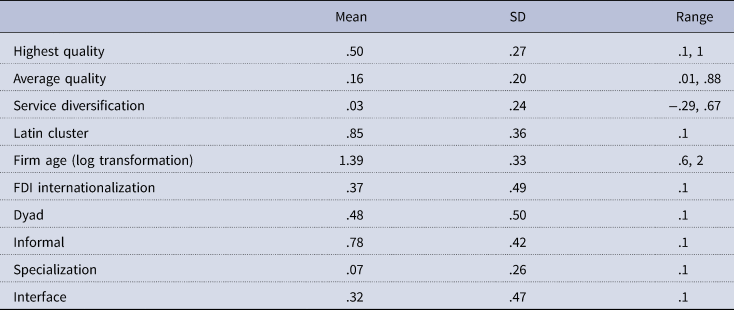
Table 2 presents descriptive statistics for all study variables. Variance inflation factors ranged from 1.10 to 1.78, well below the recommended ceiling of 10, thus relaxing potential concern of multicollinearity (Kleinbaum, Kupper, & Muller, Reference Kleinbaum, Kupper and Muller1988).
Descriptive statistics for study variables

We constructed the outcome variable out of three indicators of firm effectiveness, as explained in the methods section. Table 3 presents loadings and factor coefficient of reliability. The CFA assessed the convergent validity of the construct and found that indeed path coefficients from the latent construct to its manifest indicators are statistically significant (Anderson & Gerbing, Reference Anderson and Gerbing1988). The loadings of each indicator on the latent variable effectiveness are all greater than .8, above the traditional thresholds of .7 (e.g., Jackson, Gillaspy, & Purc-Stephenson, Reference Jackson, Gillaspy and Purc-Stephenson2009). Reliability test shows high McDonald's omega of .92 suggesting good reliability (McDonald, Reference McDonald1999). Model fit for the measurement model indicated good-fit indices (χ2[121] = 28.19; p value > .1; χ2/df = 1.28; TLI = .97, CFI = .98, RMSEA = .048), permitting us to move forward to the structural causal model without any posthoc modifications to the model (Hooper, Coughlan, & Mullen, Reference Hooper, Coughlan and Mullen2008; Jackson, Gillaspy, & Purc-Stephenson, Reference Jackson, Gillaspy and Purc-Stephenson2009). Hence, our three indicators of effectiveness were tested through CFA to establish the conceptual soundness of the latent variable effectiveness that will be used in the structural model (Schreiber, Nora, Stage, Barlow, & King, Reference Schreiber, Nora, Stage, Barlow and King2006).
Measurement model: reliability and convergent validity

*** All loadings are statistically significant at the p < .001 level
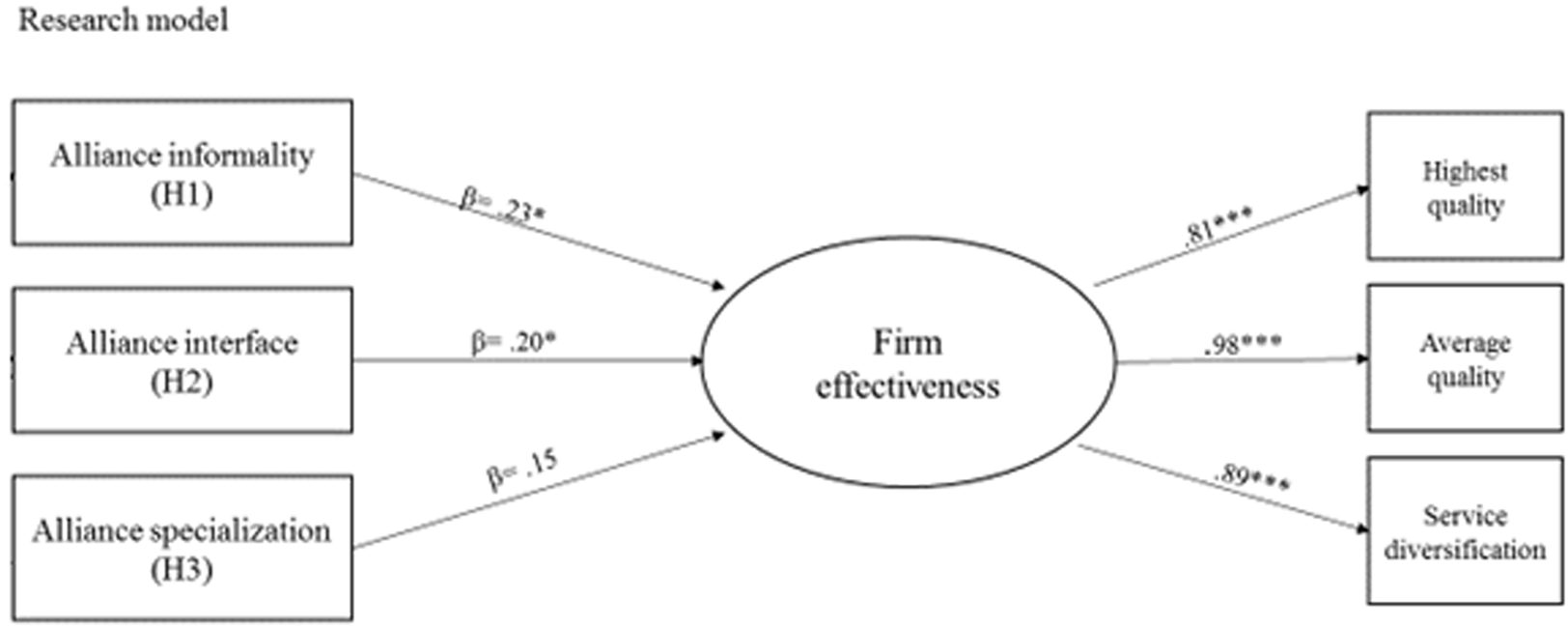
Subsequently, a structural model was examined by specifying the latent variable effectiveness as the outcome variable. An overall picture of the research model and results appears in Figure 1.
Research model.
Note. Firm effectiveness as a latent construct. *p < .05, ***p < .001

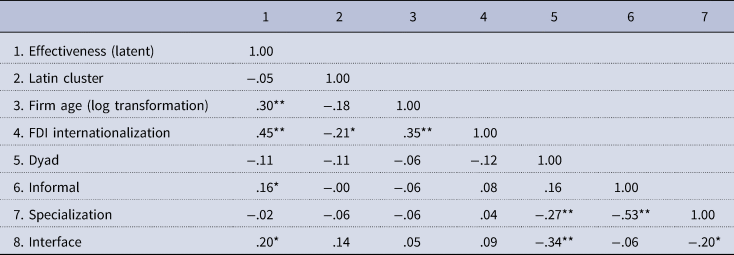
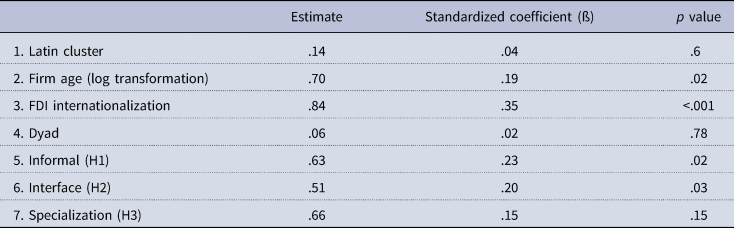
Table 4 presents correlations for the variables in the model. Model fit was unchanged and the R 2 value of effectiveness is .27. Table 5 presents the regression coefficients. The results indicate that the controls firm age and FDI internationalization positively predict effectiveness (β = .19, Z value = 2.2, p < .05 and β = .35, Z value = 3.8, p < .001 respectively), whereas the home country cultural control variable (Latin cluster) did not significantly predict effectiveness (β = .04, p = n.s); and neither did Dyad (β = .02, p = n.s).
Zero-order correlations

*p < .05; **p < .01
Regression coefficients from the structural model

Turning to our predictors of interest, alliance informality positively predicts effectiveness (β = .23, Z value = 2.3, p < .05, 95% CIs [.04–.42]), thus supporting hypothesis 1. These results represent the unique contribution of the strategy to internationalize through alliances characterized by low formalization even while holding constant any possible benefit from direct internationalization or from firm age, which were our control variable, and from the other structural variables. Hence, alliance informality contributes to higher firm effectiveness relative to higher formalization.
The results also support hypothesis 2, showing that internationalization through alliances with strong interface positively predicts effectiveness (β = .20, Z value = 2.2, p < .05, 95% CIs [.02 .38]). These results represent the unique contribution of this structural parameter to firm effectiveness even while holding constant any possible benefit from our control variable, and from alliance informality. Hence, alliance networks characterized by strong interface enjoy effectiveness benefits relative to those where interaction is more loose, distant, or undefined. The model yielded positive yet statistically insignificant results for the hypothesis 3 prediction of effectiveness by specialization initiatives (β = .15, Z value = 1.4, 95% CIs [−.06, .35]).
Robustness tests
Additional analysis was carried out to confirm the validity of the regression results in terms of the effect of strong interface and informality, due to the reduced size of their effects in relation to the effect of FDI internationalization, and in order to rule out the possibility that only direct internationalization affects effectiveness.
First, we created an alternative model where the effect of informality was omitted from the model by defining it as zero. This model and the original model were nested and differentiated by one degree of freedom. After examining the new model's fit indices (χ2[121] = 33.37; p value [χ2] = .07; χ2/df = 1.45; TLI = .95, CFI = .98, RMSEA = .061), which indicated good fit, we compared the nested models' fit directly by χ2 difference test. The original model was superior to the new model where we forced the effect of informality to be null (χ2 difference test: χ2diff = 5.17, p < .05), confirming the role of informality in the model. We repeated this procedure for the variable strong interface. After examining the new model's fit indices (χ2[121] = 32.95; p value [χ2] = .08; χ2/df = 1.43; TLI = .95, CFI = .97, RMSEA = .06), which indicated good fit, we compared the nested models' fit directly by χ2 difference test. The original model was superior to the new model where we forced the effect of strong interface to be null (χ2 difference test: χ2diff = 4.76, p < .05), confirming the role of strong interface in the model. Then, we compared the original model to a model where the effects of both these alliance structural characteristics were omitted. While having satisfactory fit indices (χ2[121] = 36.22; p value [χ2] = .05; χ2/df = 1.51; TLI = .94, CFI = .97, RMSEA = .065), the original model was superior (χ2 difference test: χ2diff = 8.02, p < .05). These tests confirmed the value of both these structural characteristics in the model, and ruled out the possibility that only FDI internationalization affects effectiveness.
To further confirm the validity of the regression results in terms of the effect of strong interface and informality, we examined three alternative models: (1) without any control variables, (2) without the Latin control variable, and (3) with controlling for each home country instead of the Latin control variables. In all these models, we obtained similar effects to those of the original model: strong interface positively predicts effectiveness (β = .54, Z value = 2.6, p < .01; β = .5, Z value = 2.2, p < .05; β = .53, Z value = 2.3, p < .05; for models 1–3 respectively), informality positively predicts effectiveness (β = .65, Z value = 2.6, p < .05; β = .6, Z value = 2.2, p < .05; β = .6, Z value = 2.3, p < .05; for models 1–3 respectively), and the effect of subgroup was positive but nonsignificant. Models 2 and 3 were tested also because of the possible effect of home country and potential bias in operationalizing the Latin control variable. The results of these alternative models, as well as the fact that model 2 fit indices were lower than the recommended range (TLI = .81, CFI = .89, RMSEA = .123), support the use of the Latin control variable. Overall, these robustness tests support the results of the original model.
Discussion
This study contributes to a finer understanding of nonequity international alliances and their effectiveness implication for partnering firms by considering the design structural parameters of alliances. Building on earlier work on the structural framework of alliances (Albers, Wohlgezogen, & Zajac, Reference Albers, Wohlgezogen and Zajac2016) and the knowledge-related advantages of alliances (Grant & Baden-Fuller, Reference Grant and Baden-Fuller2004), this study extends our understanding of the relationship between the structure of international alliances and outcomes for the partnering firm. We thus address specific calls in alliance literature to further understand structural dimensions of alliances and their implications to partnering firms (Albers, Wohlgezogen, & Zajac, Reference Albers, Wohlgezogen and Zajac2016; Contractor & Reuer, Reference Contractor and Reuer2014). We complement this stream of research, by showing that internationalizing through nonequity alliances is associated with effectiveness benefits when the alliances are (1) relatively informal and (2) have relatively strong interface. We predicted but did not find significant support for the effect of specialization initiatives on effectiveness. This may derive from issues of statistical power, as a relatively small portion of our sample exhibited such parameters. Future research is needed to further analyze the role of specialization in alliance – and firm – effectiveness.
We add to research on international alliances first by investigating a wider variety of cooperative alliance arrangements (Beamish & Lupton, Reference Beamish and Lupton2016; Juasrikul et al., Reference Juasrikul, Sahaym, Yim and Liu2018). Concentrating on fundamental structural properties of international alliances has allowed differentiating between various nonequity international alliance approaches and organizational setups. We thus complement the dichotomous approach common in international alliance literature, and capture various forms of nonequity cooperative arrangements (Beamish & Lupton, Reference Beamish and Lupton2016; Jiang & Li, Reference Jiang and Li2008). Second, we theorize and show evidence for a variance in the effects of international alliances on firm effectiveness, which are contingent on their informality and interaction patterns. We have underscored the role of these characteristics in key alliances concerns relating to knowledge access and exploitation (Albers, Wohlgezogen, & Zajac, Reference Albers, Wohlgezogen and Zajac2016; Grant & Baden-Fuller, Reference Grant and Baden-Fuller2004), allowing us to explain performance differences of firms in the same industry. We envisage future research with a significant qualitative component to allow more in-depth exploration of how various alliance approaches relate to important factors in the professional context – like knowledge transfer, retaining clients, and attracting and retaining professionals.
Addressing directly the structural design variation among international alliances (Albers, Wohlgezogen, & Zajac, Reference Albers, Wohlgezogen and Zajac2016; Boussebaa & Morgan, Reference Boussebaa, Morgan, Empson, Muzio, Broschak and Hinings2015), we contribute to the understanding of interfirm alliances and networks as strategic vehicles to enter foreign market (Beamish & Lupton, Reference Beamish and Lupton2016; Kurt & Kurt, Reference Kurt and Kurt2020). We thus contribute to research on the different cooperative strategies a firm can follow to create and develop its international presence (Beamish & Lupton, Reference Beamish and Lupton2016; García-Canal et al., Reference García-Canal, Duarte, Criado and Llaneza2002). Adding to the role of the specific context – industry – in studying the international alliances mode of entry (Laufs & Schwens, Reference Laufs and Schwens2014), this study also builds on industry characteristics (e.g., the deep embeddedness of firms and knowledge in national institutions) to explain the use of international alliances entry mode and their variation. Future research can analyze how our findings vary according to different industry, thus contributing to our understanding of the entry mode contingencies by industry (Laufs & Schwens, Reference Laufs and Schwens2014).
We argue that, for nonequity international alliances that aim to provide international reach and global integrated service to clients, the alliance arrangements should allow greater flexibility because partner firms need to coordinate complex customer demands and varying foreign environments. Our findings support this theoretical argument, showing that alliance informality (low formalization) is positively associated with firm effectiveness. This is in line with recent dynamic view of strategic alliances that emphasizes a need for more flexible organizational structural arrangements and easily changeable alliances to better correspond to dynamic and changing environments (He et al., Reference He, Meadows, Angwin, Gomes and Child2020). Future research should look at how international alliances help their members firms to acquire and utilize important higher order capabilities that are relevant to their effectiveness (Irwin, Gilstrap, Drnevich, & Sunny, Reference Irwin, Gilstrap, Drnevich and Sunny2022).
We also argue and find that alliances with strong interface are positively associated with firm effectiveness, because such interface enables efficient exploitation-focused learning by providing better access to partners' stock of knowledge. These findings are consistent with vast literature that posits interaction between partner firms as creating the framework for knowledge sharing and resource exchange (e.g., Faulconbridge, Reference Faulconbridge2010; Lawson et al., Reference Lawson, Petersen, Cousins and Handfield2009; Li et al., Reference Li, Jiang, Pei and Jinag2017). Alliance firms should broaden opportunities for joint action among member firms in order to contribute to alliance success (Li et al., Reference Li, Jiang, Pei and Jinag2017). For example, firms can nurture stronger interface – hence a higher number of connections among partner firms, a higher number of connected domains, a higher frequency or intensity of interaction (Albers, Wohlgezogen, & Zajac, Reference Albers, Wohlgezogen and Zajac2016) – which in turn will foster joint actions, such as ‘partner firms’ collective activities aimed at achieving cooperative goals’ (Li et al., Reference Li, Jiang, Pei and Jinag2017: 49). Future research can further analyze the effect of structural design parameters of alliance arrangements on behavioral dimensions of alliance, such as joint action, to better understand their interrelated impact on alliance success. Such research can draw on social exchange theory and investigate further the role of alliance structural design parameters, separately and interrelatedly, in shaping the interactions within the alliance and in affecting processes of social exchange and thus the learning and knowledge transfer among partners (Muthusamy & White, Reference Muthusamy and White2006).
Our findings relate to growing alliance research about social bonds and relational characteristics of alliances and their effect on alliance success that underscores the role of social mechanisms to govern alliance activity (Ali et al., Reference Ali, Khalid, Shahzad and Larimo2021; Jiang et al., Reference Jiang, Bao, Xie and Gao2016; Li et al., Reference Li, Jiang, Pei and Jinag2017; Robson, Katsikeas, & Bello, Reference Robson, Katsikeas and Bello2008). While social mechanisms such as trust, communication, and cultural adaptation were recently found to enhance international joint venture performance (Ali et al., Reference Ali, Khalid, Shahzad and Larimo2021), structural design parameters – such as interface and formalization in our study – shape the framework for the emergence of such social mechanisms (Albers, Wohlgezogen, & Zajac, Reference Albers, Wohlgezogen and Zajac2016). Future research can draw on social exchange theory and investigate this interdependency to advance understanding of the structural determinants of these social mechanisms, and contribute to research of alliance success.
Managerial implications
Concerning managerial implications, this study yields some new conclusions that are potentially important for firms engaged or that plan to engage in international alliances. Our analysis and findings encourage practitioners to look beyond binary legal and equity-related approaches to alliances, and beyond the generic ensemble of nonequity cooperative alliance. Particularly, this study informs practitioners that alliance structural design parameters need to be considered in order to strengthen the advantage from these entry strategies. Our analysis of the benefits of individual structural design parameters for knowledge access and learning – and hence for alliance effectiveness – allows practitioners to more closely relate their alliance membership to their strategic goals, and to allocate resources to alliances whose structure can accommodate their goals.
In the professional service context, where the organizational and managerial challenges are often compared to ‘herding cats’ (Lowendahl, Reference Lowendahl2000; von Nordenflycht, Reference von Nordenflycht2010), low formality and strong interface are easier said than done. On the one hand, we know that the professions are characterized by formalities, which often dictate the mode of interpersonal ties. However, on the other hand, our findings complement recent work on connective professionalism (Faulconbridge, Henriksen, & Seabrooke, Reference Faulconbridge, Henriksen and Seabrooke2021; Noordegraaf, Reference Noordegraaf2020) that advocates and illustrates moving away from the traditional ‘protective’ professionalism toward more engagement with key stakeholders.
Our findings also complement work like (Chang, Jack, & Webster, Reference Chang, Jack and Webster2017), indicating how alliances and networks can help acquire crucial knowledge and relational resources in foreign markets. Our work underlines the general helpfulness of low formality and strong interface in these contexts. Managers are thus advised to encourage mechanisms for easy and unhindered communications among professionals within their alliances; and to incentivize regular interactions. In practice, this will include technological capabilities as well as time.
Limitations
Our exploration of different types of international alliances was limited by the hypothesis testing approach we used. Future work should include a wider set of structural combinations – for example, high/low on formalization combined with strong/weak interface, and their effect on effectives of alliances and their component firmsFootnote 17.
While we created a time lag in the data collected for the independent variables, verified up to 3 years before the year of firm ranking, future study would benefit from a longitudinal study of the causal relationships among the research variables. In addition, although our sample was composed of all the firms that met the criteria detailed in the method section, it resulted in a modest sample. This has challenged our statistical analysis, making it harder to detect effects due to power issues. It would be interesting to test our model on a richer sample of the various alliance types.
Following calls to consider context in International Business studies (e.g., Laufs & Schwens, Reference Laufs and Schwens2014), the knowledge-based theorization in this study was very much linked to the professional service context. We do believe our findings are relevant to other settings where international alliance networks are used to overcome challenges deriving from resource scarcity, such as the case of SMEs in general (Laufs & Schwens, Reference Laufs and Schwens2014). Future research is needed to test our model in different contexts such as other industries or emerging markets.
Lastly, we relied on secondary data sources from reliable third-party sources such as Legal 500 and the legal press; but also from firm and association websites, which are not necessarily objective. We therefore endeavored to ignore claims of quality and effectiveness, and not to make claims concerning internal operations. We operationalize the structural parameters as dummy variables and not as scales, specifically in order to maintain high rigor despite the secondary data source. We triangulated information about the structural parameters of the alliances using secondary data from different sources: websites and LinkedIn pages of firms (members in the alliances), websites of established alliance networks, information on members firms and alliance networks on professional directories, and legal press. Nonetheless, future research with direct access to member firms would allow richer understanding of the effects of internal and relational aspects of alliance membership on effectiveness.
Acknowledgements
Early versions of this project were presented at the 2020 Oxford Said Annual Conference on Professional Service Firms, the 2021 Academy of International Business Conference, and International Business Review 2022 Young IB Scholars Workshop. The authors are grateful to Ulf Andersson, Ilya Cuypers, Claudia Gabbioneta, Gary Knight, Daniel Muzio, Lionel Paolella, Mark Pickering, Dorit Efrat Treister, and the late Huseyin Leblebici for all their comments and help along the way. We also thank JMO Editor Prof. Massimiliano Pellegrini and two excellent reviewers for their important contributions.
Conflict of interest
None.