

Many political scientists and economists have argued that coalition governments tend to accumulate more debt than single-party governments. This study shows that this pattern can be explained by the behavior of one particular category of governments: coalitions of parties that are unable to resolve commitment problems associated with political bargaining by making credible promises to their partners about future policy. Where political parties have reason to believe that they will depend on each other in the future (that is, where all members of the coalition have few outside options), they are able to resolve such bargaining problems. Empirically, this study finds that coalition governments with high commitment potential (that is, mutual dependence) do not tend to increase debt more than single-party governments do.
The first section discusses the literature on coalition governments and public debt and describes our approach to this important problem. The next section develops the concept of commitment potential and explains how it is measured. In the remaining sections, we present an empirical analysis of changes in public debt in 20 advanced democracies from the early 1960s to the late 2000s.
Conflicts and Compromises in Coalition Governments
The scholarly debate that began with Roubini's and Sachs's claim that “the size and persistence of budget deficits in the industrial countries … is greatest where there have been divided governments” (1989, 905–8) has generated a vast literature in economics and political science. Yet there is little agreement on the nature of the relationship between multiparty government and debt. In fact, although the received wisdom in much of the literature is that there is a positive association between coalition government and increasing debt (see, for instance, Persson and Tabellini Reference Persson and Tabellini2003, 179–83), even this basic empirical finding has been disputed in a number of studies, including early contributions by Edin and Ohlsson (Reference Edin and Ohlsson1991) and de Haan and Sturm (Reference de Haan and Sturm1997). In recent years, moreover, debt has increased the most in countries with a history of single-party governments, such as Greece and the United Kingdom (Nyman Reference Nyman2012).
The proposition that coalition governments tend to accumulate more debt than single-party governments can been derived from two different theoretical models (Persson and Tabellini Reference Persson and Tabellini2006, 734–35). In common-pool models, coalitions build up more debt since political parties (and/or individual ministers) externalize part of the costs of spending increases in the policy areas they care most about (Hallerberg Reference Hallerberg2004; Hallerberg and von Hagen Reference Hallerberg and von Hagen1999): ministers from different parties have an interest in increasing the spending of their own departments even if the combined effect is to weaken the budget as a whole. Specifically, as Hallerberg and von Hagen (Reference Hallerberg and von Hagen1999, 212) argue, if “each minister determines the spending priorities of her department, but … does not consider the full marginal tax burden,” then multiparty governments are likely to accumulate more debt.
In veto-player models, coalition governments accumulate more debt since they are less responsive to economic shocks than single-party governments. As de Haan, Sturm, and Beekhuis (Reference de Haan, Sturm and Beekhuis1999, 163) put it, “coalition governments will find it more difficult to close budget deficits after adverse shocks, since parties in the coalition will veto spending cuts or tax increases that impinge on the interests of their respective constituencies,” resulting in what we might call “veto player deadlock” (Hallerberg and Basinger Reference Hallerberg and Basinger1998). More generally, “a large number of veto players tends to ‘lock in’ economic policy and reduce its ability to respond to shocks” (Persson and Tabellini Reference Persson and Tabellini2006, 734; cf. Alesina and Drazen Reference Alesina and Drazen1991; Franzese Reference Franzese2002, Chapter 3; Tsebelis Reference Tsebelis2002, Chapter 8).
These models have different empirical implications: whereas common-pool models predict that there is a constant tendency for coalition governments to accumulate more debt, veto-player models predict that the effect of coalition government on changes in debt depends on the level of debt (Franzese Reference Franzese2002, Chapter 3; Tsebelis Reference Tsebelis2002, Chapter 8).Footnote 1 The models also rely on different assumptions about decision making within coalition governments. Common-pool models are based on the idea of “ministerial” (Strøm Reference Strøm1994) or “fiefdom” government (Hallerberg Reference Hallerberg2004), assuming, as in Laver and Shepsle's portfolio allocation model (Reference Laver and Shepsle1996), that each minister exercises considerable discretion over the jurisdiction of the portfolio. Veto-player models rely on a very different model of coalition governance, which is sometimes labeled “cabinet government,” assuming, as Tsebelis (Reference Tsebelis1995, Reference Tsebelis2002) does, that “each coalition party is a veto player that can maintain the status quo policy position against the demands of its coalition partner or partners” (Strøm, Müller and Markham Smith Reference Strøm, Müller and Smith2010, 523).
But the two models share one fundamental assumption: the idea that factions within a majority party are better able to solve bargaining problems than parties in a coalition. As Persson, Roland and Tabellini (Reference Persson, Roland and Tabellini2007, 2) note, “a single-party government is assumed to behave as a unitary decision maker, while a coalition government faces a collective choice problem,” which raises the question why “a single party representing several groups in society” should behave differently than “a coalition of parties representing the same groups.” When Persson, Roland and Tabellini made this important point, they were mainly concerned with common-pool models, but the same question can be asked about veto-player models: why are parties veto players when factions are not?
Our answer to this question is that when coalitions have high “commitment potential,” there is no practical difference between factions within a majority party and parties within a coalition government.
The assumption that factions within a single party behave (more) like a unitary decision maker than parties within a coalition is justified when at least one coalition party has outside options. Party splits are very rare events, so factions know that they will have to collaborate with each other in the future, but members of coalition governments have to consider the risk that their current partners might form other coalitions in the future (or even govern alone). This typically makes political agreements among factions more credible than those among coalition partners.
But the ability to overcome this commitment problem varies greatly between coalition governments, for many coalition parties do not in fact have outside options. This is the core of our argument. Our critique of the existing literature is that it has underestimated this important variation within the universe of coalition governments.
Our argument is based on two assumptions. First, following Bawn and Rosenbluth (Reference Bawn and Rosenbluth2006) and Persson, Roland and Tabellini (Reference Persson, Roland and Tabellini2007), we assume that all political parties have “projects” that they care deeply about (such as public programs that benefit particular groups of voters that support the party), and that it is important for them to protect those projects. Second, following Alesina and Drazen (Reference Alesina and Drazen1991), and many others, we assume that high levels of government debt have non-negligible macroeconomic costs, and that all parties in government give some consideration to these costs, either for electoral reasons or because they keep them from achieving their policy goals. In other words, each governing party faces a trade-off between its preference for low debt and its (strong) preference for protecting party-specific “projects.”
If there is such a trade-off (that is, if parties care about anything beyond their “projects”), the claim that parties always oppose spending cuts or tax increases that hurt their own projects and constituencies must be qualified, for it is not immediately apparent why parties inside a coalition should be unable to share the burdens of fiscal consolidation, ensuring that no party's project is harmed to such an extent that the party in question chooses to veto a fiscal policy change (we are assuming that it is not possible to shift all burdens of fiscal consolidation to “projects” favored only by opposition parties). If factions within a ruling single-majority party are able to resolve conflicts among factions—and this is a necessary assumption for any argument that asserts that single-party governments and coalition governments behave differently—then it should be possible, at least in principle, for parties in coalitions to do the same.
Following studies by scholars such as Lindvall (Reference Lindvall2010) and Scartascini, Stein and Tommasi (Reference Scartascini, Stein and Tommasi2014), we believe the main reason that parties in coalition governments are sometimes unable to conclude political bargains is that such bargains are associated with a fundamental commitment problem. A political party will only accept a mutually beneficial agreement if it can be reasonably confident that its coalition partners will honor that agreement in the future. If a party suspects, instead, that its current partners would take the first available opportunity to impose higher costs on its “project” in order to limit the cost to their own “projects,” it is indeed likely that it will always insist on protecting its own “project” and block all debt-reduction programs.
But such commitment problems are much easier to solve if all parties in government expect that they will depend on each other's support in the future. If each of them has few other potential coalition partners, or if they tend to cooperate frequently with the same group of parties for other reasons, then each major policy agreement—such as a debt reduction program—becomes one sub-game in a longer, repeated game, in which non-cooperative behavior would have strongly negative effects later on.
On the basis of the arguments that we have developed here, we believe that any effects of coalition government on changes in government debt should be conditional on the government's “commitment potential,” which is, in turn, a function of mutual dependence among parties.
Hypothesis: Coalition government is associated with larger year-to-year increases (or lower year-to-year decreases) in debt when the government's commitment potential is low. When commitment potential is high, coalition governments pursue fiscal policies that are similar to those of single-party governments.
We need to consider two important alternative explanations. The first comes from the growing literature on budgetary institutions and fiscal rules, which suggests that parties can sometimes use institutional changes to overcome common-pool problems and veto-player deadlock, including fixed numerical targets and restrictive procedural rules (Alesina and Perotti Reference Alesina and Perotti1999; von Hagen and Harden Reference von Hagen and Harden1995). Hallerberg, Strauch and von Hagen (Reference Hallerberg, Strauch and von Hagen2007) argue that a “delegation” approach to coalition government—in which the finance minister, for instance, is vested with significant decision-making powers—is less efficient than a so-called contract approach, in which parties negotiate overall spending targets at the beginning of the term, limiting each cabinet minister's spending. Wehner (Reference Wehner2010b) argues that the effect of party fragmentation on fiscal policy outcomes is conditional on the autonomy of legislators vis-à-vis the executive. De Haan, Jong-A-Pin and Miearau (Reference de Haan, Jong-A-Pin and Miearau2013) show that “budgetary institutions, no matter whether they are based on a strong minister of finance or fiscal contracts, become significant in case of strong ideological fragmentation, thereby mitigating the impact of political fragmentation.” Martin and Vanberg (Reference Martin and Vanberg2012) show that the presence of restrictive budgetary rules, such as restrictions on budget size, reduces the expansionary effect of an increase in the number of parties on spending.
Second, coalition governments may implement various internal mechanisms to control individual ministers and overcome bargaining problems, and as suggested by Bäck, Müller and Nyblade (Reference Bäck, Müller and Nyblade2013), this may have important consequences for policymaking in coalitions. We recognize the importance of such “coalition governance mechanisms,” but we see our hypothesis as a complementary explanation, and we argue that coalitions with a high degree of commitment potential can solve both common-pool problems and veto-player deadlock since high commitment potential should enable parties to commit to future policies without implementing specific coalition governance mechanisms.
Commitment Potential: Conceptualization and Measurement
When does a party have reason to fear that its current coalition partners might “betray” it by coalescing with other parties (or by forming governments on their own) in the future? And when, in contrast, do governments have high “commitment potential,” since the risk of betrayal is low? These questions clearly need answers before we examine the relationship between commitment potential and changes in debt.
The rich literature on coalition formation has identified a number of features of parties and party systems that are likely to affect the outcomes of government-formation processes (for an overview, see De Winter and Dumont Reference De Winter and Dumont2006). For example, parties that are large, centrally located, and have been in government before are more likely to enter government than small, peripheral and inexperienced parties (Bäck and Dumont Reference Bäck and Dumont2008; Warwick Reference Warwick1996). At the party-system level, potential governments that are of minimal-winning size, consist of ideologically similar parties and have formed before (especially incumbent governments) are more likely to emerge than governments that do not have these characteristics (Martin and Stevenson Reference Martin and Stevenson2001).
But it is not straightforward to apply these important insights when we attempt to conceptualize and measure the sort of mutual dependence among parties that we are concerned with here. We have therefore chosen to create a measure of commitment potential that is based on historical patterns of cooperation among parties. This is, in our view, a simple yet valid solution to the conceptualization-and-measurement problem that we face. First of all, parties very likely look to the past when they attempt to predict the future behavior of their current partners. Second, historical patterns of coalition formation should reflect the underlying regularities identified in the coalition-formation literature.
Our measure is inspired by an earlier measure that was created, for a different purpose, by Falcó-Gimeno (Reference Falcó-Gimeno2011, Reference Falcó-Gimeno2012). Falcó-Gimeno also seeks to estimate the likelihood of interactions among parties on the basis of historical coalition patterns: for each party in a coalition, he calculates the proportion of cabinets equal to the current cabinet out of the total number of cabinets in which the party has participated. However, an important drawback of this measure, for our purposes, is that it is based on coalition patterns during the entire period included in Falcó-Gimeno's study. Since parties in 1970 could hardly be expected to learn from the composition of the government in 1980, we only want to include past governments in the calculation of our measure (that is, governments that were formed prior to the year under observation).
We have therefore proceeded as follows. The first step in our assessment of a government's commitment potential is to calculate each governing party's potential for betrayal, which we denote Pi,j,t, for each country i, party j and year t, on the basis of that party's history of participation in government. Since electorates, party systems and political circumstances change, recent events provide more useful information about how parties behave than events in the distant past. We therefore give more recent years greater weight by discounting past observations according to the discount rate δ. We have chosen to set δ to 0.95, implying that events taking place some 14–15 years before the current observation—that is, approximately four electoral cycles earlier—have half the weight of events that took place the year before. The formula for betrayal potential, which is inspired by the calculation of “democratic capital” in Persson and Tabellini (Reference Persson and Tabellini2009), is
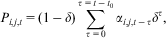 $${{P}_{i,j,t}}\, = \,(1\,{\rm{ - }}\,\delta )\mathop{\sum}\limits_{\tau \, = \,0}^{\tau \, = \,t\,{\rm{ - }}\,{{t}_0}} {{\alpha }_{i,j,t\,{\rm{ - }}\,\tau }}{{\delta }^\tau }, $$
where αi,j,t − τ is the proportion of party j's coalition partners at time t that was not in government with party j at time t – τ (if party j was in government at time t – τ; if not, ai,j,t − τ is always 0), and t 0 is either 1945 or the first year of democracy (if democratization occurred later than 1945). We multiply the right-hand side of the equation by 1 – δ because we wish to normalize P to the interval [0, 1], where 0 means that the party has no history of governing without its current coalition partners and 1 means that it has been in power continuously since the beginning of the period under observation, and none of its current partners were included in previous governments.
Note that there are two ways for a party to acquire a high “potential for betrayal”: (1) if it has recently been in government with a different set of coalition partners and (2) if it has recently governed alone. By definition, a party in a single-party government has a betrayal potential of 0, and a party has little or no potential for betrayal if it has exclusively, or almost exclusively, formed coalitions with the same partners prior to t, or if it has never been in government at all.Footnote 2
The second step in the creation of our measure is to use each party's potential for betrayal, Pi,j,t, as defined in Equation 1, to calculate each government’s commitment potential. Since no coalition government is stronger than its weakest link, we define commitment potential as 1 minus the highest potential for betrayal of any of the parties that are in government at time t, so that
 $${\rm{Commitment}}\;{\rm{Potential}}{{\:}_{i,t}} = 1\,{\rm{ - }}\,\max {{{\bf {{P}}}}_{i,t}},$$
where Pi,t denotes the set of “betrayal potentials” of the parties in government in country i at time t.
It is important to note that our measure of commitment potential does not measure whether the parties currently in government have collaborated in the past. Rather, it measures whether some parties in government have collaborated with other parties in the past (or governed alone). In other words, it is not a measure of “familiarity” (Martin and Stevenson Reference Martin and Stevenson2010, 505). The reason is that our argument about intra-coalition bargaining is not based on the idea that familiarity generates trust (as in the work of Franklin and Mackie Reference Franklin and Mackie1983, who suggest that parties that have cooperated before experience some benefits from cooperating again, since their ability to work together is higher). Instead, ours is a theory of credible commitments: parties “trust” each other when they know that the other members of the coalition are unlikely to be able to betray them in the future by forming a government without their current partners.
Since our measure of betrayal potential is based exclusively on historical patterns of cooperation among parties, it should be interpreted as the lower bound of the actual betrayal potential (even if history suggests that the probability of betrayal is 0, shocks such as the entry of new parties might increase the actual probability of betrayal). There are several other features that could plausibly influence the risk of betrayal, and perceptions thereof, including the manner in which previous coalitions between the same parties have ended (were previous coalitions “successful” in the sense that the cabinet lasted the entire term, or did they fall apart due to interparty conflict?). But the sorts of data that we would need in order to develop a more complex measure are currently only available for a subset of our sample (Strøm, Müller and Bergman Reference Strøm, Müller and Bergman2008). So for now, we have settled for the relatively simple and straightforward measure that we have developed here.
Data
Our dependent variable, year-to-year changes in public debt, is based on a measure of gross central government debt (as a percentage of GDP) from Reinhart and Rogoff (Reference Reinhart and Rogoff2009). We chose a measure of central government debt rather than general government debt since our argument is concerned with the behavior of national-level decision makers. Since the Reinhart and Rogoff dataset does not include data on all the countries we are interested in, we have used data from two other sources—Armingeon et al. (Reference Armingeon, Weisstanner, Engler, Potolidis, Gerber and Leimgruber2011) and the IMF Historical Debt Database (Abbas et al. Reference Abbas, Belhocine, Ganainy and Horton2010)—to impute missing values. The Reinhart and Rogoff and Armingeon et al. series are highly correlated (r = 0.95), as are the Reinhart and Rogoff series and the IMF series (r = 0.92). Mixing data from different sources, as we do here, is potentially risky, but since the three data series are highly correlated, we believe that the benefits of including as many observations as possible outweigh the risks. We use a measure of year-to-year changes in debt rather than a measure of deficits for three reasons: (1) deficits are more easily misrepresented through creative accounting, (2) it is the preferred measure in most of the literature that we draw on, and (3) it is available for a long time period.Footnote 3
Our analysis covers the period from 1961 to 2008 (or from democratization to 2008) and includes the following countries: Australia, Austria, Belgium, Canada, Denmark (from 1967), Finland, France, Germany, Greece (from 1976, with a one-year gap in the 1990s because of missing data), Ireland (from 1976), Italy, Japan, the Netherlands, New Zealand, Norway, Portugal (from 1977), Spain (from 1978), Sweden, Switzerland and the United Kingdom. This gives us a dataset of approximately 880 country-years.
The data source that we have used to define the two main explanatory variables—coalition government and commitment potential—is the ParlGov database (Döring and Manow Reference Döring and Manow2012). For both variables, where more than one cabinet was in government during a specific year, we have chosen to concentrate on the cabinet with the longest duration during that year. For the coalition variable, we have chosen to use a simple dummy (with single-party governments as the reference category) rather than a measure of the number of parties in government (cf. Franzese Reference Franzese2002) or the ideological range within the government (Tsebelis Reference Tsebelis1999), since these more nuanced measures generate virtually identical results (although the ideological range within the government is included as a control variable in some of our models).
As we explain in more detail below, we include a number of economic controls in our models (as well as lags of changes and levels of debt). First, to specify an economic baseline model that is very similar to the economic models estimated in most of the studies of fiscal policy cited here, we include three variables: GDP growth, using data from the Penn World Tables; unemployment, using data from Armingeon et al. (Reference Armingeon, Weisstanner, Engler, Potolidis, Gerber and Leimgruber2011); and debt-servicing costs, which we define as the long-term interest rate minus inflation minus growth times the lagged level of debt, using data on interest rates from Armingeon et al. (Reference Armingeon, Weisstanner, Engler, Potolidis, Gerber and Leimgruber2011) and data on inflation from the World Bank's World Development Indicators via Teorell et al. (Reference Teorell, Samanni, Holmberg and Rothstein2012).Footnote 4
We also include political control variables. Some of them are meant to capture transient differences related to elections and governments, while others describe enduring constitutional differences among democracies. To control for variation in governments and election cycles, we include, first of all, a dummy for election years, since previous research suggests that electoral budget cycles may influence year-to-year changes in debt (Wehner Reference Wehner2010a, 640; Wehner Reference Wehner2010b, 220; cf. Franzese Reference Franzese2002). Second, we include a dummy for minority government, since Edin and Ohlsson (Reference Edin and Ohlsson1991) argued, in an early contribution to the literature on cabinets and fiscal policy, that minority government matters greatly for fiscal policy outcomes. Third, we include a variable that describes the ideological range within the cabinet, measuring the distance between the parties furthest to the left and right, since we want to make sure that the correlation between our measure of commitment potential on the one hand, and changes in debt on the other, is not spurious (ideologically mixed governments presumably have low commitment potential). Moreover, scholars such as Tsebelis (Reference Tsebelis1999) and Franzese (Reference Franzese2002) used ideological range measures in earlier studies of legislation and budgeting. With the exception of the election year dummy—for which we rely on data from Armingeon et al. (Reference Armingeon, Weisstanner, Engler, Potolidis, Gerber and Leimgruber2011)—these variables come from the ParlGov database (Döring and Manow Reference Döring and Manow2012). In one of our models, we also introduce controls for fiscal institutions, which come from the 2012 edition of the IMF Fiscal Rules Dataset (Schaechter et al. Reference Schaechter, Kinda, Budina and Weber2012).
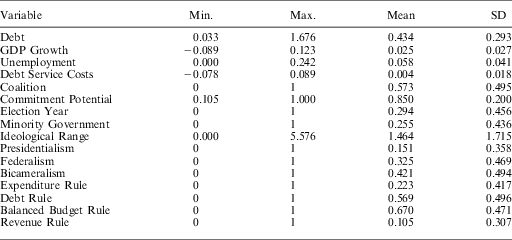
Our main source of data on constitutions is Armingeon et al. (Reference Armingeon, Weisstanner, Engler, Potolidis, Gerber and Leimgruber2011), which in turn relies on Huber et al. (Reference Huber, Ragin, Stephens, Brady and Beckfield2004). The main argument for including constitutional features in the model is that they influence the number of institutional veto players in the budgeting process (Tsebelis Reference Tsebelis2002). The first constitutional control is presidentialism, which is a dummy variable for semi-presidential countries (most countries in our sample are parliamentary, and fully presidential countries, such as the United States, have been excluded since their economic governance models are so different). The second is a dummy for federalism (weakly and strongly federal states have been combined into one category). The third is a dummy for bicameralism (systems with very weak second chambers are coded as unicameral). An additional reason for including features such as federalism and presidentialism in the model is that there may be overspending if budgetary legislation majorities are assembled through log-rolling compromises among branches and levels of government (Franzese Reference Franzese2002, 139–43). In table 1 we describe the variation in all of the variables included in our analyses.
Descriptive Statistics
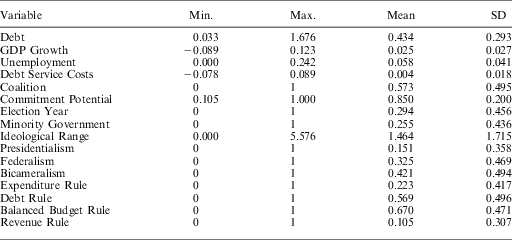
Note: Descriptive statistics for all variables except for the fiscal rules variables are based on the sample used in Model 4, Table 2 (N=883). The descriptive statistics for the fiscal rules variables are based on the sample used in Model 6 (N=457).
Empirical Evidence
We begin with some descriptive statistics to introduce the dependent variable and the main independent variables. Figure 1 presents detailed information on the development of our measure of government debt (the solid lines), periods of coalition government (the gray areas) and commitment potential (the dashed lines).
Debt and coalitions, 1960–2008 Note: the solid lines represent government debt over GDP. The gray areas show periods of coalition government. The dashed lines describe the commitment potential of all governments.

Among coalition governments in our sample, commitment potential varies from just over 0.1 to 1 (mean 0.74). Consider how commitment potential has changed in some of the cases in Figure 4. In Austria, all governments had the maximum commitment potential until the early 1980s because a grand coalition was in power continuously from the Second World War until 1966; from 1966 to 1983, Austria was governed by single-party governments, which had a commitment potential of 1 by definition. When the coalition between the Social Democrats and the liberal FPÖ (Freiheitliche Partei Österreichs) was formed in 1983, the government's commitment potential dropped to very low levels since the Social Democrats had governed alone from 1970–83. The new government's commitment potential increased slightly over the next few years, as the parties gained more experience of working together. When a Christian Democratic–Social Democratic coalition was formed in 1987, commitment potential went up (since the cooperation between these parties in the 1950s and early 1960s is not entirely discounted), only to fall again when the Christian Democrats formed a government with Jörg Haider's FPÖ in 2000. The new Christian Democratic–Social Democratic coalition in 2007 had a higher commitment potential than the previous government, since the 1987–2000 grand coalition between these parties still influences the measure. In our view, it was no accident that there was a particularly large increase in government debt in the mid-1980s in Austria, or that debt began to stabilize in the mid- to late 1990s, some ten years into the new grand coalition government.
There is too much government turnover in Italy to comment in detail on the graph in Figure 1. We will only point out that until the destruction of Italy's Christian democratic party Democrazia Cristiana in the early 1990s, the country's history of shifting coalitions meant that most governments had moderate to low commitment potential. Yet the formation of governments consisting exclusively of new parties in the early 1990s meant that governments in the mid-1990s to the mid-2000s had high commitment potential (not coincidentally, we think, this was a period when government debt decreased in Italy).
Japan fits our theory remarkably well: the correlation between (low) commitment potential and (large) increases in government debt is strong. Beginning in the 1980s, but particularly in the 1990s and 2000s, the formerly hegemonic Liberal Democratic Party formed a series of coalitions with smaller parties, and these coalitions had very low commitment potential (because the Liberal Democratic Party governed alone for so long). At the same time, government debt has increased sharply in Japan, particularly since the early 1990s. Not surprisingly, this pattern makes Japan an influential case in our statistical analyses.
Sweden has been governed, for the most part, by Social Democratic single-party governments (which by definition have maximum commitment potential). The first three-party center-right coalition government since the interwar period, formed in 1976, had a commitment potential of less than 1 since the 1950s coalition between the Social Democrats and the Farmers’ Union (an earlier name for the Center Party, one of the coalition partners in 1976) influences the measure. The center-right coalition from 1991–94 had slightly lower commitment potential than the previous center-right government since it included a fourth party, the Christian Democrats. The government that formed in 2006, however, had higher commitment potential since the last smaller center-right coalition was dissolved 24 years prior to the formation of this new four-party coalition government. Not coincidentally, in our view, there was a large increase in debt in the early 1990s, and a relatively large increase in debt in the late 1970s and early 1980s, but no comparable increase in debt after 2006.
Before we proceed to the multivariate analyses, consider Figure 2, which describes the relationship between the average commitment potential of coalition governments and the average level of debt in the period 1960–2008 in countries where more than one-third of all governments in this period were coalitions. As the figure shows, there is a strong cross-national correlation between the average commitment potential of coalition governments and the average level of debt. Yet there is a significant risk that this correlation is the result of an unknown factor that influences both government formation and fiscal policy outcomes. For that reason, and others, we now examine a multivariate statistical model. Our basic model has the form:
Debt and commitment, 1960–2008 Note: the figure plots the mean level of government debt in 1960–2008 (as a proportion of GDP) against the mean commitment potential of coalition governments in countries where more than one-third of all governments were coalitions.
 $${ {\bf {{\rDelta }}}\:Debt{{\:}_{i,t}}\, = &\,\alpha \, + \,\rho {\bf {{\rDelta }}}\:Debt{{\:}_{i,t\,{\rm{ - }}\,1}}\, + \,\gamma \:Debt{{\:}_{i,t\,{\rm{ - }}\,1}} \cr & + {{\beta }_1}\:Coalition{{\:}_{i,t{\rm{ - }}1}}\, + \,{{\beta }_2}\:Commitment\;Potential{{\:}_{i,t{\rm{ - }}1}}\, + \,{{{\bf {{\brbeta }}}}_3}{{{\bf {{X}}}}_{i,t}} + {{{\epsilon}}_{i,t}}, \cr}$$
where X is a set of (economic and political) controls. This type of model is in general use in the literature on fiscal policy (see, for example, Roubini and Sachs Reference Roubini and Sachs1989; Franzese Reference Franzese2002; Hallerberg, Strauch and von Hagen Reference Hallerberg, Strauch and von Hagen2007). The coalition and commitment potential variables, as well as many of the control variables, are lagged one year since we expect policy decisions at t – 1 to take effect at t.
In order to estimate the effect of the main variables of interest, it is important to specify an empirical model that takes into account the fact that changes in government debt are temporally correlated, and are functions of macroeconomic conditions as well as political decisions (Franzese Reference Franzese2002, 150–1). We deal with the first problem by controlling for lagged changes and levels of debt, and we address the second problem by including the three economic controls discussed above: GDP growth, the change in unemployment since the previous year and a measure of debt-servicing costs.
It is important to note that since commitment potential equals 1 for all single-party governments, Equation 3 is an interactive model that allows us to test the conditional hypothesis that we are interested in. The hypothesis that we want to test is that coalition governments are associated with larger year-to-year increases (or lower year-to-year decreases) in debt when the government's commitment potential is low, whereas coalition governments pursue fiscal policies that are largely similar to the policies of single-party governments when commitment potential is high. The main quantity of interest, when we interpret the results below, is therefore the difference in expected year-to-year debt changes between coalition governments and single-party governments, or
 $$E\,({\rm{\rDelta }}Debt\,|\,Coalitio{{n}_{t\,{\rm{ - }}\,1}}\, = \,1)\,{\rm{ - }}\,E\,({\rm{\rDelta }}Debt\,|\,Coalitio{{n}_{t\,{\rm{ - }}\,1}}\, = \,0).$$
Going back to our basic model in Equation 3, and keeping in mind that commitment potential=1 for all single-party governments, this quantity can be expressed as
 $${{\beta }_1}\,{\rm{ - }}\,{{\beta }_2}(1\,{\rm{ - }}\,Commitment\;Potentia{{l}_{t\,{\rm{ - }}\,1}}).$$
After presenting the main estimates, we will show how this quantity varies with commitment potential. But the raw coefficients are also meaningful and fairly straightforward to interpret. If β 1 > 0, then all coalition governments tend to accumulate more debt than single-party governments (assuming that β 2 is negative). If, on the other hand,  $$$ {{\beta }_1} \approx 0 $$$
but β 2 < 0, then only some coalition governments—those with low commitment potential—tend to accumulate more debt than single-party governments, not governments with high commitment potential. If β 1 < 0 and β 2 < β 1, single-party governments accumulate more debt than coalition governments with high commitment potential do.
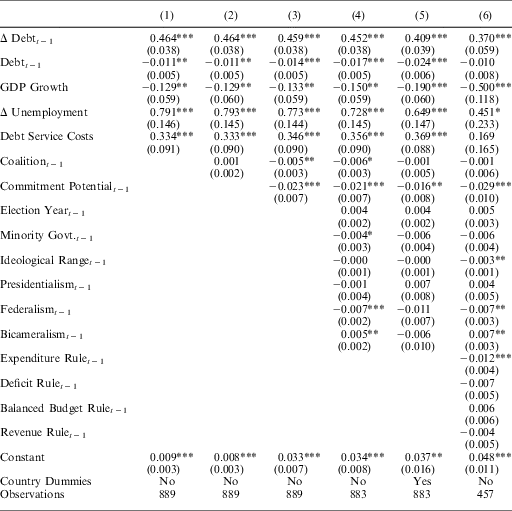
Table 2 presents the main results of the statistical analysis. Model 1 is our baseline economic model (all the models are estimated using ordinary least squares regression with panel-corrected standard errors, following Beck and Katz Reference Beck and Katz1995). The coefficient for the lagged dependent variable is positive, suggesting that changes in government debt are persistent (if debt increased last year, it has a tendency to increase this year). The coefficient for the lagged level of debt, however, is negative, suggesting that when debt is already high, it tends to grow more slowly (or to decrease faster). Low growth is associated with larger increases (or smaller decreases) in debt, as are increasing unemployment and high debt-servicing costs. These parameters are stable across specifications.
Coalitions and Changes in Government Debt, 1961–2008
In Column 2, we add a simple measure of coalition government to the baseline economic model. The coefficient is near zero and the standard error is large. Based on this model, therefore, one would conclude that the type of government matters very little or not at all to fiscal policy, or, in other words, that multiparty governments do not perform differently from single-party governments when it comes to debt management.
When we add our measure of commitment potential to the model in Column 3, however, it becomes clear that coalition governments with low commitment potential tend to accumulate more debt (or reduce debt more slowly) than coalition governments with high commitment potential (or single-party governments, as we show in Figure 3). The relatively large (and significant) negative coefficient for commitment potential suggests that this factor is important for understanding fiscal policy. The coefficient for the coalition dummy is negative, suggesting that at very high levels of commitment potential, coalition governments accumulate less debt than single-party governments (but, as we note below, this finding is not very robust).
The effect of coalition government Note: the solid lines represent the marginal effect of coalition government (relative to single-party government), plotted here as a function of the government's commitment potential (commitment potential is, by definition, 1 for single-party governments). The gray areas represent the 95 and 90 percent confidence interval around these estimates. The figures are based on Models 3, 4, and 5 in Table 2.
In Column 4, we add our political control variables. Minority government appears to be negatively associated with changes in debt, as is federalism. Elections and bicameralism, on the other hand, appear to be associated with larger increases in debt (or smaller decreases). What is most important to note concerning Model 4 for our purposes, however, is that the coefficient for commitment potential remains almost identical to the corresponding coefficient in Model 3, providing further support for our hypothesis that commitment potential matters to the fiscal policies that coalition governments pursue. Figure 3 demonstrates that the inclusion of political controls makes the error bands around the estimated difference between single-party governments and coalition governments larger, but the results nevertheless support the hypothesis that commitment potential matters to the variation in fiscal policies among coalition governments.
A Hausman test comparing Model 4 to a fixed-effects specification of the same model (that is, a model that contains country dummies) suggests that fixed effects are not required (the hypothesis that there is a systematic difference in coefficients across models is not supported). Nevertheless, as a robustness check, we present the results of an analysis with country-level fixed effects in Model 5. As Nickell (Reference Nickell1981) showed, combining fixed effects with a lagged dependent variable leads to bias, but as both he and, more recently, Beck and Katz (Reference Beck and Katz2011, 342) write, this bias is small when T is large. Beck and Katz suggest that when T is 20 or higher, including a lagged dependent variable in a fixed-effects model should not lead to significant error; in our case, T > 45 for most of the countries in our dataset. The result of the fixed-effects analysis is that even when we constrain the analysis to within-country variation over time—as in Model 5—we find reasonably strong support for our hypothesis: the magnitude of the coefficient of the commitment potential variable is reduced, but the p-value remains just under 0.05. Again, the error bands around the estimated difference between single-party and coalition governments are relatively large in this model, but the most reasonable interpretation of the results is that commitment potential matters to the behavior of coalitions.
Model 6 includes a battery of controls for fiscal rules to control for the alternative institutional explanation discussed above. Since these measures are only available from 1985 onward, the sample is much smaller, but although one type of fiscal rules (those related to expenditure) appears to have the expected negative effect, the main result for commitment potential is unaltered: high commitment potential is associated with smaller increases in debt.
For an illustration of the main results, see Figure 3, which plots the conditional effect of coalition government—as defined in the beginning of this section—as a function of the government's commitment potential, in order to illustrate what our model says about the differences between coalition governments and single-party governments. Figure 3(a) is based on Model 3 in Table 2; Figure 3(b) is based on Model 4; and Figure 3(c) is based on Model 5. The interpretation is straightforward. If commitment potential is held at the mean value for coalitions in our sample, which is 0.74, the estimated marginal effect of coalition government is close to 0. This explains why the coefficient for coalition government in Model 2 is close to 0: when commitment potential is not taken into account, the type of government appears to make no difference to fiscal policy. When commitment potential is taken into account, however, a different picture emerges. For very low values of commitment potential, coalition governments are more likely to increase debt (or to reduce it more slowly) than single-party governments. Yet at very high levels of commitment potential, coalition governments are, if anything, more likely to reduce debt (or to increase it more slowly) than single-party governments are (although this result does not hold in the fixed-effects model). It is again important to note that in the more conservative models that include political controls (Figure 3(b)) and fixed effects (Figure 3(c)), the error bands are large, which means that the difference between single-party governments and coalition governments only reaches conventional levels of statistical significance for a small proportion of coalition governments (those with very low commitment potential). But including fixed effects is a very conservative approach, since the Hausman test suggests they are not required, and it is clear that to the extent that coalition governments accumulate more debt than single-party governments, they only do so when commitment potential is low.
Before we conclude, we wish to discuss one important robustness issue. As we noted in the beginning of this section, the Japanese case is highly influential in our analyses because since the 1990s, Japan has experienced sharply increasing debt in periods when it was ruled by coalition governments with low commitment potential.
If we exclude the Japanese case from the pooled models—Models 3 and 4—the coefficients for coalition government and commitment potential are smaller (approximately half the size of those in the models that include Japan), which means that the p-values are significantly larger (0.41–0.43 for the coalition variable and 0.10–0.23 for commitment potential). Given that the direction of the effect of commitment potential remains the same, and that the p-values do not increase more than when Japan is excluded, however, we remain fairly confident in the main result that commitment potential matters to the fiscal policies of coalition governments. The result that coalition governments with high commitment potential outperform single-party governments on average, however, is clearly much less robust.
With this one exception, robustness tests suggest that our results are not sensitive to small changes in the sample.Footnote 5 The results are also robust to different specifications and estimation techniques, including models with clustered standard errors and models that include more than one lag of the dependent variable.
We have also examined the role of commitment potential in interactive models in which the effect of the type of government is conditional on the level of debt, as suggested by Franzese (Reference Franzese2002) and Tsebelis (Reference Tsebelis2002).Footnote 6 Again, only coalition governments with low commitment potential tend to increase debt more than single-party governments do (but in these interactive models they do so only at high levels of debt).
Conclusions
We have evaluated the claim that coalition governments accumulate more public debt than single-party governments do. The main idea of the article is that only some coalition governments should behave in this manner: governments in which parties are unable to resolve intertemporal commitment problems associated with political bargaining between parties. If coalition members are able to overcome such commitment problems, there is no reason why they should behave differently than single-party majority governments in the domain of fiscal policy.
To test this idea, we developed a new measure of “commitment potential,” based on the assumption that commitment problems are solved more easily when parties in government expect to cooperate again in the future with the same coalition partners. We then analyzed the variation in cabinet types and year-to-year changes in public debt across and within parliamentary and semi-presidential democracies on the basis of a time-series cross-section dataset consisting of 20 Organisation for Economic Co-operation and Development countries observed over a period of almost 50 years. We showed that commitment potential matters to the estimated difference between coalition governments and single-party governments, suggesting that the main question to ask is not how many parties there are in government, but how capable they are of reaching enduring political compromises.
Our empirical analyses suggest that it is important to distinguish between different types of cabinets when comparing the economic policy effects of coalition and single-party governments. The fact that previous studies have not examined the empirical variation in party competition and coalition formation within the universe of coalition government in terms of their commitment potential may explain why some of them find an effect of government type, but some do not. We do not claim to have found the perfect solution to the problem that this article has identified—how to classify coalition cabinets on the basis of their ability to manage intertemporal commitment problems—but we believe our approach is superior to ignoring this factor altogether.
One possible problem with our measure is that an alternative causal mechanism could also partly explain our results. In the literature on coalition governments, it has frequently been argued that incumbent cabinets are favored in coalition bargaining, and several empirical investigations have shown that coalitions are more likely to form if the parties involved have worked together in the past (Bäck and Dumont Reference Bäck and Dumont2007; Martin and Stevenson Reference Martin and Stevenson2001, Reference Martin and Stevenson2010). One possible explanation for this “incumbency effect” was presented by Franklin and Mackie (Reference Franklin and Mackie1983), who suggested that parties that have cooperated in the past derive some benefits from cooperating again, since their ability to work together is higher due to mutual trust. A shared governing experience leads to a higher degree of “familiarity” (Martin and Stevenson Reference Martin and Stevenson2010, 505).
As we noted earlier, our measure of commitment potential is concerned with the “trust” that comes from credible commitments, not the “trust” that is generated by familiarity. Measures based on previous cooperation in government are not logically or empirically the same as our measure of “commitment potential,” since, according to our measure, governments that consist exclusively of new parties (which have, by definition, never cooperated before) have high commitment potential, but a low level of “familiarity.” Nevertheless, it is difficult to disentangle the effects of these different concepts of trust, and we suggest that future research should develop new theoretical and empirical analyses that aim to do so.
Another factor that should influence the ability of political parties to deal with intertemporal commitment problems is how long a coalition of parties expects to be in government during the current electoral term (the analyses in this article, by contrast, are concerned with whether parties expect to be in government again in a medium-to-long-term perspective). One plausible hypothesis is that the effect of coalition government on the accumulation of debt might be conditional on the life expectancy of the cabinet: where the cabinet is not expected to endure for long, coalition governments are likely to run higher deficits than single-party governments. One simple way to evaluate such a hypothesis would be to consider the time that is left until the next scheduled election (Bäck and Lindvall Reference Bäck and Lindvall2011). However, this type of variable does not take into account the fact that some cabinets are unlikely to last until the next scheduled election, at least in certain institutional settings. An alternative way of measuring the expected duration of the cabinet would therefore be to use predictions from an event history model that includes common predictors of cabinet duration (such as legislative fragmentation, majority or minimal winning status of the cabinet, and various institutional features; cf. Saalfeld Reference Saalfeld2008). We believe that the evaluation of such a hypothesis might help to explain why certain cabinets are better able to solve bargaining problems, suggesting a short-term mechanism that complements the medium-to-long-term mechanism that we consider in this article.
Another promising research topic is the role of fiscal institutions, which we discussed extensively in the beginning of this article. The existing literature has identified a number of fiscal rules that tend to curb government spending. Hallerberg, Strauch and von Hagen (Reference Hallerberg, Strauch and von Hagen2007) and De Haan, Jong-A-Pin and Miearau (Reference de Haan, Jong-A-Pin and Miearau2013) suggest that some coalitions solve common pool problems by negotiating overall spending targets and rules at the beginning of the government's term, forcing each minister to work under pre-set spending limits (see also Martin and Vanberg Reference Martin and Vanberg2012). Such “fiscal contracts” may interact with our measure of commitment potential. We would expect the effect of fiscal institutions to be weaker for governments with high commitment potential, since there is less need for institutional solutions in those settings.