Introduction
Value is increasingly central to discussions about ethical archaeological practice, heritage, and interpretative reconstructions of the past. Few studies, however, have directly engaged with value in all of its archaeological facets, no doubt exactly because of its many faces. As Marx said, value ‘does not stalk about with a label describing what it is. It is value, rather, that converts every product into a social hieroglyphic’ (1995, 45). Anthropologists who study value, such as Turner (Reference Turner and Sutherland1978; Reference Turner and Maybury-Lewis1979), have argued that it is not the appropriation of value, but rather trying to establish what value actually is, that causes conflict and friction in society (see also Graeber Reference Graeber2001; Myers and Brenneis Reference Myers, Brenneis, Brenneis and Myers1991; Geary Reference Geary and Appadurai1986). Value is thus difficult to define exactly because this contestation of value's definition underpins value itself. Yet it is because value is implicated in so many aspects of archaeological practice that, as an integrating factor, it serves as an excellent impetus for critical reflection on the discipline as a whole. Value is located within at least three interconnected practices of the discipline of archaeology: (1) as a technique for assessing the value (‘significance’) of our object of study, material heritage; (2) as an analytic for making interpretations of the past (e.g. for reconstructing past societies); and finally (3) as a way to question our archaeological modes of inquiry, to ask how the first two practices produce particular effects and shape specific histories as (un)authorized. In this last instance value is therefore also a way to question why we study material heritage in the first place.
The recent increase in work on value and significance has returned focus to these important issues in archaeology (see especially Byrne, Brayshaw and Ireland Reference Byrne, Brayshaw and Ireland2001; Mathers, Darvill and Little Reference Mathers, Darvill and Little2005). Here I examine how value works in archaeology and heritage management – how it moves, shapes and articulates certain practices and techniques, as well as their effects. To do so, I address first how the determination of ‘significance’ in heritage management works in the United States (informed as well by developments in Australia and Great Britain). I concentrate on the heritage management procedures set out by law, and how these laws authorize specific histories and relationships at the expense of others. Moving to the context of North Africa, I trace the extension of these management procedures to the global scale, under the auspices of transnational organizations such as the World Bank and the international financing agreements of the Equator Principles. I then offer, as an alternative, recent anthropological work on value that has both crucial implications for how archaeology is practised and managed, and provocative analytical importance for the reconstruction of the past. Finally, I suggest some of the ways that value can be turned self-reflexively to produce a discipline of archaeology that is more engaged with contemporary social issues and situated ethical concerns. Value, as an analytic, offers us a particularly effective lens for refracting the relationship between the practices and procedures of archaeology and heritage management. It allows us to consider how the techniques of heritage management enframe the ‘past’ as an object, by assessing the value (or ‘significance’) of this material heritage. It also allows us to interrogate how the scope of archaeology is shaped as a study of the past, contrasted against heritage, which is taken to be the study of the present. By denaturalizing this perceived division between past(s) and present, archaeology and heritage, we also begin to call into question some of the most persistent and insidious assumptions upon which the practice of archaeology is based, some of which I address in my conclusion. These assumptions are damaging not in intent but in effect as unintended consequences.
Significance
Heritage management is constituted by the assignment of value, which is put into practice through an assessment of the ‘significance’ of a particular site, building, area or ‘intangible’ (such as a sacred space). The term ‘significance’ is the driving force behind heritage management in the United States, being required for the demonstration of a potential nomination to the National Register of Historic Places. Moreover, the assignment of value to material heritage is, in the end, seen at all stages of a project: value prefigures the kinds of research question being asked, the choices made in what is conserved and what is destroyed (whether for development or research programmes), how we categorize the heritage, how we manage it and mitigate impacts, and whether the material is deemed heritage at all. However, while the assignment of significance is a singular step within the process of determining how to manage a specific material heritage, it nevertheless affects and dominates the whole process. Significance is ‘the very hub of moral concerns . . . [because] virtually all management decisions depend on these admittedly judgmental assessments’ (Dunnell Reference Dunnell and Green1984, 63).
It is necessary to trace the genealogy of ‘significance’ both because of the present-day import it carries in authorizing and shaping the construction of the past within national heritage management programmes, and because of the far-reaching implications of current changes in meaning and usage upon translation to the global stage. Genealogies are particularly relevant for investigations of value. They are interpretative histories, which rather than trace a unified development, instead seek a multiplicity of narratives – branching in nature rather than linear – of the local, the specific, the contingent and the fragmented (cf. Nietzsche Reference Nietzsche2000; Foucault Reference Foucault1977; Reference Foucault and Rabinow1984; Dreyfus and Rabinow Reference Dreyfus and Rabinow1983). Thus while my genealogy of significance focuses on the United States, I also pull in similar debates on significance and value from Australia and Great Britain in order to show how these diverse and contingent experiences, among others, have contributed to an emerging international discourse on significance ‘fabricated piecemeal from alien forms’ (Foucault Reference Foucault and Rabinow1984, 78). Genealogies also direct attention towards what shapes and institutionalizes discourses, towards the creation of objects through institutional practice, as well as towards the political interests involved in writing history. I am therefore interested in the politics of archaeological practice: how discourses on significance were institutionalized through practice, laws and scholarly debate, while the ‘the past’ was simultaneously created as an object. Importantly, a genealogy of significance intimates how the sociopolitical semantics of ‘significance’ have a ‘carrying capacity’ that extends much further than the mere word, where a concept ‘is not simply indicative of the relations which it covers; it is also a factor within them’ (Koselleck Reference Koselleck2004, 86).
The business of heritage management in the United States was created in 1966 when the National Historic Preservation Act (NHPA) was passed, requiring archaeological assessment and mitigation whenever federal funding, permits or lands were involved in land-altering projects. The term ‘significance’ was first drafted into law in the direct precursor to the NHPA, the Historic Sites Act of 1935, which called for the preservation of material heritage of ‘national significance’. Significance also had earlier connotations with ‘uniqueness’ in National Park Service (NPS) management parlance. The NHPA followed from earlier dissatisfactions with experiences of government intervention in archaeology during the New Deal (Neumann and Sanford Reference Neumann and Sanford2001; King Reference King1998). As of 2001, more than 80% of the archaeologists in the United States were employed because of Section 106, while less than 20% of archaeologists were employed in academia or museums (Neumann and Sanford Reference Neumann and Sanford2001, 18–19). As a result, the procedures and practices of cultural resource management construct and shape the overwhelming majority of archaeological productions in the United States.
The 1966 NHPA law left the newly burgeoning field of ‘contract’ archaeologists with the task of figuring out how to define and assess the significance of material heritage, and in 1972 President Nixon required the NPS to establish procedures for assessing significance. Through the 1970s there was a great deal of debate and discussion, especially in the pages of American antiquity, on exactly this issue of ‘significance’. Raab and Klinger (Reference Raab and Klinger1977) suggested that in determining significance archaeologists should assess the contribution of the material heritage to explicit problem-oriented research designs, and make these assessments prior to the determination of the financial burden or investment possibilities of the archaeological material (ibid., 631; see also Moratto and Kelly Reference Moratto and Kelly1978, 18; Glassow Reference Glassow1985). Adding to this, Glassow (Reference Glassow1977) and Sharrock and Grayson (Reference Sharrock and Grayson1979) argued that future research designs should also be included in significance determinations, since resource management understands resources to be limited and therefore in need of preservation for the future. Raab and Klinger (Reference Raab and Klinger1979) meanwhile replied that such hand-wringing over future possibilities was unnecessary because future research paradigms would be framed on the basis of ‘a continuum of scientific progress in archaeology between the present and the future’ (ibid., 329). By 1978 the NPS guidelines had become enforceable by law as binding regulations.
These guidelines state that the quality of significance in material heritage should be associated with important events or people, embody distinctive characteristics of a period or represent an artistic work of a master, or have the potential to yield important information about the past. Thus for a material heritage to be deemed significant, it has to fall under one of these conditions. By the end of the 1970s and the beginning of the 1980s the debates had largely moved on to the critique and refinement of the NPS assessment guidelines. Tainter and Lucas (Reference Tainter and Lucas1983) argued that significance should be treated as an assigned meaning rather than an inherent characteristic, and further that archaeological material should be deemed significant until proven otherwise (see also Schaafsma Reference Schaafsma and Cleere1989). King (Reference King1985) noted, in a rejoinder to how these concepts have to work in the world, that archaeologists had to treat significance as inherent in order to convince the government to protect the material: ‘at the nitty-gritty level of dealing with agencies that seek every excuse to avoid having to identify and think about historic properties that are threatened by their actions, [significance] has served us well’ (ibid., 171). King's response highlights the pervasive practical and technical power of ‘significance’ in shaping heritage and its management, and the equilibrations between experiential practice and law in institutionalizing significance. Glassow (Reference Glassow1985), following on from Schiffer and Gumerman (Reference Schiffer and Gumerman1977), meanwhile emphasized that significance determinations are necessarily a comparative project because theoretically all archaeological materials have significance. Thus significance assessments require a frame of reference. Glassow suggests, for example, that the significance of the material heritage had to be weighed against the significance of development, bringing into the debate the economic considerations that had always been prohibited from assessment. Through the 1980s and up to today, archaeologists have increasingly acknowledged that the locus of contestation does not rest at the values of the material heritage itself, but extends outward to their contexts, frames of reference and ‘relevance’ as well (King Reference King2000; Mathers, Darvill and Little Reference Mathers, Darvill and Little2005, 10; Matthews Reference Matthews2004; Clark Reference Clark, Mathers, Darvill and Little2005).
While the above debates on value and significance in archaeology were raging in the United States, archaeologists in Australia were also engaging with these issues. In a foundational article in Australia, Bowdler (Reference Bowdler, Sullivan and Bowdler1984) argued that archaeological significance should ‘be assessed according to timely and specific research questions on the one hand, and representativeness on the other’ (ibid., 1, emphasis in original). In Australia the notion of significance as representativeness has largely replaced the older conception of significance as inherent to a thing (Johnston Reference Johnston1994; Byrne, Brayshaw and Ireland Reference Byrne, Brayshaw and Ireland2001, 58). The Burra Charter, as in the United States, required that economic considerations must not be taken into account in determinations of significance (ibid., 6–9). Moreover, based on the experience of heritage management in Australia, further conceptions of significance have been developed, such as mutual significance (Lilley and Williams Reference Lilley, Williams, Mathers, Darvill and Little2005), and significance that incorporates landscape and the regional analytical level (Byrne, Brayshaw and Ireland Reference Byrne, Brayshaw and Ireland2001; see also Altschul Reference Altschul, Mathers, Darvill and Little2005 for an excellent case study in the United States). In the United Kingdom, Layton (Reference Layton1989) turned attention towards indigenous values of heritage and the past. Darvill (Reference Darvill1994; Reference Darvill, Cooper, Carman, Firth and Wheatley1995; Reference Darvill, Mathers, Darvill and Little2005), meanwhile, broadened the debates on significance to focus more explicitly on value. His approach is practice-oriented, centred on a ‘conception of the desirable’ that renders a continuum of possible actions from approved, ‘the most direct way of achieving desired ends’, to disapproved, ‘considered least direct’ (Darvill Reference Darvill1994, 53). Darvill identifies three types of value in archaeology: use-value (present requirements), option value (future possibilities) and existence value (‘because it is there’). Within the context of use-value, ‘history is used to make history’ with an emphasis on consumption, whereas in option value the focus is on goal-oriented production, potentialities and preservation. Existence value he explains as largely psychological: we feel better when we can safeguard and preserve something in a life where there is so much destruction and loss (ibid., 56). Darvill's ‘existence value’ thus recalls Weiner's (1992) paradox of keeping-while-giving, which I discuss below. Unfortunately Darvill does not address what he means by ‘directness’, or the danger of a conception of value based on use-value and goal-oriented production slipping into the maximizing and calculating assumptions of utility (cf. Baudrillard Reference Baudrillard1998; Bataille Reference Bataille1991).
Value in archaeology, through the procedural practices of assessing significance in heritage management, has since travelled in interesting ways beyond the contexts of the United States and Australia. One of the most important translations has been to the World Bank – important by measure of the global reach, transformative power and vast amounts of funding poured into material heritage. Investigating the World Bank is a particularly incisive route into understanding the relationship between international heritage management and economic development because it is an ideal-type international lender which has ‘acquired a quasi-monopoly on institutional knowledge in the field of economic development’ (Hibou Reference Hibou2000, 186). Here heritage is managed in compliance with the World Bank's Safeguard Policies (www.worldbank.org/safeguards; see also Lilley, in press), as well as in stand-alone projects that seek to promote the development of material heritage for economic growth, following the World Bank's stated mission to reduce poverty. The most interesting aspect of the World Bank's borrowing of US management procedures – with potentially wide-ranging and critical effects – is the adoption of a definition of ‘significance’ that is explicitly economic in comparison with previous implicit understandings of economics in heritage management. As traced in the genealogical analysis above, heritage managers had increasingly confronted the fact that economic considerations are implicitly involved in heritage management, but significance assessments in US law and the Burra Charter specifically excluded all such economic considerations.
One of the primary criteria for the World Bank in assessing the significance of a given material heritage is its contribution to, or potential for, economic growth (Cernea Reference Cernea2001, World Bank Safeguard Operational Policy 4.11). The weight given to economic considerations for significance tends to differ slightly between different arms of the World Bank (e.g. between Compliance and Urban Development). The International Finance Corporation (IFC) initially borrowed the World Bank's safeguard policy for cultural property and fashioned the ‘Equator Principles’ as industry-wide standards for sustainable development in international project financing (www.equator-principles.com; the IFC's own policies have since been improved in 2006; see Lilley, in press). Ten leading international banks signed up to the Equator Principles in June 2003, and more banks and private lending institutions continue to do so, following pressure from non-governmental organizations. There is, as a result, a proliferation across private finance, and among the so-called ‘developing’ nations, of the World Bank's explicitly economic practices in determining significance and value in archaeology. When contrasted against the implicit role of economics in previous significance discourses, the World Bank has endowed significance with new, explicitly monetary meanings upon its translation from the national to the global scale.
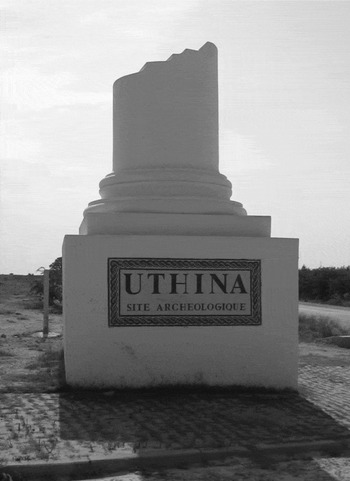
The World Bank promotes the region of North Africa (together with the Middle East) as the leader in using material heritage for economic growth (Cernea Reference Cernea2001). Within Tunisia, a World Bank project in cultural heritage is developing the Roman site of Uthina for heritage tourism, with major restoration works and the construction of tourist amenities currently under way (figure 1). While Uthina is relatively minor compared to Tunisia's other archaeological sites, it is its draw as a Roman site for Western tourists – with close proximity to the capital, Tunis, and tourist beach resorts – that confers its status as significant for the World Bank and the Tunisian government. In addition, the development of a site management plan is intended as a national model for heritage management (World Bank 2001a; 2001b). Through conditionalities, the World Bank stipulates how the nation state should conduct heritage management.
Uthina (Tunisia) site entrance.

Because the World Bank often attaches to their loans conditions of good governance (the successor of structural adjustment policies that wreaked so much havoc in the 1980s and 1990s), the heritage management policies of borrowing nations are modelled on World Bank recommendations. Thus the instruments of control have been reconfigured, from the external conditions once set by structural adjustment to internal modes of self-monitoring and self-discipline under ‘good governance’ (Mosse Reference Mosse, Mosse and Lewis2005). Moreover, these neo-liberal techniques of governing act to redefine special spaces, such as archaeological sites, in relation to market-driven principles of discipline, efficiency and competitiveness (Ong Reference Ong2006); indeed the tourism sector is one of the most important sites of privatization in Tunisia (Richards and Waterbury Reference Richards and Waterbury2008, 239–43). Capacity-building is the name of the game with the shift from structural adjustment to ‘good-governance’ policies at the World Bank – as the bank realizes that its adjustment policies ‘may have contributed to the deterioration of countries’ institutional infrastructures by exacerbating the fragmentation of central power’ (Hibou Reference Hibou2000, 210; see also Anders Reference Anders, Mosse and Lewis2005; Ferguson and Gupta Reference Ferguson and Gupta2002; Mosse Reference Mosse, Mosse and Lewis2005; Roitman Reference Roitman2005).
‘Good governance’ has created new spaces for the nation state of Tunisia to wield control, but this new ‘privatization’ of the state blurs the boundaries between public and private, state and civil society. Politics in Tunisia has become an exchange commodity (Hibou Reference Hibou2006, 189). As an example in the privatization of taxes, a tax called the National Solidarity Fund (Fonds national de solidarité) was earmarked specifically for President Ben Ali, to use at his discretion, and deposited in a personal bank account (Cassarino Reference Cassarino and Heydermann2004; Hibou Reference Hibou and Heydermann2004; Reference Hibou and Schlichte2005; Reference Hibou2006; Harvey Reference Harvey2005, 177). Yet such mechanisms of repression should not be understood as the president's, but rather are deeply rooted in Tunisian society, in the socio-economic mechanisms of power that contribute to state formation (Hibou Reference Hibou2006, 193). Similarly, development programmes, along with the attendant discourses on reform and economic development, are some of the ‘primary sites where the logic of policing, control, and repression infiltrate’ social processes (Hibou Reference Hibou2006, 192; see also King Reference King2003). In Tunisia today the discourses on reform and economic development are the principal techniques for power and the production of knowledge, but they are in fact traditional forms of power, reaching back to Ottoman rule (Hibou Reference Hibou2006, 193–96). Thus the development of material heritage for economic growth, as promoted by the World Bank at Uthina, should not necessarily be viewed as the imposition of reforms ‘from above’. Such economic development projects lock into local, already existing, mechanisms and techniques of power, effecting a symbiotic relationship between international development agencies, repression and state formation.
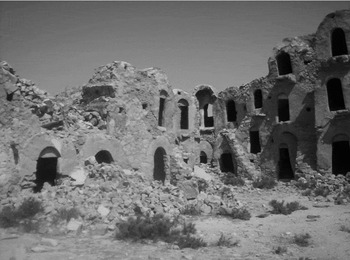
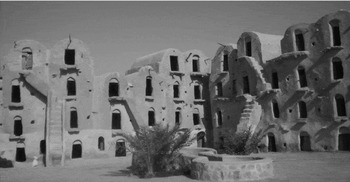
The 1.29-million-dollar project at Uthina also advances Roman material heritage at the expense of, for example, indigenous material heritage, such as the ksour (sing. ksar) in southern Tunisia, which are Berber fortified villages. The vast majority of these ksour are not managed and are falling into ruin (figure 2), except for a few instances where local initiatives have begun restoration and development of the sites (figure 3). The massive amounts of funding being directed towards Uthina, and its place as the model site for how heritage management is conducted in Tunisia, authorize transnational relationships with a Western past and narratives that promote Roman heritage. The colonial legacy in privileging a Western, Roman material heritage is fundamental to understanding how ‘heritage’ is put to work in North Africa. ‘Heritage’ for colonial administrators in North Africa equalled the Romans and their empire. The French and Italians saw themselves as the inheritors of Rome, but had to actively disinherit and alienate the Berbers from their own connections to Rome (Mattingly Reference Mattingly, Webster and Cooper1996, 51). The colonial administrators’ management of Roman material heritage justified and fuelled their own imperial aspirations, while the Roman material provided physical evidence of their imperial heritage, its material endurance and their destiny as the bearers of civilization (Hingley Reference Hingley2005, 26–27; Mattingly Reference Mattingly, Webster and Cooper1996, 50; Terrenato Reference Terrenato and Hingley2001, 80).
Ksar Jellidet (Tunisia).

Ksar Ouled Soltane (Tunisia).

In order to understand the place of value in archaeology, I have traced a brief genealogy of the term ‘significance’ in order to show the ways in which practical questions about how to approach material heritage were debated, and finally ossified, in heritage management in the United States. Only recently have archaeologists started to take a closer look at significance again, with many archaeologists complaining that the Section 106 process is broken. I also explained how these procedures for assessing significance travelled to the global stage – retaining the authoritative procedural structures and formal modes of accountability for managing material heritage – but translated to an agenda for the reduction of poverty. The implications of this translation include the privileging of specific histories that have the potential to promote economic growth, in particular those narratives most appealing to tourists.
Anthropological approaches to value
Social connotations of significance have the power to disrupt and reconfigure the institutional techniques for assessing significance, and it is for this reason that I turn now to a discussion of promising alternative approaches to value in archaeology. Specifically, I focus here on work in sociocultural anthropology that comes from a long tradition of grappling with value in closely contextual programmes of research. While anthropological research on value is based largely on ethnographies of Melanesia (Fajans Reference Fajans1997; Gregory Reference Gregory1982; Reference Gregory1996; Josephides Reference Josephides1985; Reference Josephides1991; Malinowski Reference Malinowski1922; Mauss Reference Mauss1990; Munn Reference Munn1977; Reference Munn, Leach and Leach1983; Reference Munn1986; Strathern Reference Strathern1988; Thomas Reference Thomas1991; Weiner Reference Weiner1976), theoretical developments building on this work have expanded the scope to applications of how value works in different or broader contexts (Appadurai Reference Appadurai and Appadurai1986; Elyachar Reference Elyachar2005; Godelier Reference Godelier1999; Graeber Reference Graeber2001; Herzfeld Reference Herzfeld2004; Kopytoff Reference Kopytoff and Appadurai1986; Lazzari Reference Lazzari, Funari, Zarankin and Stovel2005; Myers Reference Myers2001; Weiner Reference Weiner1992). So while ethnographic theories of value were initially set within the area study of Melanesia, as ‘travelling theories’ they find application in new contexts (Ebron Reference Ebron2002; Karp Reference Karp1997; Wolff Reference Wolff1995), such as archaeology and heritage management, which work to remake and augment these anthropological studies of value. I limit my discussion to those works which have the most analytical acuity and provocative potential for reworking for and translation to archaeological contexts – both heritage management and interpretations of the past. Indeed, I aim to demonstrate that heritage and archaeology are best understood as parts of the same context and process. Value works through both, and the way value performs in one affects the other.
Value has often been split into two different approaches: moral values and political economy. This distinction could be grossly simplified as between ‘moral facts’ and ‘conceptions of the desirable’ on the one hand (cf. Durkheim Reference Durkheim1982; Kluckhohn Reference Kluckhohn, Parsons and Schils1951), and economic price mechanisms on the other (Graeber Reference Graeber2001, 78). In practice, however, the separation has a great deal of overlap and is better conceived as a dialectic between the two (Miller, in press). Foundational to the study of value is, of course, Marcel Mauss (The gift, Reference Mauss1990), who was interested in the idea of the ‘social contract’. In The gift Mauss was attempting to sort out what it was about a gift that compels its receiver to respond with a counter-gift. In one of the most debated passages of his work, he outlines the hau of the gift, based on an interview with a Maori sage named Tamati Ranapiri. Mauss interpreted the hau as being something that is retained in the gift from its original owner, as some part of the soul of the original owner, or the spirit of the thing given (ibid., 11–12).
Weiner (Reference Weiner1985; Reference Weiner1992) follows Mauss in exploring the nature of alienable and inalienable objects. Her methodology reverses the usual focus of analysis, however, from those things exchanged (alienable) to those things held back from exchange (inalienable). She calls this the ‘paradox of keeping-while-giving’, where ownership affirms social difference rather than social equivalence. Like Simmel's (Reference Simmel, Bottomore and Frisby1990) concept of desire, an object's value comes from its ability to resist exchange. Important to her argument is a critique of the pervasive focus of anthropological ethnographies on exchange – as social contract, reciprocity and equivalencies of value. She blames the ‘norm of reciprocity’ for mystifying earlier ethnographic accounts of exchange, and traces this concept through Western history via Hobbes, Locke, Adam Smith's ‘invisible hand’, Steuart, Marx and Dumont (Weiner Reference Weiner1992, 28–31). Weiner argues (ibid., 149) that while Marx had been able to demonstrate, for capitalism, how the ‘magic’ hand of reciprocity fetishized social relations and obfuscated the development of the commodity, in the ethnographies of so-called ‘primitive’ societies the norm of reciprocity remained unquestioned – ‘the gift perceived merely in relation to the return it would elicit’. As such, these ethnographies were unable to examine ‘the particular cultural conditions that empower the owners of inalienable possessions with hegemonic domination over others’ (ibid., 150). In a similar vein to Weiner's norm of reciprocity, Baudrillard noted (Reference Baudrillard1975, 129–30) that the first principle of political economy is ‘not in the exploitation of labor, where Marxist analysis examined it, but in the imposition of a form of general code of rational abstraction . . . [which] grounds the circulation of values and their play of exchange in the regulated equivalences of values’.
Weiner explains (1992, 17) that her aim is to ‘conceptualize exchange processes and values which accommodate the place of gender in social theory and leads to a reconceptualization of how difference is transformed into rank and hierarchy’. Thus her analyses, both of her own work and of past ethnographies, focus on the heterogeneities and contradictions of exchange rather than its normative and homogeneous characteristics. She identifies two fundamental contradictions which create the inherent tension in ‘keeping-while-giving’: (1) the challenge to give is at the same time a challenge to the ability to keep, and, perhaps explained in another way; (2) the challenge to surrender the material documentation of difference is at the same time a challenge to the guardianship of autonomy (Weiner Reference Weiner1992, 150). For our purposes as archaeologists, Weiner's concept of ‘inalienable possessions’ demonstrates that it is not the circulation of objects, but rather the attempts at keeping them out of circulation, that constitutes their value. Thus archaeological interpretations of hoarding, sequestering, preserving, burying, hiding or protecting would benefit from Weiner's insights, as would further scrutiny of preservationist logic and the resultant overstuffed museum collections. Moreover, we would do well to ask how, and in what ways, archaeologists attempt to limit the circulation of material heritage.
Weiner also makes the point that value is ‘transcendent’ or ‘absolute’ and attached to objects or sites of antiquity that act as symbols of power and authority. Transcendent and absolute value recalls the ‘outstanding universal value’ required for UNESCO World Heritage sites – which masks, under their designation as the property of humanity, the social difference such sites invoke. According to Weiner, objects or sites with the most transcendent value would never be given away – unless through theft, physical decay, the failure of memory or political force – and preservation is therefore of the utmost importance (Weiner Reference Weiner1992, 6; Graeber Reference Graeber2001; Geary Reference Geary and Appadurai1986). Preservation is so important to Weiner's argument because she locates authority in the past, an authority perceived to be outside the present, reified as a form of cosmological authentication. Indeed, what makes an object inalienable is this cosmological authentication, from the genealogies, origin myths, histories of sacred ancestors, divine rulers and gods. These histories attached to inalienable objects make the authority vested in them of a higher value than other objects, therefore requiring their protection and preservation (Weiner Reference Weiner1992, 33–34 and 133). Weiner's hypothesis, in locating authority in the past, raises a call to archaeologists to contextualize the circumstances in which value does work this way, and to ask what archaeological practices reinforce or revoke an authority located in the past. When and how, in history, was the past treated as authoritative? Should our assessments of significance and archaeological interpretations locate authority strictly in the past? Weiner's focus on preservation also highlights some of its inadequacies, or lacunae where such theories could not travel, as for example a heritage management constructed around impermanence (Byrne Reference Byrne1991; Reference Byrne1995). Overall, Weiner's work on inalienable objects has much to offer for our thinking about value, especially in its emphasis on how the control and preservation of material heritage establishes difference and social hierarchy, and whether we should temporally locate authority in the past.
Graeber (Reference Graeber2001) extends Weiner's inalienable objects by joining her analysis with Munn's (1977; 1983; 1986) practice-oriented approach to value. According to Munn, value is produced by those acts with the potential to transform temporal relations. Graeber suggests (Reference Graeber2001, 45) that the value of inalienable objects ‘would simply be an effect of all the efforts people have made to maintain, protect, and preserve them’. Graeber is effectively saying that value is produced through the management of heritage. Taken together with the imbrication of temporality and value, the practices, procedures and productions of archaeologists suddenly take on whole new implications and possibilities. It renders the twinned projects of heritage management and archaeological interpretation of the past inseparable, and even seems to grant privilege of place to heritage management, whose practices manifestly shape the value of material heritage and concomitant reconstructions of the past. These temporal reconstructions and relationships nevertheless also construct what sorts of practices and procedures are adopted for management – whether and how to preserve, bury, reuse, renovate, rebuild, enclave, commemorate or destroy material heritage, or allow it to decay. In the final analysis, however, archaeological interpretations of the past should be understood as practices of management as well.
In the introduction to The social life of things (1986; see also Kopytoff Reference Kopytoff and Appadurai1986) Appadurai offers us some methodological strategies for getting at Weiner's (in)alienable objects. Appadurai's book is already well known to archaeology (for one angle see the ‘cultural biography’ studies of Darvill Reference Darvill2006; Holtorf Reference Holtorf and Nash1997; Reference Holtorf1998; Pollard and Reynolds Reference Pollard and Reynolds2002; Roymans Reference Roymans1995). According to Appadurai, the meanings of objects are inscribed in their forms, uses and trajectories, as they move in and out of ‘regimes of value’. Therefore, even though human actors encode things with significance, we should pay attention to their trajectories in order to understand this significance because ‘it is the things-in-motion that illuminate their human and social context’ (Appadurai Reference Appadurai and Appadurai1986, 5). Appadurai highlights two types of movement in particular: paths and diversions. His paths are the keda of Munn (Reference Munn, Leach and Leach1983; Reference Munn1986) – the journeys that objects take as well as the reciprocal sociopolitical links formed through these journeys – whereas diversions are sites of contestation and competition, mirroring Weiner's (1992) inalienable objects and the work of Turner (Reference Turner and Sutherland1978; Reference Turner and Maybury-Lewis1979) and Josephides (1985; 1991). Diversions are not only ‘individual strategies in competitive situations, but can be institutionalized in various ways that remove or protect objects from the relevant social commodity context’ (Appadurai Reference Appadurai and Appadurai1986, 22), thereby creating ‘enclaved’ commodities. Yet diversions only have meaning in relation to the paths from which they deviated (ibid., 28). Weiss (Reference Weiss1996) argues that the purpose of Appadurai's ‘enclaving’ and ‘diverting’ is to prevent objects from being associated or equated with other kinds of object, and especially with those types of action which characterize the trajectories of these other kinds of object.
Returning to the World Bank's heritage management project at Uthina, a reconsideration of the project in light of these anthropological theories on value raises important questions about material heritage as both inalienable and alienable, depending on its social context of practices, and trajectories of movement through these various contexts. The injection of economic criteria for significance does not automatically render the site alienable, as studies on the social life of money have emphasized (Comaroff and Comaroff Reference Comaroff and Comaroff2005; Reference Comaroff and Comaroff2006; Parry and Bloch Reference Parry and Bloch1989; Simmel Reference Simmel, Bottomore and Frisby1990; Weiss Reference Weiss1996; Zelizer Reference Zelizer1997). This is because surrounding the site are a multitude of practices and ‘regimes of value’, which also build upon and interrupt one another in the course of their interactions. Moreover, as Keane put it,
Market economies, then, do not do away with inalienables so much as they reorder the regimes of value in which they function . . . And contestations over these reorderings are not simply economic matters but are deeply concerned with the nature of persons as it is defined at the shifting boundaries between subjects and objects (2007, 270–71).
The World Bank, together with Weiner, Munn and Graeber, highlight how value arises from the management (or development) of material heritage, from the practices of people engaged with the site. However, the World Bank, for commercial purposes, in the attraction of tourists, also portrays value as inherent to the material heritage itself. Thus, unlike the more subject-oriented anthropological value theories, for the World Bank the inalienable modes of Uthina's material heritage are reordered through regimes of value, specific to tourism, that shift the boundaries of value production between subject (heritage manager) and object (material heritage). One example of this shift can be seen in the act of taking photographs of a site, a practice typically central to the tourists’ own subject formation and power of objectification (Chambers Reference Chambers1999; Edensor Reference Edensor1998; Rojek and Urry Reference Rojek and Urry1997; Urry Reference Urry2002). With the launch of the World Bank project, photography at Uthina has been forbidden so as to encourage tourists to buy the site book. Thus the only picture of Uthina that can be provided here is that of the entrance to the site. The physical memory of the site is enclaved in specific techniques of control through the singular medium of a site book, while at the same time this physical memory is rendered necessarily alienable, since the visitor can only access it by purchasing the book. As a result, the shifting boundaries between subject and object, and their reordering of inalienable regimes of value, work in tandem with the shifting boundaries between inalienable and alienable.
Another important difference between the World Bank's approach to heritage management and the approach suggested to us through anthropological theories of value is the temporal location given to authority and responsibility. While Weiner places authority in the past, and simultaneously highlights our responsibility to the past (a responsibility typically embraced by archaeologists), the World Bank places authority in the future, and by promoting economic development emphasizes Tunisia's responsibility to its future. Therefore specific acts of preservation in Weiner's formulation are contrasted with acts of development for the World Bank. Hence we can better understand the World Bank's readiness to renovate and reuse existing Roman structures at Uthina for tourist amenities (World Bank 2001a; 2001b). Through the work of Weiner, Munn and Graeber there is, however, also a call for the authority and responsibility of the present, in highlighting how present-day practices of managing heritage are central to the production of value. As a result, the foremost contribution of these theories to the World Bank's project at Uthina is the recentring of focus on the present and the contemporary situated ethical conditions of the project.
One of the other ways archaeologists can access the insights of anthropological value theories, for archaeological reconstructions of the past, is by focusing on how the past was managed in the past, as recent studies of the ‘past of the past’ have already begun to articulate (Alcock Reference Alcock2002; Bradley Reference Bradley2002; World archaeology volume edited by Bradley and Williams Reference Bradley and Williams1998; Crosby Reference Crosby1989; Matthews Reference Matthews2002). Following Graeber (Reference Graeber2001), when we engage with the prospect that value is produced by heritage management and archaeological practice, possibilities are opened up to decentre the relationship between past and present into a myriad potential temporal constructions and intersections. This allows for archaeological reconstructions of the past that probe temporal relationships, and the privileging of some temporal constructions and relationships above others. Archaeological studies on ‘the past of the past’ have explored how the unique properties of material can form certain modes of tradition, memory and the failure of memory. The attitudes towards the past of previous inhabitants are inscribed within the material heritage itself, in how objects and structures were reused, renovated, preserved, built over, added to, destroyed and so on. We can follow the social trajectories of movement of material heritage through different ‘regimes of value’ to understand how the enclaving of inalienable materials and paths of the alienable construct and interrupt particular relationships with the past. Moreover, research into ‘the past of the past’ encourages a perspective that sees material assemblages and contexts as accretions of history, rather than focusing on an attribution to a distinct chronological period.
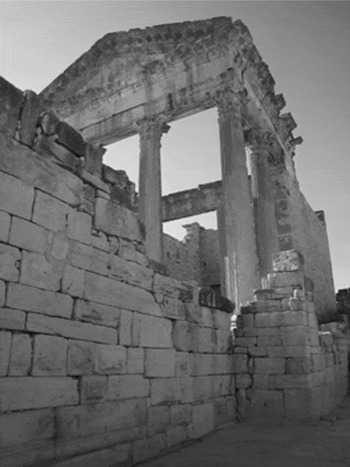
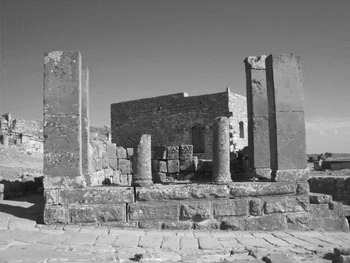
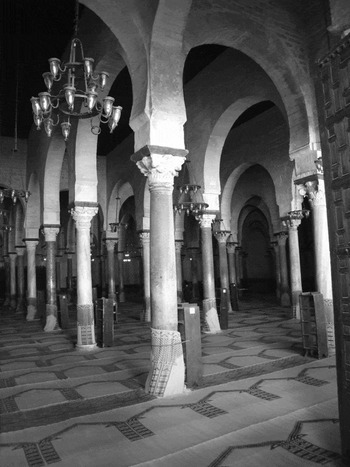
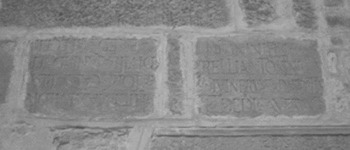
To give an example, the site of Dougga in Tunisia has a Byzantine wall wrapped around the town's Roman capitol and forum, constructed from stones quarried from the Roman ruins (figure 4), as well as an Islamic mosque, located opposite the Roman forum, used by the modern inhabitants who were moved off the site for archaeological excavations and site development (figure 5). The capitol cannot simply be ascribed to its chronological date of foundation (A.D. 166–67), but also has contexts through other periods as well, including the Byzantine and modern periods. This is what Olivier (Reference Olivier2004, 205) refers to as the embeddedness of past material in all ensuing periods and contexts: ‘as far as material things are concerned . . . the present is nothing more than the sum total of all the past times which physically coexist in the present moment’. Similarly, the reuse of Roman-period columns and inscriptions in the Great Mosque at Kairouan (Tunisia), a World Heritage site and the fourth most holy site in Islam, suggests specific attitudes of recognition and alienation towards the past – the jáhiliyyah (age of ignorance) – its material heritage, and the relationships of its builders with this past (figure 6). Scattered throughout the prayer hall are 414 columns, primarily from Roman sites such as Carthage and Sousse (ancient Hadrumetum), and an inscription from the Roman period is set within the early foundations of the minaret, adjacent to the entrance door, where half the inscription is set upside down (figure 7). The commemoration inscribed is broken and reversed, but still holds a place worthy of commemorative inscriptions. Historical remembrance imbues the building, as Bloom (Reference Bloom1993) argues that the Great Mosque was first constructed through memory, rather than building plans, which befits the cobbled-together nature of a mosque constructed from the spolia of the past. He argues, moreover, that the minaret was modelled after the Roman lighthouse standing at nearby Salakta (ancient Sullecthum).
Byzantine wall and capitol at Dougga (Tunisia).

Modern mosque at Dougga (Tunisia) with Temple to Augustan Piety in foreground.

Prayer hall of Great Mosque at Kairouan (Tunisia) constructed from primarily Roman columns.

Roman-period inscription set adjacent to entrance door of minaret in the Great Mosque, Kairouan (Tunisia). Half of the inscription is set upside down.

Value, as understood from the above works, as constituted within the very practices of archaeology, also generates a powerful tool for self-reflexivity in archaeology. It forces us to question our basic assumptions about temporal relationships in archaeology, animating disagreements over ‘whether the past really is past, over and concluded, or whether it continues, albeit in a different form’ (Said Reference Said1993, 1). It also forces us to question the effects of our temporal constructions within and across multiple scales of social responsibility (as ‘place-making’ and the production of locality do for space: Appadurai Reference Appadurai1996; Gupta and Ferguson Reference Gupta and Ferguson1992; Ferguson and Gupta Reference Ferguson and Gupta2002). If value is created through all archaeological practices, then we have to turn inward, to examine some of the assumptions that flourish when we ignore the scope of practices that create this value, practices that involve interconnecting relationships between past and present. Many of these assumptions do damage by pretending that contemporary social conditions do not apply. Considering how integral archaeological practice is to value, when we place value centre stage it cries out for archaeologists to engender more engaged archaeological practices through situated ethical agendas. On this note, then, I turn now to how value is especially crucial and perceptive for reflexive critiques of archaeology.
Value, ethics, and the reflexive turn
Value takes seriously the question of the significance of archaeological research and heritage management, indeed it begins from this question. An analytical framework based on value foregrounds an ethical engagement for archaeology. It questions how each and every action of archaeological practice has the power to produce value, and what the repercussions of this are. It also sees the potentialities of these actions across contexts: how actions might change these contexts, might construct and shape spatiotemporal relationships as authoritative, and recognize or alienate social groups (Weiss Reference Weiss2007). It further attempts to limit unintended consequences that are damaging or predatory through a concerted programme of self-reflexive critique. Thus archaeological practice profits from an analytic of value precisely in the act of situating ethical engagements, in the contextual nexus located at the intersections between time, space, practice and moral values. Indeed, it questions why we practice archaeology, what the relevance of our practices are, and how our practices create authoritative modes of engagement with the world through our role as expert. Whether we consider ourselves ‘experts’ or not, our relationships and interactions with those outside the discipline are nevertheless partly based on their perception of our discipline as a form of expert knowledge (Meskell and Pels Reference Meskell, Pels, Meskell and Pels2005; Mitchell Reference Mitchell2002). We have the power to interrogate expertise and outside perceptions but it requires some disciplinary self-searching.
Some of the most damaging repercussions of archaeological practice are unintended, owing to unexamined assumptions regarding the archaeologist's role, practice and effect in the world. My focus here is on some of the most obvious assumptions called to attention when value is understood to be produced by practices that manage material heritage, and therefore engage with the interconnectedness of past and present. Foremost amongst these is the assumption that the best reconstructions and representations of past societies are those that are somehow free from present-day bias – indeed the best reconstructions are those that have managed to excise all contemporary influences and have also worked back through the historical sources (when available), by source criticism, to peel off the accretions of subsequent ages in their partialities and prejudices. But in positing the problem as the removal of ‘bias’, these histories dodge the bigger issue of context; it is far more difficult to remove the social context in which sources are written, and furthermore one's own context of archaeological production. Thus to argue that our reconstructions of the past should be free from value judgements betrays a blinkered understanding of how archaeology is shaped by its practices, how these practices likewise exist in a social context that is decidedly contemporary, and finally how these practices are central to the production of value. Moreover, not to engage with history critically, not to seek out those instances of oppression, inequality, alienation and domination, continues the effect of placing authority in the past, where ‘difference in the present is affirmed whereas difference in the past is disguised’ (Weiner Reference Weiner1992, 10; see also Lowenthal Reference Lowenthal1996, 139–53). Rather we need to locate authority within a dialogical conversation between past and present (cf. Bakhtin Reference Bakhtin, Emerson and Holquist1986). For all of archaeology's focus on making closely contextual arguments, the focus has unfortunately become so myopic that we seem to forget what context is: how it is possible to operate simultaneously through several temporal scales of analysis – even up to the present day. Moreover, adopting a reflexive standpoint that acknowledges the temporality and historicism of our (un)ethical practices therefore addresses the potential continuities between present practices and past injustices, and our continuing responsibility to those injustices (Hall Reference Hall, Meskell and Pels2005).
The assumption of the strict separation of past and present also impoverishes our reconstructions by restricting our tools of analysis unnecessarily, or, even worse, through a determined lack of recognition of the modernity of these tools. A wonderful case in point is the recent explosion of interest in identity in the ancient world. There has always been a specific caution within archaeology over the use of modern or ‘anachronistic’ concepts, and many archaeological studies of identity still lack the admission of the modern derivation of the concept (excepting, of course, those studies of modern contexts in historical archaeology). This recognition would be a good starting point, at least, because these studies also need to make the double hermeneutic movement back, the movement that explains why applying this modern concept to the past is particularly helpful, illuminating or provocative. At this point, after a dialogical conversation between past and present, we would begin to have an archaeology that blurs those barriers between past and present, to show their interconnectedness, without disregarding their differences. We would also begin to form a convincing response to why the application of modern concepts to the past is also a reasonable way to go about the practice of archaeological interpretation. Acknowledgement of the temporality of these concepts (Koselleck Reference Koselleck2004), such as identity, would highlight the utility of this variable, temporality, in applying concepts: as a prism upon how the past, present and future interact or influence one another, how temporalities are constructed, and the effects of these constructions. Thus placing temporality as the key variable, the critical analytic, opens up the discipline of archaeology or heritage management to all sorts of unimagined research agendas that delve deep into a productive self-reflexivity, centred on what is at the heart of archaeological engagement: the ‘past’ and our relationship with these pasts.
A final point regarding the temporal mode of our concepts needs to be made: the question, or critique, of such studies that use modern analytical tools or concepts is usually whether the interpretations made are what was intended or thought at the time. The issue of intentions, the intended and the unintended, has yet to be directly addressed in archaeological research as a critical problem in the formulation of our representations of the past. In the end there needs to be a more flexible approach that blurs the two into a process where both are at work (Mitchell Reference Mitchell2002); doing so would also allow the material itself to play a larger role in reconstructions of agentic causation, the bread and butter of historical accounts. Thus, by blurring the intended and unintended, material would ‘have agency’, as it were (without overstating the case, thereby demeaning the unique properties of the material world; cf. Gell Reference Gell, Coote and Shelton1992; Reference Gell1998; Latour Reference Latour1991; Meskell Reference Meskell2004; Reference Meskell and Meskell2005; Miller Reference Miller and Meskell2005). All of the anthropological authors on value discussed above place material, and more specifically material heritage, as the vessel and impetus for value, and understand the unique properties of material to gather together or disturb social relationships, practices, taxonomies and hierarchies. Blurring the line between the intended and the unintended forces us to ask difficult questions: about the value we place on meaning and agency, to the denigration of the unique interpretative potential of archaeological material (in being material), as well as about the underlying assumptions fixing this dichotomy between the intended and the unintended.
Conclusion
The preceding discussion could be imagined temporally: as an overview of how, in the past, value in archaeology was practised through certain procedures that became institutionalized in the United States, how it is coming to be dealt with and translated in the present and on a global scale, how contemporary anthropological research on value can illuminate both present practice and future possibilities, and finally how value points us towards a more engaged and ethical archaeological practice in the future.
Overall, we can trace how the term ‘significance’ in the United States was first introduced into heritage management as meaning ‘uniqueness’ or the potential contribution of material heritage to archaeological research designs and the production of data. Through the 1970s archaeologists debated and refined their understanding of significance through hands-on practical applications in their daily work. By the end of the 1970s the National Park Service guidelines were made enforceable by law, and the power of significance to shape the past continued to be deeply appreciated by those engaged in heritage management. The broader context of material heritage, though not explicitly covered in the required guidelines, was also increasingly recognized as important to significance. Considerations of the broader economic context of material heritage were expressly forbidden, though this may have done more to conceal economic factors than bring them out into the open for debate. At the same time, these procedures for heritage management, with economic significance being one of the primary concerns, have been adopted across the globe by international financing bodies, led by the World Bank. As archaeologists we are now scrambling to keep up, having largely eschewed discussion of the economic ramifications of material heritage (except e.g. Fitting Reference Fitting and Green1984; Patterson Reference Patterson1995; Bazelmans Reference Bazelmans2006). I argue that it is our responsibility to start thinking critically again about significance, to offer some alternatives, and when using material heritage for economic development to try and incorporate economic considerations into significance without letting them run the show.
I furthermore suggest that we would do well to offer some alternatives to how significance is evaluated, alternatives in which the material heritage and its wider contexts (economic and otherwise) are taken into account, and I have outlined recent work in sociocultural anthropology on value as one such alternative. This work proposes that value is action-oriented (a verb, not a noun), and therefore embedded in practice. Specifically, value is produced through actions that engage with temporal relationships via material heritage. Value then effectively comes from all archaeological practices. Weiner demonstrated through her paradox of keeping-while-giving that it is the things held back from exchange which produce value, that these objects are inalienable because of their special relationship of authentication with the past, and that these objects are necessary to ‘valuing’ in human society. Graeber extended Weiner's analysis to offer a theory of value based on the management of material heritage. Moreover, following Appadurai, these practices can be analytically traced by following the trajectory of the material heritage itself, by focusing on the specific movements of objects as either paths or diversions – motions that illuminate social contexts through the practices associated with those objects. Heritage management is understood here as all practices of archaeological engagement, whether directed towards present conditions or towards the reconstruction of the past. All archaeological practices, whether managerial or interpretative, should be understood as producing value. Moreover, the practices in one arena of archaeology – whether academic, heritage management or subdisciplinary – affect the way that value is produced in other arenas of archaeology and how the discipline of archaeology is perceived, therefore influencing our dialogical modes of engagement with the world. Taking into account the centrality of archaeological practice to the production of value, I suggest that focusing on value would enable the discipline of archaeology to critique reflexively its own practices and assumptions, so as to engender a more engaged and situated ethics of archaeology.