1 Introduction
The variability of schwa is one of the best-known phenomena in the phonology of French, and has been investigated from many different theoretical perspectives (see, among many others, Selkirk Reference Selkirk1978, Tranel Reference Tranel1981, Anderson Reference Anderson1982, Dell Reference Dell1985, Côté Reference Côté2000, van Oostendorp Reference Oostendorp2000, Eychenne Reference Eychenne2006, Pustka Reference Pustka2007, Kaplan Reference Kaplan2011 and references therein). Although many theoretical accounts of this phenomenon are based on idealised data that can often be traced back to early normative and descriptive works (see Morin Reference Morin1987), a number of recent corpus-based studies have broadened our knowledge about the realisation of this vowel within and across varieties of French. (See in particular the results from the project Phonologie du français contemporain (PFC; see Durand et al. Reference Durand, Laks, Lyche, Pusch and Raible2002),Footnote 1 especially the contributions in Detey et al. Reference Detey, Durand, Laks and Lyche2016, Durand et al. Reference Durand, Laks and Lyche2009 and Gess et al. Reference Gess, Lyche and Meisenburg2012; see also Bürki, Ernestus et al. Reference Bürki, Ernestus, Gendrot, Fougeron and Frauenfelder2011, Bürki, Fougeron et al. Reference Bürki, Fougeron, Gendrot and Frauenfelder2011 and Bayles et al. Reference Bayles, Kaplan and Kaplan2016.) The main goal of this paper is to contribute to these recent efforts by clarifying the factors that influence the loss of word-final lexical schwa in a relatively understudied variety, namely Southern French.
The behaviour of French schwa is extremely complex, and displays a wide range of variation, as it is influenced by phonotactic, situational, social and dialectal factors, among others. Since the realisation of schwa is one of the key characteristics of the phonology of Southern French, it is useful to first review the core properties of this vowel in other varieties, which I will collectively refer to as ‘Northern French’ for the sake of convenience. Although French ‘schwa’ historically derives from a bona fide central vowel (hence its name), it merged phonetically with the mid front rounded vowel /œ/ (or sometimes /ø/, depending on the variety) as early as the beginning of the 15th century, and possibly even earlier (Fouché Reference Fouché1969: 519). The crucial difference between schwa and /œ/ is thus phonological: schwa can alternate with zero, whereas /œ/ cannot. Consider the examples in (1), which represent typical realisations of the verb relancer /rəlãse/ ‘to restart’ in different phonological environments.Footnote 2
(1)


Schwa is usually not realised in (1a), since its omission does not raise any issue with respect to syllabification, whereas it is usually realised (as a surface [œ]) in (1b), because its absence would yield an illicit consonant cluster, namely *[lrl]. Some authors, such as Scheer (Reference Scheer2011), consider that this alternation with zero is a necessary and sufficient condition to identify a phonological schwa, whereas others consider that orthography can also be a useful guide (see for instance Gess et al. Reference Gess, Lyche and Meisenburg2012).
Schwa is generally found lexically in monosyllabic clitics (e.g. je /ʒə/ ‘I’, me /mə/ ‘me’, etc.) and in initial or internal position in polysyllabic words (e.g. venir /vənir/ ‘to come’, appeler /apəle/ ‘to call’).Footnote 3 Its status in word-final position is still somewhat debated, but most researchers follow Tranel (Reference Tranel1981), regarding it as epenthetic in this position. Indeed, schwa usually does not occur word-finally unless its presence is required by phonotactic constraints to prevent the occurrence of a complex cluster (e.g. parc_naturel [parkœnatyrεl] ‘nature park’); its realisation can also be driven by prosody at the end of an intonational phrase (IP), a phenomenon known as prepausal schwa in the literature (e.g. bonjour_! [bɔ̃ʒurə] ‘Hello!’; see for instance Fagyal Reference Fagyal, Englebert, Pierrard, Rosier and van Raemdonck2000, Biers Reference Biers2017). In any case, as both examples show, the presence (or absence) of a schwa is not correlated with the presence of a word-final 〈e〉 (Durand & Eychenne Reference Durand and Eychenne2004).
The behaviour of schwa in Southern French, which is markedly different from that of other varieties, has received comparatively little attention (but see Durand Reference Durand1976, Reference Durand1988, Reference Durand1995, Eychenne Reference Eychenne2006, Reference Eychenne2014, Courdès-Murphy Reference Courdès-Murphy2018 and references therein). Although Southern French is not a homogeneous entity, and is undergoing a number of changes, most southern varieties share a cluster of core properties, which Pooley (Reference Pooley2007) calls the ‘Dominant Southern Pattern’. Following Armstrong & Pooley (Reference Armstrong and Pooley2010: 189), we can identify three important characteristics for this ‘supra-regional form’. First, schwa is much more stable in Southern French than it is in Northern French. Second, there is a lack of contrast between mid-high and mid-low vowels: mid-high vowels appear in open syllables not followed by schwa (e.g. seau [so] ‘bucket’, épais [e.pe] ‘thick.masc’), whereas mid-low vowels appear in closed syllables (e.g. sol [sɔl] ‘floor’, sec [sεk] ‘dry.masc’) or in open syllables followed by schwa (e.g. sole [ˈsɔlə] ‘sole’, sèche [ˈsεʃə] ‘dry.fem’), a pattern known as the loi de position (Durand Reference Durand1995, Eychenne Reference Eychenne2014, Storme Reference Storme2017 and references therein).Footnote 4 Third, ‘nasal vowels’ are actually realised as oral vowels followed by a nasal glide, which is usually velar, especially in word-final position ([εŋ œŋ ɔŋ aŋ]), or sometimes homorganic with the following consonant if it is a stop (e.g. compter [kɔnte] ‘to count’, tomber [tɔmbe] ‘to fall’) (Coquillon & Turcsan Reference Coquillon and Turcsan2012).Footnote 5 The relation between schwa and mid vowels has been extensively discussed in the literature (Durand Reference Durand1976, Reference Durand1995, Eychenne Reference Eychenne2006, Reference Eychenne2014, Courdès-Murphy Reference Courdès-Murphy2018), and I do not consider this issue further here. On the other hand, the phonological status of nasal vowels is relevant for this paper, and I will discuss it in more detail below (see §2.2.4).
In the traditional supra-regional form of Southern French, a lexical schwa is systematically realised, as shown in (2a), unless it occurs in morpheme-final position and is followed by a vowel within the same IP, as in (2b) (see Durand et al. Reference Durand, Slater and Wise1987: 987, Durand Reference Durand1995). In addition, this variety displays a contrast between words ending with a consonant (e.g. net [nεt] ‘neat.masc’, golf [gɔlf] ‘golf’) and words ending with a consonant followed by schwa (e.g. nette [ˈnεtə] ‘neat.fem’, golfe [ˈgɔlfə] ‘gulf’). This phonological contrast generally correlates with the absence vs. presence of an 〈e〉 in the spelling, although there are sporadic exceptions for some speakers (Durand & Eychenne Reference Durand and Eychenne2004).
(2)

A number of studies have shown that the realisation of this vowel has now become variable in non-prevocalic contexts for many Southern French speakers, especially younger ones (Durand et al. Reference Durand, Slater and Wise1987, Coquillon & Turcsan Reference Coquillon and Turcsan2012, Courdès-Murphy Reference Courdès-Murphy2018). This change in progress has been described in the sociolinguistic literature as an instance of dialect levelling, whereby the supra-local norm is spreading southwards (Pooley Reference Pooley2007). It is undeniable that sociolinguistic pressures play a role in this change, since levelling in metropolitan French is reported to be widespread, affecting many aspects of phonological structure (Armstrong & Pooley Reference Armstrong and Pooley2010). However, the precise factors which condition the loss of schwa in this variety are still not fully understood, and the main goal of this study is to provide a more accurate picture of the variables that influence its deletion in word-final position, which is the position where deletion is in the most advanced stage (Durand et al. Reference Durand, Slater and Wise1987). To this end, the paper offers a reanalysis of data from four surveys from the PFC database, which are presented in detail in §3.1. There are several reasons why a reanalysis of these data is called for. First, while the individual studies offer valuable information about the variety on which they focus, both the factors investigated and the methods used vary, making it difficult to know what holds for Southern French as a whole and what might be more specific to a given variety. Second, the statistical methods which are now available (generalised linear mixed-effects models) allow us to probe phonological variation with increased precision, and in much greater depth, than was previously possible (Bürki, Ernestus et al. Reference Bürki, Ernestus, Gendrot, Fougeron and Frauenfelder2011, Bayles et al. Reference Bayles, Kaplan and Kaplan2016). Third, as shown below, there are several potential factors whose influence (or lack thereof) is simply unknown.
The remainder of this paper is organised as follows. §2 reviews the potential factors influencing the realisation of schwa that have been taken into account in this study. §3 introduces the corpus that was constructed from the PFC database and the statistical methods that were employed to analyse it. §4 presents the results from this study. §5 provides a general discussion of schwa in Southern French in light of these results, and §6 offers some brief concluding remarks.
2 Potential factors affecting the realisation of schwa
There are a number of well-known factors which affect the presence/absence of schwa, both exclusively in Southern French and across varieties. I review some of these factors below and discuss others which, to the best of my knowledge, have never been investigated empirically in this variety, but are known (or have been argued) to have a potential effect, either in French or in other languages.Footnote 6
2.1 Social and situational factors
2.1.1 Sociolinguistic variation
Sociolinguistic variables, especially age and gender, have been particularly well documented in southern varieties of French: this is most likely due to the fact that schwa in these varieties represents an excellent testing ground for sociolinguistic theories of dialect convergence and levelling (Durand et al. Reference Durand, Slater and Wise1987, Pooley Reference Pooley2007, Armstrong & Pooley Reference Armstrong and Pooley2010, Courdès-Murphy Reference Courdès-Murphy2018). While the effect of age generally corresponds with expectations (younger speakers tend to delete schwa more than older speakers), the effect of gender is unclear. Armstrong & Unsworth (Reference Armstrong and Unsworth1999), who analysed a corpus of speakers aged 16–25 in the Aude département (one of the four localities analysed in the current study), reported a significant effect of gender within this age group: female speakers showed a greater tendency to delete schwa than male speakers. However, Courdès-Murphy (Reference Courdès-Murphy2018) compared the realisation of schwa in Toulouse (south-west) and Marseille (south-east) across a much broader age range, and found no main effect of gender in either location. She noted a mild interaction between age and gender in Marseille for her second youngest age group (out of four), with males showing a greater rate of deletion than females. However, she pointed out that this apparent effect was most likely a by-product of these male subjects having lived in Northern France for several years and showing less regional attachment. (On the possible role of regional attachment, see Armstrong & Pooley Reference Armstrong and Pooley2010: 253–254.)
2.1.2 Register and style
Like most linguistically variable phenomena, the realisation of schwa is partly conditioned by situational factors (Malécot Reference Malécot1976, Lucci Reference Lucci1983). For instance, Lucci compared the rate of realisation of schwa among several professional speakers across several settings (conference, reading task, interview and conversation). His results for proclitics (je ‘I’, me ‘me’, te ‘you.obj’, ne ‘not’, le ‘him, it’, se ‘self (3rd person)’ and the complementiser que) in non-initial position, a position where schwa is highly variable, indicate that the presence of schwa was sensitive to the level of formality. Schwa was most frequent in the reading task (59.9%), followed by the interview (55.8%), the conference speech (50.9%) and the conversation (32.3%). Although it is difficult to know to what extent these differences are significant, they are at least suggestive. A number of analyses of surveys from the PFC database give further support to Lucci's and Malécot's findings. Schwa has been reported to be more frequent in reading than in conversation in Belgian French (Hambye & Simon Reference Hambye and Simon2009), Northern French (Pustka Reference Pustka2009) and Southern French (Eychenne Reference Eychenne2006, Lonnemann & Meisenburg Reference Lonnemann and Meisenburg2009, Courdès-Murphy Reference Courdès-Murphy2018). However, none of these studies found a difference between the formal and informal conversation styles in the PFC data.
2.2 Phonological factors
2.2.1 Phonotactic and prosodic conditioning
Among the linguistic factors, the best-known linguistic variable influencing the realisation of schwa is undoubtedly its segmental context, an effect which has been documented from the earliest descriptive and prescriptive work (e.g. Fouché Reference Fouché1956, Delattre Reference Delattre1966). The most famous statement is Grammont's (Reference Grammont1920) loi des trois consonnes (‘law of three consonants’; henceforth Grammont's Law), according to which schwa is usually realised when it is preceded by two consonants and followed by one (or more) consonants, but may be omitted when it is preceded by a single consonant (see the discussion of the examples in (1)).Footnote 7 Although Grammont's Law generally holds for non-southern varieties, the precise nature of the consonants surrounding schwa plays an important role, as Grammont himself noted (see also Malécot Reference Malécot1976). Dell (Reference Dell1985) points out that in his own dialect, the realisation of schwa is obligatory when it is preceded by an obstruent + liquid cluster (e.g. arbre pourri [arbrəpuri] ‘rotten tree’), unless the cluster is simplified and the liquid is deleted (e.g. [arbpuri]). More generally, schwa is more likely to drop if the cluster resulting from its absence obeys the sonority sequencing principle (Côté Reference Côté2000: 112–119, Bürki, Ernestus et al. Reference Bürki, Ernestus, Gendrot, Fougeron and Frauenfelder2011). However, there is cross-dialectal variation, and Morin (Reference Morin1983) observes that in the variety of French spoken in Saint-Étienne, schwa can delete in contexts where it is usually expected to remain (e.g. la mère d ɇ Guy [lamεrdgi] ‘Guy's mother’, des vagues d ɇ quinze mètres [devagdkε̃zmεtr] ‘fifteen-metre high waves’, port ɇ -feuille [pɔrtfœj] ‘wallet’).
The (non-)realisation of schwa within a complex consonant cluster is further influenced by its prosodic position. It has frequently been observed that schwa is more likely to surface in the penultimate position of an IP (Léon Reference Léon1966, Morin Reference Morin1983: 82, Dell Reference Dell1985, Côté Reference Côté, Camacho, Flores-Ferrán, Sánchez, Déprez and Cabrera2007). For instance, Dell (Reference Dell1985: 231) suggests that schwa is more likely to be realised in la terre se vend ‘land sells’, where the following syllable is stressed, than in la terre s(e) vend bien ‘land sells well’, where the syllable following the potential schwa is unstressed. Côté (Reference Côté, Camacho, Flores-Ferrán, Sánchez, Déprez and Cabrera2007) reinterprets this phenomenon in terms of minimality constraints on the prosodic word, and suggests that the realisation of schwa can also be influenced by the number of syllables preceding it: according to her, schwa is more likely to be realised in l'acte commence ‘the act begins’ than in l'entract(e) commence ‘the intermission begins’. Another context where prosody plays a role is the right edge of the IP. As pointed out in the introduction, a schwa-like vowel is often realised in this context, irrespective of the number of consonants that precede it. This phenomenon has been reported in the speech of young Parisians (Hansen Reference Hansen and Perrot1997), and seems to be quite widespread, at least in metropolitan France. Eychenne (Reference Eychenne2006) observes that a similar phenomenon is found in Southern French: word-final lexical schwa is more likely to be preserved at the end of an IP than in non-final position, and some speakers display schwa epenthesis at the end of an IP even when it is preceded by a single consonant (e.g. vin blanc sec_ [vεNblaNsεkə] ‘dry white wine’), although the final trochee is not realised with the pitch contour typically found with prepausal schwa in Northern French (Fagyal Reference Fagyal, Englebert, Pierrard, Rosier and van Raemdonck2000, Biers Reference Biers2017).
2.2.2 The consonant preceding schwa
Durand et al. (Reference Durand, Slater and Wise1987) make an interesting observation about words ending in VC# in Southern French, where voiced obstruents (especially voiced fricatives) are rare in this position, and tend to be avoided in surface representations. For example, the word merguez ‘spicy sausage’, a borrowing which is realised as [mεrgεz] in Northern French, is variably assimilated either as [mεrgεs], by devoicing the final /z/, or [mεrgεzə], by inserting a schwa. Both repair strategies prevent the appearance of the voiced fricative /z/ in word-final position, and suggest the existence of a constraint such as *z# in Southern French. If phonological constraints of this type are indeed active in this variety, we should expect them to play a role in the deletion and retention of lexical schwa. The final schwa in a form such as chemise [ʃømizə] ‘shirt’ would be less likely to drop, since its deletion would cause /z/ to occur word-finally, thus violating the above-mentioned constraint. Two competing hypotheses are available to account for this effect.
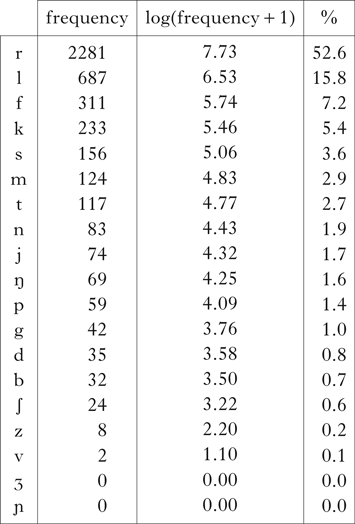
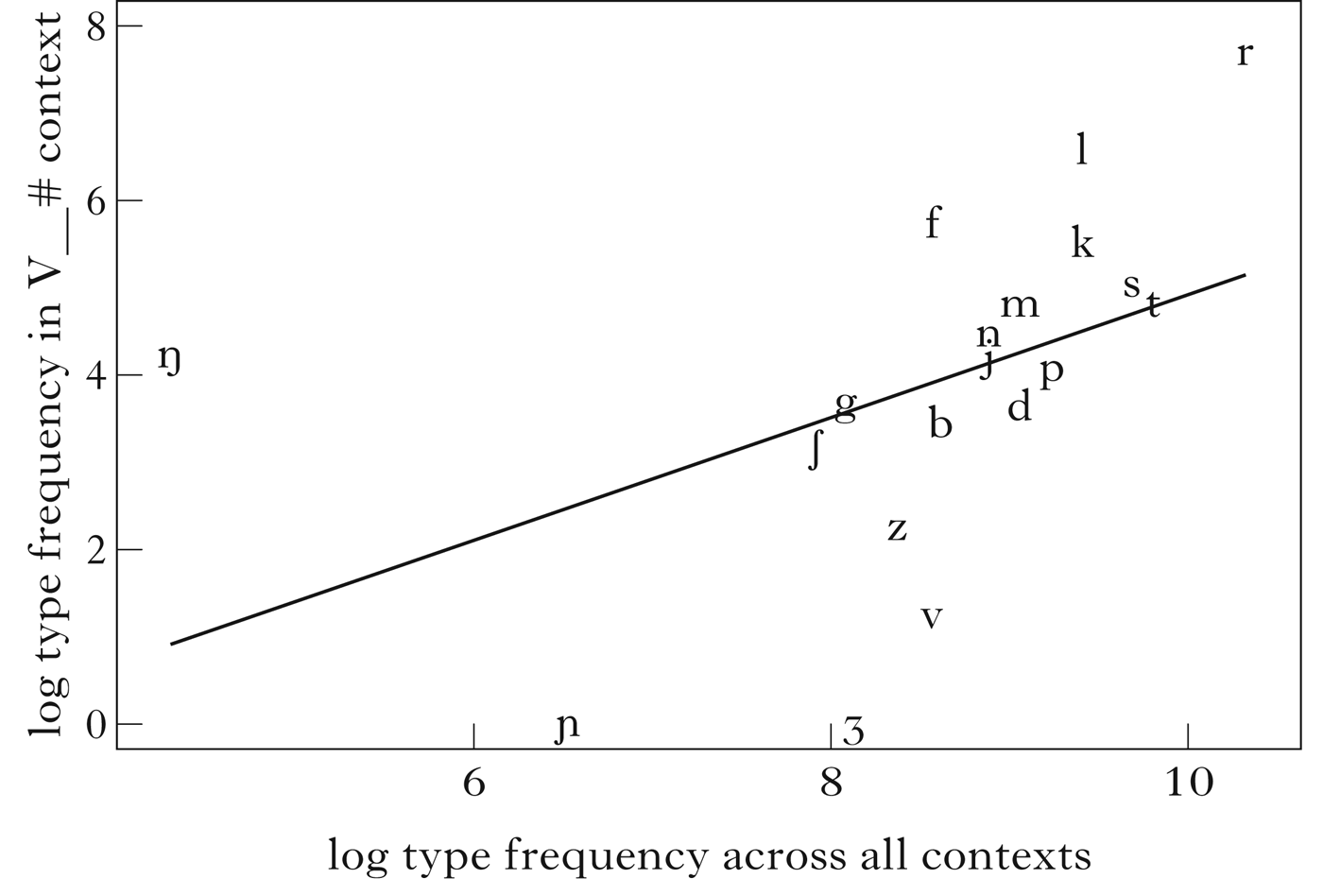
On the first hypothesis, the constraint against schwa would be a function of the frequency of word-final consonants. Words ending with a consonant which is frequent in word-final position (e.g. words ending with /l/ such as sel /sEl/ ‘salt’, fil /fil/ ‘thread’, mal /mal/ ‘badly’, etc.) would ‘attract’ words ending with a schwa that is preceded by the same consonant (e.g. selle /sElə/ ‘saddle’, docile /dOsilə/ ‘docile’): the loss of schwa would be facilitated by the fact that the consonant is frequently attested in the lexicon in word-final position. Conversely, schwa deletion in a word such as rêve /rEvə/ ‘dream’ would be hindered by the fact that the consonant that precedes schwa (in this case /v/) is very rare in word-final position (it is only found in borrowings such as leitmotiv /lEjtmOtiv/ ‘leitmotiv’ and lev /lEv/ ‘lev’ (Bulgarian currency)), since the deletion of schwa would create a highly marked or unattested word-final coda. The same reasoning can be straightforwardly extended to word-final consonant clusters, albeit with the proviso that these are relatively rare in the first place. I shall call this putative effect of final consonants (and consonant clusters) the attractor frequency hypothesis. To the best of my knowledge, this hypothesis has never been tested empirically. In order to get a better sense of how it might be at work in Southern French, I extracted frequency counts from the 50,000 most frequent words in New et al. (Reference New, Pallier, Ferrand and Matos2001), which were transcribed according to a typical Southern French pronunciation, as explained in §3.1.4. There were 4337 words (8.7%) ending in a single pronounced consonant, such as net [nεt]. Their frequency is reported in Table I. As we can see, the liquids /l r/ account for more than two-thirds of the occurrences (68.4%). At the other end of the spectrum, voiced fricatives are very rare, and /ʒ/ does not appear at all. The nasal palatal does not appear in word-final position either. In order to ensure that this distribution is not simply a by-product of the consonants’ type frequency, I also extracted the overall type frequency of consonants. Figure 1 represents a plot of the log type frequency of consonants across all contexts against the log type frequency of consonants in the V_# context. The solid line represents the expected log type frequency of a consonant in the V_# context, given its observed frequency across the board. Even though /r/ is the most frequent consonant, its frequency in word-final position is far greater than expected. On the other hand, the natural class of voiced fricatives is clearly underrepresented word-finally, and their rarity in this context is not simply due to their relatively lower frequency. Therefore, it seems reasonable to consider attractor frequency as a potential predictor of the realisation of schwa.
Frequency of word-final consonants in Southern French (V_# context).

Frequency of consonants across all contexts vs. in V_# context.

An alternative explanation for Durand et al.’s remarks could be found in the consonant's voicing specification. There is at least suggestive evidence that schwa might interact with consonant voicing. On the basis of a corpus study of spontaneous speech in Northern French, van Eibergen & Belrhali (Reference Eibergen, Belrhali and Lyche1994: 279) observed that voiceless segments tended to favour the non-realisation of schwa in their data. More recently, Bürki, Ernestus et al. (Reference Bürki, Ernestus, Gendrot, Fougeron and Frauenfelder2011) found that the voicing of the consonant preceding schwa (as well as that of the one following it) affected the duration of schwa, although it did not affect schwa deletion. These observations make it worth investigating whether consonant voicing influences the realisation of schwa in Southern French. I shall call this putative effect of voicing the laryngeal specification hypothesis.
Although the attractor frequency hypothesis and the laryngeal specification hypothesis more or less agree on the consonants that favour schwa retention (roughly, the class of voiced obstruents), they clearly make different predictions for consonants that favour deletion: according to the attractor frequency hypothesis, the liquids should be the consonants that favour schwa deletion the most, with /r/ doing so more so than /l/, whereas the laryngeal specification hypothesis predicts that it is the natural class of voiceless obstruents which favours schwa deletion, irrespective of each consonant's type frequency.
Besides voicing, there is at least indicative evidence that, in Southern French, sonorants and coronals can favour schwa deletion (Eychenne Reference Eychenne2006: 189) in the VC_# context and that fricatives favour deletion in monosyllabic clitics (Coquillon & Turcsan Reference Coquillon and Turcsan2012: 118). Therefore, the place of articulation, continuancy and sonorancy of the consonant before schwa were also taken into account in the corpus analysis reported below.
2.2.3 Syllable economy
The deletion of schwa always leads to the loss of a syllable and resyllabification of the onset of the schwa-headed syllable, either in the coda of the preceding syllable or as part of the onset of the following one. Within the framework of Optimality Theory (Prince & Smolensky Reference Prince and Smolensky2004), Tranel (Reference Tranel, Authier, Bullock and Reed1999) builds upon this observation, proposing that schwa deletion and epenthesis are the result of a conflict between a requirement to avoid marked surface structures, such as complex clusters, and the need for the grammar to use no more structure than necessary. More specifically, Tranel's analysis crucially relies on SyllableEconomy, a constraint of the *Struct family which penalises syllabic nodes. Under this view, schwa is deleted whenever possible, to minimise the number of syllables.
Whether or not one accepts Tranel's formal analysis (see for instance Gouskova Reference Gouskova2003 for a criticism of *Struct constraints), it does explicitly suggest a link between word size (i.e. the number of syllables) and the (non-)realisation of schwa. A strong interpretation of the role of syllable economy would be that the effect of this constraint is only categorically visible when it dominates the relevant faithfulness and markedness constraints, as proposed by Tranel. In that case, the deletion of schwa would always remove one violation of *Struct, no matter how long the word. It is however possible to relax this assumption, and to interpret the role of syllable economy as stochastic and gradient. Under this view, longer words could be more likely to lose their schwa than shorter words, all else being equal, because they violate syllable economy to a greater extent: the prediction in that case is that there should be a positive correlation between word length and the propensity of schwa to be deleted. An anonymous reviewer points out that, if we abandon the categorical nature of syllable economy in favour of a gradient version, another interpretation is available: since the deleted syllable in a shorter word represents a larger portion of that word's length, one might expect deletion to be more common in shorter words than in longer words, because deletion would in a sense achieve a greater effect in shorter words. In that case, the prediction is that there should be a negative correlation between word length and schwa deletion.
2.2.4 Nasality of the preceding vowel
As pointed out in the introduction, Southern French is characterised by the absence of genuine nasal vowels, and this is indeed a stereotypical feature of southern varieties (Pustka Reference Pustka2007). A ‘nasal vowel’ is usually realised as an oral vowel which may be (partly) nasalised under certain conditions, followed by a more or less prominent nasal glide (Durand Reference Durand1988, Carignan Reference Carignan2017). Durand (Reference Durand1988) puts forward several arguments supporting an analysis as /VN/ (instead of /Ṽ/) at the phonological level (see also Eychenne Reference Eychenne2006 & Courdès-Murphy Reference Courdès-Murphy2018): although this has not been investigated empirically, a prediction of this analysis is that, all else being equal, schwa should be less likely to drop when it is preceded by a VNC sequence, as in compte [ˈkɔNtə] ‘count.3sg.pres.ind’, than when it is preceded by VC, as in côte [ˈkɔtə] ‘coast’, since the NC sequence should behave like a CC cluster. (Recall that schwa is more likely to be present after CC than after VC in all varieties.)
2.3 Lexical and morphological factors
2.3.1 Word frequency
Word frequency is known to play an important role both in synchrony and in diachrony. As they become automated through repetition, word forms tend to be realised with greater gestural overlap and less precise articulatory control, which can lead to assimilation and phonetic reduction (Bybee Reference Bybee2001, Reference Bybee, Honeybone and Salmons2015). Such frequency effects have been demonstrated to affect homophones: Gahl (Reference Gahl2008) shows that high-frequency words such as English time tend to be shorter in duration than lower-frequency homophones (e.g. thyme), which suggests that word forms are associated with frequency information in the mental lexicon (Bybee Reference Bybee2001, Pierrehumbert Reference Pierrehumbert, Bybee and Hopper2001).
The effect of word frequency on French schwa in currently unclear: a number of studies have pointed out that the likelihood of schwa deletion is positively correlated with lexical frequency (Dauses Reference Dauses1973, Lucci Reference Lucci1983, Hansen Reference Hansen1994, Racine & Grosjean Reference Racine and Grosjean2002). However, in a recent corpus study, Bürki, Ernestus et al. (Reference Bürki, Ernestus, Gendrot, Fougeron and Frauenfelder2011) found that this effect disappeared once the word in which schwa occurred was controlled for by adding a random effect for word in their statistical model. This suggests that ‘there is no effect of lexical frequency on schwa alternation and that its apparent effect is simply attributable to the behavior of some specific (high frequency) words’ (Bürki, Ernestus et al. Reference Bürki, Ernestus, Gendrot, Fougeron and Frauenfelder2011: 3987). According to these results, there might be more lexical idiosyncrasy in the realisation of schwa than previously thought: while a number of frequent words happen to be particularly prone to schwa deletion, not all are.
Frequency effects have not been investigated in Southern French in word-final syllables, but they have been in word-initial syllables. Pustka (Reference Pustka2007) found that schwa, which is usually stable in this position, could only be deleted in frequent words such as s ɇ maine ‘week’ or p ɇ tit ‘small.masc’ (see also Eychenne Reference Eychenne2006, Courdès-Murphy Reference Courdès-Murphy2018).Footnote 8 Pustka (Reference Pustka2007) further shows that this vowel was more often deleted in highly frequent constructions such as un p ɇ tit peu ‘a little bit’ than in other constructions (e.g. il est petit ‘he is small’).
Taken together, these results suggest that it is worth exploring frequency effects on the realisation of word-final schwa in Southern French, taking into account the possibility that these effects might in fact be an artefact of lexical idiosyncrasy.
2.3.2 Phonological neighbourhood
In addition to frequency, research has shown that the phonetic realisation and lexical retrieval of a word could be affected by the richness of its phonological neighbourhood, i.e. by words which are similar to it. The most commonly used measure of similarity is neighbourhood density, which is usually operationalised as the number of words which differ from a target word by the insertion, deletion or substitution of exactly one segment. For instance, in Northern French, the word mal /mal/ ‘badly’ has among its many neighbours the words mat /mat/ ‘matt’ (replacement of /l/), mule /myl/ ‘mule’ (replacement of /a/), ma /ma/ ‘my.fem’ (deletion of /l/) and malin /malε̃/ ‘cunning’ (insertion of /ε̃/). Interestingly, since schwa is a feminine marker in Southern French (see §2.3.4 below), there are a number of pairs of words whose masculine and feminine forms are neighbours of each other in this variety, as the only difference is the addition of a schwa in the feminine form (e.g. net /nEt/ and nette /nEtə/ ‘neat.masc/fem’). However, this is not systematic, since some words have the same form in both genders (e.g. sale /salə/ ‘dirty’) while others differ by more than one segment if there is a latent consonant in the paradigm of the word (e.g. blanc /blaN/ ‘white.masc’ vs. blanche /blaNʃə/ ‘white.fem’) or in case of suppletion (e.g. acteur /aktŒr/ ‘actor’ vs. actrice /aktrisə/ ‘actress’).Footnote 9
Neighbourhood density has been shown to play a role in speech production, as words with a higher neighbourhood density show evidence for hyperarticulation (Munson & Solomon Reference Munson and Solomon2004, Scarborough Reference Scarborough2004). If the presence/absence of schwa is to be understood as a continuum, with the possibility of intermediate reduced realisations, as some authors have suggested (Eychenne Reference Eychenne2006, Bürki, Fougeron et al. Reference Bürki, Ernestus, Gendrot, Fougeron and Frauenfelder2011), it is plausible that word-final schwas in words with a high neighbourhood density would be less prone to phonetic reduction, and hence deletion, than schwas in words with a lower neighbourhood density.
Furthermore, psycholinguistic research has suggested that, at least in Swiss French, neighbourhood density may influence latencies in lexical naming tasks for words that have a schwa in their initial syllable (Bürki et al. Reference Bürki, Ernestus and Frauenfelder2010); Bürki et al.’s evidence is only suggestive, however, since the effect of neighbourhood density only showed a statistically non-significant trend. Nevertheless, it seems appropriate to investigate whether neighbourhood density might influence the deletion of schwa in the variety under study.
2.3.3 Grammatical category
Bürki, Ernestus et al. (Reference Bürki, Ernestus, Gendrot, Fougeron and Frauenfelder2011) tested whether the distinction between function words and content words could explain some of the behaviour of schwa in Northern French. They reported that it had no significant effect on alternation with zero and duration. As far as I am aware, the effect of this variable has not been rigorously tested in Southern French, but it has been pointed out that schwa deletion appears to be particularly frequent in function words such as une ‘a.fem’ and elle ‘she’ (Eychenne Reference Eychenne2006: 186, Coquillon & Turcsan Reference Coquillon and Turcsan2012: 117–118). It is not entirely clear whether this is due to the word's grammatical category per se or to the fact that these function words are realised as prosodic clitics, or perhaps both. The two variables are in fact very difficult to tease apart, since function words are normally realised as clitics. Nonetheless, it is still worth exploring whether there is a difference between the two word classes, keeping in mind that this difference might be (partially) attributable to prosodic structure.
2.3.4 Morphological structure
Morphological structure has been argued to affect the realisation of schwa when it is preceded by two consonants. Dell (Reference Dell1985) observes that in the future and conditional forms the schwa that appears between the base and the future/conditional suffix can be deleted even if it is preceded by two consonants, as in (3a), but cannot be deleted in derivational morphology and non-derived forms, as in (b) (see also Dauses Reference Dauses1973: 52–53). Not everyone agrees that the schwas in (a) should be regarded as lexical, and some authors consider that ‘stable schwas’, such as those in (b), have merged with /œ/ in non-alternating contexts, since the two vowels cannot be distinguished phonetically or phonologically (Morin Reference Morin1978). Whatever the case may be, it seems that, for some speakers at least, historical schwas can be optionally deleted when they appear in a future or conditional form and are preceded by two consonants, whereas they cannot be deleted in other morphological contexts in the same segmental environment.
(3)
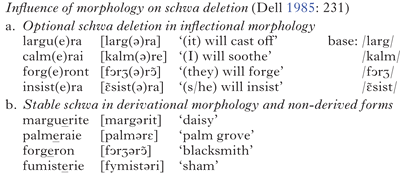
Although the focus of this paper is on the word-final position in Southern French, morphology may also play a role. The opposition between word-final consonants (the net type) and word-final consonants followed by schwa (the nette type) correlates very well with the orthography, and it is supported by inflectional morphology, since schwa can be a feminine marker, as in (4a), or a verbal suffix for some finite forms, as in (b).
(4)
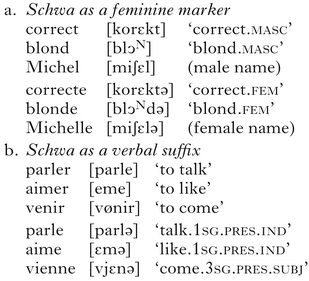
It is therefore possible that morphemic and non-morphemic schwas behave differently. However, the role of morphology could cut both ways.
On the one hand, it is possible that schwa is more resistant to deletion in forms where it realises a morphological category, such as the examples above, than in forms where it does not (e.g. pôle [pɔlə] ‘pole’, heure [œrə] ‘hour’). It has indeed been argued that morphological and phonological constraints interact within the same grammar. For instance, Rice (Reference Rice2007) uses constraints of the Max{cat} family, which require the preservation of morphological categories in surface forms, to model paradigmatic gaps in a number of languages (see also Kurisu's Reference Kurisu2001 RealiseMorpheme constraint). If constraints of this type are active in Southern French, they could protect morphological schwas to a certain extent.
On the other hand, there is evidence that morphemic segments can be shorter than non-morphemic ones. In a carefully controlled corpus study, Plag et al. (Reference Plag, Homann and Kunter2017) found that the duration of word-final [s] and [z] in English was shorter when these consonants were morphemic (e.g. contracted forms of is and has, genitive) than when they were not. If the same phenomenon is found in Southern French, it is possible that the kind of durational difference that Plag et al. observed could facilitate schwa deletion: morphemic schwas would on average be expected to be shorter and thus more prone to deletion than non-morphemic ones. These two predictions will be tested below.
3 Materials and methods
3.1 Data
3.1.1 PFC surveys
The data used in this study come from the PFC database, a large phonological database which contains material from over 600 French speakers from all over the world, sampled according to a common protocol. For each subject, the database contains the recording of a word-list, a short read text, a formal interview and an informal interview. All the files are transcribed orthographically, and transcriptions are time-aligned. In addition, the text and the interviews are coded for two phonological variables, namely liaison and schwa. Each survey typically contains ten to twelve subjects, chosen so as to obtain a balanced sample with respect to gender and age. Although the database contains some socio-economic indicators such as occupation, social class is not rigorously controlled for.
I used the four survey locations which were readily available in the PFC database for the southern part of France. These surveys come from four different administrative districts (départements). Two of the four locations represent rural areas and are small towns with fewer than 3000 inhabitants, namely Douzens (Aude) and Lacaune (Tarn). These two locations are close, both geographically and linguistically. Geographically, they are less than 100 km apart, and belong to the same administrative région, Occitanie. Linguistically, they share the same Romance dialectal substrate (Languedocian Occitan), and I will from now consider these surveys as representative of the Languedocian subdialectal area.
The other two surveys represent urban centres. Marseille (Bouches-du-Rhône) is the second largest French city. It is a large port city, with a large immigrant population, mostly from Italy and North Africa. The local substrate variety of Occitan is known as Provençal. The final location is Bayonne-Anglet-Biarritz (Pyrénées-Atlantiques), a conurbation totalling about 120,000 inhabitants. It is located in the French part of the Basque country: the substrate language is Basque, which is genetically unrelated to the surrounding Romance languages spoken in France and Spain. Although this region is also influenced by the Gascon Romance dialect, all the subjects at this survey location showed a strong affinity with the Basque language and culture.Footnote 10
Since, as noted above, the survey locations in Lacaune and Douzens share the same substrate, the four locations were grouped into three dialectal areas: the survey location in Bayonne-Anglet-Biarritz represents the Basque dialectal area, Marseille the Provençal dialectal area, and Douzens and Lacaune the Languedocian area. Several aspects of the phonology of the varieties analysed in this study have been described in previous work. See in particular Eychenne (Reference Eychenne2006, Reference Eychenne2009a) for Bayonne-Anglet-Biarritz, Coquillon & Turcsan (Reference Coquillon and Turcsan2012) and Courdès-Murphy (Reference Courdès-Murphy2018) for Marseille, Eychenne (Reference Eychenne2006, Reference Eychenne2009b) and Durand & Tarrier (Reference Durand and Tarrier2016) for Douzens, and Lonnemann & Meisenburg (Reference Lonnemann and Meisenburg2009) for Lacaune. However, the present study is the first attempt to model the behaviour of word-final schwa in Southern French using such a geographically broad sample.
3.1.2 Subjects and material
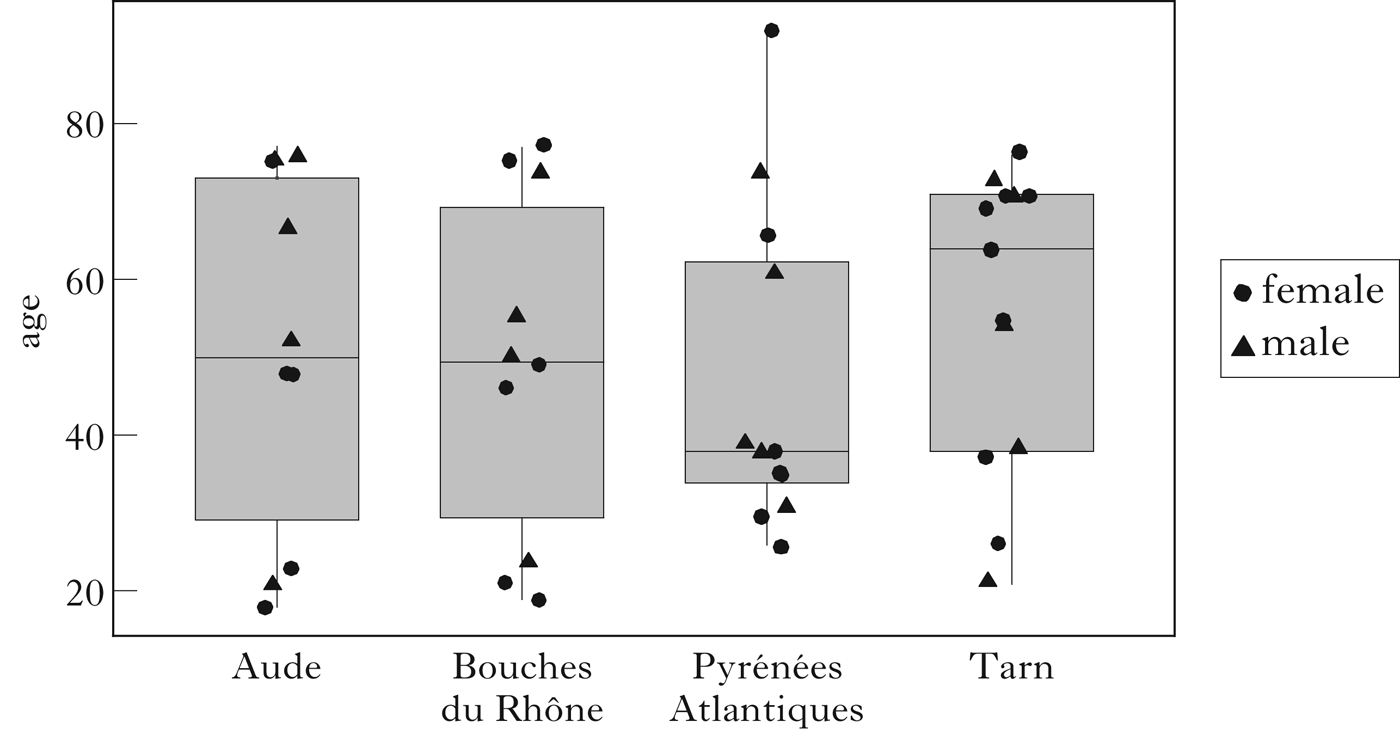
The four surveys that were selected contained recordings and transcriptions from 45 subjects (10 in Douzens, 10 in Marseille, 13 in Lacaune and 12 and Bayonne-Anglet-Biarritz). An overview of the distribution of the participants’ age and gender in the four locations is provided in Fig. 2. All the material coded for schwa from all available subjects was used in this study. For each participant, this corresponded to about ten minutes of conversation (five minutes from the formal interview and five minutes from the informal interview) and one reading of the PFC text. The PFC word-list was not used, since it is not coded for schwa.
Age of the subjects across the four survey points.

3.1.3 Extraction of word-final lexical schwas
The four surveys together contain 23,294 schwa codings across all contexts, including 15,261 tokens for the word-final position (see Lyche Reference Lyche2016 for an overview of the coding system).Footnote 11 The PFC protocol allows for three values for the realisation of schwa: present, absent and uncertain. The 326 tokens which were coded as uncertain were discarded. Since the coding scheme does not presuppose that there is a correlation between orthography (nette vs. net) and phonology (presence vs. absence of schwa; [nεtə] vs. [nεt] respectively), all word-final consonants are coded, whether they are followed by an orthographic 〈e〉 or not. Given that the correlation between orthography and the presence of word-final schwa is robust in Southern French, I only considered words which did have an 〈e〉 in their spelling, i.e. those words where schwa is assumed to be lexically present (N = 10,033). Epenthetic schwas do occur, but are quite rare: for words with a final 〈e〉, schwa is realised in 57.6% of cases (5775/10,033) in the database, whereas it only appears in 2.5% of cases (124/4909) when there is no final 〈e〉. The study of epenthetic schwas would certainly be of interest, but with only 124 tokens it would very difficult, if not impossible, to draw any sort of reliable inference, given the number of predictors considered in this study.
Among the words which do have a lexical schwa, many of them (2224 tokens) appear in prevocalic context, a position where schwa is normally categorically deleted (Durand et al. Reference Durand, Slater and Wise1987). The database contains 176 tokens (7.9%) coded with a schwa realised in this context, a surprisingly high rate. After listening to all of these tokens, I determined that most of them belonged to one or more of the following categories: (i) presence of the filler euh, often realised with creaky voice; (ii) a noticeable prosodic break between schwa and the following vowel, corresponding to an IP boundary; (iii) presence of an epenthetic glottal stop between schwa and the following vowel (e.g. pâtes italiennes [patəɁitaljεnə] ‘Italian pasta’); (iv) slow speech rate and hyperarticulation in the reading task. As a result, the prevocalic context was excluded from the analysis.
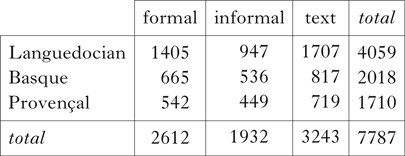
Summing up, of the 15,261 tokens coded in word-final position, the following types were excluded from the analysis: (i) tokens coded as uncertain (N = 326); (ii) tokens which did not correspond to an orthographic 〈e〉 (N = 4902); (iii) tokens in prevocalic context (N = 2224).Footnote 12 Five further tokens were discarded because their left context was erroneously coded as the left edge of an IP, or as uncertain; three of these tokens were in fact monosyllables. The final dataset only contains schwa codings in word-final position for which there is an 〈e〉 in the spelling (which is assumed to correspond to a phonological schwa), preceded by VC or CC and followed by a consonant or at the right edge of an IP. This dataset contained 7804 data points in total, with information about the coding (split by field), the left and right context of the concordance, and additional metadata about the survey, the task and the speaker's identifier, gender and age. This dataset contained 17 tokens for which the position had been erroneously coded as word-final: these tokens were removed. During exploratory analysis, I also recoded 46 cases for the left context for which I did not agree with the original coders. The final dataset contains 7787 data points: there are 6062 tokens (77.8%) where schwa is preceded by one consonant and 1725 tokens (22.2%) where it is preceded by two or three consonants. A more detailed overview of the distribution of tokens by dialect and task is provided in Table II. The full dataset can be found in the online supplementary materials.Footnote 13
Distribution of tokens by dialect and task.

3.1.4 Lexical and morphological information
The PFC coding scheme only indicates the realisation of schwa, its position in the word and general information about the left and right phonological contexts (e.g. number of consonants, presence of a prosodic boundary). In order to obtain more information about the factors that may contribute to the deletion of schwa, I used Lexique (New et al. Reference New, Pallier, Ferrand and Matos2001), a large lexical database which contains, among other things, phonetic transcriptions for all entries.Footnote 14 Since these phonetic forms represent standard French, I automatically converted them, using a custom script, to canonical southern phonological forms, as found in the Dominant Southern Pattern: contrasts between mid-high and mid-low vowels were neutralised and a schwa was inserted at the end of a word if the standard phonological form ended with a consonant but the orthographic form ended with 〈e〉, 〈es〉 or 〈ent〉. For example, a final schwa was added to /ʃãt/ in the following words: chante ‘sing.1sg.pres.ind’, chantes ‘sing.2sg.pres.ind’ and chantent ‘sing.3pl.pres.ind’.
Next, for each token in the corpus, I extracted the word in which the schwa coding appeared along with its phonological form, syllable count and token frequency. (Words which were not found in Lexique were processed manually.) Neighbourhood density statistics, although readily available in Lexique, were recalculated using the southern phonological forms, to ensure that they were adequate for this corpus.Footnote 15 Two words were considered neighbours if their phonological forms differed by exactly one insertion, one deletion or one substitution (in other words, if their edit distance was equal to 1).
In order to obtain frequency estimates, I first considered using the frequencies provided by Lexique, but this proved problematic, since the corpus contained a number of words which were absent from this database. These words were mostly quite common proper nouns, such as Toulouse and Ardennes (note that Lexique does not contain any proper nouns). I therefore simply used frequency estimates from the PFC data: I calculated the token frequency using the transcriptions of the conversations in the four surveys, and added one instance of the PFC text in order to ensure that all the words which appeared in the reading task, but not in conversation (e.g. ministre ‘minister’), had a non-null frequency. This represented a total of 158,680 tokens, corresponding to 7068 types. A list of the 30 most frequent words containing a final schwa is included in the supplementary materials.
Finally, I used the information about parts of speech in Lexique to create a categorical predictor for grammatical category with two levels: function word vs. lexical word. Function words represented 13.4% of the tokens in the dataset (N = 1045). I coded the presence/absence of a morphological boundary before the schwa manually.
3.1.5 Phonological information
Using the phonological forms gathered from the previous step, I identified the nature of the two segments preceding schwa in the phonological representation. This was either a VC sequence, where V was oral (e.g. côte ‘coast’) or nasal (e.g. compte ‘count.1sg.pres.ind’), or a CC cluster; in the latter case, I also identified the nasality of the preceding vowel (e.g. possible ‘possible’ vs. membre ‘member’). The consonant before schwa was assigned features for voicing, continuancy and sonorancy, as shown in (5).Footnote 16 I also added the feature [vocoid] to distinguish glides from liquids. Place of articulation was coded with the privative features [labial], [coronal], [palatal] and [dorsal]. The phonological status of /r/ is somewhat ambiguous in French, since it is generally realised as a uvular fricative or approximant, even though it patterns with /l/ as a liquid (Côté Reference Côté2000: 114). Some of the older speakers in this corpus have an alveolar flap/trill, and one, in the Basque Country, displays free variation between uvular and alveolar realisations. Following Russell Webb (Reference Russell Webb2009), I treat /r/ as a placeless approximant at the phonological level.
(5)
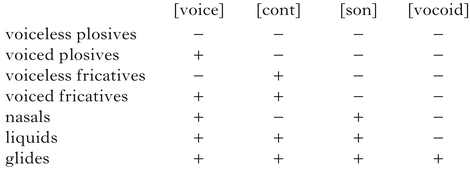
Left context and Right context were coded as categorical factors (VC_# vs. CC_# and consonant vs. IP edge respectively). I considered using a more fine-grained coding for the left context in order to take into account the nature of the consonant and/or cluster preceding schwa, but the resulting models did not converge when the interaction between the left and right contexts was added. Instead, I coded the sonority of the consonant/cluster before schwa, a strategy loosely based on Bürki, Fougeron et al. (Reference Bürki, Ernestus, Gendrot, Fougeron and Frauenfelder2011). Consonants were grouped into broad natural classes according to the following scale: obstruents < nasals < liquids. A cluster had a rising sonority profile (+1) if the first consonant had lower sonority than the second (e.g. autre /Otrə/ ‘other’, rythme /ritmə/ ‘rhythm’), a falling sonority profile (―1) if the first consonant had greater sonority than the second (e.g. adulte /adyltə/ ‘adult’, énorme /EnOrmə/ ‘huge’) and a level sonority profile (0) if both consonants had the same sonority (e.g. reste /rEstə/ ‘stay’, parle /parlə/ ‘speak’). Single consonants were assigned a level sonority profile.
Finally, the type frequency of attractor consonants and consonant clusters in the V_# context was calculated as discussed in §2.2.2 and presented in Table I.
3.2 Statistical analysis
The statistical analysis was conducted in R (R Development Core Team 2008), using logistic mixed-effects models fitted with the glmmTMB package (Brooks et al. Reference Brooks, Kristensen, van Benthem, Magnusson, Berg, Nielsen, Skaug, Mächler and Bolker2017). The realisation of schwa was treated as the outcome variable of the model. Table III offers a summary of the predictors that were taken into account as fixed effects. In addition to the main effects, I considered the interaction Age × Gender, since these variables have often been reported to interact in the sociolinguistic literature, as well as Left context × Right context, since according to Grammont's Law the effect of the right context (consonant or IP edge) crucially depends on what precedes schwa. Moreover, I took into account the interaction between Dialect and all the linguistic predictors in order to check whether the importance of these predictors differed across dialects.
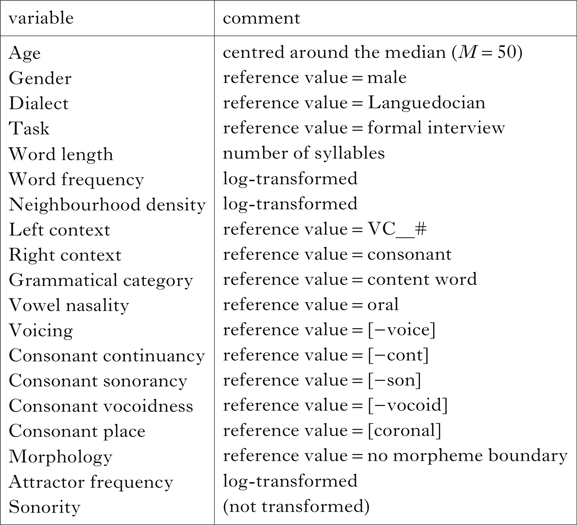
Summary of the predictors considered in this study.

Subject-level and word-level variation was controlled for in all models by including a random intercept for Subject and for Word. In addition, a random slope for Task by Subject was added to model the fact that speakers appeared to differ in their sensitivity to the effect of Task.Footnote 17 In order to find the most parsimonious model for a given context, I adopted a stepwise selection approach similar to Gries (Reference Gries2015): I started with a maximal model containing all the fixed effects for that context, and removed non-significant factors one at a time. Fixed effects were considered significant if their p-value was less than 0.05 and if they improved the fit of the model, as estimated by the Akaike Information Criterion and χ 2 likelihood ratios. Post hoc tests for multi-level categorical predictors were conducted with the lsmeans package (Lenth Reference Lenth2016).
One non-negligible issue with generalised linear (mixed-effects) models is that model fit can be difficult to assess, because residual plots are much harder to interpret than in classical linear regression. In order to assess the quality of the fit, I used the DHARMa package in R (Hartig Reference Hartig2019), which produces scaled residual plots (normalised to values between 0 and 1) based on simulated samples generated from the fitted model. DHARMa also provides several formal goodness-of-fit tests to check for common misspecification problems, including a test to check the uniformity of the scaled residuals. The residuals of the final model reported in the next section were inspected for uniformity, in order to ensure that the fit was adequate.
Finally, Nakagawa & Schielzeth's (Reference Nakagawa and Schielzeth2013) pseudo-R 2, as implemented in the MuMIn R package (Bartoń Reference Bartoń2018), was used to estimate the amount of variance explained by the model. This metric provides values for the fixed effects alone (marginal R 2) and for the combination of fixed and random effects (conditional R 2).
4 Results
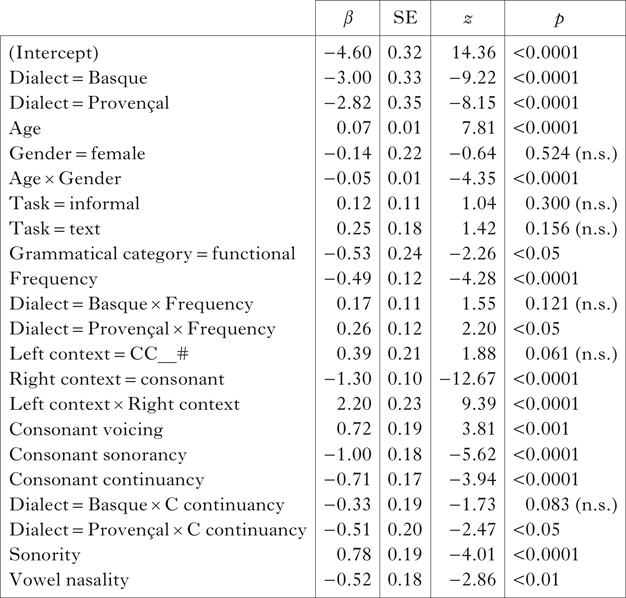
This section reports on the best-fitting model. Since the outcome variable represents the (log) odds of schwa realisation, a positive regression coefficient means that the predictor favours schwa retention, whereas a negative coefficient means that the predictor favours schwa deletion. The fixed effects of the model are reported in Table IV. Likelihood-ratio tests showed that this model, which contained a random intercept for both subject and word and a random slope for task by subject, was superior both to a model without the random slope (χ 2(1) = 65.63, p < 0.0001) and to one that only had grouping at the subject level (χ 2(1) = 342.51, p < 0.0001) or at the word level (χ 2(1) = 283.07, p < 0.0001). In addition, a one-sample Kolmogorov-Smirnov test revealed no significant deviation from uniformity in the scaled residuals (p = 0.164), which indicates that the fitted model is adequate. The fixed effects of this model accounted for about half of the variance in the data (marginal R 2 = 0.520), whereas the full model accounted for about two-thirds (conditional R 2 = 0.661).
Fixed effects of the best-fitting model.

The following variables were found to have no significant effect on the deletion of schwa once the full random effects structure was taken into account: Morphology, Neighbourhood density, Attractor frequency, Consonant place, Word length and Consonant vocoidness. In addition, although the random slope for Task by Subject was significant, there was no main effect of Task.
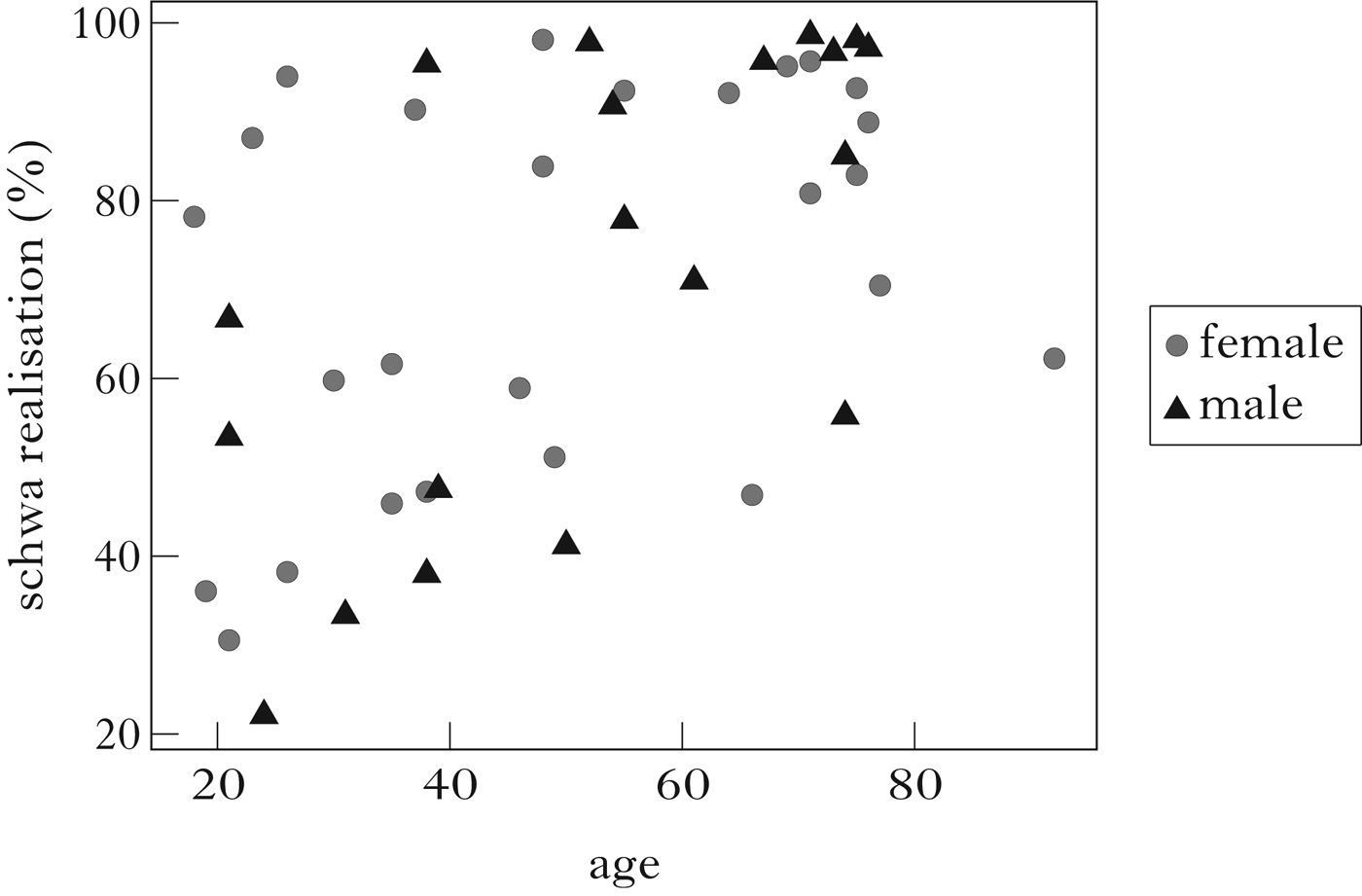
Furthermore, we can see that there is no main effect for Gender, although there is a significant interaction between Age and Gender. In order to get a better understanding of this interaction, Fig. 3 displays the realisation of schwa as a function of age across both genders: for subjects below 50 (the median age), the rate of realisation tends to be lower for males than for females.
Realisation of schwa by Age and Gender (VC_# context).

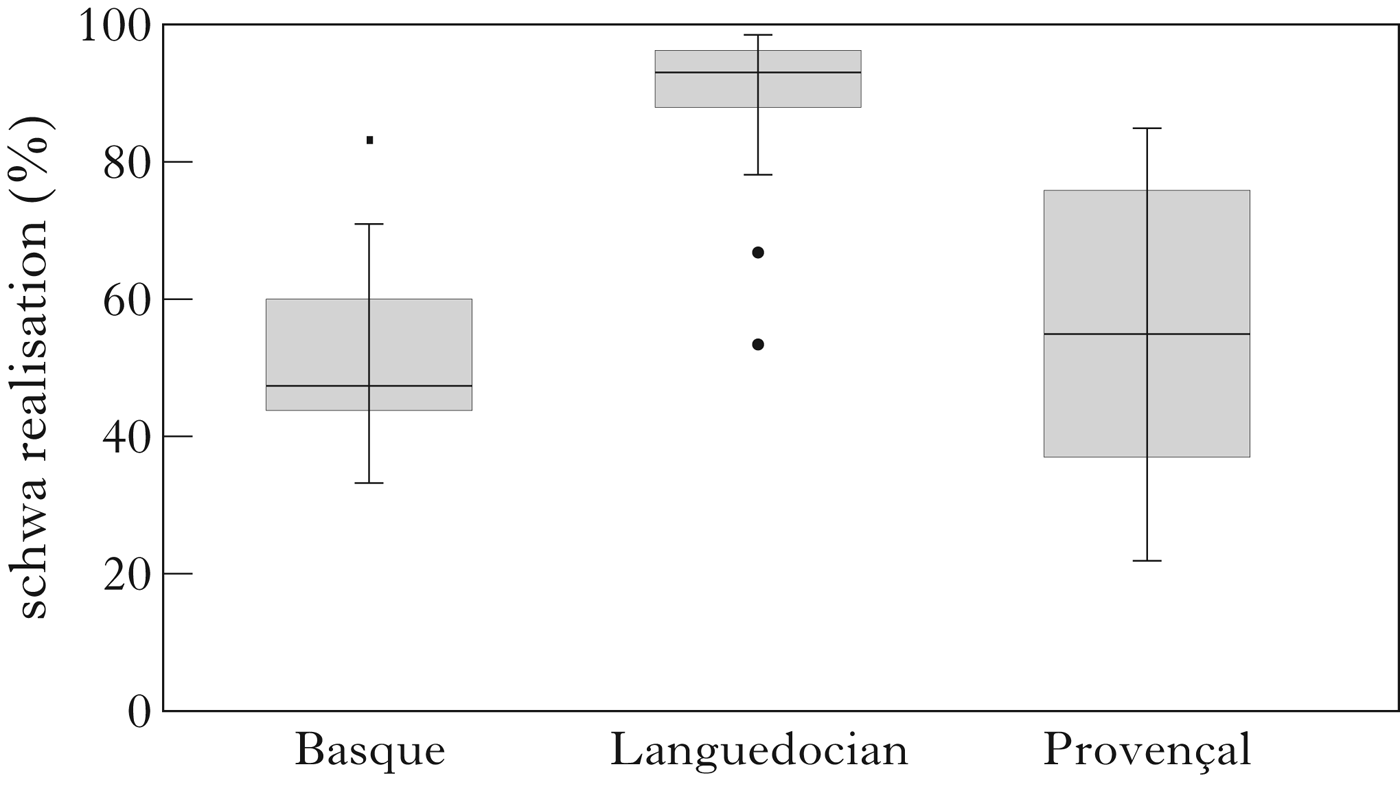
Besides Age and Gender, we see that the rate of realisation differs by Dialect: the Basque and Provençal areas both display a significantly lower rate of realisation than Languedocian (see Fig. 4). A post hoc analysis using Tukey contrasts showed that the difference between Basque and Provençal was not significant (p = 0.779).
Realisation of schwa across dialects.

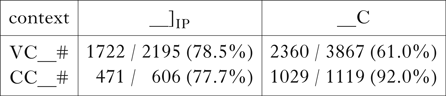
Turning our attention to the phonological predictors, we see a significant effect of the Left context and Right context, as well as a significant interaction between them. In order to better understand how these contexts interact, let us look at the rate of realisation in the four environments they define (see Table V). Interestingly, the rate of realisation at the end of an IP is virtually the same whether there is a single consonant (78.5%) or a cluster (77.7%) on the left. However, within an IP, the VC_#C environment favours schwa deletion (61.0%), whereas the CC_#C environment clearly favours schwa retention (92.0%).
Realisation of schwa as a function of the left and right contexts.

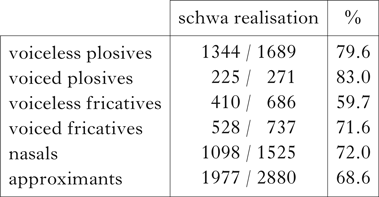
Investigating the nature of the left context in more detail, it appears that Sonority is a significant factor in the realisation of schwa: a falling sonority profile favours the absence of the vowel, whereas a rising sonority profile promotes its presence. The specification of the consonant preceding schwa also plays an important role: the coefficients for Voicing, Consonant continuancy and Consonant sonorancy together show that schwa is more likely to be preserved if the previous consonant is voiced, is a stop and is an obstruent (i.e. it is a voiced plosive). In order to better understand the interplay between these features, let us consider the effect for the six natural classes they define in French: voiced plosives, voiceless plosives, voiced fricatives, voiceless fricatives, nasals and approximants. As we can see in Table VI, the voiced plosives /b d g/ have the highest rate of schwa realisation, whereas the voiceless fricatives /f s ʃ/ are the consonants which favour schwa deletion the most. Interestingly, the effect of continuancy is not uniform across dialects: it is significantly lower for Provençal than in the other two varieties. The last phonological factor, Vowel nasality, is particularly noteworthy, since it is significant, but not in the expected direction: schwa is actually less likely to be realised if it is preceded by a nasal vowel than an oral one.
Schwa realisation as a function of the natural class of the preceding consonant.

Among the remaining grammatical and lexical factors, only Grammatical category and Frequency turn out to be significant: the rate of schwa retention is higher in content words (4941/6742; 73.3%) than in functional words (641/1045; 61.3%), and schwa is more likely to drop in more frequent words than in rarer words. Furthermore, the significant interaction between Dialect and Frequency shows that Provençal is once more singled out: the effect of Frequency is weaker in this variety than in the other two.
5 Discussion
Taken together, the results of this study provide us with a more precise picture of the behaviour of schwa in Southern French. The effect of dialect is clear, and confirms previous findings suggesting that the Languedocian area is more resistant to change than the Basque Country and Provence with respect to schwa (Eychenne Reference Eychenne2009a, Reference Eychenneb, Lonnemann & Meisenburg Reference Lonnemann and Meisenburg2009, Coquillon & Turcsan Reference Coquillon and Turcsan2012). Although this might indeed be the case, we must remain cautious in our interpretation of this difference, since the two Languedocian surveys represent rural areas, whereas the two cities in the Basque Country and Provence are urban centres. There is some evidence that the rural vs. urban distinction might be more important than dialect: Courdès-Murphy (Reference Courdès-Murphy2018) compared, among other things, the realisation of schwa in Marseille and Toulouse, a large urban centre which is also the main city of Occitanie. She found that the average rate of realisation in the two cities was very similar, and that both displayed a wide range of interspeaker variation. Since Toulouse is less than 150 km away from both Douzens and Lacaune (recall that both surveys are part of the Occitanie région), it seems that rurality might be a more important factor than dialectal area. The fact that linguistic innovation tends to first appear in, and spread from, (large) urban centres, where speakers are more mobile, is indeed well established in sociolinguistics and dialectology (Chambers & Trudgill Reference Chambers and Trudgill1980: 172–178). A large sociolinguistic survey controlling for rurality would therefore be needed to better understand the respective roles of dialectal variation and urbanity in Southern French.
The atypical interaction between age and gender was an unexpected yet robust finding: although older speakers tend to have a very high rate of schwa realisation irrespective of gender, younger men displayed a noticeably lower rate of realisation than younger women. This result is at odds with prior work on young Southerners (Armstrong & Unsworth Reference Armstrong and Unsworth1999), and more generally with the long-held view that female speakers tend to lead linguistic change and favour standard over non-standard features (Labov Reference Labov2001). Since the absence of schwa in word-final position is the norm, we would expect (younger) females to display an overall lower rate of realisation of schwa, but this is not what we observe in the data. However, Armstrong & Pooley (Reference Armstrong and Pooley2010: §7.3) point to several cases of ‘sociolinguistic gender pattern’ reversal in French, which might be partly due to social network structures.
The absence of main effect for task is another result that must be emphasised, since previous studies have repeatedly found an asymmetry between the reading task and conversation in the PFC data (Eychenne Reference Eychenne2006, Lonnemann & Meisenburg Reference Lonnemann and Meisenburg2009, Courdès-Murphy Reference Courdès-Murphy2018). This discrepancy most likely stems from differences in methodology, since previous analyses used univariate statistics or did not control for as many variables as the present study. Indeed, when we look at the global results, schwa is realised 68.9% of the time in conversation (3131/4544), but 75.6% of the time in the reading task (2451/3243). A simple chi-square test on these global data does find a significant difference (χ 2(1) = 6.81, p < 0.01). The absence of main effect in our data, however, does not mean that Task is insignificant, since including a random slope for Task by Subject did improve the model. Our results, therefore, offer a more nuanced picture of the role of this factor, and suggest that there is a great amount of interspeaker variability. Part of the explanation might be that some speakers display a different level of sensitivity to the task, which seems to match my own subjective impression, based on listening to the recordings. Some speakers are equally comfortable in the formal and informal interviews, whereas others have a clear distinction between the two registers: for instance, some speakers quite consistently use the negation clitic ne in the formal interview, but drop it in the informal interview, as is also common in casual conversation. Another possible source of explanation is that some speakers simply almost never delete schwa, and indeed ten of the 45 speakers have a realisation rate greater than 95%. For these speakers, the realisation of schwa is hardly variable at all, and there is very little room for Task to have any influence.
Let us now turn our attention to lexical factors. The effect of word category shows that schwa is more robust in content words than in functional words. As pointed out in §2.3.3, this asymmetry might simply be the result of the word's prosodic realisation, since functional words tend to be prosodified as proclitics which are dependent on, and usually shorter than, the following lexical head. In order to more precisely determine the respective contribution of word category per se and prosody, one would need a corpus which combines rich syntactic and prosodic annotations, as found in the Rhapsodie treebank (Lacheret-Dujour et al. Reference Lacheret-Dujour, Kahane and Pietrandrea2019) for instance, with schwa codings such as those from the PFC database. Unfortunately, such a corpus is currently unavailable. The effect of the other significant lexical predictor, word frequency, is noteworthy for two reasons: it is the first time that this factor has been demonstrated to play a role in word-final position in Southern French, and it is at odds with recent findings in Northern French. As noted in §2.3.1, Bürki, Ernestus et al. (2011: 3987) observe that, after controlling for word-level variation in their Northern French data, there was no significant effect of lexical frequency. They conclude that the effect reported in previous studies was probably the result of the behaviour of a number of words which happen to be frequent. Our results, on the contrary, show that word frequency is significant even when a random term for Word is included. However, it must be emphasised that there are important methodological differences between the two studies. First, while the current study focuses on schwa in word-final position, Bürki, Ernestus et al. (Reference Bürki, Fougeron, Gendrot and Frauenfelder2011) exclude word-final position from their analysis, since schwa is usually considered as epenthetic in this context in Northern French. It is not clear to me whether this may have had an influence, but it cannot be entirely ruled out. Second, Bürki, Ernestus et al. (Reference Bürki, Ernestus, Gendrot, Fougeron and Frauenfelder2011) set aside words that were represented by fewer than five tokens in their corpus, whereas I include them. The downside of their approach is that it somewhat distorts the empirical distribution of lexical items: since words follow a power law (Zipf Reference Zipf1949), whereby a small number of items are very frequent (the ‘fat head’) and a large number of items are very rare (the ‘long tail’), many words end up being discarded.Footnote 18 Effectively, the long tail of the distribution ends up being chopped off. This remark notwithstanding, it is easy to determine whether the discrepancy between the two studies could be partly due to their different sampling procedures. Applying Bürki, Ernestus et al.'s approach to the 7787 tokens in the dataset, I excluded 2288 items (29.4%). After refitting the model presented in Table IV to this subset, word frequency still emerged as significant (p = 0.0007). A plausible interpretation of this result is that the sensitivity of schwa to lexical frequency is indeed different in Southern and Northern French. This seems to be supported by the fact that the effect of frequency is not uniform across the three dialects: it is weaker in Provence. If subdialects of Southern French can differ in their sensitivity to lexical frequency, it might well be the case that some varieties are simply insensitive to it altogether.
Moving on to the phonological predictors that influence the presence/absence of schwa, we can see that the results reported above shed new light on the complex interaction between the left and right contexts. The highest rate of realisation is found in the CC_C context: as seen in §2.2.1, this is the context where schwa is most likely to be realised in Northern French, whether the schwa is lexical (e.g. par semaine [parsœmεn] ‘weekly’) or epenthetic (e.g. ours_brun [ursœbrε̃]). Although epenthetic schwa is rare or non-existent in most varieties of Southern French, the data suggest that Grammont's Law is also an important force in this variety: while it usually does not trigger schwa epenthesis, it protects schwa from deletion. On the other hand, when schwa is preceded by a single consonant, it appears that the IP-final position has a protective role compared to the IP-internal position, where schwa is followed by one or more consonants. This should not come as a surprise: most researchers consider that stress is assigned on the rightmost syllable of the phonological phrase in Northern French (Fougeron & Jun Reference Fougeron and Jun2006), and the right edge of an IP of course always coincides with the right edge of a phonological phrase. In Southern French, stress is instead assigned to the final trochee, which contains a syllable headed by a full vowel optionally followed by a schwa-headed syllable (Durand Reference Durand1976, Eychenne Reference Eychenne2006): since schwa ends up in the dependent position of a stressed trochee, some form of positional faithfulness (Beckman Reference Beckman1997) could protect it from deletion.
The unexpected direction of the effect of vowel nasality is undoubtedly the most puzzling result in this study. However, a closer inspection of the data suggests that most, if not all, of this effect can be accounted for by the behaviour of certain numerals. The words trente ‘thirty’, quarante ‘forty’, cinquante ‘fifty’ and soixante ‘sixty’ all end in /-VNtə/: although they were coded as word-final, they are frequently encountered in compound numerals such as mille neuf cent trente-six ‘1936’, where schwa is frequently dropped. These items (N = 100) indeed show a very low rate of realisation (30%). After these words were discarded and the model refitted, the p-value increased from 0.004 to 0.067, slightly above the standard significance threshold (0.05), indicating that the observed effect was essentially driven by these items. All things considered, it appears that VNC sequences (e.g. pente /paNtə/ ‘slope’) are different from VCC sequences (e.g. parte /partə/ ‘leave.1sg.pres.subj’) but do not fundamentally differ from VC sequences (e.g. pâte /patə/ ‘pasta’) with respect to schwa deletion. A possible explanation is that schwa and nasal vowels are both undergoing change in Southern French. In a recent study based on 22 speakers from Marseille (who were not involved in the current study), Courdès-Murphy & Eychenne (to appear) report the existence of a positive correlation between the loss of the nasal glide and the rate of schwa deletion: southern speakers who tend to realise nasal vowels as truly nasalised vowels (instead of oral vowels followed by a nasal glide) also have a lower rate of realisation of schwa. If the same dynamics are at work in our corpus, we indeed expect the effect of nasal vowels not to be significantly different from that of oral vowels.
Finally, let us look at the role of the consonant (cluster) preceding schwa. Our results concerning the sonority profile of the cluster preceding schwa agree with previous findings: for example, Dell (Reference Dell and Rohrer1977) observes that in Northern French, schwa was more likely to be realised after two obstruents (e.g. zest(e) /zεst/ ‘zest’) than after a liquid followed by an obstruent (e.g. farc(e) /fars/ ‘prank’), since the latter type of cluster constitutes a better coda than the former. Regarding the specification of the preceding consonant, it appears that the place of articulation and the vocoid specification of the consonant have no effect, but sonorancy, continuancy and voicing do. The fact that stops favour schwa retention seems consistent with Côté’s (Reference Côté2000: 119) observation, based on Laurentian French data, that stops are preferentially followed by a vowel, since this is the position where their acoustic cues (burst and formant transitions) are perceptually most salient (see also Côté Reference Côté, Camacho, Flores-Ferrán, Sánchez, Déprez and Cabrera2007). Finally, the results for voicing provide empirical support for the laryngeal specification hypothesis presented in §2.2.2. On the other hand, the attractor-frequency hypothesis was falsified, since attractor frequency turned out to have no explanatory power beyond what is already accounted for by consonant voicing.
6 Conclusion
The main goal of this paper has been to offer a better picture of the factors influencing the loss of word-final lexical schwa in Southern French, using a corpus containing 7787 data points obtained from 45 subjects spread over three dialectal areas, from west to east (Basque, Languedocian and Provençal). The range of variables taken into account, as well as the fact that subject-level and word-level variation was controlled for, make the results generalisable to a large part of southern France. In addition to clarifying the contribution of sociolinguistic and stylistic factors (age, gender, task), this study has demonstrated the importance of lexical frequency, grammatical category and sonority, as well as the voicing, sonorancy and continuancy of the consonant preceding schwa.
Although my aims have been essentially descriptive, the data reported in this work can inform phonological theory in various ways. First, they broaden the range of empirical knowledge of French schwa, and shed new light on some well-known aspects of the phonology of French. As we have seen, Grammont's Law seems to be at work in the CC_#C context in Southern French, despite the fact that this variety usually does not have schwa epenthesis: the constraint simply favours schwa retention over schwa epenthesis in this environment. Interestingly, the fact that there is no epenthesis does not mean that Southern French always tolerates complex clusters: a common repair strategy in this variety is consonant deletion. For example, while most northern speakers pronounce the (invented) newspaper name Ouest Liberté as [wεstœlibεrte] in the PFC text, southern speakers typically delete the final /t/ in the first word, yielding [wεslibεrte]. Schwa realisation and consonant deletion are therefore two different strategies to achieve the same output configuration (roughly, no triconsonantal cluster). This is a new illustration, within a single dialect, of what McCarthy (Reference McCarthy2002: 93) calls ‘homogeneity of target/heterogeneity of process’: the same markedness constraint can be satisfied by two apparently unrelated phonological processes.
Furthermore, the findings reported in this study regarding the effects of word-level variation and word frequency add to an already sizeable body of work which shows the importance of the lexicon in language processing and language change. For example, in the case of Northern French schwa, psycholinguistic research has shown that lexical access latency for word variants with and without schwa (e.g. fenêtre [fœnεtr] vs. [fnεtr] ‘window’) is negatively correlated with the variant's frequency (the more frequent variant is accessed faster): this suggests that both variants are stored in the mental lexicon, along with frequency information. We also know that both adults and infants exploit word-specific information in order to learn phonological categories (Feldman et al. Reference Feldman, Myers, White, Griffiths and Morgan2013), and there is strong diachronic evidence that the likelihood of losing a phonological contrast in a language is correlated with its functional load in the lexicon (Wedel et al. Reference Wedel, Kaplan and Jackson2013). Such findings are consistent with the predictions of usage-based and exemplar models which incorporate word-specific information (Bybee Reference Bybee2001, Pierrehumbert Reference Pierrehumbert, Gussenhoven and Warner2002). At the same time, the fact that the featural specification of the consonant before schwa affects its loss, irrespective of the consonant's frequency, can be interpreted as pointing to the need for abstract phonological features, as traditionally recognised in formal phonology. What is needed, perhaps, is a hybrid framework that can satisfactorily model word-specific and fine phonetic details as well as abstract phonological primitives, as argued for instance by Nguyen et al. (Reference Nguyen, Wauquier, Tuller, Pellegrino, Marsico, Chitoran and Coupé2009) and Ernestus (Reference Ernestus2014).
Whether or not one sees the development of such a hybrid model as a desirable (and achievable) goal, the facts discussed in this paper can still inform current formal theories. Over the last few decades, generative phonology has been moving away from the study of an ‘ideal speaker-listener, in a completely homogeneous speech-community’ (Chomsky Reference Chomsky1965: 3), and has started recognising the importance of variation and gradience (e.g. Hayes & Wilson Reference Hayes and Wilson2008, Pater Reference Pater2009; see Bayles et al. Reference Bayles, Kaplan and Kaplan2016 for a review). Despite the progress that has been accomplished, a lot of work still needs to be done to be able to account for the range of variation found in observational data. The fact that the corpus constructed for this study is available in the supplementary materials means that theoretical phonologists now have at their disposal another complex and intricate dataset, which displays a wide range of intra- and inter-individual variation, and against which they can evaluate competing models of variation.