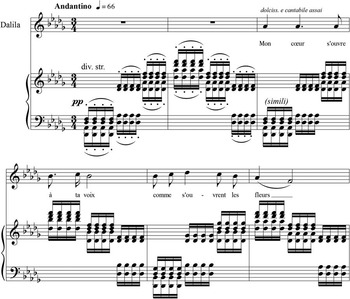
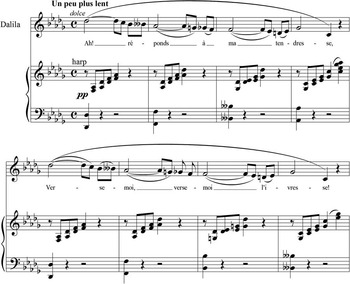
‘Mon cœur s’ouvre à ta voix’ (‘My heart opens at the sound of your voice’) sings Dalila in the famous middle movement of her duet with Samson in Act II of Saint-Saëns’s Samson et Dalila (1877), though it is Dalila’s voice that we focus on for most of the movement, and her voice, and not so much her heart, that opens. Over an eerily divisi string figure, that voice initially ascends, stepwise, with the strings rising and falling around it (Ex. 1). In the refrain it then descends, langorously and partly chromatically, the length of a minor ninth (Ex. 2), only to ascend again in a trio of closing phrases that each begin with a leap of a seventh as Dalila asks Samson no longer for his voice but for ‘ivresse’ (ecstasy, intoxication, intense pleasure). In response, we finally get to hear from the Hebrew ‘muscleman’ (the word is Kevin Kopelson’s), with what Kopelson has described as an infantile-sounding ‘Je t’aime!’, a phrase that Samson has already used twice within the duet.Footnote 1 This utterance also forms part of a ghostly duet-within-a-duet, for Samson’s ‘Je t’aime!’ is sung in countermelody with a solo clarinet, one that repeats, molto espressivo, Dalila’s final phrase.
Saint-Saëns, Samson et Dalila, Act II, Dalila’s (and Samson’s) ‘Mon cœur s’ouvre à ta voix’, first strophe, divisi string figure (Dalila: My heart opens at the sound of your voice, as the flowers open…).

‘Mon cœur s’ouvre à ta voix’, Dalila’s langorous descending ninth(s) (Ah, respond to my tenderness, fill me with ecstasy!).

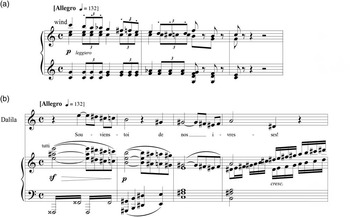
Commentators have long debated the sincerity of ‘Mon cœur’, or rather how Dalila’s expression in the movement can be so exquisite and seemingly heartfelt while she is at the same time engaged in an act of hate-fuelled manipulation. (As is well known, Dalila’s aim in the movement, as in the duet as a whole, is to get Samson to give up the secret of his powers, an aim she describes in the scene that precedes the duet in terms of ‘vengeance’ and ‘hatred’–though also in terms of ‘love’.)Footnote 2 The debate has been inspired not only by the beauty of ‘Mon cœur’ itself, but also by the way the movement reuses material, and is itself musically reused, in other parts of the opera. The first of these reuses involves the accompaniment to the second strophe, a descending chromatic sextuplet figure for winds (Ex. 3). This figure has already been heard earlier in the act, in two passages of orchestral tone-painting that precede and follow Dalila’s expression of her hatred, and its reappearance in ‘Mon cœur’ has been seen as a sign that the heroine’s sentiment here is no more than a show or ruse.Footnote 3 The second reuse involves the scene in Act III when, after the Philistines’ orgiastic Bacchanale, the defeated Samson is brought onstage and Dalila taunts him with what Ralph Locke has described as a ‘brittle’ and ‘sarcastic’ reworking of elements of ‘Mon cœur’, in particular that langorous descending ninth. This reworking, in which the ninth is restated first as a comic-ironic accompaniment to Dalila’s taunts, and then as a climactic (and partly menacing) expression of her triumph is, Locke has argued, both chilling and strikingly modern, for it transforms one of the few moments of supposedly true feeling in the opera into bitter feminine assertiveness (Exx. 4a and 4b).Footnote 4
‘Mon cœur s’ouvre à ta voix’, second strophe, descending chromatic sextuplet figure (As one sees the ears of wheat waving…).

The sincerity debate is engaging, but it misses (or is perhaps too shy about) the degree to which ‘Mon cœur’ is about passion and, frankly, sex, and that an operatic character can be sincere about a desire for sex while also using that desire to manipulate. Indeed, with its legato and ever more chromatic and vocally far-reaching lines, the repetitiveness of the accompaniment, which ‘rubs up’ against the voice to produce a delicate but insistent tension, and the way in which Samson is gradually drawn into this texture–by the end of the second strophe, the movement has turned (briefly) back into a duet, Samson singing in countermelody and then in octaves with Dalila–‘Mon cœur’ is one of the earliest examples of a nineteenth-century operatic heroine expressing heartfelt sexual longing.Footnote 5 In that sense, Saint-Saëns’s reworking of the movement in Act III is doubly modern, for it shows a heroine throwing her longing and even the fact of a sexual act back in her lover’s face.
But the sincerity debate also misses the degree to which ‘Mon cœur’ includes a perhaps surprising number of other-worldly musical gestures. These gestures are located above all in the accompaniment, in the divisi strings and then in the descending sextuplets that, in the second strophe, Saint-Saëns lays over them. It is difficult to explain the effect of the strings exactly, but there is both a tentativeness and a fixity about them–the fact that the figure is passed among the different sections rather than played by the strings as a whole is also important–that suggests something both shadowy and uncanny. The descending sextuplets (Ex. 3 again) of course exploit the chromaticism that by the 1870s had long been associated with the supernatural, and their use earlier, in what are in effect two nature interludes, makes their reappearance in ‘Mon cœur’ seem as if Dalila has summoned the natural world to her aid–or as if nature has heard her and of its own accord responded. The effect of both is to make ‘Mon cœur’ a moment of metaphysical invocation as much as physical longing and to suggest that Dalila, too, has powers–in her case perhaps those of a neo-classical sorceress, or even some kind of eroticised, cross-dressed Orpheus.Footnote 6
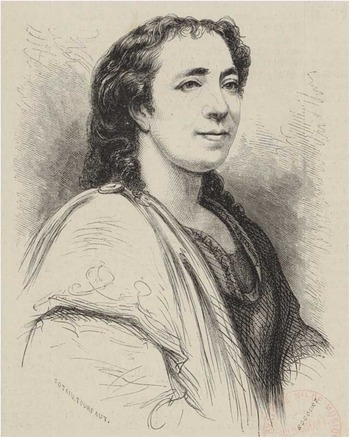
It may be relevant at this point to note that Saint-Saëns used to dress up and perform as a neo-classical sorceress–the figure in question was Gluck’s Armide, whose final monologue he used to sing at informal musical gatherings in the same period that he was completing Samson et Dalila.Footnote 7 I would like to conclude, though, with a slightly less provocative performance connection: between the opera and the French mezzo-soprano Pauline Viardot (Fig. 1). Viardot was a celebrated Orpheus and Alceste in revivals of the Gluck operas in the last years of her career, and around the same time she became a friend of the composer. By the end of the 1860s, Saint-Saëns had written the role of Dalila with her in mind (he also dedicated the score to her), and she performed it in the second of two private performances that took place before the 1877 premiere.Footnote 8 Like the soprano Giuditta Pasta before her, Viardot had ‘a long, multicoloured voice’ (the phrase is Susan Rutherford’s)–Saint-Saëns described it, at its prime, as ‘[having] enormous power [and] a prodigious range’–and that ninth, as well as the refrain’s ascending sevenths, seem unmistakably an attempt to exploit that length as well as, perhaps, the voice’s distinctive colour or changes of colour, a colour that Saint-Saëns likened to ‘the taste of bitter orange’.Footnote 9 One could go further, for the ninth was one of the first passages of the opera that Saint-Saëns wrote, and therefore potentially puts Viardot at the conception not only of the role of Dalila but also of the entire opera.Footnote 10
Samson et Dalila, Act III, reworkings of descending ninth (Do you remember our ecstasy!).

The precise nature of the relationship between Viardot and Samson et Dalila has still to be investigated, though writers, including Saint-Saëns himself, have been keen to distance the mezzo from the larger dramatic and eroticised aspects of the work. Even as sympathetic a twenty-first century commentator as Kopelson has repeated what has been said about Viardot and the role of Dalila since Saint-Saëns’s own reminiscences, which is that if the singer was a model vocally, it is inconceivable that a woman who by the 1860s was a retired, forty-something mother of four could in a larger sense have inspired or incarnated the exotic seductress.Footnote 11 And yet that ninth, which seems very much about Viardot, while also being central to Dalila’s dramatic and erotic profile, suggests that there is more to be said on this subject. Whether written as a kind of ghostly engagement with Viardot in her prime, for the more mature figure she was in the 1860s and 1870s, or for some kind of combination, it suggests a new debate that we need to have about ‘Mon cœur’: about the mixture of the immaterial and the palpable that seems to characterise both the music of this movement and its performerly origins.
(colour online) Pauline Viardot in 1871 (courtesy of the Bibliothèque nationale de France, Paris).