Implications
As behavioural responses of sows to humans at the age of 6 months and at first farrowing might be related to some extent to piglet crushing, it is suggested to include human–animal relationship observations in the selection strategies of commercial selection units.
Introduction
Crushing of piglets by the sow is still a major problem in pig production, accounting for up to 45% of all piglet deaths (Edwards et al., Reference Edwards, Malkin and Spechter1986; Edwards, Reference Edwards2002). Crushing occurs when a piglet gets trapped under the sow when she is sitting, rolling or lying down (Edwards et al., Reference Edwards, Malkin and Spechter1986), the piglets must be near the sow, and the sow must move in a way that traps the piglet between herself and some other surface such as the floor (Weary et al., Reference Weary, Pajor, Fraser and Honkanen1996a). Piglet crushing mostly occurs within 48 h after birth (Cronin and Smith, Reference Cronin and Smith1992; Weary et al., Reference Weary, Pajor, Fraser and Honkanen1996a). This piglet crushing can be described as the result of the interaction between piglet and sow behaviour, and the environment in which the animals are living (Weary et al., Reference Weary, Pajor, Fraser and Honkanen1996a). Factors influencing piglet crushing are, for example, the average weight of the piglets at birth (Weary et al., Reference Weary, Pajor, Thompson and Fraser1996b), the size of the litter (Roehe and Kalm, Reference Roehe and Kalm2000) and the farrowing crate design (Weary et al., Reference Weary, Pajor, Fraser and Honkanen1996a; Cronin et al., Reference Cronin, Dunsmore and Leeson1998). However, not all litters show dead piglets due to crushing. Grandinson et al. (Reference Grandinson, Rydhmer, Strandberg and Thodberg2003) reported that in 57% of the litters studied on farms, no piglets were crushed within 4 days after farrowing. Although farrowing stall construction and environmental parameters might have differed between litters in this on-farm study, this means that there might be sows with specific maternal behaviour, explaining part of the crushing levels (Wechsler and Hegglin, Reference Wechsler and Hegglin1997).
Maternal behaviour has a considerable effect on piglet crushing. The lying down behaviour of the sow, especially the quality of the movement (Wechsler and Hegglin, Reference Wechsler and Hegglin1997), and the frequency of standing-to-lying (Valros et al., Reference Valros, Rundgren, Spinka, Saloniemi and Algers2003) are related to piglet survival. Regarding the quality of the lying down movement, some sows might present a lying down behaviour that is dangerous for the piglet but respond quickly (by getting up again) so that piglets do not get crushed. This responsiveness of the sow to a piglet being crushed or the sound of a screaming piglet has been used as an indicator of maternal behaviour (Thodberg et al., Reference Thodberg, Jensen and Herskin2002; Grandinson et al., Reference Grandinson, Rydhmer, Strandberg and Thodberg2003). The frequency of standing-to-lying can be influenced by nursing frequency (Valros et al., Reference Valros, Rundgren, Spinka, Saloniemi and Algers2003), and also the sow’s fear of humans. Janczak et al. (Reference Janczak, Pedersen, Rydhmer and Bakken2003) found that sows demonstrating lower fear of humans were predicted to have higher reproductive success and more adaptive maternal behaviour. Furthermore, they suggested that fearful sows were more stressed or distracted by the presence of stockpersons or stimuli associated with their close proximity. As stockpersons are often present around farrowing, a sow could, as a consequence, demonstrate more frequent changes in postural positions, increasing therefore the risk of piglet crushing.
The selection of sows for future reproduction would be improved if, at an early stage, these animals could be identified based on behavioural characteristics potentially linked with maternal abilities and maternal behaviour (Thodberg et al., Reference Thodberg, Jensen and Herskin2002). Behavioural reactions to, for example, a human or exploration behaviour in a novel object test can be correlated with activity around first farrowing (Thodberg et al., Reference Thodberg, Jensen and Herskin2002). Similarly, higher levels of fear of humans at 6 months tend to be associated with a higher number of live-born piglets dying within 3 weeks of age (Janczak et al., Reference Janczak, Pedersen, Rydhmer and Bakken2003). Therefore, a characterisation of the behavioural traits of sows at a young age could be worthwhile regarding piglet survival after farrowing. However, a majority of the behavioural observations used on pigs are difficult to perform in standard commercial situations; for example, because there is not enough space to perform tests (arena tests), observations can be time consuming or there is a need for observation cameras. Ideally, these observations should therefore be performed by stockpersons trained on behavioural observations during standard management practices or observations that do not interfere with general management procedures.
In this study, the observations were performed on nulliparous sows of a commercial selection unit. The study focussed on simple observations performed during standard management procedures, or observations that can be realised by the stockpersons at 6 months of age and around farrowing. The observations aimed to evaluate the fear of humans, the reaction to novelty and to constraint and the general nervousness of the sows. Their relationships with piglet survival and reproductive performance were finally analysed.
Material and methods
Animals, housing and management
The study was carried out on a sow selection unit in Brittany, France. The selection unit raised in total 420 sows of a hyperprolific Large White breed divided in seven batches of 60 sows and was managed with a 3-week interval between farrowings. All piglets were raised until the age of 6 months at the unit, except for the castrates that were transferred to a commercial fattening unit. From weaning until the age of 4 months, pigs were raised in groups of 20 to 30. They were housed in pens measuring 3 m × 3.5 m with a partially slatted concrete floor and floor heating. Water was provided through a nipple and food (a commercial pellet diet containing 3.4 Mcal digestible energy per kg and 20% crude protein (CP)) was available ad libitum in a food trough, accessible to three pigs at a time. At the age of 4 months, the female pigs were re-allotted into groups of 10 in pens measuring 4.5 m × 2.5 m with a partially slatted concrete floor. At 6 months, they were selected for further breeding based on their weight, the number of functional teats and their genetic index. The selected sows remained at the breeding unit, were randomly re-allotted and returned to the previous indicated pens (groups of ten) without any mixing until farrowing. They were fed twice daily with an appropriated commercial feed (3.2 Mcal digestible energy per kg, 14% CP), the amount (2.5 to 3 kg) depending on their physiological state and body condition. The sows not retained for reproduction were slaughtered. In total, 75 nulliparous sows out of 475 originating from in total five different batches were kept as reproduction animals and were studied at first farrowing. The first farrowing occurred at 375 ± 3 days. One week before the expected farrowing date, sows were moved to the farrowing unit. The farrowing unit was composed of three rooms with 21 farrowing crates measuring 1.90 m × 2.40 m each. In these crates, sows were placed diagonally one besides the other with corridors on both sides. A separate piglet creep area with a heat lamp was situated behind the sow. After farrowing, sows were fed ad libitum a commercial feed (3.3 Mcal digestible energy per kg, 17% CP). In addition to daylight, lights were on from 07 : 00 to 16 : 00 and during the whole 24 h during 3 days around farrowing. Parturitions were induced at about days 112 to 113 of gestation by a prostaglandin analogue (PGF2α) injection (Planate®; Cloprostenol, Schering-Plough Animal Health, France). Adoption took place on large litters (more than 15 piglets) by re-allotting piglets towards smaller litters, and most of the litters were homogenised in number and weight within 24 h after birth.
Behavioural observations
At 6 months of age: For each batch, all nulliparous sows in the selection unit were weighed at 6 months of age. The day before weighing, all nulliparous sows were subjected to two tests, the sow escape test and a novel object test. For the sow escape test, the observer (a novel person, in this study, a woman) enters the home pen, chooses randomly a sow and tries to approach her slowly from in front, making small steps, while moving towards the animal with the right arm slightly advanced and stretched. After the approach, the observer tries to lay the hand on the back of the animal for at least 3 s. As soon as a sow was tested, she was marked with a colour marker on her back in order to distinguish her from the others still to be tested. The behavioural response was noted on a scale from 1 to 5: Score 1 – sow does not escape when approached, stands still when the observer has stopped next to her, and can be touched on the anterior part of the back for at least 3 s without movement; Score 2 – sow does not escape when approached, stands still when the observer has stopped next to her, can be touched on the hind part of the back but less than 3 s; Score 3 – sow does not escape when approached, stands still when the observer has stopped next to her, but cannot be touched; Score 4 – sow does not escape when approached, but escapes as soon as the observer is next to her; Score 5 – sow does escape as soon as the observer is approaching. A novel object test was performed four hours after the sow escape test. A non-familiar object, made of a 1.6-m-high wooden brown stick with a red coloured propeller of a fan (60 cm diameter) at the top, was placed by the observer in the middle of the home pen. After the observer went out of the pen, for each sow the latency to approach the novel object was noted. The test lasted for 4 min and each sow was given a score from 1 to 5, with Score 1 – a latency to touch the object shorter than 1 min; Score 2 – a latency between 1 and 2 min; Score 3 – a latency between 2 and 3 min; Score 4 – a latency between 3 and 4 min; and Score 5 – the sow did not touch the object within 4 min.
On the day of weighing, the sows were taken out of their pen as a group, led to the area with the weighing device and were introduced individually, one after another, into the weighing device. The area consisted of a small holding pen (approximately 2.5 m × 4 m, surrounded on two sides by a wall and on two sides by metal fences) in the middle of a corridor, the weighing device being placed at approximately 6 m of the holding pen. The weighing device was composed of metal bars and measured 1.2 m long × 0.6 m wide and 1.2 m high. It was the first experience of the sows with the weighing device. Each sow stayed inside the weighing device a minimum of 1 min during which the following operations took place, always in the same order: identification, weighing, counting the number of functional teats and ear tagging. During this procedure, the behavioural response of the sows was observed inside the weighing device, the reaction of the sow to ear tagging not being integrated. The behaviour of the sows in the weighing device during the first minute was noted as follows: Score 1 – the sow stands still, some low-pitched vocalisations may occur; Score 2 – the sow makes some slight forward and backward movements, some low-pitched vocalisation may occur; Score 3 – the sow is in movement for more than half of the time, makes frequent forward and backward movements, some low-pitched vocalisation may occur; Score 4 – the sow is almost continuously moving, making forward and backward movements of great amplitude, tries to turn around in the device, high-pitched vocalisations occur; Score 5 – the sow is very nervous, continuously moving, making forward and backward movements of great amplitude, jumps, high-pitched vocalisations occur, tries to escape from the weighing device.
At first farrowing: Seven days before the expected farrowing date, the sows were transferred from their gestation pens to the farrowing crates. The afternoon of the transfer, about 2 h after being placed in the crate, the general nervousness of the sow inside the farrowing crate was noted by the usual stockperson on a nominal subjective scale from 1 to 5 (very calm to very agitated; see example below). A high nervousness was described as frequent lying down and standing up behaviour, a high level of agitation (frequent head and body movements when standing, trying to escape from the crate or turn around, occasionally some high-pitched vocalisations):

This usual stockperson also noted 1 day before farrowing (at 10.00 h) the sow’s fear reaction when being approached from behind on a scale from 1 to 5 (not fearful to very fearful). A high fearfulness was defined as changing posture (if lying), making a movement to the front of the farrowing crate, displaying head and body movements, occasionally some high-pitched vocalisations:

Just after farrowing (within 1 to 2 h after expulsion of the last piglet), the nervousness of the sow was recorded on the same scale as the one used at the afternoon of transfer from 1 to 5 (very calm to very agitated). When farrowing occurred at night, the nervousness was judged at arrival in the farrowing unit (6 : 00). The stockperson performing the judgements was the same for all the sows implicated in the study, and referred to previous developed protocols. The nervousness and fearfulness judgements were noted on separate questionnaires by writing a cross on the line. The position of the cross was registered as an integer on a scale from 1 to 5.
Three days before expected farrowing, a second stockperson performed a human approach test, similar to the one used by Hemsworth et al. (Reference Hemsworth, Brand and Willems1981 and Reference Hemsworth, Pedersen, Cox, Cronin and Coleman1999). Their duration of withdrawal after being touched by the stockperson was determined during food distribution while having their head in the feeding trough. Withdrawal was defined as the sow moving away at least 10 cm from the person for a minimum of 1 s. Only sows standing were observed (100% in the present study). The stockperson approached the farrowing crate and stood motionless in front of the animal to be tested, at approximately 0.5 m, during the full duration of the test. After 5 s, the stockperson leaned through the bars at the front side of the crate and slowly lowered his right hand to touch gently the sow’s neck and kept his hand at the same position for 10 s. The stockperson counted down the latency of the sow to resume eating after being touched, and noted this as a score from 0 to 10. Sows that remained eating at the feeding trough received a score of zero (no withdrawal), those that withdrew were given a maximum of 10 s to resume eating and received a maximum score of 10. If a sow moved from the stockperson before he reached a 0.5 m distance or during the 5 s period when he was immobile and the sow could not be touched, the sow was given a maximum score of 10. No behavioural observations were made at second and third farrowings.
Reproduction performance
The following reproduction performances of the first three parities of each sow were noted and used for data analyses: number of live-born and stillborn piglets, and number of crushed piglets 24 h after farrowing. Crushing was determined by visual assessment performed by the stockpersons.
Statistical analysis
Statistical analyses were performed with the SAS 8.4 statistical package (SAS Institute Inc., USA). Means and s.e. for behavioural variables and performance at farrowing were calculated. As a normal distribution could not be assumed on all data, Spearman rank correlations (r s) were calculated between production performance (number of live-born, stillborn and crushed piglets) and behavioural observations. For data analyses related to crushing levels, partial correlations were calculated by taking into account the number of live-born piglets. Analyses of variance were performed using the GLM procedure to analyse the effect of weight of the nulliparous sows on the behavioural responses at 6 months. Furthermore, the effect of the batch was analysed for all data and integrated in all analyses. For the behavioural responses at 6 months, pen was included in the model as a random factor. As crushing levels were not normally distributed, sows were categorised as crushing piglets or not for first parity and the behavioural responses were compared between these two groups of sows by using least squares means. However, in the results section, ordinary means will be presented. A logarithmic transformation was used when a normal distribution or homogeneity of the variances could not be assumed on raw data. When these conditions could not be assumed on transformed data, Mann–Whitney tests were performed.
Results
Reproduction performance
All 75 sows had two farrowings. Twenty sows were sorted out of the unit after parity 2 either for low reproduction performance or for health problems. The mean number of live-born piglets at first parity was 12.81 ± 0.38, at second parity 14.12 ± 0.41 and at third parity was 14.36 ± 0.43. The mean number of stillborn piglets at first parity was 0.64 ± 0.11, at second parity 0.76 ± 0.12 and at third parity 0.91 ± 0.14. Twenty-nine sows out of 75 showed crushing at first parity (overall mean: 0.72 ± 0.13; range 0 to 5), 34 sows out of 75 at second parity (overall mean: 0.63 ± 0.11; range 0 to 6), and 25 sows out of 55 at third parity (overall mean: 0.64 ± 0.11; range 0 to 3). Of the 29 sows that crushed at least one piglet at parity 1, 14 had also at least one crushed piglet at parity 2. From the 55 sows that attained parity 3, seven sows crushed piglets at all three parties, while 15 sows crushed piglets at two out three parities.
No significant batch effects were found on the number of live-born and stillborn piglets (P > 0.10). A significant batch effect was found on the level of crushing at first parity (F 4,70 = 4.41, P = 0.003).
Behavioural responses
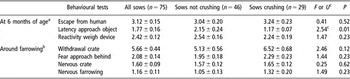
The mean behavioural responses of the sows at 6 months and at first farrowing are indicated in Table 1. No significant batch effects were found on all behavioural responses observed at 6 months of age (escape from human: F 5,69 = 0.60; latency approach object: F 5,69 = 1.63; reactivity weigh device: F 5,69 = 1.10; all P > 0.10). No effects of weight of the nulliparous sows at 6 months on the behavioural responses were found (F 5,69 = 0.10, P > 0.10). A batch effect was found on the withdrawal of the sows in the crate (F 4,70 = 4.80, P = 0.002), on fear when approached from behind (F 4,70 = 3.57, P = 0.01), on nervousness in the crate (F 4,70 = 4.13, P = 0.001) and on nervousness at farrowing (F 4,70 = 3.00, P = 0.02). Sows that crushed at least one piglet at first farrowing had a significant smaller score on the latency to touch a novel object than those with no crushed piglets (U = 2.54, P = 0.01; Table 1).
The behavioural responses of all sows and of sows crushing or not crushing piglets at first farrowing

aAll scores on a scale from 1 (low) to 5 (high).
bAll scores on a scale from 1 (low) to 5 (high) except for ‘withdrawal crate’ on a scale from 0 to 10.
cMann–Whitney U test.
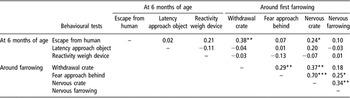
Within the behavioural observations performed at 6 months, the escape from a human in the home pen tended to be positively correlated with the reactivity in the weighing device (P < 0.10; Table 2). Within the behavioural observations performed around first farrowing, the withdrawal reaction of the sow when a human approached from the front was significantly correlated with the fear response when approached from behind and the nervousness of the sow in the crate (P < 0.05 and 0.01), the fear response when approached from behind, was significantly correlated with nervousness in the crate and around farrowing (P < 0.001 and 0.05), and the nervousness in the crate was significantly correlated with the nervousness around farrowing (P < 0.01).
Spearman rank correlations between behavioural responses observed at 6 months of age and behaviour around first farrowing

***P < 0.001; **P < 0.01; *P < 0.05.
N = 75.
The escape from the human at 6 months was significantly correlated with withdrawal when approached from the front before farrowing (P < 0.01) and nervousness of the sow in the crate. No other significant correlations were found between the observations at 6 months and around farrowing, apart from the latency to touch the novel object that had a tendency to be correlated with nervousness in the crate (P < 0.10).
Relationship between behavioural responses and reproductive performance
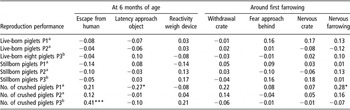
No significant correlations were found between the behavioural responses at 6 months or around farrowing and the number of live-born and stillborn piglets (P > 0.10; Table 3). For the behavioural responses at 6 months, the escape behaviour from the human tended to be correlated with the number of piglets crushed at first farrowing (P < 0.10) and was significantly correlated with the number of piglets crushed at parity 3 (P < 0.001). The latency to approach the novel object was negatively correlated with crushing level at first parity (P < 0.05). None of the behavioural responses was significantly correlated with reproductive performances at parity 2 (P > 0.10).
Spearman rank correlations between reproduction performances at the first three farrowings and behavioural responses of the sows at 6 months of age and around first farrowing

***P < 0.001; **P < 0.01; *P < 0.05.
aN = 75; N = 55.
For the behavioural responses around farrowing, the number of piglets crushed at first farrowing was significantly correlated with the nervousness around farrowing (P < 0.05), while it tended to be correlated with the withdrawal response when approached from the front (P < 0.10).
Discussion
In this study, we found relationships between behavioural responses of sows at the age of 6 months and behavioural responses around farrowing. However, most correlations found were rather low. These behavioural responses were in some cases related to subsequent levels of piglet crushing, but not to the number of live-born and stillborn piglets.
One of the objectives of the study was to observe the behavioural responses of nulliparous sows during standardised situations at 6 months of age and around first farrowing, in order to verify if these responses were linked. Although the study was performed in one selection unit and attention was paid on reproducing exactly the same protocols over the five different batches, some significant batch effects were found especially on the behavioural responses around first farrowing. Several explanations can be given. As a part of the study aimed to study the reaction to humans and handling, it might have been that certain animals had different experiences with humans in time. Although the management was the same for all batches, it might be that, for example, one additional vaccination or medical treatment influences the future behaviour of the sows, accounting therefore for a batch effect. Furthermore, despite the training and the fact that for all five batches the same stockpersons were present, it is possible that they might have varied in their way performing the observations and tests over the different batches. The stockpersons were trained on how to use the scoring grids and the intra-observer repeatability was tested before the study, but during the whole duration of the study, the stockpersons might have slightly deviated as no retraining was performed.
Relatively few significant correlations were found between the behavioural responses at both moments. It could be imagined that the reaction of a sow to a restraint situation (presence in a weighing device) would be related to the nervousness of the sow once in the farrowing crate. This could not be confirmed, possibly because these situations are finally not completely comparable. During weighing, the restraint period for the sows was relatively short, while presence in the farrowing crate is rather longer lasting. Furthermore, both situations might have been perceived differently by the sows, for example at weighing there was a considerable presence of stockpersons, which was not the case once in the farrowing crate. In addition, as during weighing the sows were preceded by other animals, and that they could see partly the actions performed on preceding animals from the holding pen, it might be that a part of the reaction is influenced by social facilitation.
Although the nature of the tests was not exactly the same, a significant correlation was found between the sow escape test performed at 6 months and the withdrawal test before farrowing. Not only was the way of proceeding different (trying to touch her on the back v. trying to touch the head), but also the amount of space available for the fear reaction was different. In the sow escape test, the sow had space to flee from the person performing the test, while in the farrowing crate no real escape was permitted because space was limited. Furthermore, in the sow escape test, the animals were inside their group (of 10 sows) and pen mates’ presence might have influenced the behaviour of the sows, while in the farrowing crate the animals were alone. Another point is that in general the withdrawal test is believed to reflect the animals’ fear response of humans (Hemsworth et al., Reference Hemsworth, Pedersen, Cox, Cronin and Coleman1999; Lensink et al., Reference Lensink, Boivin, Pradel, Le Neindre and Veissier2000). However, when performing the observation during feeding, there might be a motivational conflict for the animal between either eating or reacting to human presence. Despite these differences, a significant correlation was found, confirming earlier findings that fear reactions to humans are repeatable in time (Hemsworth et al., Reference Hemsworth, Barnett, Treacy and Madgwick1990; Janczak et al., Reference Janczak, Pedersen, Rydhmer and Bakken2003). Furthermore, the person performing the sow escape test was not the same as the one performing the withdrawal test. Although pigs can discriminate between different people (Tanida et al., Reference Tanida, Miura, Tanaka and Yoshimoto1995), this means that the sows probably generalise their reactions from one person to another (Hemsworth and Coleman, Reference Hemsworth and Coleman1998).
Around farrowing, most behavioural responses were significantly and strongly correlated. Although the four observations were all performed on different days, three of them were performed by the same stockperson. This stockperson might have memorised the response of a sow during a previous observation and might therefore have adjusted his appreciation. However, the withdrawal response of the sow when in the farrowing crate was observed by another stockperson. This withdrawal response was strongly correlated with the other behavioural responses such as nervousness of sow in the crate before and around farrowing, possibly indicating that sows fearful of humans are also more nervous or anxious (Janczak et al., Reference Janczak, Pedersen, Rydhmer and Bakken2003).
The escape behaviour demonstrated at 6 months and the withdrawal reaction just before farrowing tended to be correlated with the level of crushing at first parity. In both cases, it can be considered that sows that escaped or that had a higher withdrawal reaction were more fearful of humans. As a consequence, they might have reacted more to the passage of the observer by changing their position (for example, standing up after passage), as less fearfulness of humans tends to be associated with more resting behaviour around farrowing (Andersen et al., Reference Andersen, Berg, Bøe and Edwards2006). Another explanation could be that the fear of humans can be considered as an indicator of the general activity of the animal. Thodberg et al. (Reference Thodberg, Jensen and Herskin2002) described that nulliparous sows that were less reactive during different tests were also calmer during parturition. Similarly, nulliparous sows showing low levels of fear of humans had shorter farrowings and were more responsive when lying on a piglet, explaining a lower mortality after farrowing (Janczak et al., Reference Janczak, Pedersen, Rydhmer and Bakken2003).
The reaction to a novel object at 6 months of age was related to the level of piglet crushing, those that were interacting quickly with the novel object crushing more piglets. This correlation is not easy to interpret. Generally, the novel object test is used to test general fearfulness, those interacting quickly with the object being less fearful (Boissy, Reference Boissy1995). It could be that those interacting quickly with the object are more active animals. A low level of activity could be an important component of good maternal care in sows (Jarvis et al., Reference Jarvis, McLean, Calvert, Deans, Chirnside and Lawrence1999). Being calm immediately after farrowing prevents crushing of piglets and makes the udder accessible (Grandinson et al., Reference Grandinson, Rydhmer, Strandberg and Thodberg2003). Furthermore, prepubertal nulliparous sows whose behaviour was calmer in a stressful situation several months before farrowing were timing their nest building more optimally in a ‘get-away-pen’ than the more actively responding individuals (Thodberg et al., Reference Thodberg, Jensen and Herskin2002). In the present study, nervousness of the sows, as judged by one of the stockpersons just after farrowing, was significantly correlated with the level of piglet crushing at first farrowing. However, although the nervousness judged before and just after farrowing were significantly correlated, the nervousness in the crate just before farrowing was not correlated with piglet crushing.
No significant relationships were found between the different behavioural responses and the number of live-born and stillborn piglets. In several other studies, the fear of humans and the reproduction performance were linked (Hemsworth et al., Reference Hemsworth, Brand and Willems1981 and Reference Hemsworth, Pedersen, Cox, Cronin and Coleman1999; Grandinson et al., Reference Grandinson, Rydhmer, Strandberg and Thodberg2003; Janczak et al., Reference Janczak, Pedersen, Rydhmer and Bakken2003). For example, the number of stillborn piglets was related to the fear of humans demonstrated in a withdrawal test in the farrowing crate (Hemsworth et al., Reference Hemsworth, Pedersen, Cox, Cronin and Coleman1999). These authors argued that the presence of the stockperson around parturition might have prolonged farrowing, which could have adverse consequences on piglet mortality. Although there was also a considerable presence of stockpersons around farrowing, this could not be confirmed in the present study. One of the reasons could be the relatively low number of animals observed compared with the aforementioned study (Hemsworth et al., Reference Hemsworth, Pedersen, Cox, Cronin and Coleman1999) and field studies (Grandinson et al., Reference Grandinson, Rydhmer, Strandberg and Thodberg2003), decreasing the possibility of finding a relationship between these criteria.
The present findings suggest that it may be possible to use standard management observations or simple tests to allow selection of nulliparous sows on their level of piglet crushing. Sows could be selected based on their fear responses to humans at an early age, as fear of humans is partly under genetic control (Hemsworth et al., Reference Hemsworth, Barnett, Treacy and Madgwick1990; Grandinson et al., Reference Grandinson, Rydhmer, Strandberg and Thodberg2003). However, overall correlations are rather low and it can be discussed whether they have a useful predictive value. Furthermore, it is not always easy to standardise completely all observations in a commercial setting. Further studies would be needed to improve the test and determine their validity and repeatability for a wider use in commercial farms.
Acknowledgements
We are grateful to J.C. Le Cloarec and the staff of the Locmaria station for taking care of the animals and for performing the observations, M.L. Grannec for her involvement, and R. Fisher for revising the English in the manuscript.