Local health departments (LHDs) are essential to public health emergency preparedness and response. 1 As part of a response, LHDs may conduct disease surveillance, staff and oversee vaccination clinics, assist with evacuation efforts, and provide information to the public about the emergency.Reference Enanoria, Crawley and Tseng 2 According to the National Association of County and City Health Officials (NACCHO), since 2010, 55% of LHDs have responded to an emergency and nearly all (93%) have participated in drills or exercises for an emergency response. 3 The NACCHO survey also found that most LHDs routinely engage in certain preparedness activities, with 87% reporting the creation or recent update of an emergency plan and 84% training their staff in emergency preparedness.
The participation of LHD employees is a critical element in response quality and effectiveness. Yet, recent research has found that LHD workers vary greatly in their willingness to respond to different emergency scenarios. For example, whereas most workers (93%) report that they would respond to a weather-related emergency, only 80% would be willing to respond to an anthrax bioterrorism event.Reference Barnett, Thompson and Errett 4 This is particularly worrisome given the small size of some health departments and decreased public health workforce capacity in general. 5 If 20% of the workforce does not respond, the burden is dramatically shifted to those who do report, which threatens the response’s overall success.
Given their key role during a public health emergency response, the factors that may increase (or decrease) LHD workers’ response willingness should be explored. The legal environment, which establishes infrastructure and parameters for a response, offers one potential avenue for improving response willingness.Reference Rutkow, Vernick and Gakh 6 We examined whether the presence of 3 hypothetical legal protections—1) ensuring priority health care for workers’ families, 2) granting workers access to mental health services, and 3) guaranteeing access to personal protective equipment—influences LHD workers’ self-reported response willingness for 4 emergency scenarios. The legal protections we selected were responsive to challenges or concerns that LHD workers had noted in previous research regarding factors that may increase emergency response willingness,Reference Barnett, Thompson and Errett 4 and none are currently required by state law. We also examined whether specific demographic factors are associated with LHD workers’ response willingness given the presence of these legal protections. On the basis of prior research, we hypothesized that the legal protections would positively influence LHD workers’ response willingness.
Methods
Study Population and Design
The Johns Hopkins Public Health Infrastructure Response Survey Tool (JH-PHIRST), an anonymous internet-based survey, was fielded by the study team. JH-PHIRST includes questions about demographics and attitudes and beliefs regarding LHD workers’ willingness to respond to emergencies given the presence of specific legal protections. These questions were asked for 4 emergency scenarios: weather-related event, pandemic influenza, radiological “dirty” bomb terrorism, and inhalational anthrax bioterrorism. For example, individuals were asked to indicate their agreement with the following statement: “I would be more likely to respond during a [weather-related event] if state law granted my family priority access to health care for any condition related to the [weather-related event].” The survey gathered demographic information about age, gender, level of education, professional role in an emergency response, responsibility for family member(s), years with current organization, and years in the profession. JH-PHIRST was designed to be completed in 15 to 20 minutes, and its measures have been validated.Reference Witte and Allen 7
Three state-based clusters of local health departments received JH-PHIRST with these legal protection questions. The states were Florida, Minnesota, and Missouri. States were selected via a convenience sample of local health officers who assisted in recruiting additional health departments. Each cluster consisted of at least 3 geographically proximate health departments. A total of 24 LHDs in the 3 states received JH-PHIRST. Clusters were identified as urban or rural on the basis of US Census definitions and prior research about LHDs. 8 , Reference Rosenblatt, Casey and Richardson 9 Rural clusters were defined as those where the average LHD serves individuals from counties with an average of fewer than 50,000 residents. Urban clusters were defined as those where the average LHD serves individuals from counties with an average of more than 50,000 residents. JH-PHIRST was available to each cluster via SurveyMonkey (SurveyMonkey.com, Portland, OR) for 4 to 6 weeks between 2011 and 2012. All employees within the LHDs were asked to complete JH-PHIRST.
Review and approval of this study were provided by the Johns Hopkins Bloomberg School of Public Health Institutional Review Board.
Statistical Analyses
We recoded the JH-PHIRST demographic and response willingness questions as dichotomous variables. Response willingness was recoded as agree or disagree that the respondent would be “more willing to respond.” We analyzed data from participants who provided complete responses for one or more emergency scenarios (complete data set) and compared their characteristics with those who provided complete responses within each scenario (analysis data set). Next, we calculated descriptive statistics for characteristics of participants in our analysis data set, including responses to the willingness questions. To identify predictors of response willingness, a generalized linear logistic regression analysis, which accounts for within-cluster and within-LHD correlation of responses, was performed. The dependent variable was greater response willingness (agree or disagree) to emergencies given the presence of specific legal protections. Models were first estimated for each of the 4 emergency scenarios, with each individual demographic characteristic as the sole predictor in a separate model. Next, to evaluate the independent associations of each predictor with response willingness, we performed a multivariable analysis in which the demographic variables described above were entered simultaneously in a model for each scenario. Analyses were conducted with STATA version 13.1 (STATACorp LP, College Station, TX, 2013).
Results
Among the 2645 LHD employees who were eligible to participate in the JH-PHIRST survey, 1238 (47%) answered at least part of the survey. Across the 4 emergency scenarios, the number of responses with complete data differed for each of the 3 willingness to respond questions regarding legal protections: range, n=1155–1177 for the weather-related scenario; range, n=1129–1146 for the pandemic influenza scenario; range, n=1081–1085 for the radiological “dirty” bomb scenario; and range, n=1067–1076 for the inhalational anthrax scenario. For the demographic variables, level of education and years with current organization had the most missing data (4.0% and 2.4%, respectively). The remaining variables had missing data rates between 1.7% and 0.9%.
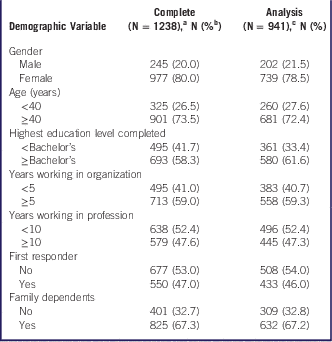
By use of the inhalational anthrax scenario as an example, the majority of respondents were aged 40 or older (n=682, 72.4%), were female (n=739, 78.5%), had completed at least a bachelor’s degree (n=580, 61.6%), had worked in their health department for at least 5 years (n=558, 59.3%), had worked in their profession for less than 10 years (n=496, 52.7%), were not first responders (n=508, 54.0%), and had dependent family members (n=632, 67.2%) (Table 1). Comparisons between the complete and scenario-specific analysis data sets for these characteristics revealed only small differences.
Comparison of Respondent Characteristics Between the Complete and Analysis Data Set for the Inhalational Anthrax Scenario

a The complete data set includes all respondents who provided any responses to the Johns Hopkins Public Health Infrastructure Response Survey Tool.
b Percentage based on non-missing responses by demographic characteristic.
c The analysis data set for this scenario includes the subset of respondents who had no missing data for any willingness-to-respond or any demographic characteristic used in the analyses.
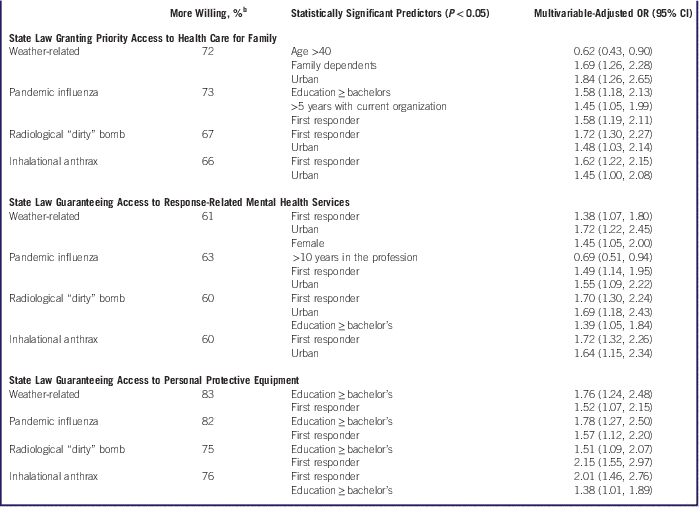
When asked about their greater response willingness if a state law granted their family priority access to response-related health care, between 66% and 73% of participants indicated that they would be more willing to participate in a response, depending on the emergency scenario (Table 2). In our multivariable models, for the pandemic flu, radiological “dirty” bomb, and inhalational anthrax scenarios, first responders had significantly higher odds of greater response willingness given priority access to response-related health care for their family than did non-first-responders. For the weather-related, radiological “dirty” bomb, and inhalational anthrax scenarios, being in an urban health department was significantly associated with greater response willingness given this protection.
Statistically Significant Predictors of Greater Response Willingness Given Specific Legal ProtectionsFootnote a

a Abbreviations: CI, confidence interval; OR, odds ratio.
b Percentage agreement is based on analysis data set for each scenario, where respondents had no missing data for any willingness-to-respond question or demographic characteristic used in the analyses.
When asked about their response willingness if a state law guaranteed them access to response-related mental health services, between 60% and 63% of respondents agreed that they would be more willing to participate in a response, depending on the scenario. In the multivariable analyses, for all 4 emergency scenarios, first responders and those working in urban health departments had significantly higher odds of greater response willingness given this protection.
When asked about their response willingness if a state law guaranteed them access to personal protective equipment for a response, between 75% and 83% of respondents agreed that they would be more willing to participate in a response, depending on the scenario. In multivariable analyses, for all 4 scenarios, first responders had significantly higher odds of greater response willingness given a guarantee of access to personal protective equipment than did non-first-responders. For all 4 scenarios, holding a bachelor’s degree or higher was significantly associated with greater response willingness with this protection.
In 11 of 12 permutations of emergency scenarios and hypothetical legal protections, first responders had significantly higher odds of a greater response willingness; the exception was for the weather-related scenario given hypothetical priority access to health care for family members (odds ratio [OR]=1.26; 95% confidence interval [CI]= 0.95, 1.68; data not shown). Those who held a bachelor’s degree or higher had significantly higher odds of greater response willingness for the radiological “dirty” bomb scenario across all 3 hypothetical legal protections (p=0.057 for priority access to health care for family members; data not shown).
Discussion
Because LHD employees are vital to the success of emergency responses, and the public health workforce has been decreasing because of financial austerity measures, it is particularly important to identify factors that may improve response willingness. Our analysis found that the majority of local public health workers agreed that they would be more likely to respond if certain hypothetical legal protections were provided by their state government. Among the 3 legal protections, a guarantee of personal protective equipment elicited the greatest agreement with improved response willingness, whereas access to response-related mental health services yielded the lowest improvement in response willingness.
In general, individuals who self-identified as first responders were significantly more likely to report greater response willingness across the 4 emergency scenarios and for the 3 legal protections than were non-first-responders. Because a successful response depends on the participation of first responders, states should consider implementing these types of legal protections to further promote response willingness among this vital cohort. Importantly, because LHDs often need to take an all-hands-on-deck approach to public health emergency responses, policymakers should also determine the types of legal protections that would improve response participation among individuals who do not self-identify as first responders.
Given the importance of education for responses to the radiological “dirty” bomb scenario, LHDs may want to provide additional trainings about the risks associated with such a response, with a focus on both physical and mental health implications. In addition, LHD leaders should use formal processes (eg, employee handbooks or orientations) to make clear what personal protective equipment (if any) is guaranteed, by law or departmental policy, to individuals who may participate in a “dirty” bomb or other response.
Limitations
Our findings should be considered within the study’s limitations. JH-PHIRST was administered to LHDs in 3 clusters established through convenience sampling. The lack of a nationally representative sample means that our results will not necessarily be generalizable to the greater US local public health workforce. Future studies should employ nationally representative samples. In addition, JH-PHIRST asked about participants’ response willingness to hypothetical emergency scenarios. While the responses we received may not reflect behavior during an actual emergency, research suggests that intention predicts real-world behavior among health care professionals.Reference Godin, Belanger-Gravel and Eccles 10 Ideally, this research should be conducted during real-time emergencies when the legal protections of interest have actually been put in place. In light of the challenges associated with real-time emergency research, we believe that the JH-PHIRST responses provide important and useful insights for policymakers, emergency planners, and others. This study only considered 3 types of legal protections. Future analyses should examine additional state or local legal protections—created through legislative or other means—to promote response willingness among LHD workers. Despite these limitations, to our knowledge, this study is the first analysis of how specific hypothetical legal protections influence response willingness among the local public health workforce.
Conclusions
Local public health workers play a key role in public health emergency responses, yet research shows that their response willingness varies depending on the emergency scenario. State and local laws offer one potential avenue to improve response willingness, by providing certain protections to or prioritization of individuals who participate in emergency responses. This study identified 3 types of legal protections that augment a majority of local public health workers’ response willingness across 4 emergency scenarios. The success of such measures rests on policymakers’ passage and implementation of these types of laws. However, policymakers must balance improved response willingness against the cost of these protections, as well as ethical considerations associated with prioritizing responders over the general public.
Acknowledgments
Support for this research was provided by a grant from the Robert Wood Johnson Foundation. Development of the survey research instrument was supported by the Centers for Disease Control and Prevention, Preparedness & Emergency Response Research Center (5P01TP00288). The funders had no role in study design, data collection and analysis, decision to publish, or preparation of the manuscript.