Dr. Henry Kissinger (during his secret trip to China in 1971): ‘Many visitors have come to this beautiful, and to us, mysterious land.’
Premier Zhou Enlai: ‘You will find it not mysterious. When you have become familiar with it, it will not be as mysterious as before.’ Footnote 1
1. Introduction
The tenth anniversary of China's accession to the World Trade Organization (WTO) is an opportune moment to review China's participation in the WTO dispute settlement system. China has rapidly developed into one of the world's largest trading nations and become party to a considerable number of trade disputes. In that capacity it has the potential to affect the operation of the dispute settlement mechanism, which is a major contributor to the WTO's success. China's current domestic legal system has only a short history and its pre-accession experience of international legal proceedings was non-existent but now, as a WTO Member, it is subject to compulsory jurisdiction, independent reviews of its domestic legislation and the possibility of trade sanctions, all of which heightens interest in its participation. Even five years after its accession, China was still only a marginal participant in dispute settlement proceedings but today it has a sufficient track record to evaluate the role that it is playing. It is not as mysterious as before.
This study is structured as follows: Section 2 reviews the trend in China's rate of participation in the WTO dispute settlement system and compares it with that of other Members. Section 3 considers the subjects of recourse to the system where China is concerned and observes a country-specific characteristic of China's complaints. Sections 4 and 5 consider the extent to which China has conformed to the system's requirements and contributed to the system's development, and characterize the role that China is playing. Section 6 considers a future challenge for the system and Section 7 presents the conclusions.
This study focuses on China's performance in the WTO dispute settlement system but it does not directly review China's compliance with its substantive WTO obligations. Given the subject matter, the study is limited to trade and does not imply a view as to China's role in other areas of international cooperation.Footnote 2
2. Trends in China's participation
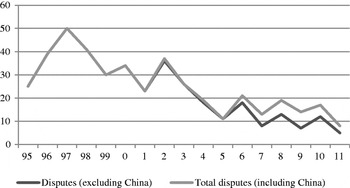
The volume of disputes to which China is party has had a significant impact on the business of the WTO dispute settlement system. Given China's size, this should not be surprising.Footnote 3 Overall, recourse to the Dispute Settlement Understanding (DSU) has declined since 2002/03, both in terms of the numbers of disputes initiated and the number of panel proceedings.Footnote 4 Disputes filed by other Members against China, and by China itself, have lessened that decline but they have not flooded the system.Footnote 5
Figure 1 below shows the total annual volume of disputes initiated in each year since the establishment of the WTO, disaggregating the data where China was a principal party, either as complainant or respondent. These comprise all requests for consultations filed under the DSU. The volume of panel proceedings, including and excluding China, (not shown) reveals a similar trend. These data do not include compliance disputes.Footnote 6
Volume of WTO disputes

China ranks among the top three parties in WTO dispute settlement during the period since its accession in 2001. It has been a principal party in 35 disputes under the DSU in relation to 24 distinct matters, and in 15 panel proceedings,Footnote 7 more during the same period than any other WTO Member except the European Union and the United States.Footnote 8 China has participated as a principal party in all the usual stages of the procedures up to and including implementation of Dispute Settlement Body (DSB) recommendations, both as complainant and respondent. This has been a rapid development for a country that until 2001 was only an observer in DSB meetings.
The overall volume of disputes involving China (in terms of separate requests for consultations) is skewed heavily toward complaints by other Members. In terms of distinct matters involving China (which filter out multiple requests for consultations by different Members regarding the same matter), those raised by other Members also outnumber those raised by China itself.Footnote 9 The number of panel proceedings to which China has been a principal party have been fairly evenly divided between those in which it is complainant and those in which it is respondent. This reflects the fact that a significant proportion of disputes in which China is respondent has been settled without recourse to a panel.Footnote 10
China's large share of disputes actually developed in five years, not ten. China's role during its first five years of WTO membership was basically that of a perennial third party in panel proceedings.Footnote 11 It was only during the second five years that China became a frequent principal party in its own right at the consultations, panel and appellate stages. Even now, it has not been a principal party to a compliance dispute or to arbitration on retaliation.
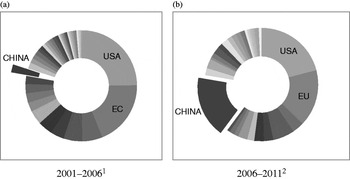
China's share of total disputes initiated under the DSU is large relative to the respective shares of most other Members in the second five years of its membership, but not during the first five-year period. Figures 2a and 2b show the relative proportion of disputes (in terms of separate requests for consultations) to which each Member was a principal party during these two five-year periods. China's share of disputes in the second five years was also large in terms of distinct matters, but less so, due to the fact that in several disputes there were multiple complainants. China also had the third-highest rate of participation as a principal party in panel proceedings in the second five-year period.
Parties to disputes

China's emergence as a major player in dispute settlement is the most significant change in the identity of the system's top participants since the establishment of the WTO.Footnote 12 China's rate of participation as a principal party in the last five years ranks in a league with the European Union and the United States during the same period. However, this is still a recent phenomenon. Further, China has not created a new ‘hub’ in the dispute settlement system, that is to say a majority of WTO disputes, in terms of distinct matters, and a larger majority of panel proceedings continue to involve either the European Union or the United States, or both, in the role of principal party, with or without other parties.Footnote 13 Every distinct matter raised in China's disputes to date can be related to one or both of these pre-existing hubs.
The trend in China's emergence as a major player in WTO dispute settlement has been the inverse of the trend in original Members’ recourse to the system as a whole. In China's case, membership began with a period of virtually no recourse to the DSU followed by a rapid increase in disputes. In contrast, the system as a whole began with a surge of complaints that later abated (as shown in Figure 1). This phenomenon has contributed to China's larger relative share of disputes during the last five years. There has been no similar trend in disputes involving other recently acceded Members.Footnote 14
The DSU was not irrelevant to China's trade relations during the first five years of its membership.Footnote 15 In 2002–2003, China was a co-complainant in US–Steel Safeguards.Footnote 16 In 2004, an EC complaint concerning China's export restrictions on coke used in the production of steel was averted by a bilateral agreement.Footnote 17 In 2004, the United States did initiate a dispute under the DSU regarding China's VAT refunds on integrated circuits, but the matter was quickly settled.Footnote 18 In 2006, the United States was ‘on the verge of filing a WTO case’Footnote 19 regarding China's anti-dumping duty on kraft linerboard but refrained after the measure was repealed a week later.Footnote 20
This low rate of complaint apparently reflects a policy of restraint by other Members in recourse to the DSU during this period, although there was no ‘peace clause’ in China's terms of accession. Transitional periods for specific accession commitments played a part in this.Footnote 21 China was entitled to three more years to implement trading rights,Footnote 22 periods up to 2005 or earlier to phase out certain non-tariff measures,Footnote 23 and transitional periods up to six years to implement certain GATS commitments.Footnote 24 A transitional review mechanism began operation in 2002Footnote 25 and, while most of the claims raised in the 2006–2007 disputes concerned obligations that entered into force upon China's accession, they were raised in the transitional review mechanism first.Footnote 26 Precipitate dispute settlement on the part of other Members might not have been more effective (and might well have been counterproductive) at a time when China was, in its own words, ‘facing enormous difficulties and capability constraints’ in implementation.Footnote 27
As for China, it was very active in addressing foreign market barriers through other avenues. In 2002–2003, it pursued its rights under the Agreement on Textiles and Clothing (‘ATC’) against Turkey and the United States in the Textiles Monitoring Body, but with limited results.Footnote 28 From 2002 onwards, it responded to numerous consultation requests under the China-specific safeguard mechanism in its Accession Protocol, and definitive safeguards have rarely been applied under that mechanism. After the expiry of the ATC at the end of 2004, China negotiated certain bilateral agreements to address textile safeguards applied under another transitional mechanism in its terms of accession.Footnote 29 It was not clear that recourse to the DSU would have been a more effective means of addressing these concerns. A suit without co-complainants may also have seemed daunting when China was still a neophyte in DSU procedures. In 2005, the Ministry of Commerce adopted rules on foreign trade barriers investigations and began publishing annual Foreign Market Access Reports.Footnote 30 China has also pursued a diplomatic campaign for recognition of its market economy status, including in the context of free trade agreement negotiations, and has obtained agreements from other countries not to have recourse to Section 15 of its Protocol of Accession (on non-market economy treatment) and Section 16 (the China-specific safeguard mechanism), or to the now-defunct China-specific textile safeguard mechanism.Footnote 31
China appears to have anticipated its later participation as a party to DSU proceedings. As early as 2003, in the negotiations on DSU reform, it proposed to halve the DSU time periods for panel and Appellate Body proceedings in disputes involving safeguards and anti-dumping measures, unless the respondent was a developing country Member.Footnote 32 Most of China's subsequent complaints fit this description. It also proposed to limit to two the number of panels that could be established in a calendar year against a particular developing country Member (such as itself) at the request or joint request of a particular developed country Member.Footnote 33 Multiple panels were indeed established against China at the request or joint request of the United States in 2007Footnote 34 and again in 2010.Footnote 35
Major changes took place in the volume and terms of China's trade during this period that probably contributed to the end of restraint in initiation of WTO disputes against China. In 2003, China's merchandise export growth rate was double that of world exports. China became the largest source of imports for Japan, the second largest source of imports for the European Union (after the United States), and replaced Mexico as the second largest supplier to the United States (after Canada).Footnote 36 By 2004, the sustained and dynamic growth in China's merchandise exports and imports led it to rank in the world's top three traders.Footnote 37 By 2005, China's trade surpluses with North America and Europe had roughly doubled or more from the time of its accession.Footnote 38 Further, some of the measures at issue in the subsequent disputes, such as the Auto Industry Development Policy, were only adopted during this period.
Disputes with China under the DSU began in earnest in 2006/07, starting with the complaints in China–Auto Parts, and they have continued up to the present time. This change in approach has not led China to disengage from bilateral channels of dispute resolution. Five of the 15 distinct matters raised under the DSU in which China was respondent have been settled at an early stage of the DSU proceduresFootnote 39 and another was settled in part.Footnote 40 Under the terms of each settlement, China revised, amended or repealed measures. It is difficult to discern a country-specific pattern distinguishing those matters which settled from those which did not, besides the fact that settlements were not reached when China was complainant.Footnote 41
One noticeable characteristic of China's disputes is that the range of parties is limited. The United States or the European Union, or both, are party to every distinct matter raised under the DSU to which China is a principal party. They are the only two Members against which China has initiated disputes in ten years. These two Members are China's largest trading partners and the top two respondents in the dispute settlement system overall. Mexico, Canada, Guatemala, and now Japan have each filed complaints regarding one or more of the same matters.Footnote 42 Although there is considerable background to each of China's early complaints (discussed in the next section), it can be observed that China's first solo complaint against the United States, filed in 2007, followed the US’ initiation of three disputes against China in quick succession earlier the same year, while another was already before a panel.Footnote 43 Similarly, China's first complaint against the European Union, in 2009, followed the European Union's initiation of its third dispute against China the previous month, by which time the DSB had adopted the reports in the first dispute, which found against China.Footnote 44 The fact that these other two Members were resorting to the DSU in matters involving China may have been a factor in China's decisions to have recourse to the DSU itself.
China has not initiated a dispute against any developing country Member, even as regards measures similar to those at issue in its disputes with the United States and the European Union. For example, from 2004, Turkey applied textile safeguards to imports from China and did not enter into a bilateral agreement, which led China to ‘demand’ that Turkey comply with the terms of the textile safeguard mechanism in China's terms of accession.Footnote 45 In 2006, Turkey also applied a definitive ‘China-specific safeguard’ (discussed below) on float glass.Footnote 46 India has applied more anti-dumping measures to goods from China than has any other MemberFootnote 47 and treats China as a non-market economy in anti-dumping investigationsFootnote 48 but this has not led to a dispute under the DSU.Footnote 49 Argentina is also one of the top users of anti-dumping measures on imports from ChinaFootnote 50 and has not implemented an agreement to recognize China's market economy status.Footnote 51 In 2010, China reportedly halted shipments of soybean oil from Argentina for six months, for quality reasons, but the incident may have been partly linked to the number of Argentina's anti-dumping measures.Footnote 52 On the other hand, developing country Members have rarely raised issues with China in the transitional reviews, let alone under the DSU. The chief exception is Mexico, which has raised issues in both fora. It can be recalled that Mexico was the last WTO Member to sign a bilateral agreement with China during its accession negotiations and that it is a competitor with China in the US market.Footnote 53
China has at least raised the possibility of recourse to the DSU regarding other Members’ measures. For example, in 2009 it warned of the potential for a complaint regarding Australia's first set of parallel anti-dumping and countervailing measures, adopted in the wake of the new US policy on countervailing duty law.Footnote 54 In 2009, China also reserved its right to file a complaint regarding India's ban on imports of toys from China, although it was confident the matter could be resolved through consultations.Footnote 55 Neither matter led to a dispute under the DSU.
In summary, China became a very active participant in the dispute settlement system as a principal party in its second five years of membership, placing it in a league with the other two major participants in the system during that relatively recent period of time. China's participation is of systemic importance because recourse to the DSU among other Members has declined from 2002/03, both at the consultations and panel stages. The trend in China's participation is distinctive, as it began with a period of mutual restraint until 2006/07, followed by a recent surge in disputes. The range of Members among whom China's disputes have been initiated is limited, being dominated by the United States and, to a lesser extent, the European Union. These two Members remain the hubs around which most WTO disputes revolve.
3. Features of recourse to the DSU
There has been a marked difference between the subject matter of disputes initiated by China and those initiated by other Members against China, both in terms of the types of measures at issue and the source of the relevant WTO obligations.
The subjects raised by other Members in their complaints against China are diverse: they span trade in goods, trade in services, and intellectual property rights; they raise border measures, domestic regulation, and alleged subsidies. All disputes initiated by other Members against China included claims regarding WTO obligations that apply multilaterally. Some of these disputes have also raised additional commitments in China's terms of accession, but those commitments were central to a minority of disputes.Footnote 56China–Publications and Audiovisual Products concerned China's commitments to grant the ‘right to trade’ (i.e. the right to import and export goods) as well as national treatment claims under both GATS and GATT 1994.Footnote 57China–Raw Materials concerned commitments on the elimination of export duties in addition to claims regarding quantitative restrictions under Article XI of GATT 1994. The right to trade was also raised in this dispute but ruled outside the panel's terms of reference on appeal.Footnote 58China–Rare Earths covers similar ground.Footnote 59 An accession commitment on the tariff treatment of kits for motor vehicles was raised by two complainants in China–Auto Parts, in addition to claims under Articles II and III of GATT 1994, among others, but not as the primary claim.Footnote 60China–Financial Information Services (which settled) raised an accession commitment regarding the independence of a regulatory authority, in addition to specific commitments in China's GATS Schedule.Footnote 61 Other important accession commitments, such as those on administration of the trade regime, non-discrimination for foreign investors, and domestic support for agriculture, have not been raised in any dispute.
The recurrent theme in China's recourse to the DSU has been discrimination. Specifically, China has challenged treatment that is differentiated because goods are of Chinese origin. Its complaints appear to reflect a strategic approach. The subject of all but one of China's complaints is contingent trade remedies and over half of those complaints have been related directly or indirectly to two Sections in China's Accession Protocol.Footnote 62 The main one is Section 15, which authorizes the continued use of non-market economy (‘NME’) methodologies in anti-dumping investigations on certain conditions, among other things. The other is Section 16, which created a transitional safeguard mechanism applicable only to goods from China (or ‘China-specific safeguard’). The other three Chinese complaints challenged measures that were almost certain to be found WTO-inconsistent.Footnote 63 These may also be considered strategic choices as they help balance the outcomes for China from participation in dispute settlement as a complainant and as a respondent. Positive outcomes in such cases may be useful in mustering support for China's own implementation efforts.Footnote 64
NME treatment has been the subject of four of China's complaints.Footnote 65 Although it is not applied uniquely to goods from China, it is applied to very few other WTO Members and, in China's case, it may be presumed to apply.Footnote 66 According to NME methodology, the ‘normal value’ in an anti-dumping investigation is not based on domestic prices or costs actually incurred by the investigated producers in China, which can lead to higher dumping margins.Footnote 67 Despite the fact that China is the world's top target of anti-dumping measures, it has to date filed only one WTO complaint regarding anti-dumping in which the key claims did not raise the issue of differentiated treatment (the exception concerns zeroing, which had already been found WTO-inconsistentFootnote 68). China's claims regarding countervailing duty law, raised concurrently with NME treatment in one dispute, also challenged the way that law applies to China in particular, given the characteristics of its economy.Footnote 69
Two of China's other complaints also challenged China-specific discrimination. One concerned a China-specific safeguard, which applies to imports from China only, under conditions less demanding than those that apply under the Agreement on Safeguards, and the enabling provision expressly foresees voluntary export restraints that are otherwise prohibited in the WTO.Footnote 70 China's sole complaint to date which did not concern a contingent trade remedy (it concerned a sanitary measure) also challenged a provision that expressly referred to products of Chinese origin only.Footnote 71
China's recourse to the DSU cases regarding NME treatment and the China-specific safeguard is, in effect, complementary to its diplomatic strategy to eliminate other Members’ use of these measures, as well as of the textile safeguard provision which expired in 2008. The wider strategy is not focused on the legality of other Members’ measures but is aimed at removing or limiting the negative impact of the enabling provisions themselves, to which China reluctantly agreed in its accession negotiations. Further, China's recourse to the DSU on these issues only occurred after great efforts to advance its interests by other means. The background to these disputes is described below.
The trigger for China's first complaint since 2002 was a major policy change relevant to NME treatment in the United States that occurred in 2006. It had been longstanding US policy not to apply the countervailing duty law to countries that the United States treated as NME countries in anti-dumping investigations, such as China.Footnote 72 This had been a rare positive aspect of NME treatment for China, but was not mentioned in its terms of accession. The prospect of a change to this policy had such important ramifications that the Chinese government had taken the unprecedented step of submitting to the jurisdiction of a foreign court, the US Court of International Trade, in an attempt to restrain the US Department of Commerce from continuing a countervailing duty investigation involving China. The Court dismissed the action for lack of jurisdiction.Footnote 73 The strategic importance of the new policy is increased by the fact that it could continue after Paragraph 15(a)(ii) of Part I of the Accession Protocol expires. The US Department of Commerce published affirmative preliminary anti-dumping and countervailing duty determinations in the case in April and June 2007.Footnote 74 These were the subject of China's maiden recourse to the DSU without co-complainants in September 2007.Footnote 75 The dispute was short-lived as the US International Trade Commission (‘USITC’) made negative injury determinations regarding the product at issue in November 2007.Footnote 76
The sequel was China's 2008 complaint under the DSU in US–Anti-Dumping and Countervailing Duties (China), which challenged four sets of parallel definitive anti-dumping and countervailing duties that had been applied by the United States according to its new policy.Footnote 77 One of China's key claims was that the concurrent application of anti-dumping duties, when the dumping margin is calculated using NME methodology, and countervailing duties, on the same products, offsets the same subsidies twice and leads to an impermissible ‘double remedy’.Footnote 78 The Appellate Body found that the imposition of double remedies was inconsistent with Article 19.3 of the SCM Agreement, although it conceived that investigating authorities could avoid this result if they adjusted their methodologies, which the US Department of Commerce had not done. China also challenged various aspects of the countervailing duty investigations, seeking rulings on issues of systemic importance to its economy, notably the definition of a ‘public body’ within the definition of a subsidy (vis-à-vis state-owned enterprises and state-owned commercial banks), the use of out-of-country benchmarks to calculate the amount of ‘benefit’ conferred by a subsidy (instead of using domestic prices and interest rates), and specificity. The rulings on these points were mixed, but the Appellate Body's interpretation of a ‘public body’ in particular – which did not equate that term with a state-owned or state-controlled entity – may assist Chinese exporters in other countervailing duty investigations.Footnote 79
As regards the European Union, the driver of both China's complaints has been NME treatment in anti-dumping investigations. China first requested market economy status in European Commission trade defence investigations in 2003.Footnote 80 Its aspiration was to obtain early recognition of that status before the expiry of the 15-year period in its terms of accession.Footnote 81 A bilateral market economy status working group was established in 2004. Some exporters from China have been granted market economy treatment, on application, on the basis of five technical criteria laid down in the EU basic anti-dumping regulation.Footnote 82 Requests from other exporters were rejected and recourse to European courts had generally proved unfruitful.Footnote 83 In 2008, the European Commission conducted an assessment and concluded that China, as an economy, satisfied only one of these five criteria.Footnote 84 In 2009, China filed its first WTO complaint against the European Communities (as they then were), in EC–Fasteners (China), in which it successfully challenged an aspect of NME treatment in the EU basic anti-dumping regulation. The issue concerned the denial of individual treatment to NME exporters or producers in the establishment of dumping margins unless they fulfill additional conditions. The Appellate Body also reviewed the NME provisions in the Accession Protocol and confirmed certain limits on their scope.Footnote 85 The conditions for individual treatment were found inconsistent with the Anti-Dumping Agreement, although the interpretation of what may constitute a single entity was nuanced.Footnote 86 In the dispute China also challenged a specific anti-dumping measure imposed on steel fasteners earlier that year, and through this vehicle challenged, with some success, certain practices in which it alleged the EU had repeatedly engaged in anti-dumping investigations into Chinese products.Footnote 87
China challenged the same aspect of NME treatment under the EU basic anti-dumping regulation in EU–Footwear (China) in 2010, and this panel largely adopted the earlier panel's reasoning and conclusions to reach the same result under the Anti-Dumping Agreement.Footnote 88 China also challenged a specific anti-dumping measure on footwear that was first applied in 2006 and extended at the end of 2009, which expired during the panel proceeding. Among its host of claims regarding EU anti-dumping practices, most of which were not upheld, China raised two other aspects of NME treatment.Footnote 89
The dispute regarding a China-specific safeguard, US–Tyres (China), can also be located within a wider context. Soon after its accession, China called on other Members to exercise ‘utmost restraint’ with this type of measureFootnote 90 and it has engaged in many consultations with Members that initiated action under this mechanism, including the United States. The USITC recommended measures under this mechanism four times from 2002 to 2005 but those recommendations were not followed.Footnote 91 China engaged in high-level consultations with the US regarding a proposed China-specific safeguard in 2009 but in this case the new US administration did impose duties.Footnote 92 China immediately challenged the measure at the WTO. Neither the panel nor the Appellate Body accepted any of China's claims.Footnote 93 Nevertheless, recourse to the DSU may have contributed to containment of the issue as other countries did not follow the United States in applying China-specific safeguards.Footnote 94 Nor was there a spiral of safeguards on tyres to prevent trade diversion, as permitted under the mechanism.Footnote 95 China's recourse to the DSU in this case was also motivated by the perceived weakness of the justification for the specific measure at issue: the US tyre industry had not requested the measure and had voluntarily relocated part of its manufacturing to China, and two members of the USITC had dissented from the determination.Footnote 96
China's complaints under the DSU concern matters in which the government has had significant prior involvement, for example, through trade remedy investigations conducted by other countries. China's lone complaint regarding a non-tariff measure (on poultry) also concerned an issue on which the Chinese sanitary authority had lengthy prior involvement. The dearth of complaints regarding China's trading partners’ domestic regulation (such as allegedly discriminatory standards) may have been due to a lesser degree of coordination between the administration and exporters. China's procedure for industry to raise issues regarding foreign trade barriers, though rarely usedFootnote 97, has led to the current investigation into certain US State government programs for renewable energy industries.Footnote 98 This may herald a new type of complaint from China.
Developing country Member status was a vexed issue in China's accession negotiationsFootnote 99 but it has not been a source of disputes with China, or even dispositive of a claim or a defence.Footnote 100 In 2002, China made an additional claim for developing country treatment under the Agreement on Safeguards in US–Steel Safeguards. The United States submitted that China should have presented facts to establish that it is a developing country Member, rather than rely on the principle of self-selection, but there was no ruling on the issue.Footnote 101 China referred to its status as a developing country in China–Auto Parts in relation to the ‘necessary’ test under Article XX(d) of GATT 1994Footnote 102 and also in China–Raw Materials in relation to Articles XI and XX of GATT 1994Footnote 103 but the panels did not need to take a position on its status.Footnote 104 In summary, China's choices as to when to have recourse to the DSU reflect a focus on strategic issues more than an ad hoc approach to measures affecting particular products. The majority of its disputes have complemented a diplomatic campaign to limit the impact of bespoke provisions in its terms of accession that allow differentiated treatment for exports of Chinese origin in contingent trade remedy laws, to which China reluctantly agreed in its accession negotiations. Meanwhile, China's accession commitments are central only to a minority of cases brought by other Members. Other Members’ claims regarding Chinese measures cover a broad range of subjects, including domestic regulation, the majority of which concern multilateral rules applicable to all Members.
4. Conformity to dispute settlement practice
Fears had been expressed prior to China's accession to the WTO that once it became a Member it might disrupt the organization's work or try to reshape the institution.Footnote 105 Dispute settlement is an important WTO function, and its relative importance to the success of the organization is accentuated by the lack of results from the WTO's rule-making function in the Doha Round negotiations. The volume of China's disputes since its accession confirm the potential impact that its attitude toward the DSU could have had on the dispute settlement system and, hence, on the WTO as a whole.
China's prior record of participation in other international organizations, particularly the United Nations, gave reason to expect that it would not have a disruptive impact on the WTO but rather that it would try to use the institution to advance its own interests.Footnote 106 An earlier study had concluded that, within the United Nations, China was ‘a satisfied conservative system maintainer, not a liberal system reformer nor a revolutionary system transformer’.Footnote 107 A later analysis of China's ‘peaceful development’ strategy showed that it was considered more effective to promote China's interests within the existing international system than to challenge it from outside.Footnote 108
As one of the world's largest traders, China holds a major stake in the security and predictability of the multilateral trading system; indeed, membership of the WTO has enabled China to achieve its present large share of world trade. However, this only indicates that China believes in the objective of the WTO dispute settlement system, not that it is willing or able to comply with the particular features of DSU procedures. There was concern that China would regard WTO disputes as political and simply reject the process itself.Footnote 109
Certain features of the system could have been particularly challenging for China. First, the WTO dispute settlement mechanism features compulsory jurisdiction backed up by the prospect of trade sanctions. Like other Members, China has no veto power over key decisions in the WTO Dispute Settlement Body, despite the fact that some of those decisions can and do specifically concern China's interests.Footnote 110 Outside the WTO, the majority of China's bilateral investment treaties (‘BITs’) restrict the scope of its consent to international arbitrations in investor-state disputes to those that involve the amount of compensation awarded on expropriation. China did not agree to permit investors to submit all disputes under a BIT to international arbitration without its specific consent until 1998.Footnote 111 No investor disputes against China have ever been referred to the International Centre for Settlement of Investment Disputes.Footnote 112 The People's Republic of China did not participate in any proceeding of the International Court of Justice until 2009, and then only in an advisory proceeding.Footnote 113
Second, WTO dispute settlement panels are mandated to conduct an independent review of the legality of Members’ measures, in terms of their consistency with the WTO agreements. In contrast, China's own courts have no general power to review national legislation, although they have powers to review certain types of specific administrative acts.Footnote 114 The 1982 Constitution states that the courts exercise judicial power independentlyFootnote 115 but there is not a tradition of judicial independence in China and the Chinese Communist Party Politics and Law Committees have a supervisory role in major cases.Footnote 116 The sensitivity in China regarding some of the issues under independent review in WTO dispute settlement proceedings is illustrated by the fact that access to the International Economic Law and Policy blog, well-known in WTO circles around the world, was blocked in China for a time.Footnote 117
Third, effective participation in WTO dispute settlement requires considerable legal and technical capacity. Chinese government lawyers had no prior experience of international dispute settlement, and the Chinese legal profession is small in relative terms and has a very short history.Footnote 118 In 2003, in the negotiations on DSU reform, China submitted that the lack of human and financial resources as well as capacities and experiences of developing-country Members ‘results in de facto imbalance in the participation in the dispute settlement mechanism’.Footnote 119 Had China become a frequent but ineffective participant in proceedings, WTO panels could have faced time-consuming issues similar to those that face domestic courts in maintaining both fairness and impartiality where an inexperienced party represents itself.Footnote 120
The transitional review mechanism in China's terms of accession, which expired in 2011, serves as a reminder of the gulf that can exist between China and its major trading partners in their respective understandings of how a WTO procedure should operate. Although much information was provided annually within that mechanism, China ‘flatly rejected’ any request or practice that was not spelt out expressly in its terms of accession, including written responses or even a timetable for submission of questions and responses.Footnote 121 Given that the transitional review mechanism was an exercise in transparency and could not lead to binding determinations or sanctions, it would have been plausible to expect China's attitude to dispute settlement to be similar or less cooperative. However, the transitional review mechanism was regarded as a stigma because it only applied to China's terms of accession, which is also the recurrent theme of China's complaints under the DSU.
China did not remain aloof from dispute settlement proceedings after its accession. Although it was rarely a principal party in the first five years, from August 2003 it made a concerted attempt to learn how the system operates by participating as a third party in panel proceedings (but less so in consultations) with remarkable frequency.Footnote 122 China also engages western law firms (who cooperate with Chinese law firms) to advise and draft submissions in each dispute to which it is a principal party.Footnote 123 As a result, China today is not at any inherent technical disadvantage in the prosecution and defence of its interests through the dispute settlement mechanism.
China's accession to the WTO in 2001 entailed the acceptance of rights and obligations under the DSU as a general proposition but the more significant development may have been China's cooperation in each of the procedural steps under the DSU as a respondent in specific cases, as these steps demonstrate acceptance of the system's actual demands. China has generally submitted to the DSU procedures without caviling. China has agreed to consultations in all matters where it has been respondent, like all other Members named as respondent, and has entered into mutually agreed solutions in certain disputes without recourse to a panel.Footnote 124 It has not attempted to block the DSB agendaFootnote 125 or challenged the composition of a panelFootnote 126 although, like other respondents, it has requested preliminary rulings on panels’ terms of reference.Footnote 127 It has complied with working procedures and timetables and, while it has raised issues regarding the correct translation of its measures, it has complied with special procedures regarding translation disagreements.Footnote 128 Panels have not had cause to seek information from China under Article 13.1 of the DSU, or to draw adverse inferences from any refusal to comply with such a request. China has accepted a partially adverse panel report without appeal.Footnote 129 It has agreed to reasonable periods of time for implementation of less than the 15 month guideline in Article 21.3(c) of the DSU, both as implementing party and complaining party, without recourse to arbitration.Footnote 130 It has provided status reports on implementation under Article 21.6 of the DSU, although it took strict views on the timing of written reports in its first two cases.Footnote 131
China has become vested in the maintenance of the norms of the system.Footnote 132 The Chinese government has refrained from making statements inside or outside the WTO that would call into question the authority of the dispute settlement system or discredit DSB rulings. China has expressed ‘regret’, ‘disappointment’, ‘reservations’, and ‘serious concerns’Footnote 133 at some of the findings made by panels and the Appellate Body, but Articles 16.4 and 17.14 of the DSU guarantee Members’ right to express their views on reports. China's statements at the time of adoption of reports tend to follow the common practice of highlighting the issues on which it has prevailed and, if important, reiterating its views where it has not.Footnote 134
China has suggested Chinese nationals who could be considered for future service as panelistsFootnote 135 and nominated candidates for the Appellate Body.Footnote 136 China's high rate of participation as a principal party and third party excludes its nationals from consideration as panelists in many cases.Footnote 137 A Chinese national, Prof. Zhang Yuejiao, has served on the Appellate Body since 2008 and is currently its Chairperson.
Like other Members, China has not questioned the composition of the divisions hearing its appeals. Divisions hearing appeals in the WTO may include a national of one or more parties to a dispute without a national of the opposing party or parties.Footnote 138 This has occurred in four out of the six appeals to which China has been party since 2008.Footnote 139 One of these cases concerned a China-specific safeguard adopted by the United States following an investigation conducted by the USITC in 2009.Footnote 140 The presiding member of the Appellate Body division that unanimously rejected the appeal was a former member of the USITC who, in that capacity, had recommended other China-specific safeguards that the United States had not adopted.Footnote 141 This is not a case of direct or indirect conflict of interest, but one can still consider the potential reactions to such a case if the nationalities were reversed.
Having submitted to jurisdiction, China has presented its submissions in terms of the rules of interpretation of the WTO agreements. The engagement of western law firms no doubt plays a role in this but China, as a Member, takes responsibility for its own submissions. Its argumentation tracks the rules of treaty interpretation that are consistently applied in WTO dispute settlement, notably the general rule set out in Article 31 of the Vienna Convention on the Law of Treaties of 1969 with possible recourse to the supplementary means of interpretation set out in Article 32 of that Convention.
On occasion, China has also made reference to other means of interpretation which do not enjoy the same status in the WTO, but which have been mentioned in previous Appellate Body reports. China has raised the principle of in dubio mitius several timesFootnote 142 but the respective panels did not refer to it in their reasoning and the Appellate Body in China–Publications and Audiovisual Products left open the question whether the principle is relevant in WTO dispute settlement.Footnote 143 China also referred to certain rules in the International Law Commission Articles on Responsibility of States for Internationally Wrongful Acts (the ‘ILC Articles’) in US–Anti-Dumping and Countervailing Duties (China).Footnote 144 In this case, the Appellate Body made extensive reference to the ILC Articles in its findings regarding the meaning of ‘public bodies’ in Article 1.1(a)(1) of the SCM Agreement without ‘resolving definitively’ the extent to which Article 5 of the ILC Articles reflects customary international law.Footnote 145 China has also referred to elements of a ‘broader public international law context’ to support its defences in certain instances.Footnote 146
China has, in general, not advocated radical reinterpretations of the WTO agreements. One exception was its claim in EU–Footwear (China) that Article 17.6(i) of the Anti-Dumping Agreement imposes obligations on Members’ investigating authorities, when that provision sets out a standard of review for WTO panels.Footnote 147 Another was its appeal in EC–Fasteners (China) which led the Appellate Body to warn against attempts to make every error of a panel a violation of Article 11 of the DSU.Footnote 148
Nevertheless, China's positions have begun to influence the interpretation of the covered agreements in certain respects. The most significant example concerns US–Anti-Dumping and Countervailing Duties (China), in which China sought and obtained a different interpretation of a term on which a previous panel (but not the Appellate Body) had already ruled.Footnote 149 The issue concerned the meaning of the term ‘public body’ in the definition of a subsidy in Article 1.1(a)(i) of the SCM Agreement, which affects the treatment of state-owned enterprises under that agreement. China presented its interpretation and submitted that the earlier panel's ruling, to the extent that it was different, should not be followed.Footnote 150 The Appellate Body in fact arrived at a new interpretation.Footnote 151 In the same case, China also obtained a ruling recognizing an obligation not spelt out expressly in the text of the WTO agreements. China submitted that a respondent Member had an affirmative legal obligation to avoid double remedies in simultaneous anti-dumping and countervailing duty investigations by virtue of the ‘collective operation’ of Article VI:3 of the GATT and Article 10 of the SCM Agreement, ‘read in light of’ Articles 19.1, 19.3, and 19.4 of the SCM Agreement.Footnote 152 The Appellate Body was able to locate such an obligation in the requirement that a countervailing duty shall be levied in the ‘appropriate’ amounts, found in Article 19.3 of the SCM Agreement, read in a wider context.Footnote 153 These interpretations caused serious concerns in the United States.Footnote 154
China has not questioned the enforceability of its terms of accession under the DSU, either directly or indirectly.Footnote 155 This is significant because a legal basis for such jurisdiction has not been fully elucidated in a dispute settlement report. No party has ever disputed that obligations under China's Accession Protocol, or that the commitments that the Protocol expressly incorporates from the Working Party Report, are enforceable under the DSU and subject to the customary rules of treaty interpretation.Footnote 156 The Appellate Body has referred to the incorporation clause in the Protocol, which provides that the Protocol shall be an integral part of the WTO Agreement.Footnote 157 The panel in China–Raw Materials also referred to other Members’ participation in the accession negotiating process under Article XII of the WTO Agreement and previous practice.Footnote 158 No report has fully explained how the Protocol became part of the ‘covered agreements’ that are enforceable under the DSU.Footnote 159
China has put in issue the way in which its accession commitments integrate into the WTO Agreement. The key question is whether the pre-existing exceptions provisions in the multilateral trade agreements annexed to the WTO Agreement apply to any or all commitments undertaken in the Accession Protocol. China first raised a general exception found in Article XX of GATT 1994 as an affirmative defence to a claim under its Accession Protocol in China–Publications and Audiovisual Products.Footnote 160 The Appellate Body in that case ruled that exceptions could apply within China's commitment to grant the right to trade but its reasoning relied on the specific wording of the commitment on trading rights, which expressly reserved China's right to regulate trade in a manner consistent with the WTO Agreement. The Appellate Body did not take a position on the systemic relationship between the Accession Protocol and the rest of the WTO Agreement.Footnote 161 China again raised general exceptions found in Article XX of GATT 1994 as defences to claims under its Accession Protocol in China–Raw Materials. Footnote 162 On this occasion, the Appellate Body, like the panel in the dispute, ruled that the exceptions could not apply to China's accession commitment to eliminate export taxes and charges, due to the wording of the individual commitment and its reading of the context.Footnote 163
The ultimate test of the degree of a Member's adherence to the principles of the WTO dispute settlement system is its record of implementation of adverse DSB recommendations and rulings. China has faced adverse recommendations at the end of each case brought against it that it did not settle first (although the recommendations did not necessarily cover all measures at issue). There have only been four such cases, hence China's record on implementation is short. It implemented the recommendations in China–Auto Parts and China–Intellectual property rights within the agreed reasonable periods of time or very soon thereafter.Footnote 164 In the third case, China–Publications and Audiovisual Products, it implemented with respect to several measures behind schedule, which appears to have been related to the fact that the dispute involved cultural products, and was more complex and sensitive than the others.Footnote 165 One aspect of that dispute remains outstanding, in relation to which the parties have recently agreed on certain preliminary arrangements.Footnote 166 The reasonable period of time for implementation in China–Raw Materials has not yet expired.
Implementation has already involved many different authorities within China, including some principal State organs, which tends to indicate the existence of a policy at a high level to cooperate with the WTO dispute settlement system. In 2009, the implementing measures in China–Auto Parts were adopted by the Ministry of Industry and Information Technology, the National Development and Reform Commission (‘NDRC’), the Ministry of Finance, the Ministry of Commerce and the General Administration of Customs. The measures took the form of joint decrees stopping implementation of specific provisions of the Automotive Industry Development Policy and repeal of an implementing decree.Footnote 167 In 2010, the implementing measures in China–Intellectual property rights were adopted by the Standing Committee of the National People's Congress, which amended the Copyright Law, and the State Council, which amended the Customs IPR Regulations.Footnote 168 The recommendation did not apply to the other measures at issue. In 2010 to 2012, the implementing measures in China–Publications and Audiovisual Products included the repeal or expiry of certain measures, and the amendment of a raft of others adopted by the State Council, the NDRC, the Ministry of Commerce, the Ministry of Culture, the General Administration of Press and Publication, and the General Administration of Customs.Footnote 169
In those cases where China was successful as complainant, the measures were withdrawn before the reports were adopted in US–Steel Safeguards Footnote 170 and the measure expired during the panel proceeding in US–Poultry (China).Footnote 171 The extended reasonable period of time expired only very recently in US–Anti-Dumping and Countervailing Duties (China) with implementation still ongoing.Footnote 172 The reasonable period of time has not yet expired in EC–Fasteners (China) or in EU – Footwear (China). Therefore, no conclusion can be drawn at the moment as to how China will respond to non-compliance by other Members or how it would approach the issue of retaliation. The sheer volume of China's imports would render viable any retaliation that it might be authorized to take. One can also infer from China's astute use of the procedures to initiate a dispute in US–Poultry (China), which appeared to be timed according to the passage of legislation through the US Congress, that it would be able to target retaliatory measures for maximum effect.Footnote 173
5. Development of the system
China made a modest contribution to the negotiations on DSU reform at a relatively early stage but, given the lack of negotiating results, China's major opportunity to affect the development of the system arises from its frequent participation as a principal party to disputes.
China has eschewed challenges to dispute settlement practices, even those that, though routine, depart from the text of the DSU. China has provided a letter (extracted by the Appellate Body) that it would deem a report issued in an appeal to have been circulated pursuant to Article 17.5 of the DSU, even though it was circulated outside the 90 day period stipulated in that Article.Footnote 174 China has agreed to extend the time available to discuss a mutually agreed period for implementation under Article 21.3 of the DSUFootnote 175 and agreed on the sequencing of an eventual compliance dispute and arbitration on retaliation under Articles 21 and 22 of the DSU, respectively.Footnote 176 Even though these practices are basically standard, China has not taken issue with the fact that they are not set out in the DSU.Footnote 177
China has also cooperated in certain new developments. It has not taken a hard line on open hearings. China was a third party in the US/Canada– Continued Suspension dispute when the issue arose in 2005.Footnote 178 At the panel stage, China argued that panels do not have the right to unilaterally disclose submissions and oral presentations of third parties (such as itself), based on Article 18.2 of the DSU.Footnote 179 After the Panels in that dispute decided to open their meetings with the principal parties to public observation, the Ministry of Commerce made an announcement on its website advising people how to register to observe the panel meeting.Footnote 180 In 2008, at the appeal stage, China, together with Brazil, India, and Mexico, opposed the principal parties’ request to open the Appellate Body's oral hearing to public observation, on the basis of Article 17.10 of the DSU.Footnote 181 The Appellate Body made a novel procedural ruling that it could open its oral hearing to public observation, subject to the right of third participants to maintain the confidentiality of their submissions. The oral statements and responses to questions of China, like those of Brazil, India, and Mexico, were not subject to observation by the public.Footnote 182 At the time of adoption of the reports, China did not take the floor, unlike India and Mexico, which reiterated their disagreement with the Appellate Body's ruling on open hearings.Footnote 183
China has also cooperated in the recent extraordinary delays in initiation of appeals at the request of the Appellate Body. In 2011, it agreed to propose that the DSB extend the time for adoption of panel reports in three disputes beyond the period stipulated in Article 16.4 of the DSU. The DSB adopted the decisions by consensus as proposed by both parties in each case in order to provide greater flexibility in scheduling possible appeals. The unusual feature of the Appellate Body's docket at the relevant times concerned two very long appeals in the large civil aircraft cases between the United States and the European Union.Footnote 184 As a result, China and the European Union agreed not to appeal or present the panel report in EC–Fasteners (China) for adoption until between 109 and 112 days after circulationFootnote 185, and the panel report in EU–Footwear (China) until between 115 and 117 days after circulationFootnote 186; while in US–Tyres (China), China and the United States agreed that the panel report would be adopted no later than 162 days after circulation, unless appealed.Footnote 187 These were very lengthy extensions given that an appeal can be filed as soon as a panel report is circulated (as in the Boeing case) and that a panel report must be adopted between 20 and 60 days after circulation, unless appealed.Footnote 188 The time lost due to the extensions was not recouped later – in fact, there was a further delay in the two subsequent appeals.Footnote 189 There was little by way of precedent for the extensions to which China agreed.Footnote 190 All three extensions were also contrary to China's interests as complainant.
China has rarely advanced novel interpretations of the DSU procedures. It is therefore striking that one such example should concern the scope of the obligation to implement a DSB recommendation.Footnote 191 The matter arose in 2009 on the first occasion when the DSB adopted reports adverse to China, in China–Auto Parts. China had unsuccessfully appealed the panel's primary conclusion (that the measure was an internal charge) but had also asked the Appellate Body to declare certain alternative findings (regarding customs duties) moot and of no legal effect. The alternative findings were relevant to the method of implementation. The Appellate Body declined to review the alternative findings and saw no reason to declare them of no legal effect.Footnote 192 At the time of adoption of the reports, China confirmed that it was aware that the Appellate Body had developed a practice of not always addressing certain issues raised on appeal but nevertheless expressed its understanding that the DSB recommendation would not extend to those alternative findings. It relied on its right to review under Article 17.12 of the DSU, which provides that ‘[t]he Appellate Body shall address each of the issues raised in accordance with paragraph 6 during the appellate proceeding’. Given that the Appellate Body had not carried out this responsibility, China did not consider itself bound to accept the unreviewed findings.Footnote 193 China was careful not to challenge the Appellate Body's practice in this regard but rather took the position that the practice could not affect its treaty rights. This was consistent with the rationale for establishing the Appellate Body as a safeguard on the adoption of panel reports by reverse consensus.Footnote 194 China's position may have taken the complainants by surprise but only one (Canada) disagreed with it. The European Communities, as they then were, instead pointed out other findings on tariff classification that had been reviewed on appeal which could be relevant to implementation. The United States had stated during the appeal that the alternative findings would no longer remain in place.Footnote 195 China has not yet been a principal party to a compliance dispute, in which other issues regarding the scope of DSB recommendations could be addressed.
China has not taken a position on recent occasions involving other implementing Members where the nature of DSB recommendations has proven more controversial. In 2008, in the Continued Suspension dispute, the United States and Canada took the unprecedented step of declining to comply with recommendations that they considered wrong and ultra vires.Footnote 196 The form and basis of the recommendations in the Appellate Body's reports in that dispute marked a radical departure from previous WTO practice. Many Members expressed their views on the matter.Footnote 197 China did not intervene, neither disagreeing with the Appellate Body's rulings nor insisting that the two Members were obliged to implement. The parties later reached certain bilateral agreements.Footnote 198 In 2011, the United States also questioned the legitimacy of the Appellate Body report in US–Anti-Dumping and Countervailing Duties (China) with respect to the findings on ‘double remedies’ that, in its view, ‘appeared to be inconsistent with Article 19.2 of the DSU’ because they allegedly imposed new obligations that did not appear to derive from the text of the covered agreements.Footnote 199 China was the complainant but did not comment, instead welcoming the US’ statement of its intentions with respect to implementation of the DSB recommendations at the next meeting.Footnote 200 It is not clear what China would do if it considered itself to be in the same position as the United States in these cases.
China's drafting inputs to the negotiations on DSU reform, submitted in 2003, were telling of its attitude to the development of the system. Like many contributions from other Members, it largely envisaged a series of incremental changes to the existing system, based on current experience.Footnote 201 It made specific suggestions on the timing of consultations, panel establishment and parties’ submissions, and enhanced third party rights. Its proposal to halve DSU timeframes in anti-dumping and safeguard cases was bolder, but not dissimilar from the accelerated timetable already applicable to prohibited subsidies in Article 4 of the SCM Agreement. Its most radical idea was a cap on the number of disputes that a single developed country Member could bring against a developing country in a calendar year (discussed above) but it did not propose to transform any of the system's basic features.
In summary, China's performance in the WTO dispute settlement system has been supportive. Its rate of participation and its conduct in proceedings, particularly its first two cases of implementation of DSB recommendations, have helped maintain the WTO dispute settlement system. It has not challenged the system's written norms or its settled practices or impeded the development of those practices. This approach advances China's own interest in the security and predictability of the multilateral trading system that the dispute settlement mechanism is designed to uphold. At the same time, China's positions on specific issues of interpretation of the WTO agreements are not necessarily conservative and have already begun to influence outcomes in certain respects. China has no record to date on the most sensitive of DSU procedures – trade sanctions – as retaliation has never been authorized either at its own request or at the request of another Member against it.
6. Future challenge
China's conformity to dispute settlement practice does not imply that the system will continue to perform as well as it has up to this point. The system's performance falls short of the ideal. The addition of another frequent participant, if that is what China continues to be, may prudently be expected to amplify the features of the system as it actually operates, including both its positive and negative aspects. One of the most negative aspects of the current practice is longstanding non-compliance in a minority of cases. The regular DSB agenda begins with a liturgy of unimplemented DSB recommendations, status reports, and exhortations to action.Footnote 202 Certain other DSB recommendations have remained unimplemented without appearing on the agenda.Footnote 203 China is one of a chorus of Members that on a monthly basis laments the failure to implement promptly in US–Section 211 Appropriations Act (‘Havana Club’) (in which the reasonable period of time expired in 2005).Footnote 204
There is a danger that China will interpret past and present cases of non-compliance with DSB recommendations as some kind of tacit understanding as to what is actually required. China has learnt WTO law and practice largely through observation of other Members. It referred to other Members’ practices, or international practice in general, on various occasions when its own measures were questioned in the transitional review mechanism.Footnote 205 After complaints began in earnest under the DSU, China made fairly pointed references to the record of the European Union and the United States in the following terms: ‘[e]ven some veteran developed-country Members have serious problems in implementing their WTO obligations in areas such as S&D treatment and compliance with DSB rulings’.Footnote 206
Although China's implementation record in its first disputes is positive, one aspect of the third and most difficult case, with the United States’ consent, remains subject to future consultations. If, in future, China's has problems implementing other DSB recommendations, these might be viewed as qualitatively different from those with which other Members grapple because they concern a Member with a different ideology, philosophy, and values. Consequently, non-implementation could cause further damage to the system's authority.
A potential crisis in the form of a dispute with Chinese Taipei has not materialized.Footnote 207 China remains vigilant regarding the terminology used to describe Chinese TaipeiFootnote 208 and did not accept Chinese Taipei's request to join consultations in a dispute in 2004.Footnote 209 Chinese Taipei has not requested to join in consultations with China since then but it does participate as a third party – by right – in most panel proceedings to which China is a principal party. In 2007, Chinese Taipei opposed adoption of the DSB agenda at a meeting to appoint four members of the Appellate Body from China, Japan, the Philippines, and the United States, due to its concern about the appointment of one of the candidates.Footnote 210 The business of the DSB (including establishment of the panel in China–Publications and Audiovisual Products) was postponed for a week and only resumed after intensive consultations, at which time all four candidates were appointed.
7. Conclusion
The volume of disputes brought by and against China during its first ten years of membership lessened an overall decline in recourse to the WTO dispute settlement system. After a slow start, China has become one of the top three principal parties in the WTO dispute settlement system but it has not created a new hub of disputes. The European Union or the United States, or both, remain a principal party to the large majority of distinct matters raised under the DSU and to an even larger majority of panel proceedings.
China has played the role of a system-maintainer under the DSU, not that of a reformer or of a transformer. It has not challenged the authority of the WTO dispute settlement system or attempted to frustrate the procedures. It has conformed to dispute settlement practice – even where that practice departs from the text of the DSU – and has participated in its ongoing development. When its measures have been found WTO-inconsistent, China has agreed to comply, although its record is imperfect. Even now, it is still too early to assess China's performance as regards compliance disputes or authorization to retaliate, as it has no record in these procedures.
China has used the dispute settlement system as a complement to other means to pursue its interest in combating differentiated treatment of goods of Chinese origin. The country-specific characteristics of its participation can largely be traced to the distinctive elements of its terms of accession. The initial period of mutual restraint in recourse to dispute settlement can partly be related to its transitional implementation periods. Most of China's own complaints since then have been related directly or indirectly to its terms of accession, notably non-market economy treatment, as well as a China-specific safeguard mechanism. Other Members’ complaints regarding Chinese measures are much more diverse and the majority of their claims do not concern terms of accession, with notable exceptions such as commitments to grant trading rights and to eliminate export duties.
The combination of China's large share of disputes and its conformity to existing practice expands the system and also amplifies features of its actual performance. A flaw in the system is that longstanding non-compliance has occurred and continues in a minority of cases. The risk is that China will not feel compelled to produce a record of implementation of DSB recommendations superior to that achieved by the other major participants in the system in the more difficult cases. That would lead to new cases of non-compliance, which will strain the system's credibility. Therefore, in addition to China's own efforts to implement, other Members can anticipate such a problem by implementing outstanding DSB recommendations without further delay so that China has no unsuitable example to emulate.