Introduction
Dementia disorders diagnosed in persons below the age of 65 are referred to as “young-onset dementia.” No prevalence study has been carried out in Norway, but based on the work of Harvey et al. (Reference Harvey, Skelton-Robinson and Rossor2003), it has been estimated that up to 1,400 Norwegian citizens are diagnosed with dementia before the age of 65 years. Even though this group is relatively small compared with the large number of people who develop dementia when they are older, there are some important differences that can lead to higher caregiver burdens. Behavioral and psychological symptoms of dementia and fronto-temporal dementia (FTD) in this younger group are more frequent than in the elderly population with dementia (van Vliet, Reference van Vliet2012). In particular, the behavioral variant of FTD is difficult to diagnose at an early stage, mainly because the first symptom is not memory impairment—as is usually observed in persons with Alzheimer's disease—but changes in behavior and/or personality (Wang et al., Reference Wang, Shen and Chen2013). For patients with FTD in Norway, it takes 59.2 months (standard deviation, SD ± 36.1) from the onset of the illness to make a correct diagnosis, almost double as long as it takes to diagnose Alzheimer's disease (Rosness et al., Reference Rosness, Haugen, Passant and Engedal2008). Because the patients who are affected are middle-aged, the disease will concern many people. Among the people involved are the close family, the spouse, and their children; and in many cases parents, siblings, friends, and colleagues. Reviews of the literature on young-onset dementia (Skovdal et al., Reference Skovdal2007; Svanberg et al., Reference Svanberg, Stott and Spector2011) have shown that the families of affected persons need social and emotional support, and services to lighten the family burden during the course of the disease. Studies have shown that, compared with the elderly carers of those with Alzheimer's disease, carers of persons with young-onset dementia are generally more weighed down with care, and report less satisfaction with the available services (Arai et al., Reference Arai, Matsumoto, Ikeda and Arai2007; van Vliet, Reference van Vliet2012).
According to Norwegian data (Haugen, Reference Haugen2004), about a third of people under 65 years old who develop dementia before they are 65 have children younger than 18 years when the disease starts. The dementia develops gradually and the family might encounter challenges. The patient's memory impairment makes it difficult to remember appointments and messages; therefore, foresight and planning in the family are disturbed. The children can become worried, confused and fearful when important information is forgotten (Haugen, Reference Haugen and Krüger2006; Allen et al., Reference Allen, Oyebode and Allen2009). Many children and adolescents experience guilt and shame, and feel embarrassed when their friends meet their parent who is forgetful or exhibits a change in personality (Haugen, Reference Haugen and Krüger2006). It might be difficult to live a normal adolescent life and perform at the same level as before at school when living with a parent with dementia. Some adolescents experience conflicts with a parent with dementia, and this is particularly the case for children of patients with FTD (Allen et al., Reference Allen, Oyebode and Allen2009).
Most studies of carers to persons with dementia do not separate spouses or cohabitants from adult children. The few studies that have focused on the children do not differentiate between young adults or middle-aged subjects, or youths still living with their parents. Neither do they take into consideration very different family contexts and stages in the children's’ development and life course (Kjällman-Alm et al., Reference Kjällman-Alm, Norbergh and Hellzen2013).
Theoretical background
The project explored the experiences of offspring of parents with young-onset dementia. The children gave stories “from within,” telling about their lived experiences. Their narratives were often retrospective, describing their reactions and personal development living in a family with a parent with progressive dementia. The study applied a perspective to person–context relationships (Kindermann, Reference Kindermann, Valsiner and Connolly2003). This term has a resemblance to relationship approaches, but without implications that the most important contexts might be dyadic. As an individual develops, his or her family and partners change as well. Kindermann (Reference Kindermann, Valsiner and Connolly2003) remarked that: “All too often contexts are seen as static frames that surround an individual.”
Developmental psychology aims “to describe and explain the developmental pathways of individuals as they interact with the changing contexts of their world,” in Kindermann's (Reference Kindermann, Valsiner and Connolly2003) formulation. He pointed out that even if the context is emphasized, rather little attention has been paid to context, different types of contexts, and interactions and meanings related to the contexts. Developmental psychologists underline the idea that developmental contexts are highly complex, and that each person is embedded in systems with multiple influences (Cairns, Reference Cairns1979; Cairns and Cairns, Reference Cairns and Cairns1998; Valsiner, Reference Valsiner2000). Family researchers have documented that modern families are very varied, far from the traditional monogamous nuclear family structure of father, mother and child/children. Families today can be described as “reconstituted families” (Stratton, Reference Stratton, Valsiner and Connolly2003).
Person-centered care is a concept and theory about caring, applied to persons with dementia (Kitwood, Reference Kitwood1997), to nursing care in general (McCormack and McCane, Reference McCormack and McCane2010) and to person-centered practice with older people (McCormack, Reference McCormack2001). “Personhood” is defined as “a standing or status that is bestowed upon one human being, by ‘others’ in the context of relationship and social being. It implies recognition, respect and trust” (Kitwood, Reference Kitwood1997). Kitwood thus emphasized that people do not exist in isolation, but are interrelated and need to be recognized by those around them. For the person with dementia and for their carers, the family is the most important context, seen and experienced through the lenses of each individual in different roles and positions. A person-centered perspective on the development of children, seen within the family context, is a theoretical perspective that is also relevant for the children of parents with dementia.
Services and support
Most children and adolescents need follow-up when the mother or the father has received a dementia diagnosis. It is important that they express thoughts, feelings, and perceptions (Allen et al., Reference Allen, Oyebode and Allen2009; Svanberg et al., Reference Svanberg, Stott and Spector2010; Gelman and Greer, Reference Gelman and Greer2011; Johannessen, Reference Johannessen2012). Studies from Europe show that, with a few exceptions, there are no structured services for the children of persons with young-onset dementia (Skovdal et al., Reference Skovdal2007; Gelman and Greer, Reference Gelman and Greer2011). One reason might be that in many countries the recommendations for the provision of existing healthcare services have not been established to meet the specific needs of individuals, but are based on categories of people (Beattie et al., Reference Beattie, Daker-White, Gilliard and Means2002), such as older people or people with disabilities. According to Beattie et al. (Reference Beattie, Daker-White, Gilliard and Means2002), persons with young-onset dementia and their families often “fall through the net” of services provided, as services for persons with dementia are in general set up to meet the needs of the elderly.
Studies on the situation of people with young-onset dementia underline the idea that it is essential to increase the competence of health workers, to establish better collaboration between the various professionals, and to be able to detect and diagnose persons with young-onset dementia at an early stage (Johannessen, Reference Johannessen2012; van Vliet, Reference van Vliet2012). Furthermore, services given to the patient, such as day care and respite care, might also be of help to the family, including the children. There are a few day-care centers designed for people with young-onset dementia in the largest cities of Norway (Gausdal, Reference Gausdal2012). In smaller communities, patients more frequently get “support contact” (an assistant with no formal healthcare education) than do the elderly (Johannessen, Reference Johannessen2012). A few group week-end meetings have been arranged for the young children of affected patients, but no evaluation of these meetings has been conducted.
With this background, we carried out the present study to explore the experiences of the adult children of persons with young-onset dementia, and the various needs they have had for support and services during the course of their parents’ disease.
Aim
To explore how adult children of a parent with young-onset dementia have experienced the development of their parents’ dementia and what needs for assistance they have.
Methods
A modified version of the method of “grounded theory” has been applied in this study. Corbin and Strauss (Reference Corbin and Strauss2008) reformulated grounded theory (see the Analysis section), and the stepwise method used is particularly suitable for the study of people's experiences of their lives through processes and social interactions, thus making it an appropriate method for this study.
Participants
Two memory clinics in the south of Norway, a nursing home designed to provide care for patients with young-onset dementia, and the Norwegian National Health Association (a voluntary organization that arranges a support group for carers of people with young-onset dementia) were contacted and asked to recruit participants for this study. We decided to include people from different sources to obtain a wide range of information on the experiences of the children of patients in various stages of dementia, those who had recently being diagnosed with dementia, as well as those who have had a parent with dementia for many years living in a nursing home. Subjects aged 18 years or older were included because they were legally old enough to give their personal consent to participate.
Health personnel and members of the National Health Association recruited adult children of persons with young-onset dementia to participate in this study. We do not know the response rate, as we do not know how many children were contacted by the voluntary organization and by the nursing home. All those contacted by the interviewer accepted participation.
A letter with a description of the project together with a stamped return envelope addressed to the project leader was sent out to ask for participation. After receiving a positive answer with consent, the project leader contacted the participant and arranged a date and a place most suitable for them to attend an interview. A total of 14 informants responded and were interviewed (age range 20–37 years); 12 were daughters and two were sons. Twelve patients (in other words, 12 parents) were female. The sample thus mainly consisted of daughters of a mother with dementia. Most of the informants (12) were between 25 and 30 years old; one was younger and one older. The mean age of the children at the time of the diagnosis was 22.5 years. Four were teenagers.
Regarding the age of the parent with dementia, one was aged 45–50 years, five were aged 50–55 years, seven were aged 56–60 years, and one was over 60 years old. Five of the parents with dementia were married to the mother of the child, three of them were divorced or separated and still single and another four had a new partner with children. Two parents with dementia were widows. The dementia diagnoses were: Alzheimer's disease (n = 6), FTD (n = 4), mixed dementia (n = 1), and dementia as a consequence of brain damage (n = 2) or a tumor (n = 1). The informants were interviewed during 2011.
The first signs of dementia were sometimes difficult to place in time, but the children often remembered when the diagnosis was established: they estimated a mean of 4.8 years between the first signs of dementia and the diagnosis. Three of the parents with dementia were still cared for at home, but 11 were living in a nursing home. Most of the children had experienced 4–5 years of the dementia disorder; three 6–9 years, and one more than 10 years.
Six of the children had been living at home when their parents first showed the early signs of dementia. None of the children lived with the parent with dementia at the time of the interview.
Data collection and analysis
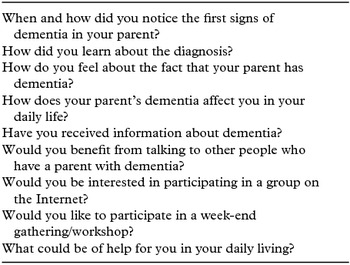
The data were collected through qualitative interviews using a semi-structured guide with thematic questions focusing on the informants’ experiences of having a parent with young-onset dementia. The questions are listed in Table 1.
The questionnaire

Depending on their replies, the aspects and ideas raised by the informants led to further questions to obtain additional information. Some specific information covering biographical and demographic information about the parent and child, the diagnosis, and the dementia process, and questions about specific services were also collected. The interviews were carried out by one of the authors, which lasted for up to 2 hours and were tape-recorded. The children were very engaged in the interviews, and gave extensive narratives about their experiences. The interviews took place at the most appropriate place for the informants. A professional typist transcribed the recorded interviews verbatim one week after each interview. The interviewer performed a quality-control check of the transcripts when listening to the tapes and reading the interviews.
The transcribed interviews were analyzed with a focus on each children's experiences within social contexts, mainly the families but also the service providers (Kindermann, Reference Kindermann, Valsiner and Connolly2003). The analysis was performed by three of the authors in line with the stepwise analysis described by Corbin and Strauss (Reference Corbin and Strauss2008). At first, we condensed every interview to 1–2 pages, showing the salient points in the stories to obtain an overview. The first analytical step (open coding) was to read all the interviews open-mindedly for relevant themes. These were a mix of themes at different levels: emotions, reactions, episodes, observations, the development of the parent's dementia, and family interactions. The themes were then compared to find the most relevant higher level of themes (axial coding) for the whole group. At the same time, sub-themes and variations were noted. Re-reading of the interviews showed that emotions and episodes often were related to interactions and achieved their meaning within social relations. At this stage of the analysis, agreement on higher-level themes was reached by discussion and reflection among the researchers. In the process, the researchers continuously related to the empirical material, analyzing it both vertically, going back and forth in the material of one respondent, and horizontally, comparing the informants on different themes, such as family relationships.
Ethics
The Regional Committee for Ethics in Medical Research, Southern Norway approved the study. The informants received oral and written information and gave written consent before being included in the study.
Findings
The findings describe both common themes and variations in the experiences of having a parent suffering from dementia, and how the adult children considered their needs of assistance during the deterioration of their parent's dementia. All informants explained how they had experienced the dementia as a great burden and stress, and that the disease had an impact on most aspects of their lives. One daughter summarized her experiences:
“Everything changes, very much changes because of the illness.”
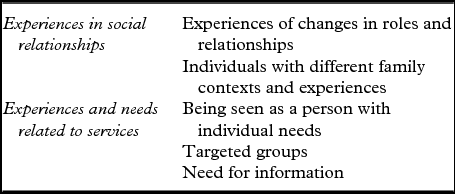
At the same time, there were wide variations in the experiences of children over time, their situations, their emotional burden, responsibilities, reactions, and needs for help, set within very varied family relations. Their experiences are presented through two main themes divided into sections with sub-themes (Table 2).
Main themes and sub-themes

Experiences in social relationships
Experiences of changes in roles and relationships
All the informants related how the changed relations to their parent with dementia influenced their daily life and personal development in many ways. Their family roles were totally changed.
“I miss having a mother. Now I am beginning to cry. I do think about it every day. I miss her, because for me she is actually dead, for she is not herself. But she is here physically. It is so terribly sad that this happened.”
This statement from the adult daughter of a mother with young-onset dementia showed at the same time her intense feelings, her complex emotions, and her missing of both the mothering role and the mother in person. A dominant theme in the interviews was how the children gradually “lost” their parent as a special person, a relation, and as a parental role figure. They saw and became involved in the gradual change and disintegration of their parent's functional capacities and they themselves usually changed from being a recipient of parental care and concern to becoming a carer to their parent. One daughter commented:
“It became a great role change. I had to brush my mother's teeth.”
All the respondents described the increasing care and concern they had to give to the parent, at the same time losing the parent's support in their own development, which had been neglected. One respondent said:
“In all the years until my parent moved permanently into a nursing home, my focus has first and foremost been on taking care of my parent, so I have not been able to focus on myself, like other young people do. I have not had a normal life.”
These role transformations were experienced with strong, varied and mixed emotions: grief, regret, concern, worries, warm feelings, but also annoyance, and sometimes aggression, which triggered guilt. These complicated and often contradictory feelings could arise intermittently, but also simultaneously, according to the children.
The parent's progressive dementia also influenced most of the other roles and relationships affecting the child, both inside and outside the family. Thus, the meaning, content, and the potentials of other relations were affected. The emotional stress of these transformations was great, often overwhelming and totally unexpected in the life course they had foreseen hitherto.
Individuals with different family contexts and experiences
The family structures of our respondents varied greatly, with different roles, relationships, and involvement. The informants’ experiences of the burden of the situation varied depending on whether they had a well-functioning parent or step-parent as the primary carer, handling the challenges in ways that the informants found acceptable. The difficulties reported would still have been great for the informants, but the feeling of being left alone was reduced when the family was collaborating and sharing the tasks, as one daughter said:
“We are such a large family, so we all helped in some way.”
Furthermore, some respondents valued the support they got from another sibling, usually an older one, who had taken the role of the most responsible child. The married respondents mentioned the support they had from their partners such as consolation, empathy, practical help, and communication.
Another experience reported was that the main carer—their mother or father—was not able to react adequately, as the respondents saw it. They also described how difficult it was when the healthy parent avoided and withdrew from the situation. A few parents were reported to have rejected an offer of home nursing. Some respondents described how the healthy parent could escape into his or her job, working long days, traveling or staying at their country cottages, leaving the most responsible child to take on the caregiving work:
“My father destroyed very much. He was the one who was supposed to be responsible, but he didn't act responsibly, and I had to do everything.”
There were also variations within the same family. Informants with siblings described how they and their siblings had been affected differently. Their roles and responsibilities depended on their age and gender, and who stayed at home when the parent's illness developed.
“My youngest sister has lived at home for a longer time than me. She has tackled the situation less well than I have.”
Children who had moved out of home and were absent during most of the dementia process expressed that they were less influenced by their parent's illness than children who had lived most of their adolescence with their parent with dementia. One of the main sources of relief experienced during the dementia process was when the child moved out of the family home. On becoming old enough, some children have moved out—often gradually, as students or for jobs—eventually returning home periodically. Their daily involvements in complicated situations were then reduced. However, even when living away, the adult children expressed that they were more or less constantly worried about the parent and the family at home. Their concern and lack of concentration had sometimes hindered progress in their studies and careers. Some had interrupted their studies or work to return home for a period to take care of their parents, while others had given up their studies. In addition, an important transition for the informants was when the parent moved into a nursing home. Even if their reactions were dominated by a feeling of relief, this move was often experienced with mixed, sad emotions. Many expressed worries that their parent did not get adequate care, and guilt was a prevailing emotion.
For those children who were in the process of finding a partner and getting married, the new partnership meant being occupied in the daily life of a separate household. This reduced some of the practical tasks and the complex emotions experienced by living together with the parent with dementia and with other family members. However, the emotional burdens were still great, as some responsibilities and care tasks were even more demanding when they had to be combined with a job and their own new family.
Experiences and needs related to services
Being seen as a person with individual needs
The respondents had found it difficult to talk about the dementia and to be understood by friends, other family members, employers, and colleagues. They reported that they had needed someone to talk to about their situation and experiences. They mentioned professional social and health workers, but also someone they could trust among their friends and family members.
A dominant expression from the informants was that they were rarely consulted by the professionals involved about the illness process; they were neither recognized as a family member, as a son or daughter of the parent with dementia, nor as persons with individual reactions and needs. It had been a problem that they were not informed by the professionals of the result of the diagnostic assessment or about the implications of the diagnosis in terms of both the short-term and long-term consequences. One informant said:
“I would very much have liked to have the information given directly to me, rather than through my father. For all I know, my father might have got some leaflets, and. . . but he has certainly not given them to us.”
Usually, they were not invited to give their opinions about the planning of services and support, or to express their own needs. Ordinarily, the primary carer in the family talked with the health personnel and service providers. The informants typically did not know exactly what information the patient and the primary carer had received at different stages of the dementia disorder. The informants usually did not feel that they possessed the status, expertise, or resources needed to make contact with the healthcare system in applying for some support for themselves. One respondent said:
“There is a need for it [support], but you should not have to ask for it yourself. It should be offered, because I would never have asked for it by myself.”
In addition, a need to be followed up over time, being offered a stable contact with someone with that responsibility, was mentioned.
Targeted groups
The informants expressed a need for groups with children stage of life, to be able to share their experiences and identify with others. They felt that in such a group they could tell each other that dementia was nothing to be ashamed of; they could just talk about their situations, laugh, and thus make the situation easier to deal with. The discovery that others shared their experiences was mentioned as important for the informants and one informant said:
“Just being together, sitting there without words or just nodding, since we all know how it is.”
However, the experiences of those who had participated in groups of carers in general (spouses, adult children, and others) had mixed experiences. The main complaint was that the groups were too inclusive, involving people in very different situations. All the informants who had had experience with such groups had critical comments; as two of them said:
“They were mostly partners, we were the only youths.” said one. “It was very different from our situation,” said the other.
Need for information
The informants reflected on two main dimensions of information: the theme of information to the general public and the theme of information they had needed and wanted for themselves.
They emphasized that it is important that people in general come to know about dementia, so that it can become an accepted subject to mention and talk about. Public knowledge should wipe out private shame. One woman said:
“What I wish today, is that everyone just had to know what dementia is. That you should grow up knowing that it is an illness. So that you do not have to be ashamed.”
The information should be presented so that others would dare to reply and include the fact that younger people can get dementia. Some also wanted lectures and information in school, so that teachers, advisers, and public nurses could advise and assist children to contact the relevant services. They related that information from the Internet, perhaps on a special web site with chat rooms, could be useful as the Internet permits intimacy and quick contact, and at the same time, provides anonymity from the shelter of geographical distance.
As for the information they had received about their parent, the main theme was that they had too little information both at the time when the diagnosis was made and later on as the dementia disorder developed. They had needed information about the specific dementia diagnosis, the progression expected, how to handle the situation for the parent with dementia, the spouse, all the family members, and themselves.
Discussion
The main findings of our study are that the children experience a very difficult life situation, and there are great variations depending, for example, on family structure and how long they had lived together with the parent with dementia. These children expressed a need to be contacted by the service providers to receive information and support. The study also found that the children had a need to express their thoughts and feelings. Services and support should focus on the children's needs, recognizing that experiences may be heterogeneous. Furthermore, it seems that targeted group meetings could be beneficial for these children.
The study found that the parents were in different stages of the dementia process. Thus, a few were in the early stages, but most of them were in the later stages and unable to stay at home, and many had moved into nursing homes when the interview took place. The children had been in different stages of their life when the dementia started and progressed. The stories told by the adult children in the present study revealed common experiences, but at the same time, important differences; the family contexts exhibited great variations, as modern families usually do (Stratton, Reference Stratton, Valsiner and Connolly2003). The situations of the children differed not only compared with respondents from other families, but also with other children in their own family. Some factors seem to have had an impact on their reactions, such as how old they were when the parent got the dementia, the length of time they had lived together, the support from other family members, and their roles and positions.
Family roles and events are normative and non-normative; they are culturally related to and compared with expectations for an ordinary “normal” life course. With respect to dementia, onset is expected to occur in old age, so dementia occurring at young age is an unexpected event (Harvey et al., Reference Harvey, Skelton-Robinson and Rossor2003), for the person with the disease, for the partner and not least for the children involved. When things happen out of order at unexpected times, they seem to have a greater impact than when events happen “on time” (Hagestad, Reference Hagestad, Binstock and George1990).
The emotions reported by the children were very varied and complex, with both positive and negative feelings and reactions. Grievances were expressed especially in the last stage of dementia, but they also related culturally inappropriate feelings such as wishing that the parent would die, aggression, bitterness, disgust, and distance. Their parent was already “lost” in the sense that he or she had no resemblance to the parent they knew, or to parenthood as it should be. These developments in the relationship were far from bereavement processes as traditionally described (Stroebe and Schut, Reference Stroebe and Schut1999). The children had a great need to talk to someone about their complicated feelings and the stressful situation.
This study shows that to develop better services that promote support for the children, the consequences and burden of the exception from a normal expected life course and role transformation between patient and parent have to be taken into consideration. Children of parents with a dementia disorder are far from a simple category but represent multiple and complex life situations, family relations and patterns of involvement. A report about services to persons with young-onset dementia underlined that their situation varies (Gausdal, Reference Gausdal2012). The present study has shown that the emotional impact and influence on the life course were great, even for those children who had moved away or when the parent was being cared for in a nursing home. The time dimension is also important: the children were growing up, the family situations were changing, and the disease was progressing. The support systems must be longitudinal and flexible.
We suggest that services should be tailored according to the needs of the children as this study has shown that the service providers easily overlooked their needs. The services should also follow the family over time, adapting to changing circumstances. Person- and youth-centered support is recommended.
Skovdal et al. (Reference Skovdal2007) and Svanberg et al. (Reference Svanberg, Stott and Spector2011) have reviewed studies and evaluations of services for people with young-onset dementia in Sweden, augmented with some international examples. They recommended planning a co-ordinated programme for a chain of care immediately after the diagnosis has been made, a plan that should be revised when the disorder progresses. It must be family oriented, with one professional person as the co-ordinator of the services, co-operating with the family. This is also in line with the “individual plan” for services. In Norway, every person with needs for multiple and co-ordinated health services has a legal right to an individual plan for such services, co-ordinated by a professional health or social worker (HOD, 2009; 2011). However, as our study shows, there is a great risk that the children's needs will be overlooked and neglected when the patient and primary carer are the focus, and the children's situation is not. The children should be explicitly mentioned in the plan, underlining their individual needs.
Gelman and Greer (Reference Gelman and Greer2011) have reported from an intervention in the USA based on counseling, support groups, and referrals to services. Individual interventions were planned for every family member. These were also encouraged to identify and make contact with family and friends who could provide support for them. Such a model could be adapted to the Nordic welfare system as integrated family-oriented, long-term support for family members.
The informants indicated a variety of information and sources that might be available to both the general public and themselves, and they saw connections between general knowledge and private communications. However, most of all, they wanted personalized information about their parent to be given during the process of the dementia disorder, and about the assistance they could get.
The informants were positive about the intentions of groups and meetings for offspring, but their experiences indicated that any group needed to be targeted rather precisely to their particular age group and life situation. Targeting groups could be one way to give the participants experiences of solidarity, support, and the sharing of feelings.
In Norway, the Norwegian Centre for Aging and Health, together with other organizations, annually offers two week-end courses for young children of parents with young-onset dementia. There the children meet other youths who also have a parent with dementia, and they have an opportunity to share experiences. During the week-end, they also attend lectures where they learn more about dementia. However, there is no formal system ensuring that these children are contacted by the service system with responsibility for their parents. In recent years, a register of people who undergo evaluations in memory clinics in Norway has been established. Thus, the way a person with cognitive impairment is examined is now quite standardized. However, there is no formal system for how family members should be followed up according to their needs for support, or who should have the responsibility. All children of people diagnosed with dementia should be contacted by specialized services to explore what needs they might have. This study has shown that there is a great need for establishing a formalized support system for children of parents with young-onset dementia.
Limitations of the study
This study has some limitations. One could argue that the experiences recounted in this project are mainly valid for daughters of mothers with a dementia disorder as most of the informants are in that category. However, we could not find any tendency for the two sons and children of fathers with dementia to recount stories that diverged from those of the majority of the children in this study. Another limitation is that we cannot be certain about the response rate, as we do not know how many children were contacted by the voluntary organization or by the nursing home.
The findings of our qualitative study cannot be generalized in a statistical sense, but we argue that our main findings are transferable to other adult children of persons with young-onset dementia and perhaps also to younger children. In Norway, the health and welfare system is well developed compared with many other countries. This strengthens the assumption that the informants’ experiences of being neglected by the service system could be transferable to less developed welfare systems.
Further research should include studies among younger children and different subgroups of children, as well as studies exploring their use of different targeted services. Longitudinal studies are also warranted, looking at the long-term consequences of the children's experiences and their need for health and social services over time.
Conclusions
This study has revealed that children of parents with young-onset dementia are a heterogeneous group with significant, unmet needs for support. A formalized system where the children can get into contact with service providers to receive information about the diagnosis, prognosis and services needs to be established. The service providers must take the heterogeneity of the children into consideration and provide tailored advice and support during the development of their parent's dementia, within the framework of a family-oriented programme for a chain of co-ordinated services.
Conflict of interest
None.
Description of authors’ roles
MLB designed the study, collected the data, analyzed the data, and wrote the paper. KE designed the study, supervised the data collection, and assisted in the writing of the paper. PKH designed the study, supervised the data collection and assisted in the writing of the paper. KT designed the study, supervised the data collection, analyzed the data, and wrote the paper. AJ analyzed the data and wrote the paper.
Acknowledgments
This study was supported by the Norwegian Ministry of Health and Care Services and Ageing and Health, and the Norwegian Centre for Aging and Health.