INTRODUCTION
The pea crab is one of the small crustaceans distributed in the neritic region worldwide. This group is ecologically interesting because it is a parasite of various invertebrates (Christensen & McDermott, Reference Christensen and McDermott1958; Pregenzer, Reference Pregenzer1978; Ueda & Kohno, Reference Ueda and Kohno1987; Yaocong et al., Reference Yaocong, Li and Cai1998; Hsueh, Reference Hsueh2001, Reference Hsueh2003). Eight species belonging to the family Pinnotheridae have been reported around Japan and the most common species among them is Pinnotheres sinesis (Miyake, Reference Miyake1983).
This species is distributed around Japan, China and the Korean Peninsula, and generally utilizes some species of bivalves as its host (Miyake, Reference Miyake1983). The flesh weight of the invaded hosts is decreased because the crab damages the gills of the host, which interferes with filtration efficiency (Sugiura et al., Reference Sugiura, Sugita and Kihara1960). If the host is an economically important species, this crab can cause serious damage to fishery production. However, few studies have been conducted regarding the ecological features of the crab except that by Ueda & Kohno (Reference Ueda and Kohno1987) observing that P. sinensis inhabited at least six bivalve host species (Mytilus galloprovincialis, Crassostrea gigas, Ruditapes philippinarum, Septifer virgatus, Saccostrea kegaki and Barbatia virescens), and that the blue mussel, M. galloprovincialis, was the most common host among them. In particular, information on the ecology of the species after invading the bivalve is very scant.
In this study, we selected Septifer virgatus as the host species, since it is not an economically important species and its natural life is not affected directly by human activity. This also means that S. virgatus is suited for elucidating the life history of P. sinensis in natural environments. The aim/purpose of this article is to clarify the life history of P. sinensis in terms of its prevalence on S. virgatus which is a very common bivalve species of the coast of Kochi Prefecture, located in south-western Japan.
MATERIALS AND METHODS
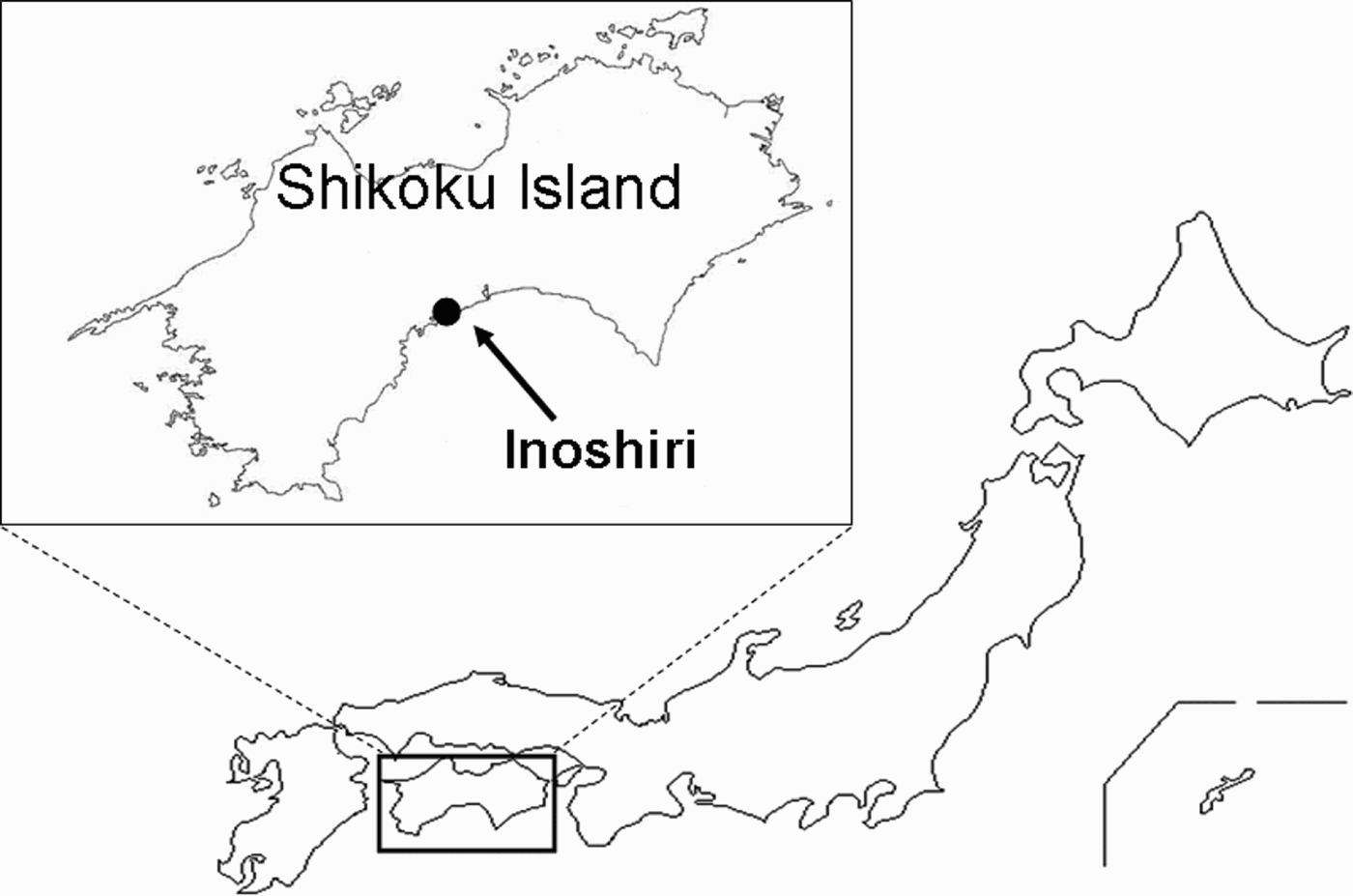
Samples were collected at Inoshiri at the mouth of Uranouchi Bay, Kochi Prefecture (33°26′N 133°27′E) (Figure 1). This bay is shallow and semi-enclosed. The sampling was carried out monthly from July 2002 to December 2004, and ~400 specimens of Septifer virgatus were collected from the same bed at each sampling. During these periods, a total of 12,054 specimens of Septifer virgatus was collected (Table 1). The specimens were all dissected in the laboratory and were examined for the presence of Pinnotheres sinensis inside. Crabs were enumerated, their body size measured (as carapace width, CW) and their sex was recorded. The sex of the invasive stage crab (first crab stage) could not be determined. In the case of females, we examined whether or not the egg is present on the pleopod. The carapace width of P. sinensis and shell length (SL) of S. virgatus were measured to the nearest 0.1 mm using a vernier caliper.
Location of sample collection site.

Monthly abundance of the bivalves.

RESULTS
Parasite
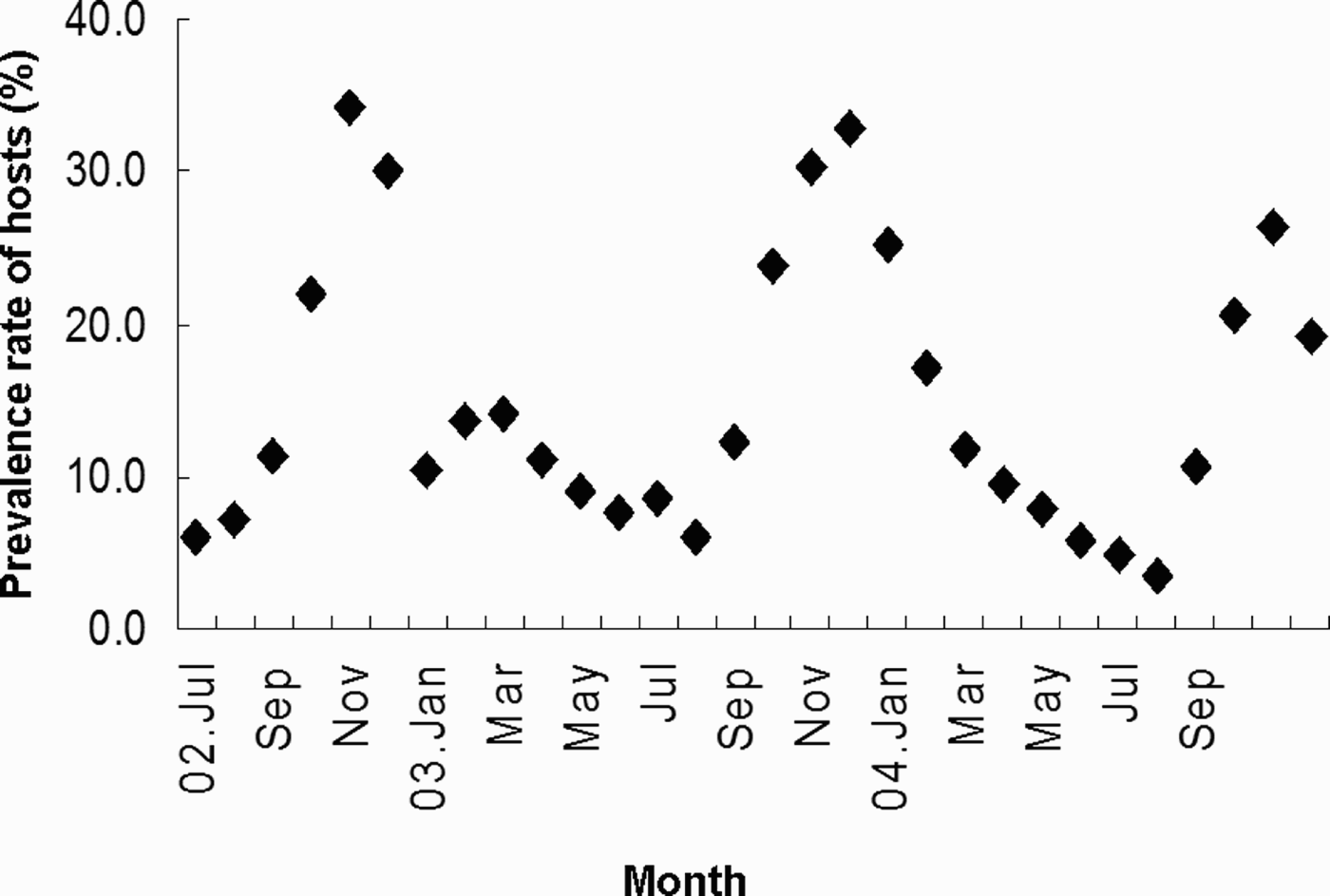
The infesting crab always inhabited the mantle cavity of the bivalve. The crabs' frequency in the bivalve fluctuated seasonally (Figure 2). The mean prevalence rate was 15.1% during the sampling period. The greatest rate was 34.2% in November 2002, and the least rate was 3.5% in August 2004. The prevalence rate was high (>15.0%) from October to January in 2003, but decreased from May to August (<10.0%). Similar patterns were observed regarding the prevalence rate in both 2002 and 2004 (Figure 2). The total number of crabs collected inside hosts was 2017 (male 887, female 1130), and that of infested host was 1820.
Seasonal change of prevalence rate in Pinnotheres sinensis from July 2002 to December 2004.

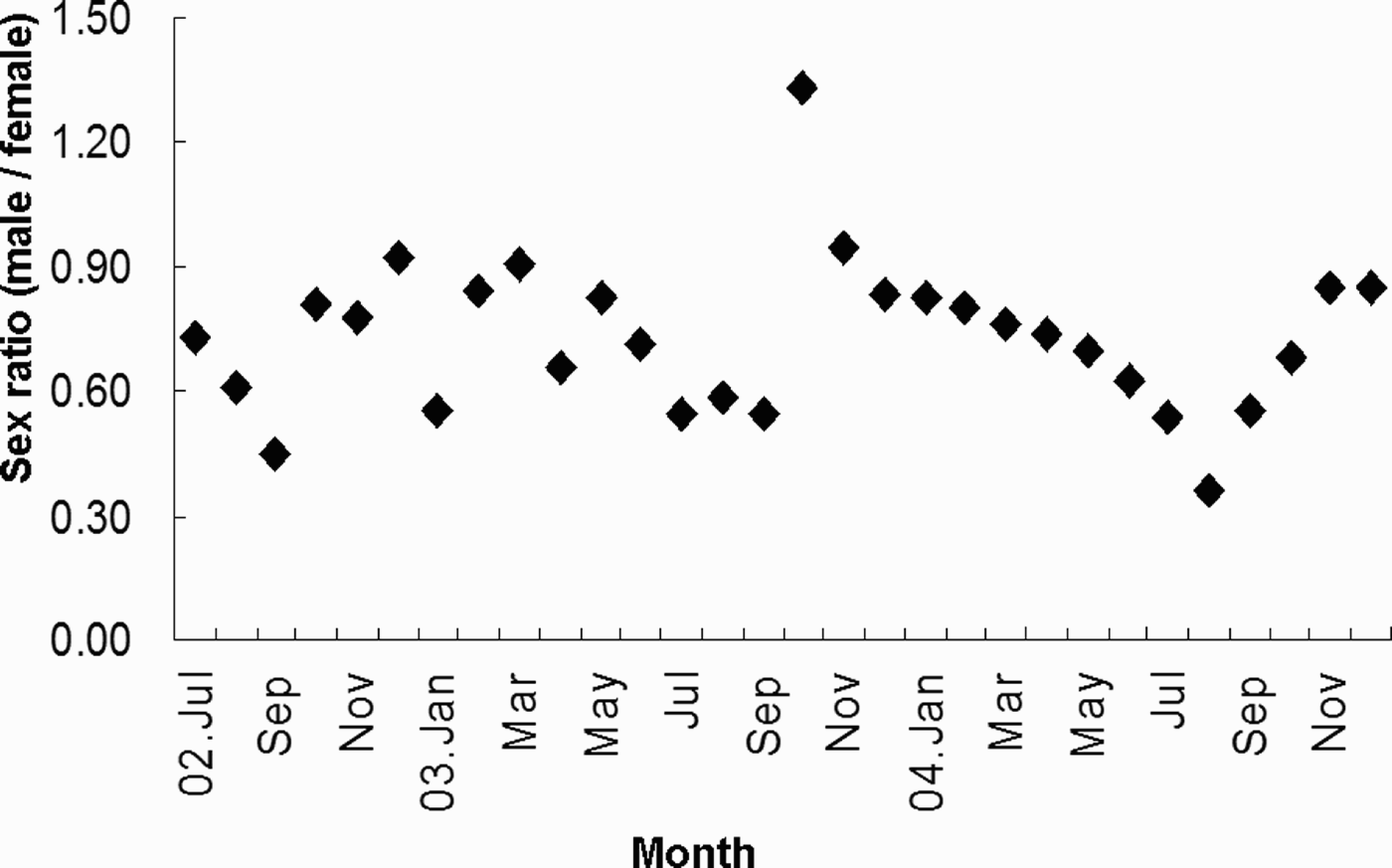
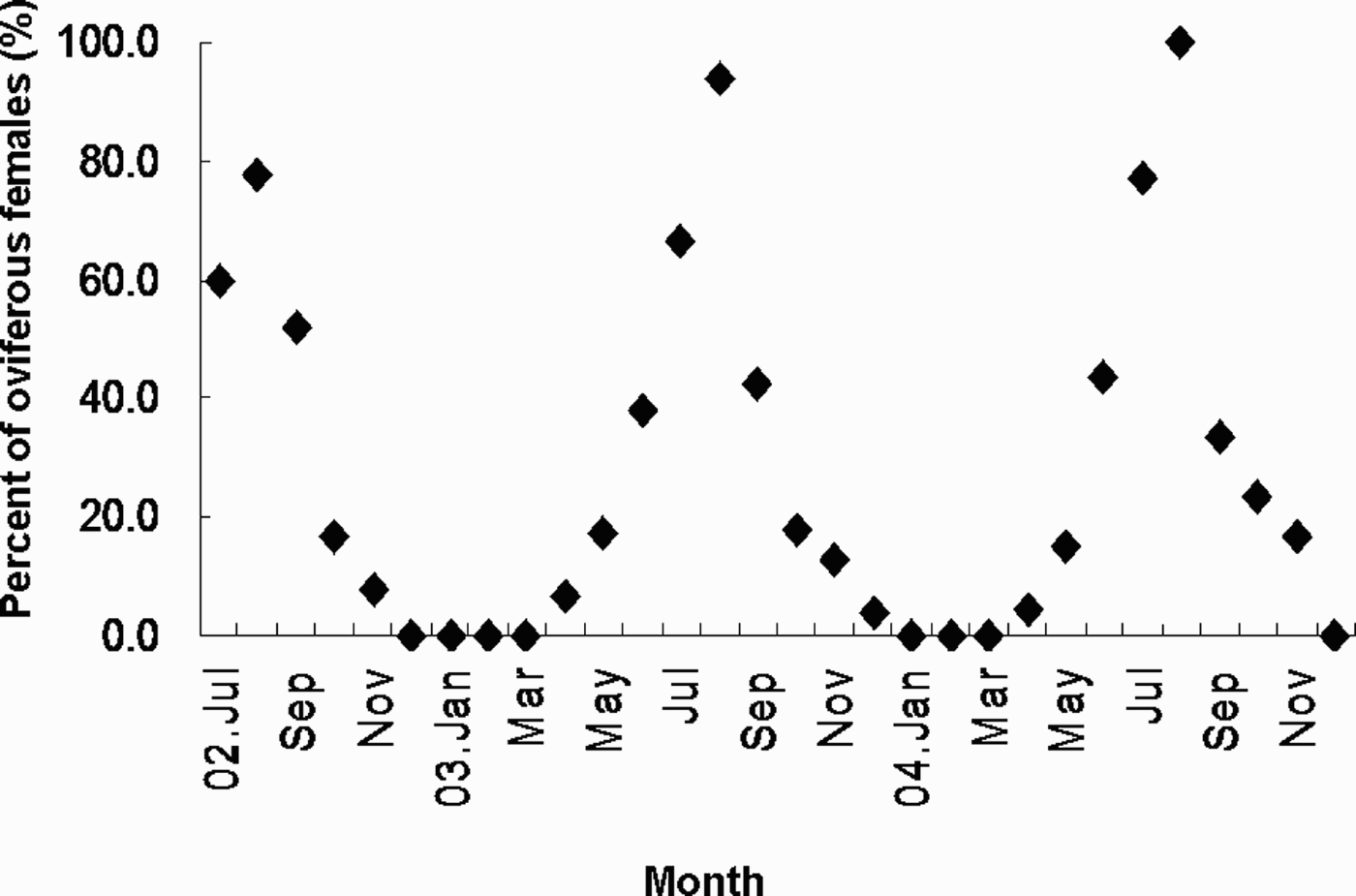
The mean sex ratio (male:female) was 0.78 during the sampling period. Generally the sex ratio was biased toward females during the sampling period; only in October 2003 did the ratio become reversed (Figure 3). At that time, the males were observed swimming and swarming at the sampling site. In summer, the rate of the ovigerous female increased, and in July and August the ovigerous rate rose to over 50% (Figure 4). By contrast, no ovigerous female was found in the winter season, from December 2002 to March 2003, and from January to March and December 2004.
Seasonal change of sex ratio of Pinnotheres sinensis from July 2002 to December 2004.

Seasonal change of percentage of ovigerous female occurring during the sampling periods from July 2002 to December 2004.

Generally, a few males were observed outside the host all year round, but no females were observed outside the host.
Body form of crab
A female crab has a somewhat round shape, while the shell of a male has a flat shape in the rostral view. The carapace of the female is soft and somewhat uniform in colour. By contrast, the male has a generally hard shell and its colour is dark with some light spots. The body size of the female was significantly larger than that of the male (Student's t-test, t = 64.974, df = 1672.6, P < 0.001).
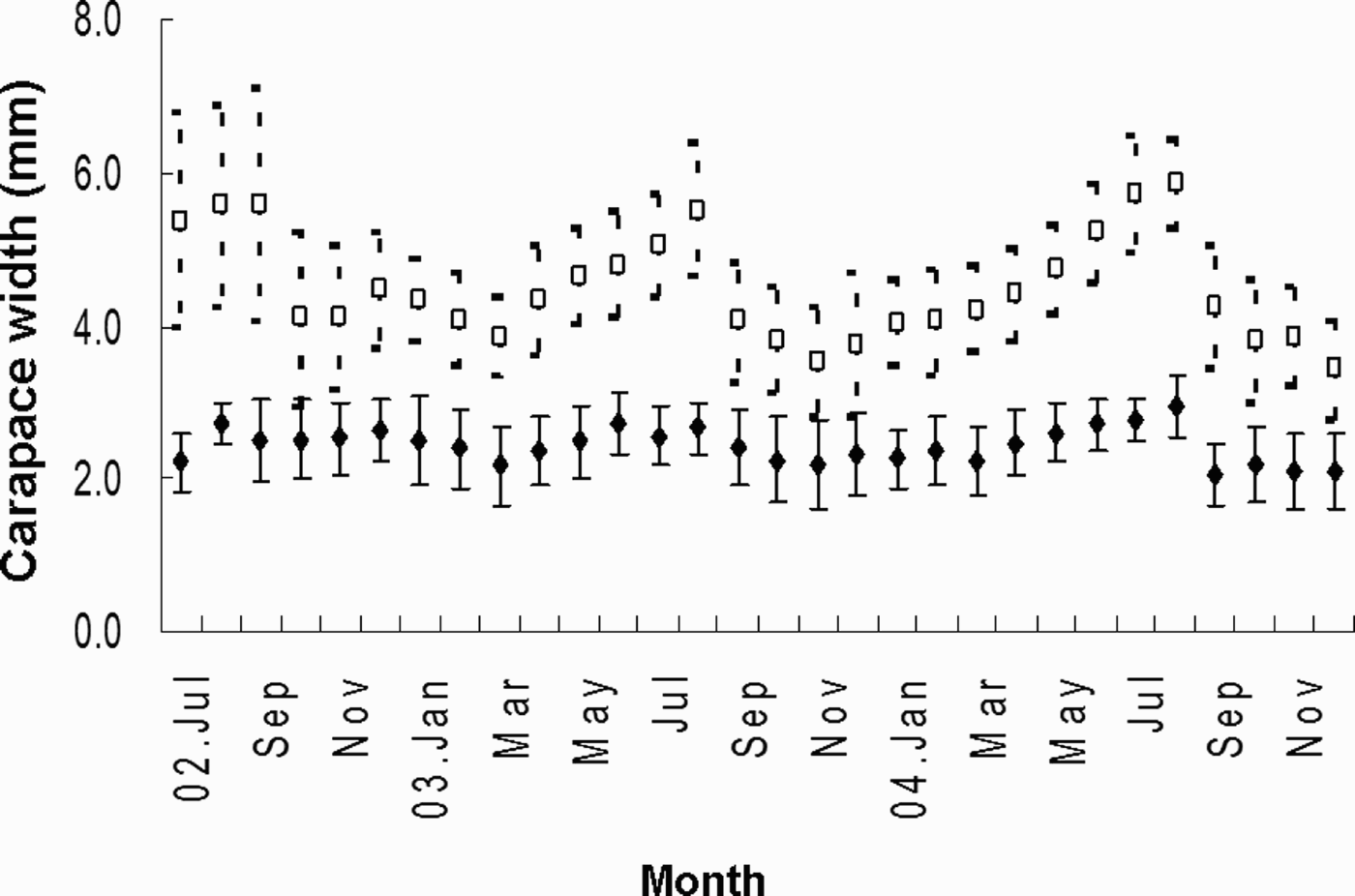
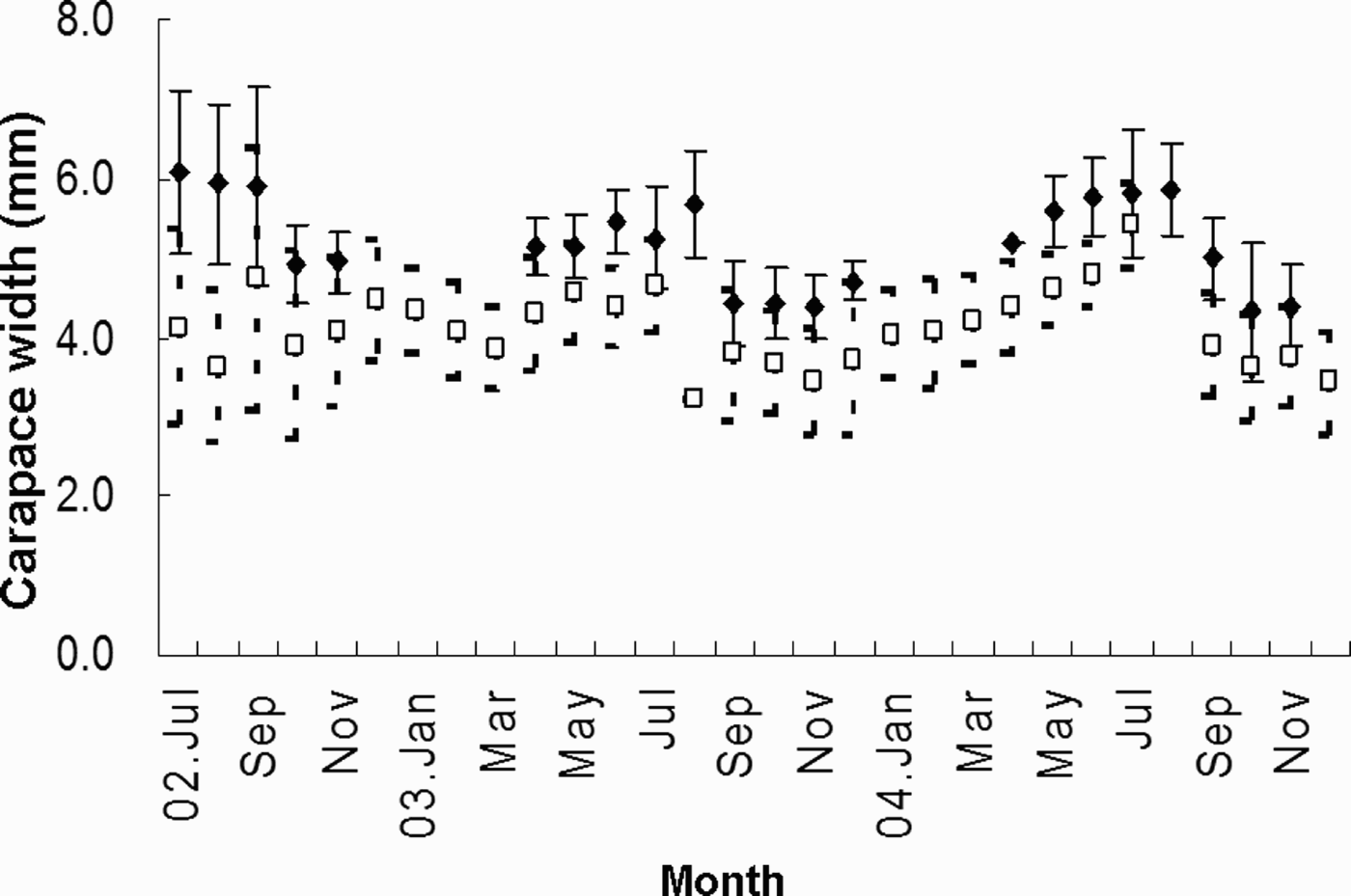
Seasonal change could be found in the CW, the female being especially remarkable for this characteristic (Figure 5). Carapace width in females clearly decreased from August to September in 2003, and gradually increased from November 2003 to August 2004. Mean body size±SD and its range for males and females were 2.4±0.4 mm (1.0–3.9 mm CW) and 4.5±0.8 mm (1.2–8.6 mm CW), respectively. The mean body size of the latter was significantly larger than that of the former. It increased from spring to summer but showed a low value in winter (Figure 5). The mean size±SD and its range for ovigerous and non-ovigerous females were 5.2±0.6 mm (3.2–8.6 mm CW) and 4.1±0.7 mm (1.2–8.1 mm CW), respectively. The ovigerous females were significantly larger than non-ovigerous ones (Student's t-test, t = –17.065, df = 347,9, P < 0.001; Figure 6). The body size of the smallest ovigerous female was 3.2 mm which was sampled in October 2004.
Seasonal change of mean carapace width (CW) of male and female crabs found from host bivalve Septifer virgatus from July 2002 to December 2004. Vertical line shows standard deviations.

Seasonal change of mean carapace width (CW) of ovigerous and non-ovigerous females found from host bivalve Septifer virgatus from July 2002 to December 2004. Vertical line shows standard deviations.

Multiple infestation
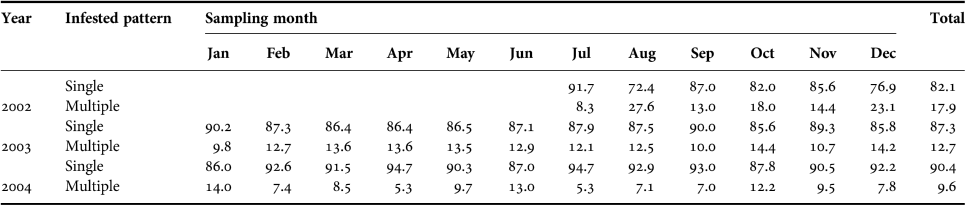
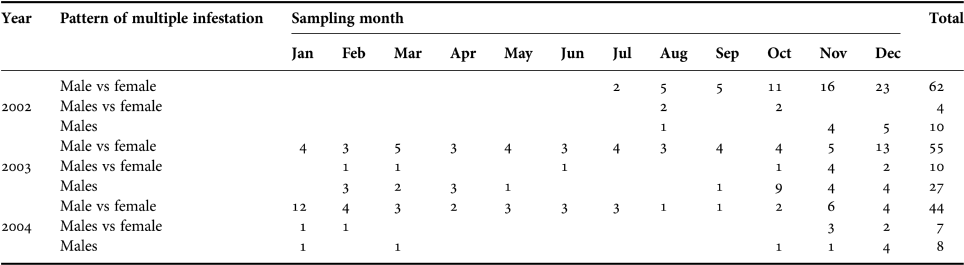
In general, each host was infested by a single crab of male or female, but multiple infestations could be observed in some cases. The rate of multiple infestations was 17.9% in 2002, 12.7% in 2003, and 9.6% in 2004 (Table 2). A normal pattern of multiple infestation was one male vs one female. The maximum number of multiple infestations consisted of eight crabs (five males, one female and two invasive stage crabs) observed in November 2003. When more than two crabs were found in a single host, the following three combinations were observed: (1) one male vs one female; (2) a plural number of males; and (3) a plural number of males vs one female. Multiple infestations by females after the invasive stage were not observed (Table 3).
Prevalence rate of the single and multiple infestation.

Number of the three patterns of multiple infestation in each sampling month.

Relation between host and crab sizes
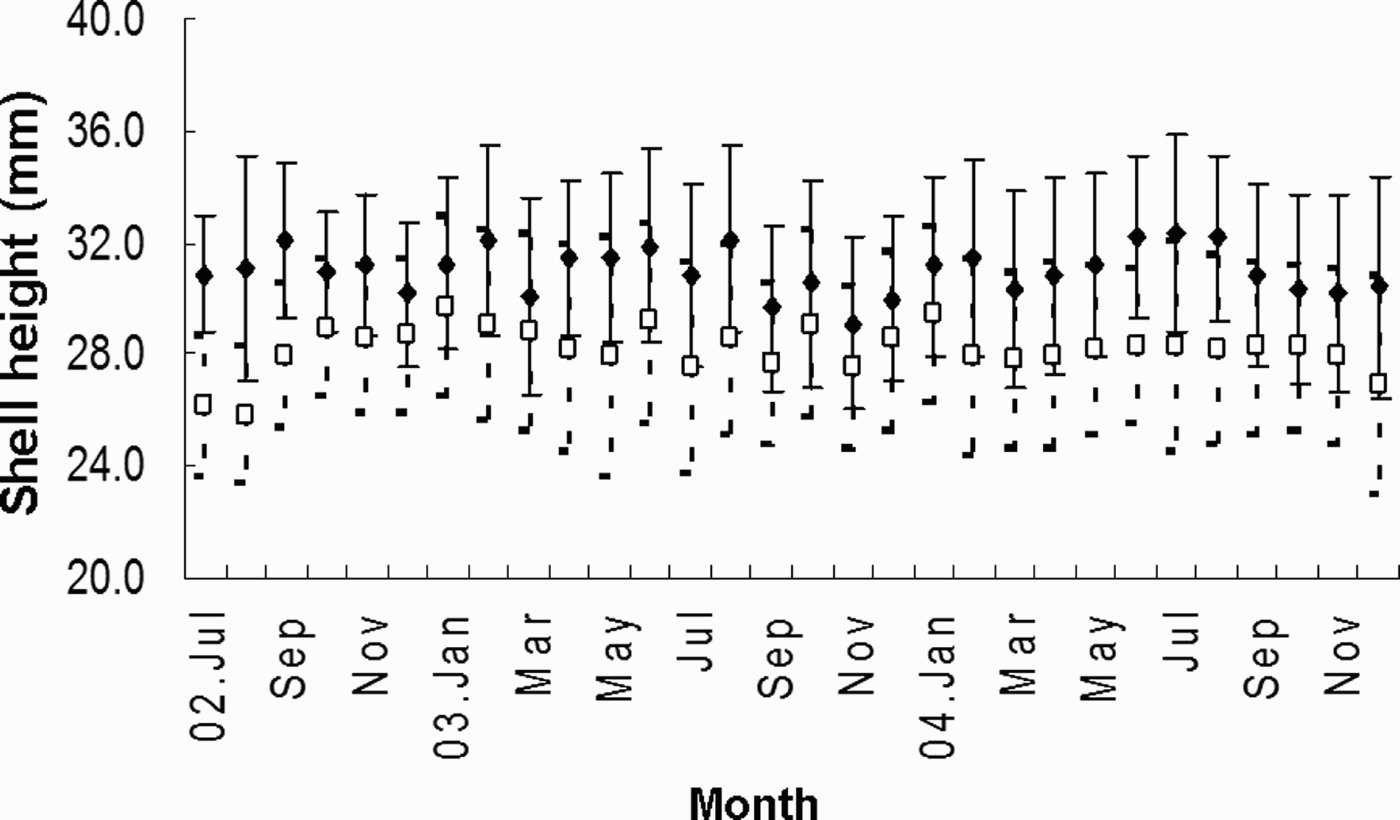
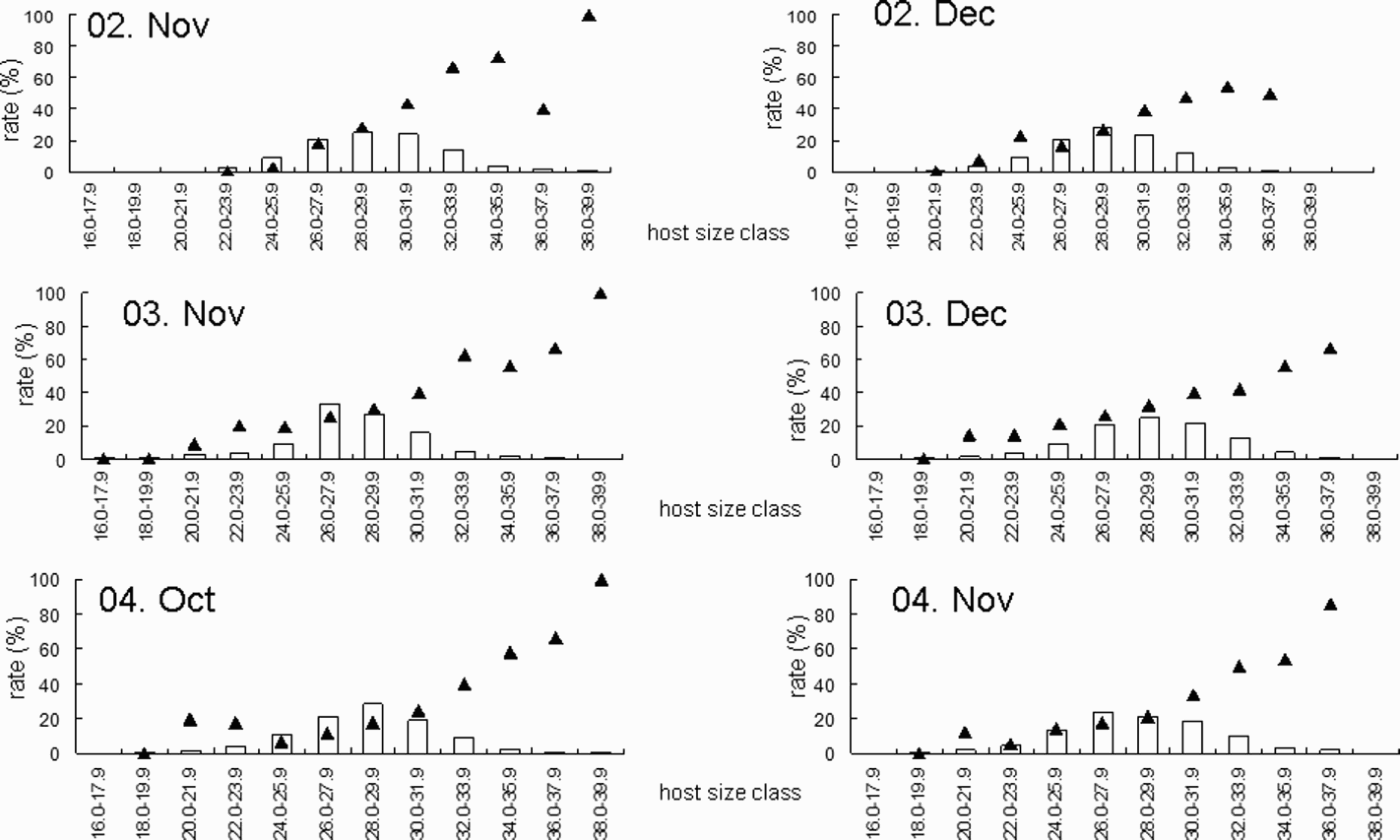
Infested bivalves were significantly larger than the uninfested ones (Student's t-test, t = 28.955, df = 2519,2, P < 0.001; Figure 7). The prevalence rate increased with the increase in size of the host size (Figure 8).
Seasonal change of size of infested and non-infested hosts from July 2002 to December 2004. Vertical line shows standard deviations.

Change of prevalence rate of host bivalve Septifer virgatus and pea crab Pinnotheres sinensis in each host size-class in two months with the highest and second highest rates from 2002 to 2004.

No correlation could be found between the CW of the crab in both sexes and the SL of the hosts collected in the sampling periods (r < 0.3). The smallest infested bivalve was 16.4 mm SL and was infested by an ovigerous female of 4.0 mm CW.
DISCUSSION
No distinct pattern of annual change in the prevalence rate, sex ratio, ovigerous rate and CW was seen in Pinnotheres sinensis collected from July 2002 to December 2004 (Figures 2–6). In a previous study on P. sinensis infesting Mytilus galloprovincalis, clear seasonal changes in the ecological and morphological features including multiple prevalence rates were observed (I. Ueda, personal communication). In the present study, we could not find any clear seasonal fluctuation in the multiple prevalence rate and it showed a consistent value (Tables 2 & 3). These facts suggest the possibility that the life history of P. sinensis differs according to the host species. Pregenzer (Reference Pregenzer1978) reported that large mussels contained the greatest number of crabs and the smallest mussel contained the smallest number of crabs. This suggests that host interior space is a limiting factor of intensity of infestation.
The observations regarding the reproduction period and the prevalence rate of P. sinensis obtained in the present study agree with that of larval stage given by Yatsuzuka & Iwasaki (Reference Yatsuzuka and Iwasaki1978). This fact suggests that the present study clarified some parts of the life history of this species. We observed the inhabitancy of P. sinensis inside some bivalve species (e.g. Crassostrea gigas, Ruditapes philippinarum, Barbatia virescens, etc.) at the sampling site (personal observation). In the future, a study should be conducted that combines morphological and ecological data with the genetic characteristics of the crabs inhabiting a variety of bivalve species.
Studies on the pea crab belonging to the family Pinnotheridae showed seasonal fluctuations in prevalence rate, sex ratio, and ovigerous rate (Christensen & McDermott, Reference Christensen and McDermott1958; Soong, Reference Soong1997; Hsueh, Reference Hsueh2003). Some causes of these fluctuations have been suggested to be related to reproduction, seasonal extirpation of the host, and intersexual difference in life span and behaviour (Pregenzer, Reference Pregenzer1978; Soong, Reference Soong1997; Hsueh, Reference Hsueh2003). The present study showed intersexual difference in the reproduction behaviour in P. sinensis (Figure 3). We observed neither seasonal extirpation of the host Septifer virgatus in the sampling station. These facts agree with those reported by Haines et al. (Reference Haines, Edmunds and Pewsey1994).
Generally one individual of P. sinensis inhabits each host of S. virgatus, and multiple infestation by the crab is rather uncommon (Sugiura et al., Reference Sugiura, Sugita and Kihara1960; Haines et al., Reference Haines, Edmunds and Pewsey1994). Two hypotheses have been suggested as to why in most pea crab species the one crab versus one host relation is common. The first hypothesis suggests that a prior resident crab might expel an invading one (Sugiura et al., Reference Sugiura, Sugita and Kihara1960; Haines et al., Reference Haines, Edmunds and Pewsey1994; Soong, Reference Soong1997). This can be applied only to the female because we observed plural numbers of males inhabiting a single host (Table 3). In fact, a female P. sinensis was observed showing aggressive behaviour toward other females in small containers (Sugiura et al., Reference Sugiura, Sugita and Kihara1960). Multiple infestation will enhance competition among conspecifics, which also supports the above-mentioned one crab versus one host relationships. The second hypothesis suggests that the crab releases a kind of pheromone that deters other conspecifics from entering the host. The pea crab has been reported by Stevens (Reference Stevens1990) to be capable of chemoreception. The pheromone might play distinct roles between sexes, functioning as an attractant to males and as a repellent to females.
The sexes of the pea crab have different life history traits (Christensen & McDermott, Reference Christensen and McDermott1958; Soong, Reference Soong1997; Hsueh, Reference Hsueh2003). Typically in the adult stage females are larger than males, and the former have rarely been found living outside the host. The P. sinensis female is a very poor swimmer and so it is unlikely that she would be able to enter a new host if her first host dies. By contrast, the male is small and its life style is typically free living. We have found only a small number of male crabs outside the host. The mature female has never been observed outside the host. These facts suggest that in P. sinensis the male might move out of the host frequently, which increases the chance of being trapped by the valves of the host and of being foraged by fish. This might be related to the fact that the sex ratio of the species was slanted toward the female in most sampling periods (Figure 3).
In October 2003, we observed the males swimming in aggregation at the sampling station. The Pinnotheridae has two types of mating behaviours. In the first type, males and females leave the hosts for copulatory swarming in open water, and only females return to their hosts (Christensen & McDermott, Reference Christensen and McDermott1958). In P. sinensis females, size is a limiting factor for escaping from and re-entering the host. This suggests that the mating behaviour in aggregation is not applicable to P. sinensis. In the second type, males travel from host to host to seek females for copulation (Pregenzer, Reference Pregenzer1978; Haines et al., Reference Haines, Edmunds and Pewsey1994; Soong, Reference Soong1997; Weiming et al., Reference Weiming, Shchun, Yuqi, Baowen and Weibo2005). Since we could not find any free-living mature females in the field, together with a pair of one male to one female observed in the present study, the mating of P. sinensis probably occurs only inside the hosts.
In several other studies, a positive size correlation between the infesting crab and its host has been observed (Christensen & McDermott, Reference Christensen and McDermott1958; Soong, Reference Soong1997; Hsueh, Reference Hsueh2001). Several authors have indicated that larger crabs are found in larger hosts (Christensen & McDermott, Reference Christensen and McDermott1958; Pregenzer, Reference Pregenzer1978; Haines et al., Reference Haines, Edmunds and Pewsey1994). Pinnotheres sinensis was seen to have a positive size correlation with the host M. galloprovincialis (I. Ueda, personal communication), but in the present study we could not find a correlation between the two. This difference may be due to the range of the body size of the bivalves which were used for these studies. Mytilus galloprovincialis was larger than S. virgatus (size range 9–69 mm SL vs 15–40 mm SL). Available space in the host bivalve seems to be a limiting factor for the growth of the infesting crab and S. virgatus might be too small for P. sinensis to grow larger. To understand the relationship between the sizes of the crab and its host species, we should examine different-sized species such as Crassostrea gigas in the same sampling site.
ACKNOWLEDGEMENTS
We thank Mr I. Ueda of Enoshima Aquarium and Dr Y. Yanagisawa of Ehime University for their advice and support. Special gratitude is expressed to Dr S. Seki of Kochi University for his valuable comments on this paper.