Implications
Shrubland communities with a high presence of gorse could be managed using dry mares, or even lactating mares when herbaceous plants of good nutritive quality are abundant, thus being able to produce horse meat. In heather-dominated shrublands, however, the incorporation of more palatable herbaceous species would be necessary for sustainability, at least for short periods as 4 months. From the environmental point of view, horse grazing could be beneficial in gorse-dominated shrublands to reduce gorse dominance and fire risk, and enhance biodiversity levels.
Introduction
Nutritionally poor heathlands cover large areas of the Cantabrian Mountains in northern Spain, largely as a result of rural abandonment and recurrent wildfires. The exploitation by grazing livestock of these semi-natural shrubland communities has an important economic significance for rural development in those less-favoured areas (Celaya et al., Reference Celaya, Martínez, Rosa García, Ferreira, López López, García and Osoro2013). Grazing by livestock also represents a valuable environmental tool, as, in the absence of grazing, these heathlands produce great accumulations of woody phytomass in a few years, increasing fire risk (Benavides et al., Reference Benavides, Celaya, Ferreira, Jáuregui, García and Osoro2009). During recent decades, there have been many wildfires in the Cantabrian Mountains, most of them affecting heathland areas (Celaya et al., Reference Celaya, Martínez, Rosa García, Ferreira, López López, García and Osoro2013) and causing serious environmental and economic losses. Heathlands may differ in terms of their botanical and structural composition as a consequence of several factors (soil, climate, previous management, etc.). Such features may affect grazing behaviour and livestock performance through differences in nutritive value and severity of parasitic infections.
Grazing behaviour of livestock species is determined by breed, age, sex and physiological status of the animals, as well as seasonality and associated changes in resource availability (Arnold, Reference Arnold1981). According to the livestock censuses (Ministerio de Agricultura, Alimentación y Medio Ambiente, 2016), in many of these Cantabrian less-favoured areas small ruminants are being replaced by large herbivores, especially horses, contradicting local knowledge and traditions. Moreover, scientific studies suggest a greater suitability of sheep and goats for these poor areas, as these species are more efficient utilizing heathland vegetation to meet their lower nutrient requirements (Osoro et al., Reference Osoro, Ferreira, García, Martínez and Celaya2017). Herds of free-roaming horses are managed in semi-feral conditions during most of the year for foal meat production, taking advantage of lower supplementary feeding costs and easier management. However, the knowledge we have about the foraging behaviour and performance of mares and foals grazing on different types of heathland is very limited. This research aimed to study the diet selection, liveweight (LW) changes and parasitic status of horses grazing on heathlands with different botanical composition, comparing dry and lactating mares rearing their foals across the grazing season, with the ultimate objective of assessing the sustainability of horse grazing systems in those plant communities.
Material and methods
Study site
The experiment was conducted between 2010 and 2012 at the Carbayal Research Station, Sierra de San Isidro, Illano, western Asturias (NW Spain, 43° 20’ N; 6° 54’ W), located at 850 to 1000 m a.s.l. The climate is characteristic of medium altitude mountains in temperate humid areas under oceanic influence. Mean annual precipitation recorded at the site during the study years was 1525 mm, mostly occurring from October to April. Mean annual temperature was 9.4°C, with a minimum monthly mean of 3.5°C in January and a maximum monthly mean of 16.0°C in August. The characteristic plant community in the area is a heather-gorse shrubland dominated by heather species (Erica umbellata, Erica cinerea and Calluna vulgaris) and gorse (Ulex gallii), a thorny and woody legume. The most abundant herbaceous species are coarse grasses such as Pseudarrhenatherum longifolium and Agrostis curtisii.
Experimental design and animal management
The experimental design consisted of three vegetation treatments: (1) heather dominated (H), (2) gorse dominated (G) and (3) co-dominated by gorse and grasses (G-G), with four replicates per treatment, adding up to 12 paddocks of 1.2 ha. In total, 24 crossbred (mostly Cabalo Galego do Monte) mature mares (310±52 kg LW, 3 to 6 years old) were managed at stocking rates of 1.6 adult animals/ha. Two mares, one dry and one lactating (plus foal), were allocated to each paddock. All mares grazed on heather-gorse vegetation during the preceding years and were familiar with the plant species included in the experiment.
Foals were born in winter and reared outdoors with their mothers on improved ryegrass–clover pastures with accessible heathland areas until the experimental grazing season began when foals were around 4 months of age on average. The intention was to graze for the entire grazing season from May to October, but in the case of H paddocks, the animals had to be removed at the end of summer (late August to early September) because of symptoms of malnutrition and unacceptable loss of body condition. All animals were dosed with ivermectin (Equimel©; Virbac group, Esplugues de Llobregat, Spain) against gastrointestinal nematodes by oral administration, using a dosing rate of 0.2 mg/kg LW, 2 weeks before turn out. After anthelmintic treatment, no faecal nematode egg counts were detected at the beginning of the experiment in all animals. Animals had free access to water in all paddocks, and no mineral supplements or additional feeds were given during the experiment.
Vegetation measurements
Botanical composition was determined as cover percentage at the start of each grazing season, utilizing the point quadrat method (Grant, Reference Grant1981). In each paddock, 500 vertical hits at 100 random loci were recorded and categorized by species and state (live or dead). Samples of the main vegetation components (heather, gorse and grasses) were harvested in all paddocks (one sample of ~300 g fresh per paddock and component) at different times of the year (June, August and October 2010; June and August 2011; June, August and September 2012) for chemical analysis. Samples were analysed following the procedures of the Association of Official Analytical Chemists (2006) for ash and nitrogen (N). Crude protein was calculated as N×6.25. Neutral detergent fibre, ADF and ADL were analysed by the methods of Van Soest et al. (Reference Van Soest, Robertson and Lewis1991).
Diet selection
The composition of the diet selected by the animals was estimated using the n-alkane technique (Mayes et al., Reference Mayes, Lamb and Colgrove1986; Dove and Mayes, Reference Dove and Mayes2006). Faecal grab samples from individual mares (one per mare) were collected during different periods across each grazing season: late June, late August and early October in 2010; mid-June and late August in 2011; late June, mid-August and late September (except in H treatment) in 2012. At the same time, samples of the main plant components, that is, leaves and/or green shoots of heather (including E. umbellata, E. cinerea and C. vulgaris), gorse and herbaceous plants (mostly the grasses P. longifolium and A. curtisii), were collected in each paddock (one sample of each component per paddock). All samples were stored at –20°C and then freeze-dried and milled through a 1-mm screen before analytical procedures. Alkanes (from C21 to C36) were extracted using the method of Mayes et al. (Reference Mayes, Lamb and Colgrove1986) and their concentrations determined by gas chromatography, using a HRGC-5160 Mega Series fitted with flame ionization detector (Carlo Erba, Milan, Italy). Alkanes C22 and C34 were used as internal standards to adjust the peak areas of the chromatogram.
Based on the distinct alkane profiles of the plant components, their proportions in the diet were estimated using an iterative least-squares procedure that minimizes the discrepancies between the observed concentrations of each n-alkane (C25 to C33) in the faeces for each animal, and the estimated proportions of plant components in the diet (Dove and Mayes, Reference Dove and Mayes2006), using the Solver routine in Microsoft Excel. For diet composition calculations, the alkanes C21, C23, C24, C35 and C36 were not used due to their low concentrations in all plant species. Alkane faecal concentrations were not corrected for incomplete faecal recovery, as previous validation studies with horses feeding on similar diets showed that faecal recovery of these markers is unaffected by carbon chain length (Ferreira et al., Reference Ferreira, Garcia, Rodrigues, Celaya, Dias-da-Silva and Osoro2007). In fact, as the accuracy of diet composition estimates depends on the relative concentrations of n-alkanes, rather than on their absolute recoveries (Dove and Mayes, Reference Dove and Mayes2006), and in the case of equines they are not modified during feed digestion, there is no need for applying any recovery correction (Ferreira et al., Reference Ferreira, Garcia, Rodrigues, Celaya, Dias-da-Silva and Osoro2007). Jacobs (Reference Jacobs1974) selectivity index was calculated as S i =(d i −a i )/(d i +a i −2d i a i ), where d i is the proportion of i plant component (heather, gorse or grasses) in the diet, and a i the proportion of i plant component available in the paddock.
Animal performance and parasitic infections
All animals were weighed monthly during the grazing season (May to October). Daily LW changes of mares and foals were calculated for spring, summer, autumn (except in H treatment) and the whole grazing season. Faecal samples from individual mares (one per mare) were collected several times during the grazing season (June, August and October 2010; August 2011; June and August 2012) for faecal egg count (FEC) analysis. Nematode ova were counted using a modified McMaster procedure (Ministry of Agriculture, Fisheries and Food (MAFF), 1986) with sodium chloride as the flotation medium, in which one egg counted is equivalent to 10 eggs/g (epg) fresh faeces. After examining for FEC, samples were pooled for each paddock and cultured as described by MAFF (1986) to allow identification of third-stage nematode larvae genera according to Lichtenfels (Reference Lichtenfels1975). In each coproculture, at least 200 third-stage larvae were identified.
Statistical analysis
Plant cover percentages (heather, gorse, herbaceous plants, dead matter and bare ground) were angular transformed before being subjected to a mixed-model procedure for repeated measures (PROC MIXED of SAS V.8; SAS Institute Inc., Cary, NC, USA). The model included the fixed effects of vegetation type (V), year (Y, three repeated measures) and the interaction V×Y, with paddocks as experimental units. Data on plant chemical composition (CP, NDF, ADF and ADL concentrations) of heather, gorse and grasses were analysed with PROC MIXED to examine the differences between the plant components, including the effects of V, Y, season (Ss, as a repeated measures factor) and the full interactions.
Individual mare data on diet composition and selectivity indices were subjected to PROC MIXED, examining the effects of V, lactating status (L), Y, Ss as a repeated measures factor, and the full interactions, with the paddock nested within treatment (P(V)) as a random effect. As most of the least-squares means for the main effects were non-estimable with the full model (because of no autumn sampling in 2011 and missing data from H treatment in the autumn of 2012), a reduced model was tested excluding those interactions containing Y×Ss. The obtained least-squares means for selectivity indices were compared with 0 with a t test, and positive selection for a particular i component was defined when S i >0 (P<0.05), rejection when S i <0 (P<0.05) and consumption in proportion to its availability when S i =0 (P>0.05). Log-transformed FEC data (FEC'=log10(FEC+1)) from 2010 and 2012 were analysed for the effects of V, L, Ss (two or three repeated measures) and their interactions, whereas there were no repeated measures for season within the 2011 data. Data on mares’ LW changes for each season and for the whole grazing season were subjected to PROC MIXED to test the fixed effects of V, L, Y and the full interactions, including the random effect of P(V). As there was only one foal per paddock, their LW gains were analysed testing the effects of V, Y and the interaction V×Y. Differences between means were examined by Tukey’s test.
Results
Available vegetation
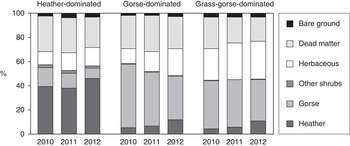
At the start of the experiment, H paddocks were dominated by heather species (40±4.3% cover), whereas the cover percentages of gorse and herbaceous species were 15±4.0% and 10±1.5%, respectively (Figure 1); G paddocks were dominated by gorse (52±5.5%), with herbaceous plants and heather accounting for 13±1.7% and 5±1.9%, respectively; G-G paddocks were co-dominated by gorse and herbaceous species (39±5.4% and 27±2.2%), whereas heather cover was 4±1.6%. The rest consisted of dead matter and bare ground. Heather cover increased across the experimental years within the three types of vegetation (from a mean of 13±1.7% in 2010 to 20±2.6% in 2012; P<0.001), whereas gorse cover decreased (from 35±3.8% in 2010 to 24±3.9% in 2012; P<0.001; Figure 1). Herbaceous cover increased from 16±1.1% in 2010 to 23±1.2% in 2012 (P<0.001). No significant V×Y interactions were observed.
Plant cover variations across 3 experimental years in three different heathland types grazed by horses.

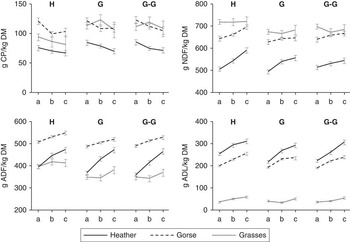
The chemical composition of the main plant species revealed a low nutritive quality of these shrublands. Cell wall components (i.e. NDF) represented the largest fraction in all plant components (535, 654 and 693 g NDF/kg dry matter (DM) in heather, gorse and grasses, respectively; SEM=6.7; P<0.001). Acid detergent fibre and ADL concentrations were lower for grasses than for shrubs (374 v. 470 g ADF/kg DM; SEM=5.8; 45 v. 246 g ADL/kg DM; SEM=3.4; P<0.001). Neutral detergent fibre, ADF and ADL concentrations increased (P<0.001) across the grazing season, especially in shrubs (Figure 2). Protein contents were lowest for heather (P<0.001), and did not exceed 90 g CP/kg DM. In general, CP concentrations decreased for shrubs and maintained steady for grasses from spring to autumn. Fibre fractions were greater (P<0.05) in H paddocks than in G and G-G paddocks (644 v. 620 g NDF/kg DM; SEM=7.1; 459 v. 428 g ADF/kg; SEM=6.5).
Chemical composition of the main plant components in different heathland types (H=heather dominated; G=gorse dominated; G-G=co-dominated by gorse and grasses) across the grazing season (a=spring; b=summer; c=autumn). Values are presented as means±SEM. DM=dry matter.

Diet selection
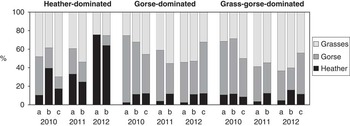
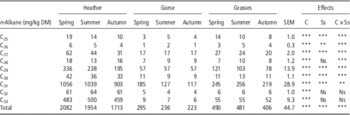
The main plant components showed different alkane profiles (Table 1). Heather had the greatest concentrations of alkanes in all grazing periods, whereas gorse presented the lowest ones (P<0.001). In all plant components, C31 was the n-alkane with the highest concentration. Estimates of diet composition of mares obtained using the alkane markers are illustrated in Figure 3. Diet composition was mainly determined by the botanical composition of the shrubland (P<0.001 for heather; P<0.05 for gorse) and the grazing year (P<0.001 for heather and gorse). Lactating state of mares did not affect their diet composition. In H treatment, grasses and heather were the main dietary components (mean proportions of 0.48±0.102 and 0.38±0.029, respectively), whereas gorse and grasses were the principal diet components in G and G-G treatments (0.49±0.073 and 0.40±0.073 gorse, 0.42±0.074 and 0.50±0.075 grasses, respectively). At the beginning of the study, mares took low proportions of heather in their diet, but they increased its consumption over time (from 0.13±0.022 in 2010 to 0.29±0.024 in 2012, P<0.001), whereas gorse consumption decreased (from 0.47±0.054 in 2010 to 0.24±0.057 in 2012; P<0.01). The increase in heather proportion in mares’ diet was especially noted in H paddocks, resulting in a V×Y interaction (P<0.001). The dietary proportion of grasses decreased in H treatment (from 0.53±0.107 in 2010 to 0.34±0.123 in 2012) but increased in G and G-G treatments (from a mean of 0.35±0.089 in 2010 to 0.51±0.087 in 2012; P<0.05 for V×Y). Season affected the heather proportion (P<0.05), although inconsistently among years and treatments (P<0.01 for V×Y×Ss; Figure 3). Gorse proportion tended to decrease from spring to summer and autumn (from 0.41±0.043 to 0.33±0.050 and 0.29±0.097, respectively; P=0.061).
Diet composition of mares grazing in three different heathland types across the grazing season (a=spring; b=summer; c=autumn).

Alkane contents of the main plant components (C) (heather, gorse and grasses) in Cantabrian heathlands at different seasons (Ss) of the year (spring, summer and autumn)

DM=dry matter.
**P<0.01; ***P<0.001; Ns: P>0.05.
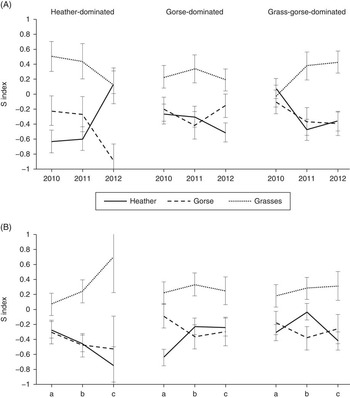
Selectivity indices for heather, gorse and grasses (Figure 4) were not influenced by the lactating status of mares, whereas interactions V×Y and V×Ss were detected for heather (P<0.001), as well as V×Y for gorse (P<0.05). In H treatment, heather was rejected in 2010 and 2011 (mean S=−0.61) and consumed in proportion to its availability in 2012, whereas in G and G-G treatments it was not selected nor rejected in 2010 and rejected in 2011 and 2012 (mean S=−0.43). In the case of gorse, mares from H paddocks consumed it in proportion to its availability in 2010 and 2011 but strongly rejected it in 2012 (S=−0.90), whereas mares in G and G-G paddocks generally consumed gorse in proportion to its availability, except for G-G treatment in 2012 (S=−0.40). In general, S index for heather increased from June to August in G and G-G, but not in H paddocks (Figure 4). Mares’ rejection for gorse increased (P<0.05) from June (−0.19) to August (−0.41) and October (−0.44). Grasses were positively selected by mares in all treatments (S=0.33 in H; S=0.26 in G and G-G), with no differences among years or seasons.
Selectivity indices (S) for heather, gorse and grasses of mares grazing in three different heathland types in each year (A) and season (B) (a=spring; b=summer; c=autumn). Values are presented as means±SEM.

Animal performance
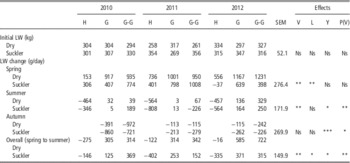
In the 3 years of study, the grazing season was shorter in H treatment than in the other types of vegetation. Animals had to be taken out of the paddocks before the end of summer (late August to early September) because of their very poor body condition, whereas in G and G-G paddocks mares stayed grazing until autumn (mid-October), when they were taken out of the paddocks and housed for the winter. In general, during the 3 study years, mares had poorer performance on H than on G or G-G vegetation treatments (Table 2). Averaging the spring to summer season of the 3 years, mares lost 216 g/day in H paddocks, whereas in G and G-G paddocks mares’ LW increased similarly at rates of 325 and 369 g/day, respectively (SEM=53.4; P<0.01). Looking at seasonal changes, mares increased their LW in all treatments during spring, but those grazing on H paddocks did it at a lower rate than those on G and G-G paddocks (353 v. 852 g/day; SEM=97.9; P<0.01; Table 2). During the summer, mares experienced substantial LW losses in H paddocks (−534 g/day), whereas those in G and G-G paddocks continued increasing their LW (59 and 108 g/day, respectively; SEM=60.9; P<0.01). No significant differences were observed between G and G-G treatments in any period. In these paddocks, mares began to lose LW at the middle-end of the summer (late August to early September), averaging LW losses of 376 g/day during autumn.
Liveweight (LW) changes of mares according to their lactating state during the grazing season at three different heathland types (heather dominated (H); gorse dominated (G); co-dominated by gorse and grasses (G-G))

V=vegetation type; L=lactating state; Y=year; P(V)=random effect of paddock nested within vegetation type.
The interactions V×L, V×Y, L×Y and V×L×Y were non-significant for all variables.
*P<0.05; **P<0.01; ***P<0.001; Ns: P>0.05.
Lactating state affected mares’ LW changes in spring, with lactating dams achieving lower gains compared with dry ones (522 v. 850 g/day; SEM=85.0; P<0.01). During the summer and autumn, there were no differences between lactating states, whereas LW changes were more favourable in dry mares than in suckler ones during the whole spring to summer (241 v. 78 g/day; SEM=50.9; P<0.05). Year affected LW changes during the summer (P<0.05), with greater losses occurring in 2011 compared with 2012. During the autumn, greater LW losses were observed in 2010 compared with 2011 and 2012 at G and G-G treatments (−736 v. −196 g/day; P<0.001). There were no interactions between vegetation type, year and lactating state in any of the periods studied.
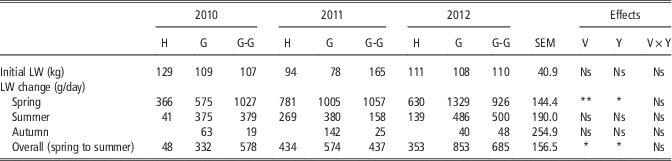
Foals’ daily LW gains (Table 3) until the end of the summer were lower in H paddocks (278 g/day) than in G and G-G paddocks (586 and 567 g/day, respectively; SEM=76.8; P<0.05). The effects of vegetation type produced marked differences in spring (P<0.01), whereas the LW gains were not significantly different between G and G-G treatments in any of the periods. Year affected foals’ LW changes in spring (P<0.05), resulting in differences at the end of the spring to summer grazing season (P<0.05), with higher LW gains in 2012 (630 g/day) than in 2010 (319 g/day). Interactions between year and vegetation type had no effect on foals’ LW changes.
Liveweight (LW) gains of foals during the grazing season at three different heathland types (heather dominated (H); gorse dominated (G); co-dominated by gorse and grasses (G-G))

V=vegetation type; Y=year.
*P<0.05; **P<0.01; Ns: P>0.05.
Gastrointestinal parasites
No differences in mares’ FEC between vegetation treatments or lactating states were found in any of the 3 years. Mean FEC increased (P<0.001) during the first half of the grazing season. Back-transformed geometric means (±SEM) from 2010 varied from 2±1.2 epg in June to 844±148 epg in August, and thereafter maintained at 728±173 epg in October. In 2012, the means varied from 22±9.7 epg in June to 437±78 epg in August. All parasites found were small strongyles from Cyathostominae subfamily.
Discussion
Available vegetation and forage selection
The poor nutritive value of herbaceous and woody plants within shrublands dominated by Erica and Ulex species, as shown by their chemical composition, entails a low animal performance, as forage intake by grazing animals is reduced due to the low palatability and digestibility of the main plant species (Osoro et al., Reference Osoro, Ferreira, García, Martínez and Celaya2017), lowering the LW gains and shortening the grazing season. Thus, the development of sustainable grazing systems with breeding females is quite restricted in these plant communities, both regarding large herbivores (Celaya et al., Reference Celaya, Ferreira, García, Rosa García and Osoro2011) or small ruminants (Osoro et al., Reference Osoro, Ferreira, García, Jáuregui, Martínez, Rosa García and Celaya2013).
In general, grasses accounted for the highest fraction of mares’ diet in all seasons (0.47), followed by gorse (0.34) and heather (0.19). It is known that horses can ingest those less lignified herbaceous species faster (Gordon, Reference Gordon1989; Fleurance et al., Reference Fleurance, Fritz, Duncan, Gordon, Edouard and Vial2009). Except in H treatment in 2012, in spring mares also included high proportions of gorse in their diet (0.41 on average), with a decreasing trend towards autumn. A different behaviour was observed when areas of improved pasture were available, with mares showing increased intake of gorse later in the season, when herbage quantity and quality were lower (Putman et al., Reference Putman, Pratt, Ekins and Edwards1987; Ferreira et al., Reference Ferreira, Celaya, Benavides, Jáuregui, García, Santos, Rosa García, Rodrigues and Osoro2013; Osoro et al., Reference Osoro, Ferreira, García, Martínez and Celaya2017). Previous studies showed how as grazing season advanced and forage digestibility decreased, mares were able to adjust their foraging behaviour to better meet their nutritional requirements, including fibrous graminoids in their diet (Fleurance et al., Reference Fleurance, Fritz, Duncan, Gordon, Edouard and Vial2009). As expected, mares’ diet was influenced by the available vegetation in each treatment. As the botanical composition changed among the experimental years, it in turn caused shifts in diet composition over time. The initial high gorse consumption by mares led to a substantial reduction in its cover and an increase in heather cover, which was reflected in decreased gorse proportions in mares’ diet across the experimental years, inversely to heather proportion. The reduction in gorse cover in G and G-G treatments allowed mares to access the herbaceous species growing below the canopy, and thus grass consumption increased over time in those treatments.
When selectivity indices for heather, gorse and grasses were explored, results indicated a strong selective drive of horses for herbaceous plants, whereas heather species were initially rejected. These results are consistent with those previously observed in Cantabrian heathlands under mixed grazing of horses and cattle (Celaya et al., Reference Celaya, Ferreira, García, Rosa García and Osoro2011). Horses are more constrained by plant secondary compounds than ruminants (Menard et al., Reference Menard, Duncan, Fleurance, Georges and Lila2002), so the tannins present in heather could have restricted its intake by horses. Previous studies have found a higher palatability of gorse relative to heather for horses (Putman et al., Reference Putman, Pratt, Ekins and Edwards1987; Ferreira et al., Reference Ferreira, Celaya, Benavides, Jáuregui, García, Santos, Rosa García, Rodrigues and Osoro2013). It is known that equines do not recycle urea back to the digestive tract to support protein synthesis by microorganisms as efficiently as ruminants (Santos et al., Reference Santos and Silvestre2011). Thus, the greater appetence for gorse in relation to heather may be related to its greater CP content, in order to balance protein requirements. In our study, selectivity indices indicated that gorse generally was not selected nor rejected in G and G-G treatments (with the exception of G-G treatment in 2012). However, a marked gorse rejection was found in H treatment in 2012, mainly due to its zero consumption in spring. It should be pointed out that this result might not be totally correct because of the limited accuracy of alkane markers to discriminate between plant species with very low alkane concentrations and similar marker profiles (Dove and Mayes, Reference Dove and Mayes2006), such as gorse and grasses that can be found in heathland communities (Ferreira et al., Reference Ferreira, García, Celaya, Rodrigues and Osoro2009). To avoid this problem, further research is needed using other epicuticular wax components as markers, such as long-chain alcohols, to obtain more accurate estimates of the diet composition of horses (López López et al., Reference López López, Celaya, Santos, Rodrigues, Osoro and Ferreira2015).
Animal performance and parasitic infections
As stated before, mares’ preference for feeding on grasses and gorse enabled them to gain weight during spring in all vegetation treatments, although at higher rates in G and G-G compared with H vegetation. In summer, mares in G and G-G paddocks were able to maintain and even increase their LW. In H paddocks, however, when the cover of herbaceous plants and gorse decreased, the reluctance to feed on heather could reduce intake and produce LW losses. These results are similar to those obtained on nearby heathlands (Celaya et al., Reference Celaya, Ferreira, García, Rosa García and Osoro2011), where mares increased their LW until mid-summer, but thereafter they were not able to keep their weights. Besides the worst productive responses, the short grazing season in H paddocks would require that horses have access to other pastures with preferred vegetation, or supplementary feeding, which will tie up other pastures or add to production costs.
At the end of the summer, mares lost LW even in G and G-G treatments, probably due to the decrease in available green vegetation cover and its lower nutritive value. Mares’ LW gains obtained in G and G-G treatments during the spring were similar to those observed in heathlands interspersed with improved pasture areas of perennial ryegrass (Lolium perennne) and white clover (Trifolium repens). Nevertheless, the availability of these better nutritive quality pastures allowed mares to achieve lower LW losses in autumn (Osoro et al., Reference Osoro, Ferreira, García, Martínez and Celaya2017). The productive responses did not differ between G and G-G treatments, indicating that the higher availability of herbaceous plants (mostly coarse grasses) in G-G paddocks, and their subsequent higher selection and intake, did not influence the nutritional status of horses.
Overall, lactating mares had worse LW changes than dry mares, although this difference was mainly observed in spring. Mares are not supposed to mobilize body reserves to compensate energy expenditures during lactation (Deichsel and Aurich, Reference Deichsel and Aurich2005). In early lactation, due to the higher milk demands of foals, mares’ requirements may not be met by pasture, despite the higher quality of the vegetation at this time, leading to poorer LW gains in spring for lactating mares compared with dry ones. The low LW gains of dry mares observed in H paddocks in 2010 (153 g/day) could be explained by their initial rejection to consume heather, whereas lactating mares were able to modify their foraging behaviour, increasing feed intake to compensate their higher nutritional requirements (Lamoot et al., Reference Lamoot, Vandenberghe, Bauwens and Hoffmann2005). As season progresses, milk yield decreases after the lactation peak is reached at the end of the 1st month of lactation (Santos and Silvestre, Reference Santos, Rodrigues, Bessa, Ferreira and Martin-Rosset2008), so foals had an increasing proportion of their demands met by their own grazing, with no significant differences found in performance between dry and lactating mares. Moreover, when herbage intake is reduced, lactating mares are unable to maintain milk production in these conditions of nutritional deficiency (Doreau and Boulot, Reference Doreau and Boulot1989), negatively affecting foals’ LW gains. The worse productive responses of mares in H paddocks during spring negatively affected foals’ growth, whereas in G and G-G paddocks foals’ performances were similar to those observed in previous studies conducted in heathlands at very low stocking rates (Celaya et al., Reference Celaya, Ferreira, García, Rosa García and Osoro2011), and somewhat lower to those achieved in heathlands associated with improved pastures (Osoro et al., Reference Osoro, Ferreira, García, Martínez and Celaya2017).
Results on mares’ FEC revealed no differences between vegetation treatments in their parasitic status, suggesting that the type of vegetation did not affect enough the most crucial parameters related to the likelihood of ingesting infective larvae by grazing horses (parasite species present, survival of larvae in the field or migration to the uppermost vegetation layers). Nematode species belonging to subfamily Cyathostominae were only found. This subfamily has been reported as the most prevalent horses’ parasites around the world and an important cause of morbidity and mortality (Matthews et al., Reference Matthews, Hodgkinson, Dowdall and Proudman2004). Climatic conditions can affect the presence of these parasites (Nielsen et al., Reference Nielsen, Kaplan, Thamsborg, Monrad and Olsen2007), as well as the management of the herds, increasing the presence of infection under silvopasturing regimes, at which Galician horses are usually managed (Francisco et al., Reference Francisco, Arias, Cortinas, Francisco, Mochales, Sánchez, Uriarte, Suárez, Morrondo, Sánchez-Andrade, Díez-Baños and Paz-Silva2009). In our study, eggs per gram peak number was reached at mid-summer, in concordance with previous studies conducted in horse grazing systems in temperate climates (Kornas et al., Reference Kornas, Nowosad and Skalska2006).
Enhanced performances observed at G and G-G relative to H treatment, both in terms of mare LW change and foal growth, and the absence of a parasitic effect between vegetation treatments agree with previous results obtained in a preliminary study conducted at double stocking rates (3.3 mares/ha) in the same experimental farm (Celaya et al., Reference Celaya, Ferreira, García, Rosa García and Osoro2012).
Overall, those results indicate that gorse and grass-gorse shrublands appear to be nutritionally better to cover the needs of horses than heather-dominated heathlands. Grazing by horses in gorse- or grass-gorse-dominated shrublands may be sufficient to cover mares’ nutritional needs until summer. By contrast, heather-dominated heathlands are unable to maintain profitable grazing systems by horses. The low nutritive quality of the main plant components of these communities in autumn requires animal access to other more nutritious plant communities or feeding supplementation, in order to enhance foals’ growth and maintain sustainable horse grazing systems.
Acknowledgements
The authors thank the Carbayal Research Station staff for their help in animal management and fieldwork. This work was funded by the Spanish National Institute for Agricultural Research (INIA, Project RTA2009-00130-C02-00) and the European Regional Development Fund (ERDF). C. L. L. is recipient of a predoctoral fellowship from INIA.