Introduction
The European Union (EU) has a mandate to protect the health of EU citizens. This was initially defined in the Maastricht Treaty in 1992. A recent evaluation of key stakeholders’ perceptions regarding the way in which the public health mandate was implemented concluded that the EU has become an important player in the public health arena and has ‘begun to develop competencies in supporting, coordinating and supplementing Member State (MS) health actions’ (Rosenkotter et al., Reference Rosenkotter, Clemens, Sorensen and Brand2013: 1074; Sorensen et al., Reference Sorensen, Clemens and Rosenkotter2013: 906–907). The adoption of the directive on patients’ rights and cross-border care in 2011 (European Union, 2011: 45) is traditionally considered important for clarifying the rights of patients to reimbursement of cross-border care following a spate of judgements by the European Court of Justice. However, an often overlooked aspect of this directive is the establishment of a legal basis for cooperation between health systems in areas such as rare diseases, health technology assessment and e-health (Clemens et al., Reference Clemens, Michelsen and Brand2014: 49–69; Hervey, Reference Hervey2015: 1–5). This is a rapidly developing area of health policy development at EU level through which Member State (MS) may benefit from seeking to cooperate in specific areas of EU added value as they are urged to respond to common challenges facing health systems throughout the EU (European Commission, 2014a).
The implementation of the Joint Procurement Agreement (JPA) to procure medical countermeasures by the European Commission and EU MS (European Commission, 2014c) is an innovative instrument aimed at encouraging MS to increase forms of health system cooperation on a voluntary basis to ensure better public health protection at European level. This Agreement therefore also presents an example of the approach to developing health policy at EU level through health system cooperation. The development of the JPA was stimulated by experience of the 2010 H1N1 influenza pandemic in which MS competed to obtain scarce supplies of medicines, being obliged to pay high prices for medicines that, in the end, were hardly needed. The publication of a Commission report on EU-wide pandemic vaccine strategies (European Commission, 2010) identified a number of weaknesses in the procurement of pandemic influenza vaccines and antivirals by MS at that time. Council Conclusions adopted under the Belgian Presidency in September 2010 (Council of the European Union, 2010) invited the Commission to develop a mechanism for common acquisition or development of common approaches to contract negotiations with manufacturers of vaccines and antiviral medication. Such a mechanism, in which MS could opt to participate on a voluntary basis, was to address issues such as liability, availability and price of medicinal products and confidentiality (European Commission, 2014b).
The topic of multi-country joint procurement for health commodities is not new but has rather been a focus of interest for middle- and low-income countries including Caribbean islands, Sub-Saharan African countries and Gulf States. Group procurement is viewed as a potential means of increasing competition among suppliers and thus reducing prices which has as an effect increasing equity by offering all member countries the same prices, regardless of their market size or level of development (Huff-Rousselle, Reference Huff-Rousselle2012: 1572–1580). Whilst larger countries would normally search for solutions that set up groups at regional or national level, for small countries these advantages can usually only be obtained through international cooperation (Huff-Rousselle and Burnett, Reference Huff-Rousselle and Burnett1996: 135–157). Whilst it is acknowledged that EU MS are at a different level of economic development to many of these countries, an understanding of experiences of engaging in multi-country procurement initiatives from other parts of the world can be informative, offering an opportunity to explore innovative solutions to challenging circumstances.
This is especially important given that the potential for circumstances to arise in the future sharing some features of the H1N1 pandemic, a situation in which ‘politics as usual’ may not apply and so that there is a need to look beyond conventional policy solutions. Thus, the financial and economic crisis has led to particular problems with access to medicines in certain EU MS notably in Greece (Karamanoli, Reference Karamanoli2012: 302), although drug shortages are experienced routinely in several EU MS (Bogaert et al., Reference Bogaert, Bochenek, Prokop and Pilc2015). Furthermore, shortages of vaccines have also been experienced by EU countries struggling to deal with the unexpected influx of refugees (Lam et al., Reference Lam, McCarthy and Brennan2015). Finally, the European pharmaceutical industry itself also appears to be interested in exploring new forms of managing entry of products on the European market (Matusewicz et al., Reference Matusewicz, Godman, Pedersen, Fürst, Gulbinovič, Mack, Selke, Timoney, Warmińska and Malmström2015: 755–758). Therefore, the rapidly changing context within which EU MS health systems find themselves may necessitate the exploration of previously untapped policy solutions.
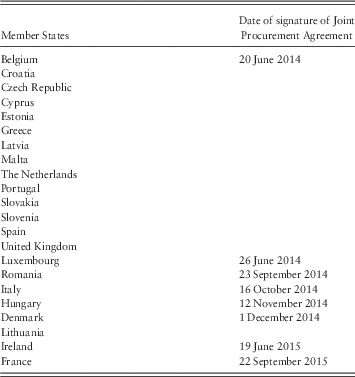
The EU’s JPA provides a vehicle for multi-country joint procurement of medicines. The European Commission and the 22 MS that signed the JPA (Table 1), expect that the JPA ‘… will strengthen the Contracting Parties’ purchasing power and ensure equitable access to medical countermeasures against serious cross border threats to health’ (European Commission and signatory Member States, 2014d). Accordingly, vaccines to counter infectious diseases are of particular interest in this perspective since they are important for striving towards herd immunity at European level. Smaller MS may perceive certain advantages of participation in joint procurement such as obtaining vaccines or medicines at a lower price. Indeed all EU MS with populations under five million signed the JPA as of November 2015. Of the MS who have not yet signed Austria, Bulgaria, Finland, Germany and Sweden are all progressing towards internal approval of the JPA. Poland is the only country which had explicitly not agreed with the formulation of the JPA on a point of principle (European Commission, 2015b) although other research has drawn attention to problems with pharmaceutical procurement in Poland that may also be a salient factor (Ozierański et al., Reference Ozierański, McKee and King2012: 175–195). Larger countries may even perceive such a mechanism as a disadvantage by forfeiting their sovereign rights to negotiate directly with suppliers, including the benefits they obtain by avoiding pricing transparency. We deem the EU JPA an important object for policy analysis since it marks a new approach to cooperation between health systems that can is of particular policy relevance at times of financial austerity.
List of countries having signed the Joint Procurement Agreement (updated 8 November 2015)

Framing the issue
An examination of the events, context and circumstances that led to the adoption of the JPA is necessary given the traditional reluctance for health matters to be a matter for European level action coupled with the current wave of Euroscepticism (Vollaard and Martinsen, Reference Vollaard and Martinsen2014: 711–731). An analysis of the JPA content as well as the ideology, issues, influence, initiative, interests and institutional context that determined this content are all important (Walt et al., Reference Walt, Shiffman, Schneider, Murray, Brugha and Gilson2008: 308–317) to understand the extent to which the mechanism is a natural progression of the developments in health policy at EU level. This in turn may reflect the depth and breadth of commitment to the initiative and hence the likelihood of successful implementation and durability. The JPA can be analysed with reference to the literature on multi-country pooled procurement mechanisms since this can provide a framework for an ex ante assessment of the potential in this new mechanism for health systems collaboration at EU level. This could be important to further our understanding of the way in which aspects of public health policy and practice are being ‘Europeanised’Footnote 1 (Radaelli and Pasquier, Reference Radaelli and Pasquier2007: 35–45), and to what extent this Europeanisation is driven by or at least in line with values such as equity and solidarity vs exigencies of the market. This latter consideration is relevant given the criticism that market ideology and economic considerations are dominating developments in EU health policy (Greer, Reference Greer2014: 13–24; Jarman and Greer, Reference Jarman and Greer2014).
In the light of the foregoing considerations, this paper analyses the JPA’s potential by seeking to answer the following research questions: What are the important prerequisites and successful outcomes associated with multi-country joint procurement programmes? How has the EU JPA been developed and what are its main features? How is the JPA expected to perform as an innovative mechanism for EU health system collaboration?
Methods
In order to answer these research questions a qualitative approach was adopted as this is deemed to be a suitable approach for the analysis of a policy process (Versluis et al., Reference Versluis, Van Keulen and Stephenson2010; Creswell, Reference Creswell2012). A range of methods and data sources were used, with triangulation of data to strengthen the validity of the study. A literature review was conducted using PubMed. Publications were not truncated for year of publication and were limited to the English language. The key terms used were a combination of multi-country, pooled or joint procurement, vaccine, pharmaceutical, medicine, medical device and commodity. Searches based on these terms were also run in Web of Science, EBSCO and Google Scholar. The available literature was reviewed to identify benefits, critical success factors and barriers to effective and sustainable multi-country procurement programmes for health commodities. The literature available to inform this paper is limited since the topic is very new at a European level and most of the available literature comes from a low- and middle-income country context which, although informative, as noted above, is not always directly relevant. The scope of this policy analysis was therefore extended by including a documentary analysis of key material relating to the JPA while a key informants’ interview was used for confirmatory validation.
A detailed analysis of the JPA documentation was carried out. The source was official documents retrieved from the European Commission’s website and included media communications, proceedings of meetings, informational and decisional documents. According to Flick, documentary analysis can be a fruitful addition to other forms of data, provided that the context of their production is also taken into account (Flick, Reference Flick2014: 352–362). An analysis of the prevailing context within which the JPA was developed was therefore also conducted. A single in-depth telephone interview with two European Commission officials from the Health Threats Unit responsible for the JPA was carried out in December 2014. The interview proceeded according to a structured interview guide that was drawn up after the literature review and documentary analysis were conducted. The purpose of this interview was primarily to obtain confirmatory validation of the findings obtained through the documentary analysis and literature review. Notes taken during the interview were immediately recorded as an interview report. The report was sent back to the interviewees for them to check the factual accuracy. Their permission was sought and obtained to refer to the content of the interview in the context of the preparation and presentation of this research paper.
Results
There is limited literature available evaluating multi-country joint procurement in the health care sector and the literature search only yielded seven relevant papers. Most information about evaluation of multi-country joint procurement comes from an analysis of the following middle- to low-income country multi-country procurement programmes: Organisation of Eastern Caribbean States Pharmaceutical Procurement Service report (Huff-Rousselle and Burnett, Reference Huff-Rousselle and Burnett1996: 135–157), proposal for a multi-country group procurement scheme in Eastern Europe (DeRoeck, Reference DeRoeck2003), Pan American Health Organisation (PAHO) revolving fund for vaccine procurement, Gulf Cooperation Council (GCC) group purchasing programme (DeRoeck et al., Reference DeRoeck, Bawazir, Carrasco, Kaddar, Brooks, Fitzsimmons and Andrus2006: 23–43), Global Fund Programme (TB, HIV, Malaria) (Wafula et al., Reference Wafula, Agweyu and Macintyre2013: 466; Wafula et al., Reference Wafula, Agweyu and Macintyre2014a: e134–e139, Reference Wafula, Marwa and McCoy2014b: 15) and the United Nations Fund for Procurement Activities (Huff-Rousselle, Reference Huff-Rousselle2012: 1572–1580).
In total, 11 factors associated with multi-country procurement programmes were extracted from the literature review and classified thematically. Seven factors have been categorised as prerequisites for programmes to become established successfully and four factors have been classified as desired outcomes that need to be achieved to sustain such programmes successfully. We interpret the link among these factors in such a way that the strong presence of prerequisites leads to desired outcomes and the generation of desired outcomes in itself further contributes to sustainable programmes.
Prerequisites for successful multi-country joint procurement programmes
Strong central leadership and management and a high level of political will from participating countries seems necessary to develop a joint procurement initiative. However, it is equally important for all the partner members to be part of the decision-making mechanism and to have a high level of involvement (Huff-Rousselle, Reference Huff-Rousselle2012: 1572–1580). Equitable representation of partners in decision-making and equitable criteria for the allocation of scarce supplies have been identified as key factors for building trust in the joint procurement programme (Huff-Rousselle, Reference Huff-Rousselle2012: 1572–1580). The use of an independent agency and a transparent, competitive tender and bid process has been described as a key incentive for countries to join an international group procurement programme in the literature from developing countries, since this prevents fraud and corruption and overcomes the problem of hidden costs for suppliers (DeRoeck et al., Reference DeRoeck, Bawazir, Carrasco, Kaddar, Brooks, Fitzsimmons and Andrus2006: 23–43; Huff-Rousselle, Reference Huff-Rousselle2012: 1572–1580). Stability in the availability of funds, mechanisms to decrease financing risk and prompt payment were associated with successful joint procurement programmes. An element of regional or supra national central financing was also considered necessary to ensure sustainable funding of the central operations for the joint procurement mechanism (Huff-Rousselle and Burnett, Reference Huff-Rousselle and Burnett1996: 135–157; DeRoeck et al., Reference DeRoeck, Bawazir, Carrasco, Kaddar, Brooks, Fitzsimmons and Andrus2006: 23–43). Uniform procurement regulations and standard requirements and specifications are viewed as a prerequisite for joint procurement endeavours. A uniform formulary at regional level is also an asset (Huff-Rousselle and Burnett, Reference Huff-Rousselle and Burnett1996: 135–157; DeRoeck, Reference DeRoeck2003). Flexibility with regards to the participation in the mechanism has been shown to be an important factor that enables particularly some of the larger countries to stay in the joint procurement scheme. The GCC allows participating countries to vary the quantity of the initial order by 20% as well as providing some possibilities to cater for specific country needs. On the other hand, the lack of an exclusivity clause may encourage some of the larger countries in particular to pursue individual and joint procurement in parallel. Whilst retaining these countries in the mechanism is important to maintain the volume of orders, this may also create conflicts of interest (Huff-Rousselle and Burnett, Reference Huff-Rousselle and Burnett1996: 135–157). The literature indicates that schemes such as those operated by the Caribbean and Gulf countries, which started with a small group of highly committed countries and a small portfolio of goods, went on to develop further in a step-wise fashion building on positive experiences (Huff-Rousselle, Reference Huff-Rousselle2012: 1572–1580). Since countries and other observers will at least partly judge success of the pilot scheme on the price reductions and overall cost savings achieved, it may be preferable to include at least one larger country in the pilot phase in order to achieve more substantial price reductions (DeRoeck, Reference DeRoeck2003).
Successful outcomes
The GCC group procurement mechanism achieved security of supply by a combination of shortening the procurement process, increasing the predictability of timing and simplifying procedures. This also led to improvements in supply chain management (DeRoeck et al., Reference DeRoeck, Bawazir, Carrasco, Kaddar, Brooks, Fitzsimmons and Andrus2006: 23–43). Furthermore, sharing of information about suppliers and use of pre-screening reduced the risk of engaging with suppliers with poor track records (Huff-Rousselle and Burnett, Reference Huff-Rousselle and Burnett1996: 135–157). Reductions in unit purchase price seem to have garnered increased support for the mechanism (Huff-Rousselle, Reference Huff-Rousselle2012: 1572–1580). Yet, the evidence on price savings is mixed – some report considerable cost savings to the individual countries (Huff-Rousselle and Burnett, Reference Huff-Rousselle and Burnett1996: 135–157; DeRoeck et al., Reference DeRoeck, Bawazir, Carrasco, Kaddar, Brooks, Fitzsimmons and Andrus2006: 23–43) including those with small populations (DeRoeck et al., Reference DeRoeck, Bawazir, Carrasco, Kaddar, Brooks, Fitzsimmons and Andrus2006: 23–43). Others did not confer financial advantages for all commonly purchased devices (Wafula et al., Reference Wafula, Agweyu and Macintyre2013: 466, Reference Wafula, Agweyu and Macintyre2014a: e134–e139). The savings made on operational costs and reduced administrative burden is a major factor encouraging participation in the scheme. If the joint procurement mechanism becomes expensive to administer then these savings are neutralised, potentially leading countries to opt out of the scheme (DeRoeck et al., Reference DeRoeck, Bawazir, Carrasco, Kaddar, Brooks, Fitzsimmons and Andrus2006: 23–43). Clearly defined procurement mechanisms, simple procurement design which minimises contractual risk and a low level of administrative burden have been noted as key success factors (Huff-Rousselle and Burnett, Reference Huff-Rousselle and Burnett1996: 135–157; Huff-Rousselle, Reference Huff-Rousselle2012: 1572–1580). One of the main benefits derived from multi-country pooled procurement has been the creation of networks of professional experts (Gessner et al., Reference Gessner, Duclos, DeRoeck and Nelson2010: A1–A5). Informal peer relationships linking experts have been shown to influence positively the sustainability of pooled procurement agreements (Huff-Rousselle, Reference Huff-Rousselle2012: 1572–1580).
Analysis of the development of the JPA
The JPA was adopted in April 2014 and came into force in June 2014 when the first 14 MS signed the agreement. As of November 2015, 22 out of 28 EU MS had signed the JPA (European Commission, 2015a) (see Table 1). The stated objectives for the mechanism are to ensure that pandemic vaccines and other medical countermeasures would be available in sufficient quantities with access being guaranteed for all participating MS (European Commission, 2014b). During the 2010 influenza A H1N1 pandemic a number of EU MS experienced difficulties with access to pandemic vaccine and antivirals (Martin and Conseil, Reference Martin and Conseil2012: 1091–1110). The key problems related to price, liability, confidentiality and flexibility to adjust quantities ordered to actual needs in the procurement of vaccines and antivirals. These problems are seen as the main triggers for the Council and the European Parliament to request that the European Commission creates a mechanism for joint procurement of vaccines in view of the risk of a potential future pandemic (European Commission, 2014b). Whilst in its final report published in 2008, the High Level Pharmaceutical Forum had drawn attention to the problems with access to certain medicines being faced by small national markets (High Level Pharmaceutical Forum 2005–2008, 2008), during the 2010 influenza pandemic difficulties in access were experienced on a wider scale. The proposal initially was not enthusiastically welcomed by all MS, since those which already had agreements in place with the industry for pandemic vaccine supply were disinterested in pursuing such a venture (Commission officials Health Threats Unit, 2014). The vaccine and pharmaceutical industry was initially also concerned about this development since it viewed the initiative as a potential vehicle to create a monopsony in Europe which would drive down prices (Commission officials Health Threats Unit, 2014). The strong normative public health basis for action appears therefore to have been the main driver that led to a quasi-unanimous agreement to the principle of pursuing a mechanism for joint procurement for cross-border threats (DeRoeck, Reference DeRoeck2003). Following the rapid agreement in principle, subsequent negotiations on the JPA were relatively protracted although delays in the decision-making process are reported to have been due more to the technicalities of legal and administrative ratification of this innovative mechanism by the various MS rather than to issues of principle (Commission officials Health Threats Unit, 2014).
On the basis of Article 168(5) TFEU, Decision 1082/2013/EU on cross-border health threats was adopted (European Union, 2013: 1–14). Article 5 of that Decision regards joint procurement of medical countermeasures. Article 5(1) provides that ‘The institutions of the Union and any Member States which so desire may engage in a joint procurement procedure (…) with a view to the advance purchase of medical countermeasures for serious cross-border threats to health’. The adoption of the Decision on cross-border health threats therefore provided the necessary legal basis for the JPA to be negotiated. The scope was widened from the procurement of vaccines to include medical countermeasures. The focus, however, remained strictly that of serious cross-border threats to health. Analysis of the text of the JPA (European Commission and signatory Member States, 2014d) showed that the JPA determines the practical arrangements governing the procurement procedures, defines the decision-making process with regard to the choice of the procedure and organises the assessment of the tenders and the award of the contract. The text clearly underlines the voluntary nature of participation in this initiative and the freedom of MS to decide whether or not to participate in the Agreement itself or in any single procurement procedure launched through the Agreement. The decision to participate in a particular joint procurement procedure does not prevent a MS from carrying out simultaneous independent procurement procedures at national level, even when they involve the same medical countermeasures or the same operators. A MS may withdraw from JPA at any time. The JPA outlines the envisaged mechanisms of allocation. Participating MS should receive the total quantity of the ordered or reserved measures, but the rate of delivery will depend on the production capacity of the manufacturers and the approved allocation criteria. The JPA, furthermore, foresees a possibility of derogation from the generally applicable allocation criteria in problematic situations, such as delivery problems or urgent needs (e.g. in case of a pandemic striking more strongly in one or more MS). This may mean that particular MS would obtain more or less than the volume specified through the allocation criteria. The manner in which derogation from the set allocation criteria will apply is not yet entirely clear but will require sufficient flexibility. The administrative arrangements underpinning the JPA are set out in detail in the policy instrument. The Commission plays a key role since it acts as the Permanent Secretariat and is responsible for ensuring the overall preparation and organisation of the joint procurement procedure. It has been granted a powerful role through providing the Secretariat and Chair of each Steering Committee. For each specific procurement procedure, a separate committee is established with responsibility for matters relating to the specific joint procurement procedure. For each specific procedure, the committee must determine the technical specifications and criteria for allocation of medical countermeasures, including temporary deviations from the allocation criteria in case of greater need. Decision making is by qualified majority, taking account of the financial commitment made by each Contracting Party. Overall, the formulation of the JPA allows a certain degree of flexibility for MS but details the processes and procedures to be followed.
Discussion
Having presented the key factors associated with sustainable multi-country joint procurement initiatives, we now examine the potential of the JPA as an innovative mechanism for health system collaboration between EU MS. The first part of the discussion assesses the EU JPA’s likelihood of success in relation to the identified prerequisites for successful multi-country joint procurement programmes. In the second part, we discuss the extent to which successful outcomes from multi-country joint procurement programmes reported in the literature from developing countries are relevant to the current EU context. We also consider whether the EU JPA could serve as an impetus for further health policy development and health systems collaboration at EU level.
Although the JPA is possibly more beneficial to small MS, 22 MS including a few larger MS had signed up to the JPA by November 2015 indicating a high level of commitment to its principles. However, representation within the decision-making structure of the JPA is not equal for all MS and neither is it the traditional qualified majority voting used in the EU Council of Ministers. Instead it is proportionate to the level of investment in the scheme (as requested by the ‘equity’ factor). Whilst this will still favour larger MS, it also attempts to take into account the level of commitment such that smaller countries with a higher financial commitment than larger countries would have more votes in the mechanism. The JPA will follow the EU procurement processes and the decision-making structure provides for a high level of transparency in procedures.
The possibility of launching a procedure even if there are only four countries and the European Commission is a positive feature since the literature indicates that such initiatives grow and develop gradually over time. This feature also provides room for small MS to collaborate even if the matter at hand is not of interest to the larger MS.
The lack of specific EU level funding for the JPA could be deemed as a factor hindering the programme’s sustainability, as adequate and stable financing does not seem to be guaranteed for the coordination of the initiative. A small amount of European funding to cover the administrative and operational costs would provide continuity and contribute to the sustainability of this mechanism.
When it comes to standardisation, whilst procurement policies are harmonised at EU level, the lack of uniform formularies could well be a weakness impeding joint procurement. However, if the European Commission is perceived by MS to be using the JPA as some sort of ‘Trojan horse’ (Martens and Wolf, Reference Martens and Wolf2009) to attempt to bring about harmonisation of the formularies, this could trigger a backlash from MS intent on safeguarding the well-established national competence to determine formulary lists. MS may then react by not committing to participate in any procurement procedures thereby placing in question the future operation of the JPA. It is possible that some degree of formulary harmonisation will emerge as a by-product, triggered by voluntary adoption of common standards by MS seeking to build deeper cooperation in medicines procurement through the JPA as has happened in between the Gulf states (Huff-Rousselle, Reference Huff-Rousselle2012: 1572–1580).
The concept of flexibility and exclusivity is a double-edged sword for the enduring viability of the JPA. The JPA would not have seen the light of day without sufficient flexibility, which does not demand exclusivity from MS, since most MS accepted the agreement because of these characteristics. However, these could also be the weakest part of the JPA since MS may not commit themselves fully to the ideal of equity and solidarity fostered through participation in the JPA. Although 22MS have signed up to the JPA, it is important to recall that MS can opt out at any stage.
Security of supply in the event of a pandemic was the key factor that drove MS to work towards setting up a joint procurement mechanism. Health security has recently been considered as one of the soft security aspects for which the EU may provide shelter for small MS (Bailes and Thorhallsson, Reference Bailes and Thorhallsson2013: 99–115). The JPA is seen as a good example of this. Whilst favourable prices are often perceived to be the main motivation for pooled procurement, price reductions may not always materialise and national engagement will often be based on factors other than price. The lowering of price will be resisted by industry and it may be possible to imagine a scenario where individual larger MS obtain better prices through bilateral negotiation. In such a scenario, steps would need to be taken to avoid the domino effect of countries dropping out. Dropping out is also likely to arise if the JPA becomes overly bureaucratic so this must be avoided, as inefficiency and lack of timeliness in procurement would work against the potential reduction of operational costs. On the other hand the JPA could potentially enhance health system performance, a key target for the new EU Commission (Juncker, Reference Juncker2014), by reducing the need for multiple procurement processes across the European Union health systems. Pooled procurement functions may therefore be viewed as a pragmatic support service provided by regional supranational organisations for their MS. In this sense, the JPA may emerge as a mechanism that enhances efficiency and resilience echoing the principles for EU health systems outlined in the Commission (CION) communication of 2014 (European Commission, 2014a). This is particularly likely to be the case for small health systems where such procurement processes may be expensive overheads.
Procurement has not typically been viewed as a complex activity requiring networking. However, the procurement of countermeasures for cross-border threats is different from that for staple supplies. Thus, networking between health technology procurement experts for exchange of information and best practices could well be one of the most unintended, yet important, outcomes from the JPA particularly for the smaller MS where professional isolation often emerges as a significant issue. The creation of professional expert networks has been shown to be a driver for the development of European health policy in communicable disease control where technical rational argumentation served to drive political action (Greer and Matzke, Reference Greer and Matzke2012: 887–914). The forerunners of the European Centre for Disease Control were actually networks of experts coordinating information, research and developing guidelines at European level. Such networking could be modelled on the existing professional networks for Health Technology Assessment, an area of activity which is now legally established in EU Directive 2011/24 and which offers plenty of scope for interaction with joint procurement activities at EU level.
Having discussed the JPA in light of the critical success factors that help in creating and sustaining a programme, we turn now to other factors that appeared relevant in our analysis of the JPA and are expected to play a role in developing the potential of the JPA.
Small MS, poorer MS and the Commission appear to have come together to provide the necessary impetus for a joint procurement initiative to be created. The issue of national pride and self-determination may preclude countries from deciding to participate in the JPA. Yet, smaller countries in search of pragmatic solutions are less likely to seek to develop their own capacity, expertise and resources for highly specialised procurement and are more likely to take up the possibilities offered through the EU JPA. However, the participation of medium sized or large countries is also important, not only because of the potential to achieve greater cost savings and lower unit prices (DeRoeck, Reference DeRoeck2003) but also because of the expertise that resides within larger countries (Gessner et al., Reference Gessner, Duclos, DeRoeck and Nelson2010: A1–A5). It should, however, be noted that convening small countries could also be viewed as a measure of success when evaluating the impact of the JPA. This could herald a new possibility for small MS to engage in forms of cooperation not usually seen at EU level where interests of MS often differ (Thorhallsson, Reference Thorhallsson2000).
The JPA, by enhancing health system collaboration, may become a source of further Europeanisation of health policy. A neo-functionalist approach can explain the development of the JPA at EU level whereby ‘the national state which no longer feels capable of realising welfare aims within its narrow borders, has made its peace with the fact of interdependence …. (Haas 1964)’ (Rosamond, Reference Rosamond2000: 57).
Whilst the scope for joint procurement may seem limited by its current legal basis, which requires that the scope of procurement be limited to cross-border health threats, interest in exploring joint procurement for rare communicable diseases such as anthrax, botulism, rabies as well as for innovative treatment for relatively common conditions such as HIV/TB/Hepatitis C has been shown (Commission officials Health Threats Unit, 2014). The JPA can bring about the adoption of innovative procurement approaches at EU level, which in turn may serve as a stimulus to research on novel antibiotics needed to tackle antimicrobial resistance by guaranteeing industry an adequate scale of purchases (World Health Organisation Regional Office for Europe, 2015). The possibility of using joint procurement for procurement of orphan drugs for rare diseases has also been raised (Fierlbeck and Herder, Reference Fierlbeck and Herder2015: 4). The Netherlands and Belgium announced joint negotiations with pharmaceutical groups focussing on diseases which affect fewer than five in 100,000 people, for which treatments are often very expensive due to the limited market (REUTERS/FRANCOIS LENOIR, 2015).
Such an initiative, if successful, would pave the way for further joint procurement at EU level although a different legal basis would be necessary to take this forward.
Establishing the practical feasibility through a first procurement initiative seems to be urgently necessary. The JPA was mentioned as a potential avenue for procurement of countermeasures against Ebola (Council of the European Union, 2014a, 2014b). Unfortunately the slow response does not augur well for the mechanism to be used in rapidly escalating situation. However, it could well be that once a practical small scale first initiative is implemented and lessons learned, it could be foreseen that different groups of MS may put in requests for joint procurement of different treatments depending on their epidemiological burden, economic situation and negotiation leverage with the multi-national industry.
Conclusion
In conclusion, the EU JPA justifies policy analysis as an innovative form of European public health action. Our assessment indicates that the JPA appears to fulfil the prerequisites of ownership, transparency and gradual development. It also strongly achieves the prerequisite of flexibility but this may actually turn out to be one of its major weaknesses in securing ongoing commitment. Standardisation has been achieved in procurement regulations but not formulary development. Equity is partly achieved through the decision-making structures but does not appear to be the underlying theme motivating the development of this policy instrument. The element of central funding is not achieved. Of the desired outcomes described in the literature, security of supply appears to have been the main outcome that drove the development of the JPA. Price savings, reduction in operational costs and administrative burden and development of professional networks appear to be outcomes that may be more attractive to the smaller MS. Furthermore, we found that a ‘window of opportunity’ characterised by the influenza pandemic of 2010 was important in creating the impetus for the JPA to be established.
At this stage, the JPA demonstrates potential as an innovative mechanism for health system collaboration at EU level, particularly for the smaller MS and has been designed in a manner that achieves most of the attributes associated with successful multi-country procurement programmes. However, the incentives for sustained commitment of larger MS to this initiative in practice may not be sufficiently attractive. Further research is needed during and following the practical implementation of joint procurement procedures launched within the framework to capture the perspective of multiple stakeholder regarding the European added value of this initiative.
Acknowledgements
The research work disclosed in this publication is partially funded by the Malta Government Scholarship Scheme grant. The authors are grateful to the two anonymous reviewers for their helpful comments and suggestions and other colleagues who have provided important input for this manuscript.