Introduction
All patients receiving concomitant chemotherapy and radiotherapy in the head and neck region develop oral mucositis.Reference Stokman, Spijkervet and Burlage1 Mucositis is a result of imbalance between cell loss and cell proliferation. Bacterial colonisation of the oral mucosa can aggravate pre-existing mucositis. Endotoxins released from Gram-negative bacilli are potent mediators of the inflammatory process in the oral mucosa.Reference Al-Tikriti, Martin and Bramley2, Reference Bernhoft and Skaug3 Mucositis may lead to suboptimum effectiveness of chemotherapy and radiotherapy.Reference Sonis4 Effective management of this complication is therefore very important. There is currently no known intervention which is completely successful in preventing or treating oral mucositis.Reference Demarosi, Bez and Carrassi5 Many agents have been tried, with various response rates, including: subcutaneous or topical granulocyte macrophage colony stimulating factor,Reference DeVries, Sprinzl, Reich, Gunczler, Thumfart and Lukas6 the prostaglandin-E analogue misoprostol,Reference Hanson, Marks and Reddy7 topical corticosteroidsReference Leborgne, Leborgne, Zubizarreta, Ortega and Mezzera8 and the parenteral radio-protector amifostine.Reference Tannehill and Mehta9
The Qur'an vividly illustrates the potential therapeutic value of honey.
Thy Lord has inspired the Bees, to build their hives in hills, on trees and in man's habitations, From within their bodies comes a drink of varying colours, wherein is healing for mankind, Verily in this is a Sign, for those who give thought.Reference Zumla and Lulat10
Biswal et al. Reference Biswal, Zakaria and Ahmad11 reported that topical application of natural honey is a simple and cost-effective treatment for radiation mucositis, and recommended further, multi-centre, randomised trials to validate their findings.
The aim of this study was to evaluate the efficacy of pure natural honey as prophylaxis against chemoradiation-induced mucositis.
Honey has been used medically throughout history. In more recent times, it has been rediscovered by the medical profession for the treatment of burns, infected wounds and skin ulcers.Reference Molan12 The rationale of using honey to manage radiation mucositis was derived from basic research and clinical observation of rapid epithelialisation in tissue injuries.Reference Bergman, Yanai, Weiss, Bell and David13 Bergman et al. reported that unboiled honey seemed to result in accelerated wound healing when applied topically, and theorised that this effect might be due to its energy-producing properties, its hygroscopic effect on the wound and its bacteriostatic properties. How much of this bacteriostasis is due to honey's inherent antimicrobial propertiesReference Cooper, Molan and Harding14 and how much to its hyperosmolar nature is unknown. Pure honey is acidic, with a pH of around 3.9. A solubility-reducing factor present in honey can activate in the absence of saliva. Honey applied to radiation-induced xerotic mucosa increased the micro-hardness of enamel, thereby preventing caries. Hence, it has been postulated that honey is less cariogenic in patients suffering dry mouth.Reference Sela, Shapira and Grizim15
In this study, we used honey derived mainly from the clover plant Trifolium alexandrenum.
The large volume of literature reporting the effectiveness of honey indicates that it may potentially be useful to treat periodontal disease, mouth ulcers and other problems of oral health.Reference Molan12
Patients and methods
This study was conducted between April 2005 and July 2006 in Assiut University Hospital, Faculty of Medicine Assiut University departments of Ear, Nose and Throat; Oncology and clinical pathology; where the study patients were assessed and treated; and Faculty of Agricalture, Assiut branch, Al-Azhar University, Egypt. It included 40 patients diagnosed with head and neck cancer who satisfied the following criteria.
Inclusion criteria
Patients included in the study satisfied the following criteria: histologically confirmed, nonmetastatic carcinoma of the oral cavity, pharynx (nasopharynx, oropharynx or hypopharynx) or larynx; patients with tumour–node–metastasis (TNM) stagings of TX, T1–T4, NX, N0–N3 and M0; Karnofsky performance statusReference Karnofsky, Abelman, Craver and Burchenal16 of ≥50 per cent; those requiring radical radiotherapy which included a significant area of directly visible oral and/or oropharyngeal mucosa in the radiation field (a significant area was defined as two or more anatomical sites at risk, e.g. the soft palate and the cheeks, or the floor of the mouth and the tongue);Reference El-Sayed, Nabid and Shelley17 and normal renal and hepatic function and normal haematological values (i.e. white blood cells >3.0 × 10⁹/l, platelets >100 × 109/l and haemoglobin >10 g/dl).
Exclusion criteria
Patients were excluded if they met the following criteria: early glottic cancer (T1 and T2); previous chemotherapy or radiation treatment to the upper airways; previous radical surgery of the primary tumour and/or regional lymph nodes; and co-morbid medical conditions such as diabetes mellitus or connective vascular disorders.
Study design
Enrolled patients were randomised to either the treatment group, to receive concomitant chemotherapy and radiotherapy plus topical application of pure natural honey, or the control group, to receive concomitant chemotherapy and radiotherapy without honey.
Pretreatment evaluation
This consisted of a complete history, physical examination including flexible fibre-optic endoscopy, complete blood analysis, liver function tests, chest X-ray, and computed tomography or magnetic resonance scans of the head and neck to assess the extent of the primary tumour as well as the neck nodes. Patients also underwent panendoscopy of the upper aerodigestive tract and biopsy for histopathological examination. All patients received pretreatment dietary counselling and dental evaluation.
Radiotherapy
This was delivered using a 6-MV linear accelerator or Cobalt-60 at a dose fraction of 2 Gy per day five times a week, without any intended gaps, up to a dose of 60–66 Gy (depending on TNM classification; T1 and T2 tumours and negative nodes were treated with a dose of 60 Gy, while patients with T3, T4 and/or positive nodes were treated with a dose of 66 Gy). Reproducibility of head and neck positioning was achieved by using a fixation device (Orfit mask; MEDTEC Inc Orange City, Iowa, USA). The treatment volume included the primary tumour site plus adequate margins and the neck nodes at risk. Usually, parallel-opposed fields were used to irradiate the primary tumour and the upper neck. A separate, anterior supraclavicular field was used to irradiate the lower neck and supraclavicular fossa. The spinal cord was protected after 40 Gy. The prescribed dose was 50 Gy to the clinically negative neck and 60–66 Gy to the gross target volume and positive neck nodes.
Chemotherapy
This consisted of cisplatin (20 mg/m2 infusion once a week before radiotherapy). All patients received adequate hydration and a serotonin antagonist to prevent vomiting during cisplatin administration. Full blood count examination was performed weekly. If the white blood cell count was lower than 3.0 × 10⁹/l, the platelet count below 100 × 109/l, or haemoglobin less than 10 g/dl, the subsequent chemotherapy dose was delayed for one week, without interruption of radiotherapy.
Honey
In the treatment group, patients were advised to smear the inside their mouth with 20 ml of pure honey, 15 minutes before, 15 minutes after and 6 hours after radiation therapy (as per Biswal and colleagues' protocol).Reference Biswal, Zakaria and Ahmad11 They were advised to rinse honey on the oral mucosa and then to swallow it slowly, in order to smear it onto the oral and pharyngeal mucosa. The above treatment was advised throughout the course of radiotherapy.
Quality control of honey
The main flower involved in the collection of nectar was that of the clover plant Trifolium alexandrenum. Honey so produced was filtered and supplied as raw (i.e. pure) honey for the trial. The honey was subjected to analysis of chemical composition, pH, density and viscosity. Thin layer chromatography was used for the chemical analysis. The honey was extracted with potassium ether, chloroform, ethyl alcohol and methyl alcohol and developed to meet a MeOH:H2O:CHCl3 ratio of 50:10:64. Chemical analysis indicated that the honey had a pH of 4.1 and contained such compounds as terpenoids, trace elements, nitrogenous compounds and sugars. Viscosity was 3.8 N and density 1.4 g/ml.
Toxicity criteria
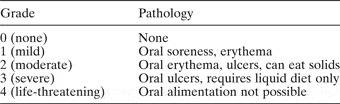
Patients were evaluated clinically every week in order to detect the development of radiation mucositis, using the World Health Organization (WHO) Radiation Therapy Oncology Group grading system (Table I).18
WHO oral mucositis grading

WHO = World Health Organization
Treatment delays or gaps were recorded for cases of intolerable mucositis; the total number of treatment days lost was also recorded.
Microbiological cultures
In order to study the antimicrobial effect of honey on patients' oral mucosa, aerobic cultures and candida colonisation tests were performed. Oral and oropharyngeal swabs were taken from areas to be irradiated, prior to and at the completion of irradiation, and also when infection was evident.
Oral care
During the study, patients were instructed to use benzydamine HCl (EPICO, Cairo, Egypt), a nonsteroidal analgesic and anti-inflammatory compound, plus supportive oral care measures. Dental evaluation was undertaken before and after radiotherapy. Antibiotics and antifungals were only used if indicated by clinical examination and culture and sensitivity results. All patients were given pretreatment dietary counselling, reinforced weekly. A nasogastric feeding tube was placed when and if needed (i.e. for grade four mucositis with absolute dysphagia).
Statistical analysis
Data were entered into a Microsoft Excel 2003 spreadsheet. The Statistical Package for the Social Sciences version 13 software was used for data analysis, which included descriptive analysis and Yates corrected chi-square analysis. Graphs were produced using Microsoft Excel 2003.
Results
Patients
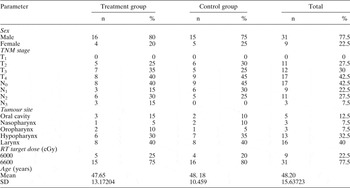
The characteristics of the patients and their tumours were comparable for the treatment group (n = 20) and the control group (n = 20) (Table II). Primary tumours were located in the oral cavity (five), nasopharynx (three), oropharynx (three), hypopharynx (13) and larynx (16). Radiotherapy treatments were similar in the treatment and control groups. In all patients, chemotherapy was administered concurrently with radiotherapy, as previously described. All treatment group patients received honey throughout their radiotherapy course. Table II shows patients' characteristics regarding sex, TNM staging and tumour site.
Patient characteristics

TNM = tumour–node–metastasis; RT = radiotherapy; SD = standard deviation
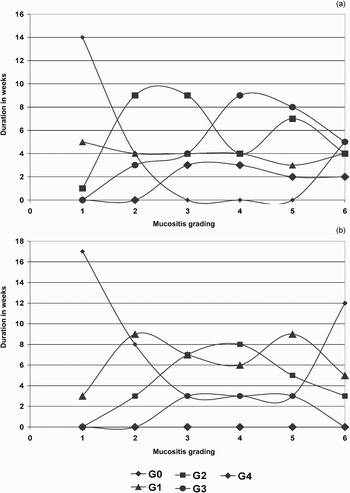
In the treatment group, no patients developed grade four mucositis and only three (15 per cent) developed grade three mucositis. However, in the control group, three patients (15 per cent) developed grade four mucositis and nine patients (45 percent) developed grade three mucositis.
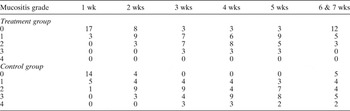
The difference in the mucositis patterns is illustrated in Figure 1. There was a significant reduction in grade three and four mucositis in the treatment group. Five control group patients' (25 per cent) therapy was interrupted as a consequence of radiation mucositis, compared with none in the treatment group. The median discontinuation time was seven days (range, four to 10 days). These patients required nasogastric tube feeding, and both enteral and parenteral fluid and nutritional supplementation. Table III shows patients' distribution of mucositis during radiotherapy.
Occurrence of various grades (G) of mucositis in (a) control group and (b) treatment group.

Occurrence of mucositis during radiotherapy

Data represent number of patients. Wk = week
Candida colonisation was found in 20 per cent of the treatment group and 25 per cent of the control group before radiotherapy, and in 15 per cent of the treatment group and 60 per cent of the control group during or after radiotherapy. The difference between the two groups at the end of radiotherapy was statistically significant (p = 0.003).
Before radiotherapy, four of the 20 treatment group patients (20 per cent) and five of the 20 control group patients (25 per cent) had positive cultures for aerobic pathogenic bacteria. During or after their radiotherapy, three of the 20 treatment group patients (15 per cent) and 13 of the 20 control group patients (65 per cent) had positive cultures for aerobic pathogenic bacteria. The difference between the two groups was statistically significant (p = 0.007).
Occasionally, more than one type of bacteria were isolated from the same patient. However, in both treatment and control groups, the bacterial species most frequently isolated was Staphylococcus aureus, in 11 patients. Pneumococcus type species were detected in six patients, and pseudomonas in four patients.
Discussion
The rationale of using honey in managing radiation mucositis was derived from basic research and clinical observation of rapid epithelialisation of tissue injuries.Reference Bergman, Yanai, Weiss, Bell and David13 Bergman et al. reported that unboiled honey appeared to accelerate wound healing when applied topically; these authors theorised that the effect may be due to honey's energy-producing properties, its hygroscopic effect on the wound and its bacteriostatic properties.Reference Bergman, Yanai, Weiss, Bell and David13 How much of this bacteriostasis is due to honey's inherent antimicrobial propertiesReference Cooper, Molan and Harding14 and how much to its hyperosmolar nature is unknown. Pure honey is acidic, with a pH of around 3.9. A solubility-reducing factor present in honey can activate in the absence of saliva. Honey applied to radiation-induced xerotic mucosa increases the micro-hardness of enamel, thereby preventing caries. Hence, it has been postulated that honey is less cariogenic in patients suffering dry mouth.Reference Sela, Shapira and Grizim15
In this study, we used honey derived mainly from the clover plant Trifolium alexandrenum. We aimed to evaluate the efficacy of pure natural honey in managing chemoradiation-induced mucositis, through clinical scoring of oral mucositis and culturing of pathogenic oral microbes.
• Previous reports suggest that topical application of natural honey may provide simple and cost-effective prophylaxis against radiation mucositis
• This study showed that prophylactic use of pure natural honey was effective in reducing mucositis resulting from radiochemotherapy in patients with head and neck cancer
• The large volume of literature reporting the effectiveness of honey indicates that it may potentially be useful to treat periodontal disease, mouth ulcers and other problems of oral health
The results of this study show that honey can markedly reduce the incidence of radiochemotherapy-induced oral and oropharyngeal mucositis of WHO grades three and four. Our findings agree with the results of another, similar prospective randomised trial testing the use of honey for radiation-induced oral mucositis.Reference Biswal, Zakaria and Ahmad11 Our findings were also comparable with the positive results reported from other trials using different approaches for management of radiation-induced oral mucositis. These approaches included the use of povidone iodine oral rinse,Reference Rahn, Adamietz and Boettcher19 prophylactic sucralfate-based mouthwashes containing ciprofloxacin or ampicillin (and clotrimazol),Reference Matthews and Ercal20 and systemic antifungal prophylaxis with fluconazole.Reference Koc and Aktas21
In patients who receive radiation therapy, the most common clinical infection of the oropharynx is candidiasis.Reference Spijkervet, Van Saene, Van Saene, Panders, Vermey and Mehta22 This was confirmed in our study. Following radiotherapy, we found a significantly higher percentage of patients with candida colonisation in the control group than in the treatment group. This prophylactic antifungal effect of honey was similar to that of fluconazole tested as prophylaxis in patients undergoing radiotherapy for head and neck cancer.Reference Koc and Aktas21, Reference Mucke, Kaben, Libera, Knauerhase, Ziegler and Hamann23 In addition, honey successfully eliminated potentially pathogenic microbial flora in treatment group patients, compared with controls. This finding confirms the antibacterial action of honey.
Conclusion
The results of our trial show that prophylactic use of pure natural honey was effective in reducing mucositis resulting from radiochemotherapy in patients with head and neck cancer. Honey differs from other agents in that it is simple, safe and inexpensive. Further studies are necessary to confirm the role and define the optimal dosage and concentration of prophylactic honey in the management of this morbidity.