Introduction
In cattle, assisted reproductive technologies (ARTs) are widely used by livestock companies to increase genetic progress, reducing the generation gap and increasing the intensity of selection. Cryopreservation has become an integral part of ARTs, as it preserves superior-quality embryos and allows the dissemination of valuable animals of high genetic merit (reviewed by Ferré et al., Reference Ferré, Kjelland, Taiyeb, Campos-Chillon and Ross2020). However, cryopreservation can produce important lesions in embryos, because thermal and osmotic shock, ice crystal formation, or cryoprotectant toxicity can cause considerable morpho-functional changes (Valente et al., Reference Valente, Marsico and Sudano2022). Overall, these effects reduce the re-expansion rates and the total cell number of blastocysts and increase apoptotic rates, leading to a decrease in the post-freezing survival rate (Arshad et al., Reference Arshad, Sagheer, González-Silvestry, Hassan and Sosa2021; Valente et al., Reference Valente, Marsico and Sudano2022). In this context, the search for new alternatives to improve this process remains an important area of investigation.
Antifreeze proteins (AFPs), found in many organisms that are exposed to subfreezing environments at some point in their life histories (Davies and Graham, Reference Davies and Graham2018), have been considered interesting molecules to include in cryopreservation protocols, due to their ability to control the growth of ice crystals, and in particular, to inhibit recrystallization (Robles et al., Reference Robles, Valcarce and Riesco2019). Previous studies have demonstrated the cryoprotective effects of AFPs in preventing cryodamage during cryopreservation of gametes and embryos (Baguisi et al., Reference Baguisi, Arav, Crosby, Roche and Boland1997; Lagneaux et al., Reference Lagneaux, Huhtinen, Koskinen and Palmer1997; Ideta et al., Reference Ideta, Aoyagi, Tsuchiya, Nakamura, Hayama, Shirasawa, Sakaguchi, Tominaga, Nishimiya and Tsuda2015; Chaves et al., Reference Chaves, Campelo, Silva, Bhat, Teixeira, Melo, Souza-Fabjan, Mermillod and Freitas2016; Liang et al., Reference Liang, Yuan, Jin, Zhang, Bang and Kim2017). However, the benefits of using AFPs are quite variable, and success seems to depend on the species, the cell type or stage of embryonic development, the type and concentration of AFP, and the cryopreservation protocol used (Correia et al., Reference Correia, Alves, Batista, Mermillod and Souza-Fabjan2021). Interestingly, the tests carried out in the cryopreservation of embryos have primarily used AFPs of fish origin (namely AFPI, AFPIII, and AFGP).
Lolium perenne L. (Lp) is a frost-tolerant forage grass from the family Poaceae that grows worldwide in cool environments (Sandve et al., Reference Sandve, Kosmala, Rudi, Fjellheim, Rapacz, Yamada and Rognli2011). It has been suggested that Lp uses its antifreeze protein (LpAFP) as a freeze tolerance strategy by inhibiting ice recrystallization (Lauersen et al., Reference Lauersen, Brown, Middleton, Davies and Walker2011; Middleton et al., Reference Middleton, Marshall, Faucher, Bar-Dolev, Braslavsky, Campbell, Walker and Davies2012). However, reports on the application of LpAFP in the cryoprotection of in vitro-produced embryos are still scarce. Considering this scenario, the aim of the present study was to analyze the cryoprotective effects of LpAFP on the vitrification of in vitro-produced bovine blastocysts.
Materials and methods
Ethical statement: The ovaries used in this study were obtained from a commercial slaughterhouse of animals that were slaughtered following international guidelines for the production of meat for human consumption. Therefore, ethical approval was not required.
Purification of LpAFP
LpAFP was kindly provided by P. Davies (Queen’s University, Kingston, Ontario, Canada K7L 3N6). In brief, recombinant LpAFP with a C-terminal 6× His-tag was purified in three steps. Initially, it was made as a His-tagged recombinant protein produced in Escherichia coli. After the removal of most contaminating E. coli proteins by boiling, LpAFP was further purified by ice affinity purification. Finally, Ni-Agarose affinity chromatography was performed, mainly to concentrate the His-tagged product. The pure protein was eluted and dialyzed against 50 mM Tris–HCl (pH 7.8), 100 mM NaCl and 1 mM ethylenediaminetetraacetic acid (Middleton et al., Reference Middleton, Marshall, Faucher, Bar-Dolev, Braslavsky, Campbell, Walker and Davies2012).
Oocyte collection and in vitro maturation
Bovine (Bos taurus indicus) ovaries (age ranging from 24 to 48 months) were collected from a local slaughterhouse and transported to the laboratory at 38°C in saline solution (0.9% NaCl) supplemented with antibiotic/antimycotic (Ab/Am; 100 U/ml penicillin, 100 µg/ml streptomycin, and 0.25 µg/ml amphotericin B; Gibco, Life Technologies, Grand Island, NY, USA). Cumulus–oocyte complexes (COCs) were aspirated from follicles measuring between 4 and 8 mm in diameter using an 18G needle attached to a 10 ml syringe containing phosphate-buffered saline solution (PBS) also at 38°C. Only oocytes with uniform cytoplasm and three or more layers of compact cumulus cells were selected and washed three times in tissue culture medium (TCM199/HEPES; Gibco, Life Technologies) containing gentamicin (10 mg/ml; Gibco, Life Technologies; washing medium). Groups of 20 COCs were washed and matured in 100 µl drops of pre-equilibrated commercial maturation medium (MIV; GeneUp Biotecnologia, Regente Feijó, São Paulo, Brazil), in 35 mm Petri dishes (Sarstedt, Nümbrecht, Germany), covered with mineral oil at 38.5 ºC in a humid atmosphere with 5% CO2 for 24 h.
In vitro fertilization (IVF)
After the maturation period, COCs were recovered, washed in a washing medium, and transferred to 100-µl drops of pre-equilibrated commercial fertilization medium (IVF; GeneUp Biotechnology). Frozen semen from a proven bull was used to obtain motile sperm, after warming, throughout the experiment. For sperm capacitation, after centrifugation for 5 min at 5500 g in a discontinuous density gradient (45%/90%) of Percoll (Pharmacia, Uppsala, Sweden), the resulting sperm fraction was resuspended in 1 ml of IVF medium and was again pelleted by centrifugation for 3 min at 70 g. Spermatozoa were then counted in a Neubauer chamber and diluted in an adequate volume of IVF medium and added to each drop of fertilization at a concentration of 1 × 10⁶ sperm/ml. The gametes were co-incubated for 18 h at 38.5°C in a humid atmosphere with 5% CO2.
In vitro culture
At the end of the fertilization period, the presumptive zygotes were completely denuded through careful pipetting and washed in pre-equilibrated commercial culture medium [Synthetic Oviduct Fluid (SOF); GeneUp Biotechnology]. The presumptive zygotes were cultured in 100-µl drops of pre-equilibrated SOF medium containing amino acids, citrate, myo-inositol and bovine serum albumin (BSA) in 35 mm Petri dishes (Sarstedt, Nümbrecht, Germany), covered with mineral oil at 38.5°C in a humid atmosphere with 5% CO2, 5% O2, and 90% N2 for 7 days.
Vitrification and warming of embryos
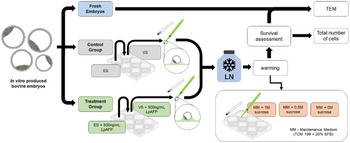
Blastocysts obtained at 7 days after the beginning of IVF were graded according to the criteria established by the International Embryo Transfer Society, and only the grade 1 blastocysts were submitted to a two-step vitrification procedure using a cryotop (Kitazato Corp., Shizuoka, Japan), supplemented or not with LpAFP throughout the vitrification procedure (Figure 1). The control group (CG) was without LpAFP supplementation and the treatment group (TG) was supplemented with LpAFP in both equilibrium and vitrification solutions. Embryos that did not undergo the vitrification process were used as fresh controls for ultrastructural evaluation. To determine an optimal LpAFP concentration, the dose-dependent effect of LpAFP was tested in a preliminary study. The survival rate was higher with 500 ng/ml LpAFP than with 1000 ng/ml LpAFP (unpublished data).
Experimental design. In vitro-produced blastocysts were pooled and randomly assigned to two groups. Vitrification was performed in medium supplemented or not supplemented with Lolium perenne antifreeze protein (0 or 500 ng/ml LpAFP). ES, equilibrium solution; LN, liquid nitrogen; MM, maintenance medium; TEM, transmission electron microscopy; VS, vitrification solution.

The maintenance medium (MM) used to formulate all equilibrium, vitrification and warming solutions consisted of TCM199/HEPES supplemented with 20% (v/v) fetal bovine serum (FBS; Gibco, Life Technologies). All procedures were performed under a laminar flow hood using a surface heated to 38.5°C and a stereomicroscope to visualize each step.
Groups of five to eight embryos were transferred to the equilibrium solution (ES) containing 7.5% (v/v) ethylene glycol (EG; Sigma-Aldrich, St Louis, MO, USA) and 7.5% (v/v) dimethyl sulfoxide (DMSO; Sigma). Afterwards, the embryos were incubated in ES for 2 min and then transferred to the vitrification solution (VS), consisting of 15% (v/v) EG, 15% (v/v) DMSO, and 0.5 M sucrose dissolved in MM. Immediately afterwards, the embryos were placed in a 1-µl drop and deposited in a cryotop, almost all the solution was removed to leave only a thin layer covering the blastocysts. Each cryotop was quickly dipped in liquid nitrogen (LN); the protective cover was attached to the cryotop and it was stored in a LN container. The time of exposure from VS to LN, was not longer than 40 s. Embryos were stored in LN for at least 3 weeks until warming for experiments.
For warming, the protective caps were removed while still submerged in N2 and each cryotop was directly immersed in a warming solution containing 1 M sucrose in MM. After 1 min, the recovered blastocysts were transferred and incubated in MM supplemented with 0.5 M sucrose for 3 min and then in MM for 5 min. All procedures were performed in a standard Nunc 4-well dish (Nunc, Roskilde, Denmark) containing 0.5 ml of warming solution. After the final wash in MM for 1 min, the blastocysts were transferred to the culture medium (SOF) and incubated at 38.5°C in 5% CO2, 5% O2, and 90% N2 at maximum humidity for 24 h.
Embryo survival assessment
To assess the survival of the warmed embryos, each blastocyst was examined after 24 h of cultivation and rated based on whether the blastocoel had been re-established (yes/no) and whether the embryo had hatched or was hatching (yes/no).
To estimate the number of cells, expanded, hatching and hatched blastocysts that survived vitrification in each group were washed in PBS supplemented with 1 mg/ml polyvinylpyrrolidone (PBS/PVP), before being fixed for 30 min in 4% paraformaldehyde in PBS at room temperature. The fixed embryos were washed three times in PBS/PVP, and then permeabilized in 0.5% Triton X-100, containing 0.1% sodium citrate in PBS for 1 h at room temperature. After permeabilization, the embryos were washed in PBS/PVP and incubated in 25 µl microdroplets of Hoechst 33342 stain (1 µg/ml) for 15 min in the dark. Embryos were washed three times in PBS/PVP to remove excess Hoechst 33342 and mounted on poly-l-lysine coated slides with ProLong® Gold mounting medium (Molecular Probes, Life Technologies, Eugene, OR, USA), covered with coverslips supported by paraffin columns, and sealed with nail varnish.
Hoechst-labelled nuclei were counted using a Leica DM5500B fluorescence microscope (Leica Microsystems, Wetzlar, Germany). Images were recorded using a Leica DFC345 FX digital camera and LAS AF software version 2.5. Images were analyzed using ImageJ v.1.48 software (National Institutes of Health, Bethesda, Rockville, MD, USA).
Transmission electron microscopy (TEM)
To better investigate the cellular morphology and organization of organelles in the cytoplasm of embryos, TEM was performed on rewarmed blastocysts cultured for 24 h, as well as the group of fresh embryos that were not subjected to vitrification. Only grade 1 embryos were used (Bó and Mapletoft, Reference Bó and Mapletoft2013). Isolated embryos (n = 15 per group) were fixed in Karnovsky’s solution (4% paraformaldehyde and 2.5% glutaraldehyde in 0.1 M sodium cacodylate buffer, pH 7.2) for at least 4 h at room temperature (∼25°C). After fixation, the embryos were embedded in drops of 4% low-melting-point agarose and kept in sodium cacodylate buffer. The specimens were fixed in 1% osmium tetroxide, 0.8% potassium ferricyanide, and 5 mM calcium chloride in 0.1 M sodium cacodylate buffer for 1 h at room temperature. Next, they were washed in sodium cacodylate buffer and then stained with 5% uranyl acetate. The samples were dehydrated through a gradient of acetone solutions and then embedded in epoxy resin (EpoxyEmbedding Kit, Sigma-Aldrich, USA). Semi-thin sections (2 μm) were cut, stained with toluidine blue and analyzed with light microscopy at ×400 total magnification. Subsequently, ultrathin slices (70 nm) were obtained from bovine blastocysts. The ultrathin sections were counterstained with uranyl acetate and lead citrate and examined under a Morgani-FEI transmission electron microscope (Barroso et al., Reference Barroso, Paulino, Silva, Vasconcelos, Gomes, Lima Neto, Silva, Souza, Donato, Peixoto and Silva2020).
Statistical analysis
Blastocysts were vitrified/warmed in, in total, five replicates. To assess the rate of re-expansion and hatching, the normality of the data was tested with the Shapiro–Wilk test. The normally distributed data were analyzed with analysis of variance (ANOVA). The non-normally distributed data – the total number of cells – were analyzed using the Kruskal–Wallis test. The data are expressed as the mean ± standard error. All analyses were performed using GraphPad Prism software (version 7.02 for Windows; GraphPad Software, La Jolla, CA, USA). P < 0.05 was defined as the significance level. Electron microscopy results are based on qualitative analyses; therefore, they were not evaluated statistically.
Results
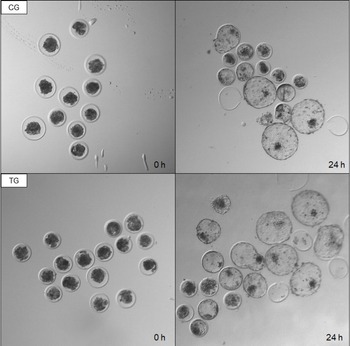
Representative stereomicroscopic micrographs of survival (re-expansion or hatching) of each group are shown in Figure 2. The re-expansion and hatching rates after warming of vitrified/warmed blastocysts in medium supplemented or not supplemented with LpAFP are shown in Table 1. At 24 h after warming, there were no differences in the re-expansion rates between the groups (CG 61.01% vs. TG 60.65%; P > 0.05). However, when hatching rates were evaluated, LpAFP supplementation produced higher hatchability (27.87%) compared with the CG (18.64%; P < 0.05; Table 1).
Representative stereomicrographs of survival (re-expansion and hatching) after warming. CG, control group; TG, treatment group.

Effect of Lolium perenne antifreeze protein (LpAFP) supplementation on survival, expansion/hatching, and the total cell number of vitrified and warmed embryos

The data are presented as the percentage of blastocysts that re-established the blastocoel and the mean ± standard error. Values on the same line with different superscript letters indicate significant differences between groups (P = 0.01). Control group: vitrified/warmed blastocysts without LpAFP supplementation; treatment group: vitrified/warmed blastocysts supplemented with 500 ng/ml LpAFP.
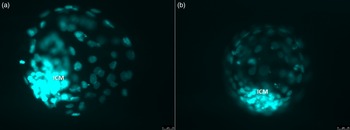
The total cell numbers after 24 h of warming, expanded, hatching and hatched blastocysts that survived vitrification/warming in medium supplemented or not with LpAFP (Figure 3) are shown in Table 1. Expanded and hatched blastocysts that survived vitrification/warming in medium supplemented with LpAFP had more cells (114.87 ± 7.24) than the CG (91.81 ± 4.94; P = 0.01; Table 1).
Blastocysts that survived warming and vitrification in medium supplemented or not with Lolium perenne antifreeze protein (LpAFP, 500 ng/ml) stained with Hoechst 33342 to count the total number of cells. (a) Control group (CG); (b) treatment group (TG). There is a significant difference between the treatments (P = 0.01). ICM, inner cellular mass.

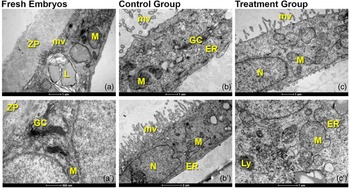
Electron microscopy revealed that all analyzed embryos, fresh and vitrified with or without LpAFP, contained cells with prominent nuclei as well as very visible microvilli and cell junctions. In fresh embryos, spherical or ovoid mitochondria, with a few visible central ridges were found, some lipid droplets could be observed and well defined Golgi complexes were visualized in all cells (Figure 4). In both groups (CG and TG), due to the vitrification process it was possible to visualize some cytoplasmic alterations such as intracellular disorganization, dilation of the rough endoplasmic reticulum, alterations in the Golgi complex and some mitochondria with dilated crests (Figure 4).
Ultrastructural micrographs of in vitro-produced, fresh (a, a′) and vitrified bovine embryos with (c, c′) or without (b, b′) 500 ng/ml Lolium perenne antifreeze protein (LpAFP) supplementation. ER, endoplasmic reticulum; GC, Golgi complex; L, lipid droplet; Ly, lysosomes; M, mitochondria; mv, microvilli; N, nucleus; ZP, zona pellucida.

The main difference between groups was that the embryonic architecture composed of lysosomes, nuclei, lipid vesicles, and other organelles exhibited higher integrity in the LpAFP group. In the CG group, microvilli were present in large quantities, and were well developed in the external membrane of the trophoblast. The CG group presented alterations related to cryopreservation at lower magnifications, while in the TG these alterations were more visible at higher magnifications (Figure 4).
Discussion
Cryopreservation of bovine embryos is an important component when it comes to the adoption and use of in vitro-produced embryos. In the present study, in vitro-produced bovine blastocysts were vitrified using the cryotop method in a medium supplemented with 500 ng/ml LpAFP, to assess the cryoprotective effect of this AFP. The results of the present study showed that the percentage of hatched blastocysts, after 24 h of warming, was significantly higher in the group supplemented with LpAFP compared with the control group.
Similar outcomes were also reported in other studies using AFPs during vitrification protocols (for a review see Robles et al., Reference Robles, Valcarce and Riesco2019). Therefore, Ideta et al. (Reference Ideta, Aoyagi, Tsuchiya, Nakamura, Hayama, Shirasawa, Sakaguchi, Tominaga, Nishimiya and Tsuda2015) reported improvements in bovine embryo short-term storage (4°C), combining the addition of recombinant fish antifreeze protein in the medium (10 mg/ml nfeAFP11) with controlled warming. Liang et al. (Reference Liang, Yuan, Jin, Zhang, Bang and Kim2017) reported that bovine-expanded blastocysts had higher re-expansion rates 12 h after warming when 1 mM antifreeze glycoprotein 8 was added to the vitrification medium compared with the untreated group.
In sheep, the addition of 10 μg/ml antifreeze protein from Anatolica polita (ApAFP914) to the vitrification medium increased the hatching rate at 24 h post-warming but had no effect on embryo survival (Li et al., Reference Li, Wang, Yin, Lin, Wu, Chen, Qiu, Jia, Huang, Jiang, Yang and Liu2020). Recently, Ordóñez-León et al. (Reference Ordóñez-León, Martínez-Rodero, García-Martínez, López-Béjar, Yeste, Mercade and Mogas2022) reported that the addition of 100 µg/ml Exopolysaccharide ID1 (EPS ID1), a molecule with similar cryoprotective activity to AFPs, produced by Pseudomonas sp., a cold-adapted bacterium isolated from marine sediments, to the vitrification medium increased the post-warming re-expansion of D7 expanded blastocysts derived from both cow and calf oocytes.
In contrast, other authors found no effects of AFPs supplementation in horse (Lagneaux et al., Reference Lagneaux, Huhtinen, Koskinen and Palmer1997), sheep (Baguisi et al., Reference Baguisi, Arav, Crosby, Roche and Boland1997) and mouse and pig (Rubinsky et al., Reference Rubinsky, Arav and Devries1992) embryos. These findings point to an important factor that has been previously mentioned and must be taken into account when using these molecules, which is the fact that the concentration, chemical nature, cryopreservation protocol, and features of the biological material could determine the success of the procedure.
Our data further indicate that the surviving blastocysts from the TG had a significantly higher total cell count per blastocyst compared with the blastocysts from the CG. The cell number is an important indicator in assessing the quality of blastocysts. In a recently published study, Valente et al. (Reference Valente, Almeida, Alves, Paschoal, Basso and Sudano2020) demonstrated that the total number of cells identified after vitrification/warming procedures was decisive for blastocyst hatching capacity, an essential step for embryo implantation, and generating a successful pregnancy. In this context, embryo transfer experiments are needed to confirm that the improved in vitro cryosurvival will indeed lead to higher pregnancy rates.
The ultrastructural evaluation of vitrified embryos with or without LpAFP supplementation revealed signs of osmotic lesions, which caused intracellular disorganization. In the CG, it was possible to visualize the dilation of the rough endoplasmic reticulum, alterations in the Golgi complex, and dilation of the mitochondrial crests. Similar lesions have been observed in vitrified bovine, ovine, swine, and rabbit embryos (Darvelid et al., Reference Darvelid, Gustafsson, Shamsuddin, Larsson and Rodriguez Martinez1994; Fabian et al., Reference Fabian, Gjørret, Berthelot, Martinat-Botté and Maddox-Hyttel2005; Dalcin et al., Reference Dalcin, Silva, Paulini, Silva, Neves and Lucci2013; Chrenek et al., Reference Chrenek, Makarevich, Popelková, Schlarmannová, Toporcerová, Ostró, Živčák and Bosze2014). Ohboshi et al. (Reference Ohboshi, Fujihara, Yoshida and Tomagane1998) suggested that stretching of the rough endoplasmic reticulum and alterations in the mitochondrial crests decrease the survival of vitrified bovine embryos.
The addition of 500 ng/ml of LpAFP seems to have mitigated the effects caused by the vitrification process, as observed by the lower proportion of mitochondria with dilated cristae and the absence of lesions in the rough endoplasmic reticulum, suggesting that LpAFP exerts its cryoprotective effect by decreasing these cytoplasmic changes. The evidence presented in this study indicated that the addition of LpAFP during the vitrification process can have a positive effect on vitrified/warmed embryos, allowing them to overcome cryogenic damage.
Cryodamage, such as mechanical and/or osmotic damage caused by the formation of ice crystals, can induce considerable morpho-functional changes in cells (Valente et al., Reference Valente, Marsico and Sudano2022). Ice recrystallization, which is a process by which smaller ice crystals gradually grow at sub-zero temperatures, is believed to be the main cause of damage and decreased cell viability associated with the cryopreservation process (Do et al., Reference Do, Catt, Kinder, Walton and Taylor-Robinson2019). Therefore, proteins and other compounds that inhibit ice recrystallization are necessary to prevent cellular damage during cryopreservation.
Authors of a previous study compared different types of AFPs and clearly demonstrated that AFPs with higher activity to inhibit recrystallization showed better results in the vitrification/warming procedure (Lee et al., Reference Lee, Lee, Kim, Lee, Ko, Kim, Lee, Suh and Kim2015). Sun et al. (Reference Sun, Jang, Kwon, Kim, Ahn, Hwang, Lee, Lee, Hwang and Lee2020) demonstrated that the addition of Leucosporidium ice-binding protein (LeIBP), a protein with recrystallization-inhibiting activity, improved the developmental potential and suppressed apoptosis of embryos derived from vitrified/warmed bovine oocytes.
LpAFP has been reported to have superior ice recrystallization-inhibiting activity compared with fish and insect AFPs (Sandve et al., Reference Sandve, Kosmala, Rudi, Fjellheim, Rapacz, Yamada and Rognli2011; Lauersen et al., Reference Lauersen, Brown, Middleton, Davies and Walker2011; Middleton et al., Reference Middleton, Marshall, Faucher, Bar-Dolev, Braslavsky, Campbell, Walker and Davies2012). In addition, Capicciotti et al. (Reference Capicciotti, Poisson, Boddy and Ben2015) reported the ability of the T67Y LpAFP mutant protein to protect a human liver cell line (HepG2) against cryoinjury, resulting in increased viability of HepG2 cells after cryopreservation. Therefore, we suggest that the cryoprotective mechanism of LpAFP treatment during the vitrification of bovine embryos, as demonstrated in the present study, is related to the ability to inhibit recrystallization.
In conclusion, LpAFP supplementation during vitrification of in vitro-produced bovine embryos improves the hatching rate and total cell number of blastocysts and mitigates cytoplasmic lesions of post-warming embryos in vitro. Future research is needed to understand whether these results translate into better pregnancy outcomes for vitrified in vitro-produced embryos.
Acknowledgements
We thank P. Davies and R. Eves, Department of Biochemistry, Queen’s University, for the antifreeze protein and A. Pedrosa-Harand, Department of Botany, Federal University of Pernambuco, for fluorescence microscope assistance. This work was supported by the National Council for Scientific and Technological Development – CNPq, Brazil.
Declaration of interest
None of the authors have any conflict of interest to declare.