Six months after the armistice that ended World War II, Field Marshal Sir William Slim wrote to Sir Philip Mitchell, the governor of Kenya colony. The letter concerned pensions for African soldiers, and was one of a number Slim addressed to colonial governors in both East and West Africa in 1946. “As a Commander who has had many thousands of African troops under him in a most arduous campaign, I suggest that the granting of a pension to Regular African soldiers for long and faithful service should be considered,” he wrote. “Feeling as I do considerable admiration and gratitude to the African soldier, the least I can do for him is to ask you to give this matter the most favourable consideration you can.”Footnote 1 Slim had commanded African troops as part of the Fourteenth Army in Burma in 1944 and 1945, where—in some of the most difficult fighting conditions of the war—he and his men had successfully driven the Japanese from Rangoon (Yangon) in early 1945 before the onset of the monsoon season.
Slim's experience was mirrored by thousands of British officers who served with the King's African Rifles (KAR) in Abyssinia (Ethiopia), Madagascar, and South Asia. Many served side by side with African troops, sleeping and shooting in close proximity with men they came to view, in some cases, as close friends. But these imperial experiences stood in stark contrast to the rigid colonial racial ordering that existed in the colonies to which they returned on leave during the war and, in many cases, as settlers after its culmination.Footnote 2 Here, Africans were expected to occupy a lower role in society, an issue magnified by a second exodus of Britons to the settler colonies of Kenya and Southern Rhodesia after 1945. Imperial assertions about rights and democracy fit awkwardly in the colonies where racial segregation was the order of the day, a notion recently highlighted in Giulia Barrera's work on the British wartime occupation of Eritrea.Footnote 3 Moreover, military planners cared little about the sorts of things that worried colonial officials: interracial marriage, white “prestige,” and postwar colonial order.Footnote 4
These contradictions and tensions found expression in the pages of Jambo, a magazine that sat at the nexus of the imperial and the colonial, and a venue for the competing discourses associated with each. Published by East Africa Command for British troops in its employ, Jambo was typically sixty-four pages long, and appeared monthly between April 1942 and November 1945. An agglomeration of political articles, general interest stories, propaganda, cartoons, crosswords, and more, Jambo's content was collected, collated, and edited from hundreds of submissions from throughout the theatres of war in which British troops under East Africa Command were stationed. Preference, indeed, was given by the editor to submissions from soldiers farther afield, for instance in Madagascar or Ceylon (Sri Lanka).Footnote 5 In this cyclical process, a fortunate author in Burma might see his hastily written story or scrawled cartoon appear back in his hands via Nairobi in (more) polished form in Jambo's pages several months later. Jambo thus provides a window into the views of some hundreds of British servicemen, who wrote extensively about the Africans with whom they served, revealing the complexities and shifts in British perceptions of African peoples during the conflict.Footnote 6 But Jambo is unique in another respect: it also provided a forum for African troops. In few other publications—and even fewer with such wide circulation—could African peoples reach thousands of British readers. Though their published letters and articles were few compared to those authored by British soldiers, African writers used the venue to critique the conditions of their military service, argue about the sort of social ordering they desired in their home communities, and create an alternate narrative of the war.
In a recent edited volume, Derek Peterson, Emma Hunter, and Stephanie Newell challenged scholars to focus on newspapers “as subjects of historical study,” and not simply as “conveyances for data.”Footnote 7 What, then, might an analysis of Jambo suggest about the colonial public sphere, the subject of this special issue? First and foremost, it aligns with the conclusion of these three scholars that it is imperative to work beyond national and regional boundaries when taking on the history of print media in the colonies, and push past the limitations of an area studies approach. During the twentieth century, after all, newspaper editors in the Caribbean, West Africa, and East Africa copied, borrowed, and sometimes plagiarised ideas, text, and images from one another.Footnote 8 Jambo, too, moved along these new pathways formed for the transfer of information across large parts of the colonised world, without necessarily involving the metropole. Second, Jambo provides a window into thinking about audiences. Colonial publications—like most others—had an intended audience; but also voracious, additional, alternate publics that mediated the articles which appeared in its pages. African soldiers—by virtue of their participation in the war, their reading of and writing in Jambo's pages, and their simple presence in the imperial theatre—demanded attention in this cosmopolitan sphere (an influence we might even extend into the realm of diligent colonial censors).Footnote 9 The colonial public sphere, an analysis of Jambo suggests, was characterised by always encompassing two orientations: it faced local situations as well as global events; for there could of course be no “colonial” without the “imperial,” no colony without empire.
*-*
World War II has proved something of a hiatus in scholarship on publications produced in the colonies during the middle decades of the twentieth century, in striking contrast to that on African literary production both before and after the war.Footnote 10 Where such research exists it generally concerns government-produced propaganda publications, and in some cases, African responses to it.Footnote 11 This, importantly, included propaganda in the vernacular: Katrin Bromber's study of Heshima (published for African troops under South-East Asia Command) and Askari (East Africa Command), for instance, is highly instructive, as is Nicholas Westcott's use of Tanganyika's Kwetu.Footnote 12 These absences are in part due to a natural focus on materials directly produced by Africans, which were limited during wartime by increased levels of censorship, as well as periodic paper rationing. Defence regulations provided little latitude for the expression of popular discontent or opinion, meaning that many newspapers were forced to shut down.Footnote 13 Thus in Kenya, for instance, the banning of the Kikuyu Central Association and arrest of its leaders meant that the publication of its mouthpiece Mumenyereri ceased. Where publications did appear, they had to temper their criticism, as in the case of the Daily Service or West African Pilot of Nigeria.Footnote 14 Similarly in South Africa, white mine owners controlled the African-produced Bantu World, by far the most commonly read newspaper among Africans. It could criticise the government up to a point, but any discussion of a major issue like land ownership was strictly off-limits.Footnote 15 Where we can recover African (and indeed European) voices in print, it is typically from memoirs written after the war's end, often after years or decades of reflection have taken place (something that also applies to oral interviews).Footnote 16 In contrast, Jambo's monthly appearance over a three and a half year span provides an immediate window into the changing views and impressions of Africans and Britons during wartime.
Edited throughout its existence by Lieutenant N. A. C. Tyfield, the pocket-sized Jambo first appeared in April 1942, replacing EAFORCE News, a four-page daily paper printed in Nairobi.Footnote 17 The magazine was something of a one-man show, although Tyfield was helped by several assistant and art editors. Jambo sold for fifty cents throughout its entire lifespan, as the editorial team deliberately kept the cost low to enable all servicemen stationed from East Africa to Burma to purchase it. Each edition included several pages of advertisements at its beginning and end that reflected Jambo's ostensible domestic audience. Most were for Nairobi-based businesses: Torr's Hotel on Delamere Avenue (now Kenyatta Avenue) advertised its dancing evenings, and Chez Gaby its French lunches; May & Co. pushed sports equipment, and MacGregor-Oates a range of Dodge, Plymouth, and Chrysler cars; Johnnie Walker occupied the back inside cover, and Tusker lager the outside. While Jambo began as something of a propaganda magazine, its approach turned largely to humour by 1944 once the fortunes of war had shifted towards the Allied side.
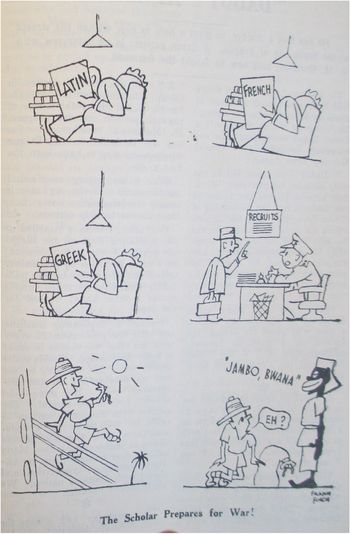
Jambo's early issues fell into using long-established colonial stereotypes to describe African peoples. Africans were “tribal,” unintelligent “others” who were largely incomprehensible to Britons. The magazine's first issue of April 1942 told a story about a Maasai man who had killed a Luo for abusing a woman. The article drew rigid ethnic lines between the Maasai man—depicted as noble, though unable to comprehend British courtroom proceedings—with the Luo, whose death was apparently justified due to his ignoble behaviour.Footnote 18 Other excerpts described Africans who were mystified by the spectacles British officers wore, and others who were unfamiliar with the use of currency (“old Gillette blades were used [as substitute]”).Footnote 19 And these notions were reflected in Jambo's cartoons, several of which appeared in each issue. In one, a British officer—familiar with a wide range of languages—is utterly unable to understand an African subaltern, who is drawn with thick white lips, closed eyes, and a wide grin.
Cartoon from Jambo 1 (April 1942), 41.

British officers themselves, though, were never a homogenous crowd. Thousands were concerned by imperialism, colonialism, and the treatment of nonwhite peoples. They were terrified by the possibilities of a war in which the slaughter of millions paid scant heed to race, colour, or religion. Their worries were exacerbated by deep respect for the African soldier, honed in the Somalia Gendarmerie (like Gerald Hanley, below), King's African Rifles, and police regiments. The war clearly suggested that the colonial project would—at the very least—require a complete overhaul. Major Philip Mumford serves as a useful example of these sorts of contradictions. A veteran of the First World War who had subsequently served in British mandate territory in Iraq, Mumford had published extensively on air power and limiting its use against civilians.Footnote 20 In 1936, he had presented his ideas to the Liberal Summer School at Oxford, suggesting that the League of Nations—“reorganised”—should be in charge of European aviation.Footnote 21 The following year, he wrote An Introduction to Pacifism. It was a “plea” for “absolute” global pacifism, a more extreme position at which he explained he had arrived during the previous year, based on his lack of “faith in … collective security.”Footnote 22 Mumford was an active member of the Peace Pledge Union (PPU), an organisation founded in 1936 that renounced war in all forms, and favoured appeasement with Nazi Germany. Mumford's sensibilities would again change in 1940, when he resigned from the PPU to join the war effort. Mumford—and others—were torn asunder by his and Britain's predicament.Footnote 23
One of the ways that Mumford perhaps sought to alleviate his situation was to continue writing. In December 1942, he wrote an article unique in Jambo's history. Titled “You and the African,” Mumford—presciently—depicted the war as a moment of transformation for African peoples, and warned that the British should not make the mistake of imagining that life in the colonies would return to the way it was in 1939. Mumford saw two possibilities: returning soldiers would arrive home either advocates of empire, or “rebels,” and there was no middle ground. Mumford viewed India as a warning: despite British success in developing India, the British were “not popular” among people who were “anxious for the speedy termination” of the Raj. He thus viewed the officers of East Africa Command as holding tremendous responsibility: if they learned Swahili, got to know their men, and developed strong bonds with them, they could shape the future of the British Empire in Africa. Otherwise, the British “arrogant claim to superiority” would finish them.Footnote 24 In this, Mumford reflected the deep concern that officials in both Britain and Africa had about the future of empire. Frank Furedi has described this threat to “white prestige” that obsessed officials during the years of war: they feared that demobilised African soldiers, now aware of racialism, racism, and global inequality, would represent an existential threat to the shaky foundations of indirect rule. Consequently, the Colonial Office sought to avoid reference to colour or any potential “colour problem” in print wherever possible.Footnote 25 (Men writing in Jambo, in fact, enjoyed more latitude than almost anywhere else.)
Jambo's articles left little question as to the crucial role African soldiers were playing in the promulgation of the war.Footnote 26 Following the KAR's successful rampage across Madagascar to seize the island from the Vichy regime, Tyfield used his editor's introduction to the October 1942 issue to rave about the “fearless hand-to-hand actions” of the regiment.Footnote 27 Jambo was only reaffirming the notion that most British officers had developed based on long months of service with African troops. In many cases, they built close relationships with these men, which they would later recall in idyllic (though occasionally patronising) terms.Footnote 28 Major Michael Blundell provided one typical account during the Allied assault on Gondar in Abyssinia in 1941, describing one evening when he counted his men back into camp at 5 am:
As so often in withdrawals … coys [companies] had become muddled up and the last six hours of the night I myself, the adjutant and OC (Officer Commanding) C Coy fought … and recced a trail as the rest of the battalion if left for a minute simply fell asleep on the ground. They lay in rows dead beat, Europeans, Africans all twisted up together. I learnt a lot about who had guts. … [The next day] from 11 at night till 2 in the morning we just lay in single file along the track we had made, like corpses, asleep until the small waning moon should rise to help us.Footnote 29
As Waruhiu Itote—a member of 36 KAR—put it, “Among the shells and bullets there had been … no air of superiority from our European comrades-in-arms. There were no racial insults, no references to ‘niggers,’ ‘baboons’ and so on.”Footnote 30 But back in Kenya after the war—with Blundell the leader of the colony's settler community—such camaraderie was unthinkable. The racial divisions that were so prominent in Kenya (as distinct from the West African colonies) would be tremendously jarring for African troops when they returned home.
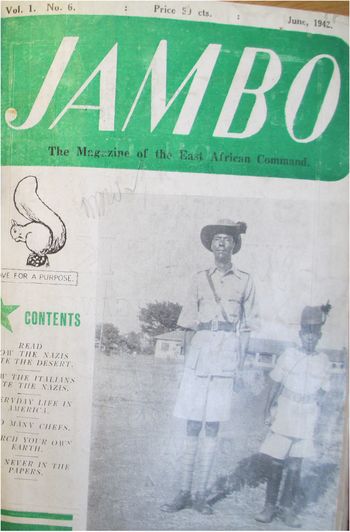
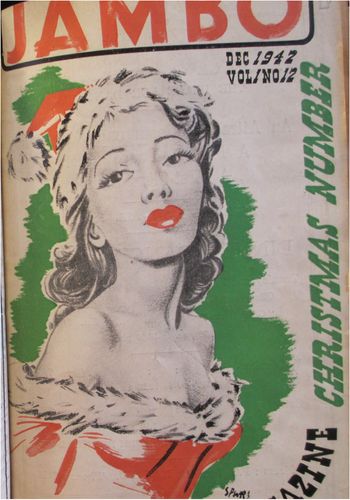
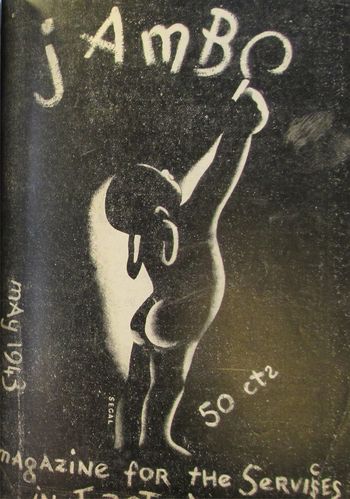
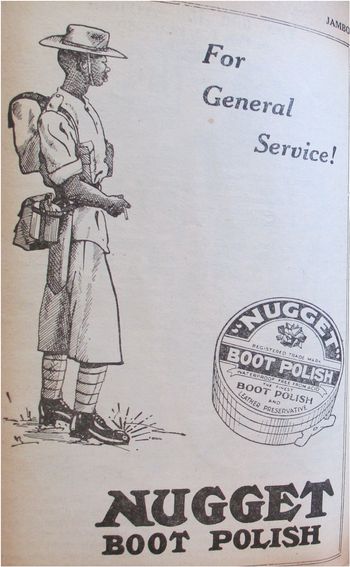
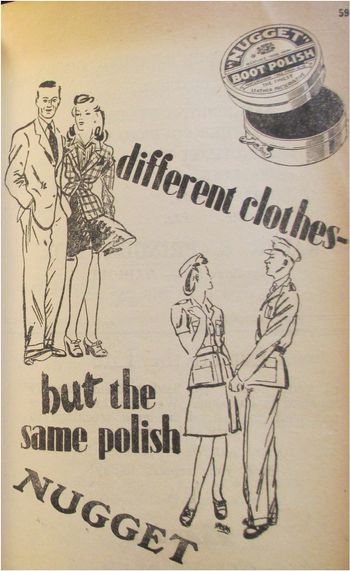
This contradiction found expression in Jambo's pages, and highlighted what awkward bedfellows were the colonial and imperial realms, a characteristic we can trace back at least as far as the impeachment trial of Warren Hastings in the late eighteenth century.Footnote 31 Even as Jambo's authors wrote in glowing terms about African soldiers and Africa in general, the magazine also became more “British-focused” and less interested in publishing letters and articles written by Africans. In 1942, Jambo's main recounting of the capture of Italian Somaliland was authored by a Luo clerk, but similar pieces became ever-more rare as instead, African voices were represented by British authors.Footnote 32 It is difficult to ascertain the reason; certainly ongoing debate existed among British officers as to whether Africans should be encouraged to read and write at all.Footnote 33 The result, in any case, was that letters to the editor written by Africans disappeared after 1943: among the extant issues of Jambo, not a single one appears in either 1944 or 1945. And Jambo's cover images reflected the change: in the first year and a half of its publication (between April 1942 and October 1943), five of the nineteen depicted Africans. The first-ever edition showed a black-and-white photograph of the War Memorial in Nairobi; June 1942 had two African soldiers standing at attention; but the three covers in 1943 focused on “tribal” Africa: two caricatures of “warriors” with spears, and the other featuring a naked child. After that, variously clothed European women came to dominate Jambo's covers, with the occasional nod to Africa's scenery or wildlife, but not its human population. This shift also occurred in the one advertisement in Jambo's pages that carried an image of a nonwhite person. In 1942, Nugget boot polish's adverts featured a handsome askari (soldier) clad in long safari shorts, casually smoking a cigarette. The caption read: “For General Service!” In early 1943 Nugget's adverts transitioned briefly into showing a simple pair of shoes, but by March 1943 featured slim, well-dressed European couples—one pair in military uniform, and one in civilian clothing.
“R.S.M. [Regimental Sergeant Major] and Bugler at Jinja Training Centre,” Jambo 1 (June 1942), cover image.

Jambo 1 (Dec. 1942), cover image.

Jambo 2 (May 1943), cover image.

Jambo 1 (Dec. 1942), 52.

Jambo 2 (March 1943), 59.

By 1943, however, the majority of British authors had begun to alter their portrayals of African peoples. This reflected several years spent in close interaction and association with Africans in the military context. More broadly, it was symptomatic of the transfer of influence and ideas from the colonies to the theatres of war and back, frequently unmediated by the metropole.Footnote 34 Africans had ceased to become largely unknown, stereotyped “others.” In Jambo, one clear example of this transformation involved indigenous forms of knowledge. In several of the magazine's earlier issues, African beliefs served as vehicles to create humour for British readers. But authors soon began to give credence to them, as they recognised that there were types of knowledge and forms of belief that Europeans might not understand. One article called “Juju” described the hold that “superstition” had on “primitive” people. It detailed how a man had been freed from a trance by discovering a cursed egg with his name on it. The man who had laid the curse then died after a British medical officer claimed the same “juju” would kill him too.Footnote 35 The officer could not explain it, but attested to the presence and efficacy of the curse. Several months later came another article, about a man named Ogwa who had killed a rival in cold blood. He was cursed by spirits when he wiped his bloodied panga (machete) on a baobab tree, and died in terror soon after. The author of the story concluded on a serious note: “There are more things in heaven and on earth than are dreamed of in our philosophy.”Footnote 36 It was a recognition that European knowledge went only so far.
A wide range of British authors came to poke fun at themselves for their backward, “colonial” misconceptions about African peoples, and the stereotypes to which they and the broader public subscribed. In a four-part story that appeared in mid-1944, war correspondent Gerald Hanley—attached to the Fourteenth Army in Burma—wrote like an early, British version of the Kenyan satirist Binyavanga Wainaina.Footnote 37 Claiming birth in Ireland (though born in Liverpool), Hanley would soon become known as a talented novelist who worked at times for the BBC, but also as a commentator who criticised the colonial system and its negative consequences for peoples of colour. He had served during the Italian occupation of British Somaliland in the war's early years, where he had come to regard Somalis highly. In Jambo, Hanley wrote about a message that was delivered which should have arrived “on an arrow which should have embedded itself in the doorway,” accompanied by “tom-toms throbbing.” “Annoyingly enough the natives up in Somalia don't get to the pictures very often, and their education has suffered accordingly,” he noted.Footnote 38 Authors came to needle Britons and their misconceptions about Kenya in particular. One new recruit was horrified to come across “no lions [and] no Ma[a]sais” during his journey to Nairobi from Mombasa, but nevertheless spent time pulling together a “creditable collection of semi-credible anecdotes” that he could twist into stories of the “real Africa” people would expect back at home.Footnote 39 Another story—set in London in 1949—told of an exhibition of “savage African headhunters.” The observer—noting a familiar face—greeted the “headhunters” in Swahili. After “a moment's confusion,” he wrote, “I have before me … in columns of threes complete with supernumerary ranks, standing to attention … the KAR. The ‘Chief Witch Doctor’ is out in front, slinging up a very special salute, and says: ‘Hapana washenzi Bwana, Askari tu’ [We aren't savages, sir, just soldiers].”Footnote 40 The story served two purposes: first, to make fun of British misconceptions about Africans, especially in the metropole; and second, to demonstrate how African peoples might use British stereotypes to win success (a prominent aspect of the tourist industry in East Africa today).
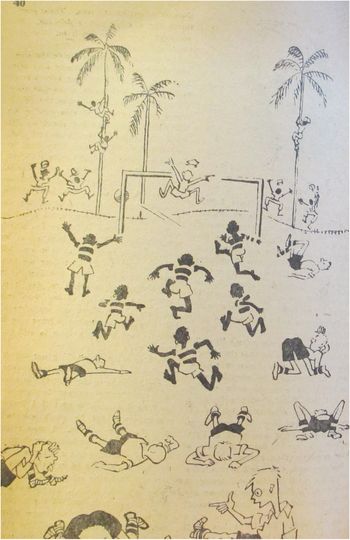
Jambo's later issues—while packed with ever-present humour—turned to more serious considerations of changes among the African population over which the British Empire ruled. Gone were depictions of “magnificently animalian” and “hunteresque” warriors with “widealert eyes and trembling nostrils … [With] fightlust [that] has ruffled their tribal blood” (an exoticism to which even the Trinidadian Pan-Africanist George Padmore had subscribed).Footnote 41 African “warriors” had become “soldiers,” modern men who listened to the radio, studied blood slides in laboratories, and drove cars. They argued with British officers in English in Jambo's pages, taking advantage of the breadth of audience Jambo provided. British officers noticed that Africans recognised British fallibility, and that officers acted foolishly at times.Footnote 42 Africans could offer wisdom about things that Europeans found difficult to explain.Footnote 43 British officers came to attribute wide knowledge to their men, and talent in attributes ranging from sharp eyesight, to tracking, to soccer, in which the supposed “pupil” far surpassed the “teacher”.
Cartoon from Jambo 4 (Aug. 1945), 10.

Cartoon from Jambo 3 (Aug. 1944), 40. “Yes Dunscombe – I know they get the goals but their POSITIONAL play is atrocious!”

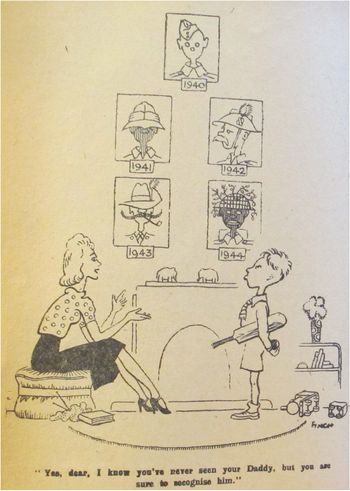
One cartoon from mid-1944 depicted a presumably British woman who was explaining to her son how she was unsure about the identity of his father. On the wall of her home hung pictures of five soldiers, one dated from each year between 1940 and 1944, with the 1944 image an African man.Footnote 44 It is difficult to imagine this cartoon appearing in 1942, and certainly not in any publication read exclusively in the colonies. Colonial fears of “black peril”—of African men raping white women—are well known. But in the imperial context, such a relationship would have been less fraught, though still controversial.Footnote 45
Cartoon from Jambo 3 (Aug. 1944), 8.

By 1944 and 1945, British authors were calling into question whether British colonialism had genuinely brought benefits to—or even impacted—African peoples. In some cases, British soldiers had viewed horrific slaughter firsthand for a number of years, something that had disillusioned them, assaulting their previous beliefs in “trusteeship” and “partnership” with Africans. One lengthy poem called “Fragments from a Kenya Satire” described World War II as a “scientific slaughter” that Europeans had brought to Africa along with “psalms” and “tobacco smoke.” The rather gloomy piece showed how the global war had changed life irreversibly in the colonies, the existence of which, indeed, was likely extremely limited. Though he put the words in the mouth of an Indian living in East Africa, the author's reference to “The Europeans' Fuehrer-like behavior / And claim, like him, to be the native's savior.” was striking and would have resonated powerfully among Jambo's readers of all backgrounds.Footnote 46 Moreover, Tyfield clearly considered the four-page poem appropriate material for his audience. Some soldiers came to question the value of their service in East Africa, though in humorous terms. One song went, “Fighting the Jap from Muthaiga, / Hitting him hard from ‘The Club.’ … / Sticking it out at the Stanley / Doing our bit for the war.”Footnote 47 It described the common experience of the British officer in East Africa whose tours sometimes included more time spent at the gin-holes frequented by Nairobi's settlers than anywhere else.
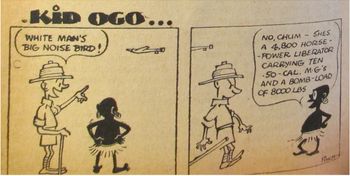
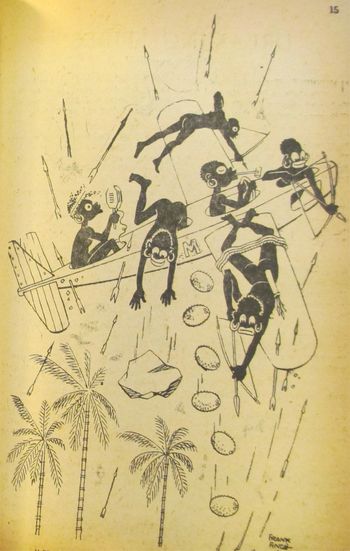
Yet even at this stage, negative—colonial—portrayals of Africans appeared. Descriptions of “wogs” were relatively common, and cartoons frequently returned to stereotyped images of African peoples with thick white lips, though their numbers were fewer. Such depictions were, of course, conspicuously absent from vernacular publications written for African and Indian troops, which avoided racialised language even when describing their Japanese enemy.Footnote 48 Moreover, they were only imaginable in a publication produced in a settler colony (Kenya). The contrast was striking: Jambo's issue of May 1944 contained a laudatory piece about the Mombasa coastal gunners, whose “smooth efficiency” and “pride born of confidence” enabled them to excel despite the tedium of their imperial employment.Footnote 49 But the following month's issue contained a cartoon showing naked “tribesmen” throwing coconuts from an airplane.Footnote 50 Some authors drew attention to these inconsistencies. In an article relating a fictional interview with a “Mr. Arbuthnot,” the subject is asked whether British men and women in East Africa should learn Swahili. “No Sir!” he replies, “Just give ‘em [Africans] a good kick right up the backside! They do it twice as fast.” He is then asked, “What do you think of the African askari?” to which he replies, “Dogged. Follow his Bwana [Master] to the end of the world. Fight to the last. Too good for the Jap. Wish he could have a crack at Jerry too—wipe the bastards clean off the face of the earth. And clean, too! scrupulously clean.”Footnote 51 The contrast reflected the difference between serving with an African in the army and meeting him on the street in Nairobi: in the first arena, skin colour meant little; in the second, the atmosphere was still racially defined and limited.
Cartoon from Jambo 3 (June 1944), 15. “M for Mfredi [Freddy] calling… Heavy flak over target area…”

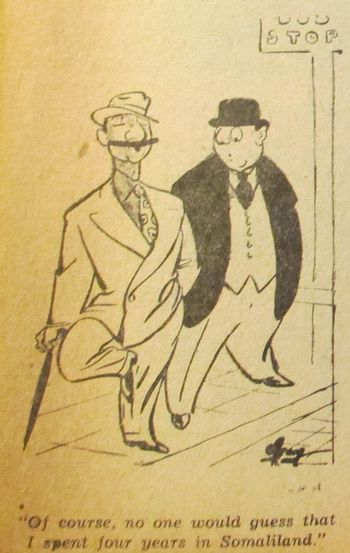
Many soldiers came to view their service—and time in Africa, in particular—as something preferable to life in Britain, where rationing and low wages greeted them after the war's end, and many struggled to readjust. In Jambo's pages, Africa became a place where things were simpler and more pleasurable. Africa had impacted these soldiers in ways of which they were barely aware: one cartoon showed a man unconsciously standing on one leg, apparently the product of four years in Somaliland where pink flamingoes are a common sight on the region's waterways.Footnote 52 British soldiers were depicted in cartoons and stories as having failed to recognise the effect that Africa had had on them, while being paradoxically obsessed with a continent that offered colour and excitement that was hard to find in grey postwar Britain. One story of this sort related a chance meeting in London in 1947 between two KAR veterans, Bill and Potter. Potter acts as though he has never left Africa, sprinkling his vocabulary with the broken Swahili of the KAR officer. When Bill attempts to leave—claiming he must get home to his wife—Potter responds: “Oh, the little mem[sahib] wouldn't mind bado kidogo-ing a spot while one effendi pots with another effendi.”Footnote 53 Bill is rather annoyed by Potter's insistence on coming home with him (irritated not just by the interruption, but also Potter's constant use of KAR-Swahili). When Potter finally vacates the home after overstaying his welcome, Bill declares to his wife that he was “bored stiff” by the conversation about Africa. His wife tartly replies, “In which case … you'll realise that I take a very dim view of settling down tomorrow to type Chapter 23 of your book about Kenya!”Footnote 54
Cartoon from Jambo 4 (Aug. 1945), 52. “Of course, no one would guess that I spent four years in Somaliland.”

*-*
Jambo's pages included a significant amount of material authored by Africans, especially in 1942 and 1943. This draws attention to the pathways of informational exchange between home and abroad that existed during the war. Jambo was dispatched outward from East Africa; but back came letters to its editor, as well as hundreds of thousands more to homes and families. In one day in 1942, for instance, district officials in Machakos (in eastern Kenya) had to sort through 1,514 individual missives for distribution to the correct villages.Footnote 55 Without question, censorship existed and limited the possibilities of expression; but the sheer volume of written material—and the speed at which it moved between correspondents—was unprecedented, and brought mail service to small towns for the first time. The great irony was that in the colonies before the war, African editors or authors wishing to share information widely were hampered by censorship, fines, difficulty in procuring paper, and the expense and complexity of the printing process. This was reflected in a significant number of publications that appeared for several months before disappearing without trace, most of which were only several pages long, and unattractive as a result of their low quality appearance.Footnote 56 Now, Africans took advantage of wartime infrastructure to communicate with one another and a British audience.Footnote 57 Awareness was magnified with the arrival of wireless radio sets—carrying global news—which blared in every marketplace across East Africa by 1945.
It is important to recognise that the very act of writing and receiving letters was a revolutionary departure from what had gone before. Serving in the military meant that African soldiers were taught—at minimum—a basic comprehension of English, and learned to write or develop their skills in both English and vernacular languages. Hanley described the thrill that the written word brought into army camps across Southeast Asia: “The passion for writing and reading had gripped them and every man had learned even a few words. In their spare moments they sat down with stubs of pencils, pushed out their tongues, and with much labour wrote a letter to Africa.”Footnote 58 These facts were clearly illustrated in Jambo: one letter, for instance, was written by “Luo Soldiers who are in Somalia.” The soldiers described the excitement they experienced when the word went around that the mail had arrived, noting that in such circumstances, it was even difficult to keep a man at his post. Thus, “[If] John gets one letter, all soldiers in the camp will gather round as if … [a] cow is being slaughtered for a feast. They gather because they want to hear news from home.” The soldiers then explained that when few letters arrived, their worry was overwhelming: “If we do not get letters … we are out of hope that there is any of our folks whom we left home who is alive.”Footnote 59 Communal reading, of course, included poring over Jambo's pages.
Soldiers serving abroad used Jambo as a venue where they could explore the new and sometimes confusing world in which they found themselves. Using the magazine, they could frame the war in terms that suited them, creating a separate narrative of the conflict. One dresser—Corporal Zabulon Denge—described how he was “scared” at the shelling he experienced during the Allied capture of Tobruk in Italian Libya. And he aimed to make the war comprehensible to African peoples who had yet to experience the noise and chaos of bombing: the shell noise was “louder than the whistle of an engine,” he explained, “Luo people may compare it with an ‘abu,’ or Kikuyu with a ‘kioro.’”Footnote 60 One Somali explained the conflict in local terms: Churchill was the “big chief”; Hitler and Mussolini were two brothers, described as players in a sort of ancient saga; the British were “God's Captain”; and the story of the war was recounted by four great winds. “Rice, dates and clothes” would be the Somalis’ reward in victory.Footnote 61 And for ambulanceman Williams (see below), expected behaviour for a soldier was best explained by recourse to a traditional proverb about a lion, rabbit, and bushbuck.
African soldiers also used Jambo as a location where they could express and argue over social concerns. In an important work, James Brennan explores how soldiers in South Asia debated notions of honour (heshima) and shame (aibu) in the Swahili-language press during the war.Footnote 62 These were several among a range of subjects—importantly including notions of race and nation—that would occupy Tanganyikans in the postwar years. Soldiers used the pages of Heshima—a KAR publication that appeared three times per month in Swahili and Chichewa—to both demand respect and call on their fellows to behave in a manner that demanded it.Footnote 63 In Jambo, there was a clear focus on appropriate gender relations at home, and the freedoms soldiers’ wives possessed while they were away at war. This desire to maintain and protect the workings of domestic life has been broadly highlighted by Derek Peterson in colonial Africa, by Tim Parsons with reference to the KAR, and by Oliver Coates among soldiers from southwestern Nigeria.Footnote 64 They would become prominent topics in the colonies after 1945, when soldiers returned home: various veterans’ groups (or groups in which veterans played a major role) would attempt to “repatriate” women to their home areas, limit their abilities to leave them without male assent, or in other ways restrict the autonomies women had gained during wartime.Footnote 65
In this vein, serving soldiers wrote a significant number of letters to Jambo's editor in 1942 and 1943. Lance Corporal W. Williams—an ambulanceman from Northern Rhodesia—reflected these worries, tying potential success in the war to maintaining a moral code: “If we do not go after girls we will be good and strong askari,” he noted.Footnote 66 Sandford Sumile—a clerk in the Northern Rhodesia Regiment—used Jambo as a way to reach other African soldiers, reflecting how the magazine enjoyed a fair readership among Africans. Sumile was writing to praise the government for sending men to rural areas to serve as letter-writers for illiterate men and women. He first raised concerns brought to him by three askari: they were worried that unknown letter-writers had been meeting with their “misbehaving” wives in their absence. Sumile dismissed their concerns about these government representatives, but not their concerns about their wives’ behaviour. Without this facility, he argued, wives would have to travel from their homes to find letter-writers. While on these journeys, “much time would be wasted” from domestic duties, he explained. And, he concluded, “I think if I am not wrong, she is likely to do many evil things in that certain village if she wants to.”Footnote 67
On one occasion, a letter written by a civilian clerk employed in Nairobi appeared in Jambo's pages. It is difficult to ascertain why the letter was reprinted in Jambo, although one suspects that the editor might have thought that the unconventional use of English and inventive metaphor would prove amusing to readers. The letter was, in essence, a plea for assistance written by the clerk to his employer. The police had arrested the clerk for residing without permission at a friend's house one night. The clerk lamented his inability to rent his own room, a concern felt by thousands of Nairobi residents who experienced poor housing in the late 1930s and 1940s. The clerk begged his employer to help him “get a room,” citing his concern that he was wasting the school fees his father had worked hard to procure.Footnote 68 The clerk thus expressed the worries young men felt in making ends meet in Nairobi.Footnote 69
Soldiers also voiced their discontent about serving conditions to Jambo's largely British audience, using the English language to take their white counterparts to task. Widespread frustration about rates of pay East African soldiers received compared to their British, West African, or Caribbean colleagues has been well documented.Footnote 70 One signalman named Abdu Salum wrote a humorous rhyming poem in which he raised the issue of poor wages, which nevertheless did not prevent fines: “Kits are lost, for Askari neglect KARO [? ] / CSM [Command Sergeant Major] charges them all [a]re punished. / … Must he pay, although his wage is low?” Salum continued to express dissatisfaction about the standard of clothing and food: “Clothes all issued, there are no more, / Cooks collect meat, all bone and raw.”Footnote 71African authors’ awareness that they could reach a British audience occasionally manifested in dialogue with British authors. One clerk named James J. Majani responded to Mumford's piece (above) four months after it appeared. Majani began by noting that he had been happy to read the piece in the previous December's issue. He described his “profound pleasure” at reading it, and that he considered the author's views “worthy.”Footnote 72
Majani and his colleagues were performing a discourse that challenged the conditions of their service and the overall imperial framework. Their sterling military accomplishments had earned them the space to offer critique in a way that would have been impossible in the colonies. Here in Jambo's unique colonial-imperial public space they could tailor their critiques and views to British authors, depicting themselves as part of the shared Allied, imperial collective fighting against Germany and Japan. Mumford's views would be important, “in life tomorrow,” Majani wrote, a nod towards the end of the war and the return of African troops to the colonies. It was an effort to situate African voices as part of the unified Allied global collective, and deserving of the rights supposedly enshrined in documents like the Atlantic Charter. In short, imperial service established an avenue for the expression of colonial critique. African soldiers would play on their wartime service to demand concessions and development funding in the postwar era, as well as to position themselves within their communities as ethnic leaders.Footnote 73
There is also a distinct collection of articles featuring African testimony in Jambo that are more difficult to comprehend. At first glance, these stories seem like planted propaganda: they powerfully compliment British officers and their methods of leading African men, and express pride in the service provided by Africans to the British Empire.Footnote 74 As I have argued in Ethnicity and Empire in Kenya, these sorts of expressions of “loyalty” in the Kamba case were related to local understandings of honour and pre-existing or contested notions of “tribal” cultural material that included not just veterans but women too.Footnote 75 But the weight of oral interviews I collected for the book prevents me from entirely dismissing the apparently sincere testimonies of veterans who profess deeply held “loyalty” to British officers and pride in having fought for Britain. It seems that explaining away such accounts does a disservice to those who express them; for some proportion of soldiers, fighting under the Union Jack was a source of tremendous pride. (Take the case of one colonial chief and war veteran who flew the Union Jack outside his home. He resigned his position at Kenya's independence because he “did not want to serve an African government.”Footnote 76) Future research is needed on this important but unfashionable area that jars with much of the “nationalist narrative,” to develop better understandings of veterans’ accounts of their time in British service. But these debates do seem to suggest how wartime service could both challenge the conditions of colonial rule and simultaneously reinforce its racialised hierarchies.
*-*
In late 1943—“with apologies to Rudyard Kipling”—“Num” wrote a three-verse poem in Jambo entitled “Gunga Njoroge.” The poem was, of course, an “African” version of Kipling's “Gunga Din,” the tale of an Indian water-carrier who—though beaten and disparaged—ultimately sacrifices his life in the service of British troops. Gunga Njoroge's story is similar: a “regimental sweeper” and toilet cleaner, Njoroge dies an ignoble death in British service while cleaning a sewer. The deaths of Gunga Din and Gunga Njoroge cause the narrators in each case to lament the way they had “belted” and “flayed” their subalterns, ultimately recognising that each was “a better man than I am.” Both narrators give their subjects the highest praise possible by attributing whiteness to them: like Din (“for all ‘is dirty ‘ide, ‘E was white, clear white, inside”), Njoroge was “the whitest man I knew,” a common refrain among Jambo's authors who wished to denote respect for their subordinates.Footnote 77 “Gunga Njoroge” summed up the transformation British soldiers had undergone in their service with African troops in the imperial context: though the latter were sometimes treated poorly, they were perceived as unfailingly loyal, and worthy of respect from their officers.Footnote 78 But by framing their efforts in terms of skin colour, the author reflected the racialised colonial world that ultimately defined their service.
Sitting at the nexus of African and Briton during World War II, Jambo's pages demonstrate how British soldiers came to rethink the terms of their relationships with Africans in a positive manner, though within the limitations of the colonial system. (It is perhaps worth noting that the King's African Rifles & East African Forces Association—an organisation of former British soldiers who served in East Africa—has raised over £300,000 for the relief of African veterans, funds they continue to disburse today.Footnote 79) And for African servicemen, Jambo provided an opportunity: they could relate their social concerns at home, express their grievances about the conditions of military service, and reach a wider British audience where they could even sometimes create a dialogue—however small—with British soldiers. Viewing themselves as new, cosmopolitan men, they demanded that their imperial experiences and service entitled them to speak as equals with their British counterparts.
So what does Jambo suggest about the colonial public sphere? First, it destabilises any narrow understanding of the “colonial.” The “colonial” was never limited to the colonies; a global war guaranteed that, laying bare the reality that for editors and intellectuals in the colonies the external world—Britain, West Africa, or Southeast Asia—was always present to be addressed, negotiated with, opposed, or simply as a backdrop. Analysing Jambo also suggests—following Bryna Goodman's important research on the press in early colonial Shanghai—that the poles of “colonial” and “imperial” might best be thought of as ends of a continuum, between which readers, authors, editors, and audiences could take varying positions at different times.Footnote 80 We might apply this logic to physical spaces too. In all this, the Second World War catalysed a vast production of writings and a reading culture that would serve as a basis for the renegotiation of the colonial space in the postwar era.
Acknowledgements
I am grateful to Leslie James, Emma Hunter, Stephanie Newell, and Andrew Arsan for arranging workshops at the University of Cambridge (2015) and Yale University (2017) where I developed the ideas contained in this paper. Participants at these meetings offered generous feedback, as did Jim Brennan on a later draft. The University of Colorado Boulder's Graduate Committee on Arts and Humanities provided funds to permit my attendance at both meetings.