A growing literature documents greater positive biases in the self-perceptions of children with attention-deficit/hyperactivity disorder (ADHD) than in comparison peers (e.g., Hoza et al., Reference Hoza, Gerdes, Hinshaw, Arnold, Pelham and Molina2004; Hoza, Pelham, Dobbs, Owens, & Pillow, Reference Hoza, Pelham, Dobbs, Owens and Pillow2002). “Positive bias” refers to a self-enhancing discrepancy between children's self-reports of competence and external indices of competence, such as ratings by other informants (e.g., teachers, parents, peers) or objective measures of performance. Of importance, a positive bias can be present for children whose self-evaluations are on par with those of their age mates, if these self-evaluations are overestimations relative to accepted measures of competence. Positive bias has generally been measured in a domain-specific manner, with the academic, social, and behavioral domains most widely studied. Such a domain-specific approach is consistent with arguments from the self-concept literature that, even within the same individual, self-views may vary across domains of competence (Harter, Reference Harter1999).
Although positively biased self-perceptions are not unique to clinically diagnosed children with ADHD (see, e.g., David & Kistner, Reference David and Kistner2000), they occur to a greater extent in this population than in control children (Hoza et al., Reference Hoza, Pelham, Dobbs, Owens and Pillow2002, Reference Hoza, Gerdes, Hinshaw, Arnold, Pelham and Molina2004). Further, evidence suggests that positively biased self-perceptions help explain, via mediation, the higher rates of conduct problems in children with ADHD, relative to controls (Kaiser, Hoza, Pelham, Gnagy, & Greiner, Reference Kaiser, Hoza, Pelham, Gnagy and Greiner2008), a point that we will return to later. Finally, an overly self-confident style may be associated with poorer response to psychosocial interventions in this population (Hoza & Pelham, Reference Hoza and Pelham1995). Given this constellation of findings, it seems particularly important to understand developmental changes in positively biased self-perceptions of children with ADHD, especially as they may relate to changes in adjustment. Yet, no such studies have been reported; extant studies have examined concurrent relations primarily. The present study extends available knowledge by (a) examining developmental change over a 6-year period in degree of positively biased self-perceptions in a group of children with ADHD and a normative comparison sample, (b) examining whether changes in biases are associated with time-dependent changes in adjustment, (c) examining the direction of effects between positively biased self-perceptions and adjustment, and (d) examining whether ADHD status moderates the longitudinal associations between positive biases and adjustment indices.
Four primary theoretical explanations have been posited in the literature to explain the greater levels of positively biased self-perceptions in children with ADHD, relative to their age mates: cognitive immaturity, neuropsychological deficits, ignorance of incompetence, and self-protection (for a review, see Owens, Goldfine, Evangelista, Hoza, & Kaiser, Reference Owens, Goldfine, Evangelista, Hoza and Kaiser2007). Although not mutually exclusive (and, in fact, partially overlapping in their predictions), these explanations emphasize different factors as central to positively biased self-views. Two of these explanations, cognitive immaturity and self-protection, will be considered here as they are best evaluated in the context of a longitudinal design. Note that we adopt a developmental psychopathology approach (Sroufe, Reference Sroufe1997) to the study of positively biased self-perceptions in children with ADHD by including both children with ADHD and a comparison group of age mates. This allows us to outline both developmental predictions arising from these two perspectives (i.e., predictions that would be expected to apply to all children as a function of development), as well as group predictions (i.e., patterns expected to differentiate children with ADHD from comparison children). Such an approach may assist in determining whether positively biased self-views in children with ADHD reflect a delay in accomplishing salient developmental tasks, such as acquiring accurate beliefs about one's abilities, versus a deviation from typical developmental patterns.
Cognitive Immaturity
With respect to cognitive immaturity, it is possible that the positively biased self-perceptions observed to a greater degree in children with ADHD are simply a function of slower maturation of self-perceptual processes in this population. Overestimations of competence are normative at younger ages because of an inability to differentiate actual competence from the desire to be competent (Harter, Reference Harter1999). These overly optimistic self-views also serve the key developmental function of promoting skill development in new areas of competence (Bjorklund, Reference Bjorklund1997). Specifically, young children are unlikely to try or persist at new tasks and activities that they view as being beyond their capability. Given that young children lack expertise in most domains, their overly positive self-views of competence promote learning or persistence on difficult tasks that might otherwise prove too discouraging (Bjorklund, Reference Bjorklund1997). By middle to late childhood, however, children generally become increasingly accurate at assessing their competencies as they both gain in actual skills and begin to use social comparison information to evaluate the self (Harter, Reference Harter1999). Hence, prior to the onset of early adolescence, most children are capable of reasonably accurate self-evaluations.
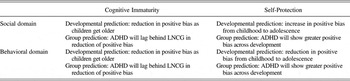
Despite this overarching pattern of increased accuracy of self-perception with development, some theorists have proposed that accuracy of self-perceptions may be temporarily disrupted at key transitional periods during adolescence. As noted by Harter (Reference Harter1999), “most developmental transitions present new tasks to be mastered, which may cause doubt and anxiety about one's abilities as well as challenge existing self-representations, leading to potential alterations and inaccuracies in self-perceptions” (p. 319). Nonetheless, even allowing for these temporary and normative disruptions, from a cognitive immaturity perspective, children would show an overall decrease in positively biased self-views with increasing maturation, with cognitively immature individuals following a similar trajectory at a slower pace. Further, cognitive immaturity should affect positive bias similarly across domains, such that the pattern of decreasing bias should be consistent across different domains of competence. Finally, if cognitive immaturity accounts for differences in positive bias between children with ADHD and control children, then the normative decreases in positive bias should be delayed for children with this condition (see Table 1 for a summary of predictions). It is important that by including both external criteria for accuracy of self-perception and a normative comparison group in the present study, we are better able to determine whether children with ADHD follow the same trajectory over time as comparison children, albeit on a delayed schedule, versus whether a different developmental trajectory is observed.
Domain-specific predictions based on the cognitive immaturity and self-protection explanations of positively biased self-perceptions in children with ADHD

Note: ADHD, attention-deficit/hyperactivity disorder; LNCG, local normative comparison group. Developmental predictions describe patterns expected as a function of typical development. Group predictions describe patterns expected to differentiate children with ADHD from comparison children.
Self-Protection
A second explanation that has been offered to explain the inflated self-perceptions that characterize many children with ADHD is that these self-perceptions serve a self-protective function (Diener & Milich, Reference Diener and Milich1997). More specifically, given the many functional deficits associated with ADHD, perhaps children with ADHD cope with their deficits largely by denying them, a strategy that seems compatible with the striking lack of insight often noted by clinicians who work with this population (Loeber, Green, & Lahey, Reference Loeber, Green and Lahey1990). This perspective is consistent with recent work indicating that not only do children with ADHD, relative to comparison youth, report self-perceptions that are more discrepant from others' views of their competence, but they also do so the most in domains of greatest deficit (Hoza et al., Reference Hoza, Pelham, Dobbs, Owens and Pillow2002, Reference Hoza, Gerdes, Hinshaw, Arnold, Pelham and Molina2004). That is, children with ADHD with high levels of aggressive behavior inflate the most in the social and behavioral domains, whereas those with low achievement inflate the most in the academic domain (Hoza et al., Reference Hoza, Pelham, Dobbs, Owens and Pillow2002, Reference Hoza, Gerdes, Hinshaw, Arnold, Pelham and Molina2004). Such a pattern may indicate an attempt to bolster one's self-views to more normative levels despite questionable or limited competence.
Consistent with this perspective, emerging evidence suggests that children with ADHD engage in a number of behaviors that may serve to maintain a positive self-image. For example, a recent study found positively biased self-perceptions to mediate the relation between ADHD status (having or not having ADHD) and frequency of certain conduct problem behaviors exhibited in a summer treatment program setting: swearing, verbally abusing staff, intentionally aggressing against staff and peers, and interrupting others (Kaiser et al., Reference Kaiser, Hoza, Pelham, Gnagy and Greiner2008). Although the exact processes underlying this association are not clear, a plausible explanation from the social psychology literature (Baumeister, Smart, & Boden, Reference Baumeister, Smart and Boden1996) is that individuals with unrealistically positive self-views may exhibit hostile, defensive reactions in response to negative or corrective feedback from others. In other words, such individuals may go to great lengths to uphold and defend their fragile, but unrealistically positive, self-views.
It is interesting that studies examining the impact of positive feedback on the inflated self-perceptions of children with ADHD indicate that positive feedback leads to a reduction in inflation in the social domain for children with ADHD (but not control children); it may be that a self-protective stance is lessened once it is no longer necessary (Diener & Milich, Reference Diener and Milich1997; Ohan & Johnston, Reference Ohan and Johnston2002; for contradictory findings regarding the academic domain, see Ohan & Johnston, Reference Ohan and Johnston2002). This supposition provides at least partial support for the contention that children with ADHD may inflate their self-views in domains of uncertain or reduced competence and then relax this strategy once it is no longer needed.
All children, however, might enlist self-protective processes during certain developmental periods when new challenges are encountered or when competent functioning in a given domain is deemed especially important. For example, as children enter adolescence, the developmental task of forming intimate relationships with peers becomes particularly important (Berndt, Reference Berndt, Graber, Brooks-Gunn and Petersen1996; Bukowski & Kramer, Reference Bukowski and Kramer1986; Hartup, Reference Hartup and McGurk1992). As such, failure in the social domain should become increasingly threatening during adolescence. In contrast, at about this same time, normative levels of delinquent and aggressive acts may begin to confer a number of advantages, including mature status and popularity among peers (Moffitt, Reference Moffitt1993; Parkhurst & Hopmeyer, Reference Parkhurst and Hopmeyer1998). Thus, getting in trouble for misbehavior, although still an indicator of poor behavioral competence, should be less threatening for adolescents than for younger children because, at this age, these behaviors are to some degree normative and accepted by peers.
From a self-protective perspective, then, positive biases regarding social competence should increase during adolescence for all children, whereas biases regarding behavioral competence should decrease. In both the social and behavioral domains, however, the level of positive bias in self-perceptions of children with ADHD should exceed the normative levels of comparison children given that their functional deficits in these domains confer a greater need for self-protection (see Table 1 for a summary of predictions).
The Adaptive Significance of Positively Biased Self-Perceptions
In addition to their underlying cause, a second important unanswered question regarding positively biased self-perceptions pertains to their implications for the adjustment of children with ADHD. It is often assumed that feeling good about oneself is a hallmark of mental health, but it is not at all clear whether it is advantageous for children with ADHD to develop positively biased self-perceptions despite relatively low levels of actual competence. As we have noted previously (Hoza et al., Reference Hoza, Gerdes, Hinshaw, Arnold, Pelham and Molina2004), whether positive self-views must be attuned to reality in order to be adaptive has been a matter of debate in the social psychology literature. Notably, Taylor and Brown (Reference Taylor and Brown1988) argued that “overly positive self-evaluations, exaggerated perceptions of control or mastery, and unrealistic optimism are characteristic of normal human thought” (p. 193) and “may be especially apparent and adaptive under circumstances of adversity, that is, circumstances that might be expected to produce depression or lack of motivation” (p. 201). Consistent with this perspective, prior work indicates that children with ADHD who are higher on depressive symptoms do indeed have self-perceptions that reflect either realistic or negatively biased self-views (Hoza et al., Reference Hoza, Pelham, Dobbs, Owens and Pillow2002, Reference Hoza, Gerdes, Hinshaw, Arnold, Pelham and Molina2004).
In contrast to this argument for the adaptiveness of positively biased self-views, others have argued for the importance of accurate self-views (Colvin, Block, & Funder, Reference Colvin, Block and Funder1995). Specifically, Colvin et al. (Reference Colvin, Block and Funder1995) note that “contrary to some prior formulations, … accurate appraisals of self and of the social environment may be essential elements of mental health” (p. 1152). If accurate self-appraisals are indeed essential, then overly positive self-views may serve as a risk, rather than protective, factor. Consistent with this perspective, research supports the notion that positively biased self-perceptions are associated with poorer adjustment in childhood (Edens, Cavell, & Hughes, Reference Edens, Cavell and Hughes1999). Specifically, children with positively biased self-perceptions are rated by parents, teachers, and peers as higher in aggression and delinquency than children without such positive biases (Edens et al., Reference Edens, Cavell and Hughes1999; see also Gresham, Lane, MacMillan, Bocian, & Ward, Reference Gresham, Lane, MacMillan, Bocian and Ward2000). Of importance, the link between positively biased self-perceptions and aggression is evident even at moderate levels of inflation and holds even when controlling for sex and ethnicity (David & Kistner, Reference David and Kistner2000).
Of course, it is possible that positively biased self-perceptions serve as a risk factor for some mental health problems, such as aggression, but as a protective factor for others, such as depression. Overly negative self-perceptions have been studied extensively as a risk factor for depression (for a review, see Jacobs, Reineke, Gollan, & Kane, Reference Jacobs, Reinecke, Gollan and Kane2008), and emerging evidence suggests that overly positive self-perceptions are protective against depression in normative development (Whitton, Larson, & Hauser, Reference Whitton, Larson and Hauser2008).
Clearly, this debate over the short- and long-term consequences of positively biased self-perceptions has important implications for the goals of mental health intervention and prevention programs, not only for disruptive behavior disorders but for other psychological disorders as well. In particular, it remains unclear whether the goals of interventions should be to promote accurate views of the self, even if accurate views are quite negative, or whether they should be to promote relatively positive views regardless of accuracy. In the proposed study, we address this important question by examining whether changes in positive biases are associated with time-dependent changes in adjustment (both symptoms of depression and aggression). We also examine whether positive bias leads to adjustment or whether adjustment problems lead to changes in biased self-perceptions. We propose that positively biased self-perceptions may serve as a risk factor for aggression and a protective factor for depressive symptoms. Nonetheless, it is possible, and perhaps even likely, that changes in aggression or depressive symptoms lead to changes in self-perceptions. For example, a child who becomes increasingly depressed may develop increasingly negative self-views, rather than the reverse. In addition, consistent with the self-protective view, children with behavioral problems may, in turn, choose to inflate self-perceptions to cope with these developing problems.
A final consideration regarding the association between positively biased self-perceptions and adjustment is whether these relations are moderated by ADHD status. For example, it is possible that positively biased self-perceptions are more strongly related to aggressive behavior among children with ADHD than among age mates. Given the problems with behavioral regulation typical among children with ADHD (Barkley, Reference Barkley1997), emotional reactions to negative appraisals may be especially likely to result in aggressive outbursts among ADHD samples.
Goals and Predictions
Overall, our first objective was to evaluate the relative utility of the cognitive immaturity and self-protective perspectives in explaining the positively biased self-perceptions of children with ADHD, using a developmental psychopathology framework. Specifically, we explored developmental change in social and behavioral positive self-perceptual biases in both children with ADHD and comparison children. If the cognitive immaturity perspective best explains positively biased self-perceptions, then both children with ADHD and comparison children should exhibit decreases in these biases with increasing age across the social and behavioral domains, but children with ADHD should lag behind comparison peers (i.e., show slower maturation). In contrast, if the self-protection perspective best explains positively biased self-perceptions, then positive biases in the social domain should increase for all children with the progression into adolescence, whereas biases in the behavioral domain should decrease. Still, because of greater deficits in competence and thus a greater need for self-protection, children with ADHD should exhibit higher levels of positive bias than control children across both domains and across the 6-year period examined (see Table 1).
Second, with respect to the dynamic association between positive biases and adjustment (aggression and depressive symptoms), and consistent with the notion that positive self-perceptual biases may serve as both a risk and protective factor, we predicted a positive association over time between degree of positive bias and aggression, and an inverse relation over time between degree of positive bias and depressive symptoms. We also explored whether ADHD status moderated the dynamic association between biased self-perceptions and adjustment. We expected increases in positive biases to be more strongly related to aggression in children with ADHD than in comparison children. Finally, we examined whether positively biased self-perceptions predicted change in adjustment and/or whether adjustment problems predicted changes in positive biases.
Method
Participants
Participants included 797 children aged 8–13 years (M = 9.97, SD = 0.93; 5.0% were 8, 37.1% were 9, 34.6% were 10, 20.3% were 11, 2.6% were 12, and 0.3% were 13 years of age at Time 1) drawn from the Multimodal Treatment Study of Children with ADHD (MTA). Five-hundred thirteen participants were classified at study entry (2 years prior to the initial data collection for the present study) as ADHD-combined type (409 males, 104 females). All diagnoses were made by MTA staff following procedures outlined in Hinshaw et al. (Reference Hinshaw, March, Abikoff, Arnold, Cantwell and Conners1997). Although carefully diagnosed, the sample was quite heterogeneous with respect to comorbidity and was selected to be widely representative of children seen in clinical practice (MTA Cooperative Group, 1999). Of the 579 participants with ADHD from which the current subsample of 513 was drawn, 33.5% had a comorbid anxiety disorder, 14.3% had conduct disorder, 39.9% had oppositional defiant disorder, 3.8% had an affective disorder, 10.9% had a tic disorder, 2.2% met criteria for mania or hypomania, and 0.2% had some other diagnosis (e.g., enuresis; MTA Cooperative Group, 1999). Comorbid diagnoses were assessed using the Diagnostic Interview Schedule for Children (Shaffer et al., Reference Shaffer, Fisher, Dulcan, Davies, Piacentini and Schwab-Stone1996), versions 2.3 or 3.0 (Hinshaw et al., Reference Hinshaw, March, Abikoff, Arnold, Cantwell and Conners1997).
These participants underwent 14 months of treatment determined by random assignment to one of four conditions: (a) medication management, (b) behavior therapy, (c) combined treatment (a treatment strategy involving both medication management and behavior therapy), or (d) community care (self-chosen treatments by community providers at participants' expense, including the possibility of no treatment). Following the 14 months of MTA-administered treatments, a follow-up phase began during which participants were periodically assessed but no further treatments were provided by the MTA. During this follow-up phase, participants were free to seek treatments in their communities. To ensure an adequate comparison group for the follow-up phase of the MTA, at 24 months, a local normative comparison group (LNCG) was recruited from the same schools as the ADHD sample. The LNCG sample size for the present study was 284 (231 males, 53 females). The children for the present study included all participants who had bias measures during at least one assessment period from the total sample of 579 children with ADHD and 289 LNCG children.
Data for this study were collected at four different time points. The first time point analyzed for the present study (Time 1) corresponded to the 24-month assessment in the main MTA study, which is 2 years after initial ascertainment and random assignment to a 14-month period of intervention, and the first time point at which LNCG data were available. Of importance, prior published analyses indicated that at 24 months (10 months after active MTA treatments terminated) there were no effects of MTA treatments on levels of biased self-perceptions in this sample (Hoza et al., Reference Hoza, Gerdes, Hinshaw, Arnold, Pelham and Molina2004); hence, randomized treatment assignment was not considered further. This 24-month time point is Time 1. Time 2, Time 3, and Time 4 assessments occurred 1, 4, and 6 years after the Time 1 assessment, respectively.
Sixty-two percent of the sample was Caucasian, 17% African American, 11% Hispanic or Latino, 8% biracial, and 2% other. The average household income of participants was $50,000–$60,000 (income range = <$10,000 to ≥$80,000). There were no significant differences in race/ethnicity, χ2 (1) = 0.49, p = .48, or sex, χ2 (1) = 0.30, p = .58, between the MTA and comparison groups. However, MTA participants did have a lower family income when compared to the normative comparison group (LNCG), F (1, 777) = 23.17, p < .001, partial η2 = 0.03.
Positive illusory biases
Participants' rated their perceptions regarding their social acceptance (e.g., “some kids are popular with other kids their age …”) and behavioral conduct (e.g., “some kids usually get in trouble because of things they do . . . ,” reverse-scored) on a scale of 1 to 4 using the appropriate subscales from the Harter Self-Perception Profile for Children (Harter, Reference Harter1985) at Time 1 and Time 2 of the study and the Harter Self-Perception Profile for Adolescents (Harter, Reference Harter1988) at Time 3 and Time 4.Footnote 1 Although self-perceptions of competence in other domains of functioning may be assessed using these instruments, they were not of interest for the present study. Scores for items in each subscale of interest were averaged to yield a competence score in each domain, with higher scores reflecting higher self-reported competence. In the present sample, the internal consistencies of both the self-reported social acceptance and the behavioral conduct scales were acceptable at all time points (α range = 0.73–0.81).
Teachers rated participants' social acceptance (e.g., “this child is popular with others his/her age … ”) and behavioral conduct (e.g., “this child is usually well-behaved … ”) on a scale from 1 to 4 using the teacher version of the Self-Perception Profile for Children (Harter, Reference Harter1985) at Time 1 and Time 2 and the teacher version of the Self-Perception Profile for Adolescents (Harter, Reference Harter1988) at Time 3 and Time 4. Scores in each subscale were averaged to yield a competence scale in each domain. When more than one teacher reported on a participating child, the scores from all teachers were averaged to create a single teacher-report score. The internal consistencies of teacher-reported social acceptance and behavioral conduct were acceptable at all time points (α range = 0.81–0.94).Footnote 2
Self-perceptual bias scores were calculated by subtracting teacher reports of participants' competence in the social and behavioral domains from children's own self-reported competence score from the parallel domain. Thus, positive bias scores reflected inflated self-perceptions relative to teacher report, whereas negative scores reflected underestimated competence relative to teacher report. Although some researchers have argued for the use of standardized difference scores rather than raw difference scores when measuring informant discrepancies (De Los Reyes & Kazdin, Reference De Los Reyes and Kazdin2004), we used raw difference scores for two reasons. First, a primary goal of the study was to examine mean change in self-perceptual bias scores across development. Although standardizing self-perception measures to create a standardized difference score retains participants' relative ranking, it obscures mean change over time. Second, standardization of measures yields scores based on the specific study sample. To make our results comparable to other studies of mean change in biased self-perceptions over time (with separate ADHD and comparison samples), raw scores for self-perceptual biases were selected. Because of missing self or teacher reports, 13% of the sample was missing bias scores regarding social and behavioral competence at Time 1. Because of missing data and/or attrition, 18%, 30%, and 34% of the sample were missing self-perceptual bias scores at Times 2, 3, and 4, respectively.
Depressive symptoms
Participants reported on their depressive symptoms (27 items) on a scale from 0 to 2 using the Children's Depression Inventory (CDI; Kovacs, Reference Kovacs1985). Scores from each item were summed to yield an overall depressive symptoms score. Higher scores reflected greater levels of depressive symptoms. The internal consistency of the CDI was good at all assessment periods (α range = 0.83–0.89). Because of missing data and/or attrition, 3%, 7%, 15%, and 29% of the sample were missing CDI scores at Times 1, 2, 3, and 4, respectively.
Aggressive behavior
Participants' aggressive behavior was assessed with the DSM-IV Conduct Disorder Checklist (Hinshaw et al., Reference Hinshaw, March, Abikoff, Arnold, Cantwell and Conners1997), a 38-item parent-rating measure of the frequency of behaviors defining conduct disorder according to DSM-IV on a scale of 1 (never) to 4 (often), with additional aggression/conduct items included (e.g., “hit other children”). Items were summed to yield an overall aggression score. Most participants (93% at Time 1) had reports from the biological mother; in addition, many of these participants also had reports from biological fathers (44% at Time 1). However, other reporters also were included (e.g., 4% had reports from fathers only or fathers and stepmothers). Given the relatively high correlation between scores by different reporters (e.g., r = .60, p < .001 between biological mothers and biological fathers at Time 1), scores were averaged to create one caretaker-report score if more than one caretaker reported on the participant. The internal consistency of this scale was good (α range = 0.89–0.91). Because of missing data and/or attrition, 5%, 8%, 13%, and 27% of the sample were missing aggression scores at Times 1, 2, 3, and 4, respectively.
ADHD symptoms
Participants' ADHD symptoms were assessed by parent report using the Swanson, Nolan, and Pelham IV Rating Scale (Swanson, Reference Swanson1992). This measure consists of 39 items assessing symptoms of ADHD (e.g., “Is easily distracted by extraneous stimuli”) and oppositional defiant disorder (e.g., “loses temper”). Only the 18 ADHD items were used for this study. Parents rated items on a scale from 0 (not at all) to 3 (very much). Scores from each item were averaged to create an ADHD symptoms score, with higher scores reflecting greater symptoms. Most participants (93% at Time 1) had reports from the biological mother; in addition, many of these participants also had reports from biological fathers (44% at Time 1). However, other reporters were also included (e.g., 3% had reports from fathers only or fathers and stepmothers at Time 1). Mean scores were averaged across reporters to yield an overall ADHD symptoms score. The internal consistency of this scale was excellent at all time points (α range = 0.95–0.96). Because of missing data and/or attrition, 4%, 8%, 13%, and 27% of the sample were missing ADHD scores at Times 1, 2, 3, and 4, respectively.
Results
Missing data
Five-hundred eighty-three participants (73% of the sample) remained in the study through Time 4. We examined whether there were differences between participants who remained in the study compared to participants for whom data were not available (or who were lost to attrition) by Time 4. Results indicated that attrition was not associated with self-perceptual biases in the social domain at Time 1, F (1, 690) = 2.81, p = .11, biases in the behavioral domain at Time 1, F (1, 692) = 1.55, p = .21, depressive symptoms at Time 1, F (1, 772) = 0.64, p = .43, family income, F (1, 777) = 1.55, p = .21, ADHD status, χ2 (1, N = 797) = 2.93, p = .09, or race, χ2 (4, N = 797) = 7.71, p = .10. However, attrition was associated with age, F (1, 795) = 98.22, p < .001, partial η2 = 0.11, aggressive conduct at Time 1, F (1, 758) = 5.67, p < .05, partial η2 = 0.01, and ADHD symptoms at Time 1, F (1, 761) = 4.34, p < .05, partial η2 = 0.01. Specifically, older participants and participants with higher levels of aggression and ADHD symptoms were less likely to be included in the study than were their peers. Maximum likelihood estimation procedures were used to accommodate missing data. However, analyses were reconducted excluding participants without full data by Time 4. With four exceptions (the interaction between level of self-perceptual biases and ADHD status in predicting aggression; aggression at Time 2 predicting behavioral biases at Time 3; social biases at Time 1 predicting aggression at Time 2; and behavioral biases at Time 3 predicting aggression at Time 4), all significant findings reported remained significant in these analyses. In addition, most of the findings that dropped to nonsignificance remained marginally significant (p < .10) despite the reduction in power because of a smaller sample size. Therefore, findings do not appear to be an artifact of attrition.
Characteristics of the MTA and normative comparison groups
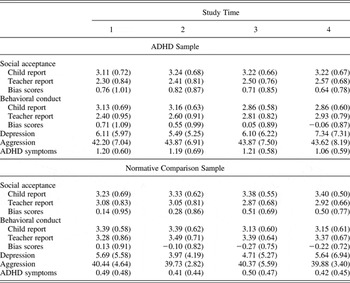
Three repeated measures analyses of variance were conducted with ADHD symptoms, aggression, and depression as the repeated measures factor and ADHD status as the between-subjects factor. Results indicated that children in the MTA sample exhibited elevated levels of ADHD symptoms, F (1, 527) = 286.69, p < .001, partial η2 = 0.35. There was a mean change in ADHD symptoms over time, F (3, 525) = 14.48, p < .001, partial η2 = 0.08, and ADHD status moderated mean change in ADHD symptoms over time, F (3, 525) = 2.81, p < .05, partial η2 = 0.02. Among ADHD participants, there was a decrease in symptoms at Time 4. Among control participants, there was a decrease in ADHD symptoms at Time 2, an increase at Time 3, and a decrease at Time 4 (see Table 2). Results indicated that children in the MTA sample exhibited elevated levels of aggression, F (1, 525) = 70.44, p < .001, partial η2 = 0.12. There was no mean change in aggression over time, F (3, 523) = 1.75, p = .16, and there was no interaction between ADHD status and mean change in aggression over time, F (3, 523) = 0.10, p = .96. Finally, MTA participants exhibited elevated levels of depressive symptoms, F (1, 522) = 11.02, p < .01, partial η2 = 0.02. There was mean change in depression over time, F (3, 520) = 21.76, p < .001, partial η2 = 0.11, with depressive symptoms decreasing at Time 2 and increasing again through Time 4. There was also a marginally significant interaction between ADHD status and mean change in depression over time, F (3, 520) = 2.56, p = .05, partial η2 = 0.02, with a more pronounced decrease in depressive symptoms at Time 2 for the control children (see Table 2). These results indicate that the MTA sample was at elevated risk for a number of problems across the 6 years of the study. Note also in Table 2 that the positive bias in self-perceptions of the children with ADHD appeared to arise from lower teacher ratings of competence, rather than from elevated self-reports of competence. In other words, the positive bias seemed to result from an attempt to “normalize” self-appraisal, not from self-appraisals that exceeded the norm.
Means (SD) of study variables
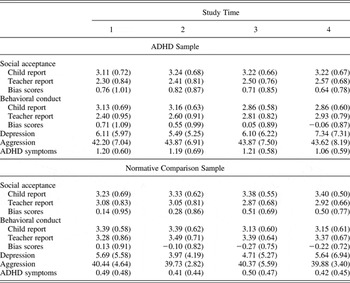
Note: ADHD, attention-deficit/hyperactivity disorder. Higher scores reflect higher levels of competence, biases, depression, aggression, and ADHD symptoms.
Developmental change in levels of positive biases
To examine developmental change in levels of positive biases regarding social acceptance and behavioral conduct, we employed linear mixed models (LMMs) using SAS Proc Mixed. LMMs are an extension of regression models and utilize restricted maximum likelihood estimation procedures to estimate fixed effects. As in multiple regression analyses, the estimates provided for each predictor in LMMs control for the influence of the other predictors in the model; thus, the unique role of each predictor can be assessed. However, LMMs allow correlated residuals so that mean change in measures over time can be assessed (Long & Pellegrini, Reference Long and Pellegrini2003). LMMs provide a number of advantages over more traditional methods such as regression or repeated-measures analysis of variance when analyzing longitudinal data (see Bryk & Raudenbush, Reference Bryk and Raudenbush1992; Long & Pellegrini, Reference Long and Pellegrini2003; Verbeke & Molenberghs, Reference Verbeke and Molenberghs2000). For example, LMM procedures are more robust to violations of assumptions, permit more parsimonious models than traditional methods, yield higher power in the testing of effects, and can accommodate missing data (Long & Pellegrini, Reference Long and Pellegrini2003; Verbeke & Molenberghs, Reference Verbeke and Molenberghs2000).
The first LMM examined developmental change in levels of biases regarding social acceptance. Inspection of mean change in levels of biases indicated potential linear and quadratic change over time (see Table 2). In this analysis, the equation used to model mean-level change incorporated ADHD parameters so that we could examine differences in the ADHD and comparison samples' (a) social self-perceptual biases at the start of the study (i.e., intercept) and (b) changes in self-perceptual biases (i.e., linear change). Comparison of a variety of covariance structures indicated that an unstructured variance–covariance matrix fit the data well, so we adopted this matrix for our final models. Preliminary analyses indicated that ADHD group status did not moderate quadratic change in level of biases; as a result, this parameter was dropped from the final model. The following equation was used to estimate the fixed effects:

where μj is the mean social biases at time j (indexed by assessment Times 1, 2, 3, and 4), l j is the term used to model the linear trend across time, and q j is the term used to model quadratic change over time. In this analysis, l j = (age in years – 8) at time point j, with 8 years subtracted so that the intercept reflects values for the youngest participants at the first time point; q j is the square of the linear term (i.e., age in years – 8); and γ0, γ2, and γ4 capture the degree of mean level change over time for the normative comparison sample, with γ0 indicating the predicted self-perceptual biases at the first assessment period (i.e., the intercept) for the youngest participants, γ2 representing the strength of the linear trend in positive biases over time, and γ4 indicating the strength of quadratic change in positive biases. In addition, γ1 and γ3 represent the interaction of ADHD status with the intercept and the linear term, respectively. In these analyses, a is the ADHD status (0 = normative comparison sample, 1 = ADHD sample).
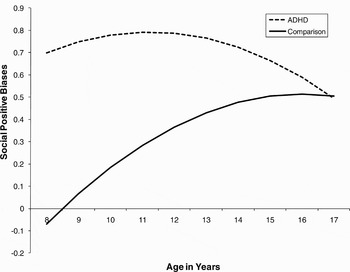
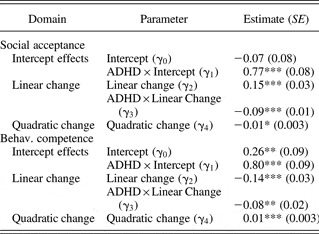
The results of this LMM, presented in Table 3, indicated that the normative comparison group did not exhibit positive self-perceptual biases regarding social acceptance at age 8. However, participants in this group displayed positive linear change and negative quadratic change in their biases over time, suggesting an increase and then leveling off of these biases across the course of the study. Across the course of the study, comparison children's biases increased by approximately 0.50 points. In contrast, children in the ADHD sample exhibited significant biases at age 8, with an average difference score of 0.70, but did not exhibit linear increases in their biases over time. Rather, the significant negative quadratic change for the ADHD sample indicated an increase and then decrease in biases across time, with biases peaking around 11.5 years of age. The predicted social bias trajectories for the ADHD and normative comparison sample are presented in Figure 1.
Predicted trajectories of social biases for children with ADHD and comparison children. The X axis displays age of participants in years. The Y axis displays the discrepancy between child and teacher ratings on the social acceptance subscale of the Self-Perception Profile for Children (child score minus teacher score).

Association between ADHD status and mean change in self-perceptual biases

Note: ADHD, attention-deficit/hyperactivity disorder. The sign of each estimate indicates the direction of the effect.
*p < .05. **p < .01. ***p < .001.
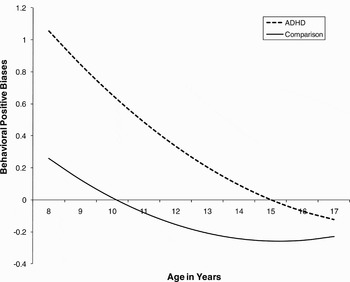
We conducted a parallel LMM to examine mean change in biases regarding behavioral conduct in the ADHD and comparison groups. Equation 1 was used to estimate the fixed effects, with μj representing the mean behavioral biases at time j. The results in Table 3 indicate that the normative comparison group exhibited positive biases regarding their behavioral conduct at age 8, with a bias of about 0.25 points. Moreover, this normative sample displayed negative linear change and positive quadratic change in behavioral biases, suggesting a decreasing trajectory that leveled off at the end of the study. In fact, by age 17, comparison children exhibited a negative bias of about –0.25 points. In contrast, the ADHD sample exhibited heightened levels of positive bias regarding behavioral conduct at age 8 (~1 point) and exhibited a steeper decline in these biases than the comparison group, with a negative bias of approximately –0.10 by age 17. The predicted behavioral positive bias trajectories for the ADHD and normative comparison samples are presented in Figure 2.
Predicted trajectories of behavioral biases for children with ADHD and comparison children. The X axis displays age of participants in years. The Y axis displays the discrepancy between child and teacher ratings on the behavioral conduct subscale of the Self-Perception Profile for Children (child score minus teacher score).

Follow-up analyses were conducted to demonstrate that the mean change in positive biases reflected true developmental change and was not simply an artifact of changes in other factors potentially associated with positive biases (e.g., ADHD symptoms, depression, or aggression). For example, it is possible that the tendency for positive biases among children with ADHD to approach those of the normative comparison group near the end of the study reflects reductions in ADHD symptoms or increases in depressive symptoms among these participants. To address this possibility, the LMM analysis presented in Equation 1 was replicated; however, in this analysis, ADHD symptoms, aggression, and depressive symptoms were added as time-varying covariates of positive biases. In other words, these analyses controlled for the longitudinal association between these three factors and self-perceptual biases. The results (not shown) replicated all significant findings regarding mean change in positive biases for the ADHD and normative comparison groups. These results suggest that the mean change in positive biases, in fact, reflects developmental change rather than changes in other factors such as ADHD symptoms, aggression, or depressive symptoms.Footnote 3
Dynamic covariation of self-perceptual biases and adjustment
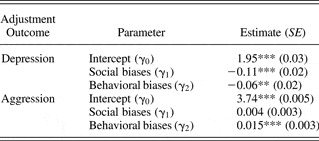
With respect to the hypothesis that decreases in positive biases would be associated with increases in children's depressive symptoms and decreases in aggressive behavior, preliminary analyses indicated that children's reports of depressive symptoms were positively skewed at each assessment period. Thus, we selected generalized LMMs (GLMMs) with correlated error terms (McCulloch & Searle, Reference McCulloch and Searle2001) to accommodate the skewed response variables. In the first GLMM, our model included changes in biases regarding social and behavioral competence as predictors of change in depressive symptoms. A gamma distribution with a log-link for the response variable using the PROC GENMOD module in SAS was specified for this model. We chose this distribution because it approximated the depressive symptoms distribution well (i.e., depression was a positively skewed, continuous variable). A constant of 1 was added to depressive symptom total scores because this distribution requires that all scores on the response variable are greater than zero. Identifying the gamma distribution with a log-link for the response variable in PROC GENMOD results in the specification of the log for this variable during model estimation (see Davis, Reference Davis2002). Thus, the equation for the GLMM was as follows:

where log(μj) is the log of the mean depressive symptoms at the jth time point; socj and beh j represent social biases and behavioral biases, respectively, at the jth time point; γ0 is the intercept of depressive symptoms; and γ1 and γ2 represent the strength of the association between social biases and behavioral biases and depressive symptoms, respectively. The results of this analysis (Table 4) indicated a significant negative association between self-perceptual biases and depressive symptoms. That is, decreases in positive biases regarding social and behavioral competence were associated with increases in depressive symptoms over time.Footnote 4
Longitudinal association between self-perceptual biases and adjustment

Note: The sign of each estimate indicates the direction of the association between biases and outcome variables.
**p < .01. ***p < .001.
The next analyses examined the dynamic association between self-perceptual biases and aggressive behavior. Preliminary analyses indicated that children's aggression scores were positively skewed at each assessment period. Thus, we utilized Equation 2 for this analysis, with log(μj) representing the log of the mean aggressive behaviors at the jth time point. The results presented in Table 4 indicate that increases in positive biases regarding behavioral conduct were associated with growth in aggressive behavior over time. In contrast, positive biases regarding social acceptance were not related to change in aggression.
ADHD as a moderator of the association between self-perceptual biases and adjustment
We conducted a GLMM to examine whether ADHD status moderated the longitudinal covariation between self-perceptual biases and depressive symptoms. The equation for this GLMM was as follows:

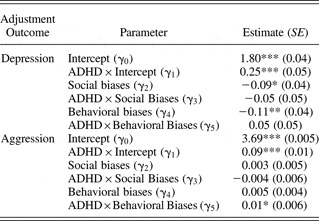
where log(μj) is the log of mean depressive symptoms at the jth time point and a represents ADHD status; γ0 is the intercept of depressive symptoms; γ2 and γ4 represent the strength of the association between social biases and behavioral biases and depressive symptoms, respectively, for participants in the normative sample; and γ1, γ3, and γ5 represent ADHD group differences in the intercept, the covariation of social biases and depression, and the covariation of behavioral biases and depression, respectively. The results, which are presented in Table 5, indicated that children with ADHD exhibited higher levels of depression than their peers. However, ADHD status did not moderate the dynamic covariation between positive biases and depressive symptoms.
ADHD status as a moderator of the longitudinal association between self-perceptual biases and adjustment

Note: ADHD, attention-deficit/hyperactivity disorder.
*p < .05. **p < .01. ***p < .001.
We conducted a parallel analysis using Equation 3 with log(μj) representing mean aggression at the jth time point (see Table 5). The significant ADHD X intercept interaction indicated that ADHD participants were more aggressive than children in the comparison sample. In addition, the ADHD × Behavioral Biases interaction indicated that changes in behavioral biases were more strongly associated with trajectories of aggression among children with ADHD than among their peers.
Cross-lag path analyses assessing direction of effects
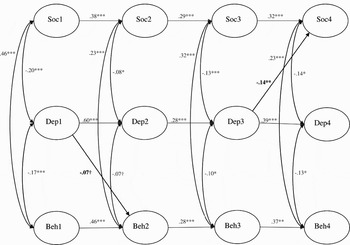
Follow-up cross-lag path analyses using MPlus version 3.01 (Muthén & Muthén, Reference Muthén and Muthén1998–2004) were conducted to examine whether positively biased self-perceptions predicted changes in adjustment (i.e., depressive symptoms and aggression, respectively) over time and/or whether adjustment predicted changes in positive biases. Given the positive skew of depression and aggression across the course of the study, the maximum likelihood robust estimator was used for these analyses (see chapter 15 in Muthén & Muthén, 1998–2004). A cross-lag model assessing the longitudinal associations between depressive symptoms and positively biased self-perceptions in the social and behavioral domains was estimated first. This model included stability estimates for positively biased self-perceptions and depression and within-time associations among biased self-perceptions and depression. To our knowledge, no previous studies have examined the stability of positively biased self-perceptions over time; thus, these analyses provided the first test of whether such biases are stable over time. In addition, all cross-lagged associations between depression and biases in the social and behavioral domains, respectively, were estimated. Finally, age was controlled in this model using a multiple indicators multiple causes model (Muthén, Reference Muthén1989). These analyses provided a stringent test of the direction of effects that might account for the longitudinal association between depression and biased self-perceptions revealed in the LMM analyses. The results of significant pathways are depicted in Figure 3. Positive biases in the social and behavioral domain were moderately stable over time. In addition, within each of the four time points, depression was associated with biased self-perceptions in the social and in the behavioral domains, although these effects were small (and the association between Time 2 depression and biases in the behavioral domain only approached conventional levels of statistical significance). Biased self-perceptions in the social and behavioral domains also were moderately associated, suggesting that children with one form of bias were more likely to exhibit the other form of bias. Examination of significant cross-domain paths revealed that depressive symptoms at Time 1 were marginally associated with lower biases in the behavioral domain at Time 2. In addition, depressive symptoms at Time 3 predicted lower biases in the social domain at Time 4. In contrast, positively biased self-perceptions were not related to later depressive symptoms.
Standardized path coefficients for significant paths. Comparative fit index = 0.95, root mean square error of approximation = 0.05. Soc, positive biases in the social domain; Beh, positive biases in the behavioral domain; Dep, depressive symptoms. Numbers designate time of assessment. Stability estimates and within-time correlations are presented in gray; significant cross-domain paths are depicted in bold. Only significant and marginally significant paths are included in the figure. †p < .10, *p < .05, **p < .01, ***p < .001.

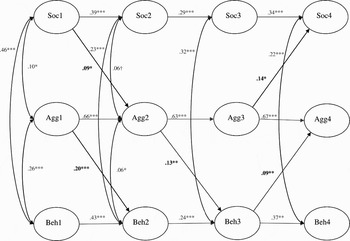
An additional cross-lag model was estimated to explore whether aggression predicted increases in positively biased self-perceptions and/or whether biased self views predicted increases in aggression. This model controlled for age and included within-time correlations, stability estimates, and all cross-lagged associations between aggression and positively biased self-perceptions in the social and the behavioral domains, respectively. The results, which are depicted in Figure 4, indicated that aggression was highly stable over time. Within-time correlations suggested that aggression was only associated with positively biased self-perceptions at Time 1 and Time 2. Findings for cross-domain paths indicated that aggression was associated with later biased self-views. Specifically, aggression at Times 1 and 2 predicted subsequent biases in the behavioral domain. In addition, aggression at Time 3 predicted later biases in the social domain. However, evidence also suggested that positively biased self-perceptions were related to later aggression. Specifically, positive biases in the social domain at Time 1 and positive biases in the behavioral domain at Time 3 predicted later aggression. These findings suggest a vicious cycle in which aggression predicts increases in positively biased self-perceptions and these biased self-perceptions predict increases in aggression over time. A set of follow-up analyses (not shown) indicated that ADHD status did not moderate any of the cross-lag paths in the depression and aggression models.
Standardized path coefficients for significant paths. Comparative fit index = 0.92, root mean square error of approximation = 0.07. Soc, positive biases in the social domain; Beh, positive biases in the behavioral domain; Agg, aggression. Numbers designate time of assessment. Stability estimates and within-time correlations are presented in gray; significant cross-domain paths are depicted in bold. Only significant and marginally significant paths are included in the figure. †p < .10, *p < .05, **p < .01, ***p < .001.

Discussion
By examining changing trajectories of biased self-perceptions over time in both children with ADHD and similar-aged comparison peers, we were able to compare the cognitive immaturity and self-protective explanations for positive biases among children with ADHD in two distinct competence domains: social and behavioral. Consistent with the self-protective explanation of positively biased self-views, our results differed substantially by domain. Hence, little support was found for the cognitive immaturity perspective. Specifically, were cognitive immaturity the best explanation, we would have seen largely similar (i.e., parallel) and declining trajectories for children with ADHD and comparison peers across both domains, with the ADHD group simply lagging behind age mates or progressing at a slower pace. Examination of Figures 1 and 2, however, indicates that this was not uniformly the case.
Instead, and more consistent with the self-protective perspective, trajectories of change differed substantially by domain. Regarding social competence, children with ADHD displayed large and consistently positive biases across the 6-year period examined. However, contrary to expectations, we did not see as large a developmental increase in social bias for children with ADHD as we did for controls. Positively biased self-perceptions of large magnitude were already evident for children with ADHD by age 8, and remained to a similar extent over the 6-year period, despite a significant quadratic change reflective of a slight increase followed by a slight decrease over time. It is likely that children's self-perceptions were already inflated to the maximum extent possible, precluding further increases. Examination of means for children's social self-perceptions in Table 2 indicate means between 3 and 4 at all time points, on a scale with a maximum value of 4, suggesting that this is a plausible explanation. In contrast, comparison children began at Time 1 with relatively accurate social self-views, followed by an increase and then leveling off in their degree of positive bias. These patterns are consistent with the viewpoint that self-protection may be operating (Diener & Milich, Reference Diener and Milich1997), in that children with ADHD, who generally experience peer difficulties beginning at an early age and continuing into adolescence (Hoza, Reference Hoza2007), would have greater need for a self-protective stance across the entire period under examination.
For comparison children, this need for self-protection would primarily arise in response to the relative emphasis on social functioning that emerges during early adolescence (Berndt, Reference Berndt, Graber, Brooks-Gunn and Petersen1996; Bukowski & Kramer, Reference Bukowski and Kramer1986; Hartup, Reference Hartup and McGurk1992). However, given their generally greater success at negotiating these challenges, comparison children would not be expected to show the same magnitude of self-protective responses, even during this critical developmental period. Consistent with this perspective, at all time points examined except Time 4, comparison children exhibited less bias than children with ADHD. This pattern suggests a normative bolstering of social self-views during early adolescence in children without ADHD, but not by as much as seen in children with ADHD. Further support for the self-protection hypothesis comes from the finding that the absolute levels of self-rated competence for those with and without ADHD were similar; that is, ADHD children's self-ratings did not exceed those of peers without ADHD. Thus, the children with ADHD appeared to be “normalizing” their self-perceptions rather than enhancing above the norms.
Results for the behavioral domain also were compatible with the self-protection hypothesis. Specifically, because nonextreme forms of delinquent and aggressive acts as well as authority challenges are normative as youth move through adolescence (Moffitt, Reference Moffitt1993), there would be less need for youth exhibiting these behaviors to self-protect by denying these behaviors. In fact, there is some evidence that these acts may enhance status among peers during adolescence (Parkhurst & Hopmeyer, Reference Parkhurst and Hopmeyer1998). This explanation seems particularly likely given that youth with ADHD have positive bias scores indicating, on average, a discrepancy of one point at age 8 that reduces to, on average, zero discrepancy by age 15. Of importance, examination of means in Table 2 indicates that children's reports of behavioral competence showed small decreases by the end of the study, even as teachers' reports of behavioral competence showed small increases. This pattern is consistent with the notion that youth with ADHD relax their self-protective stance once it is no longer needed (Diener & Milich, Reference Diener and Milich1997). Of course, because youth with ADHD continue to be rated lower in behavioral competence by their teachers than comparison youth, even at the last two time points, an alternative explanation is that continued negative feedback about behavior finally “gets through” even to youth with ADHD, despite their inattentiveness to social cues.
Results from the cross-lag path analyses also provided support for the self-protection hypothesis. Specifically, aggression was associated with increases in positively biased self-perceptions in both the social and behavioral domains over time. These results suggest that behavioral problems such as heightened involvement in aggression lead to the development of biased beliefs regarding one's social and behavioral competence. In effect, children with behavioral problems may, in turn, inflate self-perceptions to cope with these problems.
It is important that mean changes in positive biases across development persisted when controlling for changes in other factors, such as ADHD symptoms, aggression, or depressive symptoms. Even when controlling for the longitudinal covariation of positive biases and these factors, developmental trajectories of positive biases remained in place. These results are consistent with the notion that the observed changes in positive biases reflect mechanisms related to developmental change (i.e., increased need for self-protection in the social domain during adolescence and decreased need in the behavioral domain) and are not simply an artifact of changes in other behaviors or symptoms.
Aside from the developmental significance of positively biased self-perceptions, an equally important question has to do with their adaptive significance. As noted earlier, there is considerable debate as to whether self-views that are fully consonant with reality are an asset (Colvin et al., Reference Colvin, Block and Funder1995) or a liability (Taylor & Brown, Reference Taylor and Brown1988). Indeed, we raised the possibility that they may be both a protective factor against depression and a risk factor for aggression. Our analyses are consistent with the supposition that positive illusions may serve as a risk factor for aggression. In agreement with Baumeister et al.'s (1996) perspective, increases in levels of positively enhanced self-perceptions in the behavioral (but not social) domain were predictive of greater aggression over time. In addition, cross-lag path analyses provided support that positively biased self-perceptions were associated with increases in aggression over time. Because increases in social bias may be normative, it makes sense that only counternormative increases in bias in the behavioral domain would predict increased aggression.
In contrast, our findings did not provide support for the idea that positive biases are protective against depressive symptoms. In fact, although decreases in positive biases regarding social and behavioral competence were associated with increases in depressive symptoms over time, cross-lag path analyses did not provide support for the idea that positive biases predicted changes in depression. Instead, the only significant cross-lag path indicated that depression predicted decreases in positive self-perceptions over time. This suggests that accurate or negatively biased self-perceptions may be the result of, rather than the cause of, depressive symptoms. Taken together, these findings suggest that positive biases may serve as a risk factor for aggressive conduct but do not appear to buffer against the development of depression.
It is interesting that there was support for the hypothesis that ADHD status would moderate the dynamic association between self-perceptual biases and adjustment. Consistent with our predictions, increases in positively biased behavioral self-perceptions were more strongly associated with increases in aggressive behavior in children with ADHD than among the comparison sample. These findings are consistent with the hypothesis that emotional reactions to negative appraisals may be especially likely to result in aggressive outbursts (Baumeister et al., Reference Baumeister, Smart and Boden1996); children with ADHD may be especially prone to this vulnerability given their impaired emotion regulation capacities.
One key question that remains is the level of self-protection that is desirable if indeed self-protection underlies enhanced self-perceptions in children with ADHD. The present paper provides a first step in clarifying the question by demonstrating that among predominantly non-ADHD youth, enhanced self-perceptions do indeed appear to serve a developmental purpose in at least some domains and at certain developmental periods. The amount of enhancement by children with ADHD, however, clearly exceeded normative levels even though the absolute levels of self-rated competence did not necessarily differ from normative peers. Moreover, although positively biased self-perceptions may develop for protective purposes, they do not appear to serve as a buffer against the development of depressive symptoms. Investigations directly addressing the question of how much self-enhancement is too much for children with ADHD are sorely needed.
For instance, it is possible that at least a low level of dissatisfaction with one's self could provide important motivation for positive change and engagement in treatment among at-risk youth. Consistent with this possibility, prior researchers (Lochman, Coie, Underwood, & Terry, Reference Lochman, Coie, Underwood and Terry1993) noted that aggressive and/or rejected children receiving a social skills and cognitive behavioral strategies intervention reported decreased self-esteem at postintervention (perhaps reflective of greater insight), relative to those who did not receive the intervention. It is important to note that our findings do not support the promotion of positively biased self-perceptions among children with ADHD. Positive biases did not appear to reduce children's risk for developing depressive symptoms. Moreover, ADHD status moderated the association between illusory biases and aggression, suggesting that the maintenance of such biases may be especially likely to result in aggression for ADHD youth, perhaps because of their poor emotion regulation capacities. Consistent with this possibility, one prior study (Hoza & Pelham, Reference Hoza and Pelham1995) found that, for a subset of children with ADHD, higher self-reported confidence was associated with less counselor-rated improvement in teasing/peer aggression in a summer treatment program. It may be that effective treatments for children and adolescents with ADHD must encourage both greater self-insight and more productive strategies and cognitions for dealing with this awareness. This speculation also invites empirical investigation. Any attempted application to therapeutics must consider that there are two ways to decrease positive bias: top-down by reality orientation versus bottom-up by increasing competence.
It is important to evaluate the results of this study in light of its strengths and limitations. The large size of our sample, inclusion of multiple informants (teachers, parents, youth), and our ability to examine trajectories of both children with ADHD and comparison peers simultaneously over an extended (i.e., 6-year) time period represent strengths. In addition, use of sophisticated statistical techniques allowed us to address both skewed and missing data in a statistically appropriate fashion. At the same time, however, several limitations must be acknowledged. Our sample, although carefully selected to be as representative as possible of children seen in clinical settings, may not necessarily be representative of all (identified and unidentified) children with ADHD. Further, our initial measure of positively biased self-perceptions was obtained when children were already 8–13 years old, truncating the opportunity for the most complete picture of developmental processes. In addition, on some measures at later time points, data were missing for approximately one-third of the sample. Although our statistical methods were appropriate to deal with missing data, sample attrition was a limitation. It is also possible that teacher reports of competence are less valid at the later assessment points, given that high school teachers often spend less time with students than teachers in earlier grades. Whereas our analyses provided some support for the validity of teacher reports of competence at these ages, future research may benefit from including alternative measures of competence when determining positive biases (e.g., observational methods, parent reports). Future research exploring the longitudinal association between bias and aggression may also benefit from including other measures of aggression (e.g., self-reports, teacher reports, or observations), as parents may underestimate the frequency of children's aggressive behavior. Finally, although our analyses provided preliminary support for the idea that positive biases serve as a risk factor for aggression but not as a protective factor against depression, the effects were small in size. However, it is important to note that the cross-lag analyses provided a very stringent test of direction of effects because both within-time correlations among variables and stability of variables were controlled in these analyses, giving us greater confidence in our findings. Nonetheless, such limitations may be addressed by further research, which we hope this paper will facilitate.