David Williams, Ian Scrivener-Lindley and Nicola Dowsett write: During the spring of 2007, Nicola Dowsett, a ceramics conservation student at West Dean College near Chichester, was asked by Chichester District Museum to undertake repairs and conservation on the top half of a broken Roman amphora as part of her graduate diploma studies. The amphora, which was represented by a collection of some 16-odd broken sherds, had been kept in the museum stores since the 1930s. The only specific reference to the finding of the amphora is in the Chichester Museum Accession Register, entry 487, which records a gift from W.L. White in 1939 of ‘the mouth and shoulders (bearing potters marks) of a Roman amphora, found in Chapel Street’. There are no records of archaeological material being found in Chapel Street prior to the 1930s and it seems likely that the amphora was one of a number of pottery finds recovered from digging gas main trenches there between 1934 and 1935.
The Chichester District Historic Environment Record contains a record of what would today be termed a watching-brief, carried out during trenching by ‘the Gas Company’ along West Street and Chapel Street in Chichester. The ground-works were watched over by Raymond Carlyon-Britton and William Llewellyn White. Although never fully written up, a brief account of the discoveries for 1934 was published in Sussex Notes and Queries. Footnote 94 The remains uncovered included walls of a Roman town-house with part of a tessellated floor and a ‘… considerable amount of pottery of several periods …’. It was also noted that some of the finds were to be reserved for the city museum ‘… when it is fully established’. The gas main trenches were probably some of the first major disturbances to have taken place in Chichester’s streets in the twentieth century; clearly Carlyon-Britton and White had acted upon this opportunity for archaeological discovery. Carlyon-Britton was a noted coin collector, the son of a founder of the British Numismatics Society. Both he and White were instrumental in the eventual establishment of a museum for Chichester in the former chancel of the Greyfriars church in Priory Park, their own collections forming a substantial part of the museum’s displays. The 1930s proved to be an eventful decade for archaeology in Chichester and a number of important discoveries were made. Carlyon-Britton located the site of the amphitheatre on the south-east side of the city in 1934 and some limited trial-trenching was carried out there the following year by White’s daughter Molly, later Lady Grahame Clark. Between 1934 and 1937 Carlyon-Britton and White also carried out the first planned excavations of the Roman cremation and inhumation cemetery at St Pancras outside the east gate of the city.
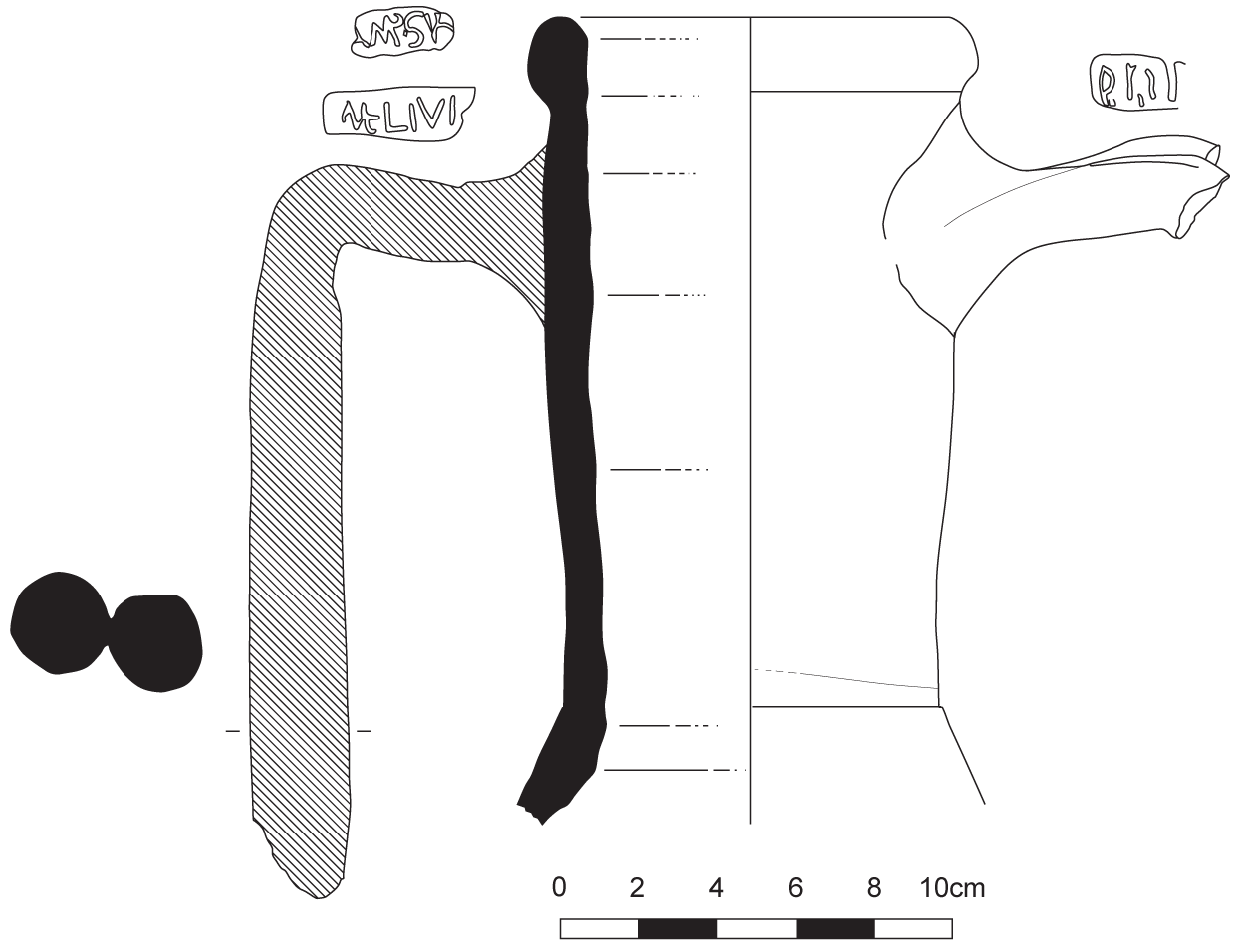
The restored amphora, which has an almost complete rim, neck and attached bifid handles, belongs to the Dressel 2–4 classification (fig. 9).Footnote 95 The Chichester example is distinctive as a hand-specimen, for the rather coarse fabric appears to contain much ‘black sand’ — caused by the presence of frequent dark green crystals of augite.Footnote 96 This visually distinctive fabric has been sourced to the region around the Bay of Naples and is especially associated with the towns of Pompeii and Herculaneum.Footnote 97 It was used extensively, both for the local pottery and also for building materials such as brick and tile.
An Augustan Dressel 2–4 amphora from Chichester. Scale 1:3. (Drawn by Penny Copeland)

The Dressel 2–4 amphora form (Koan type) was based on prototypes from the Aegean island of Cos and in Italy replaced the larger, thicker-walled Dressel 1. It has a simple bead rim and a neck that tapers gently inwards towards a marked carination at the shoulder, with a body that tends to be cylindrical, leading to a short solid spike.Footnote 98 The handles, which comprise two parallel clay shafts looted together into a characteristic bifid section, are flexed and join the amphora immediately below the rim and on the shoulder close to the junction with the neck. However, within this general type description there is some slight variation in shape depending on origin. This form is particularly common in the early Empire and was made in many different parts of the western and eastern Mediterranean, and to some extent in the northern Roman provinces as well, including Britain at Brockley Hill.Footnote 99 In Italy, Campania was an important production area and several kiln sites are known in the north of the region, including Sinuessa/Mondragone,Footnote 100 Falciano, Masseria Zannini, near Masseria Corbo, Masseria Pagliare, Santuario della Gran Celsa, Masseria Starza, and Masseria Dragone.Footnote 101 Production is also attested at MinturnoFootnote 102 and Fondi/Terracina.Footnote 103 Those Dressel 2–4 made in the ager Falernus commonly appear taller and with a body that is more or less cylindrical.Footnote 104 Although no kilns have yet been recorded in the vicinity of Pompeii, the frequent occurrence of the Dressel 2–4 ‘black sand’ fabric at that town and the fact that a large number are stamped with the name of L. Eumachius, who was probably the father of the Eumachia who paid for an important building in the forum of Pompeii, suggest that they were produced fairly locally.Footnote 105 The distinctive feature of the Pompeii Dressel 2–4 amphora is the somewhat squat shape of the cylindrical body, which tends to make it appear shorter than other types of Dressel 2–4 manufactured in Italy and in the provinces.Footnote 106
Tituli picti make it clear that the main content carried in Dressel 2–4 was wineFootnote 107 and Italian varieties of Dressel 2–4, particularly those from Campania, occur widely throughout the Roman Empire, from Britain and the North-West provinces to Portugal,Footnote 108 North Africa, Egypt, the eastern Mediterranean, and even as far as the Red Sea and India.Footnote 109 There seems to have been a wide variety of wines that were produced in the area between Vesuvius and the headland of Sorrento.Footnote 110 A few of them could probably be classed as quality wines but the majority seem to have been regarded as vin ordinaire, certainly compared with the reputation of the Falernian of northern Campania; quantity rather than quality seems to have been the watchword of the region.Footnote 111 However, it seems that very few Roman amphora types were commodity specific and other contents were certainly transported in the Dressel 2–4 form from time to time, including garum in a Gaulish example from Antibes found in London.Footnote 112 The general class of Italian Dressel 2–4 amphorae seems to have been produced from c. 70 b.c. to the early third century a.d., though the main thrust of production, certainly as far as export was concerned, appears to have been over by the end of the first century a.d.Footnote 113 More specifically, the Vesuvian eruption of a.d. 79 must have destroyed the Pompeian and Sorrentine vineyards and possibly many in the ager Falernus also, as well as disrupting the road system and port facilities of the region.Footnote 114 However, production continued in other parts of Italy and Dressel 2–4 were still being made there at the beginning of the third century a.d.Footnote 115 In the western provinces, Pompeian Dressel 2–4 are found predominantly on the frontiers, where their main market seems to have been a military one.Footnote 116
There are three impressed stamps on the Chichester amphora (fig. 9). These appear in oblong cartouches with rounded ends on the tops of the handles just before the curve, two (one incomplete) on one handle and one on the other. The stamps read M. LIVI… and AMP.S on one handle and RVS (in retrograde) on the other. The stamp M. LIVI… is incomplete for the remainder of the stamp has been truncated by the sharp bend at the top of the handle and the roughness of the clay. However, enough remains to identify the name as M[arcus] LIVI[us] [Causorius]. The other stamps most probably refer to his slaves or freedmen: AMP[hio]. S[ervus] and SVR[us]. All three stamps appear on individual amphorae from the Grand Ribaud D wreck, Ile de Porquerolles, France.Footnote 117 No direct evidence has yet been found to suggest that Marcus Livius Causorius was a citizen of Pompeii, or indeed any other town or estate in the region of the Bay of Naples, and his name is known only through amphora stamps. However, the coarse ‘black sand’ fabric of the amphorae associated with his stamps points to his estate being located in this region.Footnote 118 Another possible indication of an origin at or close to Pompeii is the association on the Grand Ribaud D wreck of stamped amphorae of Marcus Livius Causorius with those of the L. Eumachius from Pompeii mentioned above.Footnote 119 The total number of amphorae recovered from this wreck was estimated at between 208 and 267 vessels, of which some 162–210 belong typologically to the Pompeii region Dressel 2–4 category established by Panella, including those of Marcus Livius Causorius and L. Eumachius.Footnote 120 The port of embarkation of the Grand Ribaud D ship was thought to have been Minturnae, on the Gulf of Gaeta, which was suggested by the stamps on the eleven large dolia found on the wreck.Footnote 121 These must have acted as permanent bulk ‘containers’ and quite likely contained local wine from the region.
The Grand Ribaud D wreck has been dated to the last decade of the first century b.c.Footnote 122 In addition, amphorae bearing the stamps of Marcus Livius Causorius have also been found at Pompeii, Ostia, Carthage, Vindonissa, Ephesus, Barcelona, Masada and as far as Mathura in India.Footnote 123 At Ephesus, an amphora with the stamp of Marcus Livius Causorius was found in the construction deposit of the Basilica Stoa erected in a.d. 11.Footnote 124 A similar stamp also appears on an amphora from Delattre’s ‘First Amphora Wall’ at Carthage, which is dated by tituli picti which mention the names of a number of consuls whose years of office all fall between 43 and 15 b.c., with a concentration of dates between the years 22 and 15 b.c.Footnote 125 Also, the stamps of Lucius Eumachius, which are associated with those of Marcus Livius Causorius on the Grand Ribaud D wreck, are generally dated to the last quarter of the first century b.c.Footnote 126 All this suggests that the racking of the wine from the estate of Marcus Livius Causorius into the Chichester amphora most probably took place sometime between 25 b.c. and a.d. 10. At this time, exports of Italian wine in Dressel 2–4 continued to be important, especially in Gaul and on the northern frontier, though the evidence from shipwrecks shows that there were far fewer cargoes of Italian Dressel 2–4 amphorae than was the case for the earlier Dressel 1 varieties.Footnote 127 Campanian wine certainly appears to have played a large part in this export,Footnote 128 though it seems that most wines from the Pompeii-Surentum region were destined for Rome.Footnote 129
In view of the early dates associated with the stamps of Marcus Livius Causorius, if the Chichester amphora can be shown to come from an archaeological context, it would be a remarkable find, and the most westerly occurrence of such stamps. However, in view of its ‘sketchy’ background, it is possible that the Chichester amphora may have reached these shores in more recent times. A few years ago one of the writers (D.W.) saw the top half of a Greco-Italic amphora offered for sale at a car boot sale in Southampton, which had in turn been bought as a souvenir by the sellers from fishermen in Naples a few years before. It is feasible, therefore, that the Chichester amphora may also have been brought to this country as a souvenir some time in the recent past and then subsequently lost or donated to the local museum. While taking this possibility into account, there are, however, a number of points that, while not conclusive, do nevertheless strongly suggest that this was not the case and that the vessel should instead be regarded as a ‘legitimate’ archaeological find. First of all, one of the writers (D.W.) noted that there were traces of soil under the rim and where the handles join the body. Some of this was scrapped off and mounted onto a glass slide prior to an examination under a petrological microscope in order to cast light on the soil composition of the find spot. This method has already been successfully used to show that an Etruscan cup held by the University of Southampton since the 1920s was a recent import from Italy rather than an early twentieth-century archaeological find from Cheshire.Footnote 130 The soil sample taken from the Chichester amphora showed frequent silt-sized grains of quartz, black iron oxide and small pieces of flint. These are all fairly common non-plastic inclusions but, as an assemblage, they would not be out of place if found on an object buried in the local Eocene formations and valley gravels that Chichester is built on.Footnote 131 In contrast, there were no exotic minerals or small fragments of rocks that would have suggested a deposition source, for example, around the Bay of Naples, which would have indicated that it was a more recent import.Footnote 132 Secondly, W.L. White, who conducted the original watching-brief, was a well-respected and experienced archaeologist, well-known in and around Chichester at the time and closely connected with the establishment of Chichester Museum. Taken together, both pieces of information suggest that the amphora is most probably a ‘legitimate’ find.
If we then regard the Chichester amphora as reasonably secure archaeologically, it would join an impressive number of pre-Conquest pottery finds from both Chichester and nearby Fishbourne, which, besides amphorae, include Arretine and Gallo-Belgic wares.Footnote 133 The pre-Conquest amphora forms are made up of Italian Dressel 1B and Spanish Dressel 1–Pascual 1, Dressel 7–11, and early Dressel 20.Footnote 134 The Chichester amphora of Marcus Livius Causorius also points tantalizingly to the prospect of wine from Pompeii being imported to the area before the Conquest — though considering relations between Late Iron Age Britain and the Roman Empire at this stage, perhaps not the best vintage available.
ACKNOWLEDGEMENTS
The writers are grateful to Chichester District Museum for permission to publish this vessel. Penny Copeland very kindly drew the amphora and stamps.