1. Introduction
The study of Egyptian personal religiosity during the third century ad presents an interesting opportunity to explore the processes of cultural encounters between Egypt and the Roman Empire. The religious situation was more complicated and variegated than the textual evidence seems to suggest; sometimes one becomes aware of the existence of certain beliefs only through their iconographic record. For this reason, decorated stelae, coffins, and mummy wrappings are crucial materials for research into questions of religious exchange. This article presents the case of a third-century ad shroud from Memphis painted with a woman's portrait and funerary scenes, along with a representation of Isis navigans.Footnote 1
Painted funerary cloths have a long history in Ancient Egypt, although the number of examples preserved varies according to the period.Footnote 2 The first known case, which comes from Predynastic times, consists of a series of cloth fragmentsFootnote 3 found in a tomb at Gebelein dating to Naqada II (c.3750–3300 bc).Footnote 4 Among other things, the fragments show scenes of boats similar to those on the west wall of Tomb 100 at Hierakonpolis (Naqada II).Footnote 5 From then on down to the dynastic Late Period, mortuary textiles were mainly at the service of the funerary texts and their corresponding illustrations. It was not until after the Roman conquest that the eminently iconographic practice of decorating funerary cloths (primarily shrouds) experienced both its peak in popularity and its definitive collapse.Footnote 6
In the context of Roman funerary portrait art, shrouds with realistic portraits and funerary scenes have captured the most attention from both researchers and the general public. The religious scenes depicted on these cloths have generally been ignored, although they constitute the largest collection of vignettes of the Book of the Dead during the Roman period.Footnote 7 The same has been true for those examples which display an idealized central figure (following frontal images of divinitiesFootnote 8 ), which also have great potential for research. It is important to remember that when it comes to studying both types of shroud, these should be considered not only within their Egyptian context but also within the wider religious framework of the Roman Mediterranean world.
The Memphite area is without a doubt an ideal place to study Roman–Egyptian cultural contacts, owing to its geographic location and the social interrelationships that derived from that.Footnote 9 Under the Romans, the region still remained a cultural melting pot and played an important role in the dissemination of beliefs and practices of differing types and origins.
In the Memphis necropolis of Saqqarah, evidence of the practice of wrapping the dead with painted shrouds goes back to the dynastic Late Period.Footnote 10 There are some examples from the Roman period which are difficult to date with precision, while in other cases the work of dating is facilitated to a certain extent by the realistic portraits, which offer some clues via their hairstyles and attire. Only three painted shrouds dating from the first century ad can be contextualized in Saqqarah, while in the second century the practice seems to have expanded considerably. The latest examples of this practice of decorating the shrouds can be dated to the third century ad, although in these instances painting occasionally gives way to gilt stucco.Footnote 11
2. The Berlin mummy wrapping
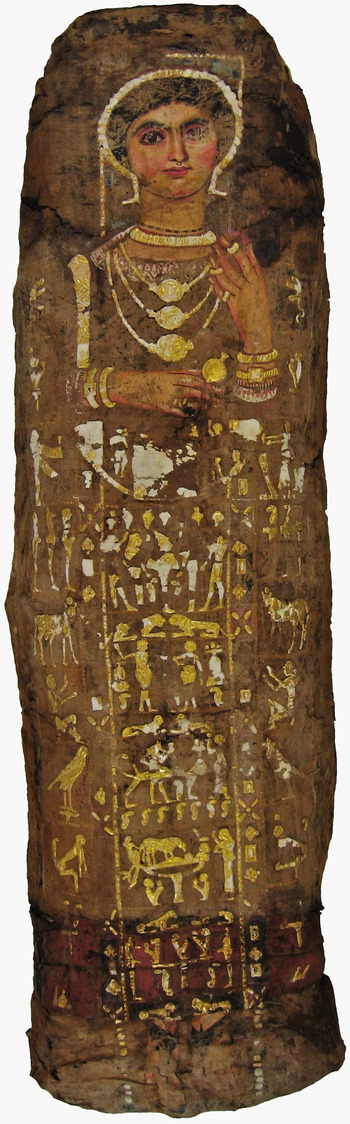
From the Saqqarah necropolis comes the decorated shroud now in the Ägyptisches Museum und Papyrussammlung in Berlin (see figure 1). This wrapping constitutes one of the oldest examples of this type of product from the Memphite region. It consists of several layers of textile topped by the shroud, which presents a portrait of the bust and feet of the deceased, and some decoration in gilt stucco on the central part consisting of religious scenes, as well as a painted (not dyed) red background. The earliest known discovery of an example of this type was made on 25 January 1616 by the explorer Pietro della Valle.Footnote 12
Mummy wrapping, third century ad, 170 × 55 cm, found in the Saqqarah necropolis. Ägyptisches Museum und Papyrussammlung, Berlin, ÄM 11659. All photographs by the author, and taken courtesy of the Ägyptisches Museum und Papyrussammlung der Staatlichen Museen zu Berlin – Preußischer Kulturbesitz.

The Berlin wrapping belonged to a woman, doubtless from elevated social circumstances, who died and was buried in the third century ad. The first time that the portrait was dated, on the basis of its hairstyle and clothing Klaus Parlasca proposed that it was made in the second half of the fourth century.Footnote 13 This estimate was later changed by the same author to c.300 or the first quarter of the fourth century ad, but at the same time citing Barbara Borg's alternative dating to c.230/240 ad.Footnote 14 The portrait's chronology is problematic because there are no parallel cases which allow for more precision, but I believe that the clothing, hair dress, and overall style date it to no later than the third century ad.
The general characteristics of its decoration connect the shroud to the examples found in Saqqarah by Pietro della Valle in the seventeenth century, and by an expedition carried out by the University of Pisa in the twentieth century.Footnote 15 Moreover, the registry of the Berlin museum includes the following note: ‘Geschenk des Herrn Rudolf Mosse 1892. Durch Prof. Brugsch von d. Beduinen Ali & Farag gekauft; erworben 1893’ (‘Gift of Mr Rudolf Mosse 1892. Purchased through Prof. Brugsch from the Bedouins Ali and Farag; acquired 1893’). The location given for the discovery is ‘Sakkara’.
The shroud appears to have first been mentioned in Georg Ebers’ 1893 book on ancient portraits and was summarily described in two catalogues of the royal museums in Berlin at the end of the nineteenth century.Footnote 16 Since then, only the portrait has been studied; some of the scenes have been mentioned, but not studied.Footnote 17
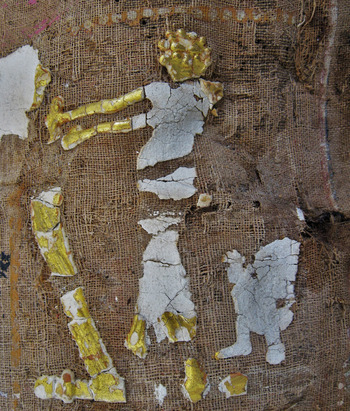
Without any doubt the shroud merits a complete study of its iconography, but such work would go far beyond the limits proposed here. In this article I will therefore focus on an interpretation of one of its religious scenes, which includes a representation of Isis navigans, which has not been identified until now (see figure 2).
Detail of the mummy wrapping, showing Isis navigans.

3. New light on Isis navigans
The iconographic identification of Isis navigans seems certain, based on various components of the representation of the goddess and the scene, although the style is considerably different from other examples; in fact, it is closer to feminine representations produced in ‘Coptic art’. The upper part of Isis’ body is presented frontally, leaning slightly backwards, while the legs, one of which is thrust forward, are shown in profile. The goddess has her arms stretched forward, holding in both hands a sail (her mantle?) of a boat, whose prow is found underneath, depicted in outline form. It can be said that the image itself is classic in all its components.Footnote 18 Iconographic examples from Egypt of this version of the goddess are rare. Only in Alexandria does one find some examples on lamps, gems, and coins, while the only other place where the image is documented is on a lamp from Athribis.Footnote 19
Scholars unanimously consider Isis navigans to be the mistress of maritime navigation.Footnote 20 Prior to the Roman period, the goddess was connected to several boats,Footnote 21 although there is no document that establishes her relationship with the sea.Footnote 22 It is thought that this attribute of the goddess may have emerged in the Ptolemaic period and probably would have come to define other aspects of this divinity.Footnote 23 The facet of Isis linking her to the sea has been connected to her status as patroness of Alexandria, a city with a pronounced commercial character and where this version of the goddess may have originated. Her protection of maritime navigation may have caused Isis to be considered as an important religious figure in many coastal cities.Footnote 24 That role even granted her a festivity in the Roman calendar on 5 March, called navigium isidis, by which the start of the season for favourable navigation was marked.Footnote 25 As far as this aspect goes, mention should also be made of one of the Roman hymns to Isis which was found in the city of Cyme, Asia Minor, in which the goddess is described as the inventor and patroness of sailing, as well as a divinity who could calm the sea.Footnote 26 It is well documented that sailors who found themselves in difficulty would commend themselves to her.Footnote 27
The new iconographic case of Isis navigans introduced here is not the latest from the Roman period, but it is the one found furthest south in Egypt and, more importantly, it is the only one which can clearly be associated with a funerary context. Furthermore, although the majority of cases known throughout the Mediterranean world present the image of Isis as alone on a ship or sailing towards the lighthouse of Alexandria,Footnote 28 this new evidence forms part of a composition without any known parallels.Footnote 29
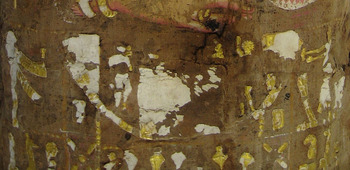
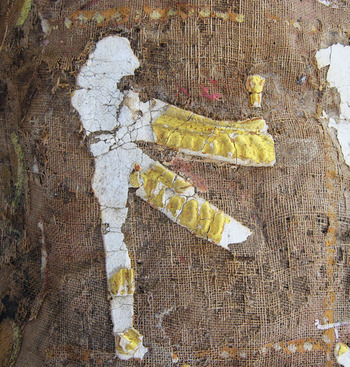
In the case of decorated shrouds from Roman Egypt, the complete portrait is usually flanked by diverse scenes and motifs. Sometimes some religious iconography is also found on the centre part of the cloth.Footnote 30 In the shroud examined here, the depiction of Isis navigans is located to the left of a decorative row situated below the painted bust of the deceased woman, and consists of three differentiated parts (see figures 1 and 3). On the opposite side from Isis stands a winged goddess who may be holding a branch of lotus flowers (see figure 4), one of the many apotropaic themes which are found on the shroud's flanks. In between the two goddesses, as the central scene, is the image of a bark (see figure 5). This has a square space, from which the inner details have disappeared because the gilt stucco has become detached, although it is possible to conclude that the space was crowned by two winged cobras; likewise, the bark's prow and stern are also poorly preserved. On the right side of the bark there is a standing female figure with her right arm raised in a gesture of lament, while on the left is a standing female figure who handles the helm.
Detail of the mummy wrapping, showing the decorative row containing Isis navigans.

Detail of the mummy wrapping, showing the winged goddess.

Detail of the mummy wrapping, showing the bark of Osiris.

The iconographic characteristics of the ship make us think that this is one of those funerary boats that are modelled on that of Osiris. As a general rule, there is a divine shrine under which the god is placed and sometimes one also finds winged serpents, as in the Berlin example. Both Isis and Nephthys usually appear as well. With this type of mortuary vessel, movement is normally indicated by jackals or divinities with this animal's head who tow the bark, but this is not the case in our example. However, that does not necessarily mean that no deity is responsible for its motion. Here, I believe that it is Isis navigans who allows the ship to continue on its course towards the heavenly expanse of the blessed. This goddess could also be the one who takes charge of the helm, a function similar to that which has turned up in representations of Isis-Fortuna on some Roman gemstones.Footnote 31 With this and the Osirian model in mind, the other female figure could be the goddess Nephthys, who would represent the act of mourning for the deceased woman.
The reason why Isis might not be pictured on the central boat, apart from the fact that it would be extremely unusual even by the standards of the period, is explained by the other motif that accompanies the goddess in the lateral scene, which has not been discussed yet, but which completes the meaning of the religious concept that is being expressed. Behind Isis appears the lower half of a human figure dressed in the Roman fashion, which must be a full-body portrait of the deceased woman (see figure 2).Footnote 32 This practice of including the image of the deceased, albeit with the appearance of being alive, in scenes on objects among the grave goods is fairly typical for Roman Egypt.Footnote 33
The deceased is found on the same ship whose bow is depicted beneath the goddess. Isis appears to be carrying her to a place which must be the Afterlife, a role which normally is assigned to Anubis, but which here is taken over by the feminine divinity, who also appears to be in charge of protecting the vessel. Taking into consideration that the deceased is shown behind the goddess, the religious idea attached to this decorative row seems to be fairly clear: the piece narrates the deceased's sailing to the Afterlife on Osiris’ bark, which is protected by Isis (and the winged divinity, which may be her as well), who takes charge of the sail and perhaps the helm, and is accompanied by Nephthys, who symbolizes lament for the deceased woman.
The identification of the central bark as that of Osiris and the deceased, with the goddesses Isis and Nephthys on the sides, seems to be corroborated by the depiction of the same vessel on a later shroud of the same type in the State Art Collections, Dresden (Aeg. 777).Footnote 34 This shroud has a representation of the main boat, with the bow and stern in the form of a bird's head, and the central part more closely resembling a pentagon, owing to the shape of the centre. There is no crew, nor any cobras, but a portrait bust of the deceased is preserved in the central details. The birds’ heads front and back could refer to Isis and Nephthys as kites, which are often found on Osiris’ boat.
4. Final remarks
The Late Antique representation of Isis navigans originating from the Memphite area which has been presented here reveals a hitherto unknown aspect of this version of the Egyptian goddess, related to the voyage between the worlds of the living and the dead and the protection of funerary navigation. This evidence provides us with new data for evaluating the relationship between the all-powerful Roman Isis and other gods such as Nike/Victory, Tyche/Fortuna, and Hermes/Mercury.
From an iconographic point of view, linking the Egyptian goddess in her sailing version with Nike/Victory would also have funerary implications.Footnote 35 Isis participates in the victory over death, even crowning the dead, as can be seen in the example presented by the painted assemblage (coffin and shroud; British Museum, London, EA 6706) belonging to a Cleopatra who lived and died in Egyptian Thebes during the second century ad.Footnote 36
In some instances, Isis can been seen on board a boat with the attributes of the goddess Fortuna,Footnote 37 in a variety of representations which have been connected with trade, and especially with the annona.Footnote 38 However, the new funerary attribute of Isis navigans presented here offers us new perspectives, placing the cornucopia and/or helm in closer proximity to the world of the dead. This is all the more true in those scenes in which Isis is seen depicted twice, once with a sail and once with a helm, on a vessel in whose centre appears a seated figure of Serapis.Footnote 39 This journey seems to be situated in the watery region of the Afterlife, not referencing the story that Plutarch and Tacitus tell about the arrival of the prototypical image of the god Serapis to Alexandria from Sinope (modern-day Turkey),Footnote 40 nor evoking a theme related to the annona by linking the divinity on the stern with the goddess Demeter.Footnote 41
It is also interesting that, beyond the protection of navigation and commerce that is presupposed to Isis navigans, she also functions like a psychopomp goddess. This is a traditionally important aspect of the goddess which places this version of her in closer proximity to Hermes/Mercury, something which will merit further exploration.Footnote 42
I would like to conclude by suggesting that images such as that represented on a gemstone from Carthage (British Museum, London, AF.329Footnote 43 ), in which Isis navigans appears with a sail and helm next to the inscription ‘NAVI/GA FELIX’, refer not to a safe voyage by sea or river in this world but to the journey to the Afterlife. Such objects would then have belonged not to a sailor or a merchant but to a deceased individual hoping to secure a successful passage to the immaterial world of the blessed.