In this article, we employ social network analysis (SNA) to help understand the social networks that underpinned the historically documented Wendat (Huron) and Haudenosaunee (Iroquois) confederacies of the northeastern woodlands. In North American anthropology and archaeology, the term confederacy has been applied to a variety of social formations, particularly the collectively oriented polities encountered by Europeans in contact-era eastern North America (Ethridge and Hudson Reference Ethridge and Hudson2002; Morgan Reference Morgan1851; Swanton Reference Swanton1925; Trigger Reference Trigger1976). A confederacy is generally understood as a formal alliance of peoples or groups who act in mutual support or to achieve common ends. Perhaps because these political formations operate on a plane parallel, but not equivalent to, anthropological problem orientations about state formation, confederacies remain somewhat undertheorized. This is particularly the case for the Northern Iroquoian confederacies that formed around the cusp of the seventeenth century (Figure 1). The Haudenosaunee confederacy or “League of the Iroquois” may be one of the most intensively studied indigenous social formations in the history of anthropology (e.g., Fenton Reference Fenton1998; Hewitt Reference Hewitt1920; Morgan Reference Morgan1851; Richter Reference Richter1992; Tooker 1978). The ethnohistorical record of the Wendat (Huron) is one of the richest in North America (e.g., Biggar Reference Biggar1922–1936; Thwaites Reference Thwaites1896–1901; Wrong Reference Wrong1939) and has been closely studied by anthropologists (e.g., Tooker Reference Tooker1964; Trigger 1969, Reference Trigger1976). There are also robust archaeological records for both groups. Despite the fact that the Haudenosaunee and Wendat confederacies have been so well studied, systematic, comparative analyses of their organizational structures are lacking.
Location of archaeologically and historically documented Northern Iroquoian societies.

The confederacies likely developed in the sixteenth and early seventeenth centuries AD (Kuhn and Sempowski Reference Kuhn and Sempowski2001; Snow Reference Snow1994; Starna Reference Starna2008; Trigger Reference Trigger1976). Both were encountered by European explorers and missionaries in the first decades of the seventeenth century (Biggar Reference Biggar1922–1936; Thwaites Reference Thwaites1896–1901; Wrong Reference Wrong1939). In the mid-seventeenth century, military campaigns undertaken by the Haudenosaunee resulted in the destruction, displacement, or incorporation of all other Iroquoian-speaking peoples in the Lower Great Lakes region, including the Wendat. Although there is a recognizable Iroquoian cultural pattern, the historical development of each confederacy, including clan structure, mortuary practices, geopolitical footprint, and specific cultural traditions, differed appreciably. The political mechanisms governing each confederacy, as documented by seventeenth-century European observers and later oral histories, also differed. Despite these historical and structural differences, the political organization of the Wendat and Haudenosaunee is often discussed in a generalized fashion, contributing to the assumption that they were structurally equivalent.
SNA is a valuable tool for documenting and analyzing social relationships that may be otherwise hidden from view in traditional archaeological analyses (e.g., Collar et al. Reference Collar, Coward, Brughmans and Mills2015; Knappett Reference Knappett2011, Reference Knappett2014; Mills et al. Reference Mills, Peeples, Haas, Borck, Clark and Roberts2015). Previous SNA of Northern Iroquoian pottery decoration has proved valuable for understanding the evolution of Iroquoian ethnic groups (Hart and Engelbrecht Reference Hart and Engelbrecht2012), nations (Hart et al. Reference Hart, Shafie, Birch, Dermarkar and Williamson2016), and interaction patterns among such populations (Hart, Birch, and Gates St-Pierre Reference Hart, Birch and Gates St-Pierre2017; Hart and Engelbrecht Reference Hart, Engelbrecht, Jones and Creese2017).
Here we employ SNA based on pottery decoration to critically assess variability in modes of social signaling networks within each confederacy and within the pan-Iroquoian networks. While the symbolism encoded in this decoration was visible to all members of a household, as well as other community members and visitors, it was women who created and manipulated the signals. As such, we interpret pottery decorations as constituting active components of their political activities. Our results suggest that Haudenosaunee and Wendat women signaled participation in networks with very different topologies. We consider these patterns in the context of the settlement trajectories leading to the formation of each confederacy as well as contemporary understandings about their emergence and organization. Accordingly, this study gives voice to Wendat and Haudenosaunee women and develops insights into how their political activities contributed to the functioning of Northern Iroquoian confederacies.
Social Networks and Social Capital
SNA belongs to a long research tradition in the social sciences. However, while it has seen some prior use (e.g., Terrell Reference Terrell1976, Reference Terrell1986), archaeologists have only recently widely adopted it (Brughmans Reference Brughmans2010, Reference Brughmans2013; Collar et al. Reference Collar, Coward, Brughmans and Mills2015; Knappett Reference Knappett2011, Reference Knappett2013, Reference Knappett2014; Mills Reference Mills2017). One of the benefits of SNA is a formal framework to analyze and examine both relationships and their effects directly (Brughmans Reference Brughmans2013:625). Archaeological data are especially well suited to SNA—they represent both social and spatial patterns, permit the articulation of different scales of analysis, and are easily configured to acknowledge temporal dynamics (Knappett Reference Knappett2011). In addition, network theory provides a useful complement to archaeological theory, encouraging archaeologists to think beyond the borders of disciplinary paradigms.
We are particularly concerned here with how SNA can illuminate social contexts within which political formations were negotiated and constructed (e.g., Fulminante Reference Fulminante2012; Mizoguchi Reference Mizoguchi2009; Mullins Reference Mullins2016; Munson and Macri Reference Munson and Macri2009; Pailes Reference Pailes2014; Peeples and Haas Reference Peeples and Haas2013). An important consideration is the concept of social capital. Social capital is a functional property of the structure of relations between actors, relations that confer social and economic benefits on network members because of their shared social ties (Bourdieu Reference Bourdieu and Richardson1986; Coleman Reference Coleman1988; Kwon and Adler Reference Kwon and Adler2014; Lin Reference Lin1999; Putnam Reference Putnam2000). Researchers have used the concept under two frameworks (Borgatti, Jones, and Everett Reference Borgatti, Jones and Everett1998). One sees social capital as a quality of groups and societies (e.g., Putnam Reference Putnam2000), and the second as the value of an individual's social relationships (e.g., Burt Reference Burt1992). Here, we are concerned primarily with the former, including such things as morals, values, social integration, and trust among members of a group or society (Borgatti, Jones, and Everett Reference Borgatti, Jones and Everett1998:27). Within social systems, the collective benefits of social capital are emphasized, including feelings of goodwill, camaraderie, and fellowship between individuals belonging to the same network or institution (Borgatti, Jones, and Everett Reference Borgatti, Jones and Everett1998; Putnam Reference Putnam2000). The volume of social capital depends on the size of the social network as well as the volume of capital possessed by each of those agents to which one is connected (Bourdieu Reference Bourdieu and Richardson1986:249). The accumulation of social capital as a means of establishing trust and norms of reciprocity among allied individuals and communities was a precondition of polity formation in Northern Iroquoia.
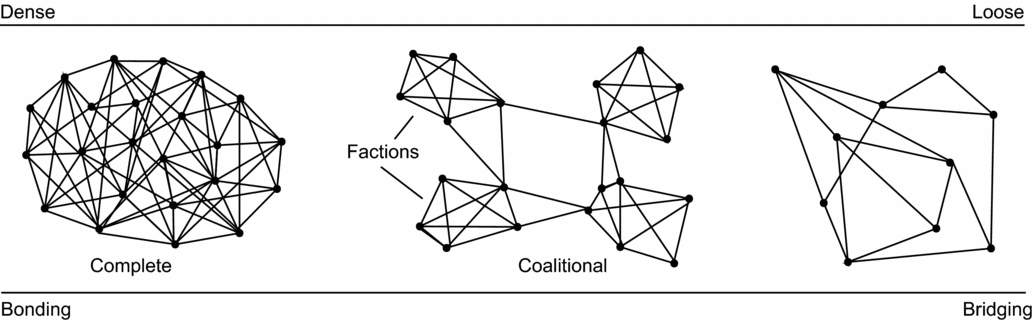
Social capital varies along multiple dimensions. First, its distribution among network connections may confer both individual and collective benefits. Individuals may form connections that benefit them directly, but benefits can also accrue at the community, national, or regional level within larger networked social structures (Bourdieu Reference Bourdieu and Richardson1986; Putnam Reference Putnam2000). This means that individuals who were not directly involved in building social networks nevertheless benefit from the social capital that accrues within the network (R. D. Putnam, cited in Borgatti, Jones, and Everett Reference Borgatti, Jones and Everett1998:28). These benefits may be social, economic, or political but are essentially tied to mutual trust and networks of action, cooperation, and reciprocity (Aldrich and Meyer Reference Aldrich and Meyer2015; Coleman Reference Coleman1988). The second dimension is the distinction between bonding (inclusive) and bridging (exclusive) social capital (Gittell and Vidal Reference Gittell and Vidal1998; Kwon and Adler Reference Kwon and Adler2014; Peeples and Haas Reference Peeples and Haas2013; Putnam Reference Putnam2000; Figure 2). Bonding social capital refers to social cohesion within networks and accrues benefits to the collective. Bonding networks are more effective in promoting inward-looking organizations (e.g., fraternities, clubs, secret societies) and are good for undergirding specific reciprocity and mobilizing solidarity. Bridging social capital refers to looser or weaker connections within networks and accrues benefits to actors, whether individuals or groups. Bridging networks promote information diffusion and links to external assets across diverse social groups (e.g., political movements, interdenominational religious organizations). Granovetter (Reference Granovetter1973) identified the importance of the weak ties in social networks, along which bridging forms of social capital may be transmitted, conferring greater benefits than the “stronger” bonding ties. Variability in forms of social capital and the benefits conferred by bonding and bridging ties to individuals, communities, and regional networks provide a useful lens for understanding confederacy dynamics.
Typology of network structures (after Crowe Reference Crowe2007:Figure 1; Ramirez-Sanchez and Pinkerton Reference Ramirez-Sanchez and Pinkerton2009: Figure 2).

Confederacy as a Societal Form
Neoevolutionary typologies, such as that of bands, tribes, chiefdoms, and states (Sahlins and Service Reference Sahlins and Service1960) as well as later twentieth-century models of cultural evolution (Carneiro Reference Carneiro1970; Earle Reference Earle1987; Fried Reference Fried1967; Johnson and Earle Reference Johnson and Earle2000), framed the evolution of political complexity in functionalist and materialist terms and reinforced the dichotomy between simple or small-scale, egalitarian societies and complex, large-scale, hierarchical ones. This often involved a Hobbesian social contract between individuals and elites who could institutionalize power by providing economic, military, and other services to a subaltern populace (Blanton and Fargher Reference Blanton and Fargher2008:13; Flannery Reference Flannery1972; Service Reference Service1975). Under these schemata, Iroquoian societies were commonly thought of as tribal and lacking complex forms of political and economic organization. However, contemporary approaches to political organization eschew evolutionary frameworks and instead embrace the multidimensional nature of power and institution-building in middle-range societies (e.g., Cobb Reference Cobb2003; Feinman and Neitzel Reference Feinman and Neitzel1984; Grinin and Korotayev Reference Grinin and Korotayev2011). In some cases, the structure of governance was not a goal in and of itself but was a means to solve important problems encountered by the society, requiring the development and institutionalization of new political forms (Blanton et al. Reference Blanton, Feinman, Kowalewski and Peregrine1996; Grinin and Korotayev Reference Grinin and Korotayev2011; Kowalewski Reference Kowalewski, Pluckhahn and Ethridge2006). Sometimes this involved the emergence of social inequality, but organizational strategies can also favor the promotion of strong horizontal links within a network, weakening tendencies toward centralization (Grinin and Korotayev Reference Grinin and Korotayev2011:285). Understanding the social relationships that were the foundation of political formations provides new insights into organizational forms.
Northern Iroquoian Confederacies
After approximately AD 1000, sites that are recognizably Iroquoian occur in the archaeological record of southern Ontario and central New York. These sites are primarily small, palisaded villages with incipient longhouses that functioned as base camps for groups who practiced some agriculture but who were also committed to broad-based subsistence strategies (Williamson Reference Williamson, Ellis and Ferris1990). After about AD 1250–1300, the first longhouse villages emerged in the context of an increasing commitment to agriculture and year-round village life (Dodd et al. Reference Dodd, Poulton, Lennox, Smith, Warrick, Ellis and Ferris1990; Hart Reference Hart2000). Although villages in this period were politically autonomous, distinctive forms of material culture and mortuary patterns suggest a certain amount of integration among and cultural differentiation between groups inhabiting subregional territories (Bamann et al. Reference Bamann, Kuhn, Molnar and Snow1992; Williamson and Robertson Reference Williamson and Robertson1994). The emergence of longhouse-based social units may have coincided with the development of matrilineality and clan exogamy, which extended the social networks of kin-based groups (Trigger Reference Trigger1976). After AD 1450, there is evidence for increasing hostility throughout Northern Iroquoia; settlements became fewer in number and larger in size and were increasingly situated in defensive locations and surrounded by multirow palisades (Birch Reference Birch2015; Engelbrecht Reference Engelbrecht2003; Snow Reference Snow1994; Trigger Reference Trigger1976). It is unclear whether hostilities took place between adjacent communities or between groups farther afield. However, there is no evidence for the emergence of confederacies at this time, and violence was probably organized at the community or subcommunity level; alliances between communities were possible. One potential outcome of the widespread hostility was the dispersal of groups inhabiting the eastern end of Lake Ontario and the upper St. Lawrence Valley (Abel Reference Abel2002; Engelbrecht Reference Engelbrecht1995; Pendergast Reference Pendergast, Pendergast and Chapdelaine1993). Recent SNA indicates that groups on the eastern shore of Lake Ontario occupied brokerage positions between Ontario and New York groups during the fifteenth century (Hart, Birch, and Gates St-Pierre Reference Hart, Birch and Gates St-Pierre2017). For other groups, the outcomes of fifteenth- and sixteenth-century coalescence and conflict included the development of complex organizational strategies within and between communities and potentially the genesis of “tribal” nations (Birch Reference Birch2015). Nations were composed of allied communities that shared common territories and acted in concert to achieve sociopolitical and economic objectives. In the late 1500s and early 1600s, certain of these nations allied into the historically documented Haudenosaunee and Wendat confederacies. The Tionotaté (Petun) were closely allied with the Wendat. The Neutral and Erie may have also formed confederacies, but less is known about their internal configurations and political organizations.
Within each confederacy, nations possessed distinct identities and languages, held their own councils, and retained political autonomy (Engelbrecht Reference Engelbrecht2003; Fenton Reference Fenton1998; Trigger Reference Trigger1976). Each clan segment had leaders for civil and military affairs. The former sat on political councils and ensured peaceful relations with other headmen and groups; the latter arranged and led war parties (Trigger Reference Trigger1976:102). Civil leadership was heritable within matrilineages; influential women in each matrilineage or subclan made decisions about succession based on merit. Esteemed qualities in each society included bravery, oratory abilities, generosity, and being of good mind (Labelle Reference Labelle2013; Snow Reference Snow1994; Trigger Reference Trigger1976). Warfare was undertaken by local leaders and communities (Morgan Reference Morgan1851), although participation in war parties was variable and drew on wide ranges of social ties and interests. In these ways, the political systems were based around coalition, consensus, and persuasion; the accumulation of social capital was key to building and maintaining consensus.
Wendat
The Wendat confederation formed in the late 1500s to early 1600s. It comprised four or possibly five nations, with 18–25 villages and a population of 20,000–30,000 (Trigger Reference Trigger1976; Warrick Reference Warrick2008). Although ancestral Wendat communities previously occupied the north shore of Lake Ontario and the Trent Valley, in the early sixteenth century, these populations coalesced in a circumscribed area south of Georgian Bay and north of Lake Scugog called “Wendake” (Figure 1). Although the precise etymology of Wendat is unclear, the name has been variously translated as “Dwellers on a peninsula” or “Islanders” (Steckley Reference Steckley2007). It may have been that coresidence in the Wendake landscape was an important part of becoming Wendat.
The Attignawantan and Attigneenongnahac were the longest-lived nations in Wendake, having descended from the earliest Iroquoian migrants from Lake Ontario in the fourteenth century. The Jesuit Relations records them as being the “most populous” nations (Thwaites Reference Thwaites1896–1901:16:227–228), owing to their adoption of many “families” over time. These families likely originated among groups on the north shore of Lake Ontario, who gradually migrated north in the years between AD 1350 and 1600 (Birch and Williamson Reference Birch and Williamson2015). SNA has confirmed the existence of close ties between communities in the Toronto region and those in Wendake as early as AD 1350 (Hart et al. Reference Hart, Shafie, Birch, Dermarkar and Williamson2016). There is also archaeological evidence for a significant degree of residential mobility and relocation of longhouse clusters between communities throughout the prehistoric period. According to the Relations (Thwaites Reference Thwaites1896–1901:16:227–229), “families remained distinct little nations, retaining the names and memories of their founders, a general name [for themselves], and a war chief and council chief” (Tooker Reference Tooker1964:11). The Arendarhonon originated in the Trent Valley and are thought to have joined the confederacy about AD 1590. The Tahontaerat were the smallest nation, inhabiting a single large village, and are thought to have been the last group to migrate north and join the confederacy about AD 1610.
Political influence was apparently not equal within the confederacy council (Thwaites Reference Thwaites1896–1901:10; Trigger Reference Trigger1976:58). Each “sib” or subclan (Trigger Reference Trigger1963) had its own leaders, from whom council members were selected. Issues considered included the installation of new chiefs, resolving conflicts within member nations, maintaining friendly relations with non-Wendat allies and trading partners, and coordinating raids on common enemies, particularly the Haudenosaunee. Another purpose of council meetings was to provide opportunities to “strengthen the confederacy by bringing together the headmen from all the Huron villages and giv[e] them an opportunity to reaffirm old friendships and discuss topics of mutual interest” (Trigger Reference Trigger1976:59). Ossuary burial and the associated Feast of the Dead also provided Wendat men, women, and children the opportunity to come together for feasting, gift-giving, ceremony, and mourning (Thwaites Reference Thwaites1896–1901:10).
Haudenosaunee
The Haudenosaunee was a confederacy of five nations, which were dispersed in discrete settlement clusters across central New York (Figure 1). These groups included, from west to east, the Seneca, Cayuga, Onondaga, Oneida, and Mohawk. Each group seems to have developed more or less in situ during the fifteenth century and remained bound to that territory into the contact era. In the early seventeenth century, the Haudenosaunee confederacy population is estimated to have been 18,000–20,000—similar to but somewhat smaller than the Wendat (Jones Reference Jones2010a, Reference Jones2010b; Snow Reference Snow1995).
The confederacy may have started out as a loose nonaggression pact among member nations intended to resolve conflict in the region (Kuhn and Sempowski Reference Kuhn and Sempowski2001:301–302). The foundational Haudenosaunee genesis story is known from fragments that date to as early as the eighteenth century and is consistent across multiple accounts (Fenton Reference Fenton1975, Reference Fenton1998; Vecsey Reference Vecsey1986). There is general agreement that nations joined the league in order from east to west, with the Seneca the last to join (Fenton Reference Fenton1968; Parker Reference Parker1916). Archaeological reconstructions suggest that the eastern- and westernmost members of the confederacy interacted regularly by the last decade of the 1500s (Kuhn and Sempowski Reference Kuhn and Sempowski2001). Starna (Reference Starna2008) suggests a slightly different scenario, with the Mohawk playing a prominent role and the unification of the league correlating with the initiation of Dutch trade in AD 1615. Within the confederacy, the councils of the sachems constituted the only corporate activities (Wolf Reference Wolf1982:167–169). There are eight recorded versions of the “Roll Call of the Founders” (see Fenton Reference Fenton1998:191), which show a great deal of consistency in the roster of 50 chiefly titles attributed to the founders of the confederacy and their distribution among the five nations. Kinship idioms are extended throughout each tribal roster, with members referring to each other as “elder” or “younger” siblings and cousins, depending on rank and role (Fenton Reference Fenton1998:194–195).
Women and Power
Although Northern Iroquoian men were primarily responsible for conducting intervillage diplomacy, women were active in community, nation, and confederacy politics (Bilharz Reference Bilharz, Klein and Ackerman1995; Birch 2016; Brown Reference Brown1970; Lafitau Reference Lafitau1724:I:66–67; Prezzano Reference Prezzano, Claassen and Joyce1994). Women also held council meetings (Lafitau Reference Lafitau1724:I:295; Richter Reference Richter1992:43; Thwaites Reference Thwaites1896–1901:10:281–283). Senior women selected and unseated male representatives of their clan segments on the confederacy council; domestic structures, field systems, and the harvest were overseen by women, placing them in control of the domestic economy. Another way in which women wielded power was the provisioning of, or refusal to provision, war parties with maize and moccasins (Bilharz Reference Bilharz, Klein and Ackerman1995; Prezzano Reference Prezzano, Claassen and Joyce1994:98). As elders, skilled farmers, and craftspersons, women may have had asymmetrical status. They were critical in building consensus, transmitting skills and information, and mediating relationships within communities. Especially important from a network perspective is that women were responsible for arranging marriages, binding clans and communities together through networks of obligation (Lafitau Reference Lafitau1724:I:66–67).
Pottery Decorations as Signals
The underlying premise of our analyses is that decorations on the collars of Northern Iroquoian pots were signals (Hart, Birch, and Gates St-Pierre Reference Hart, Birch and Gates St-Pierre2017; Hart and Engelbrecht Reference Hart and Engelbrecht2012; Hart et al. Reference Hart, Shafie, Birch, Dermarkar and Williamson2016; see Bliege Bird and Smith Reference Bliege Bird and Smith2005). Collars are thickened bands of clay that encircle a pot and extend down from the lip for up to several centimeters (Figure 3). Collar decorations generally consist of multiple straight incised and/or stamped lines that form geometric patterns sometimes elaborated with annular punctations and/or effigies. Collars were not necessary for a pot to function well for cooking, brewing, or storing. Pottery without collars was used for cooking in Northern Iroquoia by at least the fifteenth to fourteenth century cal BC (Taché Reference Taché2005; Taché and Craig Reference Taché and Craig2015; Taché and Hart Reference Taché and Hart2013). Collars do not appear until the ninth century cal AD, constituting small percentages of assemblages prior to about AD 1400 (Brumbach Reference Brumbach, Rieth and Hart2011). Collars required additional raw materials (clay, temper) and additional construction time and complicated the drying of a pot prior to firing. Affixing an often heavy collar to a thin-walled, hand-constructed pot took skill, as did the planning and execution of complex decoration while the clay was still plastic.
Examples of collared vessel types (bracket denotes collar): (a) Black Necked; (b) Sidey Notched; (c) Roebuck Corn-Ear; (d) Huron Incised (modified after Birch et al. Reference Birch, Wojtowicz, Pradzynski, Pihl, Jones and Creese2017).

Pottery manufacture was generally the responsibility of women (Trigger Reference Trigger1976:39; Whallon Reference Whallon, Binford and Binford1968:223–224; Wrong Reference Wrong1939). As with farming and other craft production (Perrelli Reference Perrelli, Miroff and Knapp2009), potting was done in groups, where an individual may have been responsible for the construction of complete or only specific portions of pots. At the sixteenth-century Jean Baptiste-Lainé (Mantle) site, the teaching of pottery production also appears to have been a restricted, group-oriented activity (Birch Reference Birch2016). Given the communal ethos surrounding production and consumption in Iroquoian households and communities, it would be surprising if any aspect of ceramic production was carried out solely by individuals (see also Harris and Cipolla Reference Harris and Cipolla2017:61–63 regarding Western influences on the individual as a universal concept). Working in such groups as well as in the general cultural context of those groups, an individual potter expressed both group norms and her own skills and taste in choosing and executing collar decorations (Bliege Bird and Smith Reference Bliege Bird and Smith2005). These choices and their execution were visible to the group of potters as well as to others during subsequent pottery use.
A primary locus of women's political activities was the domestic sphere. Collar decorations were readily decoded by members of a woman's community and socially distant visitors. While decorations occurred on the neck, shoulder, interior rim, and/or lip of some pots, the collar was the most visible portion of a pot in the interior of the longhouse (Chilton Reference Chilton1996). As such, collar decorations had absolute and contextual visibility (Carr Reference Carr, Carr and Neitzel1995). While these decorations were not a primary signal, they reinforced or mirrored symbols visible in wider ranges of settings such as tattoos, clothing, and hairstyles (Krutak Reference Krutak, Deter-Wolf and Diaz-Granados2013; Steere Reference Steere, Deter-Wolf and Diaz-Granados2013). Collar decorations were symbolically generalized communication media that facilitated communication within large, regional networks (Mizoguchi Reference Mizoguchi and Knappett2013)—an archaeologically visible medium in which women signaled their membership in political and other networks, forming and strengthening alliances within and between communities (Bliege Bird and Smith Reference Bliege Bird and Smith2005; Bowser Reference Bowser2000; Bowser and Patton Reference Bowser and Patton2004; Wobst 1977).
Methods
Numerous coding schemes have been devised for Iroquoian collar decorations (e.g., Engelbrecht Reference Engelbrecht1971, Reference Engelbrecht and Sullivan1996; Latta Reference Latta1976; Ramsden Reference Ramsden1977; Smith Reference Smith1997). Because they are geometric, these coding schemes are mostly interchangeable. Following our previous work (Hart Reference Hart2012; Hart, Birch, and Gates St-Pierre Reference Hart, Birch and Gates St-Pierre2017; Hart and Engelbrecht Reference Hart and Engelbrecht2012, Reference Hart, Engelbrecht, Jones and Creese2017; Hart et al. Reference Hart, Shafie, Birch, Dermarkar and Williamson2016), we used Engelbrecht's (Reference Engelbrecht1971, Reference Engelbrecht and Sullivan1996) scheme. Currently, the dataset has codes for 234 sites distributed across Northern Iroquoia. Each site has a minimum of 25 distinct pots, and altogether the dataset includes a total of 70,463 coded collars. Each collar decoration is assigned to one of 29 analytic decorative motif categories. The resulting dataset of motif category counts was used to calculate a Brainerd-Robinson (BR) similarity coefficient matrix (Brainerd Reference Brainerd1951; Robinson Reference Robinson1951) in Tools for Quantitative Archaeology 5.0, with 1,000 Monte Carlo pairwise trials using a random seed set from the clock to adjust for variation in sample size (Kintigh Reference Kintigh2010). The coefficient ranges from 0 to 200, with the latter representing perfect similarity.
For the present analyses, each site was assigned to one of six groups based on historical Northern Iroquoian territories: (1) Haudenosaunee, (2) Erie, (3) Jefferson County St. Lawrence Iroquoian, (4) St. Lawrence Valley Iroquoian, (5) Wendat-Petun, and (6) Neutral (Figure 4). The Wendat and Petun were grouped together owing to their close political alliance and geographic proximity. Each site was also assigned to one of six 50-year time spans, starting at AD 1350 and ending at 1650, based on radiocarbon dates, pottery seriation, and settlement pattern changes. Three undirected graphs were constructed from the BR matrix: AD 1450–1550, 1500–1600, and 1550–1650. These graphs represent 147 sites and 56,073 collars (Figure 4; Supplemental Table 1). Following Hart and colleagues (Hart, Birch, and Gates St-Pierre Reference Hart, Birch and Gates St-Pierre2017; Hart et al. Reference Hart, Shafie, Birch, Dermarkar and Williamson2016), 100-year periods with 50-year overlaps were used to account for any inexactness in chronological assignment and to account for lags in network trends resulting from subregional population movements. The analyses were not extended earlier, because of small sample sizes of 10 and 13 for Haudenosaunee-territory sites in the 1350–1450 and 1400–1500 graphs, respectively, compared with 43 and 45 sites for the Wendat territory.
Location and coded groups of sites employed in this analysis, ca. AD 1450–1650.

All graph measures were calculated in UCINET 6.627 (Borgatti, Everett, and Freeman Reference Borgatti, Everett and Freeman2002) unless otherwise noted in the results section. We used either valued (weighted) or binary graphs as required by a given UCINET module. We recognize that binary graphs can bias the results of network measures depending on the underlying assumptions made in choosing a similarity coefficient threshold for binarization (Peeples and Roberts Reference Peeples and Roberts2013). However, we consider the use of binary and valued graphs with different measures to be complementary. In most cases, we used a BR ≥ 110 threshold, which produced interpretable network visualizations while minimizing network fragmentation for pan-Iroquoian graphs (Hart, Birch, and Gates St-Pierre Reference Hart, Birch and Gates St-Pierre2017). In some instances, we used binary graphs at different thresholds to account for weaker and stronger ties in the networks. Network visualizations were realized in visone 2.16 (Brandes and Wagner Reference Brandes, Wagner, Jünger and Mutzel2004). We used the UCINET permutation t-test, which does not require assumptions of random and independent samples, to determine whether two samples are significantly different (Borgatti, Everett, and Johnson Reference Borgatti, Everett and Johnson2013). A matrix of geodesic distances was created using the ArcInfo v. 10.2 Point Distance Tool in a geographic information system of site locations with the North America Lambert Conformal Conic, NAD 1983 projection (Supplemental Table 2).
Results
Regressions of geodesic distances (kilometers) on BR values indicate that distance has little or no effect on collar decoration similarity in either confederacy territory (Supplemental Table 3). The only Wendat-territory network in which distance explains >20% of BR variation (35.2%) is that which dates to AD 1550–1650. However, removing the two late sixteenth-century Trent River valley sites results in distance explaining only 3.8% of BR variation. These sites have over 10% St. Lawrence Iroquoian–like pottery (Ramsden 1990), unlike other contemporaneous and later sites in Wendake. Regression for Haudenosaunee territory graphs explains 37.0%, 8.8%, and 15.6%, respectively. For the AD 1450–1550 graph, it is only at a distance greater than 150 km that distance explains more than 20% of the BR variance. Although distance accounts for little of the BR variation for either confederacy territory, the underlying structures of the two territories’ networks are very different, as made evident by a series of measures.
Network visualizations are presented in Figures 5–7. In each 100-year period, the confederacy territory networks have very different topologies. The Haudenosaunee-territory networks show distinct subgroups of nodes linked by one or a few edges. Other sites form appendages or pendants on the network. By contrast, the Wendat-territory networks consist of one highly connected cluster with other sites forming one or two appendages. These topologies are also reflected in the pan-Iroquoian visualizations, with highly connected Wendat-territory sites compared with the Haudenosaunee-territory sites.
Network plots, AD 1450–1550: (a) Pan-Iroquoian; (b) Wendat-Petun; (c) Haudenosaunee.

Network plots, AD 1500–1600: (a) Pan-Iroquoian; (b) Wendat-Petun; (c) Haudenosaunee.

Network plots, AD 1550–1650: (a) Pan-Iroquoian; (b) Wendat-Petun; (c) Haudenosaunee.

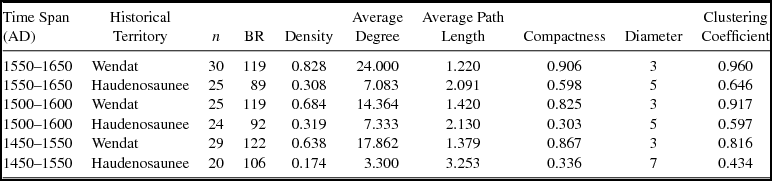
A series of network cohesion measures (Borgatti, Everett, and Johnson Reference Borgatti, Everett and Johnson2013) were calculated for the Haudenosaunee- and Wendat-territory networks from binary graphs at the ≥BR 110 threshold. Density is the number of edges present in a network divided by the total possible edges. Average degree is the mean of the number of nodes to which all nodes are connected. Average path length is the average number of steps from each node to every reachable node. Compactness represents the mean of all reciprocal distances in a network. The weighted overall clustering coefficient is a measure of the tendency of nodes to cluster together in a network. Also called the transitivity coefficient, it is the proportion of triads in which all three nodes are connected. Diameter is the number of steps in the longest path from one node to another.
For each measure, the Wendat territory values indicate greater network cohesion and thus greater social capital (Borgatti, Jones, and Everett Reference Borgatti, Jones and Everett1998) for network villages than in the corresponding Haudenosaunee-territory network. Also included are the maximum BR values that result in connected networks. For each graph, the value for the Wendat territory is greater—Wendat-territory sites have stronger ties to one another than the Haudenosaunee-territory sites (Supplemental Table 4). Permutation t-tests indicate that the differences are significant. Assemblage evenness was calculated from motif category counts using Simpson's E1/D (Smith and Wilson Reference Smith and Wilson1996). The Haudenosaunee territory means are larger in each graph pair than the Wendat territory means, and there is a trend toward less evenness in the Wendat territory graphs (Table 1). This result parallels our earlier analysis (Hart et al. Reference Hart, Shafie, Birch, Dermarkar and Williamson2016) showing that Wendat-territory motifs were dominated by simple oblique designs late in the sequence (Figure 3d), representing meta-identifying signals (Clark et al. Reference Clark, Huntley, Hill, Lyons and Card2013). Cohesion measures for graphs binarized at the maximum BR value that maintains a connected network in the respective territories also indicate greater cohesion for the Wendat-territory networks (Table 2).
Network Cohesion Measures for Individual Historical Wendat- and Haudenosaunee-Territory Graphs Binarized at Brainerd-Robinson Coefficient (BR) ≥ 110.

a Maximum BR value that connects all vertices.
b Calculated from motif category counts.
Network Cohesion Measures for Individual Historical Wendat- and Haudenosaunee-Territory Graphs at the Maximum Brainerd-Robinson Coefficient (BR) that Maintains a Connected Network.

Node-level normalized flow betweenness and degree centralities were calculated with valued graphs for the three Haudenosaunee- and Wendat-territory networks. Flow betweenness centrality measures the total flow of a network through a given node, while degree centrality is a measure of the connectedness of nodes. Permutation t-tests indicate that the Wendat-territory means are significantly greater than the Haudenosaunee-territory means (Supplemental Table 5). This is a further indication of greater social capital on average for Wendat-territory villages (Borgatti, Jones, and Everett Reference Borgatti, Jones and Everett1998).
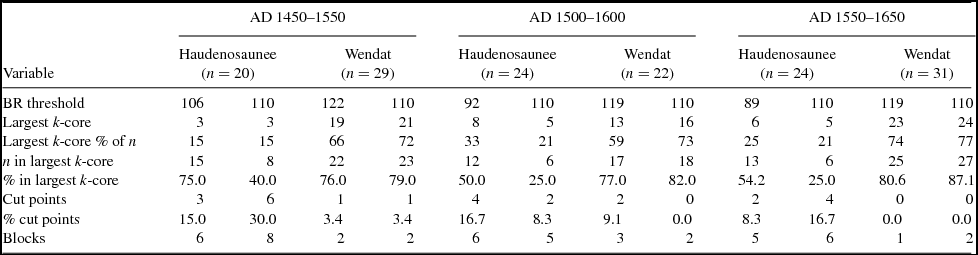
We examined k-cores, cut points, and bicomponents or blocks to assess network configuration (e.g., Crowe Reference Crowe2007; Ramirez-Sanchez and Pinkerton Reference Ramirez-Sanchez and Pinkerton2009). k-cores represent the maximum-sized subgraph, k, to which each node is connected. Cut points are nodes that bridge structural holes whose removal disconnects a network, resulting in two or more blocks. High k-core values reflect bonding ties, while larger numbers of cut points and blocks reflect bridging ties (Crowe Reference Crowe2007:478). We used binary graphs at two thresholds: BR ≥ 110 and the maximum BR value for each graph that maintains a connected network. In each case, the Wendat networks have the highest maximum k-core, representing higher percentages of total sites, and higher percentages of nodes with that value, except for the maximum BR to maintain a connected AD 1450–1550 network (Table 3). For each time span, the Haudenosaunee-territory network has the highest percentage of cut point nodes and blocks. These results, along with their respective visualizations, suggest that the Wendat-territory networks are complete and the Haudenosaunee-territory networks are coalitional (Crowe Reference Crowe2007; see Figure 2).
k-Cores, Cut Points, and Blocks at Maximum Brainerd-Robinson Coefficient (BR) for Connected Network and BR ≥ 110 Thresholds by Territory.

To further explore how the Haudenosaunee- and Wendat-territory networks differed, External-Internal index values were calculated for pan-Iroquoian networks with valued graphs using Borck and colleagues’ (Reference Borck, Mills, Peeples and Clark2015) method, with 5,000 iterations and normalized for sample size. The External-Internal index is a measure of the connectedness of nodes to nodes within and outside of their respective groups; values >0 indicate a preponderance of external ties (heterophily), while those <0 indicate a preponderance of internal ties (homophily). The values for the Wendat-territory sites remain negative throughout the sequence, with little change in means. The AD 1450–1550 Haudenosaunee-territory value is slightly positive, while the AD 1500–1600 and 1550–1650 means are negative (Supplemental Table 6). The Haudenosaunee territory has a greater range of values throughout the sequence and includes sites with positive values. Permutation t-tests indicate that the Haudenosaunee-territory means are significantly greater than the Wendat-territory means for the AD 1450–1550 and 1550–1650 graphs (Supplemental Table 6). Taken together, these results indicate that the Haudenosaunee territory has a greater external focus than does the Wendat territory throughout the sequence, suggesting exposure to a wider range of external ideas (Borgatti, Jones, and Everett Reference Borgatti, Jones and Everett1998).
Discussion
Each analysis indicates the Wendat- and Haudenosaunee-territory social signaling networks had very different topologies. Wendat-territory BR values are significantly greater than those for the Haudenosaunee territory throughout the sequence, indicating stronger ties between the sites. The Wendat-territory network possesses high degrees of network cohesion, with constituent sites that are homophilous and lacking the clearly defined subgroups present in the Haudenosaunee network (Bodin and Crona Reference Bodin and Crona2009; Wasserman and Faust Reference Wasserman and Faust1994). As such, the networks can be classified as complete and coalitional, respectively (Crowe Reference Crowe2007), and are defined by different forms of social capital.
The Wendat-territory networks are characterized by bonding ties that are associated with greater intragroup communication and trust (Borgatti, Jones, and Everett Reference Borgatti, Jones and Everett1998; Granovetter Reference Granovetter1973). Bonding social capital typically reinforces dense social relationships within communities in which members are directly tied to many other members within the network. In this case, bonding social capital may have served to create strong in-group loyalty by mobilizing solidarity and specific reciprocity between group members (Bourdieu Reference Bourdieu and Richardson1986; Crowe Reference Crowe2007; Putnam Reference Putnam2000). Such networks may also create strong out-group antagonism that may result in negative external effects (e.g., conflict with neighbors; Putnam Reference Putnam2000:22–23). The positive impact of such a complete network is that it facilitates cohesion and lowers the risks associated with cooperation among members to achieve mutually beneficial ends.
The Haudenosaunee-territory networks have less cohesion and some heterophilous sites and include multiple subgroups or factions, which are linked through a small number of nodes and bridging ties. Bridging ties permit increased cohesiveness between subgroups and facilitate more effective communication between diverse stakeholders (Bodin and Crona Reference Bodin and Crona2009:368). This network structure is defined as coalitional and lies in the middle of the continuum of dense versus loose network structures, conferring some of the benefits of each form (Crowe Reference Crowe2007; Figure 2). Haudenosaunee social capital also provided members of the network with weak ties that created better linkages to distant acquaintances, who served as external assets that provided network members with broader ties of reciprocity and information (Granovetter Reference Granovetter1973; Putnam Reference Putnam2000:22). The formalized structure of the Haudenosaunee confederacy council seems to reflect the importance of maintaining bridging ties between member nations and clans in the absence of direct ties (or regular face-to-face interaction) between members of the network.
It is also clear that women in the Wendat and Haudenosaunee confederacies had different signaling practices. Evenness values indicate that in the Wendat-territory networks, few collar motifs were emphasized, reflecting the need for meta-identifiers (Clark et al. Reference Clark, Huntley, Hill, Lyons and Card2013) as groups coalesced into a constricted area, resulting in increased interactions (Hart et al. Reference Hart, Shafie, Birch, Dermarkar and Williamson2016:6). Meta-identifiers may be created during periods of social transformation and de-emphasize prior cultural divisions so that groups can act collectively in mutual interest; such identifiers transcend, but do not necessarily replace, earlier identities (Clark et al. Reference Clark, Huntley, Hill, Lyons and Card2013). Haudenosaunee-territory networks relied on larger numbers of motifs, which helped maintain separate group identities, while the sharing of motifs between communities and nations facilitated interactions between groups making up the confederacy. The coalitional network structure and greater frequency of bridging ties in the Haudenosaunee-territory networks signal shared access to resources, information, and opportunities—or the sharing of sources of social capital that existed in one faction with members of other factions (Granovetter Reference Granovetter1973). A diverse set of bridging ties within a network increases the agency of groups and factions by reducing obligations to all members of the network (Crowe Reference Crowe2007; Newman and Dale Reference Newman and Dale2007). These different topologies have implications for the political activities in the formation and maintenance of each confederacy.
Among the Wendat, signaling networks that included meta-identifiers may have both been generated by and helped to facilitate residential mobility as an adaptive strategy throughout the AD 1450–1650 period. The social and symbolic ties engendered by existing signaling networks facilitated the migration of populations to Wendake during the process of confederacy formation. As such, women played a more active role in the process of forming and maintaining sociopolitical networks than has previously been recognized. Women acted to help assimilate themselves into a new social structure that emphasized common identities and goals. However, while complete networks enhance norms of trust and lower the costs of cooperation, they can also be costly in terms of obligations of reciprocity.
For the Haudenosaunee, community sequences and signaling practices were more bounded, with multiple generations more likely residing within a single village sequence, resulting in distinctive “micro-traditions” (Tuck Reference Tuck1971:219). Because intrasite settlement pattern and artifactual data are lacking for the majority of Haudenosaunee settlements, these patterns are difficult to verify independently. While there is ceramic evidence suggesting the movement of Jefferson County St. Lawrence Iroquoian populations to ancestral Haudenosaunee nations, these migrations may have been less common than among the Wendat and precipitated by major events as opposed to the regular fission and fusion of community segments (Engelbrecht Reference Engelbrecht1995; Niemczycki Reference Niemczycki1991:32; Snow Reference Snow1994:81).
These different network topologies may have had important economic impacts, particularly as they relate to European contact. Contemporary literature on community economic development suggests that complete, or bonding, networks may hinder economic growth by inhibiting economic development on an individual level and deincentivizing expenditures of time and effort on the creation of external ties (Crowe Reference Crowe2007). For the Wendat, strong network obligations may have both hindered the benefits of cultivating external ties and negatively impacted whether those who sought them were perceived as trustworthy. Trigger (Reference Trigger1976:288–289) discusses how access to French trading partners and sources of wealth led to tensions between social groups and efforts to remediate such potential conflicts in the first decade of the seventeenth century. For the Haudenosaunee, less intragroup obligation, stronger bridging ties, and greater external orientation may have conferred strategic benefits during the period of European contact, when groups were negotiating relationships with various indigenous and European agents on the colonial frontier. Bridging ties are more effective for seeking out and obtaining resources (Lin Reference Lin1999). The formalities of trade as a function of diplomacy were pronounced among the Haudenosaunee (Richter Reference Richter1992) and may have served to create and affirm the existence of such ties.
Finally, the dominant metaphor of the Wendat was a circular society (Sioui Reference Sioui1999; Sioui and Labelle Reference Sioui and Labelle2014). For the Wendat, bringing trading partners and allies into the circle of relations was important to cementing relationships. The intent was to create an “awareness of each party's situation of the other” (Sioui Reference Sioui1999:63). As central figures in their communities and societies, women were essential in this endeavor (Sioui and Labelle Reference Sioui and Labelle2014:181). This pattern is evident in the networks by about AD 1450, prior to the confederacy's formal emergence. As such, “circular” values preceded and underpinned confederacy formation. In all periods under consideration, social signaling was a symbolic means of communicating network membership to both community members and socially distant members of the network. Through pottery decoration, the norms of trust, reciprocity, and forms of social capital were signaled by women to community members and allies within the collectively oriented Wendat-Petun network. In the AD 1550–1650 period the network reached its greatest density (Figure 7), concomitant with the crystallization of the confederacy and increasing threats from external enemies among the Haudenosaunee.
The defining metaphor for the Haudenosaunee was the longhouse (Fenton Reference Fenton1998; Morgan Reference Morgan1851; Richter Reference Richter1992), with the five nations of the confederacy stretched out across central New York. Diplomacy among members of the confederacy council proceeded according to strict rules of protocol that included variable degrees of deference in accordance with status differentiations between member nations (Fenton Reference Fenton1998; Richter Reference Richter1992). As such, the Haudenosaunee network was defined by bridging ties, conferring greater autonomy on actors within the network or their representatives. The Haudenosaunee network was more in keeping with a political alliance that promoted the sharing of information and links to external assets across diverse social groups that retained greater autonomy, as opposed to a more tightly integrated society or collective. This is in keeping with interpretations of the Haudenosaunee confederacy as a strategic alliance based on shared military and economic aims (Richter Reference Richter1992; Starna Reference Starna2008). The signaling networks reflect this structure. Signaling reflected women's role of integrating communities within factions while at the same time maintaining flexible relations across the confederacy as well as relationships external to the confederacy. These latter two were concentrated in a few villages, where the women were integral to maintaining the confederacy structure and ensuring the availability of resources external to the confederacy.
Conclusions
Accounts of Wendat and Haudenosaunee confederacy structures and politics have focused on male activities. This is perhaps because the early European chroniclers were male. Much less is known about the political activities of Wendat and Haudenosaunee women. If we accept that women were potters, that the designs they created on pottery collars were signals, and that those signals reflected at least in part women's political identities, then networks constructed on the basis of village-level collar decoration assemblages provide insights into women's political activities within their respective confederacies. The SNA results indicate that the structure of Wendat and Haudenosaunee women's networks were very different. The complete Wendat-territory network suggests that Wendat women shared a greater amount of solidarity and trust and may have been bound more closely through networks of mutual obligation. The coalitional Haudenosaunee network indicates that these characteristics were shared by members of the same factions but not across the confederacy as a whole, where bridging ties facilitated the flow of social capital and reciprocity. Some of this difference is the direct result of how the respective confederacies were spatially structured through centuries of sociopolitical and settlement pattern developments. However, it is evident that women were integral to the maintenance of each confederacy, playing active roles in the integration of groups into confederacies with very different structures.
Acknowledgments
We thank Robert Feranec for his assistance with R and Jacob Lulewicz for his help with MatLab. Susan Dermarkar, William Engelbrecht, Christian Gates St-Pierre, and Ronald F. Williamson assisted in assembling the dataset. Comments from Louis Lesage and three anonymous reviewers enhanced the manuscript. Thanks to Jon Micon and Louis Lesage for translating the abstract into French.
Data Availability Statement
All data used as the basis for analyses are included in the supplemental data files.
Supplemental Materials
Supplemental materials are linked to the online version of this article, which is accessible via the Society for American Archaeology member log-in at https://doi.org//10.1017/aaq.2017.59.
Supplemental Table 1. Motif Category Counts.
Supplemental Table 2. Geodesic Distance Matrix.
Supplemental Table 3. Results of Regressions of Geodesic Distances on Brainerd-Robinson (BR) Values by Network.
Supplemental Table 4. Mean Brainerd-Robinson (BR) Values by Confederacy Territory.
Supplemental Table 5. Permutation t-Test p-Values for Haudenosaunee versus Wendat Territory Normalized Node Centrality Values by Time Period.
Supplemental Table 6. Site-Level Valued Normalized Internal-External Ranges for Haudenosaunee and Wendat Territories within Pan-Iroquoian Graphs.