INTRODUCTION
Skates, like many elasmobranchs, can be susceptible to over-exploitation as a result of a combination of life history characteristics that include slow growth, late maturation and low productivity. As a result of over-exploitation, two formerly-abundant skate species, the common skate (Dipturus batis) and the barndoor skate (Dipturus laevis) are thought to have been fished down to a small fraction of their historical population sizes (Brander, Reference Brander1981; Casey & Myers, Reference Casey and Myers1998; Gedamke et al., Reference Gedamke, DuPaul and Musick2005). These declines may be a result of unregulated fishing pressure (Sulikowski et al., Reference Sulikowski, Morin, Suk and Howell2003); therefore, it is important to determine accurate growth rates and maximum longevities. These life history characteristics are essential to demographic models and stock assessments used in developing effective management strategies for both commercially important and incidentally taken fish.
In California waters, skates are commonly taken as incidental by-catch in commercial trawl and recreational fisheries. California Department of Fish and Game catch statistics indicate that skate landings have been slowly increasing since 1995 (Zorzi et al., Reference Zorzi, Martin, Ugoretz, Leet, Dewees, Klingbeil and Larson2001) and this is likely the result of increasing demand. Skate wings are commonly sold fresh, frozen, salted, or dried, primarily to Asian markets in southern California and are used as a substitute for scallops (Martin & Zorzi, Reference Martin, Zorzi and Branstetter1993). Elsewhere, the growth of these markets, as well as the development of new markets, has made skate wings more profitable (Sosebee, Reference Sosebee1998). In the early 1990s, the market value of skate wings increased substantially due to a reduction in groundfish quotas, which led to increased landings of previously discarded skates (Zorzi et al., Reference Zorzi, Martin, Ugoretz, Leet, Dewees, Klingbeil and Larson2001).
The sandpaper skate, Bathyraja kincaidii (Garman, Reference Garman1908), is one of the most commonly collected skates off central California. It is often caught with the big skate, Raja binoculata, California skate, Raja inornata, and longnose skate, Raja rhina, in trawl fisheries by-catch and in fishery independent groundfish surveys conducted by the National Marine Fisheries Services (NMFS), Santa Cruz, California (Ebert & Cailliet, Reference Ebert and Cailliet2007). Bathyraja kincaidii can be found from the Gulf of Alaska to Baja California and most commonly occurs along the outer continental shelf and upper slope (Ebert, Reference Ebert2003). Taxonomically, B. kincaidii has been synonymized by some authors (Ishihara & Ishiyama, Reference Ishihara and Ishiyama1985) with the Bering skate, Bathyraja interrupta (Gill & Townsend, Reference Gill and Townsend1897). However, recent studies have distinguished them as separate and valid species (Craig, Reference Craig1993; Ebert, Reference Ebert2003; Ebert & Compagno, Reference Ebert and Compagno2007).
Given the common occurrence of B. kincaidii in trawl fisheries, and the lack of life history information, it is important to investigate its life history characteristics, such as age and growth. For elasmobranchs in general, age and growth rates can be estimated by interpreting the periodicity of concentric growth bands found in calcified structures, including vertebral centra, dorsal fin spines and neural arches (Cailliet & Goldman, Reference Cailliet, Goldman, Carrier, Musick and Heithaus2004). To date, vertebral centra have been the primary structure used in elasmobranch age and growth studies (Ishiyama, Reference Ishiyama1951, Reference Ishiyama1958; Daiber, Reference Daiber1960; Taylor & Holden, Reference Taylor and Holden1964; Du Buit, Reference Du Buit1972; Cailliet et al., Reference Cailliet, Martin, Kusher, Wolf and Welden1983), but more recently caudal thorns of skates have been used for age and growth analyses of this unique group (Gallagher & Nolan, Reference Gallagher and Nolan1999; Gallagher et al., Reference Gallagher, Nolan and Jeal2006; Matta & Gunderson, Reference Matta and Gunderson2007). Gallagher & Nolan (Reference Gallagher and Nolan1999) compared validated age estimates from vertebral centra to those from caudal thorns and verified their use as an accurate structure in the age determination of Bathyraja albomaculata, B. brachyurops, B. griseocauda and B. scaphiops. Gallagher et al. (Reference Gallagher, Nolan and Jeal2006) made a preliminary determination that caudal thorns were more reliable than vertebral centra for ageing Amblyraja radiata and Matta & Gunderson (Reference Matta and Gunderson2007) successfully aged B. parmifera using caudal thorns. However, caudal thorns have also been determined as unreliable structures for age and growth (Davis et al., Reference Davis, Cailliet and Ebert2007; Ainsley, Reference Ainsley2009). The novel aspect of this approach relative to other methods is that the use of caudal thorns for age determination provides a non-lethal means for ageing skates, given that the growth of thorns can be shown to follow somatic growth.
Therefore, the objectives of this study were to: (1) estimate age and growth of B. kincaidii using vertebral central; (2) evaluate the use of caudal thorns for age estimation; (3) verify the consistency of age estimates between caudal thorns and vertebrae; (4) validate age estimates using centrum edge and marginal increment analyses; and (5) fit an appropriate growth model to size-at-age data to describe the growth parameters of this species.
MATERIALS AND METHODS
Data collection
Bathyraja kincaidii were collected off central California from January 2002 to July 2004. Specimens were collected from monthly trawl and longline surveys conducted by the NMFS, Southwest Fisheries Science Center, Fisheries Ecology Division in Santa Cruz, California, and NMFS, Northwest Fisheries Science Center in Newport, Oregon, and from commercial fish catches on two separate occasions. Bathyraja kincaidii were collected between 22 and 667 m depth. For each skate, total length (TL mm) and weight (g) was determined and a portion of the vertebral column was collected and frozen until further analysis. Based on the methods described by Gallagher & Nolan (Reference Gallagher and Nolan1999), the first five caudal thorns were removed from each specimen and were soaked in 2 ml of trypsin for one to seven days, or until attached tissues were dissolved. Subsequently, thorns were dried and stored in labelled vials until further analysis.
Caudal thorns
To determine allometric relationships for thorn size relative to TL, three-dimensional measurements were made for whole caudal thorns. From the largest of the five caudal thorns collected from each fish, the base length, thorn height, and thorn length (length from the tip of the thorn to the base, measured along the anterior margin) were measured to the nearest millimetre (mm). Each measurement was plotted against TL for the entire sample set, as well as for immature skates and mature skates separately. A regression analysis was used to determine which, if any, provided a positive linear relationship.
Whole and sectioned thorns were examined for growth bands with a dissecting microscope at 40X magnification. Whole and sectioned thorns were stained with silver nitrate (Stevens, Reference Stevens1975) and were examined for growth bands to determine if staining increased clarity. Whole thorns were viewed under reflected light and caudal thorns, sectioned longitudinally and transversely in 0.3 mm thick sections, were examined under transmitted light.
Age estimation
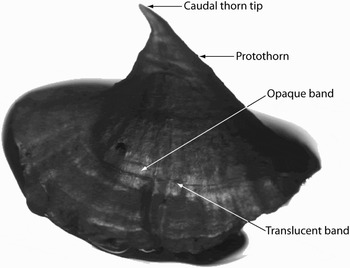
For age estimation using caudal thorns, a maximum of five male and five female specimens were selected from each 100 mm size-interval. Caudal thorns were examined to find the protothorn and to enumerate the number of growth bands beyond this marker (Figure 1). The protothorn, which occurred at the apex of each thorn, was assigned age 0, and subsequent broad opaque bands and narrow translucent bands were assumed to indicate annual growth (Gallagher et al., Reference Gallagher, Nolan and Jeal2006). Age assignments were determined by a single experienced reader multiple times and were accomplished without the knowledge of sample identification, month of collection, size, or prior age estimate. Age assignment was based upon the agreement of at least two independent reads, with additional reads if necessary.
Whole caudal thorn from Bathyraja kincaidii indicating the caudal thorn tip, protothorn, and subsequent opaque and translucent bands. Translucent bands were associated with ridges on the outside surface.

Vertebral centra
A preliminary evaluation of the thoracic, precaudal and caudal vertebrae indicated that the thoracic vertebrae were the largest, contained the most interpretable growth banding patterns, and would likely provide the most consistent age estimates. Therefore, thoracic vertebrae from each specimen were cleaned and dorsal and lateral measurements were used to determine mean centrum diameter (Wintner, Reference Wintner2000). Mean centrum diameter was then plotted against TL. The relationship between TL and mean centrum diameter was calculated for males and females separately and sexes were compared using a one-way analysis of variance.
Age estimation
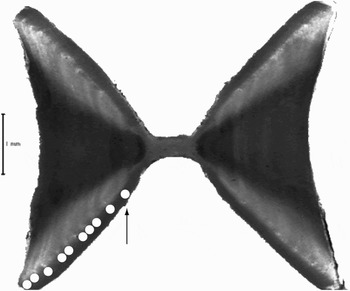
For age analysis using vertebral centra, two male and two female specimens were selected within each 10 mm size interval. Vertebrae from these selected samples were sectioned longitudinally to a thickness of 0.3 mm for age estimation analysis. Sections were examined using transmitted light under a dissecting microscope at 40X magnification to identify the birth mark (an angle change in the corpus calcareum) and the number of growth bands (Walter & Ebert, Reference Walter and Ebert1991; Goosen & Smale, Reference Goosen and Smale1997; Sulikowski et al., Reference Sulikowski, Morin, Suk and Howell2003). Growth bands consisted of pairs of alternating zones, one dense zone that appeared dark (opaque) and one less dense zone (less calcified) that appeared light (translucent) under transmitted light (Figure 2).
Sectioned vertebral centra from a 9-year old female Bathyraja kincaidii. The birth mark is indicated by the arrow and subsequent white dots indicate band pairs.

Age assignments were determined by a single experienced reader multiple times and were accomplished without the knowledge of sample identification, month of collection, size, or prior age estimate. Age assignment was based upon agreement of at least two independent reads. In some cases, sectioned vertebrae were deemed unreadable because of poor section quality and were not considered further in the study.
Precision and bias
Precision and bias analyses were used to assess reader consistency and reproducibility between reads within and between structures. Average percentage error (APE), coefficient of variation (CV), and index of precision (D) were calculated for caudal thorns and vertebral sections separately, in order to provide a measure of readability for each structure (Beamish & Fournier, Reference Beamish and Fournier1981; Chang, Reference Chang1982). Age 0 samples were excluded from precision calculations because they can distort APE (Officer et al., Reference Officer, Gason, Walker and Clement1996). Differences between age estimates for each structure were accomplished with paired t-tests and structural comparisons between caudal thorns and vertebrae were evaluated with age bias plots (Campana et al., Reference Campana, Annand and McMillan1995).
Validation
Validation (Cailliet et al., Reference Cailliet, Smith, Mollet and Goldman2006) of the periodicity of annuli was attempted using two indirect methods of validation, centrum edge analysis (Tanaka & Mizue, Reference Tanaka and Mizue1979; Cowley, Reference Cowley1997) and marginal increment analysis (MIA; Hyashi, Reference Hyashi1976). Sectioned vertebrae were viewed with a compound microscope and were rated on a scale from 1 to 4 based upon clarity (Smith et al., Reference Smith, Cailliet and Melendez2007) whereby ratings 3 and 4 (considered unacceptable) were excluded. For edge analysis, centrum edges were classified as translucent, narrow opaque, or broad opaque (Tanaka & Mizue, Reference Tanaka and Mizue1979) and were plotted against month of capture. MIA was accomplished by capturing digital images of sectioned vertebrae using a Leica® compound microscope with an attached SPOT RT® video camera. Measurements of the centrum radius and band increment widths were taken using the image analysis software Image Pro Plus®. Mean increment ratios were calculated to determine the time/season of growth band deposition using the equation:

in which CR = centrum radius, Rn = distance from focus to last fully formed growth band, and Rn-1 = distance from focus to last fully formed growth band preceding Rn. (Branstetter & Musick, Reference Branstetter and Musick1994; Wintner & Cliff, Reference Wintner and Cliff1999; Sulikowski et al., Reference Sulikowski, Morin, Suk and Howell2003). Marginal increment ratios were plotted by month of capture and a Kruskal–Wallis test was used to test for significant differences between months (Sulikowski et al., Reference Sulikowski, Morin, Suk and Howell2003).
Growth analysis
Von Bertalanffy, Gompertz, and logistic growth functions were fit to age–length data (Ricker, Reference Ricker1979; Cailliet et al., Reference Cailliet, Smith, Mollet and Goldman2006) using Iterative Growth Modeling with Optimal Results (IGOR), which uses non-linear parameter estimation and provides 95% confidence intervals for L∞, k, and the anchor values (Cope, Reference Cope2000). Regression coefficients (r2), residual mean square error (MSE), and significance level (P < 0.05) were used to determine which growth model provided the best fit to age–length data (Neer & Cailliet, Reference Neer and Cailliet2001; Carlson & Baremore, Reference Carlson and Baremore2005; Neer & Thompson, Reference Neer and Thompson2005). Male and female data were fit separately and maximum likelihood ratio was used to test for significant differences among the parameter estimates L∞, k, and to (Kimura, Reference Kimura1980; Cerrato, Reference Cerrato1990; Haddon, Reference Haddon2001).
RESULTS
Caudal thorns
In total, 393 Bathyraja kincaidii were collected with male samples (N = 196) ranging from 199–635 mm TL and female samples (N = 197) ranging from 195–610 mm TL. Of the 393 B. kincaidii collected, 100 samples (50 males and 50 females) were used to determine the allometric relationship between thorn size and total length and a subsample of caudal thorns (N = 46) was selected for age and growth analysis. Selected male specimens (N = 26) ranged from 199–580 mm TL and included the smallest specimen used for age estimation in vertebral centra. Females (N = 20) ranged from 195–570 mm TL and also included the smallest specimen used for age estimation in vertebral centra. Caudal thorns were inadvertently not collected from the largest male (635 mm TL) and female (610 mm TL) specimens.
The regression for caudal thorn base length to TL was significant (P < 0.001; N = 100), but the fit of the linear regression indicated that thorn growth may not be related to somatic growth (r2 = 0.33). However, the outer surface of whole thorns contained a conspicuous protothorn (age 0), and broad opaque (light), and narrow translucent (dark) bands which were associated with ridges (Figure 1). This observation led to the decision to attempt age estimation from thorn growth zone counting, despite the lack of an ontogenetic thorn size relationship. The age estimation analysis resulted in age estimates that ranged from 1 to 9 years for males and 1 to 10 years for females.
Vertebral centra
Of the 393 B. kincaidii collected, 190 samples (90 males and 100 females) were chosen for the age analysis of vertebrae. The analysis included the smallest and largest, male and female specimens (199 mm TL and 635 mm TL males; 195 mm TL and 610 mm TL females). As expected, the relationship between centrum diameter and TL was linear, positive and significant (P < 0.001), providing an indication that the growth of vertebrae corresponds with increasing body size. Therefore, vertebrae were deemed an appropriate structure for age and growth of B. kincaidii. No significant difference (P = 0.101) was found between males and females with respect to centrum diameter and fish length, and data were combined.
Age estimates were determined for all fish where vertebrae were readable, resulting in the loss of two male samples and one female sample deemed unreadable. Age estimates for males (N = 88) ranged from 0 to 18 years. Age 0 fish included the smallest specimen (199 mm TL), although the maximum estimated age of 18 years was not the largest (596 mm TL cf 635 mm TL), aged at 15 years. Age estimates for females (N = 99) ranged from 0 to 17 years. Age 0 fish included the smallest specimen (195 mm TL), although the maximum estimated age of 17 years was not the largest female specimen (535 mm TL cf 610 mm TL). No age could be assigned to the vertebrae of the largest female because the vertebrae were damaged during sectioning and could not be reliably interpreted.
Precision and bias
Precision estimates and age bias plots indicated that caudal thorns were unreliable structures for age and growth analysis, as was expected from the determination that thorn size was not dependent on fish length. Precision values for APE (14.5%), CV (19.6%), and V (11.3%) were relatively high, further indicating that estimates of age were unreliable from thorns of B. kincaidii. In addition, the maximum estimated age obtained from caudal thorns was 10 years, less than the maximum estimated age obtained from sectioned vertebrae by 8 years. An age-bias plot indicated that there was a pattern to the age estimate discrepancy between structures; thorn reads overestimated the age of young fish and underestimated the age of older fish. In contrast, the precision was good for vertebrae (APE = 10%, CV = 9% and D = 6%), and indicated good reproducibility.
Validation
Validation of the seasonal periodicity of growth band formation could not be established using edge characteristics of vertebral centra. A total of 187 samples were examined for both edge and marginal increment analyses; however, 104 samples were discarded because the distinction between opaque and translucent band type at the margin or edge could not be determined. The 83 samples used for edge and marginal increment analyses, which included both immature and mature B. kincaidii, failed to provide a clear indication of annual growth band formation. Because edge or margin type analyses are typically best for the period of most rapid growth (juveniles), 44 immature samples were considered independently in this manner. However, this analysis was also inconclusive, possibly as a result of low sample size.
Growth analysis
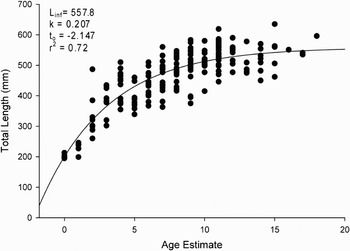
Using the age estimates from vertebral centra, a three-parameter von Bertalanffy growth function was selected based on the best fit to the age–length data for all females, males, and sexes combined (Table 1). No significant difference was detected (P > 0.05) between male (L∞ = 580.2 mm; k = 0.185; to = –2.530; N = 88) and female (L∞ = 537.3 mm; k = 0.237; to = –1.629; N = 99) growth parameters so data were combined. The resulting von Bertalanffy parameters (with 95% confidence intervals) were 557.8 (532.3–583.4); 0.21 (0.16–0.26); –2.1 (–3.0––1.3) for L∞, k, and to, respectively (Figure 3).
Von Bertalanffy growth function fitted to all reliable age–length data for Bathyraja kincaidii generated from growth band counting in vertebral sections.

Growth parameters from 3 growth functions with r2 values (Iterative Growth Modelling with Optimal Results calculated 95% confidence intervals are provided in parentheses).

DISCUSSION
Age estimates obtained for vertebral centra of Bathyraja kincaidii were considered reliable even though interpretation of edge characteristics was not successful. This kind of complication is common because growth bands in vertebral centra of some deep-water elasmobranch species can be difficult or impossible to interpret (Cailliet & Goldman, Reference Cailliet, Goldman, Carrier, Musick and Heithaus2004). Deep-water habitats are more environmentally stable with fewer seasonal cues. Therefore, differences in growth band densities or widths may not be conspicuous, particularly at the edges where growth has slowed and bands are closer together (Gallagher & Nolan, Reference Gallagher and Nolan1999; Cailliet et al., Reference Cailliet, Andrews, Burton, Watters, Kline and Ferry-Graham2001). It is often assumed that these growth bands represent seasonal growth in skates (Daiber, Reference Daiber1960; Du Buit, Reference Du Buit1972; Zeiner & Wolf, Reference Zeiner and Wolf1993); however, validation was accomplished for a number of skate species, including Raja fusca (Ishiyama, Reference Ishiyama1951), R. clavata (Holden & Vince, Reference Holden and Vince1973; Ryland & Ajayi, Reference Ryland and Ajayi1984), Leucoraja erinacea (Natanson, Reference Natanson1993), Leucoraja ocellata (Sulikowski et al., Reference Sulikowski, Morin, Suk and Howell2003) and Bathyraja parmifera (Matta & Gunderson, Reference Matta and Gunderson2007). Therefore, based upon compelling information from these species and a similarity in the growth banding structure, it was assumed that B. kincaidii produced one growth band pair each year.
Bathyraja kincaidii can be considered a relatively long-lived skate species with a moderate growth rate when compared to existing age and growth studies. Longevity estimates for other skate species range from 7 to 26 years (Ryland & Ajayi, Reference Ryland and Ajayi1984; Abdel-Aziz, Reference Abdel-Aziz1992; Licandeo & Cerna, Reference Licandeo and Cerna2007) with von Bertalanffy growth coefficients ranging from 0.05 to 0.5 yr−1 (Cailliet & Goldman, Reference Cailliet, Goldman, Carrier, Musick and Heithaus2004). The growth characteristics for B. kincaidii were similar to Raja montagui and R. interrupta. Raja montagui is a slightly larger species that reaches longevity of 15 to 18 years for females and males, respectively, with slightly lower growth rates for males (k = 0.19) and females (k = 0.18; Holden, Reference Holden1972). Bathyraja interrupta is a morphologically similar, but larger species, that has a slightly greater longevity in the Gulf of Alaska (21 years for both sexes), similar longevities in the eastern Bergin Sea (females = 19 years and males = 18 years), but has lower growth rates (k = 0.06 for both populations; Ainsley, Reference Ainsley2009).
It is also important to note that the von Bertalanffy growth function may have problems estimating growth parameters when the smallest and the largest sizes of the population are missing or are represented by only a few samples (Francis & Francis, Reference Francis and Francis1992). In this study, the smallest size obtained was 195 mm TL while the size at birth reported for this species is between 120 and 160 mm TL (Ebert, Reference Ebert2003). However, the largest individuals from this region were most likely obtained and while the estimate for L0 is high (199.8 mm TL) the estimate for L∞ is low but appears reasonable. The largest B. kincaidii collected in 393 samples collected over 18 months for this study was a 635 mm TL female. The maximum size obtained for this study was smaller than the maximum size (680 mm TL) reported by Eschmeyer et al. (Reference Eschmeyer, Herald and Hammann1983) and is larger than the maximum size (560 mm TL) reported for B. kincaidii in California waters (Ebert, Reference Ebert2003). Considering that first maturity determined for this population off central California appears to occur at 450 mm TL for females and 446 mm TL for males (Perez, Reference Perez2005), a maximum size of 860 mm TL seems unlikely. First maturity is reported to occur between 60 and 90% of asymptotic length for most elasmobranchs (Holden, Reference Holden and Jones1974) and at >80% of asymptotic length for Bathyraja sp. in the Bering Sea (Ebert, Reference Ebert2005). Given a maximum size of 860 mm TL, first maturity would occur at ~52% of asymptotic length for both female and male B. kincaidii. Therefore, the maximum size off central California appears to be 635 mm TL and the estimate for L∞ with 95% CI (583.4 mm TL) is slightly lower. Therefore, a precautionary approach should be taken until validation of age and growth parameters is accomplished.
Similar to results for B. trachura (Davis et al., Reference Davis, Cailliet and Ebert2007) and B. interrupta (Ainsley, Reference Ainsley2009), caudal thorns did not appear to be a reliable structure for age and growth and could not verify age estimates from vertebral centra. While a positive correlation was found between vertebral diameter and TL of B. kincaidii, a positive correlation did not exist between thorn size and TL. The relationship of thorn size to body size was also highly variable and more logarithmic for Bathyraja spp. (Gallagher & Nolan, Reference Gallagher and Nolan1999) and Amblyraja georgiana (Francis & Maolagáin, Reference Francis and Maolagáin2001), indicating that thorn growth decreases relative to somatic growth. Therefore, the growth of caudal thorns may not follow somatic growth since they do not support the increasing weight of an individual, contrary to vertebral centra (Casselman, Reference Casselman1990). In addition, they are external features, much like bony fish scales, and they may respond to external environmental cues more than internal skeletal structures. Hence, it is reasonable to conclude that caudal thorns are not necessarily a reliable structure for use in age and growth analyses.
ACKNOWLEDGEMENTS
We thank the following people for assistance on various aspects of this project: Don Pearson, Alec McCall, John Field and E.J. Dick (NOAA Fisheries, SWFSC, Fisheries Ecology Division in Santa Cruz, California), Keith Bosley, Erica Fruh, Dan Kamikawa, Aimee Keller, Teresa Turk, Victor Simon (NOAA Fisheries, Northwest Fisheries Science Center) and Steve Todd (Pacific States Marine Fisheries Commission) for providing B. kincaidii specimens; Joanna Grebel Moss Landing Marine Laboratories (MLML), Jason Cope (University of Washington), Wade Smith and Joe Bizzarro (Pacific Shark Research Center, MLML) for friendship, guidance, and support throughout the time that C.R.P. spent at MLML; Aaron Carlisle, Chris Rinewalt, Heather Robinson and Chante Davis (Pacific Shark Research Center, MLML) for help with dissecting B. kincaidii; Matt Levey and Chad Smith (MLML) for help with maps and figures; Allen Andrews (NOAA Fisheries, Pacific Islands Fisheries Science Center, Hawaii) for several thorough revisions to this manuscript; Ralph Larson (San Francisco State University) for a review of the MS thesis of C.R.P.; Andy Wisner and Amber Gentemen (Tetra Tech) for help with maps and figures. Funding for this research was provided by NOAA/NMFS to the National Shark Research Consortium and Pacific Shark Research Center, and in part by the National Sea Grant College Program, US Department of Commerce, National Oceanic and Atmospheric Administration under NOAA Grant No. NA04OAR4170038, project number R/F-199, through the California Sea Grant College Program and in part by the California State Resources Agency. Additional funding was provided by PADI project A.W.A.R.E., PADI Grant Foundation, the Packard Foundation, and the Dr Earl H. Myers and Ethel M. Myers Oceanographic and Marine Biology Trust.