INTRODUCTION
Children with specific language impairment (SLI) vary widely in their ability to use tense and agreement (hereafter, tense/agreement) inflections depending on the type of language being acquired. The present study is concerned with tense/agreement inflection use by Finnish-speaking children with SLI. Finnish provides a unique perspective from which to evaluate the nature of tense/agreement inflection use by children with this type of disorder. As will be seen, this language can prove illuminating to the study of SLI both in terms of the types of errors that children with SLI might make in contexts requiring tense/agreement use, and in terms of the particular requirements made on the children given how tense and agreement are structured in the language.
Error types in tense/agreement contexts
In English, the inflections that express tense/agreement (past tense -ed, third person singular present tense -s) are used inconsistently by children with SLI for a protracted period (Norbury, Bishop & Briscoe, Reference Norbury, Bishop and Briscoe2001; Rice, Wexler & Hershberg, Reference Rice, Wexler and Hershberger1998). During the preschool years, these children not only lag behind same-age typically developing peers in their ability to use tense/agreement forms, but they also exhibit greater difficulty with these forms than do typically developing children who are two or three years younger (e.g. Leonard, Eyer, Bedore & Grela, Reference Leonard, Eyer, Bedore and Grela1997; Rice & Wexler, Reference Rice and Wexler1996). When English-speaking children with SLI fail to use the correct tense/agreement morpheme, they nearly always use a bare stem (e.g. push in place of pushed; run in place of runs). These errors are often interpreted as the child's selection of a non-finite form – an infinitive – rather than a failed attempt to produce the inflected form (Rice & Wexler, Reference Rice and Wexler1996).
In languages such as German, Dutch and Swedish, children with SLI show higher percentages of use of tense/agreement inflections than their English-speaking counterparts, but nevertheless lag behind their typically developing (TD) peers (Bartke, Reference Bartke1994; de Jong, Reference de Jong1999; Hansson, Nettelbladt & Leonard, Reference Hansson, Nettelbladt and Leonard2000; Rice, Noll & Grimm, Reference Rice, Noll and Grimm1997). Failures to produce tense/agreement inflected forms are often productions of infinitives, which, in these languages, are forms with overt inflections rather than bare stems. For example, in Swedish, the past tense form lek-te ‘played’ is often replaced by the infinitive form lek-a ‘[to] play’ rather than the bare stem lek, even though the latter is a permitted form in the language (e.g. the imperative lek! ‘play!’).
Languages with rich inflectional morphology such as Spanish and Italian show a different pattern of use by children with SLI. In these languages, children with SLI may be somewhat less accurate than same-age typically developing peers. However, only in select cases are they less accurate than typically developing children who are two years younger. Importantly, in these languages, children with SLI very rarely produce infinitives in contexts requiring tense/agreement inflections. Instead, they usually substitute one tense/agreement form for another (Bedore & Leonard, Reference Bedore and Leonard2001; Reference Bedore and Leonard2005; Bortolini, Caselli & Leonard, Reference Bortolini, Caselli and Leonard1997). For example, in Italian, first person singular present tense inflections are sometimes produced in contexts requiring first person plural present tense inflections. In Spanish, third person singular past tense inflections are sometimes produced in contexts requiring third person plural past tense inflections. Infinitives are not often produced as substitutes in these languages.
The differences in error types between English, German, Dutch and Swedish on the one hand, and Spanish and Italian on the other, seem closely related to the obligatory versus optional status of subjects in the language. In languages such as Spanish and Italian, subjects can be omitted when the context makes the identity of the subject clear. In these situations, the rich subject–verb agreement system of these languages allows the listener to ‘recover’ the subject with relative ease. With the subject absent, inflections for tense/agreement thus become highly salient, and children learn to make extensive use of these forms relatively early. In the case of children with SLI, errors will occur, but they will take the form of attempts at expressing a verb form with tense/agreement.
Accounting for the cross-linguistic tense/agreement profiles in SLI
The Extended Unique Checking Constraint (EUCC) account
Alternative proposals have been offered to account for these differences in error types as a function of language typology. Rice, Wexler and their colleagues (Rice & Wexler, Reference Rice and Wexler1996) proposed that children with SLI go through a protracted period during which tense/agreement is treated as optional. When tense/agreement is not expressed, children select a non-finite form. In contexts ordinarily requiring a verb with a tense/agreement inflection, this will be an infinitive that is unspecified for tense or agreement. Subsequently, Wexler (Reference Wexler1998; Reference Wexler, Levy and Schaeffer2003) modified this proposal to some extent, to account for the cross-linguistic differences between languages in which children with SLI produce infinitives in tense/agreement contexts (e.g. English, German) and languages in which these children do not produce this type of error (e.g. Spanish, Italian). Operating within a feature-checking linguistic framework (Chomsky, Reference Chomsky1995), Wexler proposed that, for all children, there is a period during which, in the children's grammars, a Determiner (D) feature in a Determiner Phrase (DP) can only check a non-interpretable D feature at one functional category, Tense (T) or Agreement (AGR). This constraint – referred to as the Unique Checking Constraint – is assumed to be operative until a biologically based linguistic principle has matured. Such maturation occurs rather quickly in most children. However, maturation of this principle is assumed to be very slow in children with SLI, leading to what can be referred to as an Extended Unique Checking Constraint (EUCC).
According to the EUCC account, Germanic languages require checking at both T and AGR, thus violating the constraint and resulting in a production that is not specified for tense/agreement (e.g. Every day Mommy drive to work). On the other hand, Wexler assumes that in languages that do not require overt subjects (‘null-subject’ languages) such as Spanish and Italian, checking is not required at AGR. Checking at T constitutes a single checking operation and therefore the EUCC is not violated and the tense/agreement inflection can be expressed.
The proposal of a constraint on checking provides a plausible rationale for why errors in the form of infinitives in place of tense/agreement forms occur in some languages and not others, and why, in those languages that do show infinitive errors, children with SLI are especially slow in their development of tense/agreement use. However, this account was not designed to explain errors that do occur in languages that permit checking at T only. As just noted, these errors involve substitutions of one tense/agreement form for another.
Assumptions of processing limitations in SLI
Some attempts to account for substitutions of this type have come from proposals of processing limitations on the part of children with SLI. The notion that children with SLI have limitations in processing capacity and/or processing speed has been prominent in the literature for more than thirty years (recent reviews can be found by Ellis Weismer & Thordardottir, Reference Ellis Weismer, Thordardottir, Accardo, Capute and Rogers2002; Gillam, Montgomery & Gillam, Reference Gillam, Montgomery, Gillam and Schwartz2008; Graf Estes, Evans & Else-Quest, Reference Graf Estes, Evans and Else-Quest2007; Leonard, Reference Leonard and Kail2007). According to this general type of approach, the nature of the material to be learned is not the central problem; instead, the difficulty rests in the amount of material to be integrated and stored, and the time available for performing these mental operations (Bishop, Reference Bishop1992). Although there is substantial evidence of processing limitations in children with SLI, most accounts of processing limitations are concerned with explaining how these limitations might cause the broader language deficit in SLI rather than any extraordinary weaknesses within the broader deficit (Leonard, Reference Leonard and Kail2007). Relatively few specific proposals within the processing limitations school of thought have been offered to account for the particular grammatical profiles of children with SLI in a single language or across languages. One exception is the surface account (e.g. Leonard, Reference Leonard1998: 246–55; Leonard et al., Reference Leonard, Eyer, Bedore and Grela1997). According to this account, children with SLI have speed of processing limitations that are especially perilous for grammatical morphemes of brief duration. These are grammatical morphemes in the form of word-final consonants (e.g. English past tense -ed) and non-final weak syllables that appear in contexts in which they cannot be significantly lengthened. It is assumed that children with SLI are capable of perceiving these grammatical morphemes. However, given the brief duration of these morphemes, the children have difficulty completing all of the operations needed for fully processing them. In particular, children must detect the morphemes, hypothesize their grammatical function and place them in the proper cell of a morphological paradigm. These operations must occur in real time, as the utterance in the input is still unfolding. The demands of these operations when the morphemes are brief will often result in incomplete processing of the morpheme. Consequently, children with SLI will require a greater number of encounters with the morpheme before it can be established in their grammars.
According to the surface account, children with SLI hypothesize the grammatical functions of morphemes in the same developmental order as typically developing children. Thus, although inflections with, say, word-final /s/ will be relatively challenging, these children will hypothesize a function such as noun plural before a function such as third person singular subject–verb agreement. For cross-linguistic comparisons, the surface account is not especially illuminating, because it is rare that any two languages mark precisely the same grammatical function in the same phonetic manner. One other limitation of this account is that in languages with a rich morphology, certain inflections of relatively brief duration are less problematic for children with SLI than the surface account might predict.
The morphological richness account
A second processing account that addresses specific grammatical profiles of SLI – and the one evaluated in the present study – is the morphological richness account (Bedore & Leonard, Reference Bedore and Leonard2001; Leonard, Reference Leonard1998: 255–57; Leonard, Sabbadini, Leonard & Volterra, Reference Leonard, Sabbadini, Leonard and Volterra1987; Lukács, Leonard, Kas & Pléh, Reference Lukács, Leonard, Kas and Pléh2009). According to this account, extraordinary difficulties with details of grammatical morphology are the result of an interaction between a more general limitation in language ability and the properties of the particular system of grammar that must be acquired. Like the surface account, the morphological richness account assumes processing limitations in children with SLI. However, the emphasis is on limitations in processing capacity rather than speed. Of course, processing capacity and processing speed are inter-related; faster speed can translate into faster rehearsal which, in turn, can enable a greater amount of information to be retained. To explain cross-linguistic differences in the grammatical profiles of children with SLI, the morphological richness account assumes, following scholars such as Dressler (Reference Dressler, Laaha and Gillis2007) and others, that children acquire grammatical morphology more readily when the language has a rich morphology. According to this account, in a language such as English with relatively few inflections, children with SLI devote their limited resources to the more prevalent grammatical cues conveyed by word order and other syntactic information. Fewer resources remain for the learning of grammatical morphology; more encounters with these morphemes will therefore be needed to promote adequate acquisition.
In contrast, children with SLI who are acquiring languages with a rich inflectional morphology will devote their limited resources to this area of the grammar. As a result, differences between children with SLI and typically developing children will be smaller in a language with a rich morphology than in a language such as English. In spite of these expected cross-linguistic differences, children with SLI will have some problems with inflections even in languages with a rich morphology if the inflections themselves reflect a complex combination of grammatical functions. The more functions that the children must consider simultaneously, the greater the demands on their limited processing capacity, and the greater the number of encounters with the inflections that will be required before they become a stable part of the children's grammars. In the meantime, the weaker representations of these inflections in the children's verb inflection paradigms will make these forms more difficult to retrieve on a consistent basis.
An important assumption of this account is that when errors occur, the errors will most often be approximations of the target form, that is, ‘near misses’ that differ from the target form by only a single feature (Bedore & Leonard, Reference Bedore and Leonard2001; Lukács et al., Reference Lukács, Leonard, Kas and Pléh2009). These near misses reflect considerable knowledge of the functions of tense, person and number, given that a particular substitute will increase or decrease in likelihood according to how closely it resembles the target in the functions that it reflects. For example, a third person plural past tense inflection is not a likely substitute for a first person singular present tense inflection, but it is a much more likely as a substitute for a first person plural past tense inflection (e.g. Lukács et al., Reference Lukács, Leonard, Kas and Pléh2009). According to this account, if substitutions deviate from this near-miss pattern, the form with the greatest strength in the verb paradigm due to the child's frequent encounters with this form (viz. the third person singular present form), will prove to be the substitute.
The contributions of Finnish
The mixed paradigm for verbs
Characteristics of the Finnish verb paradigm make it a valuable language for the study of children with SLI in general as well as for evaluating the EUCC and morphological richness accounts in particular. For the first and second person, subjects can be omitted; in this respect, Finnish functions like a null-subject language. However, subjects are obligatory in the third person. Recall that for null-subject languages, errors usually take the form of one tense/agreement form substituting for another, whereas in Germanic languages which require a subject, errors are usually infinitives. Will the type of error committed by Finnish-speaking children with SLI vary according to whether the target can or cannot appear without an overt subject?
The theoretical significance of this question is that Finnish could provide a within-child test of Wexler's (Reference Wexler1998; Reference Wexler, Levy and Schaeffer2003) proposal that when checking must occur at both T and AGR (as in third person verb forms), the EUCC is violated and tense and agreement cannot appear together in the verb. However, first and second person verb forms can be used without a subject. Therefore, these forms might require checking only at T, thus conforming to the EUCC and resulting in a tense/agreement form. In short, errors in first and second person contexts might differ in kind from the errors seen in third person contexts.
Vainikka & Levy (Reference Vainikka and Levy1999) have noted the mixed nature of Finnish in allowing null subjects in the first and second person but not in the third person. Their technical account is somewhat different from that of Wexler (Reference Wexler1998), but they agree on the important element that the checking required at AGR for third person inflections does not apply to first and second person inflections. Vainikka and Levy also made the observation that colloquial Finnish differs from standard Finnish in certain respects that affect the null-subject properties of parts of the paradigm. In particular, first person plural inflections which allow null subjects in standard Finnish can be replaced in colloquial Finnish by impersonal passive forms that do require subjects. These differences between colloquial and standard Finnish are important to examine because both are heard extensively by children. As we discuss later, the particular differences between colloquial and standard Finnish in their inflectional paradigms have implications for predictions concerning both the EUCC account and the morphological richness account.
The morphological richness account provides no basis for expecting near-miss errors to be restricted to only part of the verb paradigm (first and second person verb forms in this case). Given the numerous functions that must be hypothesized even in the third person (present versus past tense, and singular versus plural, as well as third person versus first and second person), near-miss errors are expected even when third person targets are involved. Although accuracy is expected to be higher for third person singular present tense forms due to their higher frequency of occurrence in the language, errors on third person forms, too, should most often be near misses. If errors do deviate from near misses, the most likely substitute is expected to be the third person singular form, as this form should have the greatest strength in the paradigm and thus is the most likely to replace a form that has less strength in the paradigm.
Agglutinating inflections in Finnish
The great majority of languages reported in the SLI literature are languages that employ ‘fusional’ inflections. That is, many of the inflections in these languages reflect a conjunction of tense, person and number. Thus, the inflection -s in English (e.g. runs, jumps) reflects, simultaneously, present tense, third person and singular. The same applies for the German (third person singular present tense) inflection -t. For Germanic languages, the fusion of tense and agreement makes the realization of these inflections quite vulnerable to the EUCC, because an inflection that marks tense and agreement cannot be realized if either tense or agreement is left unspecified. The fusional properties of languages such as Spanish and Italian, in contrast, do not create the same obstacle, because in these languages checking is required only at T.
Other languages have ‘agglutinating’ characteristics in their inflectional system
One such language is Hungarian. In this language, when speaking in a first person plural past tense context, for example, one produces a past tense morpheme immediately after the verb stem, followed by an agreement morpheme that attaches to the past tense morpheme (e.g. tol-t-uk ‘pushed’). Lukács et al. (Reference Lukács, Leonard, Kas and Pléh2009) found that Hungarian-speaking children with SLI were less accurate than both younger and same-age TD peers in their use of agglutinating inflections. Near-miss errors were by far the most frequent error type. An important point in this finding is the fact that Hungarian is a null-subject language. Thus, in this language, checking is presumably required only at T, thus conforming to the EUCC proposed by Wexler (Reference Wexler1998; Reference Wexler, Levy and Schaeffer2003).
Finnish verb inflections also possess an agglutinating property. As in Hungarian, for past tense verb forms, a past tense morpheme appears immediately after the verb stem, followed in turn by an agreement morpheme that fuses person and number. For the present tense, an overt tense morpheme is not used; instead, the agreement morpheme appears immediately after the verb stem. For third person singular, an agreement morpheme is not used (though in the present tense, stem-final short vowels are lengthened in this context). In the past tense, only the past morpheme appears with the stem in third person singular contexts. As can be seen, then, past tense morphemes and agreement morphemes are separable. Therefore, children can conform to the EUCC through checking at either T or AGR, and the morpheme (tense or agreement) associated with the checked category can be realized in the child's utterance.
In summary, Finnish provides an important means of evaluating both the EUCC and morphological richness proposals. The EUCC account predicts higher accuracy levels in first and second person contexts than in third person contexts. In first and second person contexts, children with SLI should be as accurate as younger typically developing peers, but should be less accurate than their younger peers in third person contexts. The EUCC account provides no basis for expecting any particular type of error in first and second person contexts. However, in third person contexts, the most frequent error should be a verb correctly inflected for either tense or agreement, but not both, given that checking at T only or at AGR only will prevent the realization of only one of the two agglutinating morphemes.
The morphological richness account predicts that Finnish-speaking children with SLI will be less accurate than same-age typically developing peers but will differ only minimally, if at all, from younger typically developing children. For all target inflections, the most frequent error will be the production of an inflected form that differs from the target by only one feature. Any exception to this pattern should be the most frequent inflected form in the language, the third person singular present form.
METHOD
Participants
Fifty-one monolingual Finnish-speaking children coming from comparable socioeconomic backgrounds participated in the study. Seventeen children (13 boys and 4 girls, mean age=5 ; 2, range=4 ; 0–6 ; 6) with SLI comprised the first group. All children with SLI were recruited from the area of the Northern Ostrobothnia Hospital District in Finland. The Ethical Committee of this Hospital District approved the study. The selection criteria for the children with SLI were the same as those used in recent research on SLI in other languages (e.g. Bedore & Leonard, Reference Bedore and Leonard2001; Reference Bedore and Leonard2005; Leonard, Reference Leonard and Kail2007). Each child in the SLI group scored at least 1·25 standard deviations below the mean on a test of expressive language, the Finnish standardization of the Reynell III (Edwards, Fletcher, Garman, Hughes, Letts & Sinka, Reference Edwards, Fletcher, Garman, Hughes, Letts and Sinka1997) and at least 1·0 standard deviation below the mean on a test of receptive vocabulary, the Finnish Peabody Picture Vocabulary Test (Dunn & Dunn, Reference Dunn and Dunn1981). Children also met the following exclusionary criteria based on diagnostic records: non-verbal IQ scores above 85 on the WPPSI-R (Wechsler, Reference Wechsler1995), passed both hearing screening (20 dB at 250, 500, 1000, 2000, 4000 and 6000 Hz) and an oral-motor examination, and had no evidence of frank neurological dysfunction or impaired social interactions. Furthermore, these children had no history of chronic otitis media according to parental report. These criteria served to reduce participant heterogeneity while still capturing the most common characteristics of SLI. In addition, the children were required to produce, with at least 80% accuracy, all of the speech sounds required for the grammatical inflections under investigation. Finally, all children readily produced polysyllabic words, and showed the ability to produce words that matched in length the inflected verbs under investigation.
The remaining thirty-four typically developing children were recruited from eight day nurseries. Permission to study normally developing children was received from the Head of the Day-Care and Family Work Unit of the City of Oulu. Seventeen of the typically developing children (10 boys and 7 girls, mean age=5 ; 2, range=4 ; 1–6 ; 3) were recruited to serve as a same-age comparison group. The age of each participant in this group (hereafter referred to as the TD-A group) was within three months of age of a child in the SLI group. The remaining seventeen children formed a group of younger typically developing (10 boys and 7 girls, mean age=3 ; 8, range=3 ; 6–3 ; 11), hereafter referred to as the TD-Y group. The use of younger typically developing children was designed to detect whether the difficulties experienced by the children with SLI with tense and agreement morphology resemble the developmental patterns seen in younger children. All TD-A and TD-Y children scored within normal limits on all language measures.
A brief sketch of Finnish verb inflections
Finnish has a subject–verb agreement system in which finite verbs are inflected with one of six person–number suffixes (see Dasinger, Reference Dasinger and Slobin1997; Karlsson, Reference Karlsson1999; Reference Karlsson and Brown2006; Toivainen, Reference Toivainen and Slobin1997, for a more detailed description). Finnish is also a ‘mixed’ language: it operates like a null-subject language in first and second person singular and plural but like a non-null-subject language in third person singular and plural. Thus, the personal pronouns preceding the verbs can be omitted in the first and second person singular and plural. In addition to the person–number markings, finite verbs also express tense, mood and voice. The Finnish tense system has four tense forms: two simple forms (present, past) and two composite forms (perfect, pluperfect). The two simple tense forms are the focus of the present study. The present tense corresponds to English present and future tenses and is formed through the use of one of the six person–number suffixes (e.g. istu-n, sit-1SG ‘I am sitting, I'll sit’). The past tense is used to indicate that an action has taken place prior to the moment of utterance. It is formed with the suffix -i- which is attached to the verb stem before the person–number suffix (e.g. istu-i-n, sit-PAST-1SG ‘I sat’). Thus, tense and agreement are co-occurring but in separate morphemes and in a sequential, agglutinating arrangement. The moods and voices of Finnish verbs are not under investigation in this study; for this reason, we do not discuss them here.
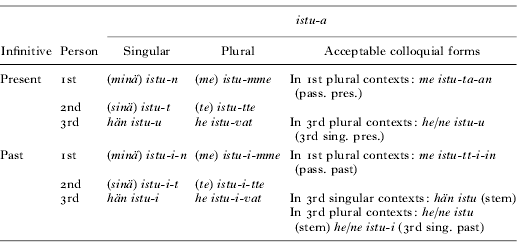
Table 1 illustrates the tense/agreement inflections applied to the verb istua ‘sit’ in both present and past tense. The personal pronouns that are optional are in parentheses. The basic, dictionary form is the first infinitive (e.g. istu-a ‘(to) sit’). (Finnish has several infinitive forms, referred to as the first infinitive, second infinitive and so on. The first infinitive corresponds to the infinitive in English, whereas the other infinitives in Finnish are used where English uses gerunds or present participles.) Before one can inflect the verb for tense/agreement, the first infinitive suffix must be removed from the stem. The tense/agreement suffixes are then added to the stem.
Inflected forms for istua ‘sit’
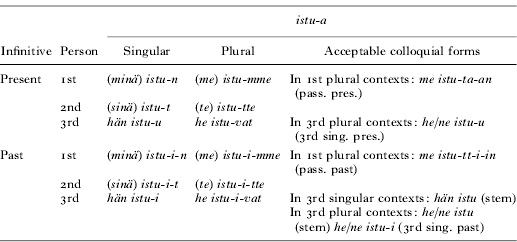
Table 1 also illustrates the forms that are acceptable in colloquial speech. Colloquial use is not restricted to particular groups of speakers or to particular ages; indeed, typical speakers of Finnish of all social class levels often use colloquial Finnish (Mantila, Reference Mantila2004). Standard Finnish continues to dominate in reading materials (Latomaa & Nuolijärvi, Reference Latomaa and Nuolijärvi2002); importantly, this includes books that adults read to young children. Standard Finnish is also frequently used in television programmes. One example of colloquial speech is the use of impersonal passive forms in place of the first person plural forms. Passive forms make a distinction according to present and past and, unlike first person plural forms in standard Finnish, these passive forms require an accompanying subject. In colloquial speech, it is also acceptable to use third person singular present tense forms in third person plural present tense contexts, to use stems in third person singular past tense contexts, and to use either stems or third person singular past tense forms in third person plural past tense contexts. Finally, Finnish does not distinguish gender in the pronoun system, although it has separate forms for humans (hän ‘he/she’, he ‘they’) and non-humans (se ‘it’, ne ‘they’). The non-human forms are very often used to replace the human forms in colloquial speech.
Although Finnish can be typologically characterized as an agglutinating language, it also displays various morphophonological changes such as consonant gradation and vowel mutations (Aksu-Koc, Ketrez, Laalo & Pfeiler, Reference Aksu-Koç, Ketrez, Laalo, Pfeifer, Laaha and Gillis2007; Dasinger, Reference Dasinger and Slobin1997; Karlsson, Reference Karlsson1999; Reference Karlsson and Brown2006; Laalo, Reference Laalo1999). To ensure that the task used in the present study primarily measured the children's ability to add appropriate tense/agreement inflections to verb stems rather than their ability with morphophonology, the items employed required no morphophonological changes (see below). Finnish has fixed stress and the primary word stress falls on the first syllable. Thus, the inflections are prosodically non-salient.
Relative to a language such as English, the Finnish inflections of interest emerge quite early in the speech of typically developing children. It is true that during the period of children's earliest words, their output is primarily limited to two-syllable words (Kunnari, Reference Kunnari2002; Saaristo-Helin, Savinainen-Makkonen & Kunnari, Reference Saaristo-Helin, Savinainen-Makkonen and Kunnari2006; Savinainen-Makkonen, Reference Savinainen-Makkonen2000), thus reducing inflected words that are greater than two syllables in length. Furthermore, in this very early period, words that appear to be inflected may be unanalyzed wholes produced by the child (Laalo, Reference Laalo1999). However, by age 1 ; 4, examples of first person singular present and third person singular present are seen with more than one verb stem (Toivainen, Reference Toivainen and Slobin1997). By age 1 ; 8, past tense in third person singular contexts is seen, and more widespread use of first person singular present and third person singular present is observed. At the same age, the colloquial form of first person plural present is seen. By age 2 ; 4, past tense is used with first person singular and colloquial first person plural forms. At this same age, children often begin to use the standard third person plural present inflection.
Studies of the diversity of inflections used per lexical verb show that by age 3 ; 0 Finnish-speaking children show a variety of inflections with each verb and these values do not differ greatly from the values computed for the children's input (Aksu-Koç et al., Reference Aksu-Koç, Ketrez, Laalo, Pfeifer, Laaha and Gillis2007). However, standard first person plural present and standard third person plural past forms appear to be relatively late in acquisition, as they are usually not observed until after age 3 ; 0 (Toivainen, Reference Toivainen and Slobin1997). When young children use tense and agreement inflections together, they are highly accurate in producing them in the correct (tense+agreement) sequence (Dasinger, Reference Dasinger and Slobin1997). Despite the fact that sequences of agglutinating inflections result in longer productions than verb stems with only a single inflection, length measures such as mean length of utterance do not adequately capture children's developing use of inflections in Finnish (Nieminen, Reference Nieminen2007). Surprisingly little information is available concerning the errors children make when they fail to use the expected form in an obligatory context. Notably absent is reference to infinitive forms produced in contexts requiring a tense/agreement inflection. Based on this literature, we expected that the TD-Y children in our study, at ages 3 ; 6 to 3 ; 11, would show considerable use of the tense/agreement inflections but fall well short of mastery levels, whereas the TD-A children would be approaching mastery levels, at least if colloquial forms were taken into account. The ages of the children in these two groups seemed quite suitable for providing a good basis of comparison for the data obtained from the children with SLI.
Procedures
The children's use of the tense/agreement inflections was assessed through specifically designed probe tasks. Eight verb inflection types were examined in this study: (1) first person singular present tense, hereafter 1sgpres; (2) first person singular past tense, or 1sgpast; (3) first person plural present tense, or 1plpres; (4) first person plural past tense, or 1plpast; (5) third person singular present tense, or 3sgpres; (6) third person singular past tense, or 3sgpast; (7) third person plural present tense, or 3plpres; and (8) third person plural past, or 3plpast. There were twelve items for each of the eight verb inflection types, creating a total of ninety-six items. The verbs selected for the probe tasks were those that required no morphophonological changes in the word stems when tense/agreement inflections were added. All of the verb stems used in the task ended in vowel /o/, /u/ or /y/ (e.g. seiso-a ‘(to) stand’, istu-a ‘(to) sit’, kyykisty-ä ‘(to) crouch’). These stems required no morphophonological changes, and the particular diphthongs that resulted from inflection (e.g. /ui/ in istu-i-n) cannot be reduced in Finnish.
Another important safeguard was the use of intransitive verbs that were expected to appear in sentence-final position in the children's responses. This step was especially relevant in the case of the inflection -n, which when followed by /h/, /s/ and possibly /f/ can be omitted in rapid speech (Suomi, Toivanen & Ylitalo, Reference Suomi, Toivanen and Ylitalo2008: 43). In addition, the stimuli selected ensured that if a child added an optional element after the verb (e.g. adding kivellä ‘on the rock’ after istu-i-n ‘(I) sat’), the speech sound immediately following the verb did not permit omission of -n. In all cases other than when followed by /h/, /s/ or /f/, the inflection -n is produced by speakers of Finnish, either in its full form, or in a reduced manner that reveals on acoustic analysis a formant transition and vowel nasalization. These facts about Finnish were taken into account during the transcription and analysis phases, as we describe later. (Recall as well that all children showed evidence of producing all of the speech sounds required for the grammatical inflections at 80% accuracy or higher.) Word length (the stem plus all inflections) in the probe verbs varied from two to four syllables. Pilot testing with children from the same age groups as the participants was used to ensure that the verbs selected for the probes were familiar to children and that the task did, in fact, yield productions of the target inflections.
Based on pilot testing, the specific types of prompts that were used varied according to the particular tense/agreement inflection being assessed. An example of the probes used for each tense/agreement inflection for the verb ‘sit’ appears in the Appendix. For some of the inflections of interest, sets of drawings depicting actions and objects were employed. For other inflections, we used enactments and computer-presented animations in which puppets and other characters performed various actions. The use of enactments and animations allowed us to devise obligatory contexts for particular inflections that are very difficult to create with drawings. For each probe item, the examiner asked a question or made a request that, in conjunction with the drawing, enactment or animation, created an obligatory context for the inflection of interest. For example, to elicit the first person singular present tense form, the child was asked to act out and describe the actions first modelled by the examiner. For the verb ‘sit’, the examiner sat down and said Minä tykkään istua ‘I like to sit’, and then asked Mitä sinä teet? ‘What do you do?’ as the child was sitting. The expected response was istu-n ‘(I) sit’. For items assessing third person inflections, the question was general (‘What happens/happened in this picture/animation?’) so that a subject was obligated along with the inflected verb. It should be noted that all first person items permitted elliptical responses; subject pronouns were not required in these instances. This applied as well when the children produced a colloquial form of the verb, even though in other speaking contexts a subject is required with these forms. In contrast, all third person items required an overt subject, given the open-ended nature of the examiner's prompt for these items and the non-null-subject nature of this portion of the Finnish verb system. Across children in each group, the probes were administered in counterbalanced order. In addition, children were provided with three practice items at the beginning of each of the probes to ensure that they understood the task.
Scoring and reliability
All probe sessions were audio- and video-recorded and transcribed orthographically. For all of the items of each probe, the presence of obligatory contexts of the tense/agreement inflection of interest was noted. If a child provided a verb that was different from the one targeted (e.g. ‘jumps’ instead of ‘steps’), that response was considered scorable if the verb was relevant to the situation. Items for which the child gave no response, imitated the examiner's preceding utterance, or produced a response unrelated to the item, were deemed unscorable and excluded from further analysis. For each scorable response, the accuracy of the tense/agreement inflection was coded. Because the number of scorable items varied across children, the scores were converted to percentages of scorable responses correct for each tense/agreement inflection. We used a scoring method that permitted colloquial forms (see Table 1). When referring to contexts that permit a colloquial form in addition to the standard Finnish form, we label the context using a notation that includes all acceptable forms. For example, in first person plural present tense contexts, impersonal passive forms in present tense are also acceptable. Accordingly, we refer to this target as 1plpres/passpres. For correct responses, we documented the particular form (standard, colloquial) used by the child; we also noted the particular type of error made when the child produced an incorrect response.
Both intra- and inter-judge reliability of scoring was assessed using the responses of three children in each group, selected randomly. Intra-judge scoring agreement for the probes was 93·7% for the SLI and 99·7% for the TD-A and TD-Y groups. Inter-judge reliability was 88·9% for the SLI, 99·3% for the TD-A and 97·9% for the TD-Y groups. A different procedure was used for first person singular, because, in Finnish, word final -n is often difficult to perceive. For this inflection, a consensus procedure was applied. If consensus between two co-investigators was not reached, scoring was based on acoustic analysis (Praat program; Boersma & Weenink, Reference Boersma and Weenink2005).
Predictions
According to the EUCC account, children with SLI show a protracted period during which their grammars permit checking only at T or only at AGR. For this reason, it was expected that the children with SLI would be less accurate than both groups of TD children in their use of third person inflections but would be relatively accurate and not differ from the TD-Y children in their use of first person inflections. If the impersonal passive was used in first person plural contexts, as is permitted in colloquial Finnish, errors might occur as these forms are not associated with a null-subject grammar, and thus it is possible that checking could occur at AGR only, and not at T. In such cases, it would be expected that the present tense passive form would be produced in contexts requiring the past tense form. This prediction holds even given the elliptical nature of the first person items. It is not the discourse context that determines the checking operations required for the verb, but the status of the verb form as part of a null-subject or non-null-subject system in the grammar. For example, in English, it would be assumed that use of the third person singular present tense inflection -s requires checking at both AGR and T even in response to a sentence frame such as ‘Every morning the girl … (e.g. eats breakfast)’. It is not assumed that the examiner's use of the subject (‘the girl’) obviates the need for checking at AGR. (To assume otherwise would render the EUCC an account of on-line grammatical processing rather than one pertaining to the status of children's underlying grammars.)
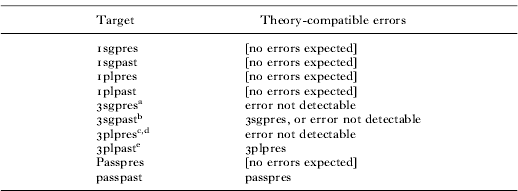
Table 2 provides the errors that would be compatible with the EUCC account. In some instances, a theory-compatible error is acceptable according to colloquial use. In other instances, a theory-compatible error might not be detectable given that third person singular as well as present tense have no overt inflections. In still other instances, however, a theory-compatible error would be both detectable and unacceptable in Finnish, even in colloquial speech. Note that, because checking at T only or at AGR only would allow for the surface appearance of a tense or agreement inflection, respectively, there is no basis for predicting stem or infinitive productions as substitutes.
Theory-compatible errors according to the Extended Unique Checking Constraint account
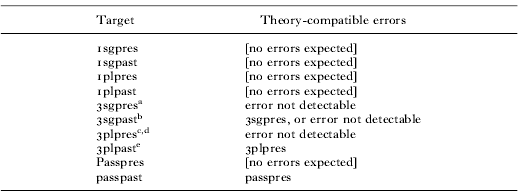
a Because 3sgpres has no overt inflections, neither checking at T only or at AGR only will reveal a detectable error.
b Because there is no overt inflection for 3sg, checking at T only will not reveal a detectable error.
c Because there is no overt inflection for pres, checking at AGR only will not reveal a detectable error.
d 3sgpres as a substitute would be compatible with this account (through checking at T only), but 3sgpres is acceptable in this context, according to colloquial use.
e 3sgpast as a substitute would be compatible with this account (through checking at T only), but 3sgpast is acceptable in this context, according to colloquial use.
According to the morphological richness account, children with SLI should be less accurate than TD-A children with all inflection types, with the exception of third person singular present tense inflections, as this is a frequent form and most likely to be correct by these children. However, few if any differences between the children with SLI and the TD-Y children should be seen. Near-miss errors – productions that differed from the target by only one feature – should be the dominant error type for all target inflections. Productions of stems or infinitives as substitutes are not predicted by this account.
RESULTS
The analyses employed the scoring system that allowed colloquial forms in both first person plural present and past tense contexts, in third person singular past tense contexts, and in both third person plural present and past tense contexts. Because colloquial forms neutralize some of the tense, person and/or number distinctions that exist in the standard Finnish paradigm, our analyses did not treat tense, person and number as separate factors; instead, a single within-subject factor consisting of eight contexts was employed. The between-subjects factor was participant group (SLI, TD-MLU, TD-A). Arc-sine transformations were applied to the percentage correct data.
A mixed model analysis of variance (ANOVA) revealed a significant main effect for participant group (F (2,48)=23·21, p<0·001). A least significant difference (LSD) test revealed that the children with SLI (M=67·25%, SD=34·10) were significantly less accurate than both the TD-Y (M=88·79%, SD=18·12, p<0·001, effect size d=1·751) and TD-A (M=90·24%, SD=17·80, p<0·001, d=1·869) children. The latter two groups did not differ. A significant main effect for context type was also seen (F (7,336)=33·76, p<0·001), along with a significant participant group by context type interaction (F (14,336)=3·60, p<0·001). Closer analysis of the interaction revealed that the children with SLI were significantly less accurate than the TD-Y children in their use of 1sgpres (SLI M=60·92%, TD-Y M=93·99, d=1·408), 1sgpast (SLI M=38·59, TD-Y M=68·98, d=1·208), 1plpast/passpast (SLI M=55·00, TD-Y M=88·25, d=1·283), 3plpres/3sgpres (SLI M=67·45, TD-Y M=78·36, d=1·040) and 3plpast/stem/3sgpast (SLI M=72·56, TD-Y M=93·40, d=0·973) (all ps<0·05). Based on Cohen (Reference Cohen1988), all of the effect sizes were quite large. The group differences for the three first person inflections run counter to the predictions of the EUCC account, as both 1sgpres and 1sgpast require checking at T only, and errors on 1plpast/passpast targets should not be detectable if checking occurs at AGR only (see Table 2). According to the morphological richness account, the SLI and TD-Y groups should differ minimally, if at all. Therefore the finding of group differences for five different inflections is inconsistent with this account.
Not surprisingly, the children with SLI were also significantly less accurate than the TD-A children in their use of 1sgpres (SLI M=60·92%, TD-A M=94·09, d=1·412), 1sgpast (SLI M=38·59, TD-A M=92·47, d=2·143), 1plpast/passpast (SLI M=55·00, TD-A M=90·07, d=1·352) and 3plpast/stem/3sgpast (SLI M=72·56, TD-A M=95·98, d=1·094) (all ps<0·03). Again, all of the effect sizes were large. For all children in the study, responses to first person items lacked pronoun subjects, even when the colloquial impersonal passive form was used in first person plural contexts. Recall that subjectless responses in the latter case were acceptable given the elliptical nature of the responses required. In contrast, for all children, responses to third person items contained a subject. When errors occurred, the verb form was in error, not the person or number features of the overt subject.
It is notable that the children with SLI were significantly less accurate than the younger TD children even in some of the contexts that permitted use of alternative, colloquial forms. To examine further the role that colloquial use had on the three participant groups' responses, we re-scored the children's responses, this time counting as correct only those productions that conformed to standard Finnish inflection use. Using this scoring method, all three groups showed lower scores (SLI M=40·12%, SD=14·10; TD-Y M=62·02%, SD=13·80; TD-A=72·15%, SD=13·33). Nevertheless, group differences were again seen (F(2,48)=24·52, p<0·001), and again the children with SLI scored significantly lower than both the TD-Y children and the TD-A children, with very large effect sizes. Not surprisingly, for all three groups, the inflection types responsible for the drop in accuracy relative to the first scoring method were those that permit an alternative colloquial form. Yet, differences favouring the two TD groups remained even for inflection types that had alternative, colloquial forms, such as 1plpres, 1plpast and 3plpres. These findings suggest that the group differences were quite robust and not due to one group using colloquial forms to a greater degree than the other groups.
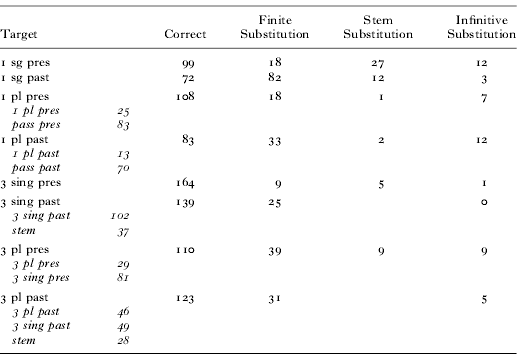
Given the disparity between the relatively high levels of accuracy by the TD-Y and TD-A groups and the lower accuracy of the SLI group, we focused on the error patterns of the latter group. Table 3 displays the total number of correct responses and the total number of each type of error according to context type for the children with SLI. For correct responses, the productions are divided into those that matched the target and those that were correct from the standpoint of colloquial use.
Summary of the scorable responses from the children with SLI
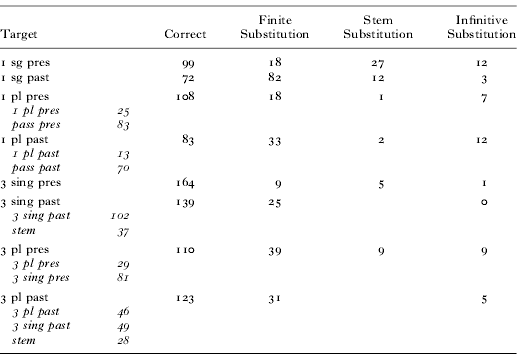
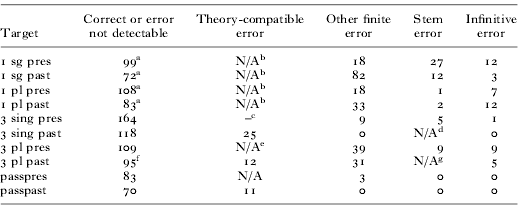
In Table 4, we provide a breakdown of the children's responses from the perspective of the EUCC account. From this table, it is apparent that some of the errors committed by the children with SLI did not conform to the predictions of this account. Specifically, this account predicts no errors on first person singular present and first person singular past tense inflections given that checking at AGR is not required for these forms and checking at T – a single checking operation – should be sufficient for the correct use of these inflections. The same predictions hold for first person plural present and first person plural past inflections unless a colloquial impersonal passive form is selected. In the latter case, errors could occasionally occur with passpast targets, as checking could occur at AGR only, resulting in a form with no overt tense marking, which is superficially identical to the passpres form. Unlike first person inflections, third person inflections require checking at both AGR and T. For these inflections, given the separate inflections for tense and agreement, the EUCC account predicts that either a tense inflection alone or an agreement inflection alone should result from the checking constraint, because checking at either T or AGR is permitted. However, there were instances of stem substitutions and infinitive substitutions in third person contexts. Furthermore, some of the finite inflections used as inappropriate substitutes were not those that would emerge as the result of checking at T only or at AGR only.
The responses of the children with SLI, categorized according to the Extended Unique Checking Constraint account
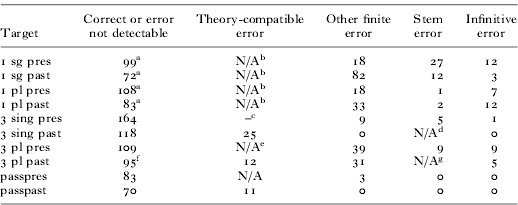
a Correct form; checking at T for these forms should be sufficient to yield the correct form.
b First person forms can have null subjects and therefore checking at Agr is not required.
c Because neither third singular nor present have overt inflections, there are no theory-compatible errors that can be detected.
d Productions of stems are acceptable in colloquial speech, and thirty-seven such productions were observed in 3sgpast contexts. These are included in the Correct column.
e Checking at T only yields a production of third singular present, which is acceptable in colloquial speech. There were twenty-nine such productions in 3plpres contexts. These are included in the Correct column.
f Checking at T only will yield a 3sgpast form, which is acceptable in colloquial speech. There were forty-nine such productions. These are included in the Correct column.
g Productions of stems are acceptable in colloquial speech, and twenty-eight such productions were noted.
Of the errors that were not predicted by the EUCC account, the occasional use of infinitives in first person singular present tense contexts might have been a task artifact. For probes in this context only, the examiner produced an infinitive form of the target verb in the prompt (as in ‘I like to sit. What do you do?’). It seems plausible that some children simply repeated the infinitive form produced by the examiner (e.g. ‘to sit’).
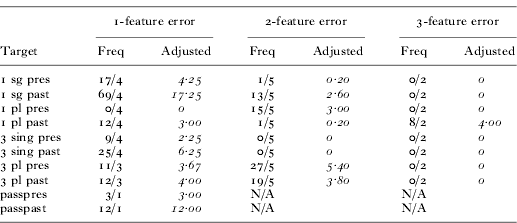
According to the morphological richness account, when substitutions occur they should most often be near-miss errors – errors that differ minimally from the target in their grammatical details. Any errors that deviate from this pattern were expected to be inappropriate productions of third person singular forms, as their strength in the children's verb inflection paradigms may lead them to be accessed on occasion when retrieval of a more appropriate (but more weakly represented) form is required. Table 5 provides a summary of those errors in which one finite form was used incorrectly in place of another finite form. Near-miss errors differ from the target by a single feature. For 1-feature, 2-feature and 3-feature errors, the total (raw) frequency of the error is provided for each target form, as well as an adjusted frequency. The adjusted frequency takes into account the number of alternative finite forms that could have served as a 1-feature, 2-feature or 3-feature substitution for the target. For example, for 1sgpres targets, the possible 1-feature errors were productions of 2sgpres, 3sgpres, 1plpres and 1sgpast. The adjusted frequency represented the total frequency divided by the number of possible alternative finite forms. Colloquial forms are taken into consideration in the determination of possible errors. For example, the child's production of 3singpres in place of the target 3plpres would ordinarily be considered a 1-feature error; however, in colloquial use, the production of 3singpres in this context is acceptable. Therefore, this particular substitution was not included in the calculations.
The incorrect use of finite forms by the children with SLI, categorized according to the morphological richness account
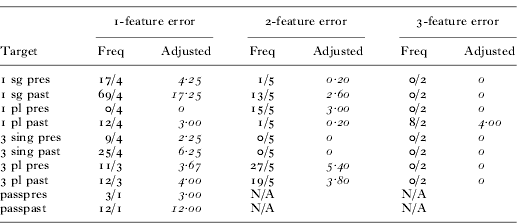
As can be seen from Table 5, for first person singular and third person singular targets in both present and past tense, 1-feature errors predominated. However, for first and third person plural inflections, 1-feature errors were not the most frequent type of finite substitution error. The unexpectedly high frequency of 2-feature errors in 3plpres contexts was due to the children's use of the 3sgpast form (27 times). Colloquial use permits the use of 3sgpres in these contexts, but not 3sgpast. Most of the remaining 2- and 3-feature errors were due to the children producing 3sgpres forms in 1plpres, 1plpast and 3plpast contexts.
The 3sgpres form is the most frequent in the language and therefore it was expected to be the most frequent substitute when the incorrect form differed from the target by more than one feature. Nevertheless, because it replaced a variety of target forms, we examined its use in greater detail. On thirty-six occasions, 3sgpres was used when it differed from the target by one feature. (In addition, 3sgpres was used on eighty-one occasions in 3plpres contexts – a context that differed from 3sgpres by only one feature – but this substitution is permitted in colloquial use.) On forty-seven occasions, 3sgpres was used to replace a target that differed by two features. Finally, on eight occasions, 3sgpres was used when it differed from the target by three features. Adjusting these frequencies for possible occurrences yields adjusted values of 18·00, 15·67 and 8·00, for 1-feature, 2-feature and 3-feature differences, respectively.
We also determined whether 3sgpres forms used inappropriately were accompanied by a third person singular subject. The children produced the subject that was appropriate in the context, or, in first person contexts, used no subject, as would be appropriate given both the task and the null-subject nature of first person forms in Finnish. This pattern of use suggests that the children were not having difficulty with assuming the role of the character(s) in first person contexts and were not simply singling out one character out of several in the third person plural contexts.
DISCUSSION
One important finding of the present study is that the children with SLI differed from the TD-Y children to a greater degree than has been reported for other languages with a rich inflectional morphology. Specifically, in studies of preschoolers with SLI acquiring null-subject languages such as Italian (e.g. Bortolini et al., Reference Bortolini, Caselli and Leonard1997) and Spanish (e.g. Bedore & Leonard, Reference Bedore and Leonard2001), these children lag behind TD-Y children only for select inflections. When inaccurate productions occur, near-miss errors predominate. In contrast, in the present study, the children with SLI differed from TD-Y children to a greater extent than is usually seen in studies of rich inflectional morphology languages, and, although near-miss errors were common, other error types occurred with surprising frequency.
Given that the criteria for selecting children with SLI in the present study were similar to those used in other studies, we have no reason to believe that these Finnish-speaking children with SLI had unusually severe deficits. In addition, at the outset of the study, the children with SLI also showed ample evidence of producing words with sufficient length to allow them to succeed in the experimental tasks. Indeed, some of the children's errors were longer than the correct forms that they replaced (e.g. first person singular past istu-i-n in place of first person singular present istu-n) or were of the same length as the correct forms that they replaced (e.g. the infinitive istu-a in place of first person singular istu-n). Likewise, the large group differences cannot be explained by the particular feature expressed by Finnish inflections. These features – person, number, tense – are commonly expressed in the inflections of languages that produce smaller differences between children with SLI and their younger TD peers. These findings indicate that there are limits to the view, expressed by Leonard (Reference Leonard, Bishop and Leonard2000), that languages with a rich inflectional morphology offer learning advantages for children with SLI.
Based on our interpretation of the EUCC account, the null-subject properties of first person inflections should have permitted accurate productions by the children with SLI, given that checking only at T is required. On the other hand, checking at both T and AGR are required for third person inflections. However, because of the agglutinating characteristics of Finnish, checking at T only should permit the appearance of the correct past tense inflection (without an accompanying agreement morpheme) and checking at AGR only should permit the appearance of the correct agreement morpheme (without an accompanying past tense morpheme). The colloquial impersonal passive in first person plural contexts has a non-null-subject property; therefore, for this verb form, checking at both T and at AGR is required. If, in conforming to the EUCC, checking occurs at T only, no error will be detected because passives make no distinction according to person or number. However, if checking occurs at AGR only, forms that are superficially identical to passpres forms could be produced in passpast contexts.
The findings differed from the predictions of the EUCC account in some key respects. First, the children with SLI were less accurate than the TD-Y children on three first person inflections for which no difference should have occurred. In addition, stems sometimes appeared when they were not expected, infinitives were also seen in contexts other than 1singpres, and some of the substitutions of one finite form for another were surprising because the produced form was not the one that should have been realized if checking had occurred at T only or at AGR only. Strikingly, excluding the infinitive productions in 1sgpres contexts, of the detectable errors, 326 errors were not predicted by the EUCC account whereas 48 errors were theory-compatible.
According to the morphological richness account, the rich information supplied by inflections in Finnish should direct the limited resources of children with SLI to this aspect of language. Although differences between Finnish-speaking children with SLI and typically developing children should be smaller than in languages with a sparse morphology, children with SLI are expected to produce errors given their assumed processing limitations and the demands of considering many features (involving tense, person, number) simultaneously. Because the main obstacle for these children is the processing load rather than the individual features themselves, most errors should be near-miss errors, differing only minimally from the target. When the substitute differs from the target by more than one feature, the most frequent substitute is expected to be a form that occurred with a high frequency of occurrence in Finnish, namely 3sgpres.
The findings provided only limited support for these predictions. Differences between the children with SLI and their typically developing peers were larger than the group differences seen in other languages with a rich morphology; the TD-Y children showed greater accuracy than the children with SLI on five different inflections. Furthermore, although 3sgpres was the most frequent substitute when the errant form differed from the target by more than one feature, there were many more 2- and 3-feature errors than this account predicts. Of the eight target inflections for which a comparison among 1-feature, 2-feature and 3-feature errors could be made, 1-feature errors were most prevalent for only four targets. By contrast, consider the same type of comparison made by Lukács et al. (Reference Lukács, Leonard, Kas and Pléh2009) for Hungarian tense/agreement inflections. Like Finnish, Hungarian has a rich morphology with agglutinating tense+agreement inflections. Lukács et al. found that for all twenty-four target inflections they examined in the speech of children with SLI, 1-feature errors were most frequent. Clearly, near-miss errors were not showing this type of dominance in the present study. Furthermore, the morphological richness account has no basis for predicting bare stems and infinitives in the responses of the children. Yet such responses were not infrequent.
The findings indicate that neither the EUCC account nor the morphological richness account provides a satisfactory way of accounting for the Finnish data of this study. We suggest that whatever the merits of these two approaches, they will prove insufficient until or unless they add provisions that accommodate potentially problematic aspects of paradigm learning that have been neglected thus far. We suspect that these problematic aspects are responsible for the large group differences found between the children with SLI and their typically developing peers, and for many of the errors that were not predicted by either the EUCC or the morphological richness account. These problems seem to be: (1) difficulty in recognizing verb inflections as being composed of an agglutinating sequence of tense+agreement inflections; (2) a problem in distinguishing the null-subject portions of the verb paradigm from the non-null-subject portions, especially in the light of certain colloquial forms that change a null-subject context (first person plural in present or past tense) to a non-null-subject context (impersonal passive in present or past tense); and (3) a problem in learning the specific features of each inflection given the neutralization of certain distinctions that result from permissible colloquial forms.
The first of these problems could clearly pose difficulty for some of the predictions of the EUCC account. If the children with SLI did not recognize that the agglutinating morphemes are composed of separable tense and agreement inflections then the checking assumptions of this account would not be appropriate. For example, if the children viewed the sequence -i-n as a single inflection, -in, they might assume that it simultaneously reflected past tense, first person and singular, and that -n simultaneously reflected present tense, first person and singular. Given this interpretation, the expression of these inflections would depend on checking at both T and AGR, in violation of the EUCC. Because checking at only one of these functional categories would not be sufficient, conforming to the EUCC would result in the absence of the inflection. The analogy is the third person singular present tense form -s in English. Checking at T only or at AGR only would not be sufficient, as this inflection requires both. Productions such as She run every day would result regardless of whether checking had occurred at T only or at AGR only.
However, children's possible failure to recognize the agglutinating nature of tense and agreement was not the only reason that the predictions of the EUCC account were not borne out. First person singular forms uniformly allow null subjects, suggesting that checking at T should be sufficient for realization of the inflection. Yet, inappropriate tense/agreement inflections as well as stems occurred in first person contexts as well.
This finding suggests that the children with SLI might also have had difficulty with the mixed nature of the verb paradigm, consisting of null-subject and non-null-subject characteristics. This paradigm is complicated further by the fact that the colloquial form that is also permissible in first person plural contexts (the impersonal passive) has a non-null-subject property, unlike the first person singular counterpart.
The third problem facing the children with SLI in our view is a problem in learning the specific features of each inflection given the neutralization of certain distinctions that result from permissible colloquial forms. For example, the acceptability of third person singular in place of third person plural in both present tense and past tense contexts serves to blur the number distinction. This blurring is compounded by the fact that passive forms can replace first person plural forms in present tense and past tense, and these are not marked for number or person, only tense. Furthermore, the acceptability of stems in third person singular and plural past tense contexts seems to neutralize the number distinction. Because stems do not express person either, there is the risk that they may be applied more extensively.
Children's potential problems in recognizing the appropriate features of each inflection might explain why the morphological richness account was not successful when applied to our Finnish data. According to this account, differences favouring younger typically developing children over children with SLI will be relatively small in a language with a rich morphology. Yet, in the present study, these differences were very large. We suspect that the co-existence of inflection distinctions in standard Finnish and neutralizations in colloquial Finnish might have slowed the pace at which the children with SLI arrived at the correct hypotheses about the features expressed by an inflection. Until these hypotheses could be formed and then confirmed, the inflections would not have sufficient strength in the paradigm for consistent retrieval and production. This same problem might have led to our finding of many more 2- and 3-feature errors than would be expected by the morphological richness account. Frequently occurring forms in the language that were registered in more than one context due to colloquial use may have been inappropriately extended to still other contexts because the appropriate inflections belonging to those contexts had not yet achieved sufficient strength to compete with the more frequent forms.
In summary, current accounts of tense/agreement use by children with SLI do not predict the pattern of use observed in the present study on Finnish. Our findings suggest that, for children with SLI, learning the tense/agreement inflection system of a language will be radically affected by details within the system over and beyond the particular tense and agreement distinctions that are made in the language. It appears that the tasks of recognizing inflections as agglutinating, discovering the mixed (null-subject as well as non-null-subject) nature of a system and discerning distinctions among inflections when these distinctions can be neutralized in co-existing colloquial forms are all potential obstacles for children with SLI. Any successful account of SLI will need to incorporate these obstacles to learning in a theoretically coherent way.
APPENDIX
Examples of probe items