On February 10, 2013, at approximately 5:00 pm, an EF-4 tornado with sustained maximum winds of 170 mph struck Hattiesburg, Mississippi, a small city with a population of 46 085 residents. 1 The tornado traversed densely inhabited areas including residential homes, businesses, and a large state university, causing $40 million in damage and resulting in 50 reported injuries and no fatalities. 2
For the first time in the Hattiesburg area, new weather technologies, such as the dual-polarization radar, combined with the social media entity Twitter were used in a concerted effort to mitigate morbidity and mortality. This report analyzes the combined use of these technologies in preventing injury and death during a violent storm.
Tornadoes are severe wind storms that are characterized by a violently rotating column of air that reaches the ground. 3 Tornadoes are classified using the enhanced Fujita (EF) scale, which rates the intensity based on resultant structural damage. A rating of EF-0 is the weakest, with estimated wind speeds of 65 to 85 mph; and EF-5 is the strongest, with sustained winds exceeding 200 mph. 3 , 4 During an average year, only 2% of tornadoes are categorized as violent, with ratings of EF-3 and above. 5 Nearly 1000 tornadoes occur in the United States every year and account for an average of 87 fatalities and 1500 injuries. 5
Geographically, most US tornadoes occur in “Tornado Alley,” located in the central Midwest. However, Hattiesburg is located in the southern part of the country, where tornadic activity is likely. 6 The clash of warm, humid air from the Gulf of Mexico and cool, dry air from the north sets prime conditions for severe thunderstorms to spawn tornadoes in so-called Dixie Alley. 6 This area has a high frequency of long-track EF-3 through EF-5 tornadoes, with 2 peak periods throughout the calendar year. Specifically, Mississippi experiences an average of 2 EF-3 or stronger tornadoes per year, with an average of 3 tornadoes of any strength occurring in February, as calculated from data collected from 1991 to 2010. 7 Late winter and early spring tend to show greater instability in the atmosphere in Dixie Alley compared to the traditional spring increase in tornadoes often seen in Tornado Alley. 6 Thus, it is not unusual for the Hattiesburg area to experience severe weather in February.
The 3-year average of tornado deaths in the United States from 2010 to 2012 was 222 from a total of 34 deadly tornadoes of EF-3 strength or higher, with an average of 7 fatalities per event. 7 Injuries and deaths usually result from persons becoming airborne, struck by solid projectiles, or crushed as a consequence of structural collapse.Reference Simmons and Suttor 8 Risk factors for severity of injuries include the type of dwelling and sheltering precautions taken within a dwelling; the presence of a motor vehicle; decreased advance warning time; and extremes of age.Reference Eidson, Lybarger, Parsons, MacCormack and Freeman 9 Half of all documented injuries occur during tornado recovery efforts.Reference Eidson, Lybarger, Parsons, MacCormack and Freeman 9 , 10
Hattiesburg Demographics
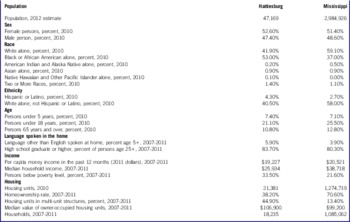
Hattiesburg is located in south central Mississippi and has a population of approximately 45 000. 1 Hattiesburg's demographic population statistics are representative of the state of Mississippi (see Appendix A, Table 1). Hattiesburg is located in both Forrest and Lamar counties; Forrest County is the more densely populated of the 2. 1
Hattiesburg Health System Demographics
The Hattiesburg community is served by 2 community-based hospitals. One hospital has 512 beds and is a designation level II trauma hospital, and the other has 211 beds and does not participate in the Mississippi trauma care system.
Twitter Impact on Weather Alerts
With the paradigm shift in how the public gains access to the news, many organizations have researched and integrated Twitter, a microblogging service that was introduced July 15, 2006. Twitter enables users to send and receive messages that are up to 140 characters in length known as tweets. As of July 1, 2012, Twitter had 141.8 million registered users in the United States, with a total number of 517 million global users. 11 In September 2011, half of the 200 million registered users at the time logged in once a month, and 25% logged in daily. 12 On average, each Twitter user has 126 followers. 13 An average of 16% of all tweets are retweeted at least once, which allows for a viral exponential outreach. 13
According to the Twitter blog written by employees of the company, Twitter users send approximately 200 tweets per minute about the weather in general. 14 This number rises to an average of 300 to 500 tweets per minute if the weather is particularly noteworthy, such as severe weather. The National Weather Service (NWS) has also created several individual Twitter accounts for cities across the United States that track weather specifically in those areas.
Several notable organizations used Twitter during the tornadic events in February. These organizations included the NWS in Jackson, Mississippi (@NWSJacksonMS), the Weather Channel (@weatherchannel), the Sun Herald newspaper (@SunHerald), and WDAM News, Talk and Radio, a local organization (@WDAM). Twitter users followed weather-related handles for up-to-the-minute information regarding current weather conditions in areas where they maintain community ties, usually their hometown or that of a family member or close friend. NWS in particular uses its Twitter handle to disseminate information and extend its reach to communities “for the protection of life and property and the enhancement of the national economy.” 15
While not always current, the information is disseminated to the public quickly, especially in the event of severe weather in an area that may experience loss of power and Internet service. In this instance, smart phones with high-speed networks, which are owned by more than half of all adults in the United States, may still be able to receive texts and tweets regarding the severe weather. 16 Twitter followers also have the opportunity to retweet, or send a tweet about the weather to their own followers, which sends the message to an exponential number of Twitter users.
New Weather Technology: Dual-Polarization Radar
On January, 23, 2013, the NWS in Jackson, Mississippi, completed a $225 000 radar upgrade from the traditional Doppler radar to the new dual-polarization radar (Dual-Pol radar). 17 Dual-Pol radar provides a 2-dimensional picture of the precipitation using horizontal and vertical pulses. This image allows forecasters to clearly differentiate the type of precipitation in the air at different elevations and debris from a possible tornado (Kyle Hopkins, BA, written communication, March 2013). This technology is especially helpful at night when ground visibility is limited.
Methods
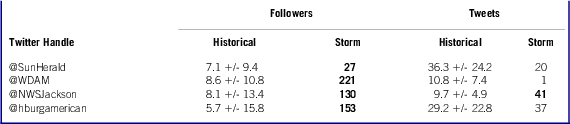
Twitter data from 4 authoritative Twitter handles in the region were obtained from Twitter and Gnip, an authorized reseller of tweets. 18 Twitter handles belonging to the NWS (@NWSJacksonMS), WDAM-TV news and weather station (@WDAM), the Hattiesburg American newspaper (@HburgAmerican), and the Sun Herald newspaper from the Mississippi coastal areas (@SunHerald) were analyzed. Tweets and retweets from these 4 handles were calculated 24 hours before the tornado and on the day of the tornado, and then combined. The growth of followers during this period for each Twitter handle was also analyzed. The change in followers and number of tweets for the day of the tornado was also compared to historical averages for each Twitter handle. A Student t test was used to determine statistical significance (P < .05).
Medical records were reviewed from Wesley Medical Center and Forrest County Hospital for patients who were treated during the 24 hours after the tornadic storms; these included basic demographic information, types of injuries sustained, and injuries by International Classification of Diseases 9 (ICD-9) codes. An injury severity score (ISS) was calculated for all trauma-related records.Reference Baker, O'Neill, Haddon and Long 19 When insufficient medical record information was provided, the study group assumed it to be attributable to the tornado in its immediate aftermath.
The Forrest County Emergency Operations Center and the NWS in Jackson, Mississippi, were contacted to obtain historical tracking data from the Dual-Pol radar systems used during the tornadic storms.
Approval for this study was obtained by the William Carey University College of Osteopathic Medicine institutional review board committee and from the participating hospitals. All institutions provided an institutional review board exemption for this project.
Results
The first tornado warning issued for the Hattiesburg area came at 3:08 pm from the NWS in Jackson for Lawrence County, which is adjacent to Lamar and Forrest counties. 2 While not an immediate threat to the Hattiesburg community, this warning alerted storm chasers and citizens to the tornado threat that was quickly approaching the area. After damage was reported in Lawrence County, a second tornado warning was issued at 4:11 pm in Marion and Lamar counties, just west of Hattiesburg. 2 During this tornado warning, the Hattiesburg Police Department dispatch center activated the tornado sirens. The sirens had been strategically placed within city limits to have the sound range of each overlapping the neighboring siren.
The tornado is heading northeast to Hardy Street, a well-populated area of Hattiesburg, MS. Photo Credit: Steven Piper, DO.

Damage was reported along the Marion County and Lamar County lines, prompting the Hattiesburg Police Department dispatch center to activate the sirens a second time. Simultaneously, an official tornado emergency was issued by the NWS for Hattiesburg (Forrest and Lamar counties) at 5:00 pm. By 5:11 pm, the Lamar County Emergency Management Agency sent an alert about a tornado that was on the ground and moving into West Hattiesburg; the alert was tweeted by the NWS. The NWS sent a second tweet with the phrase “tornado emergency” for the city of Hattiesburg at 5:15 pm. After tearing a 21-mile path of destruction through a main street of Hattiesburg near the University of Southern Mississippi and into a lower-income neighborhood in the downtown area and through Petal, Mississippi, the tornado finally dissipated at 5:33 pm in Perry County 2 (see Appendix B, Image A).
Twitter users and storm chasers used this terminology to inform the public about the severity of this tornado. Along with the strong wording in the tornado warnings issued by the NWS, the Weather Channel used tweets to describe the specific direction of the tornado, as indicated by radar and storm spotters on the ground. Twitter users in the Hattiesburg community were alerted to the specific location of the tornado and were then able to judge the safety of their current location.
Dual-Pol Radar
Dual-Pol radar was used by the NWS in Jackson, Mississippi, which gave the community approximately 30 minutes of advanced warning time and detected debris as high as 20 000 feet. Furthermore, Dual-Pol radar enabled meteorologists to track the tornado's path through the Hattiesburg community. Due to the rotational differences between the ground and at 6000 feet, the NWS radar produced a tornado track that deviated approximately 1 mile from the actual tornado track on the ground (see Appendix B, Image B).
Injuries Assessment
An ISS was calculated for the 50 patients who presented with acute traumatic injury. The ISS ranged from 1 to 29, with an average of 3.9. Three patients presented with an ISS of 16 or greater. Six patients were admitted for trauma management. Four patients required admission, and 2 patients were admitted to the intensive care unit. No fatalities were documented.
Of the 50 patients, 9 were aged 16 years or younger, 9 were 65 years or older, 9 were 50 to 64 years, and 23 were 17 to 49 years. Thirty-one patients were female and 19 were male. Twenty-two patients presented with a history of continuous medical care due to chronic illness or ailment.
Discussion
This study revealed that the combined use of Dual-Pol radar and Twitter has the potential to significantly improve outcomes in communities faced with tornadic activity.
The National Oceanic and Atmospheric Administration installed the first operational Dual-Pol radar in March of 2011. 20 The NWS completed upgrading its 122 radar sites to Dual-Pol radar in April 2013. 20 The average warning time preceding a tornado is 13 minutes. With the use of Dual-Pol radar, the tornado warning time was 30 minutes in advance of the storm that occurred on February 10, 2013. 2 , 21 The dramatic increase in warning time provided local citizens ample time to reach a safe location, and likely was a major factor in the absence of fatalities and critical injuries.
In other instances, the Dual-Pol radar technology proved to be vital in confirming tornado activity on the ground, particularly in the tornado outbreak on April 14, 2012, in Wichita, Kansas. That day, more than 24 tornadoes were noted in the Wichita NWS area of responsibility. Dual-Pol radar allowed the forecasters to more confidently issue warnings to the public, emergency managers, and media outlets. Specifically, they were able to see a tornado debris signature at the altitude of 15 000 feet from 70 miles away. 20 The magnitude of this debris signature informed the NWS that this was a very powerful tornado causing much damage. This urgent message to the public was conveyed while the tornado was still active on the ground.
While anyone in a tornado-warned area should take immediate shelter, the rationale is that provision of specific locations and descriptions may encourage the more complacent citizen to move to a safer location, thus decreasing potential for serious injury or death. The EF-3 tornado in Wichita resulted in no loss of life. Dual-Pol radar played a key role in providing the forecasters consistency and confidence in their reports, which in turn allowed individuals at risk to take the appropriate precautions. 20 The use of Dual-Pol radar technology should be broadly implemented by counties located in geographic areas of high tornadic activity. Using this technology with real time geographic positioning systems data will allow for greater specificity of the tornado track and quicker assessment of areas and individuals that are likely to be affected.
Combining the timely notification of Dual-Pol radar with the use of Twitter positively affected the outcome on February 10, 2013. The Twitter timeline demonstrated an example of real-time warnings regarding the tornado path. Statistical significance in follower growth was seen in all 4 Twitter handles, indicating that the general population used Twitter as a means for obtaining critical information. All handles analyzed also had an increase in retweets compared to the previous 24 hours. However, only @NWSJacksonMS demonstrated statistical significance, with a six-fold increase in the number of tweets and a 20-fold increase in the number of retweets compared to the previous day. 18 , 22 Twenty-four hours before the tornado, @NWSJacksonMS tweets had 24 retweets. For the 24 hours after the tornado, @NWSJacksonMS recorded approximately 500 retweets of their tweets. With a universal average of 126 followers per Twitter handle, the potential outreach of the overall tweets reached approximately 64 000 Twitter users. 23 This finding illustrates the exponential power of communication for this medium (see Appendix B, Tables 1 and 2).
The use of the phrase tornado emergency as part of the NWS alerts and tweets also likely raised the alert in communities. 24 Tornado emergency is a phrase that was instated by the NWS in 2005 to alert highly populated areas of a tornado on the ground that is expected to continue to produce a high magnitude of damage along its path coupled with the high likelihood of numerous fatalities. 24 For a tornado emergency to be issued, 3 separate criteria must be met: reports of significant damage and/or an amateur (ham) radio report of a large tornado on the ground, radar showing strong indication of a strong/violent tornado and environmental conditions supporting strong/violent tornadoes, and/or a “particularly dangerous situation” tornado watch in effect. The danger associated with the tornadic storms in the Hattiesburg area was highlighted with the issued tornado emergency. This type of alert has only been issued a total of 13 times in Mississippi since 2005, with 3 occurring during the April 15, 2011, and April 27, 2011, tornado outbreaks in the Southeast United States. This calculation translates to an average of a single tornado emergency alert issued every 2 years.
These notifications were frequently tweeted by the NWS handles, and were subsequently retweeted. These transmissions enabled the communique to go viral, or to be transmitted exponentially. 13 One of those tweets that mentioned the phrase tornado emergency was retweeted 19 times.
Compared to 2 previously published studies documenting the burden of injury that used ISS, the analysis revealed a lesser overall burden of injury for the community. Overall, the Hattiesburg tornado had zero fatalities, as compared to 12 and 32 deaths in Greenburg, Kansas, and Tuscaloosa, Alabama, respectively, both of which were classified as EF-5 tornadoes.Reference Ablah, Tinius, Konda, Synovitz and Subbarao 25 - Reference May, McGwin and Lancaster 27 The medical record review demonstrated an average ISS of 3.9, which is significantly less than the 2 previously documented tornadoes: 6.4 in Greensburg, Kansas, in 2007 and 6.9 in Tuscaloosa, Alabama, in 1998.Reference Ablah, Tinius, Konda, Synovitz and Subbarao 25 - Reference May, McGwin and Lancaster 27 At that time, Twitter was not widely used, especially to disseminate weather information, and the more common Doppler radars were used by the NWS.
In contrast, in the current event, only 3 patients by ISS definition were critically injured, with an ISS of 16 or greater. It should also be noted that the critical mortality rate was also zero, as defined by the total number of deaths from the event in the emergency departments divided by the total number critically injured.
Another factor likely contributing to better outcomes was the fact that this community has previously experienced severe weather events, including Hurricane Katrina. It is important to note that in 2011 the city of Hattiesburg obtained a grant totaling $116 000 from the Mississippi Emergency Management Agency and the Federal Emergency Management Agency to install 5 new tornado warning sirens to alert the public to an approaching tornado or when winds are in excess of 60 mph. 28 Lessons learned from Hurricane Katrina enabled local hospitals and first responders to be better prepared and led to improvements in medical and public health response to natural disasters. Mitigation as part of preparedness was accomplished by installing a greater number of tornado sirens, installing a water supply pump, and reinforcing power supplies for hospitals. 29
As the event occurred over a holiday weekend during the Mardi Gras season, a final variable worth noting is that many students and community members are often out of town, reducing the population that was at risk.
Limitations
Among residents in Forrest County, 11.6% are older than age 65 years. 1 As evidenced from past research, there is a need to examine access to warning systems for the disabled and geriatric population that takes into account sensory and mobility impairment, adequate evacuation procedures, tracking and identification, education development, relocation health planning, and access to and familiarity with newer technologies.
With the median income level for a household in Forrest County at $35 000 (2011 dollars) with 26.8% living below the poverty level, further limited access to technology must be considered. This issue might also affect similar communities. 1
This study is retrospective and limited by the type, amount, and content of Twitter database documentation that includes historical retweet data. However, the data we collected and the inferences made in this regard highlight the protective factors of instantaneous messages regarding a tornado warning and the specificities of the new Dual-Pol radar technologies. A disaster registry system similar to a state-based trauma registry is recommended as a method to monitor ongoing injuries and fatalities due to tornadoes.
While we recognize that other forms of risk communication such as television, radio, and other social media outlets were used during the tornado, we believe that Twitter was the most efficiently designed method for communication, particularly with the ubiquitous use of smart phones. This method of risk communication was useful for the public, emergency management, and health care providers to identify the severity of the impending tornado.
Finally, we thought it best to focus on local authoritative Twitter handles rather than national Twitter handles as only 0.77% of Twitter profiles use a global positioning system. 11 It is most likely that local Twitter handles would be primarily followed by those living in the region, whereas larger companies with greater networks create handles that tend to garner followers from all over the country. As such, our findings likely underrepresent the true magnitude of Twitter because some citizens may have followed a national handle.
Conclusions
Given the scope of damage sustained, it is no small wonder that fatalities were avoided altogether. The advent of more accurate weather-sensing technologies coupled with the adoption of more recent social media communication channels such as Twitter may serve as an effective early warning system in regions routinely experiencing high frequency of tornadic activity and should be further explored.
Acknowledgments
We would like to thank Wesley Medical Center and Forrest General Hospital and their respective IRB Committees for their support and supplying medical records for the project. We thank Sherry Turner, DO for her continuous support of the many facets of this project. We acknowledge Sarah Middleton and Elizabeth Smith-Trigg for their organizational skills and being an integral part of the team. We would also like to acknowledge Kyle Hopkins and the Forrest County Emergency Operations Center for providing background information on technology and severe weather events.
APPENDIX A
Appendix Hattiesburg, Mississippi (Lamar Co. and Forrest Co.)

Historical Average vs. 24 hours Post-Tornado

Twitter Handle Activity

APPENDIX B
Image A

Image B

Image C