

Introduction
Livestock systems are complex and therefore difficult to simulate and optimize. As they are based on biological phenomena, stochastic processes are very important and this has to be taken into account when optimizing certain variables (Mayer et al., Reference Mayer, Belward and Burrage1998). Besides the complexity of the system and the wide variability of the results that a given scenario can present, the optimization of these systems has to challenge multi-objective purposes that can be economic, social and environmental (Ripoll-Bosch et al., Reference Ripoll-Bosch, Díez-Unquera, Ruiz, Villalba, Molina, Joy and Bernués2012). When we modify management strategies, trade-offs between these sustainability pillars normally appear. Hence, when modelling these systems, we have to cope with the complexity of the system and the representation of the individual variability, the optimization of variables of different nature and dimension and the evaluation of the trade-offs that can occur when we change the objectives of our optimization. To solve this problem, we present an integrated decision support tool for sheep farming systems that combines simulation and optimization procedures.
Material and methods
The tool integrates three models that work at the animal level. The first one, Rumen, represents the rumen function in a mechanistic way (Illius and Gordon, Reference Illius and Gordon1991). Starting from the characteristics of the animal (BW, physiological state, etc.) and the characteristics of the diet (nutrient content, digesta kinetics, etc.), the model assesses the daily intake (kg of dry matter) and the amount of metabolizable energy and protein provided by the diet. The second model, Nutrient partitioning, simulates the partitioning of energy and protein provided by the diet to the different physiological functions (maintenance, pregnancy, lactation) (Agricultural and Food Research Council, 1993). Depending on the energy and protein balance of the ewe, this model simulates the body reserves storage or mobilization, or the daily milk production. The third model, Reproductive, represents the seasonality of sheep and the probability of conception (Dzakuma and Harris, Reference Dzakuma and Harris1989). In addition, the effect that body reserves and the implementation of pre-mating feeding have on the reproductive results (Díez Unquera, Reference Díez Unquera2013) have been included.
A web-based software (Pastor) integrates the three models. Different user interfaces include the breed and flock definition, the feeding system and the management of inputs at the farm level, and the simulation and optimization parameters. The model represents a farm where each animal is simulated individually, their physical features (live weight, etc.) and the productive potential (milk yield). Nevertheless, the management rules are applied at the flock level, trying to mimic the rationale and management generally followed by farmers in real farms. Therefore, in order to simulate the flock management, sheep are grouped into homogeneous batches according to their physiological state (dry, pregnant or lactating), by management rules (pre-mating feeding, pre-lambing feeding) or by the state of lactation (early, middle or final lactation). Inputs to the model are related with management decisions, such as the date when rams join the female flock, the decision to apply artificial insemination, the formulation of the diet (combining concentrate, purchased forage and farm produced forage) or the amount of feed that is offered to each sheep batch.
The stochastic simulation of every single animal allows the generation of diversity of individuals for traits such as BW, body condition score or milk production potential, making it possible to design different types of flocks in terms of variability. It is also possible to define the quality and quantity of the resources available and the price of inputs and outputs. Therefore, different scenarios representing the complex reality of the dairy sheep farms (dairy and meat) can be simulated.
Finally, a Life Cycle Analysis module has been integrated within the model (Ripoll-Bosch et al., Reference Ripoll-Bosch, de Boer, Bernues and Vellinga2013). This module calculates the greenhouse gas (GHG) emissions expressed in CO2-equivalents at a farm level, taking into account all the inputs used in the farm for milk or meat production. In this way, we can obtain the ‘cradle-to-farm-gate’ carbon footprint of milk and lamb meat.
The model has been integrated in a multi-objective genetic algorithm (MOGA)-based optimization routine (Fonseca and Fleming, Reference Fonseca and Fleming1993), which opens wide opportunities for the utilization of the software. The MOGA searches for optimal solutions based on the mechanism of natural selection and evolution. Each possible solution represents a combination of the set of variables of the simulation (related with feeding, reproductive and management decisions). The MOGA search intends to find the solution that minimizes the vector of objectives. Solutions in the MOGA population are sorted and developed by using Non-Dominated Sorting Genetic Algorithm (Deb et al., Reference Deb, Agrawal, Pratap and Meyarivan2000). The vector of objectives of each solution is defined according to technical, economic and environmental criteria: incomes, costs, GHG emission, nitrogen and energy surplus.
Results
Each sub-model was validated separately. The outputs of the first two models were compared with data of existing validated models and with real farm data. For the third model, we used a functional validation and real farm data. The farm model was validated with real data from the experimental flock of Neiker-Tecnalia in Arkaute. The results obtained were considered to represent the original flock with an acceptable level of accuracy, indicating that the tool can be a helpful in decision support (Díez Unquera, Reference Díez Unquera2013).
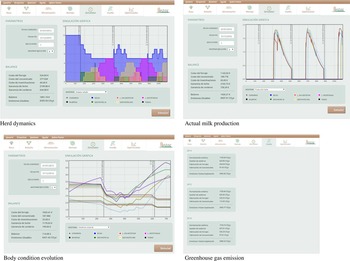
The web interface helps to simulate and optimize sheep systems for milk or meat production. The interface also presents the results of the herd dynamics, for example, the number of animals in each physiological state (lactation, gestation, dry) or the lambing distribution. It also presents individual (animal) features like the live weight variation along the simulated period, the body reserves of the sheep and the actual milk production. The intrinsic individual variation of each animal simulated (weight, potential milk production) and the variation generated by the random events (like oestrous expression, conception, stillborn etc.) may result in relative high variable technical and economical outputs from a simulated farm between runs. In order to obtain the mean simulation output, each farm can be simulated as many times as needed and the interface presents the mean and standard deviation at the end of the simulation. So, when comparing different simulated alternatives, not only the mean performance but the risk associated to this performance can be considered (Figure 1).
Outputs obtained in the simulation interface of the software Pastor.

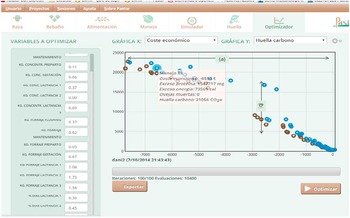
One of the intrinsic characteristics of the multi-objective optimization is that different objectives (i.e. economical, GHG emissions, nitrogen surplus, energy surplus) should be previously weighted to define the fitness of a solution in the MOGA. This a priori step depends upon the criteria of the user. The different interests between stakeholders can be analysed in the last version of Pastor in which all solutions can be presented in a Pareto diagram. Therefore, the user can check graphically all the solutions according with their fitness in two of the objectives included (Figure 2). This allows analysing the relationship between the objectives, simulating each one of the possible solutions and deciding, upon certain criteria, which is the best solution.
Optimization output from the genetic algorithm search of the software Pastor.

The outputs of the MOGA can constitute a good basis to discuss alternatives within or between stakeholders. In Figure 2 we draw two lines that could frame the discussions. First, the (a) line reflects the trade-off in the economic objective (in the x-axis, the lesser the best) when obtaining a better (lower value in y-axis) environmental objective (GHG emissions). This could be interpreted in policy design as the cost of greening or as the green payment that farmers should receive to change the management in order to reduce GHG emissions. Second, the (b) line reflects the GHG emission variation between solutions with a similar economical outcome. Technicians and farmers could discuss these solutions in order to check whether they are possible in the real world or not.
Acknowledgements
Research funded by projects INIA-RTA2006-00170 and RTA2011-00133 of the Spanish Ministry of Science and Innovation, Basque Government, Government of Aragón and FEDER.
Further information
The LiveM International Livestock Modelling and Research Colloquium was hosted by the Basque Centre for Climate Change (BC3) at the Maritime Museum in Bilbao, Spain between the 14 and 16 of October 2014. LiveM is the livestock and grassland modelling theme of the EU knowledge hub Modelling European Agriculture with Climate Change for Food Security (MACSUR). The MACSUR project is a pilot knowledge hub started by FACCE-JPI in 2012. It provides an opportunity to explore the role and potential of multidisciplinary networking structures to address complex regional and global issues. More information on MACSUR and the LiveM theme can be found at www.macsur.eu, with PDFs of slides from conference presentations available through the conference website http://www.livem2014bilbao.com/.